
Deduction u_s 80CCD for CPF _NPS upper Limit One Lakh only _ #SIMPLETAXINDIA
305 views
Skip to first unread message

Jagadish
Dec 15, 2014, 1:13:25 AM12/15/14
to Surisiva Group, GMCS Google Group, Vinay, Asish, M PRABINA KUMAR, foru...@googlegroups.com
Dear Friends,
Section 80CCD(1) allows an employee, being an individual employed by the Central Government on or after 01.01.2004, or by any other employer ,or any other assessee being an individual, a deduction of an amount paid or deposited out of his income chargeable to tax under a pension scheme as notified vide Notification F. N. 5/7/2003- ECB&PR dated 22.12.2003 (National Pension System –NPS) or as may be notifed by the Central Government.
In Finance Act, 2014 ,Finance Minister has increased the Overall Saving Limit for Section 80C,80CCC and 80CCD(1) from Rs 1,00,000/- earlier to Rs 1,50,000/- wef financial year 2014-15. But many of you may not aware of that the upper limit of Rs 1,50,000/- is not available for contribution made by employee /Self employed in Contributory pension Scheme(CPF) /National Pension scheme(NPS) u/s 80CCD for financial year 2014-15 onwards.
In Finance Act, 2014 ,Finance Minister has increased the Overall Saving Limit for Section 80C,80CCC and 80CCD(1) from Rs 1,00,000/- earlier to Rs 1,50,000/- wef financial year 2014-15. But many of you may not aware of that the upper limit of Rs 1,50,000/- is not available for contribution made by employee /Self employed in Contributory pension Scheme(CPF) /National Pension scheme(NPS) u/s 80CCD for financial year 2014-15 onwards.
In Finance Act,2014,an internal limit of Rs 1,00,000/- has been fixed u/s 80CCD(1).So Central/State Government or any other employee contributing to the NPS/CPF can claim maximum deduction of Rs 1,00,000/- for financial year 2014-15 onwards .However such person can claim deduction of Rs 1,50,000/- through other scheme available u/s 80C like PPF ,ELSS,NSC etc.
Tax treatment of the Contribution in NPS/CPF
Tax treatment for Employee
Employee Contribution :Employee's contribution is eligible for deduction u/s 80CCD(1) subject to maximum 10% of salary (includes Dearness Allowance but excludes all other allowance and perquisites). The deduction under section 80CCD(1) shall not exceed Rs. 1,00,000/-.
Employer's contribution : Contribution by Govt /Employer to New Pension scheme /Contributed Pension scheme is taxable in the hand of Employee as perquisites . Any contribution made by the Central Government or any other employer to the account of the employee under the New Pension Scheme as notified vide Notification F.N. 5/7/2003- ECB&PR, dated 22- 12-2003 referred to in section 80CCD shall also be included in the salary income.
However the contribution made by the Central Government or any other employee to a pension scheme u/s 80CCD(2) shall be excluded from the limit of Rs.1,50,000/- provided under section 80CCE.
Tax treatment for Self employed:
Tax treatment for Self employed:
- Deduction for contribution in NPS available u/s 80CCD(1)
- Maximum Limit 10% of Gross Total Income
- Maximum Limit of 1,00,000 also applicable.
- Amount shall be included in upper limit of Rs 150000/-.
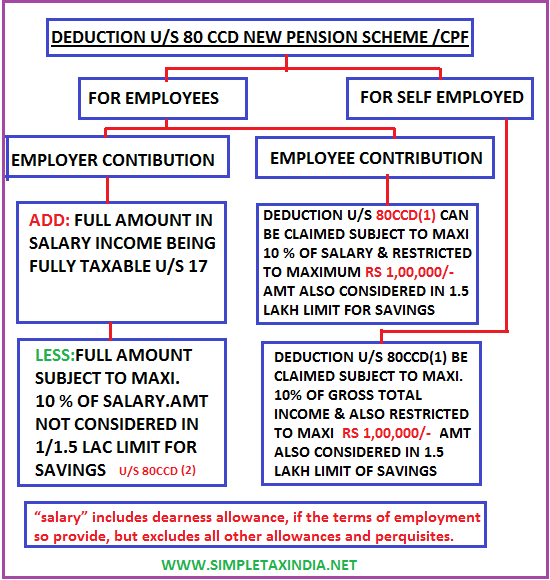
Example :
Basic =60000 DA=40000 taxable allowance =10000 Total Monthly =110000 Yearly 1320000
Employer's contribution to NPS (CPF)=10% of 100000=10000= Yearly=Rs 120000/-
Employee contribution to NPS (CPF) =10% of 100000=10000=Yearly = Rs 120000/-
Employee invested in Insurance Policy eligible u/s 80C =30000 PPF =40000
Computation of Income
Income from Salary = 1320000/-
Add : Employer's contribution to CPF/NPS = 120000/-
Gross Total taxable salary (income) (A) = 1440000/-
Less : Deduction u/s 80C
LIC : 30000
PPF= : 40000
Employee's share CPF : 100000 [120000 but subject to maximum 1,00,000 u/s 80CCD(1)]
Total :170000/-
(but maxi 1.50 lakh) =150000/-
Less :Employer's contribution to CPF
deduction u/s 80CCD(2) =120000/-
Total deduction (B) =270000/-
Net Taxable Income (A) -(B)=1440000-270000=1170000/-
Section 80CCD reproduced hereunder.
80CCD. (1) Where an assessee, being an individual employed by the Central Government or any other employer on or after the 1st day of January, 2004], 57[or any other assessee, being an individual] has in the previous year paid or deposited any amount in his account under a pension scheme notified or as may be notified by the Central Government, he shall, in accordance with, and subject to, the provisions of this section, be allowed a deduction in the computation of his total income, of the whole of the amount so paid or deposited as does not exceed,—
(a) in the case of an employee, ten per cent of his salary in the previous year; and
(b) in any other case, ten per cent of his gross total income in the previous year.
The following sub-section (1A) shall be inserted after sub-section (1) of section 80CCD by the Finance (No. 2) Act, 2014, w.e.f. 1-4-2015 :
(1A) The amount of deduction under sub-section (1) shall not exceed one hundred thousand rupees.
(2) Where, in the case of an assessee referred to in sub-section (1), the Central Government or any other employer makes any contribution to his account referred to in that sub-section, the assessee shall be allowed a deduction in the computation of his total income, of the whole of the amount contributed by the Central Government or any other employer as does not exceed ten per cent of his salary in the previous year.
(3) Where any amount standing to the credit of the assessee in his account referred to in sub-section (1), in respect of which a deduction has been allowed under that sub-section or sub-section (2), together with the amount accrued thereon, if any, is received by the assessee or his nominee, in whole or in part, in any previous year,—
(a) on account of closure or his opting out of the pension scheme referred to in sub-section (1); or
(b) as pension received from the annuity plan purchased or taken on such closure or opting out,
the whole of the amount referred to in clause (a) or clause (b) shall be deemed to be the income of the assessee or his nominee, as the case may be, in the previous year in which such amount is received, and shall accordingly be charged to tax as income of that previous year.
(4) Where any amount paid or deposited by the assessee has been allowed as a deduction under sub-section (1),—
(a) no rebate with reference to such amount shall be allowed under section 88 for any assessment year ending before the 1st day of April, 2006;
(b) no deduction with reference to such amount shall be allowed under section 80C for any assessment year beginning on or after the 1st day of April, 2006.
(5) For the purposes of this section, the assessee shall be deemed not to have received any amount in the previous year if such amount is used for purchasing an annuity plan in the same previous year.
Explanation.—For the purposes of this section, “salary” includes dearness allowance, if the terms of employment so provide, but excludes all other allowances and perquisites.
Thanks & Regards
Jagadish
Jagadish
" Think GREEN, Save Earth "
P Print only if essential.
SAVE TREES
P Print only if essential.
SAVE TREES
Reply all
Reply to author
Forward
0 new messages