
40 dead, 172 missing as two ships collide

Felix Evangelista
 |
|
 |  |
40 dead, 172 missing as two ships collide
By Julliane De Jesus
Agence France-Presse, INQUIRER.net
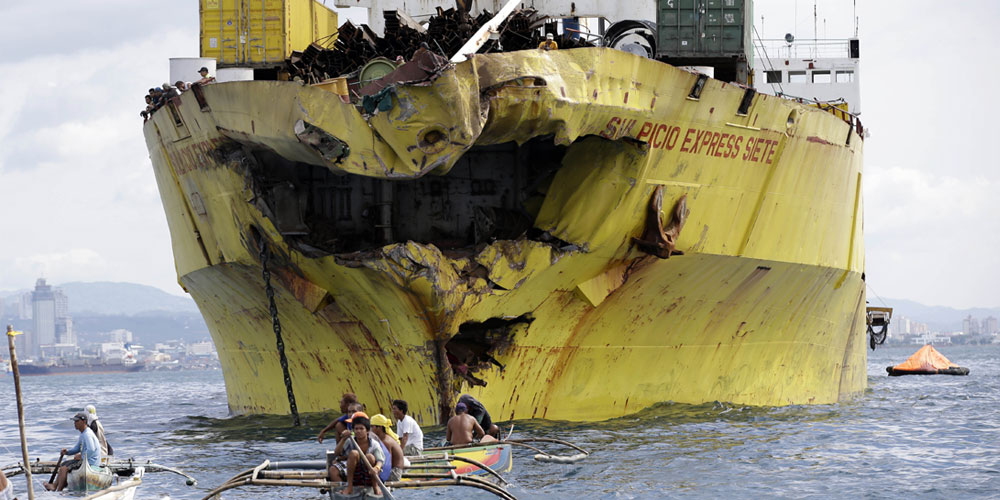
DENTED. Volunteers search near the damaged cargo ship Sulpicio Express Siete a day after it collided with a passenger ferry off the waters of Talisay City, Cebu on Saturday. AP
MANILA, Philippines—Rescuers scour the waters for more than 170 people missing after a passenger ferry collided with a cargo ship and sank almost instantly off Cebu province in thick darkness, with 31 already confirmed dead.
Transportation Secretary Joseph Emilio Abaya said MV St. Thomas Aquinas was carrying 831 people—715 passengers and 116 crewmembers—when it went down late on Friday night in a dangerous choke point near the port of Cebu City.
Coast guard and military vessels, as well as local fishermen in their own small boats hauled 629 people out of the water alive.
Abaya said 172 people were still unaccounted for and 31 bodies had been retrieved. The Philippine Coast Guard has warned the death toll would inevitably rise.
Reporters at the site, about two kilometers from shore, saw the bodies coated with fuel and oil that spilled from the ferry.
PCG deputy chief Rear Admiral Luis Tuason, vice commandant of the coast guard, said that some of the missing could be trapped inside the vessel that sank in waters 100 feet deep off Talisay City in Cebu province, about 570 kilometers south of Manila.
“There could be more bodies there, but there were ropes inside that our divers could get entangled in,” Tuason said on radio.
The captain of the ferry MV Thomas Aquinas, which was approaching the port late Friday, ordered the ship abandoned when it began listing and then sank just minutes after collision with the MV Sulpicio Express Siete, he said.
“It did not take long, about 10 minutes, before the ferry sank,” Tuason said.
“The captain managed to declare abandon ship and they distributed life jackets but, because of the speed by which it went down, there is a big chance that there are people trapped inside.”
One survivor, Maribel Manalo, 23, recounted to her brother the horror of suddenly being plunged into the cold water in darkness, and emerging from the chaos without her mother.
“She said there was a banging noise then the boat suddenly started sinking,” the brother, Arvin Manalo, told Agence France-Presse.
“They quickly strapped on life jackets and then jumped into the dark sea. She said they felt like they were pulled under. My sister said she pushed our mother up, but they got separated.
“My sister was rescued. My sister knows how to swim, but my mother does not.”
He said their mother, 56, remained missing.
Fifty-eight babies were among the passengers on board the ferry, according to the coastguard, and it was unclear how many of them survived.
The accident occurred at 9 p.m. in calm waters near the mouth of the port between two and three kilometers from shore, authorities said.
Navy divers on a speed boat scoured the sea on Saturday amid orange life rafts that had already been mostly emptied, according to an AFP photographer on the scene.
However two lifeless bodies were seen on one raft.
Tuason said helicopters had also been deployed and specialist divers sent to search through the sunken vessel.
Local fisherman Mario Chavez said he was one of the first people to reach passengers after the ferry sank in the 270-feet channel.
“I plucked out 10 people from the sea last night. It was pitch black and I only had a small flashlight. They were bobbing in the water and screaming for help,” he said.
“They told me there were many people still aboard when the ferry sank… there were screams, but I could not get to all of them.”
The cargo ship, Sulpicio Express Siete, which had 36 crew members on board, did not sink. Television footage showed its steel bow had caved in on impact but it sailed safely to dock.
Tuason said it appeared one of the vessels had violated rules on which lanes they should use when travelling in and out of the port.
The enforcement office chief of the government’s Maritime Industry Authority, Arnie Santiago, said the strait leading into the Cebu port was a well-known danger zone.
“It is a narrow passage, many ships have had minor accidents there in the past. But nothing this major,” Santiago told AFP.
“There is a blind spot there and each ship passing through needs to give way in a portion of that narrow strip.”
The Thomas Aquinas was a “roll-on, roll-off” ferry, which allows vehicles to be driven aboard and is commonly used in the Philippines.
Ferries are one of the main modes of transport across the archipelago of more than 7,100 islands, particularly for the millions of people too poor to fly.
But sea accidents are common, with poor safety standards and lax enforcement typically to blame.
The world’s deadliest peacetime maritime disaster occurred near the capital, Manila, in 1987 when a ferry laden with Christmas holidaymakers collided with a small oil tanker, killing more than 4,300 people.
In 2008, a huge ferry capsized during a typhoon off the central island of Sibuyan, leaving almost 800 dead.
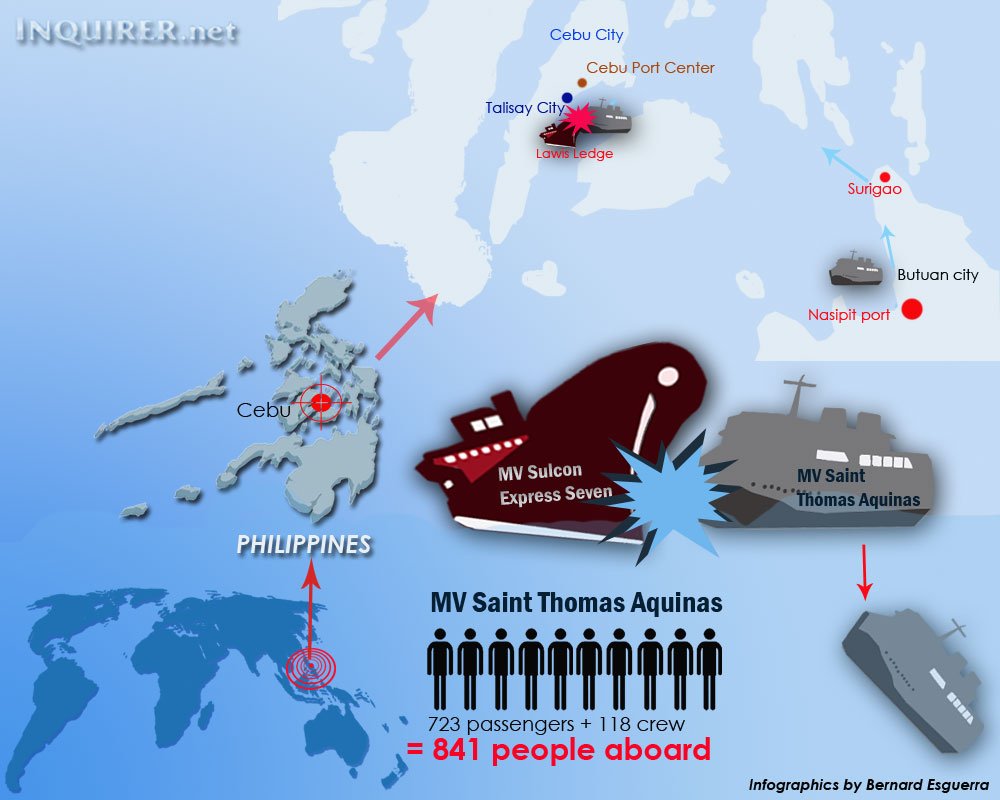
- An infographic account of the collision between the MV Thomas Aquinas of 2GO Shipping Lines and the Sulpicio Express 7 near the port of Cebu Friday night, Aug. 16, 2013, that left dozens of people dead and over 200 missing. The Philippine Coast Guard is leading the search and rescue operations for survivors.
Read more: http://newsinfo.inquirer.net/467617/death-toll-from-ship-collision-off-cebu-up-to-26-coast-guard#ixzz2cPASvLM9
Follow us: @inquirerdotnet on Twitter | inquirerdotnet on Facebook

Seno, Rowel P.
picture of Mv st. Thomas before and damage on epress siete
40 dead, 172 missing as two ships collide
By Julliane
De Jesus
Agence France-Presse, INQUIRER.net
11:34 pm | Saturday, August 17th, 2013
139 21.9K 9583
DENTED. Volunteers search near the damaged cargo ship Sulpicio Express Siete a day after it collided with a passenger ferry off the waters of Talisay City, Cebu on Saturday. AP
History of the two Shipping Company
Former SuperFerry and became 2GO Travel
|
|
|
|
Industry |
|
|
Founded |
|
|
Area served |
|

SuperFerry, founded as Aboitiz Shipping Company, later Aboitiz SuperFerry was one of the largest ferry companies in the Philippines before it was purchased by Negros Navigation, which simultaneously was purchased by the Chinese government through its private equity fund the China-Asean Investment Cooperation Fund, and became 2GO Travel, part of the 2GO Group.
The shipping company was known in the 1990s as William, Gothong & Aboitiz (WG&A). Aboitiz bought out the William Lines and Gothong Lines Group . The Gothong Group restarted its own shipping company called Carlos A. Gothong Lines (CAGLI), while the William Group opted to concentrate on its logistics, warehousing, and courier business, called Fast Logistics. SuperFerry and its sister companies SuperCat and Cebu Ferries are owned and operated by the former Negros Navigation when Negros Navigation bought all of Aboitiz Transport System, was sold to China-Asean Investment Cooperation Fund, and relaunched as 2GO Travel in 2012.
Vessels
Some of these vessels are still operating as part of the 2GO Travel fleet
- St. Thomas Aquinas (formerly SuperFerry 2) (Sank after hitting by M/V Sulpicio Express Siete, 31 bodies found, 172 missing,August 16 2013. [1] )
- St. Pope John Paul II (formerly SuperFerry 12)
- St. Gregory the Great (formerly SuperFerry 20 (formerly M/V Sunflower Kogane acquired from Diamond Ferry))
- St. Leo the Great (formerly SuperFerry 21 (formerly M/V Sunflower Nishiki acquired from Kansai Kisen))
- St. Joseph the Worker (former fleet of Negros Navigation)
- St. Peter the Apostle (former fleet of Negros Navigation)
- St. Michael the Archangel [former flagship of Negros Navigation)
- St. Augustine of Hippo (formerly Cebu Ferry 1)
- St. Anthony de Padua (formerly Cebu Ferry 2)
- St. Ignatius of Loyola (formerly Cebu Ferry 3)
- SuperFerry 3 (Burned while in drydock, 2000)[2]
- SuperFerry 6 (Destroyed by fire, 2000[3])
- SuperFerry 7 (Burned at the dock in 1997[3])
- SuperFerry 8 (Renamed SuperFerry 19, 2004)[4])
- SuperFerry 9 (Sunk, 2009[5])
- SuperFerry 10 (Broken up in China[6])(Former flagship)
- SuperFerry 11 (Renamed Our Lady of Banneux and transferred to SuperFerry's subsidiary, Cebu Ferries. Sold and broken up in 2003.)
- SuperFerry 14 (bombed and caught fire, 2004[7])
- SuperFerry 15 (Sold)
- SuperFerry 16 (Sold)
- SuperFerry 17 (Sold)
- SuperFerry 18 (Sold)
- SuperFerry 19 (No longer in service, already tied-up)
- Our Lady of Medjugorje(Sold to a shipping company in Indonesia)
- Our Lady of Lipa
- Our Lady of Good Voyage (Sold to Gothong Southern, named as M/V Doña Conchita Sr.; was later sold by Gothong Southern to Trans-Asia Shipping Lines, now named as Trans-Asia 9)
- Our Lady of Naju
- Our Lady of Sacred Heart
- Doña Virginia (sold)
- Our Lady of Mount Carmel (sold to George and Peter Lines & renamed as M/V GP Ferry 2)
- Our Lady of Lourdes
- Our Lady of Montserrat
- Our Lady of Manaoag
- Our Lady of Fatima
- Our Lady of Guadalupe
- Our Lady of the Rule (broken by ship breakers in Alang, India)
- M/V Sta. Rita de Casia (formerly SuperFerry 1; laid-up)
- M/V St. Joan of Arc (formerly SuperFerry 5; laid-up)
- M/V Doña Monserrat
- M/V Doña Florentina
- M/V Don Julio
- M/V Don Claudio
- M/V Don Juan (sunk in 1980)
- M/V Santa Florentina
- M/V Santa Maria
- M/V Connie I
- M/V Connie II
- M/V San Sebastian
- M/V Don Vicente
- M/V Princess of Panay (sold to breakers)
- M/V St. Ezekiel Moreno (sold to breakers)
- M/V St. Francis of Assisi (caught fire in 1999; later sold to breakers)
- M/V Mary, Queen of Peace (sold to breakers)
- M/V San Lorenzo Ruiz (sold to breakers)
- M/V San Paolo (sold to breakers)
- M/V Princess of Negros
- M/V Cebu City (sunk in 1994)
- M/V Misamis Occidental
Incidents and accidents
- On October 12, 2000, SuperFerry 6 caught fire on its starboard panel and sinks. More than 1,000 passengers were rescued.
- On February 27, 2004, SuperFerry 14 was bombed by the Abu Sayyaf terrorists killing 116 people. It was considered as the worst terrorist attack in the Philippines.
- On March 9, 2006, SuperFerry 12 caught fire off the coast of Bantayan Island. None of the 664 passengers were injured.
- On September 6, 2009, SuperFerry 9 reported engine trouble while on its way to the port of Iloilo from General Santos. The ship then listed to a 30–40 degree angle, and at 2am the captain of the vessel ordered to abandon ship. It later sank off the southern Zamboanga peninsula with more than 966 people on board. 957 people have been rescued but there are also 9 fatalities.
- On August 16, 2013, the cargo ship Sulpicio Express Siete collided with the ferry St. Thomas Aquinas, sinking it in 100 feet deep waters off Talisay City in Cebu province. There were 831 people on board (715 passengers and 116 crewmembers). Initial reports indicated over 600 were rescued, with 31 confirmed dead and 172 missing.
Former Sulpicio Lines (Philippine Span Asia Carrier Corporation)
|
Philippine Span Asia Carrier Corporation |
|
|
Shipping Line |
|
|
Industry |
|
|
Headquarters |
Don Sulpicio Go Bldg. Sulpicio Go St. North Reclamation Area, Cebu City, Philippines |
|
Area served |
Luzon, Visayas, Mindanao Islands |
|
Key people |
Carlos Go (Chief Executive Officer) |
Sulpicio Lines is the common name of Philippine Span Asia Carrier Corporation, a shipping line in the Philippines. Sulpicio Lines' operations was halted by the Maritime Industry Authority of the Government of the Philippines following the sinking of the MV Princess of the Stars in 2008.[1] When it renewed operations, the line had changed its corporate name to "Philippine Span Asia Carrier Corporation".[1]
Sulpicio Lines owned and operated the MV Doña Paz, which sank duirng the world's worst maritime disaster during peace time on December 20, 1987.[1] 4,375 people lost their lives when the ship struck the oil tanker M/T Vector.[1]
As of August 2013 the company's vessels have figured in five major maritime disasters with a total exceeding 5,000 lives lost.[1]
Maritime disasters
Maritime disasters involving PSACC include MV Doña Paz on December 20, 1987, MV Doña Marilyn in 1988, MV Princess of the Orient on September 18, 1998, and MV Princess of the Stars on June 21, 2008. The latter three were caused by the vessels setting sail during violent weather conditions.
PSACC currently holds the world record for the worst peacetime maritime disaster due to the sinking MV Doña Paz which is said to have claimed more than 5,000 lives in the Philippines.
MV Princess of the Stars, June 2008

An inflatible boat from the Maritime Prepositioning Ship USNS GYSGT Fred W. Stockham helps search for survivors of the capsized commercial passenger ferry MV Princess of the Stars June 25. The ferry capsized during Typhoon Fengshen.
Docking ports and vessels
Philippine Span Asia Carrier's main ports of call are the cities of Manila and Cebu. Other ports of call are the cities of Baybay, Butuan, Cagayan de Oro, Catbalogan, Cotabato, Davao, Dipolog, Dumaguete, General Santos, Iligan, Iloilo, Maasin, Masbate, Ormoc, Ozamis, Puerto Princesa, Surigao, Tacloban, Tagbilaran and Zamboanga. It also include the towns of Calubian, Coron, Estancia, Jagna, Nasipit, Naval and Palompon.
Its vessels are:
Passenger Vessels :
- Princess Of The Earth
- Princess Of The South (Current flagship)
Cargo Vessels :
- Span Asia 1
- Span Asia 2
- Span Asia 3
- Span Asia 5
- Span Asia 7
- Sulpicio Container V
- Sulpicio Container XII
- Sulpicio Container XIV
- Sulpicio Express Uno
- Sulpicio Express Dos
- Sulpicio Express Tres
- Sulpicio Express Siete
Former vessels:
- Philippine Princess caught fire in 1997, later broken-up
- Cagayan Princess sold to Roble Shipping Inc. as M/V Theresian Stars
- Cebu Princess sold to Roble Shipping Inc. as M/V Joyful Stars
- Dipolog Princess sold to breakers in China
- Cotabato Princess sold & broken-up in Villono Shipyard
- Iloilo Princess sunk in Pier 7, sold & broken-up
- Nasipit Princess sold & broken-up
- Palawan Princess sold & broken-up
- Tacloban Princess sold & caught fire, later declared a total loss
- Princess of Paradise sold to breakers in China
- Princess Of The Caribbean sold to breakers in China
- Princess Of The Ocean sold to breakers in China
- Princess of the Stars capsized & sunk near San Fernando, Romblon, later broken up in situ.
- Princess of the Orient sunk near Batangas during a typhoon in 1998, over 70 died, with almost 80 people missinh
- Princess of the Pacific sold & broken-up
- Princess of New Unity sold & broken-up sometime in the 2000s
- Princess of the World caught fire in Zamboanga
- Princess Of The Universe sold to breakers in India
- Filipina Princess sold to breakers in China
This e-mail communication and any attachments are confidential and intended only for the use of the designated recipients named above. If you are not the intended recipient, you are hereby notified that you have received this communication in error and that any review, dissemination, distribution or copying of it or its contents is prohibited. If you have received this communication in error, please immediately notify the sender by reply e-mail or phone and destroy all copies of this communication and any attachments.


