
Tap water in Aquarium/Pond; Chlorine/Chloramines, TDS, Vitamin C

Carlrs
 If your tap water has Cloramines, you will need to remove them
chemically before adding the water to your aquarium. Standard
de-chlorinators such as "Start Right" Water Conditioner will remove the
chlorine, but leave the ammonia (NH3) for either your bio filtration or
Zeolite (freshwater only) to remove. These basic de-chlorinating
products are simple Reducers (sodium thiosulfate) and are quite safe,
even overdosed contrary to some opinions floating around.
If your tap water has Cloramines, you will need to remove them
chemically before adding the water to your aquarium. Standard
de-chlorinators such as "Start Right" Water Conditioner will remove the
chlorine, but leave the ammonia (NH3) for either your bio filtration or
Zeolite (freshwater only) to remove. These basic de-chlorinating
products are simple Reducers (sodium thiosulfate) and are quite safe,
even overdosed contrary to some opinions floating around.
The vastly preferred products for use in conditioning water treated with
Chloramines such as Amquel (or better Amquel Plus) or SeaChem Prime
will remove the chlorine and neutralize the ammonia (and more).
Prime is made from Hydrosulfite salts which are basically non toxic
reducing agents made up of bisulfites and hydrosulfites, aqueous
solution, buffered at pH 8. As mentioned earlier, reducing agents are
basically non toxic at reasonable doses to fish and aquatic animals.
A product resource for: SeaChem Prime
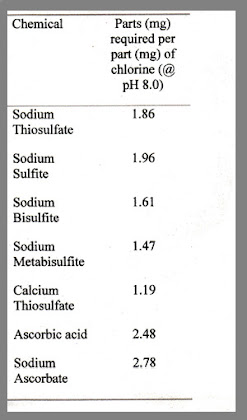
The chart to the right shows some common chlorine/chloramines reducing agents.
You will note that metabisulfites and bisulfites are efficient reducers,
however it should be noted that some studies have shown these to lower
dissolved oxygen levels. I have never had a problem with this due to the
fact I always employ good circulation when ammonia, chloramines, or
chlorine are a problem (actually good circulation should always be
employed).
Also note, Vitamin C (ascorbic acid/sodium ascorbate)
is also an reasonable reducer (albeit not as strong as others at doses
that do not affect pH dramatically), which also goes along with many of
my points for a Reducing Redox.
In fact, Vitamin C in either Ascorbic Acid or Sodium Ascorbate can
effectively lower chlorine or break the chloramine bond. Generally,
approximately 2.5 to 2.8 parts of Vitamin C is required to neutralize 1
part chlorine
Be aware that Vitamin C, in particular in the form of ascorbic acid, can dramatically lower pH in normal doses to be effective.
Vitamin C may be a good choice for 25% water changes where its lower
reduction abilities at safer pH doses might even be desired.
HOWEVER, in larger water changes or especially with chloramines, the
undesirable drop in pH at doses required may make it a poor or even
dangerous choice. Ascorbic Acid at doses that may be required will
immediately reduce pH by 1.5 on the logarithmic pH scale (which can
shock or even kill fish when this change happens suddenly, which it
does). Sodium Ascorbate will change pH at doses required will
immediately reduce pH by .5 (reference 1).
Nor is Vitamin C as a good a choice for long term Redox balance and reduction since it is a short term reduce
For much more information about water conditioners that will remove Chlorine and/or Chloramines, please read this article:
Aquarium (& Pond) Water Conditioners.
Further Aquarium Redox Information:
Aquarium Redox