
FDS - REAC with PVC -> FDS5 vs. FDS6

p.we...@hhpberlin.de
Hello dear FDS developers,
my name is Peter and on behalf of my teammates I would like to hear your thoughts on the following matter.
We simulated fire in for very different buildings, we commonly use the simple chemistry approach. We define the amount of C, H ,O and N atoms, the heat of combustion, CO and soot yield values for the desired Reaction.
Commonly, we use the following fire composition in offices or similar scenarios: 33% WOOD 33% PUR and 33% PVC.
To get the fuel information we use standard values [p.e. from SPFE Handbook] for WOOD, PUR and PVC and adding their atoms, heat of combustion, soot and CO yield values according to their fraction, respectively. We normalize the atom count so that C equals 1.
In FDS5 we had the opportunity to define additional atoms by using OTHER; MW_OTHER in the REAC line.
The REAC line looks like that:
&REAC ID='Mixture'
FYI='33% Douglas FIR, 33% Polyurethan, 34% Polyvinylchlorid, '
C= 1
H= 1,467
O= 0,3168
N= 0,03366
Other= 0,17
MW_OTHER = 35,453
SOOT_YIELD= 0,10468
CO_YIELD= 0,03528
HEAT_OF_COMBUSTION= 19238
IDEAL= .FALSE.
VISIBILITY_FACTOR= 3
MASS_EXTINCTION_COEFFICIENT= 8700 /
&RADI RADIATIVE_FRACTION= 0,3 /
With FDS6, this option isn’t available anymore. You can see that we ran
into a problem while using a reaction which contains PVC, which uses a
relatively heavy CL atom.
We tried to use the complex chemistry approach and it worked. But to be honest, it’s a little bit bulky, especially when there are multi burners with different ramp ids.
So we thought of something else. Coming back to PVC, the only problem is that we cannot define the atom CL in the simple chemistry approach, thus missing a comprehensive part of the weight of the C2H3Cl. But on the other hand, we define soot yield, CO yield and the heat of combustion and the heat release rate. So from a FDS point of view, it is rather unimportant how much 1 mol Fuel weights. The HRR and HoC define the amount of fuel needed at any given time. The soot yield defines the fraction of the fuel at any given time by the following equation:
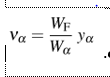
where:
· ys = soot yield,
· Wa=weight of soot and
· Wf=HRR/HoC.
So we can get the desired amount auf soot. The only problem is, that the amount auf CO2 would be much higher, because the missing Cl atom-weight in the fuel results in more mol fuel otherwise, which leads to a greater amount of C in the Fuel. Because we define soot yield and co yield the surplus C atoms of the fuel will go to CO2. In order to compensate this we need more air to sustain the reaction. I think that’s not a big deal, because in most cases we simulate well ventilated scenarios. The temperature should not be affected, right?
To solve the problem with CO2, we could simply define an amount of N atoms that equals the Cl weight for PVC in the given reaction. Because, if I understand the reaction equation right, N is only transported and does not affect the relevant products.
What do you think of that approach? Do we miss some effect? For example, in what way does the composition of the products does influence the plume?
Best,
Peter

Randy McDermott
--
You received this message because you are subscribed to the Google Groups "FDS and Smokeview Discussions" group.
To unsubscribe from this group and stop receiving emails from it, send an email to fds-smv+u...@googlegroups.com.
To post to this group, send email to fds...@googlegroups.com.
To view this discussion on the web visit https://groups.google.com/d/msgid/fds-smv/7df55ff0-ff4f-432e-92c8-f04cc1336b58%40googlegroups.com.
For more options, visit https://groups.google.com/d/optout.
p.we...@hhpberlin.de
Hello,
thank you for your the reply. I will try to rephrase und elaborate on some of my statements.
I do not understand the comment, "it is unimportant how much 1 mol of fuel weighs". It is important. The mole weight directly affects the local mass density of both fuel and products and therefore the plume dynamics.
Plus, what do you use for W_soot? If you are using W_fuel = HRR/HoC, then W_soot must be the total rate of soot produced in the system. But in the FDS code we use the mole weight of C_.9 H_.1. I cannot see how you plan to get the desired soot yield.
I will make 3 quick examples in order to explain my previous posting.
For arguments sake, lets say the following parameters stay constant in all 3 examples (which of course is not true because depending on the composition of the fuel used, those change drastically):
Soot Yield: ys = 0,10;
CO_Yield: yco = 0,03;
Heat of Combustion: HoC = 20000 kJ/kg;
Heat Release Rate: HRR=1000kJ/s (constant)
WS = 0.9 C * 0.1 H = 0.9*12.0107+0.1*1,00794 = 10.91 g/mol
1. Fuel composition: C1 H1.5 O0.3 N0.03 Other 0.2 / MW_Other=35.453
WF = 25.83 g/mol ; Ws = 10.91 g/mol ; vs =0.237
2. Fuel composition: C1 H1.5 O0.3 N0.03
WF = 18.74 g/mol; Ws = 10.91 g/mol ; vs = 0.172
3. Fuel composition: C1 H1.5
WF = 13.52 g/mol ; Ws = 10.91 g/mol ; vs = 0.124
It is obvious that we stoichiometric parameter of Soot vs deviate in the 3 examples. And that is because the Fuel Weight WF for 1 mole of Fuel is different.
Now going into the simulation, the amount of fuel burned (in order to achieve the modelled HRR) is described by HRR /HoC, right? I was under the impression, that the chemical equation is multiplied by a factor of [HRR / HoC ] / WF. Lets call this factor vF.
So the stoichiometric factor vF for the FUEL at a certain timestep is different for the 3 examples:
1. [HRR/HOC] / WF = [1000/20000] / [25.83/1000] | [ kJ/s / kJ/kg] / [g/mol] / 1000g/kg]
vF= 1.935 mol/s
2. [HRR/HOC] / WF = [1000/20000] / [18.74/1000] | [ kJ/s / kJ/kg] / [g/mol] / 1000g/kg]
vF= 2.668 mol/s
3. [HRR/HOC] / WF = [1000/20000] / [25.83/1000] | [ kJ/s / kJ/kg] / [g/mol] / 1000g/kg]
vF= 3.698 mol/s
To me that makes sense, because if a given fuel weight is less then another fuel in order to achieve the same burnrate, we need more fuel.
So the amount of Soot released at a given timestep is vs * Ws * vF, right?
So lets look at the 3 examples:
1. Soot_released: vs * Ws * vF = 0.237 * 10.91 * 1.935 = 5.0 g/s
2. Soot_released: vs * Ws * vF = 0.172 * 10.91 * 2.668 = 5.0 g/s
3. Soot_released: vs * Ws * vF = 0.124 * 10.91 * 3.698 = 5.0 g/s
Back to my first posting ->
vs = [(HRR/Hoc) / Ws ] * ys with Ws = 10.91 g/mol ->
vs = [1000/ 20000] / [10,91/1000] * 0,1 = 0,458 mol/s;
Soot released: vs * Ws = 5.0 g/s
That is what I made of the equations in the UserGuide. It could be that I am totally off here, so I would appreciated if you take the time to look at the examples and comment on them.
To say the “it is unimportant how much 1 mol of fuel weighs” was not correct. But it looks to me that the soot production is not governed by it, right?