Survival–WWF OECD talks break down over tribal
consent

This Baka woman and her
husband are among many tribal people in Cameroon who
have been beaten by WWF-funded wildlife guards. They
were attacked and had their belongings taken from them
while they were collecting wild mangoes.
© Survival
International The
landmark
mediation talks between Survival and the World
Wildlife Fund (WWF) over
breaches of OECD guidelines for
multinational corporations have broken down over the
issue of tribal peoples’ consent.
Survival
had asked WWF to agree to secure
the Baka “Pygmies’” consent for how the conservation
zones on their lands in Cameroon were managed in the
future, in line with the organization’s
own indigenous peoples policy.
WWF refused, at which point Survival
decided there was no purpose continuing the talks.
Survival
lodged
the complaint in 2016, citing the creation of
conservation zones on Baka land without their consent,
and WWF’s repeated failure to take action over serious
human rights abuses by wildlife guards it trains and
equips.
It
is the first time a conservation organization has
been the subject of a complaint under the OECD guidelines. The resulting
mediation was held in Switzerland, where WWF is headquartered.
WWF has been instrumental in the
creation of several national parks and other protected
areas in Cameroon on the land of the Baka and other
rainforest tribes. Its own policy states that any such
projects must have the free, prior and informed consent
of those affected.
A
Baka man told Survival in 2016: “[The anti-poaching
squad] beat the children as well as an elderly woman
with machetes. My daughter is still unwell. They made
her crouch down and they beat her everywhere – on her
back, on her bottom, everywhere, with a machete.”
Another
man said: “They told me to carry my father on my back. I
walked, they beat me, they beat my father. For three
hours. Every time I cried they would beat me, until I
fainted and fell to the ground.”

Conservation has been used as
a justification for forcibly denying Baka access to
their land, but the destruction of the rainforest by
logging companies – some of whom are WWF partners – has
continued.
© Margaret
Wilson/Survival Background
briefing
- Survival first raised its
concerns about WWF’s projects on Baka land in 1991.
Since then, Baka and other local people have repeatedly
testified to arrest and beatings, torture and even death
at the hands of WWF-funded
wildlife guards.
- The OECD
is the Organization for Economic Co-Operation and
Development. It publishes guidelines on corporate
responsibility for multinationals, and provides a
complaint mechanism where the guidelines have been
violated.
- The complaint was lodged with the Swiss
national contact point for the OECD, as WWF
has its international headquarters in Switzerland. Talks
took place in the Swiss capital, Bern, between
representatives of WWF and
Survival.
- The principle of Free, Prior and
Informed Consent (FPIC) is the
bedrock of international law on indigenous peoples’
rights. It has significant implications for big
conservation organizations, which often operate on
tribal peoples’ land without having secured their
consent.
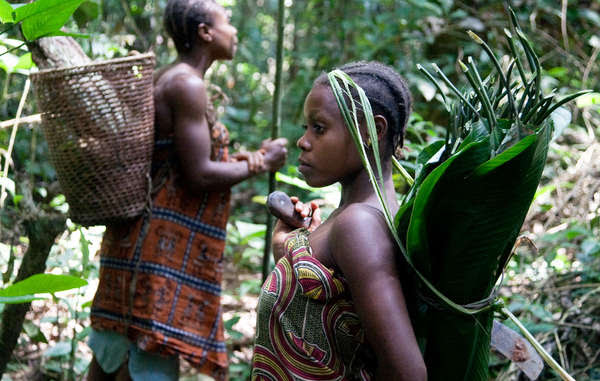
Tribes like the Baka have
lived by hunting and gathering in the rainforests of
central Africa for generations, but their lives are
under threat.
© Selcen
Kucukustel/Atlas Tribal
peoples like the Baka have been dependent on and managed
their environments for millennia. Contrary to popular
belief, their lands are not wilderness. Evidence proves
that tribal
peoples are better at looking after their
environment than anyone else. Despite this, WWF has alienated them from its conservation
efforts in the Congo Basin.
The
Baka, like many tribal peoples across Africa, are
accused of “poaching” because they hunt to feed their
families. They are denied access to large parts of their
ancestral land for hunting, gathering, and sacred
rituals. Many are forced to live in makeshift
encampments on roadsides where health standards are very
poor and alcoholism is rife.
Meanwhile,
WWF has partnered with logging
corporations such as Rougier, although these
companies do not have the Baka’s consent to log the
forest, and the
logging is unsustainable.
Survival’s
Director Stephen Corry said: “The outcome of these talks
is dismaying but not really surprising. Conservation
organizations are supposed to ensure that the ‘free,
prior and informed consent’ of those whose lands they
want to control has been obtained. It’s been WWF’s
official policy for the last twenty years.
“But
such consent is never obtained in practice, and WWF would not commit to securing it
for their work in the future.
“It’s
now clear that WWF has no
intention of seeking, leave alone securing, the proper
consent of those whose lands it colludes with
governments in stealing. We’ll have to try other ways to
get WWF to abide by the law, and
its own policy.”
Watch:
Baka father speaks
out against horrific abuse
“Pygmy”
is an umbrella term commonly used to refer to the
hunter-gatherer peoples of the Congo Basin and elsewhere
in Central Africa. The word is considered pejorative and
avoided by some tribespeople, but used by others as a
convenient and easily recognized way of describing
themselves.
Read
this online: http://www.survivalinternational.org/news/11800
Amazon Guardians travel to city for landmark
protest

Guajajara Guardians protest
for the protection of their land
© Guajajara
Guardians A
group of Brazilian Indians hailed as heroes for
patrolling the Amazon and evicting illegal loggers have
occupied government offices, to demand protection for
their lands.
It
is the first protest of its kind by the Indians, known
as the Guajajara
Guardians. Their people face an emergency, as much
of their forest has been razed to the ground.
The
Guardians work to protect their forest in the
north-eastern Brazilian Amazon. They share the area,
known as the Arariboia indigenous territory, with uncontacted
Awá Indians.
The
Indians’ forest is an island of green amid a sea of deforestation.
Heavily armed illegal loggers are now penetrating this
last refuge, and the government is doing little to stop
them.
Tainaky
Guajajara, one of the Guardians’ leaders, said at the
protest in the city of Imperatriz: “We’re occupying
FUNAI [government indigenous
affairs department] to demand our rights to the land,
and protection for the environment. We need help,
urgently. Our land is being invaded as we speak. The
Brazilian government has forgotten us – it’s as if we
don’t exist. So we’ve reached the limit. We will no
longer put up with the way they treat us.”

Arariboia indigenous
territory is an island of green surrounded by
deforestation
© Google Maps The
Guajajara Guardians have taken matters into their own
hands to save their land from destruction, and to prevent
the genocide of the Awá. They patrol the forest,
detect logging hotspots and crack down on invasions.
Kaw
Guajajara, the Guardians’ Coordinator, said: “The
uncontacted Awá can’t live without their forest. Our
work has stopped many of the invaders… As long as we
live, we will fight for the uncontacted Indians, for all
of us, and for nature.”
Their
work is dangerous – the Guardians constantly receive
death threats from the powerful logging mafia, and three
Guardians
were killed in 2016. But they continue courageously
and they know that the Awá, like all uncontacted
peoples, face catastrophe unless their land is
protected.

The Guajajara Guardians
protect their forest in the Brazilian Amazon
© Survival Their
operations have succeeded in drastically reducing the
logging, but they urgently
need help from the Brazilian authorities: Resources
and equipment for their expeditions, and support from
government agents who can arrest the loggers and keep
them out.
The
Guardians are also demanding that the government
implement an agreement drawn up by FUNAI, the military police force and
the State’s security forces to build base camps to
protect the territory, and to carry out joint operations
to police the area.
Survival
International’s Director, Stephen Corry, said: “The
Guardians are protecting one of the last patches of
Amazon rainforest in the region. Their determination to
keep their forest intact is more important than ever as
President Temer’s administration is trying to slash
indigenous land protection throughout Brazil. The
Guajajara Guardians are unique and an inspiration to all
who care for human rights and the environment. The
government’s constitutional duty is to help them protect
the forest. Its destruction could wipe out the
uncontacted Awá. This is another humanitarian crisis in
Brazil’s treatment of its tribal peoples.”
Read
this online: http://www.survivalinternational.org/news/11798
|