
[Empirical Finance Research Blog] Economic Growth and Equity Returns: 6/10
2 views
Skip to first unread message

Wesley R. Gray
Sep 21, 2009, 5:09:06 PM9/21/09
to empirical-fin...@googlegroups.com
Investment Potential Rating: 6/10 (1 worst, 10 best)
============
Economic Growth and Equity Returns
Jay Ritter
University of Florida
Pacific-Basin Finance Journal 13 (2005) http://bear.cba.ufl.edu/ritter/PBFJ2005.pdf
Abstract:
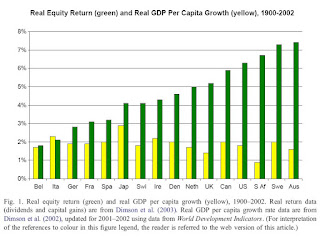
It is widely believed that economic growth is good for stockholders. However, the cross-country correlation of real stock returns and per capita GDP growth over 1900–2002 is negative. Economic growth occurs from high personal savings rates and increased labor force participation, and from technological change. If increases in capital and labor inputs go into new corporations, these do boost the present value of dividends on existing corporations. Technological change does increase profits unless firms have lasting monopolies, a condition that rarely occurs. Countries with high growth potential do not offer good equity investment opportunities unless valuations are low.
Data Source:
Data for this study come from multiple resources. The primary data sources are the World Bank's World Development Indicators and from Angus Maddison's Monitoring the World Economy.
Data Specification:
If you have ever watched CNBC or read articles in the Wall Street Journal, it becomes painfully obvious that the commentators seem to believe that investors do well when the economy is doing well. Unfortunately, there is very little discussion of valuations.
Rational investors should always think of investments as containing two components: an underlying intrinsic value, and a price. Unfortunately, this concept seems to be lost all too often.
Here is a simple example to illustrate. Ask your typical CNBC commentator the following:
Would you rather invest in situation A or situation B
Situation A:
"Space-age country X's GDP growth going forward will be 100% per year, profit margins will be 99% a year, there will be no inflation or deflation in the economy, and government will run a low-tax business friendly environment."
Situation B:
"Zimbabwe's GDP growth will likely be low and volatile going forward, profit margins will be 5% a year, inflation and deflation are real dangers, and the government runs the country and is 100% corrupt."
Next ask these folks their thoughts on investing in these various scenarios. Most will probably answer, "Is this a trick question? Situation A is obviously better; that is the greatest economy in the world, why WOULDN'T you be buying that market?"
Sadly, these folks aren't asking the MOST important question--what price do they have to pay for the stock market? Obviously, if the market is selling at 1 quadrillion, the best economy the world has ever seen can't justify the price someone has to pay. Similarly, if you are in the worst economic environment of all time, but the market is selling for $.01, it may make more sense to be excited as an investor.
This paper essentially makes this point empirically--economic growth doesn't really matter to investors. What matters is THE PRICE YOU PAY.
Investment Strategy:
This is more of an anti-investment strategy, which essentially highlights the fact that if you put time and effort into forecasting macroeconomic variables as a way to get an edge on the stock market--without emphasizing valuation--you may be a one-legged man trying to win an ass kicking contest. The variables that predict stock market returns are perturbations on valuation: p/e, p/b, default spreads, etc. Stick with these in your quant portfolio and you should be okay.
Here is a graph of the key result Jay Ritter finds (click on image to enlarge)
Implementation Issues and Remarks:
It is pretty apparent that economic growth is great--you live longer, have better technology, can buy more gadgets, have more disposable income/time, etc. However, economic growth may not be great for your investment portfolio if you pay too high a price. The trick for investors is to determine their projection for the intrinsic value of the market and then compare that value with the current price--if the market's cheap, buy it, if the market is expensive, sell it or invest elsewhere. If your game is to predict economic growth and not investment returns, here is a paper for you http://papers.ssrn.com/sol3/papers.cfm?abstract_id=159293
Investment Potential Rating: 6/10
--
Posted By Wesley R. Gray to Empirical Finance Research Blog at 9/04/2009 07:05:00 AM
============
Economic Growth and Equity Returns
Jay Ritter
University of Florida
Pacific-Basin Finance Journal 13 (2005) http://bear.cba.ufl.edu/ritter/PBFJ2005.pdf
Abstract:
It is widely believed that economic growth is good for stockholders. However, the cross-country correlation of real stock returns and per capita GDP growth over 1900–2002 is negative. Economic growth occurs from high personal savings rates and increased labor force participation, and from technological change. If increases in capital and labor inputs go into new corporations, these do boost the present value of dividends on existing corporations. Technological change does increase profits unless firms have lasting monopolies, a condition that rarely occurs. Countries with high growth potential do not offer good equity investment opportunities unless valuations are low.
Data Source:
Data for this study come from multiple resources. The primary data sources are the World Bank's World Development Indicators and from Angus Maddison's Monitoring the World Economy.
Data Specification:
If you have ever watched CNBC or read articles in the Wall Street Journal, it becomes painfully obvious that the commentators seem to believe that investors do well when the economy is doing well. Unfortunately, there is very little discussion of valuations.
Rational investors should always think of investments as containing two components: an underlying intrinsic value, and a price. Unfortunately, this concept seems to be lost all too often.
Here is a simple example to illustrate. Ask your typical CNBC commentator the following:
Would you rather invest in situation A or situation B
Situation A:
"Space-age country X's GDP growth going forward will be 100% per year, profit margins will be 99% a year, there will be no inflation or deflation in the economy, and government will run a low-tax business friendly environment."
Situation B:
"Zimbabwe's GDP growth will likely be low and volatile going forward, profit margins will be 5% a year, inflation and deflation are real dangers, and the government runs the country and is 100% corrupt."
Next ask these folks their thoughts on investing in these various scenarios. Most will probably answer, "Is this a trick question? Situation A is obviously better; that is the greatest economy in the world, why WOULDN'T you be buying that market?"
Sadly, these folks aren't asking the MOST important question--what price do they have to pay for the stock market? Obviously, if the market is selling at 1 quadrillion, the best economy the world has ever seen can't justify the price someone has to pay. Similarly, if you are in the worst economic environment of all time, but the market is selling for $.01, it may make more sense to be excited as an investor.
This paper essentially makes this point empirically--economic growth doesn't really matter to investors. What matters is THE PRICE YOU PAY.
Investment Strategy:
This is more of an anti-investment strategy, which essentially highlights the fact that if you put time and effort into forecasting macroeconomic variables as a way to get an edge on the stock market--without emphasizing valuation--you may be a one-legged man trying to win an ass kicking contest. The variables that predict stock market returns are perturbations on valuation: p/e, p/b, default spreads, etc. Stick with these in your quant portfolio and you should be okay.
Here is a graph of the key result Jay Ritter finds (click on image to enlarge)

Implementation Issues and Remarks:
It is pretty apparent that economic growth is great--you live longer, have better technology, can buy more gadgets, have more disposable income/time, etc. However, economic growth may not be great for your investment portfolio if you pay too high a price. The trick for investors is to determine their projection for the intrinsic value of the market and then compare that value with the current price--if the market's cheap, buy it, if the market is expensive, sell it or invest elsewhere. If your game is to predict economic growth and not investment returns, here is a paper for you http://papers.ssrn.com/sol3/papers.cfm?abstract_id=159293
Investment Potential Rating: 6/10
--
Posted By Wesley R. Gray to Empirical Finance Research Blog at 9/04/2009 07:05:00 AM
Reply all
Reply to author
Forward
0 new messages