Overflow in 2D, flat and periodic active nematic simulation

245 views
Skip to first unread message

Peter Hampshire

unread,
Aug 24, 2023, 6:46:44 AM8/24/23
to Dedalus Users

Hi thanks for creating such a nice resource. I would like to reproduce the active nematic simulations from the following paper https://arxiv.org/abs/2306.15352. The simulations are on a 2D, flat and periodic domain and the dimensionless equations are as follows:
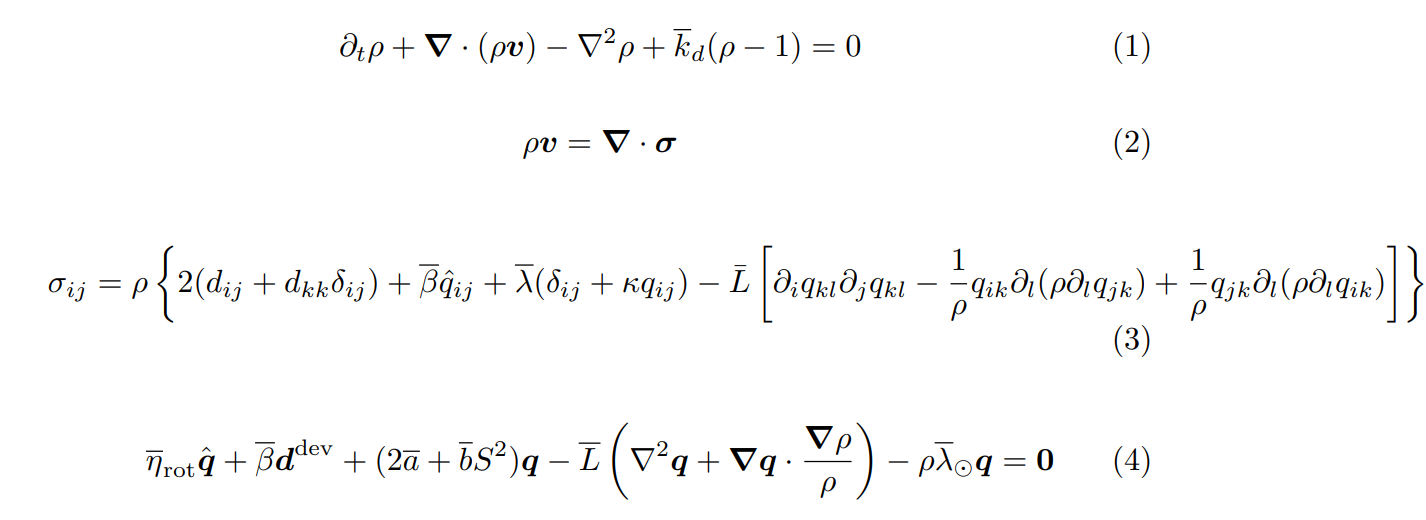
image

I attempted to solve the equations using Dedalus 3 but I get the error "RuntimeWarning: overflow encountered in multiply" on the first time step (see first code below).

Perhaps the problem arises because of the constraint equation (Equation 2 in the image above). It is linear in the velocity field but the velocity terms have coefficients that are dependent on the other variables (the nematic q tensor and density rho). There are many ways to write it such that the LHS is linear in the problem variables, so my attempt was to simply divide by rho.

My question is whether it is possible to solve these equations with Dedalus? If so, how can I change my code so that I do not get an overflow error on the first time step?

I tried reducing the max_time_step and the standard deviation of the noise in the initial conditions for q and rho but in both cases I still got an overflow error on the first time step. I also tried solving a LBVP to get a consistent initialisation for the velocity field (see second code below) but I get the error "f"Problem is coupled along distributed dimensions: {tuple(np.where(coupled_nonlocal)[0])}"".

Thanks,
Peter

import numpy as np import dedalus.public as d3 import logging logger = logging.getLogger(__name__) # Parameters Nx, Ny = 256, 256 dealias = 3/2 timestepper = d3.RK222 max_timestep = 1e-4 Nsteps = 10000 dN = 100 k_d=0.1 L=1 b=20 eta_rot=1 beta=-0.2 lambdabar_sun=6 lambdabar=1.3*(1+2*np.sqrt(k_d))**2 kappa=-0.8 c=4 a=1/2*(lambdabar_sun+c) Lx, Ly = 8*2*np.pi/(np.sqrt(np.sqrt(k_d))/np.sqrt(2)), 8*2*np.pi/(np.sqrt(np.sqrt(k_d))/np.sqrt(2)) stop_sim_time=Nsteps*max_timestep sim_dt=dN*max_timestep dtype = np.float64 # Bases coords = d3.CartesianCoordinates('x', 'y') dist = d3.Distributor(coords, dtype=dtype) xbasis = d3.RealFourier(coords['x'], size=Nx, bounds=(-Lx/2, Lx/2), dealias=dealias) ybasis = d3.RealFourier(coords['y'], size=Ny, bounds=(-Ly/2, Ly/2), dealias=dealias) # Fields rho = dist.Field(name='rho', bases=(xbasis,ybasis)) v = dist.VectorField(coords, name='v', bases=(xbasis,ybasis)) q = dist.TensorField((coords, coords), name='q', bases=(xbasis,ybasis)) # Substitutions dx = lambda A: d3.Differentiate(A, coords['x']) dy = lambda A: d3.Differentiate(A, coords['y']) x, y = dist.local_grids(xbasis, ybasis) ex, ey = coords.unit_vector_fields(dist) identity = ex*ex+ey*ey d = 1/2*(d3.grad(v) + d3.trans(d3.grad(v))) w = 1/2*(d3.grad(v) - d3.trans(d3.grad(v))) #qhat=d3.dt(q)+...@d3.grad(q)-w@q+q@w d_dev = d-d3.trace(d)/2*identity sigma = rho*(2*(d+d3.trace(d)*identity)\ +beta*1/eta_rot*(-beta*d_dev-(2*a+b*2*d3.trace(q@q))*q+L*(d3.lap(q)+1/rho*d3.grad(q)@d3.grad(rho))+lambdabar_sun*rho*q)\ +lambdabar*(identity+kappa*q)\ -L*(2*(d3.grad(q@ex@ex)*d3.grad(q@ex@ex)+d3.grad(q@ex@ey)*d3.grad(q@ex@ey))\ -1/rho*q...@d3.div(rho*d3.grad(q))+1/rho*d3.trans(q...@d3.div(rho*d3.grad(q))))) # Problem problem = d3.IVP([rho, v, q], namespace=locals()) problem.add_equation("dt(rho)-lap(rho)+k_d*rho = k_d - div(rho*v)") problem.add_equation("v = 1/rho*div(sigma)") problem.add_equation("eta_rot*dt(q)+beta*d_dev+2*a*q-L*lap(q)=\ -eta_rot*(v@grad(q)-w@q+q@w)\ -b*2*trace(q@q)*q+L/rho*grad(q)@grad(rho)+lambdabar_sun*rho*q") # Solver solver = problem.build_solver(timestepper) solver.stop_sim_time = stop_sim_time # Initial conditions rho.fill_random('g', seed=42, distribution='normal', scale = 0.05) rho += 1 q.fill_random('g', seed=42, distribution='normal', scale = 0.05) q['g'][1,0]=q['g'][0,1] q['g'][1,1]=-q['g'][0,0] # Analysis snapshots = solver.evaluator.add_file_handler('snapshots', sim_dt=sim_dt, max_writes=10) snapshots.add_task(rho, name='rho') snapshots.add_task(d3.div(v), name='divergence') snapshots.add_task(-d3.div(d3.skew(v)), name='vorticity') # CFL CFL = d3.CFL(solver, initial_dt=max_timestep, cadence=10, safety=0.2, threshold=0.1, max_change=1.5, min_change=0.5, max_dt=max_timestep) CFL.add_velocity(v) # Flow properties flow = d3.GlobalFlowProperty(solver, cadence=10) # Main loop try: logger.info('Starting main loop') while solver.proceed: timestep = CFL.compute_timestep() solver.step(timestep) if (solver.iteration-1) % 100 == 0: #max_w = np.sqrt(flow.max('w2')) logger.info('Iteration=%i, Time=%e, dt=%e' %(solver.iteration, solver.sim_time, timestep)) except: logger.error('Exception raised, triggering end of main loop.') raise finally: solver.log_stats()
import numpy as np import dedalus.public as d3 import logging logger = logging.getLogger(__name__) # Parameters Nx, Ny = 256, 256 dealias = 3/2 Nsteps = 10000 dN = 100 k_d=0.1 L=1 b=20 eta_rot=1 beta=-0.2 lambdabar_sun=6 lambdabar=1.3*(1+2*np.sqrt(k_d))**2 kappa=-0.8 c=4 a=1/2*(lambdabar_sun+c) Lx, Ly = 8*2*np.pi/(np.sqrt(np.sqrt(k_d))/np.sqrt(2)), 8*2*np.pi/(np.sqrt(np.sqrt(k_d))/np.sqrt(2)) dtype = np.float64 # Bases coords = d3.CartesianCoordinates('x', 'y') dist = d3.Distributor(coords, dtype=dtype) xbasis = d3.RealFourier(coords['x'], size=Nx, bounds=(-Lx/2, Lx/2), dealias=dealias) ybasis = d3.RealFourier(coords['y'], size=Ny, bounds=(-Ly/2, Ly/2), dealias=dealias) # Fields rho = dist.Field(name='rho', bases=(xbasis,ybasis)) v = dist.VectorField(coords, name='v', bases=(xbasis,ybasis)) q = dist.TensorField((coords, coords), name='q', bases=(xbasis,ybasis)) #Substitutions dx = lambda A: d3.Differentiate(A, coords['x']) dy = lambda A: d3.Differentiate(A, coords['y']) x, y = dist.local_grids(xbasis, ybasis) ex, ey = coords.unit_vector_fields(dist) identity = ex*ex+ey*ey d = 1/2*(d3.grad(v) + d3.trans(d3.grad(v))) w = 1/2*(d3.grad(v) - d3.trans(d3.grad(v))) #qhat=d3.dt(q)+...@d3.grad(q)-w@q+q@w d_dev = d-d3.trace(d)/2*identity sigma = rho*(2*(d+d3.trace(d)*identity)\ +beta*1/eta_rot*(-beta*d_dev-(2*a+b*2*d3.trace(q@q))*q+L*(d3.lap(q)+1/rho*d3.grad(q)@d3.grad(rho))+lambdabar_sun*rho*q)\ +lambdabar*(identity+kappa*q)\ -L*(2*(d3.grad(q@ex@ex)*d3.grad(q@ex@ex)+d3.grad(q@ex@ey)*d3.grad(q@ex@ey))\ -1/rho*q...@d3.div(rho*d3.grad(q))+1/rho*d3.trans(q...@d3.div(rho*d3.grad(q))))) # Problem problem = d3.LBVP([v], namespace=locals()) problem.add_equation("v-1/rho*div(rho*(2*(d+d3.trace(d)*identity)-beta*1/eta_rot*beta*d_dev))=\ 1/rho*div(rho*(beta*1/eta_rot*(-(2*a+b*2*d3.trace(q@q))*q+L*(d3.lap(q)+1/rho*d3.grad(q)@d3.grad(rho))+lambdabar_sun*rho*q)\ +lambdabar*(identity+kappa*q)\ -L*(2*(d3.grad(q@ex@ex)*d3.grad(q@ex@ex)+d3.grad(q@ex@ey)*d3.grad(q@ex@ey))\ -1/rho*q...@d3.div(rho*d3.grad(q))+1/rho*d3.trans(q...@d3.div(rho*d3.grad(q))))))") # Initial conditions rho.fill_random('g', seed=42, distribution='normal', scale = 0.05) rho += 1 q.fill_random('g', seed=42, distribution='normal', scale = 0.05) q['g'][1,0]=q['g'][0,1] q['g'][1,1]=-q['g'][0,0] #LBVP solver = problem.build_solver() solver.solve()

Peter Hampshire

unread,
Aug 24, 2023, 7:02:34 AM8/24/23
to Dedalus Users
Note that q hat is defined as the Jaumann derivative
Untitled picture.png

Daniel Lecoanet

unread,
Aug 26, 2023, 7:54:05 AM8/26/23
to Dedalus Users
Hi Peter,

I would suggest that you try to put as much of the div(sigma) term on the LHS as possible. You can write sigma = rho*\bar{sigma}, then div(sigma) = rho*div(\bar{sigma}) + \bar{sigma}.grad(rho). When you divide eqn 2 by rho, then the first term include some linear terms. If you can write q = q0+q’, then there will be more linear terms. Another trick may be to evolve an equation for log(rho) rather than rho itself. You can see that log(rho) appears in the equations more often than rho.

I think others may have solved similar equations in the past using Dedalus, so you might want to look at our list of papers using Dedalus to see if you can find anything similar.

Hope that helps,
Daniel

On Aug 24, 2023, at 7:02 AM, Peter Hampshire <peterhamp...@gmail.com> wrote:

Note that q hat is defined as the Jaumann derivative
-- 
You received this message because you are subscribed to the Google Groups "Dedalus Users" group.
To unsubscribe from this group and stop receiving emails from it, send an email to dedalus-user...@googlegroups.com.
To view this discussion on the web visit https://groups.google.com/d/msgid/dedalus-users/ab533150-8fae-4768-8153-960430a7bfefn%40googlegroups.com.
<Untitled picture.png>

Peter Hampshire

unread,
Sep 14, 2023, 9:37:11 AM9/14/23
to Dedalus Users
Dear Daniel,

Thank you for the suggestions. I have implemented them into Dedalus and unfortunately the density becomes less than zero in some regions and there is overflow (see the full details below).

I still suspect that the problem arises because of the constrain equation (Equation 2 below). I linearised it as much as I could but there are still velocity terms that have coefficients that are dependent on the other variables. This means the RHS has terms involving the velocity. Do you agree that this is causing the problem and if so how can I fix it?

Best,
Peter

The aim is to reproduce the results from Figure 2 in the preprint https://arxiv.org/abs/2306.15352.
I re-wrote the equations in my original post in terms of ln(rho) and linearised them as much as possible. The form of the equations that I inputted into Dedalus are as follows:
Picture3.png

My code runs for 55 time units before I get an Overflow error. At this point the density becomes less than zero in some regions and I also noticed some unusual quadropoles in the vorticity field.
Picture2.png

I tried reducing the time step, and changing the number of modes and the aliasing but I still get an Overflow error after around 55 time units.

The full code is 

```
import numpy as np
import dedalus.public as d3
import logging
logger = logging.getLogger(__name__)


# Parameters
Nx, Ny = 256, 256
dealias = 3/2
timestepper = d3.RK222
max_timestep = 1e-1
Nsteps = 1000
dN = 100                
k_d = 0.1
L = 1
b = 20
eta_rot = 1
beta = -0.2
lambdabar_sun = 6
lambdabar = 1.3*(1+2*np.sqrt(k_d))**2
kappa = -0.8
c = 4
a = 1/2*(lambdabar_sun+c)

Lx, Ly = 8*2*np.pi/(np.sqrt(np.sqrt(k_d))/np.sqrt(2)), 8*2*np.pi/(np.sqrt(np.sqrt(k_d))/np.sqrt(2))

stop_sim_time = Nsteps*max_timestep
sim_dt = dN*max_timestep

dtype = np.float64


# Bases
coords = d3.CartesianCoordinates('x', 'y')
dist = d3.Distributor(coords, dtype=dtype)
xbasis = d3.RealFourier(coords['x'], size=Nx, bounds=(-Lx/2, Lx/2), dealias=dealias)
ybasis = d3.RealFourier(coords['y'], size=Ny, bounds=(-Ly/2, Ly/2), dealias=dealias)


# Fields
lnrho = dist.Field(name='lnrho', bases=(xbasis,ybasis))

v = dist.VectorField(coords, name='v', bases=(xbasis,ybasis))
q = dist.TensorField((coords, coords), name='q', bases=(xbasis,ybasis))


# Substitutions
dx = lambda A: d3.Differentiate(A, coords['x'])
dy = lambda A: d3.Differentiate(A, coords['y'])
x, y = dist.local_grids(xbasis, ybasis)
ex, ey = coords.unit_vector_fields(dist)
identity = ex*ex+ey*ey
d = 1/2*(d3.grad(v) + d3.trans(d3.grad(v)))
w = 1/2*(d3.grad(v) - d3.trans(d3.grad(v)))
#qhat=d3.dt(q)+(v@ex)*dx(q)+(v@ey)*dy(q)-w@q+q@w
d_dev = d-d3.trace(d)/2*identity
sigmaprime = (2*(d+d3.trace(d)*identity)\
              +beta*1/eta_rot*(-beta*d_dev-(2*a+b*2*d3.trace(q@q))*q+L*(d3.lap(q)+dx(lnrho)*dx(q)+dy(lnrho)*dy(q))+lambdabar_sun*np.exp(lnrho)*q)\
                  +lambdabar*(identity+kappa*q)\
                      -L*(2*(d3.grad(q@ex@ex)*d3.grad(q@ex@ex)+d3.grad(q@ex@ey)*d3.grad(q@ex@ey))\
                          -...@d3.div(d3.grad(q))-q@(dx(lnrho)*dx(q)+dy(lnrho)*dy(q))+d3.trans(q...@d3.div(d3.grad(q))+q@(dx(lnrho)*dx(q)+dy(lnrho)*dy(q)))))

sigmaprimelinear = (2*(d+d3.trace(d)*identity)\
              +beta*1/eta_rot*(-beta*d_dev-(2*a)*q+L*(d3.lap(q)))\
                  +lambdabar*(kappa*q))

sigmaprimenonlinear = (beta*1/eta_rot*(-(b*2*d3.trace(q@q))*q+L*(dx(lnrho)*dx(q)+dy(lnrho)*dy(q))+lambdabar_sun*np.exp(lnrho)*q)\
                       +lambdabar*identity\
                           -L*(2*(d3.grad(q@ex@ex)*d3.grad(q@ex@ex)+d3.grad(q@ex@ey)*d3.grad(q@ex@ey))\
                               -...@d3.div(d3.grad(q))-q@(dx(lnrho)*dx(q)+dy(lnrho)*dy(q))+d3.trans(q...@d3.div(d3.grad(q))+q@(dx(lnrho)*dx(q)+dy(lnrho)*dy(q)))))    

sigmaprimenonconstant = (2*(d+d3.trace(d)*identity)\
              +beta*1/eta_rot*(-beta*d_dev-(2*a+b*2*d3.trace(q@q))*q+L*(d3.lap(q)+dx(lnrho)*dx(q)+dy(lnrho)*dy(q))+lambdabar_sun*np.exp(lnrho)*q)\
                  +lambdabar*(kappa*q)\
                      -L*(2*(d3.grad(q@ex@ex)*d3.grad(q@ex@ex)+d3.grad(q@ex@ey)*d3.grad(q@ex@ey))\
                          -...@d3.div(d3.grad(q))-q@(dx(lnrho)*dx(q)+dy(lnrho)*dy(q))+d3.trans(q...@d3.div(d3.grad(q))+q@(dx(lnrho)*dx(q)+dy(lnrho)*dy(q)))))  


# Problem
problem = d3.IVP([lnrho, v, q], namespace=locals())
problem.add_equation("dt(lnrho)-lap(lnrho)+div(v) = (dx(lnrho)**2+dy(lnrho)**2)-k_d+k_d*np.exp(-lnrho) - v@grad(lnrho)")
problem.add_equation("v - div(sigmaprimelinear) - grad(lnrho)@(lambdabar*identity) = div(sigmaprimenonlinear)+grad(lnrho)@sigmaprimenonconstant")
problem.add_equation("eta_rot*dt(q)+beta*d_dev+2*a*q-L*lap(q)=\
                     -eta_rot*((v@ex)*dx(q)+(v@ey)*dy(q)-w@q+q@w)\
                         -b*2*trace(q@q)*q+L*(dx(lnrho)*dx(q)+dy(lnrho)*dy(q))+lambdabar_sun*np.exp(lnrho)*q")


# Solver
solver = problem.build_solver(timestepper)
solver.stop_sim_time = stop_sim_time

# Initial conditions
lnrho.fill_random('g', seed=42, distribution='normal', scale = 0.05)
lnrho = np.log(1+lnrho)
q.fill_random('g', seed=43, distribution='normal', scale = 0.05)

q['g'][1,0]=q['g'][0,1]
q['g'][1,1]=-q['g'][0,0]

# Analysis
snapshots = solver.evaluator.add_file_handler('snapshots', sim_dt=sim_dt, max_writes=10)
snapshots.add_task(np.exp(lnrho)-1, name='rho-1')
#snapshots.add_task(d3.div(v), name='divergence')
snapshots.add_task(np.sqrt(2*d3.trace(q@q)), name='q')

snapshots.add_task(-d3.div(d3.skew(v)), name='vorticity')


# CFL
CFL = d3.CFL(solver, initial_dt=max_timestep, cadence=10, safety=0.2, threshold=0.1, max_change=1.5, min_change=0.5, max_dt=max_timestep)
CFL.add_velocity(v)


# Flow properties
flow = d3.GlobalFlowProperty(solver, cadence=10)

# Main loop
try:
    logger.info('Starting main loop')
    while solver.proceed:
        timestep = CFL.compute_timestep()
        solver.step(timestep)
        if (solver.iteration-1) % 100 == 0:
            #max_w = np.sqrt(flow.max('w2'))
            logger.info('Iteration=%i, Time=%e, dt=%e' %(solver.iteration, solver.sim_time, timestep))
except:
    logger.error('Exception raised, triggering end of main loop.')
    raise
finally:
    solver.log_stats()
```
Reply all
Reply to author
Forward
0 new messages