
la folie des mondes virtuels, openmoko, internet politics, etc.

Daily Soufron

- D'abord, tout le monde se demande qui est le premier et pourquoi, par exemple Habbo vient de passer devant World of Warcraft : World of warcraft derrière Habbo [MMO]
- De leur coté, Second Life et Club Penguin confirment leur croissance : Second Life and Club Penguin Among Fastest Growing UK Sites
- Mais surtout... Google lance son propre service de monde virtuel 3D : Google Lively
- Pour la version rigolote voyez plutôt : Google penetrates fake sex world with Lively
- Lively
- Google Releases 3D World Lively
- Google’s Virtual World “Lively” Online
- Google Launches Lively In-Browser Virtual World [Google]
- New 3D virtual world Lively launches [Google]
- Elite Social Networker Spire Gets $9 Million First Round From Hearst, Others
- Breaking the law : one-third of US residents rip DVDs
- Online "Public" Spaces Don't Guarantee Rights
- Un bilan de la L.C.E.N. (Juriblogsphere)
- Net Neutrality : Five Facts Everyone Must Know
- La lecture exportable, ou la mort du copyright ?
- Piratage de magazine, une poule rentre dans la danse
- Cinemassively : Three strikes on file-sharing in Europe could mean no internet for life
- A privacy link on Google.com
- Taxer les blogueurs ? Merci au Sénat et à Jérôme (Neteco)
- Syncing My Friends, Feeling the Social Media Burn
- Science Versus Magic — Is There a Difference in the World of Fiction ? [Debate]
- [Internet] -Surveillez l’usage qui est fait de votre compte Gmail (PcHelp 06 77 91 30 56)
- Discover Your Next Favorite Science Fiction Author [Hugo Awards]
- Nolan Bushnell on the rise of advertising and the casual game
- Sci Fi Terrorism Comes To Comics [Five Minutes In The Futurewar]
- Revue du Geoweb et de la géolocalisation de la semaine
- Préparation de la décision politique : le trop-plein de corruption
- Jimmy’s Lost His Toilet Paper
"Assez sidéré de lire sur le site Club Sénat (une information aussi reprise par l'AFP) :
« Les internautes français sont déjà des dizaines de milliers à gagner un peu d'argent sur le Net en...
[[ This is a content summary only. Visit my website for full links, other content, and more! ]]


 "
"Voir en ligne : Taxer les blogueurs ? Merci au Sénat et à Jérôme (Neteco)
Pulse - shapeshifting emotion visualisation
"
Pulse is a live visualisation of the recent emotional expressions written on the private weblogs of blogger.com. These emotional expressions are parsed according to a list of synonyms and transform a physical shapeshifting object.

"
Voir en ligne : Pulse - shapeshifting emotion visualisation
Ordered Openmoko
"
Don’t ask me why but I just purchased an Openmoko Freerunner (and debug board). My order number is just over the three thousand marker (would of figured it would have been higher because of the international press but that could be because of anything). I’m also going to be out there to Friday morning most likely in line buying the iPhone 3G. My excuse is that I’m a software engineer and need to know the market and my options (a good enough excuse for me. got ideas and need to know the platforms :-)).
"Voir en ligne : Ordered Openmoko
Syncing My Friends, Feeling the Social Media Burn
"
 I’ve been looking into ways to get my followers in sync between the various services I’m using, mainly FriendFeed, Twitter, Facebook, and Identi.ca. It’s not easy. Of course there’s the Twitter 2 FriendFeed Importer, but ultimately, adding contacts is still very much a manual process these days. I tend to batch this process on a regular basis by going through my email and opening tab after tab (see?). This is insanity, actually.
My need for data portability is desperate. I’m literally wasting huge amounts of my time adding, adding, adding the same friends over and over again. If you’re my friend online, then you should just be my friend no matter what service I sign up for. I’m quite sick of it.
And for the most part, what we’re getting from developers are YAWA offerings – that’s “yet another web app” - instead of tools that help us manage the ones we have today. And because they’re these shiny new objects, we sign up, add friends, and the cycle repeats. It repeats because we’ve just proved to the app’s creators this is what we want. It repeats because we’re going to sign up for the next app, too.
So when I see someone trying to address this issue, I get excited. Whether it works or not, I’m excited because they care. They’re at least moving in the right direction.
I was excited about the post I did today on Genome. They’re trying to make identities flexible and portable, but did this get a lot of positive comments? No. And the ones left weren’t even that nice.
I don’t get it. Explain it to me, because today, I’m lost. Do we, as social media enthusiasts really only care about the next cool thing and not about the process of actually making these tools effective for the everyday user. Is that just “oh, ho-hum, that’s for someone else to worry about?”
I hope that’s not the case. Hey, I love the next new thing as much as the next guy (see identi.ca early adopter tips), but I give equal time to the problem-solvers, too.
So, on that note, here’s your problem solver tip for today:
From the same guy who brought you the Better FriendFeed Subscribed To Me script, comes the Better FriendFeed Recommended Page. It works by finding the subscriptions of your subscriptions and sorts them by popularity (mutual subscriptions) as shown below:

There you go, equal time. Something useful. That deserved a post.


 "
"Voir en ligne : Syncing My Friends, Feeling the Social Media Burn
Breaking the law : one-third of US residents rip DVDs
"
A third of consumers have made copies of DVDs in the last six months, according to new survey results from the US and UK. This number is up from a year ago, but a majority of these users say they only copy their own DVDs for personal use.


 "
"Voir en ligne : Breaking the law: one-third of US residents rip DVDs
Google Lively
"
Remember how we were talking about Google's semi-secret virtual world project?
No longer quite so secret. Please discuss. (thx, Lum) News coverage here (via Google, natch.)
Voir en ligne : Google Lively
Google penetrates fake sex world with Lively
"
Watch clips of Sadville on virtual YouTube TV
It starts with a hug, then some petting on top of colored balls and before you know it you're down at some 3D sex club wielding a dildo.…
"Voir en ligne : Google penetrates fake sex world with Lively
Lively
"
Lively! I should think so. Google has just announced it's new web-based virtual world:
"A free, browser-based virtual environment with tight integration to
MySpace, Facebook, OpenSocial, and Google gadgets like Picasa and
YouTube."
... says Virtual Worlds News.
It seems at first glance to be rather exactly along the lines of MetaPlace and Whirled, although I'm sure there will be differences on investigation. The avatars look like Bratz. Some of the rooms look like Home.
Here's a user generated room called "I hate Ewoks" - clearly the creation tools are pretty good!

So I know I've been a bit off the grid recently, what with the nipper and a new busy job, but I missed any and all early news of this one. Is there anything Google can't do?


 "
"Voir en ligne : Lively
Google Releases 3D World Lively
"
Google just released Lively, a 3D world where you can chat with others and create your own rooms. Traces of this program appeared back in 2007 under the name of My World (this project also received the rumor nickname Google metaverse; TomHTML, Tony and I also lately saw traces of something called Google Rooms, though we aren’t 100% sure it’s related). After installing the desktop setup for Windows – yes, this is one of the rare Google products which isn’t completely browser-based – you’ll be forwarded to lively.com again. There, you can pick from a number of available rooms, and sign-in with your Google account.
I experienced a couple of problems with this service right now; from odd user name restrictions (I ended up re-selecting my Google ID name, even though they asked me to pick a new name at first), to very slow loading (I mostly saw skeletons at first), to finally, a program crash (the message “Lively has encountered a problem and an error report has been sent” appeared and the program closed). These may be launch problems, though, and nothing permanent... we’ll see.
Once you logged into a room, you can start customizing your avatar. First you can pick from a base type – like male, female or animal – and then you can fine-tune your hair, skin color, eyes and more. You’ll then see yourself surrounded by other avatars, and there’s background music and lots of laughing, grunting and other noises. The graphic has a lighthearted cartoon touch, reminiscent of something like a Lucasarts 3D game. When you talk by using the chat box at the bottom, your words appear as speech bubble above your character.
You can then move around by kind of dragging your avatar (clicking your avatar switches to self-navigation mode, and clicking outside it switches to camera navigation). This may be an unusual mode of navigation at first, but after some seconds it works very well.
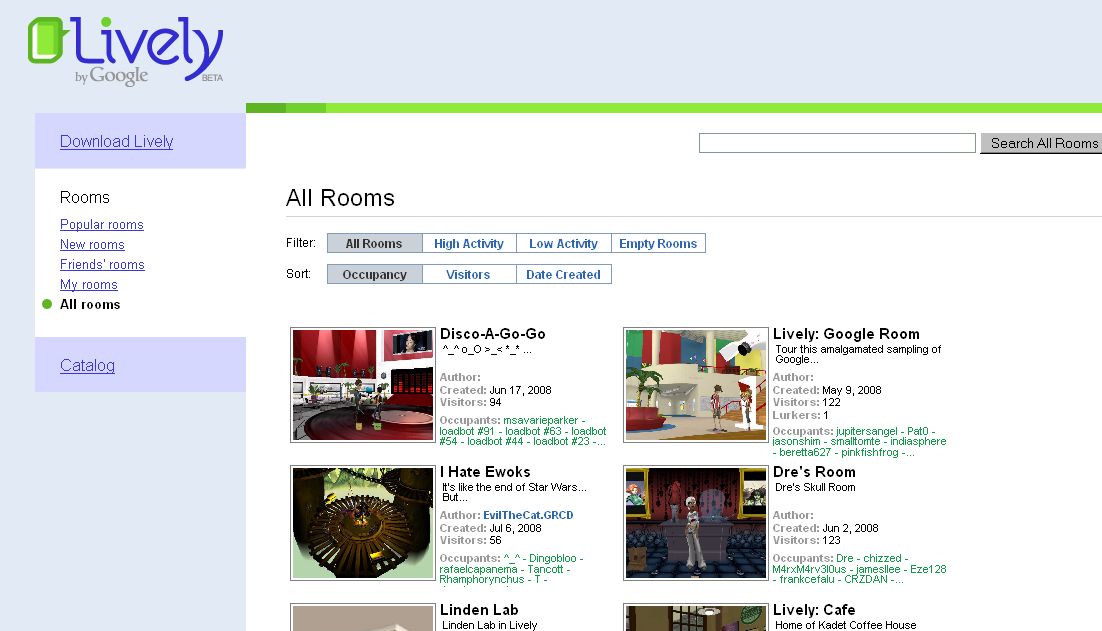
Selecting a room from the Lively site
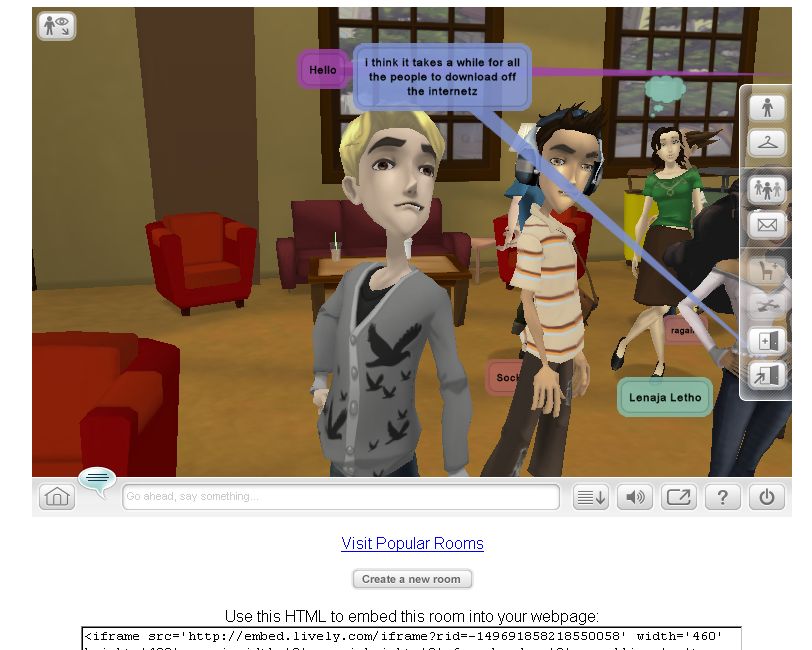
Joining a room, like this cafe
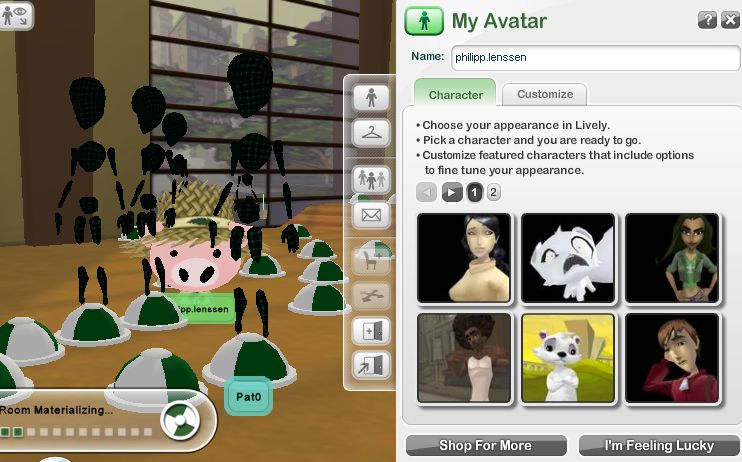
Configuring your avatar appearance (with some loading symbols in the room)
Clicking on objects, like an armchair, pops up a little dialog to let you e.g. add a comment to the object or interact with it, like sitting down. Clicking on other avatars lets you see their profile, and also initiate actions... like choking, slapping, kissing and much more. Indeed, there’s a whole lot of kicking and beating going on at the moment, and you may find your avatar being body-slammed around the room while you’re busy, say, configuring your hair color. I suppose it may calm down a bit after people are done with testing their moves, or perhaps Google wants to allow all kinds of user types – including World of Warcraft style fighters – to enjoy Lively...
If you want to create your own room, you’ll start out with a blank setup. You can then expand a furniture selection sidebar, for instance, to drop a chair, which will be represented by a loading cone at first. Note to move objects, you need to switch on the Move icon to the right, and then drag and drop things. A quiet room like your own may also be the right setting to further customize your avatar (you’ll note that you’ll be able to browse the Lively product catalog for more apparels, like your favorite shoes) or go through your repertoire of moves; from pleading and bowing to ROFLing or dancing, or “see no evil.”

Customizing your room. Google’s Niniane Wang at the official announcement post says, “If you enter a Lively room embedded on your favorite blog or website, you can immediately get a sense of the room creator’s interests, just by looking at the furniture and environment they chose. You can also express your own personality by customizing your avatar’s look, showing people who you are without having to say a word. Of course, you can chat with each other, and you can also interact through animated actions.”
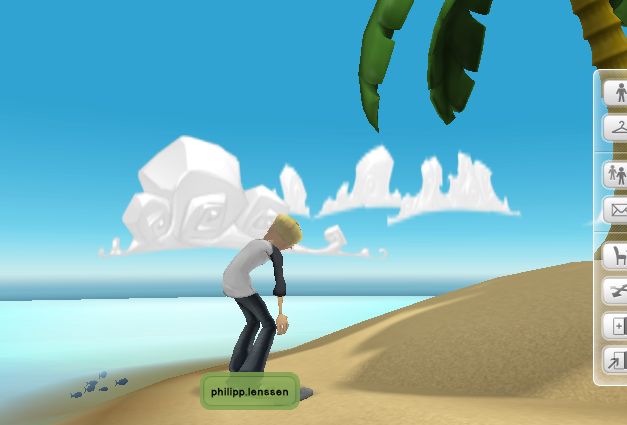
Crying on a lonely island (with Monkey Island style clouds in the background)
Once you’re finished with your own room, you can edit its settings. Like choosing whether you want to have it be publicly listed, whether visitors can move objects, what kind of background music plays and so on. You can also pick a different room type, called “shell,” like an island. And then you can grab some HTML inline frame code to embed the whole thing onto your own website for others to join, provided of course they have Lively installed. A room also has its own URL to share, which takes a form like this one.
All in all I found Lively to be an enjoyable experience so far. Some of its features may get some time to used to and its much to early to tell how well the social features will play out, but it’s one of Google’s more ambitious and fun projects. And Second Life may just have gotten a new competitor...
[Thanks Martin Porcheron, Luka, Tony and TomHTML!]
[By Philipp Lenssen | Origin: Google Releases 3D World Lively | Comments]
[Advertisement] Find the right keywords for your campaigns at KeywordDiscovery.com
 "
"Voir en ligne : Google Releases 3D World Lively
Google’s Virtual World “Lively” Online
"
 “Lively,” a virtual world from Google went online today, as predicted by me and 10,000 other bloggers. I’ll dig into the TOS and see how they’re approaching intellectual property and other legal issues. In the meantime… thoughts?
 "
"Voir en ligne : Google’s Virtual World “Lively” Online
[Internet] -Surveillez l’usage qui est fait de votre compte Gmail (PcHelp 06 77 91 30 56)
"Google vient de lancer au sein de sa messagerie Gmail une nouvelle fonctionnalité qui vise à permettre à l’utilisateur de surveiller l’usage qui est fait de sa messagerie, ainsi que de se déconnecter d’une machine distante, au cas où il aurait laissé une session ouverte sur un ordinateur public. Ce faisant, Google espère renforcer la confiance qu’accordent les internautes à son service de messagerie, et tente d’améliorer son image de marque, déjà écornée à plusieurs reprises sur la question de la vie privée. Les utilisateurs de Gmail devraient voir apparaitre au fil des heures ou des jours à venir des informations inédites dans le pied de la page qui affiche leur boite de réception Gmail. Sur ces quelques lignes, ils pourront voir quand et par qui le compte Gmail concerné a été consulté pour la dernière fois, ou visualiser l’adresse IP des éventuelles machines connectées sur ce compte, ainsi que le type d’accès ouvert (POP, depuis un téléphone mobile, etc.). Ces nouvelles fonctionnalités, qui permettent donc de garder un oeil sur l’activité de son compte, devraient être appréciées des utilisateurs qui se connectent souvent à Gmail depuis un ordinateur public. Elles seront déployéee dans les jours à venir sur l’ensemble des comptes Gmail, les anglophones semblant être les premiers servis. Leur lancement intervient alors que Google s’apprête à faire face à une nouvelle levée de boucliers relative au respect de la vie privée. Un tribunal américain lui a en effet récemment ordonné de livrer l’ensemble des journaux de connexion enregistrés sur son portail vidéo YouTube au groupe médias Viacom. Déjà vertement tancé par l’Electronic Frountier Foundation suite à cette injonction, Google a récemement pris le parti d’afficher dès la page d’accueil de son moteur de recherche un lien direct vers la politique de confidentialité mise en place par la société, ce qu’il s’était toujours bien gardé de faire jusqu’ici. Source1: source2:
Clubic : Surveillez l'usage qui est fait de votre compte Gmail ...
Le petit blog de l'Alain : Surveillez l'usage qui est fait de votre compte Gmail ...
participants : PcHelp 06 77 91 30 56,Clubic,Le PHP facile.com,Les Incompris,Le petit blog de l'Alain...
(6 posts, dernière mise à jour 09/07/2008 01:32)"
Voir en ligne : [Internet] -Surveillez l’usage qui est fait de votre compte Gmail (PcHelp 06 77 91 30 56)
Elite Social Networker Spire Gets $9 Million First Round From Hearst, Others
"
 Because the elite can't be seen networking with the rest of us… Spire.com, a social networking site for folks whose net worth is $250k or more, has raised a rich-looking, $9 million first round from Hearst, Trident Capital and TL Ventures. The site calls itself a "social resource", as it's designed to help users discover and share information with each other like what the buzz is on Croatia's Dalmation coast or where you can find a female-friendly golf-course with lessons and full spa treatment. With the funding, Spire has acquired London-based Suzanne's Files a high-end content site, bringing in 55,000 readers. Terms of that deal were not disclosed. Co-founder and CEO Janet Kraus previously founded Boston-based marketer Circles. Of course, the most well-known elite social networking site is ASmallWorld, which recently said it had $3 million in revenue in 2007. Release.
Related
ContentNext's EconCeleb Seminar examines what drives the economics of celebrity content. July 23, 2008 at the Roosevelt Hotel, Hollywood. Learn more.


Voir en ligne : Elite Social Networker Spire Gets $9 Million First Round From Hearst, Others
Net Neutrality : Five Facts Everyone Must Know
"The term net neutrality, unless you’re a tech geek, conjures up thoughts of fair trade, international policy or possibly anti-fishing zones. Here's a clarification the oft confusing technical jargon slimmed down to only the necessary information:"
Voir en ligne : Net Neutrality: Five Facts Everyone Must Know
Google Launches Lively In-Browser Virtual World [Google]
"
 The newest addition to Google Labs is a "3D virtual experience" called Lively, a Windows-only browser plug-in that lets you create and join customized virtual "rooms" in-browser to chat with your friends and associates. You can embed those rooms onto your web site as well. Not at all productivity-related, but a fun new way to interact online somewhere less boring than a text-based forum.


 "
"Voir en ligne : Google Launches Lively In-Browser Virtual World [Google]
Science Versus Magic — Is There a Difference in the World of Fiction ? [Debate]
"
 One of the biggest debates among people who like scifi — aside from the Star Wars vs. Star Trek thing — is where to draw the line between science and magic. Some adhere to the idea that magic is simply science that we don't yet understand, others feel that magic represents an essential mystery that can't be understood rationally. Of course the other big dividing line between magic and science has to do with genre: magic appears mostly in fantasy stories, and science (of course) in science fiction. And yet there is currently a trend in the scifi world toward creating stories that blur the line between science and magic: A lot of steampunk novels blend technology and sorcery (one of my favorite examples is in Elizabeth Bear's New Amsterdam, where one of the characters is a "forensic sorceress"). And shows like Lost and X-Files have frequently mingled the mystical and the rational. We talked to five authors whose fiction blurs the line between magic and science to find out what they thought of the difference between the two. Here's what they said.
Jeff VanderMeer, author of City of Saints and Madmen (and, with Ann VanderMeer, a columnist for io9):
The main difference is that science exists and magic doesn't. Even though everything in a novel is made up in a sense, this still matters—it creates different responsibilities. If, for example, the physical laws of a fantastical or SF world are different than our world, there has to be some explanation, no matter how off-the-cuff. And if that world contains magic, I think the writer has to be even more rigorous in thinking out how magical systems work, no matter how much of that appears in the text. This is because we are used to constraint. We are worlds of blood-and-water existing within a larger but finite network of people and settings, and all of that is constrained by the egg-yolk that is the Earth. If even something as arbitrary and recent as a sonnet suffers from constraint, then magic can be no different.
Of course, if you're a surrealist or absurdist, you often don't care about the difference between science and magic because the boundary between the two is going to be trampled and gleefully pissed on anyway. As well it should. Nothing is more annoying than allowing a little reality ruin your fun. If you have the imagination to get away with it.
Or, if you're Jack Vance, you just set your stories far enough in the future that the science seems like magic and you sit back in your golden throne, fold your arms, and cackle like either a mad scientist or a crazy sorcerer—take your pick.
One reason I have no magic in most of my fiction is that I cannot believe in it and thus cannot write about it in any convincing way. This is the same reason you do not find unicorns in my fiction. Or Smurfs. Or Republicans. I can and do, however, believe in huge intelligent squid ponderously pulling themselves through the alleys of a weird city, protecting themselves with helmets full of water. I can also believe in nefarious mushroom-based intelligent life forms living in bizarre underground caverns. However, since this is merely an audacious application of current theory on biology and biological systems it amounts to perfectly good science.
Elizabeth Bear, author of New Amsterdam and Dust:
That's a really interesting question, especially since for both SF and fantasy, I tend to lift my "rules"—whether that means the laws of physics or the laws of magic—from outside sources. Basically, in terms of writing—science fiction or fantasy—science and magic both serve (for me) to form a framework upon which I can hang the rest of the story. They're a structural element. So I try to find the coolest bits of either than I can.
Stephen Hunt, author of Court of the Air:
A fantasy author creates a monster by having a character in robes of any colour mumbling a spell, whereas the rules clearly state a science fiction writer has to put the character in white robes only, and have them mumbling something about genetic engineering and how at termination of protein synthesis, type I release factors promote hydrolysis of the peptidyl-transfer RNA connection in reaction to recognition of a stop codon. For the average reader, though, these both seem equally magic.
Ted Chiang, author of Stories of Your Life and Others:
Roughly speaking, if you can mass-produce it, it's science, and if you can't, it's magic. As an example, suppose someone says she can transform lead into gold. If we can use her technique to build factories that turn lead into gold by the ton, then she's made an incredible scientific discovery. If on the other hand it's something that only she can do, and only under special conditions, then she's a magician. And I don't mean that she's a charlatan; she might actually be able to transform lead into gold. But scientific phenomena are reproducible by other investigators; they aren't dependent on a specific person.
Electricity might have seemed magical at one time in history, but it works for everyone; you don't need to have an innate talent or be descended from someone special for a light bulb to turn on which you flip a switch. It took the work of very smart people to get us to the point that we can all use electricity, but none of them were magicians, precisely because they were able to make their discovery work for everyone.
To go on at slightly greater length, the reason magic can't be mass-produced is that it usually relies on some subjective quality of the practitioner: her intense concentration, her spiritual purity, something that can't be substituted with another person or with a machine. Magic is, in a sense, evidence that the universe knows you're a person. When people say that the scientific worldview implies a cold, impersonal universe, this is what they're talking about. Magic is when the universe responds to you in a personal way.
China Miéville, author of Perdido Street Station and Un Lun Dun:
What is the difference between science and magic? In real life, loads. In SF, I think the question's misleading, because I think that whatever SF may think and claim, and however much individual books may justly pride themselves on scientific accuracy, fundamentally the genre is not predicated on 'real' science at all. It's about apparently authoritative use of supposed scientific language, or, to put it another way, bullshitting. And that is not (necessarily) a dis.
There you have it, dear readers. What do you think?


Voir en ligne : Science Versus Magic -- Is There a Difference in the World of Fiction? [Debate]
New 3D virtual world Lively launches [Google]
"
Lively from Google is yet another 3D virtual world, kind of like Second Life but as yet unpopulated by furries or Goreans — completely virgin virtual land for griefers from like the clever goons at Something Awful to terrorize! But rather than an expansive, open-ended universe, Lively is a collection of individual "rooms" which you can then embed on third-party Web sites. Though it's not a browser-based application but a Windows-only download — so you'll have to wait just a bit before I can confirm whether or not you can "cyber," gamble or run ponzi schemes. You can, at least, feel up other users:
In our user research, we’ve been amazed at how much more poignant it is to receive an animated hug than seeing the text “[[hug]]”.
In the promotional video, the characters looke a bit like the anime-styled Yahoo Avatars. I can only hope Google's thought to include leather-daddy apparel, having released the product during Pride month.


 "
"Voir en ligne : New 3D virtual world Lively launches [Google]
Online "Public" Spaces Don't Guarantee Rights
"mikesd81 recommends an AP piece covering a lot of examples of the ways free speech and other rights don't exist on the private Web. One case featured was that of Dutch photographer Maarten Dors, who had this picture deleted by flickr. Without prior notice, Yahoo deleted the photo on grounds it violated an unwritten ban on depicting children smoking. While Dors eventually got the photo restored, after the second time it was deleted, the case highlights the consequence of having online commons controlled by private corporations. "Rules aren't always clear, enforcement is inconsistent, and users can find content removed or accounts terminated without a hearing. Appeals are solely at the service provider's discretion. Users get caught in the crossfire as hundreds of individual service representatives apply their own interpretations of corporate policies, sometimes imposing personal agendas or misreading guidelines. First Amendment protections generally do not extend to private property in the physical world, allowing a shopping mall to legally kick out a customer wearing a T-shirt with a picture of a smoking child." Reason.com has some more analysis on the issues brought up by the AP story.

Read more of this story at Slashdot.

 "
"Voir en ligne : Online "Public" Spaces Don't Guarantee Rights
Discover Your Next Favorite Science Fiction Author [Hugo Awards]
"
 Want to discover some cool new authors, and feel in-the-know about one of the most important Hugo awards at the same time? It's your lucky day. You have two easy ways to get to know the nominees for the John W. Campbell Award for Best New SF Writer. Arachne Jericho's Spontaneous Derivation blog has a rundown of the Campbell finalists, including what they've written, their website URLs, and a brief writing sample. And finalist Jon Armstrong is interviewing the other finalists on his podcast, If You're Just Joining Us. Find out how Joe Abercrombie feels about bad reviews, or Mary Robinette Kowal's magic formula for elevator pitches, by clicking the links. [Spontaneous Derivation and If You're Just Joining Us]


Voir en ligne : Discover Your Next Favorite Science Fiction Author [Hugo Awards]
Nolan Bushnell on the rise of advertising and the casual game
"
Filed under: Interviews, MMO industry, Free-to-play, Casual
 Nolan Bushnell, who bootstrapped the entire video game industry with Computer Space, Pong and the Atari 2600, later went on to found Chuck E. Cheese and several other ventures, has the solution for expanding the size of the gaming market. Casual games, everywhere. And how to pay for them? 30 second ad spots -- commercials, just like the ones on television or before movies. And he can target these ads better than ever. Are ad-supported games the wave of the future? In your MMO of choice five years from now, will a shampoo ad run whenever you ding? And by then, will you even mind? Gamasutra interviews Nolan Bushnell about casual games, targeted advertising, and the death of the hardcore gamer.
Read | Permalink | Email this | Linking Blogs | Comments
 "
"Voir en ligne : Nolan Bushnell on the rise of advertising and the casual game
Google Open Sources Its Data Interchange Format
"A number of readers have noted Google's open sourcing of their internal data interchange format, called Protocol Buffers (here's the code and the doc). Google elevator statement for Protocol Buffers is "a language-neutral, platform-neutral, extensible way of serializing structured data for use in communications protocols, data storage, and more." It's the way data is formatted to move around inside of Google. Betanews spotlights some of Protocol Buffers' contrasts with XML and IDL, with which it is most comparable. Google's blogger claims, "And, yes, it is very fast — at least an order of magnitude faster than XML."

Read more of this story at Slashdot.

 "
"Voir en ligne : Google Open Sources Its Data Interchange Format
Are IP Addresses Personal ? Hell Yes.
"
I’m referring, again, to the Viacom - Google lawsuit, the latest development of which is Google giving IP addresses (and other personal data) of users to Viacom on court’s order.
I’ve written on the subject at length, and Paul has addressed it, too, so why do I feel the need to revisit it?
 Well, mainly because of this blog post by Google. I missed out on it at the time it was published, and I’ve only briefly read it when I wrote about the case a couple of days ago. But now I’ve been reading and rereading it, and I still can’t understand its purpose - other than being a lame attempt by Google to justify giving out user data to the authorities, which they obviously (and accurately) predicted will inevitably happen at some later date.
The important question here is “what is personal data?” It’s not a simple question, but Google somewhat simplifies it for me by using this broad definition: “personal data … can be used to identify you as an individual.”
If we take that definition as the starting point, then there are two aspects to Google’s blog post, both very important: one is purely logical, and the other technical. I cannot say that Google’s Alma Whitten was wrong on these accounts, but I can argue that she’s trying to bend the truth to make it sound more favorable to Google.
First, consider this quote:
“An Internet Protocol (IP) address is an address for a computer on the Internet, which exists to allow data to be delivered to that computer.“
Simplified, but true. Now, think about the implications. The entire purpose of the IP - from any standpoint you choose - is to determine a computer connected to the network as a unique entity, separating it from all other computers. Forget about IP spoofing and advanced technical stuff: this is what the IP is about. It gives your computer a unique name on the net.
Now’s the time to think about the logical standpoint. The IP identifies the computer, not you. But, you’re using the thing; so you’re obviously implicated. The license plate of your car identifies the car, not you; but if you’re using the car, then it identifies you, too. If you define “personal data” as Google did in that blog post, the IP is obviously personal data: it’s as personal as it gets. In fact, I can’t think of another piece of data that Google could provide to Viacom that’s more personal than the IP address. Sure, it alone may not be enough to determine who you are (more on that later); just like your first name also might not be enough to determine who you are, but I also consider it personal. So, I ask you, if the IP address is not personal, what is?
Here’s an example. When someone makes a comment on this blog, I can see the name, URL and the e-mail this person provided - which can all easily be fake. I can also see the IP address and the exact time of entry - much harder to fake by the average user. If the authorities wanted me to provide info about the person in question, what piece of data will be more important to them: the nickname, which can be something like “Crazy Joe” or the IP address? I rest my case.
The Google blog post then proceeds to selectively pick the technicalities in favor of their thesis.
The situation gets a bit more complex, though, because the IP addresses that people use can change frequently. For instance, your Internet service provider (ISP) may have a block of 20,000 IP addresses and 40,000 customers. Since not everyone is connected at the same time, the ISP assigns a different IP address to each computer that connects, and reassigns it when they disconnect … Most ISPs and businesses use a variation of this “dynamic” type of assigning IP addresses, for the simple reason that it allows them to optimize their resources.
Because of this, the IP address assigned to your computer one day may get assigned to several other computers before a week has passed. If you, like me, have a laptop that you use at work, at home, and at your corner café, you are changing IP addresses constantly. And if you share your computer or even just your connection to your ISP with your family, then multiple people are sharing one IP address.
This is all true. But the painful truth is, IP addresses don’t come alone. Google is not going to just dump a long list of IP addresses onto Viacom - which would be completely useless - the logs will undoubtedly contain other info.
And, for example, once you have an IP address and the timestamp, all you need to do is contact the ISP and ask them to give you a listing of who connected through which IP address at what time. Since you already have the most important piece of data - the IP address - the ISP will have no problem providing you with the rest of the info you need to uniquely determine a person, because a timestamp - for example - is even less personal than an IP address. So, little by little, by gathering all these supposedly non-personal pieces of information, a third party can get all the data they need to identify you.
The point about people sharing computers with their family is equally weak. It may mean that the IP address is not identifying you in the metaphysical sense, but one only needs to remember RIAA’s john doe lawsuits to know that knowing that something was done from a computer is enough to slap a lawsuit on the whole household. Was it you or the granny who was downloading those torrents? Who cares: it’s only important that you pay.
In fact, RIAA’s john doe lawsuits are a great example of how hypocritical this IP-is-not-personal attitude is. Here you can find a very detailed explanation of what happens in a john doe lawsuit. However, after this bit…
“The techie, working on behalf of the RIAA, uses another program — separate from the P2P software — to find the Internet address (IP address) from which it appears the file they’ve searched for can be downloaded.“
…there is no further explanation of how the RIAA, together with the ISP, gets the true identity of “john doe.” You know why? Because it’s so damn easy. Forget odd circumstances and forget techie experts who can hide their IP: in the vast majority of cases, if someone wants to identify someone on the Internet, the IP address is the most important piece of data they need to obtain. It is unlike Google to try to wiggle out of a major moral standpoint such as this on a technicality, but it seems it’s come to that: sad but true.
---
Related Articles at Mashable! - The Social Networking Blog:
Keepm Saves Your Friends’ Information
Free For All @live.com Today
TorrentSpy Blocks U.S. Users In Response to Court Order to Log IP Adresses
Rumor: @live.com Email Addresses Roll Out Tomorrow
Again, One Clueless Person Destroys the Privacy Of Millions
Search Engines Must Comply With Strict EU Privacy Rules
GMail Adds Group Mailing List Functions


Voir en ligne : Are IP Addresses Personal? Hell Yes.
Sci Fi Terrorism Comes To Comics [Five Minutes In The Futurewar]
"

Announced at last weekend's Wizard World Chicago convention, new comic Iron Maiden One takes the real life War On Terror one further, showing the American Government reacting to a new terror attack on American soil by taking the fight to space. It's not the first comic to imagine a super-charged response to future terror attacks; Wanted creator Mark Millar's upcoming series War Heroes imagines President John McCain giving US soldiers super powers to better kick terrorist ass after the destruction of the Capitol Hill. We talked to Millar and Iron Maiden One writer B. Clay Moore to ask, when did it become okay to imagine the War On Terror getting worse?
The striking thing about both War Heroes and Iron Maiden One is that both start from a place that would've been unimaginable even a few years ago; not that the War On Terror is ongoing four or five years from now, but that America is still unable to prevent terrorist attacks within its own borders. Does this mean that the general public has forgotten the intensity of 9/11, or simply become desensitized enough to be able to fictionalize it? Mark Millar isn't convinced:
I remember saying to my wife as we left Titanic that I felt it exploited a real world tragedy and were we all killed in a bomb blast would some idiot be making a movie about it 80 years later. At least Cameron had the decency to wait almost a century. But what really struck me was when I googled it and found that the first Titanic movie had gone into production mere months after the disaster. The moral of this story is one of two things... a) writers are most influenced by the headlines and chatter around them or b) we're all opportunists who hope to be first on a real world trauma. The answer probably lies somewhere between the two.
Iron Maiden One's B. Clay Moore:
I think it's interesting that you'd assume a desensitization to the war is what would allow us to imagine worst case scenarios in the future. From my vantage point, it's blindingly obvious that the public at large is desensitized to the war, and has been for some time. While it's true that news gathering organizations like to link disapproval of the war to some kind of anti-war sentiment that's sweeping the nation, I don't think that's true. Not to sound too cynical, but I think a lot of Americans don't like the war the way they don't like broccoli. What bothers the government more is probably eroding support from the international community, and I think this story takes that ball and runs with it.

Does either writer feel that their series bears any guilt or responsibility to do more than entertain, considering the weight of their backdrop? Moore:
I think it's always "okay" to create fiction that probes the darker corners of possibility. This book is more a chase/thriller than a pointed commentary on the direction of the war. The elements that provide the backdrop aren't fun, but they are plausible, and in a sense, the story asks a sort of, "What would good people do when faced with horrible choices?" question. I think reminding people that wars are not just fought in sound bites, and that they always involve the brutalizing of human beings, actually runs countercurrent to that desensitization, in any event.
Millar:
It's kind of like Stan [Lee] and Jack [Kirby]'s emergence from the atomic atrocities and somehow turning it into superheroes. Japanese culture using the worst incident in their history and turning it into Godzilla. I think the entertainment industry has a curious habit of turning the worst of what's around us into something we can rationalize and to some extent control.
Turning the unknown of terrorism into "something we can control" seems to be a subconscious theme in comic coverage of current events - War Heroes is overt in turning the Iraq War into something approaching satire (much like DC's Army@Love and Image's Special Forces series), playing the real life drama much broader in order to present something much more comfortably enjoyable and less disturbing than what may really be happening "over there."
Of course, whether these two new series will be exploitative, exorcising or simply just entertaining will, ultimately, be judged by the audience (Previews for Iron Maiden One haven't been made available yet, although descriptions of the series by Moore as "a space chase terror thriller extravaganza" suggest that he's not going the dark comedy route). War Heroes launches at the end of July from Image Comics; Iron Maiden One's launch date is unknown at this time.
B. Clay Moore on Iron Maiden One [Newsarama]
War Heroes Issue One Preview [Newsarama]


Voir en ligne : Sci Fi Terrorism Comes To Comics [Five Minutes In The Futurewar]
La lecture exportable, ou la mort du copyright ?
"

La propriété intellectuelle ou sa version anglo-saxonne, le copyright, protègent l'auteur contre toute exploitation non autorisée de son oeuvre, et ce jusqu'à 70 ans après sa mort. Cette protection ne connaissait jusqu'à présent que deux exceptions majeures: la copie privée et le droit de citation. Selon l'article L 122-5 du Code de la propriété intellectuelle: «Lorsque l'oeuvre a été divulguée, l'auteur ne peut interdire: les représentations privées et gratuites effectuées exclusivement dans un cercle de famille (...); les analyses et courtes citations justifiées par le caractère critique, polémique, pédagogique, scientifique ou d'information de l'oeuvre à laquelle elles sont incorporées.»
Avec le content embedding, ou lecture exportable, le web dynamique a ouvert une troisième brèche dans la forteresse de la propriété intellectuelle. Depuis la création de YouTube, en 2005, cette fonction est familière à tout titulaire de blog ou de compte web 2.0: pour intégrer dans sa page une vidéo issue de la plate-forme visuelle, il n'est pas nécessaire d'en recopier le contenu, puis de le retélécharger sur son propre serveur. Il suffit de copier une ligne de code, disponible sous l'intitulé "embed", puis de la coller sur son propre site. Dans un environnement adéquat, cette série d'instructions permet de restituer la visualisation de la séquence dans des conditions similaires à celles offertes par la plate-forme.
Le principe de la lecture exportable a été vulgarisé par les sites de partage de vidéos pour éviter de pénaliser les usagers par la répétition de longs téléchargements et pour augmenter la viralité des contenus, tout en esquivant les blocages du copyright. Pourtant, loin de se limiter à ce contexte, elle est utilisée par la plupart des plates-formes de partage de contenus. De nombreux usagers l'ignorent, mais faute d'un paramétrage volontaire, la mise en ligne de photographies sur Flickr procure à n'importe quel internaute la même possibilité, conforme aux règles de la communauté, d'une diffusion externe sans demande d'autorisation préalable.
La lecture exportable n'est ni une citation, ni une copie. Elle n'est pas une citation, car l'auteur (ou le diffuseur) reste maître des conditions de divulgation du contenu: il peut bloquer la fonction a priori, par le paramétrage de son compte, ou bien mettre fin à une rediffusion en détruisant ou en modifiant les conditions de consultation d'un contenu. Cette capacité se manifeste par les mentions de "contenu inaccessible" qui émaillent les sites web. Dans ces conditions, puisqu'il ne comprend aucun transfert substantiel de l'oeuvre, l'embedding ne peut être considéré comme une copie. Il n'est par conséquent pas possible de le soumettre au copyright.
Le paradoxe est que, ne répondant ni à la définition de la citation, ni à celle de la copie, la lecture exportable permet l'une et l'autre dans de bien meilleures conditions que celles définies par la loi. La propriété intellectuelle limite la copie au cercle de famille et la citation à un extrait bref (limitation qui exclut en principe toutes les oeuvres des arts graphiques). Pourtant, la lecture exportable permet la diffusion publique non seulement de photographies, mais d'oeuvres vidéos complètes (pour autant que celles-ci s'inscrivent dans les limites temporelles des plates-formes: 10 mn sur YouTube, 20 mn sur Dailymotion). En d'autres termes, aussi longtemps qu'ils restent en ligne, la lecture exportable généralise les conditions de la copie privée à tous les contenus partagés.
Mieux encore: depuis la loi DADVSI, et en l'absence de toute disposition spécifique, la lecture exportable peut même être considérée comme protégée par l'alinéa 6 de l'article L 122-5 du code, qui exempte d'autorisation «la reproduction provisoire présentant un caractère transitoire ou accessoire, lorsqu'elle est une partie intégrante et essentielle d'un procédé technique et qu'elle a pour unique objet de permettre l'utilisation licite de l'oeuvre ou sa transmission entre tiers par la voie d'un réseau faisant appel à un intermédiaire». Reprise paresseuse du texte de l'article 33 de la directive 2001/29/CE du Parlement européen du 22 mai 2001, cette disposition était prévue pour éviter de placer tout acte de lecture sur internet (browsing) sous la férule du copyright – ce qui aurait eu pour effet de mettre fin à l'usage du web. Rédigé avant la généralisation de la pratique de l'embedding, cet article lui fournit néanmoins un fondement juridique parfaitement utilisable.
Le copyright est-il mort? Depuis l'avènement d'internet, les proclamations de son décès n'ont pas été rares. Cette vulgate a souvent produit des effets contraires et encouragé la promulgation de lois renforçant la propriété intellectuelle. Extension du principe de l'hyperlien, sur lequel le web a fondé toute sa dynamique, la lecture exportable propose un système d'une redoutable efficacité, qui a la particularité de ne pas être en contradiction avec la loi. Ce dépassement du copyright par l'usage est bien un facteur nouveau. Pour les contenus partagés, qui vont de la vidéo à la musique en passant par les ouvrages en pdf, l'utilité de la protection légale n'est plus manifeste. Au fur et à mesure du transfert des contenus vers le web, ses dispositions cesseront de s'appliquer pour des pans de plus en plus importants de la production culturelle. On peut dès à présent en faire le constat: entre le monde des contenus disponibles et celui des contenus sous contrainte, le fossé des usages se creuse et devient un abîme. Si l'on ajoute que la technologie Flash, sur laquelle repose en majeure partie l'embedding, est désormais indexable par Google et Yahoo, on se dit que la lecture exportable a de beaux jours devant elle.
"Voir en ligne : La lecture exportable, ou la mort du copyright?
DOCUMENTAL
"
DOCUMENTAL is an exhibition by four emerging photographers, including two good friends of mine, Irene Kaoru Malatesta and Sarah Sharp. Exhibition ends with a live gig, apparently. If you’re in NYC on the 11th, please do go and see them. Details in the link, obviously.

Voir en ligne : DOCUMENTAL
Black Gold - Une série symptomatique d’une crise
"
 Une fois n’est pas coutume, voici une série de télé-réalité qui mérite l’attention. Black Gold, comme son nom l’indique, parle du pétrole et des moyens de s’en procurer coûte que coûte à un moment où le prix du baril flirte avec les 150 dollars.
Cette envolée de la valeur du brut a eu pour conséquence de relancer les forages pour décrouvrir toujours plus d’or noir, dont les réserves s’épuisent pourtant rapidement. Les plus pessimismes parlent d’une fin des gisements avant 2020 et les plus optimistes aux alentours de 2050.
Quoi qu’il en soit, et malgré la nécessité de trouver des solutions de remplacement au pétrole - ne serait-ce que pour des raisons écologiques - les Etats-Unis continuent de miser sur le précieux liquide fossile et les forages ont repris dans l’Ouest du Texas.
Black Gold se présente sous la forme d’une compétition (une sorte d’Interville, en quelque sorte) entre trois équipes qui doivent chacune forer un puits. Il y a l’équipe Longhorn (couleur marron), l’équipe Black Dog (couleur bleue) et l’équipe Viking (couleur rouge).
Toute l’émission est conçue comme une course de deux semaines pour creuser un puits de 10.000 pieds et être le premier à atteindre une nappe, rendant ainsi le forage rentable. La série est menée sur un rythme trépidant, montrant les conditions de travail extrêmement pénibles des ouvriers et les revers de fortune auxquels ils doivent faire face.
Des interviews des chef d’équipe et de leurs hommes viennent encore renforcer l’intensité dramatique. On suit la progression de chaque équipe avec des animations graphiques tandis que les explications techniques fournies par le narrateurs aident à la compréhension.
Petit reproche, l’insistance presque obsessionnelle accordée au coût d’un forage. Il est répété à l’envi qu’une journée de travail équivaut à un investissement de 45.000 dollars pour l’entreprise pétrolière qui a commandé les forages.
L’impression que veut laisser cette série est qu’à une époque où l’essence n’est plus bon marché aux Etats-Unis et où certains sont obligés de modifier leurs habitudes de consommation, tout est mis en oeuvre pour maintenir le niveau de vie des Américains. L’idée est de rassurer, alors que les inquiétudes commencent à poindre.
Certes, Black Gold n’est pas une fiction, mais cette série est particulièrement symptomatique des craintes éprouvées par les ménages américains et elle rappelle que pour l’instant, les Etats-Unis n’ont nullement l’intention de modifier leur consommation énergétique. En filigrane, on voit se dessiner un parallèle entre les équipes de forage en concurrence et la société américaine : l’or noir est un moyen d’assurer sa survie.
A regarder comme un sujet de curiosité.
Voir en ligne : Black Gold - Une série symptomatique d’une crise
Cinemassively : Three strikes on file-sharing in Europe could mean no internet for life
"
Filed under: World of Warcraft, Fantasy, Real life, Video, Cinemassively, Machinima
Surely you would have heard about this before, right? They managed to fit it in one week before voting and there is now only one day left to fight back! On Monday, voting will begin on this legislation. However, given the short notice, many of those voting may have not even read it. If you would like to do something about this, you can find more information on the Strange Company website.
[Thanks, Hugh and Johnnie!]
If you have machinima or movie suggestions from any MMO, please send them to machinima AT massively DOT com, along with any information you might have about them.
Read | Permalink | Email this | Linking Blogs | Comments
 "
"Voir en ligne : Cinemassively: Three strikes on file-sharing in Europe could mean no internet for life
Revue du Geoweb et de la géolocalisation de la semaine
"
- Orange va lancer son nouveau logiciel de navigation pour smartphones
Orange Maps est la future application rassemblant divers services d’Orange liés à la géolocalisation.
Se basant sur les même outils qu’Orange Navigation, (le système de guidage sur mobile OnBoard GPS de l’opérateur), Orange Maps y rassemblera ses fonctionnalités (calcul de trajet, information routières actualisées en temps réel, guide d’adresses utiles) mais innovera au niveau communautaire et partage.
Orange Maps propose un système de guidage vocal en temps réel pour le mode voiture (prévu aussi en mode piéton) et un affichage en 3D pour la navigation. Les fonctions de recherche de POI (restaurant, commerce etc…) sont présents avec en plus une fonction de partage. Par exemple, vous pourrez partager simplement les coordonnées d’un restaurant avec vos amis qui pourrons recevoir l’adresse, ou le plan pour s’y rendre.
(via Mobinaute)
- Skyhook : un système de localisation sans GPS plus précis
Skyhook a annoncé la sortie de sa nouvelle plateforme hybride de positionnement qui combine désormais les signaux GSM des antennes des opérateurs avec les signaux WiFi et GPS pour améliorer la précision des systèmes actuels. Baptisée « XPS 2.0 », cette nouvelle version permet d’améliorer la précision du système de positionnement en intérieur ou dans les villes avec seulement deux GPS captés et le WiFi activé, le tout avec une précision augmentée de l’ordre de 35%. Ce service est utilisé par exemple par l’iPhone.
(via MacGeneration) - Google Earth en hologramme
Cette technologie de présentation holographique a été mise au point par UbiqWindow. Le plus étonnant est que vous pouvez intéragir avec l’image. Google Earth est un bel exemple d’intéraction. - Tous les mashups de Google Maps Mania sur une Timeline
Très belle façon de présenter les milliers de mashups référencés par Mike Pegg sur Google Maps Mania.
(via Google Lat Long) - Portail cartographique : Falk arrive en France
Falk est l’un des leader en Allemagne. Son portail cartographique GoFalk est désormais disponible en version française et propose des services de carte, d’itinéraire ou de recherche d’hôtels.
Malheureusement les cartes ne sont pas très lisibles et ne comportent pas, pour l’instant, de points d’intérêt.
(via Mobinaute) - Les marées disponibles sur Geoportail
Géoportail met à disposition des surfeurs et dew pêcheurs les horaires des marées sur son interface.
Une couche "Prédictions des marées" a été ajoutée. En fonction du lieu sélectionné et du jour vous obtiendrez toutes les informations indispensables : marée haute, marée basse, hauteur, coefficient etc…
(via Futura-Sciences) - Le portail Ask utilise désormais Microsoft Virtual Earth pour son portail cartographique
Le moteur de recherche et service Ask avait un service cartographique assez innovant. J’en avais déjà parlé.
Il semblerait que Ask a été abandonné sa plateforme cartographique au profit de la technologie Microsoft Virtual Earth.
(via Virtual Earth, An Evangelist’s Blog)


 "
"Voir en ligne : Revue du Geoweb et de la géolocalisation de la semaine
Un bilan de la L.C.E.N. (Juriblogsphere)
"
Ce sigle barbare de L.C.E.N. cache la loi n° 2004-575 du 21 juin 2004 pour la confiance dans l'économie numérique. Un rapport très instructif sur la mise en application de cette loi, et à consulter par tous ceux qui s'intéressent à un titre ou à un autre au droit ...
Source : Juriblogsphere (s'abonner)
Explorer : Economie numérique, Jean Dionis du Séjour
"Voir en ligne : Un bilan de la L.C.E.N. (Juriblogsphere)
Préparation de la décision politique : le trop-plein de corruption
"Cet article est dédié à Lawrence Lessig en hommage à sa décision le 17 juin 2007 d’arrêter son investissement prioritaire dans les luttes pour l’environnement réglementaire d’internet et de consacrer les années qui viennent à la lutte contre la corruption de l’élaboration démocratique des politiques publiques. Je suis seul responsable des affirmations contenues dans l’article.
Cet [...]"
Voir en ligne : Préparation de la décision politique : le trop-plein de corruption
Jimmy’s Lost His Toilet Paper
"

Pertri Purho, the creator of the IGF-winning Crayon Physics, has knocked out another minigame. This time it’s a puzzle-platformer called Jimmy’s Lost His Toilet Paper. You can get it here. I found it a little frustrating to control, and banged Jimmy’s ever-grinning bonce on the platforms a little too often. Nevertheless it makes up for the frustrations in charm and excellent music. … [visit site to read more]


 "
"Voir en ligne : Jimmy’s Lost His Toilet Paper
Panique dans la tribu des journalistes
"
Jean-Marie Le Ray, sur Adscriptor, a traduit (avec son autorisation) un remarquable billet de Jay Rosen sur la « tribu des journalistes » confrontée au défi de sa migration vers les contrées inconnues du net, les difficultés de cette aventure, et la remise en cause en profondeur du métier qu'elle entraîne : « Quelques-uns enfin admettent que c'est la panique. »
Un extrait ici, pour vous donner envie de lire l'intégral.
"La tribu de la presse professionnelle traverse une condition dramatique, où il en va de sa survie. Ces dernières années, elle a commencé à réaliser qu'elle ne pouvait plus vivre des rentes héritées d'une situation où les journalistes étaient les pourvoyeurs industriels d'infos one-to-many, capables de dicter le consensus.
Le terrain sur lequel ont vécu les gens dans les salles de rédaction - qui était également leur modèle économique - ne suffit plus pour rémunérer leur travail, d'où le tournant qu'ils doivent prendre, en dépit de leur réticence : et pour continuer, pour maintenir la presse professionnelle sur sa voie, la tribu de l'info devra migrer, traverser la fracture numérique et se réinstaller sur de nouvelles terres, un nouveau sol, ou, comme nous l'appelons parfois : une nouvelle plateforme.
Toute migration, que les américains idéalisent facilement, est un traumatisme pour la communauté. Il est difficile de tout quitter et d'abandonner des contrées familières. Certains membres de la tribu de l'info ne veulent pas partir : les bilieux des rédactions, un groupe réactionnaire. D'autres préfèrent nier la situation, d'autres encore s'éloigner discrètement du journalisme. Beaucoup sont éjectés vu la régression des conditions contractuelles et économiques de la tribu. Quelques-uns enfin admettent que c'est la panique."
La suite chez Jean -Marie, sur Adscriptor...
Voir en ligne : Panique dans la tribu des journalistes
La tribu de la presse à un tournant
"La tribu de la presse à un tournant
Comme l'observe Narvic (c'est moi qui graisse) :
Aujourd'hui, on tire sur les journalistes de toutes parts, et des études montrent assez l'ampleur du malaise : la crédibilité est en miette, la défiance s'est installée. Mais les journalistes eux sont les seuls à ne pas tirer sur les journalistes !Les journalistes me font penser à une tribu, une tribu migrante qui est à un tournant de son existence professionnelle (ce que les traducteurs vivent déjà depuis des années...), plutôt mal négocié pour l'instant. C'est ainsi qu'en lisant Migration Point for the Press Tribe, signé Jay Rosen, je lui ai demandé l'autorisation de traduire son billet, qu'il m'a gentiment accordée. Adaptation libre.
Il serait temps qu'ils s'y mettent ! Il y a beaucoup de choses qui ne vont pas dans le journalisme et chez les journalistes.
Nous assistons à la période initiale d'une montée en puissance du journalisme semi-professionnel, qui s'accompagne d'un déclin de l'ancien mode de vie de la tribu des journalistes professionnels. Je les nomme "tribu" parce qu'ils partagent une culture et un même sens du destin, et parce qu'ils s'imaginent qu'ils possèdent la presse, qui serait la leur, en quelque sorte, du fait qu'ils en dominent la pratique.Voilà. Je ne suis qu'un “amateur” mais c'est ma manière de contribuer au débat qui agite en ce moment les esprits sur la crise du journalisme et de la presse en général. Je laisse aux “pros” le soin d'adapter ce billet à la réalité francophone et de trouver les liens qui vont avec.
Le premier amendement de la constitution américaine dit à tous les citoyens : vous avez le droit de publier ce que vous savez, de dire ce que vous pensez. Or hier ce droit n'était exercé que de façon fort abstraite, alors qu'il s'exerce aujourd'hui concrètement, depuis que la population dans son ensemble se partage le pouvoir de publier. Les projets qui amènent les gens à exercer leur droit pour une presse libre renforcent la presse, que ces projets renforcent ou non les journalistes de profession qui ont mainmise sur la presse.
La tribu de la presse professionnelle traverse une condition dramatique, où il en va de sa survie. Ces dernières années, elle a commencé à réaliser qu'elle ne pouvait plus vivre des rentes héritées d'une situation où les journalistes étaient les pourvoyeurs industriels d'infos one-to-many, capables de dicter le consensus.
Le terrain sur lequel ont vécu les gens dans les salles de rédaction - qui était également leur modèle économique - ne suffit plus pour rémunérer leur travail, d'où le tournant qu'ils doivent prendre, en dépit de leur réticence : et pour continuer, pour maintenir la presse professionnelle sur sa voie, la tribu de l'info devra migrer, traverser la fracture numérique et se réinstaller sur de nouvelles terres, un nouveau sol, ou, comme nous l'appelons parfois : une nouvelle plateforme.
Toute migration, que les américains idéalisent facilement, est un traumatisme pour la communauté. Il est difficile de tout quitter et d'abandonner des contrées familières. Certains membres de la tribu de l'info ne veulent pas partir : les bilieux des rédactions, un groupe réactionnaire. D'autres préfèrent nier la situation, d'autres encore s'éloigner discrètement du journalisme. Beaucoup sont éjectés vu la régression des conditions contractuelles et économiques de la tribu. Quelques-uns enfin admettent que c'est la panique.
Donc à l'instar des migrants réticents partout dans le monde, les membres de la tribu de la presse doivent décider ce qu'il leur faut prendre avec eux. Quand partir. Où aller. Ils doivent choisir ce qui est essentiel à leur mode de vie, déterminer quelles sont les choses adaptées à l'ancien monde qui sont désormais inutiles, voire handicapantes dans le nouveau ; et se demander s'ils peuvent emmener avec eux ce qu'ils savent. Maintenant, que sera la vie dans l'océan numérique reste bien sûr une inconnue pour tout migrant, et génère un sentiment de crise immédiat pour les anciens de la tribu, qui ont toujours su comment vivre auparavant.
C'est déjà assez dur comme ça. Même si cela le sera encore davantage - ainsi qu'un défi toujours plus grand à relever pour la sagesse politique de la tribu - vu que le terrain sur lequel la presse devra se reconstruire est déjà occupé par des gens comme Jane Hamsher, Roger L. Simon, Arianna Huffington et Glenn Reynolds, qui eux sont occupés à construire une espèce de civilisation alternative aux infos et aux commentaires professionnalisés, ce qui ne les empêche pas de faire usage de la presse à l'ancienne et de l'industrie sous-jacente.
L'une des questions face à laquelle les journalistes sont de plus en plus perplexes aujourd'hui, c'est quoi faire des pros installés et de leurs vieilles habitudes, et comment se positionner vis-à-vis d'eux.
Dans l'actuelle fracture numérique, les conditions d'exercice du journalisme ne sont plus du tout les mêmes. Laissez-moi vous citer quelques faits marquants. La communication est bidirectionnelle, many-to-many. Le partage horizontal de l'info est devenu aussi important que le modèle top-down de sa diffusion. Les lecteurs sont devenus rédacteurs, et les gens qu'on qualifiait hier d'audience sont aujourd'hui des producteurs de contenu, des experts qui partagent leurs opinions et des consommateurs autonomes.
Il y a une chose que la tribu de l'info n'a pas compris en 1996, lorsqu'elle s'est retrouvée en ligne, en considérant le Web comme un bon moyen de reconditionner son contenu, pris tel quel à l'ancienne plateforme ; or même si le Web peut permettre cela, l'idée de reconditionner le contenu informationnel a un coût intellectuel énorme. Cela n'a pas aidé la tribu à bien appréhender sur quel terrain elle devait reconstruire, mais a permis à la presse de retarder la date de sa migration.
De nos jours, la presse est un territoire partagé, avec des zones pro et des zones amateur, une délimitation appropriée puisque la liberté de la presse elle-même est un territoire partagé, qui appartient autant aux amateurs qu'aux pros. En ligne, les deux zones sont connectées et ont un débit commun (voir un exemple ici). Cela fonctionne toujours sur un mode vertical : de la presse vers le public. Mais ça marche aussi horizontalement : de pair à pair. Avec une partie en système fermé — les systèmes fermés étant bons pour contrôler les choix éditoriaux —, et une partie en système ouvert.
Les systèmes ouverts, en revanche, sont bons pour participer, former la communauté et identifier l'intelligence où qu'elle se trouve sur le réseau. Ils sont bons pour partager et pour faire émerger le bon contenu. Mais ces deux systèmes éditoriaux ne fonctionnent pas de la même façon. L'un ne remplace pas l'autre. Ils ne sont pas ennemis pour autant. Nous avons donc besoin de mieux comprendre comment ils peuvent travailler ensemble.
C'est de là que vient l'idée d'un journalisme pro-am. Je pense que les formes hybrides seront les meilleures - l'ouverture avec ce qu'il faut de contrôle, les amateurs travaillant au côté des pros -, mais cela signifie que nous devrons appréhender comment fonctionnent ces formes mixtes de collaboration. Arianna Huffington, Amanda Michel, Mayhill Fowler, Marc Cooper et moi-même, accompagnés par plus de 3 000 membres abonnés, sommes actuellement plongés dans une tentative de ce genre, OffTheBus.
Arianna et moi voulions unir nos forces pour couvrir les élections américaines, sans idées claires sur la manière de le faire, jusqu'à ce que nous trouvions le nom, OffTheBus. Notre sentiment était que le courant dominant de la presse n'avait réussi jusqu'alors ni à innover ni à s'ouvrir bien loin. Nous voulions donc étendre les pouvoirs de la presse couvrant la campagne présidentielle à celles et ceux qui ne faisaient pas partie du club des pros, aux non-accrédités ayant des convictions et fiers de participer à la vie politique. Ce qu'a fait l'Huffington Post en permettant à des milliers de blogueurs d'écrire dans ses colonnes, en signant avec des milliers de journalistes citoyens pour suivre la campagne.
Notre idée : vous pouvez publier des sujets politiques indépendamment de votre positionnement. Vous n'avez pas besoin d'être dans la zone "presse" pour faire du journalisme sur la campagne présidentielle. Huff Post filtre les meilleurs sujets qui font la une, et, de là, sont injectés dans la conversation nationale. Nous allons ensuite tester un modèle de publication distribuée pour couvrir la campagne.
Dans la course à la narration, nous entreprenons quelque chose de “nouveau”, comme l'a observé Zephyr Teachout pour inaugurer cet événement, quelque chose en dehors des sentiers battus. Ainsi que l'a souligné Clay Shirky, l' “action collective en est facilitée”. En mettant nos idées en pratique, nous avons voulu faire, quelque part, une presse renouvelée.
Au final, je pense qu'il est temps que la presse s'élargisse, ne croyez-vous pas ? Cela signifie que nous devons étendre nos idées sur le sujet. C'est le but de ce billet.
Sur le modèle de publication distribuée, voir également ici. Personnellement, je pense que ce pourrait être là un excellent laboratoire d'expérimentation pour développer une contribution communautaire “encadrée”.
Laissez-moi enfin vous signaler trois lieux de réflexion essentiels : Narvic, Journalistiques et Média Chroniques. Déjà si vous lisez tous leurs billets et suivez tous leurs liens, vous en saurez ... davantage que moi :-)
Merci encore à Jay Rosen, et si vous souhaitez suivre la campagne présidentielle américaine jusqu'à son terme, voici un lien de choix : OffTheBus !
En France, ne reste plus qu'à savoir qui et quand sera capable de sauter hors du bus...

Partager sur Facebook
P.S. Juste une citation (via ABC Digital Futures) :
Journalists are too often reduced to a cross between call-centre workers and data processors.
Trop souvent le rôle des journalistes se réduit à un croisement entre les tâches d'opérateurs de centres d'appels et celles d'opérateurs de traitement des données.
 Actualités, presse, crowdsourcing, journalisme, journalistes, pro-am, blogging, blogueurs, médias, Internet, Web 2.0"
Voir en ligne : La tribu de la presse à un tournant
La grande crise silencieuse du journalisme
"
Le débat en commentaires de mon billet, prévu initialement comme « léger », « Mon blog préféré et mon blog détesté du moment », et la réaction qu'il suscite chez Nicolas, sur Versac, « Journaliste blogueur », me font réaliser que les journalistes ont pris conscience et débattent entre eux, depuis quelques, temps de la profonde et grave crise que vit leur profession, mais que ce débat n'a pas débordé jusqu'à maintenant hors des cercles professionnels.
Les blogs spécialisés de journalistes parlent beaucoup de ça en ce moment, mais ce débat n'est en effet pas vraiment relayé auprès du grand public, par les médias eux-mêmes (et il est intéressant de se demander pourquoi).
Jean-François Kahn est l'un des rares à se faire l'échos en public de ce débat, et je suis surpris que ses propos paraissent alarmistes à l'extérieur, quand l'ensemble de la profession est en train de crier qu'il y a vraiment le feu au lac, c'est à dire exactement la même chose... 
 « Presse écrite : la grande crise a commencé » (8 avril 2008)
Trois forums réservés aux professionnels, qui se sont tenus récemment à Paris et à Lille, ont permis de prendre la température du malaise général du journalisme et des menaces qui pèsent sur lui aujourd'hui.
Pour ceux que cette question intéresse, et parce qu'il me semble préférable que ce débat se tienne au grand jour, quelques liens pour savoir ce que se disent aujourd'hui les journalistes, quand ils sont réunis entre eux pour se regarder dans un miroir. Un seul mot résumé la tonalité de ces échanges : le désarroi.
Débat au SNJ, Syndicat national des journalistes :
- sur novövision : « Face au net : des journalistes désemparés » (26 avril 2008)
- Philippe Couve, sur Samsanews : « Web et journalisme : le débat organisé par le SNJ ».
- Frédéric Cognard, sur Ceucidit : « Le web, sauveur ou fossoyeur du journalisme ? »
Débat du Syntec RP/Newzy, au Celsa :
- « La dernière chance des journalistes » (21 mai 2008)
Aux Assises du journalisme à Lille :
- Philippe Couve, sur Samsa News : « Variations lilloises sur l'(in)utilité des journalistes » (voir notamment l'intervention de Jean-François Kahn)
- sur novövision : « A Lille, stupeur et désarroi des journalistes » (24 mai 2008)
Voir en ligne : La grande crise silencieuse du journalisme
YouTube, Viacom Fight Over Users
"Lawyers for Google asked Viacom for permission to better hide information that might help identify YouTube users before Google complies with a judge's demand that it hand over YouTube "user logs" to Viacom.


 "
"Voir en ligne : YouTube, Viacom Fight Over Users
Piratage de magazine, une poule rentre dans la danse
"Après la disparition du groupe SCaN, le petit monde de warez se dote d'un nouveau pirate de magazines du nom de MagChicken.
 "
"Voir en ligne : Piratage de magazine, une poule rentre dans la danse
Les netroots sont-ils solubles dans la campagne US ?
"La Netscouade et I Love Politics vous invitent à une rencontre-débat avec Jeremy Heimans et David Madden, lundi 7 juillet à 19 heures. Venez nombreux :-)

Nous vous invitons à découvrir et débattre de deux aspects marquants de la campagne présidentielle américaine :
* jamais les "netroots", ces mouvements auto-aurganisés sur le Net qui ont notamment nourri le succès du parti démocrate au Sénat en 2006, n'ont été aussi forts et pesé autant sur une élection ;
* les réseaux militants organisés par les candidats – et en particulier Barack Obama et son Movement – ont atteint leur pleine maturité.
Quels sont les particularités de ces réseaux progressistes complémentaires et, dans une certaine mesure, concurrents ? Quels sont leurs équivalents, côté républicain ? Comment ces communautés se sont-elles constituées et organisées ? Qui les anime ? Quel pourrait être leur rôle auprès l'élection ?
Activistes et consultants, Jeremy Heimans et David Madden sont à l'origine de plusieurs de ces communautés en ligne. Ils ont pris part à la campagne présidentielle américaine de 2004, et à la net campagne française de 2007 en tant que consultants pour La Netscouade de Ségolène Royal. En 2007, ils ont fondé Avaaz.org, la "plus grande communauté politique au monde", qui comprend 3,2 millions de membres.
lundi 7 juillet de 19 à 21 heures dans les locaux de la Netscouade
8 passage Brulon, 75012 - Métro Faidherbe-chaligny / Ledru-Rollin
Inscription obligatoire à con...@lanetscouade.com ou sur Facebook
www.lanetscouade.com | www.ilovepolitics.info

About Purpose Campaigns/Jeremy Heimans and David Madden
Since 2004, Purpose Campaigns has undertaken several path-breaking projects in the US, Europe and Australia. Our recent work includes:
* Co-founding www.Avaaz.org – the world's biggest online political community (3.2m members, 13 languages)
* Co-founding www.GetUp.org – Australia's largest and most influential campaign group (280,000 active members)
* Developing a major national television and online advertising campaign during the 2004 US presidential elections, funded by George Soros and hundreds of thousands of online supporters
* Designing the digital media strategy for GlobalZero.org – a new international campaign on the nuclear threat, including a major film by the makers of An Inconvenient Truth, led by world leaders such as Mikhail Gorbachev, Jimmy Carter and Richard Branson (launching November 2008)
* Advising French presidential candidate Segolene Royal's Internet team
* Helping the Paris-based Organization for Economic Cooperation and Development re-brand and reposition a major global initiative (in progress)
* Developing the branding, technology and business strategy for an online marketplace for carbon credits (not publicly launched yet).
Purpose Campaigns is led by Jeremy Heimans and David Madden. Heimans and Madden, both graduates of Harvard's Kennedy School of Government, have a long history of involvement with innovative uses of technology and new media. Prior to their work together, Madden served as the Strategy Director for the award winning youth-focused online group www.Inspire.org, and then later as the Director of Business Development at the online retailer www.dstore.com. Heimans worked for the international strategic consulting firm McKinsey and Company (www.mckinsey.com), where his primary focus was on internet strategy.
Heimans and Madden's work has been recognized internationally in publications such as The Economist and The New York Times. In 2006, Heimans and Madden were named one of the "Top 10 People who are Changing the World of Politics and the Internet" by Politics Online and the World E-Government Forum.
Réservez votre place à bord de L'Avion et envolez-vous en Classe Affaires à un prix inoubliable.
Ilovepolitics en version Mobile et iPhone : http://m.ilovepolitics.info
L’univers d’Ilovepolitics sur Netvibes : www.netvibes.com/ilovepolitics
Le groupe Ilovepolitics sur Facebook

Voir en ligne : Les netroots sont-ils solubles dans la campagne US ?
Bercy se la joue pour le Mondial du Gaming
"Depuis ce midi et jusqu'à dimanche soir se déroule à Paris le Mondial du Gaming, une grosse compétition dédiée à de nombreux jeux vidéo multijoueurs."
Voir en ligne : Bercy se la joue pour le Mondial du Gaming
Second Life and Club Penguin Among Fastest Growing UK Sites
"New research from Nielsen tracks the top ten sites in the UK in average monthly minutes. There aren't any virtual worlds on the list--MSN Search, eBay, and Facebook take the top slots--but Club Penguin and Second Life make the up-and-coming...

 "
"Voir en ligne : Second Life and Club Penguin Among Fastest Growing UK Sites
YouTube, Viacom Fight Over Users
"Lawyers for Google asked Viacom for permission to better hide information that might help identify YouTube users before Google complies with a judge's demand that it hand over YouTube "user logs" to Viacom.


 "
"Voir en ligne : YouTube, Viacom Fight Over Users
Piratage de magazine, une poule rentre dans la danse
"Après la disparition du groupe SCaN, le petit monde de warez se dote d'un nouveau pirate de magazines du nom de MagChicken.
 "
"Voir en ligne : Piratage de magazine, une poule rentre dans la danse
Les netroots sont-ils solubles dans la campagne US ?
"La Netscouade et I Love Politics vous invitent à une rencontre-débat avec Jeremy Heimans et David Madden, lundi 7 juillet à 19 heures. Venez nombreux :-)

Nous vous invitons à découvrir et débattre de deux aspects marquants de la campagne présidentielle américaine :
* jamais les "netroots", ces mouvements auto-aurganisés sur le Net qui ont notamment nourri le succès du parti démocrate au Sénat en 2006, n'ont été aussi forts et pesé autant sur une élection ;
* les réseaux militants organisés par les candidats – et en particulier Barack Obama et son Movement – ont atteint leur pleine maturité.
Quels sont les particularités de ces réseaux progressistes complémentaires et, dans une certaine mesure, concurrents ? Quels sont leurs équivalents, côté républicain ? Comment ces communautés se sont-elles constituées et organisées ? Qui les anime ? Quel pourrait être leur rôle auprès l'élection ?
Activistes et consultants, Jeremy Heimans et David Madden sont à l'origine de plusieurs de ces communautés en ligne. Ils ont pris part à la campagne présidentielle américaine de 2004, et à la net campagne française de 2007 en tant que consultants pour La Netscouade de Ségolène Royal. En 2007, ils ont fondé Avaaz.org, la "plus grande communauté politique au monde", qui comprend 3,2 millions de membres.
lundi 7 juillet de 19 à 21 heures dans les locaux de la Netscouade
8 passage Brulon, 75012 - Métro Faidherbe-chaligny / Ledru-Rollin
Inscription obligatoire à con...@lanetscouade.com ou sur Facebook
www.lanetscouade.com | www.ilovepolitics.info

About Purpose Campaigns/Jeremy Heimans and David Madden
Since 2004, Purpose Campaigns has undertaken several path-breaking projects in the US, Europe and Australia. Our recent work includes:
* Co-founding www.Avaaz.org – the world's biggest online political community (3.2m members, 13 languages)
* Co-founding www.GetUp.org – Australia's largest and most influential campaign group (280,000 active members)
* Developing a major national television and online advertising campaign during the 2004 US presidential elections, funded by George Soros and hundreds of thousands of online supporters
* Designing the digital media strategy for GlobalZero.org – a new international campaign on the nuclear threat, including a major film by the makers of An Inconvenient Truth, led by world leaders such as Mikhail Gorbachev, Jimmy Carter and Richard Branson (launching November 2008)
* Advising French presidential candidate Segolene Royal's Internet team
* Helping the Paris-based Organization for Economic Cooperation and Development re-brand and reposition a major global initiative (in progress)
* Developing the branding, technology and business strategy for an online marketplace for carbon credits (not publicly launched yet).
Purpose Campaigns is led by Jeremy Heimans and David Madden. Heimans and Madden, both graduates of Harvard's Kennedy School of Government, have a long history of involvement with innovative uses of technology and new media. Prior to their work together, Madden served as the Strategy Director for the award winning youth-focused online group www.Inspire.org, and then later as the Director of Business Development at the online retailer www.dstore.com. Heimans worked for the international strategic consulting firm McKinsey and Company (www.mckinsey.com), where his primary focus was on internet strategy.
Heimans and Madden's work has been recognized internationally in publications such as The Economist and The New York Times. In 2006, Heimans and Madden were named one of the "Top 10 People who are Changing the World of Politics and the Internet" by Politics Online and the World E-Government Forum.
Réservez votre place à bord de L'Avion et envolez-vous en Classe Affaires à un prix inoubliable.
Ilovepolitics en version Mobile et iPhone : http://m.ilovepolitics.info
L’univers d’Ilovepolitics sur Netvibes : www.netvibes.com/ilovepolitics
Le groupe Ilovepolitics sur Facebook

Voir en ligne : Les netroots sont-ils solubles dans la campagne US ?
Bercy se la joue pour le Mondial du Gaming
"Depuis ce midi et jusqu'à dimanche soir se déroule à Paris le Mondial du Gaming, une grosse compétition dédiée à de nombreux jeux vidéo multijoueurs."
Voir en ligne : Bercy se la joue pour le Mondial du Gaming
Second Life and Club Penguin Among Fastest Growing UK Sites
"New research from Nielsen tracks the top ten sites in the UK in average monthly minutes. There aren't any virtual worlds on the list--MSN Search, eBay, and Facebook take the top slots--but Club Penguin and Second Life make the up-and-coming...

 "
"Voir en ligne : Second Life and Club Penguin Among Fastest Growing UK Sites
World of warcraft derrière Habbo [MMO]
"

La nouvelle est tombée, Habbo hotel “le skat des ados” vient de doubler la star des jeux massivement en ligne en terme d’utilisateurs actifs. Wow c’est aujourd’hui 9,5 millions d’abonnés, Habbo le mois dernier a franchi la barre des 10 millions.
Bon faut relativiser la news, car sur WoW il faut quand même payer 10$/mois alors que Habbo est entièrement gratuit.
Pour fêter ça, j’ai décidé de créer mon avatar :

Mais impossible d’installer shockwave donc je vais rester ignorant du monde merveilleux des legos. Mais je sais pas pourquoi, je suis pas triste…


 "
"Voir en ligne : World of warcraft derrière Habbo [MMO]
Ma vie sans médias (1)
"
Ce mois-ci, j'ai décidé de ne plus acheter de journaux, d'écouter le moins possible la radio, de ne pas regarder la télé (c'est facile, je n'en ai pas) et de limiter mes incursions sur le net.
Bref, une tentative de diète médiatique comme je l'ai déjà fait par le passé.
Mais, en général, ça n'a pas duré longtemps.
Pourquoi cette pause? Pour plusieurs raisons:
1) C'est l'été, envie de décompresser
2) Un peu de lassitude
3) Envie d'expérimenter
4) Envie de me libérer du temps Aujourd'hui, donc, je suis passé devant plusieurs kiosques à journaux. J'ai lu machinalement la Une du Monde: "Sarkozy veut une Europe du concret".Un titre à vous décourager de lire. Heureusement!
Sarkozy veut une Europe du concret. Ce titre est mauvais, symbolique de la baisse de niveau du Monde ces derniers temps.
_ Sarkozy dans le titre, forcément.
_ cette expression débile, "Europe du concret", ça ne veut rien dire
_ on sent, dans ce titre, une trop grande proximité entre le message que veut transmettre l'Elysée et celui que transmet Le Monde. La phase de décryptage a, semble-t-il, été éludée. Bref, une fois de plus, on a affaire à du fast journalisme, qui colle à l'événement, qui colle au communiqué de presse, sans recul suffisant. C'est l'impression que donne le titre, puisque je n'ai pas acheté le journal. Mais, je n'ai vraiment pas eu envie de le lire, avec une accroche pareille.
Peu après, je tombe sur un affichage du Monde: "Europe: les 4 chantiers de Sarkozy". Même envie de pas lire.
En traversant la rue, vers le boulevard Arago, un homme en scooter me hèle: "Eric, Eric!" Je vais vers lui. C'est Jim, le sympathique serveur de la Comète, au Kremlin Bicêtre, où on ne croise pas que des cons. Il me demande comme ça va. Ça va, le ciel est bleu, il fait 25° et je n'ai pas acheté Le Monde.
(texte écrit le 1er juillet)
"Voir en ligne : Ma vie sans médias (1)
BitTorrent a aidé Heroes et Lost, avoue l’un des coproducteurs
"La moitié des utilisateurs du réseau Torrent s'en servent pour télécharger des épisodes TV, et des séries prestigieuses comme Lost ou Heroes ont connu jusqu'à 10 millions de requêtes."
Voir en ligne : BitTorrent a aidé Heroes et Lost, avoue l'un des coproducteurs
OpenMoko FreeRunner Linux phone to launch on July 4
"OpenMoko has announced plans to launch the Linux-based FreeRunner mobile phone on July 4. The highly-anticipated open source handset will be distributed through OpenMoko's web-based store and will begin shipping on July 7. The FreeRunner will also be available from several vendors in Europe and India."
Voir en ligne : OpenMoko FreeRunner Linux phone to launch on July 4
A privacy link on Google.com
"Posted by Pablo Chavez, Senior Policy Counsel
Google values our users' privacy first and foremost. Trust is the basis of everything we do, so we want users to be familiar and comfortable with the integrity and care we give their personal data.
So, today, we're making a homepage change by adding a link to our privacy overview and policies. We added this link both to our homepage and to our results page to make it easier for users to find information about our privacy principles. The new "Privacy" link goes to our privacy center, which was revamped earlier this year to be more straightforward and approachable with videos and a non-legalese "Privacy Overview" to make sure users understand in basic terms what Google does, doesn't, will, and won't do in regard their personal information.
You can read more about it on the Official Google Blog.


 "
"Voir en ligne : A privacy link on Google.com
'Métropolis' : la version longue retrouvée !
"La news a fait l'effet d'une véritable petite bombe: une version longue de "Métropolis", chef d'oeuvre absolu du cinéma fantastique réalisé par Fritz Lang en 1928, vient d'être retrouvée en Argentine. La fondation Friedrich Wilhelm Murnau, détentrice des droits du film, a annoncé que deux..."
Voir en ligne : 'Métropolis' : la version longue retrouvée!