
dollhouse, le web 2.0 en classes sociales et en questions, le noise vs l'information, etc.

Daily Soufron

- Un excellent article contre le techno-enthousiasme de la blogosphère et du monde du web 2.0 dont l'auteur pensent qu'ils oublient trop souvent que leurs idées ferait bien de servir un peu aux gens qui en ont vraiment besoin... : The tech blogosphere is a closed circle feeding on itself
- Qui utilise vraiment ces services d'ailleurs... : The Hyperconnected vs. 84% of Everyone Else on Earth
- Avec une petite carte : Social Networking map of the world
- Justement, Google China essaie de mettre en place quelques moyens pour assister l'aide humanitaire après le tremblement de terre : Google China’s Extended Earthquake Help
- Sur le même thème, intéressant papier de Scoble sur FriendFeed et cie... pour savoir si ces outils réussiront à pénétrer le grand public... le pour : Why FriendFeed will go mainstream (Part II)
- Le contre... : Why FriendFeed won’t go mainstream (Part I)
- Et la vie privée dans tout ça... pas brillant : Privacy ? Forget it. Sell your brain and desires to the highest bidder
- Et les données, elles sont où... sur Internet : Dear Web Applications : Where Are My Files ?
- Et est ce que aide les ventes... pas évident : Pew Internet Finds Web Has Little Effect On Purchasing
- Une analyse intéressante du genre de médias embeddés sur les blogs hebergés par Wordpress... ca peut donner des idées à ceux qui souhaitent monter des blogs ou des plateformes de blogs : Les types de médias intégrés sur wordpress.com
- AOL rachète bebo, ayé le chèque est signé : AOL-Bebo : $850M Deal Closes ; AOL Combines Bebo, AIM, ICQ Into People Networks Headed By Shields
- Les web services d'amazon sont un tel succès qu'ils représentent désormais plus de trafic que le site amazon lui même : Amazon Web Services far ahead of Amazon.com in Bandwidth consumption
- Facebook France : Le cap des 2 millions vient d’être dépassé !
- Silicon Valley’s janitor problem
- Les informations de Google News sont remarquablement dépourvues de "noise" : Why Google News has no noise
- Mais le "noise" a peut-être aussi une valeur : FriendFeed only adds to the noise under a key assumption
- Sur cette question, Reuters vient justement d'aboutir à la 2e version de Calais, leur protocole de tagging sémantique : Reuters Launches Calais 2.0 - Now With Pop-Culture
- De toute façon, maintenant il faut s'intéresser aux flux de données plus qu'aux données elles-mêmes : It’s Not The Data, It’s The Flow
- Terry Moore est un dessinateur génial... son prochain comics a l'air génial... : Propaganda looks at Echo. The next big project from Terry Moore
- Joss Whedon est génial... il était un peu cramé par l'échec de Firefly, mais son prochain projet s'annonce fantastique : Final Dollhouse Trailer Kicks 100 Percent More Ass [Dollhouse]
- Pour ceux qui ne savent pas ce que sont les CAPTCHA... voilà des peintures de CAPTCHA : CAPTCHA Paintings by Becky Stern
- Hedi Slimane lance un photoblog, c'est très joli mais dommage qu'il ne soit pas en libre : Hedi Slimane’s Photoblog
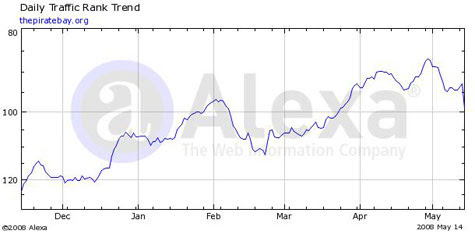
- The Pirate Bay devient l'un des 100 plus gros sites du monde... à partir de quand les considérera-t-on l'égal de Youtube ? The Pirate Bay Enters List of 100 Most Popular Webites
- Book Review : Microcosm
- Philippe Manœuvre veut dîner avec son « assassin »
- Hardcore gamer builds Chinese empire
- Tokyo Giants baseball food is beautiful
- de la lecture au-delà du livre
- Le blog de David Assouline commence à se faire (gentiment) taper dessus : L'impact des nouveaux media sur la jeunesse
- Anton Kannemeyer - The Alphabet of Democracy
- Iraq : BlogIraq is Dead
- Republicans fear Obama victory after polls shock
- L’Express pointe les techniques des "anti-anti OGM"
Les types de médias intégrés sur wordpress.com
"
La plateforme de blogs Wordpress.com publie toutes sortes de statistiques aussi bien sur les nouveaux utilisateurs, les pages vues… mais aussi sur la nature des médias intégrés comme les photos de flickr, photobucket ou les vidéos de youtube ou de google vidéo.
Les vidéos Youtube dominent mais pas autant que ce que je pensais. En effet, environ 4000 vidéos Youtube sont intégrées chaque jour sur les blogs de wordpress.com mais flickr et photobucket ne sont pas si loin que cela avec environ 3000 photos postées chaque jour pour chacune des deux plateformes. En revanche, google vidéo est bien à la traine avec une centaine de posts quotidiens…

Mark Evans a d'ailleurs calculé que flickr pourrait valoir quelques milliards de dollars actuellement compte tenu du trafic et du cash généré par les utilisateurs payants. Un investissement payant pour Yahoo donc!


Articles en rapport


 "
"Voir en ligne : Les types de médias intégrés sur wordpress.com
AOL-Bebo : $850M Deal Closes ; AOL Combines Bebo, AIM, ICQ Into People Networks Headed By Shields
"
 It's official—AOL (NYSE: TWX) now owns Bebo, closing the $850 million acquisition roughly two months after making it public. The social media network will not stand on its own; instead, AOL is combining Bebo, AIM, ICQ and its other community platforms into a new business unit known as the People Networks with some 80 million unduplicated users. Joanna Shields, who led the sale as president of Bebo, joins AOL as president of the new unit and corporate EVP. Shields (via video chat) and Grant spoke at our EconSM conference late last month but couldn't discuss detailed plans. They went deeper in a joint interview on the eve of the People Networks' announcement.
AOL's Platform-A will handle the new unit's advertising with the exception of an existing deal between Bebo and Yahoo (NSDQ: YHOO) for the UK, Ireland and Australia. As for international strategy, Shields told paidContent, "We're going to match AOL's international strategy throughout the rest of this year." On the ad side, "we'll be definitely leveraging assets of Platform-A for the expansion of Bebo." And what about branding? Could ICQ be rebranded? AOL president and COO Ron Grant said carefully: "We are committed to looking at what's the right brand for the right audience. We have unified the back end (of AIM and ICQ) to make sure the technology platform is unified and open." Bebo's deal with Yahoo is until September 2009, so it is likely that won't be renewed...this is Yahoo's only deal with a big social net: Google (NSDQ: GOOG) has MySpace and Microsoft (NSDQ: MSFT) has Facebook.
Some excerpts:
-- On the new unit: Grant still wasn't ready to go into detail about the financials of the new unit: "Clearly this will be a standalone unit with its revenue and profitability goals. We plan on providing more transparency." Shields pointed out that Bebo already is profitable and that the new unit is expected to start in the black.
-- On advertising: Grant: "Platform A will be the organization that will handle the advertising but we're very much going to be moving into the engagement marketing aspect that Joanna's built because we think it really provides a differentiator, not only from the content side but how it's sold." What happens with Yahoo? "I think we're evaluating our options. Right now they're our partner of record and we evaluating what the right next steps are. But we plan on looking at all our options in that situation. They're providing a fine service." Shields added: "In the U.S., we don't have a relationship with Yahoo ... The strength of the AIM user base in the U.S., that's going to be one of our top priorities as well as the international expansion."
-- On international plans: Shields: "We're behind the curve already. I'm not quite sure how long it will take us to catch up to them (AOL)." Bebo is strongest in the UK, weaker in the US. The immediate focus beyond the UK and US for Bebo will be Europe. But her new access to deeper resources may alter some of the roadmap: "I still haven't quite switched my brain from the scarcity world of a startup." Ideally, "I'd like to see Bebo as a social media network be able to say we're global and everywhere that's relevant." They'll be launching at least six different language sites.
-- Content: Shields says Bebo will continue as a social media network and will encourage original programming. Branded entertainment presented serially has worked well for Bebo. As for other content, "I'm very excited we don't have to go out and do the content partnerships."
Related
- @ EconSM: Interview: Ron Grant, President, AOL: Bebo Will Return Us To Our Roots
- @EconSM: AOL & Bebo; 'The Final Leg Of The Stool'
- Bebo Founders Will Make About $600 Million
- Interview: Joanna Shields, President, Bebo: AOL Was First Suitor; 'Attractive Bids'; Staffing Up
- Updated: Bebo's Revenue Numbers: Not So Big; AOL Paid 160 Times EBITDA: Report
- AOL-Bebo: Falco: 'Gamechanging For AOL'; Shields: Didn't Plan To Sell; Birches Out Of Picture
- AOL-Bebo: Links To Coverage Across Our Sites


Voir en ligne : AOL-Bebo: $850M Deal Closes; AOL Combines Bebo, AIM, ICQ Into People Networks Headed By Shields
Hedi Slimane’s Photoblog
"

You probably know who Hedi Slimane is — well, at least you know his work with fashion house Christian Dior. Hedi was the creative force behind men's Dior Homme collection from 2000 to 2007. Quitting last year to retain his creative freedom meant, among other things, starting a photoblog. If you like beautiful people, amazingly high-end fashion, Star Wars characters, wallpaper, drugged-out musicians and fireworks as much as we do then the appeal will be obvious. The blog doesn't have a RSS feed, which is a bit annoying, but it is a nice source of inspiring images from the man that defined the look of men's fashion for so many years.
Art, Design, Fashion, photography


 "
"Voir en ligne : Hedi Slimane’s Photoblog
Amazon Web Services far ahead of Amazon.com in Bandwidth consumption
"
Here is some food for thought on the Amazon Web Services Blog. We have graph showing how much bandwidth Amazon Web Services consumes compared to Amazon.com retail sites combined.


 "
"Voir en ligne : Amazon Web Services far ahead of Amazon.com in Bandwidth consumption
Propaganda looks at Echo. The next big project from Terry Moore
"
Echo # 1
Written and illustrated by Terry Moore

Echo is the new series from Terry Moore, much loved round these parts for his series Strangers In Paradise (link to the review of SiP). When that series ended many of us wondered what he was going to do next and although this technological chase thriller isn’t initially what we were expecting it is worth remembering that Terry always tried to put an element of a crime thriller throughout SiP.
Julie Martin is minding her own business in the desert, taking photographs of flowers when there’s a huge explosion above her and small metallic pellets rain from the sky. Julie’s unfortunate enough to be underneath the result of the murder of a woman test flying an experimental beta-suit. The woman, Annie, is on a routine test flight but quickly
realises that her employers;the PHI project have decided to test the suits limits and her life is completely expendable.
But the suit’s not just a flight suit. It’s also a tactical nuclear weapon, one that rains down from the skies following Annie’s murder. Each piece of the suit is a bomb, transformed by the explosion:
Or, as Foster, boss of the PHI Project explains to Genral Cade: “Clearly the viscoelasticity of the suit is similar to an inorganic polymer/ We may have just created the Thixotropic liquid of nuclear weaponary …. It appears the supercritical conditions of the explosion turned the suit into silly putty. Our one bomb … is now many.”
(In case you’re interested, Moore has got his use of Thixotropic substances pretty much right. link. Oh sad, sad me.)

(It’s raining …. thixotropic liquid bomblets. Doesn’t quite have the same ring to it does it? Art from Echo # 1 by Terry Moore.)
And this silly putty is what rains down from the sky onto Julie. Small balls of silvery bombness stick to her and her truck, and then, when she makes the mistake of picking up a larger piece, it bonds to her skin and the pellets migrate across her body to form a breastplate, complete with a symbol last seen on the destroyed beta-suit.
It’s too early to see which way Moore’s going with this, although it certainly looks like he’ll be pushing the thriller aspects of his SiP work more to the fore here. As for whether you’ll like it, I’d imagine that depends on your fondness for SiP. The art’s the same easy on the eye, big panel, simply laid out joy that SiP always was. I imagine that he’ll add more characters and expand on their background in time. The fascinating thing about Echo and SiP is Moore’s affinity for female characters, he obviously feels very comfortable writing them. And, judging on the responses we used to get at my old shop, Nostalgia & Comics, it’s obvious that they’re well written enough to appeal to a large female audience.

(Can Echo repeat the incredible success and incredibly wide - and real mainstream - appeal that Strangers in Paradise achieved? We wait and see. Cover to Strangers in Paradise Volume 1 by Terry Moore)
I thought Echo was an interesting and intriguing start to a series and I’ll be picking up the next few issues to see how it develops. He’s not doing anything radically different here, but that was never what Terry Moore was about. SiP was great because Terry wrote believable yet fun characters and made you care deeply about what they were going through. My faith in him is such that I can pretty much guarantee that the same will be true of Echo.
Richard Bruton is a lifelong comics fan and former Comic Book Store Guy; you can read more of his thoughts on comics and life on his blog Fictions.
Voir en ligne : Propaganda looks at Echo. The next big project from Terry Moore
CAPTCHA Paintings by Becky Stern
"

Becky Stern at the Free Art and Technology Lab (FAT) makes beautiful paintings of CAPTCHAs, which she sells on Etsy.
photo by Becky Stern
 "
"Voir en ligne : CAPTCHA Paintings by Becky Stern
The tech blogosphere is a closed circle feeding on itself
"
 Those of us in the tech blogosphere forever seem to have a high opinion of ourselves and our thoughts. We continually pontificate on how what we are doing is going to change the world. We are forever coming up with cutesy phrases and buzz words of how we have discovered a new way to spread the word of technology. It might be fancy terms like Data Portability that really is nothing more than ways for the established high valued players to fill in the chinks that are developing in the walls of their silos. Or then there is the whole idea of social media that actually has nothing to do with make our real social interaction anything more than electronic patting on the back,
As Adam Ostrow said recently on Mashable when he was talking about Data Portability:
Not quite. At first, it seemed like Data Portability was a lot of hot air, with everyone scrambling to put out a press release and associate themselves with “the open Web,” but offering little in the way of specific plans. But then last week, MySpace announced Data Availability. Finally, there was a real implementation of Data Portability on the horizon, that out of the gates promised us integration with Yahoo, eBay, Photobucket, and Twitter. But then, Facebook announced Facebook Connect. And then, Google announced Friend Connect. Facebook then decided it didn’t like Friend Connect and blocked it. So much for that idea. There’s a word to describe this, and that word begins with cluster and rhymes with duck.
Then there is this whole internal buzz within the blogosphere of how social media is going to be the big game changer when in fact all it is doing is creating a new buzz word for things that have been around for as long as computers have been able to talk to each other. It is just a revamped proxy for non-personal; or rather faux personal communication. Sure things like blogs and social networks might have old media running scared but even as Michael Arrington pointed out on TechCrunch this Data Portability is just a whole new set of walled gardens.
Then through all this we have the ongoing discussion about how noisy courtesy of things like FriendFeed, Twitter and Facebook the whole tech blogosphere has become. Funnily enough this appears to be only afflicting the tech blogosphere as it seems from what I have read elsewhere things like the political or lifestyle blogs have had a better acceptance factor outside of the blogosphere as a whole. For us we seem to be spending more time bickering about noise, made up concepts like data portability and social media than we are about Matters like some web service hitting the illusionary line of mainstream seem to be more important than real discussions about society and it being changed by technology.
We bicker about who broke the news over a tidal wave and earthquake instead of making true social changes to our society. Social media is suppose to be the game changer for old media forcing it to join the rest of the world in this new user generated world that does nothing more than to make a small group continually richer. Instead we seem to be finding ourselves locked away in silos where the talk is nothing about using technology to change our society. Rather we seem to be spending more and more time propagating the illusion that what we are talking about is important.
The fact is that all these discussion aren’t making any changes to our society. As Sara Perez points out in a post on ReadWriteWeb where we are more concerned with all the tools at our disposal; which in turn only increase a limited number of tool providers market evaluation, instead of using the incredible power of numbers to force real change.
Much is made of the generation who has grown up with the Internet and all these services and how they could be the ones to use all these tools to make changes to our society. However both Sarah in ReadWriteWeb and Corvida from SheGeeks show in two different post just how much of this idea is not much more than bullshit and marketing spin for the corporations behind the whole Web 2.0 movement.
While it is nice to see people get all warm and fuzzy about disasters a world away and plugging for donations it means nothing as long as we have people in our own country living in their cars or cardboard boxes. Social media doesn’t mean squat when we see our education system sliding down to the point where it can be ranked with third world countries. Freedom of information on a world wide basis doesn’t mean a rat’s ass as long as the very gateways to the information are being blocked by corporations more concerned with executives earning 255% more than the average worker.
Until social media means something more than Katrina victims  abandoned by their government and any changes affect the very society that is being left on the have not side of the technological divide all this talk is nothing more than a giant circle jerk trying to see who’s ego can fly the furthest.
A noisy internet means squat when your child goes to bed with a gnawing hole in their gut. Data Portability isn’t worth llama spit when the working poor have to decide between food on the table or insurance on their vehicle so they can keep trying to see the other side of the poverty line.
Don’t tell me how all this technology is going to change our world when the poorer get poorer and the rich get richer off of user generated content. So as you go to all your fancy tech conferences full of your own egos ask yourself - just how much of a change is this freenomics of yet another useless social network or twitpitch doing to really make this a better world. Or is it really just a matter of joining the ranks of the super rich.
Conversation Tags: social media, social networks, homelessness


 "
"Voir en ligne : The tech blogosphere is a closed circle feeding on itself
Google China’s Extended Earthquake Help
"
Google China has launched a multitude of help efforts for people looking for information in relation to the disastrous May 12th earthquake centered in Sichuan province. Some days ago, the Google China homepage linked to a special Google Maps layer, as previously mentioned:

Google China also shows a custom search engine, made for the purpose of looking for relatives (qin ren). The Google Custom Search Engines service is part of Google’s Co-op initiative:
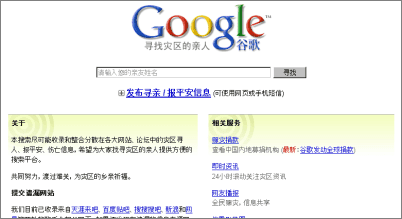
The link from the Google homepage has now been changed to this custom search engine:

Google partner Tianya also allows discussion of the incident at their Lai Ba community (to what extent fully open discussion is possible on partly moderated Lai Ba I don’t know):

Accompanying this, Google launched a multitude of advertisements in Google results pointing to these services. There are ads for the maps layer, the custom search engine, and the Tianya community, when entering queries like 四川 (Sichuan), China earthquake and more:


Additional to the advertisements, Google is showing a special alert onebox linking out to the custom search engine, the maps layer, Google News results, and several other search types like blog search or video search:

Google.com and Google.cn also put up a donations page using Google’s payment system Checkout; this page also links out to other efforts, like the maps layer and a Google Earth layer. Google on this page also state that they will donate $2 million themselves:

Now, some people thought Google utilized the situation to promote their own products – the owner of a site dedicated to provide Chinese translations of Google Blogoscoped in a translation last week argued that (if I understand it right) Google’s homepage actions felt “cold blooded.” For those who read the translation I wanted to note I did not make or imply any judgment on the situation, and did not say these things; their blog has already added a correction to clarify this, with thanks to their helpful and dedicated team of translators (their team is located all over the world and provides many translations in their spare time). Kai-Fu Lee, President of Google Greater China, contacted us over this as well. He lists the different services Google rolled out in this situation and says many Chinese Google employees have been “working all night” on these.
The Chinese Google employees, Kai-Fu argues, “have been the most dedicated and passionate people I have ever worked with. I am proud to be working among them. But I am very saddened to see the hard work they put in not recognized, and even attacked.” He adds: “At a difficult time like this, I hope we can all turn our anxiety and sadness into real contributions”.
As an example of the kind of work Google China’s employees recently undertook, Kai-Fu tells how the Google custom search engine (CSE) came about:
<<[Engineering lead Harry Ke] and two other engineers came up with the idea of helping people search for lost relatives or friends. Given there are >20,000 dead, tens of thousands still trapped, and some 200,000 wounded, and many more homeless. Also, cell phone and land lines are mostly not working. Transportation is difficult because the disaster area is on mountains and valleys. So, there are many people frantically looking for lost relatives and friends.
The engineers idea was to use CSE, and add URLs of all the sites, discussion groups, tables, hospital websites, etc.... anywhere there are names of people who might be found, alive, wounded, or dead. The CSE would just report results based on these sites. A big issue is where to find all these websites, so we mobilized about 100 (...) of our employees to look everywhere for content and enter them.
We also allowed users to submit their input to us. And we included discussion groups for everybody, including our competitor’s, as possible places for them to submit input.>>
Kai-Fu says that Google ran into some problems as some sites were not crawled often enough by Google’s crawlers – when these sites were small, the Google team had volunteers do crawling by hand.
Update: Google China is now showing a black and white logo on their homepage. Yahoo China and Chinese search engine Baidu, among others, show gray-scale images as well. A note from google.cn is linked to help contact information, containing support numbers and addresses of charities. The note reads “2008年5月12日14时28分 - 让我们永远铭记这一刻,愿逝者安息,生者坚强”, which as far as we are able to tell translates to “May 12, 2008, 14:28 - Let us always remember this moment, may the deceased rest in peace, and the living be strong.”

[Thanks Xujie, S. and Jansen.]
[By Philipp Lenssen | Origin: Google China's Extended Earthquake Help | Comments]
[Advertisement] Want to advertise here? Your ad will show in the blog and feed.
 "
"Voir en ligne : Google China's Extended Earthquake Help
L'impact des nouveaux media sur la jeunesse
"
C'est l'objet d'une mission du sénateur David Assouline, et du blog associé. Notre sénateur est bien seul, et ne reçoit pas de commentaires. Peut-être ya-t-il moyen de l'aider ?
A la lecture des premiers billets, ce serait sans doute utile. Sous l'intitulé très généraliste, le sénateur développe une vision très sécuritaire du sujet. Comme si l'objectif de compréhension affichée de l'impact des nouveaux media sur la jeunesse ne se traduisait que dans le domaine de la pornographie et de la violence (sans parler du specte éternel de la pédophilie). Prismes un peu atterrants : peut-on aussi suggérer au sénateur de comprendre mieux comment se fait cette sociabilité, avant de songer au débat éternel (et de manière ingénue) sur les modes de contrôle possible ?
Allez, un indice. Lire cet article (PDF), déjà. Et aller au delà du blog : rencontrer des jeunes et comprendre ce qui se passe dans leurs usages (ou interroger quelques sociologues qui se sont penchés sur la question.
Voir en ligne : L'impact des nouveaux media sur la jeunesse
Why FriendFeed will go mainstream (Part II)
"
In the first part of this two-post series you read my ideas on why FriendFeed won’t go mainstream. In this part I get to answer why it will go mainstream.
First, something funny: Thomas Hawk just posted this to FriendFeed: ““Things in life that are addictive: digital photography, Flickr, Tommy’s cheeseburgers, those tangy sea salt and vinegar blue chips in the blue bag, coffee, Red Bull, and friendfeed.”” Of course that started a conversation.
So, why is FriendFeed going to go mainstream:
1. The team. Among the seven people who are currently working on FriendFeed is the guy who gave Google it’s “don’t be evil” tag and who wrote Gmail. Another guy on the team did Google Maps. Yet other people on the team did impressive things. This team will be unhappy with themselves if they just get me and Thomas Hawk and Louis Gray to use it. They are building something from the bottom up to be used by millions of people.
2. Them who owns a unique database will be able to build value. FriendFeed knows every item that’s been commented on and is building a database of interesting other stuff too.
3. By aggregating all social software sites together they are getting a database that’ll let them build a search service that’ll be very interesting (and already is to me — I already go there at least 20% of the time I want to find something or someone).
4. Their UI sucks and is brilliant at the same time. In the old post you read how it sucks. In this post look at what’s brilliant about it. First, it’s always fast. You gotta watch this video with Kevin Fox, interaction designer at FriendFeed, to get his philosophy behind building UIs. Think he doesn’t know crap about design? Go read his resume (PDF), he designed Gmail 1.0, Google Calendar 1.0, and Google Reader 2.0.
5. It is freaking fast and much more reliable than Twitter. Today I’ve been putting dozens of Tweets into Twitter and they show up in FriendFeed BEFORE I can refresh the page. It is amazingly fast at gathering new stuff from Twitter. I have not found any other service as reliably fast.
6. It’s very flexible. For instance, check out these links:
- Everyone who has shared an item on Google Reader.
- Everyone who has shared a song on Last.fm. or on iLike.
- Everyone who has Tweeted on Twitter (do a test and see how fast yours shows up there).
- Everyone who has shared a video on YouTube.
- Everyone who has written a blog post.
- Everyone who has put, or favorited, a photo on Flickr. On SmugMug. On Picasa.
- Everyone who has posted something on FriendFeed itself (link or a note).
- Everyone who has shared an event on Upcoming.
- Everyone who has bookmarked an item on Del.icio.us.
Those are just a sample of the things you can search on. Just visit the advanced search and select the servce you want
7. FriendFeed is a place where you can study people’s gestures and signals. Huh? Well, when I “like” something in FriendFeed it means I found it to be interesting and not just pure noise. When I comment on something it means I found it important enough to engage with. You can see items I’ve commented on, items I’ve liked, and both of them added together. You can also do that for everyone on FriendFeed.
8. If you want to watch everything your kids are doing, you’ve got to follow them around multiple services. That takes too much time. It’s far easier for your kids to just say “follow me on FriendFeed.”
9. The most interesting early adopters and smart people have already signed up so you can track them. Here’s just a small sample:
- Singer Samantha Murphy.
- Presidential candidate Barack Obama.
- Open source developer (did bleeding edge work at BBC, now doing projects at MySpace) Ben Metcalfe.
- Venture Capitalist Brad Feld (guy behind NewsGator and others).
- Google exec Bradley Horowitz (while at Yahoo he spearheaded purchase of Flickr, Delicious, and others).
- Dave Morin, head of Facebook’s application platform.
- Gary Vaynerchuk, owns a wine store in New Jersey that sells $50 million a year and does WineLibrary.tv
- Joi Ito, head of Creative Commons.
- Joshua Schacter, founder of Delicious.
I could keep going, but gotta run to catch a plane to New York.
So, which way are you heading? Is FriendFeed going to be an epic fail? Or the best thing since Facebook?
What did I miss on either side of this argument?
UPDATE: the conversation is already underway on FriendFeed here.


Voir en ligne : Why FriendFeed will go mainstream (Part II)
Privacy ? Forget it. Sell your brain and desires to the highest bidder
"
Web $9.95
Comment All around us the toasters are getting smarter. Sadly, we don't seem to be keeping up with the program. We remain poor schlubs.…
"Voir en ligne : Privacy? Forget it. Sell your brain and desires to the highest bidder
Pew Internet Finds Web Has Little Effect On Purchasing
"

Contrary to what many Mashable readers might think, it seems a surprisingly small percentage of people research purchases online. Fewer still let it information on the Internet influence their buying decisions.
The results of a study by the Pew Internet & American Life Project have been released, and it was found that people are not using the Internet in quite the fashion we’ve all assumed. Using music purchases as an example, 83% of respondents said they still discovered new music by way of radio broadcasts, and 64% through conversation with friends/family and co-workers, while 56% found new music from going to various online tools like an artist’s website and listening to it on streams. Of course, seeing as the results are published on information pooled between August 3 and September 5, 2007 among a sample of 2400 adults age 18 or older, that specific data set may not be particularly accurate. But if we’re ballparking, Web streams and digital downloads from iTunes, Amazon MP3, eMusic, and others still clearly have much room to grow.

The study also goes on to say that of the people who purchased music in the past year, only 7% found online factored into their purchases, while 10% of cell phone buyers and 11% home buyers/renters shared the sentiment.
In a similar vein, Steven Musil of CNET points out a study conducted by Parks Associates that found that 30% of people have never written or sent an email. Mind you, Parks discloses that over half of these people polled were over the age of 65, and of those, 56% had no formal education, which speaks more to the digital age divide than anything else. Nonetheless a fascinating number.
As time goes on, we will probably see the number of people making purchases and performing serious purchasing on the Internet as a whole, and suffice to say that the number of people familiar with email correspondence is sure increase greatly in the next 5-10 years.

---
Related Articles at Mashable! - The Social Networking Blog:
The Daily Poll: Would Microsoft/Yahoo be Bad for the Internet?
The Daily Poll: Should Australia Filter Pornographic Content?
The Daily Poll: If Digg Gets Acquired, Users Will …
The Daily Poll: Catching Up Socially
Editorial Poll: Which Type of Web Startups Interest You The Most?
The Daily Poll: What Was Your First Web Browser?
The Daily Poll: The Politics of Facebook


Voir en ligne : Pew Internet Finds Web Has Little Effect On Purchasing
Facebook France : Le cap des 2 millions vient d’être dépassé !
"

Facebook compte désormais +2 millions de membres français, un cap certes symbolique mais preuve que le réseau social, au delà du simple buzz/effet de mode, continue sa croissance et continue encore à attirer de plus en plus d’utilisateurs.


 "
"Voir en ligne : Facebook France: Le cap des 2 millions vient d’être dépassé !
Why FriendFeed won’t go mainstream (Part I)
"
Robert Blum got me to call him an idiot because of this Tweet: “FriendFeed only helps if you’re dedicating your life to following yet another web site.”
Chris Saad took the conversation in a different direction with this Tweet: “discussion should occur around the target object - if its a blog then in the comments - not on friendfeed.” Which, of course, got this conversation going.
That got Mobile Jones to agree with Chris Saad on this Tweet: “Chris is on the right end of this. FF is like is not in the best interests of those who create the content.” Which, of course, got this conversation going.
Rob LaGesse wrote a whole blog post about how he thinks FriendFeed is ugly: “The service is ugly (to me). It has all kinds of crap I don’t care about in my feed.” Of course that got this conversation going.
Mark Evans goes even further and says he just can’t deal with anything else that’ll steal his attention. Of course that started a conversation over on FriendFeed too.
And to put punctuation on this whole story, Corida and others talk about the noise on FriendFeed.
All of these get to the heart of why FriendFeed won’t go anywhere other than to early adopter communities who like lots of noise.
I’ve studied tons of people’s reactions to FriendFeed. Here’s why it won’t go mainstream:
1. Only early adopters care about gluing together various social networks like I do (look at the right side of my blog, for instance, and you’ll see travel and schedule and events and photos and videos and more all glued together). Most people aren’t on more than one or two services and aren’t content creators (of everyone on Upcoming.org, for instance, only a handful of people have more than 5 events and most have none).
2. Normal people (ie, those who aren’t on Twitter 18 hours a day) don’t like noise. Even on Twitter, what’s the number one thing I hear from followers? “You’re too noisy.” FriendFeed brings tons of new noise to normal people, especially if they add a bunch of the friends that FriendFeed recommends (I’m one of them, but the others on that list are among the noisiest people on the Internet). For normal people they can’t handle the noise. It’s chaotic, confusing, and until they figure out the “hide” link they will get turned off. Usually when unpassionate or late adopter types get turned off they just hit the back button.
3. There isn’t one method of using these services. Some people just want to see their closest friend’s baby photos. Other people, like me, want to use these services like a chat room to talk with large numbers of people about today’s hottest news. This disconnect pisses both of us off and makes it less likely I’ll tell “normal users” about these services. Of course anyone who reads my blog isn’t normal, so I don’t mind telling you all about these things incessantly. :-)
4. FriendFeed is frustrating to use even for advanced users. Here, quickly, tell me how you can see only Flickr photos on FriendFeed and block everything else. Hint: there is a way, it’s just hard to find. How about, quickly again, tell me how to see all posts that have a comment or a “like” on them. Sorry, that one isn’t possible yet. How about find me all posts from everyone that mentions the word “noise” in them? Yes, that one is possible, but to do it you gotta get acquainted with FF’s advanced search features. At Microsoft we learned no one ever uses those features. Have you figured out how to hide all Twitter messages that don’t have a comment on them yet? It’s possible too, but you gotta click on the Hide feature and play around. Frustrating, frustrating, frustrating.
5. FriendFeed doesn’t work well on mobile phones. Most people around the world use their mobile phones far more often than they use their laptops. So, if you don’t have good mobile phone interfaces you can kick your going mainstream dreams in the toilet.
6. Want to find some new friends? The recommended friends feature is pretty cool (albeit frustrating to find) but the problem is you can’t figure out why it is presenting the friends it is (hint: it presents the most popular users up front. These are the most noisy users on the service and probably are pretty geeky to boot. People like me, Dave Winer, Louis Gray, Michael Arrington, etc).
7. I can’t add new services easily. Qik, for instance, is among my most favorite data type. But how do I get that added? Oh, I gotta add an RSS feed for services that aren’t already in the system. But then the videos don’t look as nice as, say, YouTube’s or Flickr’s. That’s disappointing.
8. It pisses bloggers off because all their comments are moving onto FriendFeed rather than staying on their blogs. Watch this post, I bet I get more comments over on FriendFeed than here. Now this one does NOT piss me off. I don’t really care where you talk about my ideas and I’ll go wherever the audience goes (which is why I often commented on other people’s blogs). But they do have a point. It’d be nice if bloggers got warned when a conversation was happening about what they wrote and if there were an easy way to join FriendFeed comments and conversations into their own blog commenting systems. When bloggers get pissed off they tend to talk less about new services, which retards their ability to go mainstream.
9. Comments get fragmented, even inside FriendFeed. Why? Well, let’s say you write a really great blog post. You’ll get shared on tons of people’s Google Reader shared feeds. Some comments happen on Louis Gray’s FriendFeed. Some happen on mine. Others happen on Thomas Hawk’s. Still others happen on other people’s feeds. Everyone has their own audience which gets involved and now we have duplicate items all over the place (noise, and not the fun kind) and comment fragmentation.
Well, that’s enough. There’s more, but these are the biggies, I think. Got any other reasons why FriendFeed won’t go mainstream? You know where to leave a comment. I’ll be watching for it.
This is part I. In second part I’ll explain why FriendFeed will go mainstream.


Voir en ligne : Why FriendFeed won’t go mainstream (Part I)
The Hyperconnected vs. 84% of Everyone Else on Earth
"
Two studies that crossed my screen tonight here in London point to a widening digital divide. I am not referring to the gap between those who are online and everyone else. The gulf I am addressing here is between those who are fully engaged with the web and, well, Earth.
The first piece of research from Parks Associates (via Dwight Silverman and CNET) reveals that one-fifth of all U.S. heads-of-household have never used e-mail. Based on the conversations I had in Europe this past week, this is even more pronounced outside the US where high mobile penetration makes things a bit more complicated to track.
Meanwhile, a separate white paper from IDC/Nortel (via Jackie Huba) - this one spanning 17 countries - found that 16% of the information workforce is already "Hyperconnected" and that another 36% will be joining us soon. Definitely download the PDF. It's an interesting read.

Source: IDC/Nortel White Paper - The Hyperconnected: Here They Come!
All of this data is consistent with what Charlene Li and Josh Bernoff talk about extensively in their new book, Groundswell. If you play with Forrester's Technographic profile tool, you can zero in on just how wide the divide is within your target audience. They peg 52% of the US online population as largely passive.
Net, this leaves me convinced that despite all of the buzz around the growth of new media and/or digital advertising, neither will replace existing modalities for some time to come. Yes, Scoble, that's why Google News still rules. Digital media is going to be additive in the near to medium term. However, in a decade - perhaps sooner, perhaps later - it will be a different story.
The data bodes well for businesses like the TV nets that live off the 30-second spot. Some have written the :30 off for dead. However, that's a bit premature.
The challenge for traditional media companies and the advertising ecosystem that support them is that static advertising is no longer a growth businesses. This will become particularly true as the number of Hyperconnected skyrocket. However, for now, old still co-exists with new.
The takeaway for marketers is to utilize all of the relevant venues/tactics as part of a comprehensive marketing strategy (the same goes for PR). Ignoring something because it's old school doesn't always make sense.


 "
"Voir en ligne : The Hyperconnected vs. 84% of Everyone Else on Earth
Why Google News has no noise
"
I’m a noise junkie. I used to be a news junkie, but I’ve hung out with the world’s top journalists enough now to see that the good ones are noise junkies. They are the types that head into a crowded party and listen to pitch after pitch (noise) and drunken story after drunken story (noise) to find something that their audiences will find interesting (news). I’m not the only one who likes the noise: Hutch Carpenter defends the noise too.
Last year I got a tour of the Wall Street Journal’s West Coast printing plant. They print 60,000 copies an hour. At the end of the tour the head pressman said “I’ve been reading this six hours before you did for more than 15 years now and it hasn’t helped yet.” Why? Cause the news isn’t where the action is: the high value bits are stuck in the noise.
I’ve been studying noise and news now for quite a while. I’ve been wondering why sites like Google News and TechMeme have no, or little, noise? Tomorrow I’ll tour the New York Times headquarters in New York to pick up even more tips of how they make sure noise doesn’t sneak onto its pages.
First, let’s do a little definition of the difference between news and noise. The noise examples were pulled off of Twitter in the past few minutes.
NEWS: tens of thousands dead in China quake.
NOISE: BrianGreene: some pirate is playing old radio nova tapes on 92FM dublin, with old jingles and old ads. adverts for rent a 20″ TV 48p a day (48 pence!)
NEWS: Janitors go on strike.
NOISE: flawlesswalrus: @craigmod Iron Man’s fun times. Enjoy!
NEWS: Facebook blocks Google
NOISE: dmkanter: organizing my igoogle homepage
So, how come services like Twitter and FriendFeed have so much noise? Who likes the noise? Who likes the news?
I like the noise. Why? Because I can see patterns before anyone else. I saw the Chinese earthquake happening 45 minutes before Google News reported it. Why? Because I was watching the noise, not the news.
Let me ask you something. Do you think Walt Mossberg will wake up tomorrow and worry about what’s on TechMeme or Google News, or will he sit through yet another boring PR pitch from some gadget company trying to find something unique to tell his readers?
The news is in the noise. Which is why Twitter is crack for newsmakers. There’s no better place to find noise, er news, than on Twitter. Even on FriendFeed there’s less noise than there is on Twitter (if you subscribe to both). Why? Because of the “Hide” link and clustering. I can put 156 Tweets in my Twitter follower’s faces, blocking all other Twitterers from getting to their pages. But on FriendFeed? All my Tweets are clustered together and blocked from view unless you expand them to read them all.
So, anyway, how does Google News and Techmeme keep the noise from hitting their pages?
Google News: Only tracks sites that have “teams” of people working on them. That usually means there’s an organized effort. That alone blocks 99.9% of bloggers and Twitterers from even being considered.
TechMeme: requires multiple “votes” by an elite to get on the page. Even a link from TechCrunch (which is the #1 “voter” on TechMeme) won’t get you onto Techmeme. You’ve gotta have something else to go with that link.
Google News: the more “big city newspapers and news sources” that cover something, the more likely that story will get to the home page.
TechMeme: watches signaling from key members on Twitter and Google Reader. If enough people who are on the TechMeme Leaderboard Twitter and share an item on Google Reader you’ll see the item pulled onto the page.
Both Google News and Techmeme: only stuff in past 24 hours gets onto the page.
What differentiates Techmeme and Google News? Google News only considers news from news teams (mostly, only a few blogs are there among hundreds of thousands of newspapers, TV stations, magazines, and news blogs like Huffington Post). Techmeme? Looks at Twitter and Google Reader for signaling mechanisms (what news is getting hot) but mostly considers blog posts and professional journalism that have gotten the attention of a limited number of “elite” bloggers/journalists. Techmeme gets news from sources that aren’t always professionally run sites, which is the biggest differentiator. Techmeme could be said to have more noise than Google News, which is what makes it more interesting than Google News — to me. To my dad? I bet he’d like Google News better because it only has news, no noise.
The problem with both Google News and Techmeme? New ideas and new people won’t get onto the page easily. You have to convince multiple people who control these sites that your stuff is important. In Google News’ case you’ll probably have to publish your news on a site that already is added to Google News’ database. That’s one reason why I see Dave Winer’s stuff only when he writes for Huffington Post show up there. Convincing someone like Huffington Post that you’re important enough to publish is pretty hard and takes building up a reputation and an audience of your own.
If you’re looking for new faces and new conversations that haven’t yet gotten to be important enough to get onto Google News or Techmeme, then FriendFeed and Twitter are far better places to hang out.
Getting on TechMeme? You better convince someone near the top of the TechMeme leader board (getting me to link to you doesn’t really matter unless someone in the top five also links to you) to talk about you and link to you. That’s really hard. Why? Cause we don’t agree on what’s important. You can see that come out in last Friday’s Gillmor Gang. Heck, we’re yelling at each other on the phone. You think we’re going to decide to link to you? Hah!
I know Google News and TechMeme will get more of a mainstream audience because all they report is news, but excuse me if I spend a lot more time over on Twitter and FriendFeed swimming in the noise.


Voir en ligne : Why Google News has no noise
FriendFeed only adds to the noise under a key assumption
"
ReadWriteWeb’s recent piece “Don’t Be So Naive: FriendFeed Adds to the Noise” writer Corvida tried to put to bed the ongoing argument of whether or not FriendFeed adds to the “noise” of the internet conversation or not. RWW, while conceding that it added to the conversation, came firmly down on the side that it clearly was a noise polluter.
From the RWW post:
There are dozens of ways that Friendfeed adds to the noise. For one, it pulls in one of the noisiest services out there: Twitter. At least 10% of Twitter streams have much to do about nothing and filtering out this noise is hard to do on FriendFeed. Secondly, for those that don’t entertain certain services that FriendFeed aggregates, that’s extra noise.
The Noise Argument Rests on One Key Assumption
This noise argument for sites like Twitter and FriendFeed are based on one (often unmentioned) tenant that the users of these services know what they are looking for on the Web. The premise that users of Twitter or FriendFeed have a known result or conversation that they are searching for through the noise is implicit in the noise argument. You must have a signal you’re trying to find in all of that noise for there to be a difference, right?
This is a flawed assumption. I would argue that many of the users of FriendFeed and Twitter are not using it simply to keep track of the signal from their friends but also to learn and find what is not currently known to them. They use it to cast a wider net on the conversation of the Web, to put out bigger receivers - to capture more information in hopes of finding what is interesting to them. In this mode of searching for the unknown there is no distinction from signal and noise because that distinction is not made until the information is processed by the user.
To me the information flowing at me from FriendFeed and Twitter is not noise but opportunity to learn more, to learn something currently unknown to me, to be thrust further in to a conversation or experience or area of knowledge. I cannot judge what is noise and what is signal because I have no reference point to the new and unknown information.
For Known Information the Opposite is True
The opposite remains true - that if you’re trying to follow a known conversation or track down known information or follow a known data stream it makes it harder to separate the noise from the signal; however the default argument should not rest on the premise that all users of the service are seeking out a known signal.
In the end it comes down to your vantage point - whether you’re in the “known” or “unknown” category - but arguments over whether the service creates more noise then become moot as each user’s mileage will vary based on the camp they fall in.
What do you think?
"
Voir en ligne : FriendFeed only adds to the noise under a key assumption
Social Networking map of the world
"

A visualization of the purported marketshare of various online social networking services. It's super interesting, but incomplete: I wonder where the data on China is? Click for larger size. From Le Monde, via Azeem Azar on twitter, via Tim O'Reilly's blog. (thanks Jolon Bankey!)


 "
"Voir en ligne : Social Networking map of the world
Hardcore gamer builds Chinese empire
"
Filed under: Fantasy, Business models, News items, Zhengtu Online

In the months leading up to the Summer Olympics in Beijing, with world events being what they are, it's not often that foreigners residing in the mainland turn to China Daily's English pages for the news. This little gem is an exception, however. When you picture the man who's fast becoming a leading light in China's expanding online gaming industry, who do you see?
Maybe you picture a slick twenty-something entrepreneur from Hong Kong, decked out in a $5000 suit and shuffling between calls on a few wafer-thin cell phones. Or do you envision a middle-aged bureaucrat turned businessman from Beijing, using his network of connections and riding the tide of interest in online games? Stereotypes aside, no matter how you picture Shi Yuzhu, that aforementioned 'leading light,' you're probably wrong. The 46-year-old CEO of Giant Interactive (NYSE: GA) is more outwardly eccentric than most would guess. Shi, who prefers tracksuits over 3-piece-suits, is reportedly the first CEO ever to ring the NYSE bell in anything but formal attire... much less athletic wear.
Continue reading Hardcore gamer builds Chinese empire
Read | Permalink | Email this | Linking Blogs | Comments
 "
"Voir en ligne : Hardcore gamer builds Chinese empire
L’Express pointe les techniques des "anti-anti OGM"
"L'Express pointe les techniques des "anti-anti OGM"
Les visiteurs de mon Blog auront constaté sans mal (!) que deux ou trois internautes particulièrement motivés "polluent" mon Blog, pour reprendre le titre d'un article de l'Express que j'invite à lire, car il en dit long sur les techniques de ceux qui in fine défendent les intérêts de Monsanto:
www.lexpress.fr/info/societe/dossier/ecologie/actu.asp
De cet article, je retiens ce passage concernant l'un de mes détracteurs professionnels, un certain Gil Rivière-Wekstein, de "Agricuture-environnement":
"Le site, actif il y a encore quelques jours, semble connaître des problèmes techniques. Son auteur, dont Le Canard pointait les antécédents en matière "d'intelligence économique", répondait il y a quelques semaines à nos questions. Se disant notamment "perplexe" à propos du documentaire de Marie-Monique Robin Le Monde selon Monsanto, il notait: "
La réalisatrice y décrit un monde imaginaire, où tout n’est que complot. Elle s’appuie sur des études soi-disant scientifiques et sur des prétendus spécialistes qu’elle ne cite même pas".
Difficile d'être de plus mauvaise foi: le documentaire de Marie-Monique Robin, tout comme son livre, est au contraire truffé de références, un modèle du genre (ce que l'on peut vérifier sur le site d'Arte)! Les témoins des deux "camps" -agriculteurs, scientifiques, membres de la Food and Drug administration, l'instance qui a facilité la mise sur le marché des OGM aux Etats-Unis, industriels- sont tous cités, la plupart interviewés, et la réalisatrice indique ses sources, notamment sur Internet..."
J'en profite pour rappeler que la firme de Saint Louis a recours une agence de communication américaine, le groupe Bivings, qui s'est spécialisée dans le marketing viral.
C'est ce que j'explique dans un commentaire intitulé "appel à la vigilance" que l'on peut consulter sur mon Blog , dans la rubrique" des nouvelles de la toile".
Enfin, j'ai reçu plusieurs mails me demandant pourquoi je ne supprimais pas les messages des "Zobi" , "Anton", ou "Ruuyjin" qui font partie des "pollueurs" les plus tenaces. Je redis ce que j'ai déjà écrit sur mon Blog: Non! Laissons les s'exprimer!!
"
Voir en ligne : L'Express pointe les techniques des "anti-anti OGM"
Reuters Launches Calais 2.0 - Now With Pop-Culture
"
 Thomson Reuters' Calais, a semantic markup API that we first reviewed in February, has reached its 2.0 release. The latest version aims to fix one of the main issues with Calais -- that it was too focused on business. Because Calais has roots as Clearforest, the rules it applies while parsing text are biased toward the language of business, which meant that its utility was limited. Version 2.0 has added new semantic entity types in an effort to rectify that.
Calais 2.0 has a dozen new semantic entity types, which Reuters says will increase its utility for "pop-culture publishers and bloggers covering media, music, entertainment and sports, as well as those covering pharmaceuticals, medicine and healthcare." In addition to expanded semantic identification capabilities, Calais 2.0 can now prints results in the Simple Tags format and Microformats, as well as the original RDF.
More than 3,200 developers have signed up to work with Calais since launch, according to product lead Thomas Tague, who said in a press release that Calais and plugins and services built on the API will "make it easy to kick-start metatagging and enter the era of the Semantic Web."
Along with an updated web site, a handful of new code samples and libraries, Thomson Reuters is announcing three new plugins that utilize Calais.
- Calais Marmoset is a tool that enables developers to automatically create metadata for use with Yahoo!'s open search platform, Search Monkey (our coverage).
 Calais is also announcing the official release of Tagaroo, a Wordpress plugin that allows bloggers to automatically tag relevant people, places and things in their posts, as well as pull in semantically relevant Flickr photos. We wrote recently about an unofficial Wordpress plugin for Calais, and noted that its utility would be limited mainly to business and tech bloggers because those were the API's strengths. Calais 2.0 should theoretically improve the utility for both plugins for a wider variety of bloggers.
- Though they've been out since last month, Thomson Reuters is also officially introducing their Calais plugins for Drupal, a popular content management system, that it developed with Phase2Technology.
Calais is an awesome top-down semantic API that can help fuel the bottom-up approach by combing unstructured data and spitting out structured tags. We're excited for the second version of Reuters' product and the added utility that new semantic entity types should bring.


 "
"Voir en ligne : Reuters Launches Calais 2.0 - Now With Pop-Culture
Tokyo Giants baseball food is beautiful
"

Check out the beautifully prepared box-meals served at Tokyo Giants baseball games, including a hamburger bun branded with a bold serif number one.
Link
(via TokyoMango)


 "
"Voir en ligne : Tokyo Giants baseball food is beautiful
It’s Not The Data, It’s The Flow
"
My partner Brad and I were having lunch with Umair a couple months ago and we were talking about how we look for a unique data asset in all of our investments. And Umair scratched his head and said something like, "I don't think it's the data that's so valuable, it's the flow of the data through the service."
Longtime readers know that I think Umair is one of the great strategic thinkers on the impact of the Internet on technology, the economy, and society and so I've been stewing on that comment for months.
That comment came back to me this morning as I was reading all the discussion about "data portability".
Scoble says:
Now, why is this little tree so important? Why shouldn'€™t I be able
to copy this little tree over to, say, FriendFeed or Twitter or
Upcoming.org or Yelp or Flickr or Google's Friend Connect?Easy. There'€™s a TON of money in that little tree and the hundreds of
millions of little trees that YOU have added into Facebook and MySpace
and other places.
Of course we all know there'€™s something about Google's implementation
that is screwing with Facebook's business model. Facebook is telling us
this in case we hadn't figured out that €œenabling€ users to do what
they want with their data was only allowable with Facebook Connect and
not Google or Microsoft or God help us, Twitter Connect. Imagine what
happens if our Twitter Follow cloud and its Track filtering enable us
to nail up and down connections in real time over XMPP. Oh wait, I can
do that right now.
As some people are astutely pointing out, humans have been moving their data around for years. And whether Facebook likes it or not, its gonna happen.
But here's a little secret. All of this data is already leaking out in
ways that Facebook and other social networks can hardly control.
Startups are finding ways around their official APIs to get the data
consumers want into their own systems.
You can digest the entire "data portability" discussion here:
My take on all of this is that the data already is portable if you want it to be. If you are an ad network that can extract value out of my social graph, you are scraping Facebook for that data already. If you are a new web service that wants to make it easy to get my social graph ported over, you are going to come up with some kind of hack to make that happen. With Google and others in the mix, it's just going to get easier and easier to get social graph data out of social web services. The social graph itself is being commoditized as all things get commoditized by the subversive technology we have created on the Internet.
What you cannot commoditize is the desire to create a social graph on a web service and the desire to maintain a social graph on a web service and the flow of data into and around that social graph.
Facebook provides an incredibly valuable service to my three children. The other day I saw my oldest daughter get an invite to a party on Facebook, she accepted it, and then went to look at her accepted invite page. It was her social calendar, every party she plans to attend in the next two months is there. She noticed she had another event that night and then switched her acceptance to tentative. She uses Facebook the way I use Outlook. Who cares if she can port her social graph out of Facebook? It's not going to happen anytime soon because the social context and data FLOW through Facebook is providing enormous value to her and her friends.
Twitter does the same thing for me. Sure I can do the same thing on Pownce or even FriendFeed. But I have no desire to use anything else. I am getting a tremendous amount of social and business value out of Twitter. If they stop providing that value to me, then it will be easy to move on.
So the point is this. Social web services need not fear data portability. They need to fear others providing a better experience. Because when others do that, the flow of data moves and they aren't in the middle anymore. They might still have your data but they won't have you. And that's where the value is.


 "
"Voir en ligne : It's Not The Data, It's The Flow
The Pirate Bay Enters List of 100 Most Popular Webites
"
 The Pirate Bay is the second BitTorrent site that has managed to get a spot among the 100 most visited (97) domains on the Internet. The BitTorrent tracker has good company in this prestigious list, as it brushes shoulders with sites such as Google, Yahoo, YouTube, Facebook and Wikipedia.
Of all BitTorrent sites, Mininova is currently in the lead, ranked 52th according to Alexa’s new and improved statistics. The Piratebay comes second, before isoHunt, Torrentz.com and btjunkie. It is estimated that The Pirate Bay has close to 25 million unique visitors per month.
It is not only the web traffic that got a traffic boost, the number of people using the Pirate Bay tracker has quadrupled compared to the population in December 2006, and is now at 12 million. The number of torrents has grown from 600,000 to 1,200,000 in the same period.
Hollywood is doing all it can to force The Pirate Bay offline, but it seems that the site only grows more and more, perhaps because of the extra publicity generated by anti-piracy activities. We saw a similar pattern two years ago, when the Pirate Bay nearly doubled their traffic after the raid by the Swedish police.
The expansion of The Pirate Bay and other BitTorrent sites shows that BitTorrent’s popularity continues to grow, and there is no sign that this will stop anytime soon.
This is an article from: TorrentFreak
The Pirate Bay Enters List of 100 Most Popular Webites


Voir en ligne : The Pirate Bay Enters List of 100 Most Popular Webites
Book Review : Microcosm
"
Microcosm: E. coli and the New Science of Life
Author: Carl Zimmer
Publisher: Pantheon Books
Available: Order Here
In newspapers or science programs, one occasionally hears mention of an evolutionary ‘ladder,’ naturally with humans perched on the exalted top rung. Not to take anything away from our species, we are indeed uniquely endowed by physiology in numerous ways. But until I read Carl Zimmer’s Microcosm, I didn’t fully appreciate that that picture isn’t just over simplified, it’s just plain wrong.

The anatomically modern human species has been around a few thousand generations. Our class, the mammals, has been evolving for many millions more leaving behind an impressive legacy of living form and function. Imagine what our bodies, organs, and cells might be physically capable of, if the long sharp scalpel of natural selection had been operating on our kind for uncounted trillions of generations. There are such miraculous creatures.
One in particular has developed the capacity to completely remake their entire metabolism from the molecular bottom up or retrofit their gross anatomy from the top down. If humans were capable of equivalent transformations, we would be able to sprint across a continent subsisting only on a diet of rancid meat, stand on the ocean’s shore, sprout a tail and gills in the space of a few hours, and swim across the Atlantic feeding only on toxic red algae. Yet even that doesn’t do their sophistication justice, for they have evolved to evolve with clever system built into and onto clever systems. They are among the greatest human allies; they can be our worst enemy. More recently, these marvelous creatures have become a biological Rosetta Stone translating nature’s most tightly held secrets of life, and they’ve been domesticated to serve man.
Carl Zimmer tells all those tales and many more quite masterfully in Microcosm.


 "
"Voir en ligne : Book Review: Microcosm
Philippe Manœuvre veut dîner avec son « assassin »
"Philippe Manœuvre a porté plainte contre le plaisantin qui avait colporté la rumeur de sa mort sur Wikipédia. Une plainte qui a permis de retrouver le malheureux farceur. Le rédacteur en chef de Rock & Folk et membre du jury de La Nouvelle Star a déclaré qu’il souhaitait surtout comprendre (...)"
Voir en ligne : Philippe Manœuvre veut dîner avec son « assassin »
Silicon Valley’s janitor problem
"
The janitors for many of tech’s biggest companies decided to walk out on strike today.
I’m not a big union supporter. I generally don’t like the things because, for the most part, I live in a meritocracy. If I don’t get interesting videos, no one will show up and eventually sponsors figure that out and decide to spend their money somewhere else.
In the tech world if you build something interesting you’ll get the money and the job and all that. Yeah, I know there are exceptions and we should talk about those again sometime but that meritocracy works because it’s easy to get noticed in the geek world.
Right now at Google there’s a bunch of geeks coding cool stuff for mobile phones as part of WhereCamp. Are you a geek who knows how to code something cool for mobile phones? Well, you just need to show up. There’s no walls keeping you out. No entry fees. No one saying “your type can’t come in here.”
But, I’m not naive enough to think that the entire world works that way.
Have you ever thought about the people who clean your buildings? They are easy to miss. They usually come in after 10 p.m. — long after you should have left. At Microsoft I got to know a few of them because I was one of the few employees who’d stick around after hours.
I also lived with a guy who was a janitor at a San Jose school for a while, so I got to know a little bit about the profession that most people don’t like to talk about (or even see, which is why most of these people work at night).
But I do notice and it’s criminal that the people who clean the billionaires’ offices only make $23,000 or so, especially when janitors in other areas make more (and the housing costs of those people in those areas are less too, which doubles the insult). Yes, I know that to most people in the world $23,000 sounds like a lot of money (more than half of the world lives on $2 or so a day in income). But in Silicon Valley? That’s way below the poverty line (remember, an average house here costs more than $700,000).
So, it’s time to fix this little problem before Monday and pay them more and get them back to work. Oh, and to the people who work at these companies: why don’t you stick around until 8 p.m. or so, then drop off your trash in front of the CEO’s office? I guarantee if you do that this problem will get solved by Tuesday morning.


Voir en ligne : Silicon Valley’s janitor problem
de la lecture au-delà du livre
"

Hier soir, relisant ce début d'un très grand livre (récent, et il n'y aura pas grande difficulté pour vous à trouver qui en est l'auteur...), surpris par le fait que cette page, que pourtant je connaissais, prenait un tel autre sens avec nos pratiques Internet.
Comment pousser au niveau de l'exigence littéraire, qui convoque l'expérience humaine en même temps que l'imaginaire, des pratiques de lecture dont la rapidité et le flux pourraient nous détourner ?
Et c'est rempli de conséquences concrètes : ainsi, alors que les digital ware house (j'en mets un américain, pour éviter de citer des eDistributeurs hexagonaux) affichent d'emblée le nombre de livres numériques en ligne au nombre de zéros... On peut multiplier si facilement les mises en ligne, mais que nous importerait : il s'agit de lecture infiniment reproductible, de lecture faible. Ne m'intéresse pas de mettre en ligne la version Viardot libre de droits du Don Quichotte, mais des textes d'écrivains ou d'essayistes sur comment nous lisons ou comment nous traduisons aujourd'hui Don Quichotte. L'enjeu me semble bien plus de faire naître des démarches éditoriales que proposer des océans de pages molles.
Ainsi, dans un échange récent avec amis d'une grande bibliothèque, m'expliquant que ce serait plus commode qu'ils acquièrent et cataloguent publie.net selon les titres (« Tu nous copies 100 pdf sur un CD avec la facture, et voilà... »), faire l'effort du refus : ces textes perdent leur sens si on les sépare du flux, le contexte qui nous les fait choisir pour nos mises en ligne, et les enjeux et liens que nous souhaitons exprimer pour chacun.
Si les nouveaux supports numériques, si fascinants qu'ils soient, parlent seulement étendue de catalogue, on considère la lecture comme une masse indifférente, et c'est raté.
Il y a des usages faibles et des usages denses de la lecture. L'enjeu de notre travail numérique, c'est de faire que ces usages denses restent greffés sur les tuyaux de la grande circulation générale. On est plutôt optimiste (ainsi, merci La Feuille, Virginie Clayssen, Alain Pierrot et Blandine Longre, plus Lignes de fuite aux récents échos sur publie.net).
Dans la tradition de cette page du dimanche, on donne aujourd'hui le texte sans l'auteur, et les références dimanche prochain.
Les lecteurs de livres, dans la tribu desquels j'entrais sans le savoir (nous nous croyons toujours seuls à chaque découverte, et chaque expérience, de la naissance à la mort, nous paraît formidable et unique), développent ou concentrent une fonction qui nous est commune à tous. Lire des lettres sur une page n'est qu'un de ces nombreux atours. L'astronome qui lit une carte d'étoiles disparues, l'architecte japonais qui lit le terrain sur lequel on doit construire une maison afin de la protéger des forces mauvaises ; le zoologue qui lit les déjections des animaux dans la forêt ; le joueur de cartes qui lit l'expression de son partenaire avant de jouer la carte gagnante ; le danseur qui lit les indications du chorégraphe, et le public qui lit les gestes du danseur sur la scène ; le tisserand qui lit les dessins complexes d'un tapis en cours de tissage ; le joueur d'orgue qui lit plusieurs lignes musicales simultanées orchestrées sur la page ; les parents qui lisent sur le visage du bébé des signes de joie, de peur ou d'étonnement ; le devin chinois qui lit des marques antiques sur une carapace de tortue ; l'amant qui lit à l'aveuglette le corps aimé, la nuit, sous les draps ; le psychiatre qui aide ses patients à lire leurs rêves énigmatiques ; le pêcheur hawaïen qui lit les courants marins en plongeant une main dans l'eau ; le fermier qui lit dans le ciel le temps qu'il va faire – tous partagent avec le lecteur de livres l'art de déchiffrer et de traduire des signes. Certaines de ces lectures sont colorées par la notion que l'objet lu a été créé dans ce but spécifique par d'autres êtres humains – la musique, par exemple, ou la signalisation routière – ou par les dieux – la carapace de tortue, le ciel nocturne. Les autres relèvent du hasard.
Et pourtant, dans chaque cas, c'est le lecteur qui lit le sens : c'est le lecteur qui accorde ou reconnaît ) un objet, un lieu ou un événement une certaine lisibilité ; il revient au lecteur d'attribuer une signification à un système de signes et puis de le déchiffrer. Tous, nous lisons nous-mêmes et nous lisons le monde qui nous entoure afin d'apercevoir ce que nous sommes et où nous nous trouvons. Nous lisons pour comprendre, ou pour commencer à comprendre. Nous ne pouvons que lire. Lire, presque autant que respirer, est notre fonction essentielle.
Je n'ai appris à écrire que beaucoup plus tard, à sept ans. Je pourrais peut-être vivre sans écrire. Je ne crois pas que je pourrais vivre sans lire. La lecture, ai-je découvert, vient avant l'écriture. Une société peut exister – beaucoup existent – sans l'écriture, mais aucune société ne peut exister sans la lecture. Selon l'ethnologue Philippe Descola, les sociétés sans écriture ont du temps un sens linéaire, tandis que dans les sociétés dites alphabétisées le sens du temps est cumulatif ; les unes et les autres évoluent à l'intérieur de ces temps différents mais également complexes en lisant la multitude de signes que l'univers peut leur offrir. Même dans les sociétés qui rédigent la chronique de leur passage, la lecture précède l'écriture ; celui qui souhaite écrire doit être capable de reconnaître et de déchiffrer le système social des signes avant de les inscrire sur la page. Pour la plupart des sociétés alphabétisées – pour l'Islam, pour les sociétés juives et chrétiennes telles que la mienne, pour les anciens Mayas, pour les vastes cultures bouddhistes – la lecture se trouve au début du contrat social. Apprendre à lire fut mon rite de passage.
Lorsque j'ai su déchiffrer mes lettres, je me suis mis à tout lire : des livres, mais aussi des notices, des publicités, les petits caractères au dos des tickets de tramway, des lettres jetées à la poubelle, de vieux journaux traînant sous mon banc, au parc, des graffitis, la dernière page de couverture de magazines entre les mains d'autres lecteurs dans l'autobus. Quand j'ai découvert que Cervantès, dans son amour de la lecture, lisait « jusqu'aux bribes de papier qu'on jette à la rue », je connaissais exactement la nécessité qui le poussait à de telles récupérations. Ce culte du livre (rouleaux, papier ou écran) est l'un des dogmes de notre société alphabétisée. L'Islam pousse cette notion plus loin encore : le Coran n'est pas seulement l'une des créations de Dieu, il est l'un de Ses attributs, telles Son omniprésence ou Sa miséricorde.
L'expérience m'est venue des d'abord des livres. Quand, plus tard dans ma vie, je me suis trouvé en présence d'événements, de circonstances, de personnages similaires à ceux que j'avais rencontrés dans mes lectures, cela m'a souvent donné l'impression un peu étonnante mais décevante de déjà vu, parce que j'imaginais que ce qui se passait à ce moment m'était déjà advenu en paroles, avait déjà été nommé. Le plus ancien texte hébreu de réflexion systématique et spéculative – le Sefer Yezirah, écrit dans le courant du IIIème siècle – affirme que Dieu créa le monde au moyen de trente-deux voies secrètes de sagesse : dix Sefirot ou chiffres et vingt-deux lettres. A partir des Sefirot, toutes choses abstraites furent créées ; à partir des vingt-deux lettres, tous les êtres réels le furent dans les trois strates du cosmos – le monde, le temps et le corps humain. Dans la tradition judéo-chrétienne, l'univers est conçu comme un Livre écrit, fait de chiffres et de lettres ; la clé de notre compréhension de l'univers consiste en notre capacité de lire ceux-ci correctement et de maîtriser leurs combinaisons, et par là de donner vie à une partie de ce texte colossal, en imitation de notre Créateur. (Selon une légende médiévale, les savants talmudistes Hanani et Hoshaiah, une fois la semaine, étudiaient le Sefer Yezirah et, au moyen de la bonne combinaison de lettres, créaient un veau de trois ans dont ils faisaient ensuite leur dîner.)
Mes livres étaient pour moi des transcriptions ou des gloses de cet autre Livre colossal.
Texte sous copyright. Nom de l'auteur et références dans une semaine.

Voir en ligne : de la lecture au-delà du livre
Final Dollhouse Trailer Kicks 100 Percent More Ass [Dollhouse]
"
Here's a revised version of the trailer for Joss Whedon's new show Dollhouse, which explains the show's concept much more clearly and features a lot more ass-whuppin'. Plus, parachuting and assassining. The show's central conceit — that these "Actives" are blank slates who can be programmed to have any skillset or emotion — comes out really clearly. Plus it gives a hint of one of the show's main sources of conflict. Those of you who had a tepid response to the first version should check this one out. [Whedonesque, via Damon/Zeitgeist]


Voir en ligne : Final Dollhouse Trailer Kicks 100 Percent More Ass [Dollhouse]
Dear Web Applications : Where Are My Files ?
"
What’s wrong with the “friends connection” programs announced by Facebook, MySpace, and Google? Many people have been trying to explain the principle of data portability as if it were a new concept, but it’s actually not. It’s been on our PCs for years.
Think about the applications you use on your computer — the ones that run LOCALLY on your computer. They all produce files. You’ve got your word processor files, your spreadsheet files, your presentation files, your accounting software files. You create some data with the application then save it to your drive. You can take you take those files and put them on any other computer and open them with any application that supports the file type.
Think .doc, .xls, .jpg, .mp3
Web applications are different, because they don’t run on your computer — they run on the servers of the application provider. You access the application over the web, using your web browser.
So the application isn’t on your computer. And neither is the data you create with the application. That, too, is stored on the servers of the application provider.
Social networking sites like Facebook and MySpace are applications that run on the web. You can use them to create data, just like applications on your computer. You can enter information about yourself in your profile, and you can create connections to your friends profiles.
All the information is stored in your profile — on the Facebook’s or MySpace’s servers.
You can’t actually get at the “file” with your profile data. It’s in a big database, not separated out like the files on your computer.
Here’s “data portability” in a nutshell: I used the Facebook application to enter data. Where’s my file? I want to save it on my computer, and maybe use other applications to open it.
What the Friend Connect programs do is let other applications read SOME of your file on Facebook, MySpace, etc. But these programs don’t let you actually take your file, save it, move it, do what you want with it, like the files on your desktop. And they don’t let other applications fully open your file.
Why won’t Facebook and other web applications give you your “files”? Because you didn’t pay for the software. When you buy Microsoft Office, you get a copy of the software to keep and use as you please, so there are no limits on how you use or store the data you create with the application.
But many web applications aren’t charging for the software. Instead, they want to sell ads, i.e. they want to be media companies. That’s how Google, a software application company, got rich. So that’s what everyone else wants to do.
But to sell ads, Facebook et al need your data. And they need you to keep using the applications. And if you can take your files with you, then maybe you — and all of your friends — will start using another application. OR you’ll keep using Facebook, but you’ll create data with another application that Facebook can’t access.
That’s why Facebook created Facebook Platform for others to build applications — so it can keep all the data.
Ask Nick O’Neill puts it plainly:
While I am a fan of data portability, the reality is that true data portability kills social network sites. If we take data portability to the extreme and I was able to export all of my data and contacts from Facebook, Facebook would be nothing more than a well designed communications platform. Perhaps in the end that’s all they will be but for now, their valuations have been based on their skyrocketing user base.
Want to explain “data portability” to a non-geek Facebook user? Ask them if they’ve saved their Facebook file to their computer. Ask them if they’ve backed up their Facebook data. Ask them where their Facebook data is.
Facebook, MySpace and other social networks want to base their business models on the absence of an application feature so basic it’s been around since the earliest days of PCs.
And the reality is that you don’t have to literally save your web application files to your computer hard drive. You can keep them on the web.
But you should be able to put them on any web server you want. And use them with any compatible application. (See Dare Obasanjo for the difference between data portability and interoperability.)
If cloud computing, web applications, and the web as OS is really going to replace local computing, it needs to have more features, not fewer.
If Facebook et al want to have long-term viable businesses, they need to keep users because their applications are BETTER. Not because users have no choice but to keep using their applications, given the inability to save a file.


 "
"Voir en ligne : Dear Web Applications: Where Are My Files?
Anton Kannemeyer - The Alphabet of Democracy
"

White Nightmare (Sedan Chair), 2008
Yesterday i arrived in Manhattan just on time to see the last hour of Anton Kannemeyer's solo exhibition at Jack Shainman Gallery. The title, The Haunt of Fears, comes from the 1950s EC Comics title, The Haunt of Fear, a bi-monthly horror comic from the '50s. As co-editor of Bitterkomix, the satirical comic magazine he started with Conrad Botes in 1992, Kannemeyer became known for creating a new South African brand unconcerned with hypocrisy and political correctness.

Say! If You Speak English..., 2008

Birth, 2008
The gallery presented a selection of Kannemeyer's works on paper from The Alphabet of Democracy-series, a new series entitled Cursed Paradise and drawings from recent sketch books; all of which raise extremely uncomfortable questions in the debate about racial stereotypes and South Africa cultural and socio-political landscape.

"n is for nightmare" (2008)
With The Alphabet of Democracy, the white South African artist tackles many issues politicians and journalists tent to "diplomatically" avoid. The series sharply comments on the madness below the surface of the rabidly conformist parts of white South African society, especially the Afrikaans community. Black politicians are not protected from his sarcasm either as the alphabet also targets the absurdity of some of their statements. However, some images from this series transcend satire. J is for Jack Russell, for example, shows a dog sleeping on the blanket with which its master's murdered body has been covered.
In this context, the word "democracy" becomes subversive. The liberated South African society and its form of government are shown as just another arbitrary social order fraught with moral ambiguity and human absurdity.

M is for Mugabe

R is for Rainbow nation

S is for suicide
In Pappa in Afrika, a parody of the controversial Tintin in the Congo, as a white African trapped in his own incriminating skin - a character who cannot escape his colonial past regardless of his personal political convictions. It depicts a content white man in a car driven by a black servant. A machine-gun-toting black soldier stands guard, while poor black natives watch the car filled with boxes labeled Texaco and Halliburton pass.

White Nightmare: Black Dicks
More images: Michael Stevenson and Jack Shainman Gallery.


 "
"Voir en ligne : Anton Kannemeyer - The Alphabet of Democracy
Iraq : BlogIraq is Dead
"

I am sad to report the death of Ahmed the writer of the blog BlogIraq who was murdered in the Al-Mansour district of Baghdad. May he rest in peace. Iraqi bloggers are a close-knit community and we mourn the death of fellow bloggers as if it is from our own family. There is not one family in Iraq that has been untouched by the violence that gripped our country and Iraqi bloggers are no different. His friend, Mohammed Alani, who helped set up the blog, wrote on BlogIraq:
Ahmed (BlogIraq) is dead. He was killed in Baghdad on April 11th, 2008… He had an appointment that day with a guy he knew. This guy was supposed to get him some documents that prove corruption in some USAID office back in Baghdad. I don't have complete details about it. Anyway, he and the guy bringing the documents were killed at their meeting place in Mansour district in Baghdad…
His brother in-law found him dead with his friend in Mansour district in one of the small streets there. Thank God his body was found, unlike many of our friends who were killed or just vanished without a trace.
When I first setup this blog for him, he gave me the admin password of his blog and I gave him the password of mine. We agreed that whoever dies first, the other should write about it in his blog. Its just my bad luck that he died first. I can only think of his 20 months old daughter. Shes about the same age as my daughter, Aya.
May God take revenge of those who killed him and orphaned his lovely daughter.
Abbas Hawazin adds: “I am feeling so much anger boiling, I tried to cry but I couldn't.”
If you read no other post this week read this one:
The media is increasingly making noises about how the modern world is creating a new environmental crisis. Yet scant attention is being paid to the environmental disaster that is befalling iraq as a result of five years of war. Last of Iraqis takes a look at all aspects of the crisis:
year after year it's getting hotter, I remember before the war and two years after it when I used to sit in my room the fan was enough…
but in 2007… I remember when I got back to my house and opened the door, I swear to god it was like opening a door to hell although the house was left for only 36 hours without air cooling! … one can feel that the weather got crazy here, this year we were punished by the several sand storms and the swinging temperatures…
Deterioration in agriculture was the reason behind the climate change as I think; people say that what used to be farms became a desert now in the south middle and west of Iraq and that's one of the main reasons behind the sand storms that we suffer from now because there are no trees and plants to hold the sand storms, Iraq is suffering and it's transforming, I know people are dying in Iraq and they can't be even counted but what will we inherit our children even if the situation improved and Iraq became free again and everything is settle? What will we inherit them? A destroyed land? A desert? a community filled with hatred?
Waiting for the war to come in Mosul

The Iraqi president, Nouri Al-Maliki has made a big noise about reclaiming the northern Iraqi city of Mosul. Like the massive Basra offensive he moved to Mosul to personally direct the army. Iraqi bloggers give their impressions of a city about to be at war.
Najma is bored of being locked up at home because of endless curfews:
Hatred, such a strong unhealthy feeling.. but I just can't help but hate it here.. I hate it, I hate it, I HATE IT.. I want to shout it at the top of my lungs so everybody can know that I just can't stand it here.
The curfew that started at 9 PM last Friday was only temporarily stopped at 6 AM today and is going to start again at 6 PM until further notice.
And Sunshine writes about life in the war zone:
Everyone knows the new operation may starts in every sec , and the curfew may last for few weeks probably, so my dad bought every thing we need, rice , flour, eggs, cheese ,oil, meat , vegetables , fruit, etc. but there are many families can’t buy all those stuff , and live day by day, so when the national guards allowed the citizens to walk , many people started to do shopping, but this time, the prices were doubled or got higher 30-50% ..It breaks my heart to see my people living under hard circumstances, there are many issues need to be solved, like economy for example, and many other things, but who cares ?!!…
On the third day … a fight started in far away neighborhood, dad immediately harried to carry Yosif inside , as soon as he carried Yosif a bullet hit the pavement where Yosif was standing !! I am so thankful it didn’t hit Yosif ..
The situation today is not good, we heard many explosions and shooting.. and there were sounds of helicopters since the early morning, as well as many tanks
She concludes:
I really hope Mosul will be free of terrorists, I don’t mind spending 3 months stuck in the house, if there’ll be a happy end, we want to live in peace, we are tired of the continues fights, kidnapping, and killing. all Iraqis want their lives back, I want to go back to my room and sleep there, and I am eager to the day we’ll fix our house and be aware it won’t be damaged, whenever I look at our walls or my closet and see the bullets and shrapnel, my heart breaks, each damaged corner in the house has a painful story ..
I want to be able to walk freely in the streets without being afraid of terrorists, many times I wonder, god created us all equally, and gave us mind to think , and feelings to sense, everyone like children because they are so innocents, why some of those children grew up and became evils ? why people fight each other ? I can’t understand that, why someone wake up in the morning and his attention is to kill ? I can’t understand the reason that motivate people to kill, sometimes they kill because of nationality!, religion!, race, some times I wish everyone can remain a child to keep the innocence!
And finally
Given the - for want of a better word - unique experiment of democracy in Iraq, where does the young intelligent Iraqi look to for a role model in a world leader? Marshmallow26 tells us:
I was watching on TV with dad of course… Any way Dad was pointing at Medvedev, I said dad is that the new Russian president?
Yes daughter. Dad said
Wow he looks hot!! haha I mean he is really cute and young and above all he is taking the responsibility of leading his country…
As he took the oath he stated:
I believe my most important aims will be to protect civil and economic freedoms; We must fight for a true respect of the law and overcome legal nihilism, which seriously hampers modern development.
Waw “to protect civilians”!! that is a very important thing, now days in Iraq we miss hearing this phrase from our leaders, as a matter of fact there is a conflict amongst them which is about how to get rid of civilians and fight them to death!!…
I hope there will be rightfulness in our next elections, I hope that Iraq finds and elects the honest person who cares about his people and his country first.
"Voir en ligne : Iraq: BlogIraq is Dead
Republicans fear Obama victory after polls shock
"John McCain's supporters are reeling after a humbling defeat in a Mississippi by-election. Paul Harris reports"
Voir en ligne : Republicans fear Obama victory after polls shock