
From KBI & WOLA: Denouncing Into the Void: The Dismantling of Internal Oversight and Accountability at DHS

Adam Isacson
19 Mar 2026
Denouncing Into the Void: The Dismantling of Internal Oversight and Accountability at DHS
Adam Isacson, Juan Cuéllar Torres, Sr. Tracey Horan
 A report from the Kino Border Initiative (Nogales, Arizona/Sonora) and the Washington Office on Latin America (Washington, DC).
Download in printer-friendly PDF format
Executive Summary
One year ago, on March 21, 2025, hundreds of experienced employees overseeing the Department of Homeland Security (DHS) abruptly learned that the Trump administration was firing them. The Department’s Office of Civil Rights and Civil Liberties (CRCL), Office of the Immigration Detention Ombudsman (OIDO), and Office of the Citizenship and Immigration Services Ombudsman (CISOMB), if not abolished, were to be shrunk to their “absolutely irreducible minimum.”
The “Reductions in Force” came at the same time that the new administration was launching a “mass deportation” campaign, supercharging often aggressive arrests, detentions, and repatriations while dramatically increasing the capacities of the Department’s border and migration law enforcement agencies, Customs and Border Protection (CBP), Border Patrol, and Immigration and Customs Enforcement (ICE).
This report focuses mainly on the Civil Rights and Civil Liberties office and the Detention Ombudsman’s office, which most frequently oversaw the law enforcement agencies. A year later, including contract personnel, the first has seen its staff cut by 80 percent and the second by 96 percent. Litigation to undo the cuts continues in federal court.
Even before the Trump administration took an axe to them, these offices were far too small and under-resourced to oversee a Department with about 240,000 employees. They lacked the authority to initiate investigations and to make their recommendations stick. As the Kino Border Initiative found during years of submitting abuse complaints on behalf of migrants arriving at its Nogales, Sonora shelter, a lack of transparency was a chronic problem.
But since the agencies’ near-total dismantling on March 21, the experience has been far worse. Many complaint investigations have been halted. No new recommendations have been issued. The ability to submit new complaints—through web forms in English—has been truncated. Investigations now stop if the complainant is no longer in ICE custody. Case updates are almost impossible to obtain after receiving a sparse form email. In Nogales, over the past year, the Kino Border Initiative has experienced months of radio silence from offices that were more communicative in the past, followed by a wave of case‑closure notices offering no indication that complaints were meaningfully investigated or that any recommendations resulted.
This deep reduction in oversight could not come at a worse time, as regular front-page revelations of abuse and rights violations committed by DHS agencies, from the streets of Minneapolis to the cells of the U.S. detention network, make urgently clear. These times call for more oversight, more accountability, more transparency, and more embedding of democratic, rights-respecting values throughout the Department.
This report, from two organizations with decades of combined experience monitoring human rights at the U.S.-Mexico border, contains a series of recommendations to guide a restoration of internal oversight capacity at DHS. While the March 2025 reductions in force must be reversed immediately, the Department can go further. Assisted by new authorities and appropriations from Congress, it can take a series of common-sense steps to uphold the dignity of victims, make repeated abuses less likely, and instill a culture that recognizes that respect for civil rights, civil liberties, privacy, and detainees’ rights is a necessary element of success in securing the homeland—never an obstacle.
I. What these agencies were and did
On March 21, 2025, two months after Donald Trump’s inauguration, the Department of Homeland Security (DHS) abruptly issued “Reduction in Force” (RIF) notices informing nearly all staff at three of the Department’s internal oversight agencies that their positions were being abolished and their offices subjected to “dissolution.” Those agencies are the DHS Office of Civil Rights and Civil Liberties (CRCL), the Office of the Immigration Detention Ombudsman (OIDO), and the Office of the Citizenship and Immigration Services Ombudsman (CISOMB).
This report focuses on what befell the first two, CRCL and OIDO. These more frequently oversaw and investigated the DHS border and migration law enforcement agencies: Customs and Border Protection (CBP) and its Border Patrol component, and Immigration and Customs Enforcement (ICE).
Statutory authorities of CRCL and OIDO
The Homeland Security Act, passed in 2002 following the September 11, 2001 attacks, created DHS, a collection of component agencies that comprise by far the largest civilian law enforcement entity in the United States. Within DHS, the largest of those armed, uniformed agencies are CBP and ICE. At first, the Homeland Security Act did not establish strong internal oversight or internal affairs bodies to govern conduct and discipline within those agencies’ ranks, even as the DHS workforce grew to approximately 240,000 people.1
Today, those bodies—most formed well after 2002—do exist, but they remain small and fragmented, with overlapping authorities. They include:
- An Inspector-General (about 700 employees);
- Offices of Professional Responsibility at CBP (about 700 employees and 550 criminal investigators) and ICE (about 251 criminal investigators);
- CRCL (about 144 employees as of early 2025); and
- OIDO (about 116 employees as of early 2025).2
Assuming 240,000 personnel, that is a pre-2025 ratio of 126 employees per oversight agency employee. This was a very lean oversight presence. By comparison, the largest police force in the United States, the New York Police Department, had half this ratio in 2015: 63 police per Internal Affairs employee.3
Under Title 6 U.S. Code, Section 345 and Title 42 U.S. Code, Section 2000ee-1, CRCL can investigate civil rights and civil liberties complaints, such as discrimination based on a protected characteristic (such as race, religion, or sexuality), violation of rights while in immigration detention or as when subjected to immigration enforcement, violation of due process rights, or any other type of abuse, including physical abuse. In addition to responding to individual complaints, CRCL provides policy advice to DHS and its agencies on civil rights and civil liberties issues.
OIDO was created by the Consolidated Appropriations Act of 2020, which added it to the U.S. Code, making it a permanent agency. The office takes individual complaints about conditions in DHS custody, offering “an independent, neutral, and confidential process to receive, investigate, resolve, and provide redress.” It can conduct unannounced visits to detention facilities, and makes recommendations to DHS agencies. The statute establishing OIDO requires that the Office’s functions be “complementary” to the functions of existing DHS agencies, including CRCL.
Missions
Key missions that these offices—especially CRCL—fulfilled include the following.
- Investigating complaints. In recent years, CRCL processed about 3,000 complaints per year, and OIDO received about 11,000 per year.
- Making recommendations, and influencing policies. At times, complaints and investigations have resulted in CRCL’s publication of formal recommendations calling for changes to DHS policies and procedures to prevent a repetition of abuse. However, CRCL was not empowered to compel DHS components to follow those recommendations: if they did not concur or did not change their behavior, the agency could do little more. Still, recommendations have often influenced how policies were carried out.
- Receiving notice of, and reviewing, all deaths in ICE custody and CBP-involved deaths. “At least half a dozen death-related complaint investigations were open when CRCL’s work was abruptly and illegally stopped,” explained whistleblower testimony from a former CRCL official.4
- Conducting inspections of detention facilities. OIDO staff paid frequent inspection visits of ICE and CBP facilities.5
Size and growth
The Homeland Security Act of 2002 created the position of a Civil Rights and Civil Liberties Officer at DHS, but did not specify that Officer’s staff and budget. Over the years, as complaints, responsibilities, and caseloads grew, so did the CRCL office. Over more than 20 years of appropriations, DHS requested, and often received from Congress, additional funds to carry out the CRCL Officer’s increased responsibilities.
By fiscal 2023, CRCL had 144 employees and a $46 million annual budget, just 0.05 percent of the overall, pre-“One Big Beautiful Bill Act,” DHS budget.6 By early 2025, OIDO had 116 paid employees.7 As noted above, this staffing strength, which includes CRCL staff dedicated to Equal Employment Opportunity cases among DHS personnel, is modest compared to the Department’s 240,000-person workforce, and especially compared to its base budget of nearly $100 billion per year (plus about $140 billion more through 2029 via the 2025 “One Big Beautiful Bill” Act).
Examples of successes
As an agency within the DHS chain of command that could issue recommendations but not enforce them, CRCL and OIDO lacked teeth and resources, but they made a difference, especially in urgent individual cases or during crises requiring guidance for reforms.
CRCL is “an office that serves a fire alarm function,” Margo Schlanger, a former CRCL officer, told Bloomberg Government.8 Even without the power to discipline or compel behavior, “the civil rights team served as a deterrent to Border Patrol and immigration agents who didn’t want the hassle and paperwork of an investigation, staff said, and its closure signals that rights violations, including those against U.S. citizens, could go unchecked,” ProPublica explained.9
- CRCL played an important role in revealing the migrant family separations that generated a major public outcry during the first Trump administration. The agency helped to uncover “that officials weren’t properly tracking children and parents to be able to reunite them,” Schlanger said.10
- CRCL’s investigations into medical care in detention facilities were particularly well-regarded, as they relied on the work of contracted medical experts.11 “Without this oversight, there is risk of imminent harm to individuals with urgent medical or mental health needs,” warned a May 2025 disclosure from protected whistleblowers from CRCL, led by the Government Accountability Project.12
- OIDO was effective in individual cases that needed immediate attention. “OIDO could fix things in real time,” a legislative staffer told KBI and WOLA.13
- Its lack of enforcement power “doesn’t mean that CRCL has been useless,” Schlanger wrote at Democracy Journal. “In fact, it has made a significant difference in both Democratic and Republican administrations. For example, CRCL played a key role in improving DHS’s policies to prevent sexual abuse in immigration detention, and in building systems to bridge language barriers.”14
Flaws
Thirty-two complaints that KBI originated over the past 11 years resulted in new CRCL recommendations or referrals for disciplinary action. Still, meaningful results from the complaint process were all too rare. “Civil society is disenchanted with these processes, after seeing a majority of complaints result in no accountability,” recalled a 2023 KBI-WOLA report, which detailed numerous “failure points” at which complaints often “died” or got stuck.15
- Recommendations were not enforceable. Schlanger noted that federal oversight bodies like CRCL are designed to have “influence without authority.”16 Upon concluding an investigation, CRCL can make recommendations to the agency or DHS, or it can close a complaint with informal advice. It cannot compel discipline for misconduct or force an agency to adopt its policy recommendations.
- Much ended up in the “information layer.” CRCL commonly recorded complaints in its database, which it calls the “information layer,” and took no further action to investigate. KBI and WOLA noted in 2023, “CRCL Compliance has shared with advocates that 70 percent of complaints that the Office receives are not investigated: instead, they are added to the information layer for analysis of patterns and trends.”17
- Transparency was often lacking. There is no formal way to track the progress of a complaint, nor are there clear guidelines for what triggers a need for investigation. As KBI and WOLA noted in 2023, “There is not currently transparency regarding under what conditions CRCL considers that a pattern may exist and an investigation is necessary, beyond the requirement that a large, but unspecified, number of similar complaints emerge.”18 That report noted that of 72 complaints that KBI had submitted to CRCL between 2020 and 2022, 28 ended up in the information layer, and another 28 just “died”: at some stage, the agency stopped communicating about the case with KBI.
These institutional challenges called for a rethinking of the agency’s authorities, placing it outside the political chain of command and strengthening of its capacities, including staffing and caseload management. Instead, the Trump administration worked quickly to pare CRCL down to a bare, skeletal staff, vastly diminishing not just its authority but also its influence.
II. What happened a year ago
(See the annex below for a timeline of key events.)
Abrupt office closures
On March 21, 2025, DHS officials called CRCL employees to an all-hands meeting at 1:00 p.m., and told them that, under a federal “Reduction in Force” (RIF), their positions were being terminated in May. “Effective immediately staff would be placed on administrative leave, should stop work and not contact anyone about the RIF, and collect their personal belongings,” they were told, according to whistleblower disclosures managed by the Government Accountability Project. Personnel were unable to notify complainants and stakeholders that they would not be able to respond to their cases: they could not even set up email auto-reply messages.19
“All the oversight in DHS was eliminated today,” read a text that day from an employee, cited by ProPublica.20 All but three CRCL staff members were laid off on May 23, 2025.
The new DHS management did not portray the firings merely as an effort to cut costs or gain efficiencies. The assistant secretary of Homeland Security for Public Affairs at the time, Tricia McLaughlin, explicitly stated that the offices were being shut down because performance of their statutory duties represented “roadblocks to enforcement.”McLaughlin added, “These offices have obstructed immigration enforcement by adding bureaucratic hurdles and undermining DHS’s mission. Rather than supporting law enforcement efforts, they often function as internal adversaries that slow down operations.”21
“But that’s the whole point!” wrote Schlanger, the former CRCL officer. “Congress created CRCL precisely to put the brakes on runaway operations that threaten civil rights.”22
The Reduction in Force notices had referred to the “dissolution” of CRCL and OIDO.23 KBI received an emailed response to an April 2025 complaint to OIDO that read, “The Office of the Immigration Detention Ombudsman has been abolished and is no longer operational. Consequently, this inbox will not be monitored.”24
Abolition or dissolution would be unlawful: both offices’ existence is mandated by statute, and only Congress can repeal those mandates. In litigation brought by former CRCL, OIDO, and CISOMB employees (Robert F. Kennedy Human Rights v. Department of Homeland Security), declarations from Trump administration officials denied that they sought to dissolve or abolish the offices.
Instead, the new administration sought to reduce the agencies to their “absolutely irreducible minimum.”25 Two months after the RIFs, on May 19, 2025, Ronald Sartini, the official simultaneously serving as USCIS ombudsman and deputy director of CRCL and OIDO, told Judge Ana C. Reyes, “Right now we’re in the process of forming our plan. The Secretary’s office has asked me to come up with a notional plan for the two offices.”26
What’s left of the agencies
By December 2025, according to a deposition from Sartini that month, the staff reductions were as follows:
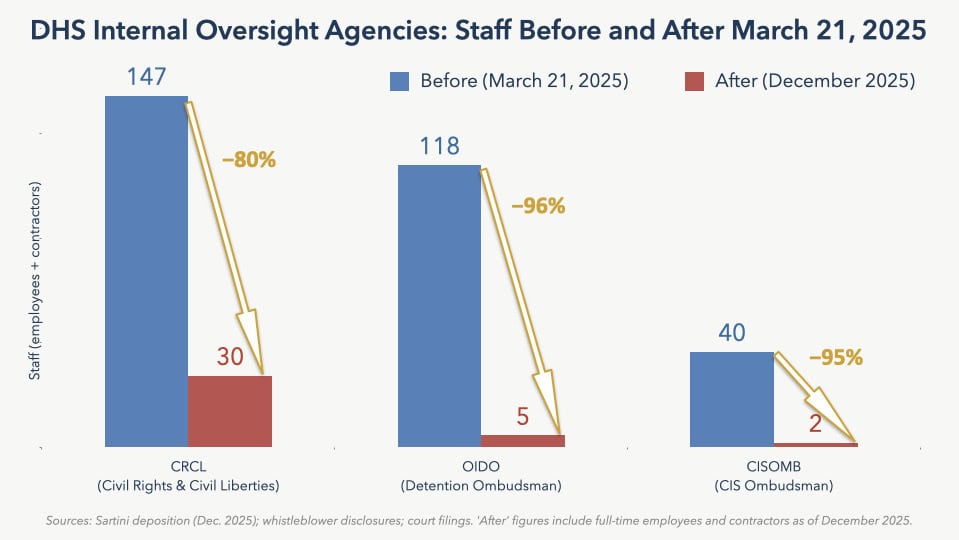
- CRCL had two full-time employees (not counting its new chief officer, Troup Hemenway, or Sartini) and about 25 to 30 full-time-equivalent contractor personnel. Assuming 30 personnel equivalents, this represents an 80 percent reduction in workforce from 147 before March 21, 2025.
- OIDO had three full-time employees, two detailees, and no contractors, for a total of five people. That is a 96 percent reduction in workforce from 118 before March 21, 2025.
- CISOMB had one full-time employee and one detailee, for a total of two staffers plus a portion of Sartini’s time. That is a 95 percent reduction in workforce from 40 before March 21, 2025.27
“I believe this level of staffing is inadequate to fulfill the statutory duties of the Office,” read June 2025 testimony, before Senate Judiciary Committee Democrats, of former CRCL employee and whistleblower Rebekah Tosado.28 “This staffing plan shows either a marked lack of understanding of or indifference to the statutory duties of the office and the personnel needed to fulfill these duties,” read a court filing from a former CRCL senior policy advisor. “Given that DHS has over 250,000 employees and 200,000 contractor staff, it would be impossible for less than 25 employees to provide adequate oversight and ensure statutory compliance of all of the Department.”29
The reduced capacity is stark. At a time when DHS’s ICE component is regularly breaking records for the size of its detained population, with 11 in-custody deaths in the first 60 days of 2026, OIDO now has only five full-time employees to respond to situations in 220 active detention facilities.30
Sartini testified in December 2025 that this ratio of employees to detention facilities is “feasible. And the fact that we already have knocked out 22 inspections tells me that that can be done.”31 In a January 2026 filing, however, former employees’ attorneys noted that “all of these were announced inspections with a few business days’ notice and were conducted by one or two OIDO employees as inspectors, without any of the medical or environmental experts” who used to participate.32
Halting complaint investigations and other work
On March 21, 2025, CRCL had 778 complaints either under investigation or pending review. Approximately 550 cases were open and under investigation; the rest were pending review.33 More than 200 open investigations involved medical referral complaints.34
A February 6, 2026 filing from DHS noted that “CRCL has not issued recommendations memos” since the March 2025 firings, though a January 2026 filing mentions “one complaint [that] resulted in a draft recommendation memorandum.”35
A whistleblower disclosure noted that complaints left in limbo included allegations that CBP discriminated against travelers at ports of entry based on national origin, religious affiliation, or “engagement in protected First Amendment activity”; both ICE and CBP selecting enforcement targets based on “language spoken, race and ethnicity, and First Amendment protected activity”; and allegations of inadequate medical care at ICE detention facilities in California, “including one complainant who reported severe gastrointestinal pain with rectal bleeding for six months before he obtained a colonoscopy.”36
With the firings of all staff with expertise in prison rape and sexual abuse prevention, “all oversight aimed at making recommendations to enhance protections against sexual abuse or assault in DHS custody has stopped,” the whistleblower disclosure warned. CRCL had approximately 25 sexual abuse complaint investigations open and pending when staff were fired on March 21, 2025. “For example, CRCL was investigating allegations that a woman was ‘forcibly strapped to a restraint chair by male guards, stripped, and mocked’ during a mental health crisis in ICE detention at the Baker County Detention Facility.”37
For its part, “OIDO had 388 complaints as of March 21, 2025, of which 375 resulted in an open investigation,” read a January 17, 2026 DHS filing.38 DHS data obtained through discovery noted that OIDO “resolved, dismissed, or otherwise closed” 2,057 complaints between January 20 and March 21, 2025, and none between March 21 and August 13, 2025 (when the data was provided).39
The February 6 DHS filing noted a troubling policy change during the past year: “if the alien is no longer in ICE custody, the Offices enter the complaint into the system but do not open an investigation.” This means that deporting the victim may now be sufficient to close investigations into even serious cases of abuse.40
Other policy changes have created new obstacles to submitting new complaints. CRCL and OIDO are no longer accepting complaints via email or postal mail. The only way to submit a complaint is through the offices’ web portals. In response to the White House’s executive order mandating that all government communications be published in English only, the portal now offers no options in other languages, even though nearly all victims’ native languages are not English.41
The web portal is now the only option for people held in ICE detention to submit complaints about mistreatment, even though in 2023, only 2.2 percent of OIDO complaints (282 of 12,664) were initiated that way.42 Some, but not all, detention facilities provide tablets that detainees can use to complete the English form. Assuming that a tablet is indeed available—a big question, especially if being held in solitary confinement—the detained person must (a) have sufficient internet access, (b) have guards grant enough time to complete the form, (c) be able to enter information in English or using translation apps (requiring much copying-and-pasting on a tablet’s mobile OS), and (d) not be deported, which would close the investigation.

Between March 21 and December 21, 2025, OIDO received 280 complaints, a stark, steep drop from the 12,664 received in fiscal year 2023.43 In a deposition, Sartini stated that the drop is mainly due to the absence of OIDO case workers, who had frequently been present at detention centers before March 2025.44 His testimony did not indicate whether OIDO, in its reduced form, supported people in detention who sought to file complaints, or provided information about the complaints process. Another likely reason for the decline is that, by June 2025, DHS had removed posted information from detention facilities about how to file complaints with CRCL and OIDO.45
In the months after the March 21 firings, those with pending complaints received form emails, sent in batches. “These form emails also afford no way for the complainant or assistance requester to communicate directly with the office to provide information relevant to an ongoing investigation or to request further assistance,” explained a January memorandum from plaintiffs in the Robert F. Kennedy Human Rights v. Department of Homeland Security litigation.
Before March 21, 2025, correspondence from CISOMB and CRCL used to include a phone number and email address that people could contact with questions or to provide additional information. These phone numbers are no longer operational, and emails sent to CISOMB’s email address prompt an autoresponse that the mailbox is no longer monitored.46
Poor reporting to Congress
One of the only ways to determine whether these agencies are fulfilling their missions is through regular reports to Congress required by law. These must provide quantitative data on the use of funds, complaints, investigations, recommendations, and their outcomes.47
These reports’ delivery was chronically late before the Trump administration began, but the tempo has slowed notably since then. CRCL must produce an annual report, which is only current through September 30, 2024, and semiannual reports, which are only current through March 31, 2024. OIDO must produce an annual report, but has not done so since March 29, 2024 (covering fiscal 2023).48 This lateness, likely a consequence of the radical staff cuts, makes oversight very difficult.
By February 2025, DHS had already wiped from its website most publicly available records of past CRCL investigations and recommendations, making oversight even more difficult. Meanwhile, congressional staff who are trying to conduct oversight of civil rights, civil liberties, and detention issues at DHS are being stonewalled. One minority party staffer from a relevant committee said that DHS headquarters hadn’t responded to an inquiry in months. “We’re getting almost nothing out of DHS.”49
III. The national effect of diminished oversight
More operations that place rights and liberties at risk
The sharp staff reductions, procedural obstacles, and severely reduced operational tempo at DHS’s internal oversight agencies have happened at a time of greatly elevated risk of human rights abuse.
- The Trump administration has launched a historic “mass deportation” campaign, promising more aggressive enforcement activity, more detention operations, and more deportations.
- Top officials at the White House and DHS have communicated to agents that they are unfettered and even have “immunity,” while portraying victims of apparent misuse of force as “criminals” and “domestic terrorists.”50
- The administration proposed, and the U.S. Congress narrowly approved in July 2025, an unprecedented infusion of over $170 billion in new border and immigration enforcement spending, the vast majority of it for CBP and ICE. That will be enough to multiply detention and deportation capacity, while more than doubling ICE’s Enforcement and Removal Operations (ERO) division and adding 3,000 more Border Patrol agents to a force of less than 20,000.51
“This massive infusion of funds to ICE is super problematic,” an unnamed former CRCL employee told NPR in October 2025. “If we were still there, we would be incredibly busy.” This individual added, “More people are going to die in custody as a result because there are not going to be the same level of checks and balances internally. And the American public will not be able to be as outraged because there’s no one with whom to file these complaints.”52
From the January 2026 ICE and Border Patrol killings of Renee Good and Alex Pretti in Minneapolis, to the 11 deaths documented in ICE custody between January 3 and March 1, 2026, the risks of human rights abuse at the hands of DHS personnel and contractors have become a major national issue, the stuff of daily front-page news.53 While this report will not detail those risks, any list must include the following.
- Misuse of both lethal and non-lethal force, from point-blank shootings to deliberate misuse of less-lethal projectiles to hazardous vehicle pursuits. Failure to de-escalate or show basic knowledge of democratic crowd control. Official narratives of incidents later contradicted by evidence.
- Rapid hiring of law enforcement personnel, with loosened eligibility standards. For ICE agents, training has been cut from 72 to 42 days.54
- Agents masking and otherwise hiding identities while carrying out operations.
- Setting very high ICE arrest quotas—reportedly 3,000 per day, although daily totals have been less than half of that—and profiling people based on race, ethnicity, language or accent, presence at a particular location, or profession.55
- Raiding residences without judicial warrants.56
- Placing civil liberties and privacy at severe risk through rapid adoption of new technologies: facial recognition, data mining, license plate readers, combined federal databases, seizing phones at border crossings, issuing administrative subpoenas to tech companies, and much else.
- Deteriorating conditions in detention—including at newly opened or reopened sites, like Fort Bliss’s East Montana tent encampment, the Guantanamo Bay naval base, or the Dilley Family Detention facility—with allegations ranging from misuse of force to denial of medical care, including for pregnant and lactating mothers and children.57
- Expansion of detention through the development of a $38 billion warehouse system that may hold nearly 100,000 people at a time. Increasing the detained population by revoking documented statuses for populations that overwhelmingly have no criminal records. Denying bond for millions with asylum or other immigration cases who may have, at one time, entered the United States improperly.
- Expanding deportations of people who have lived in the United States for much of their lives. Shackling them on long flights. Deporting third countries’ citizens to about 20 countries.58 Attempted use of the Alien Enemies Act to deny due process and imprison people indefinitely overseas. Parents separated from U.S. citizen children at times without the choice to bring or leave them.59
What recourse remains
This panorama calls for a robust and aggressive oversight capability. Small and limited in their authorities, CRCL and OIDO were not always robust or aggressive, but the deep cutbacks leave victims of DHS rights violations with even less recourse.
“Nobody knows where to go without CRCL, and that’s the point,” a former senior CRCL official told ProPublica. “They [Trump administration officials] don’t care about civil rights and civil liberties.”60 Without the internal DHS bodies, “immigration advocates are turning to members of Congress to address problems on behalf of their clients,” NPRnoted.61 That solution may only work for the most egregious abuses, however, and it does not scale if congressional staffers’ limited bandwidth for moving individual cases is saturated.
“The elimination of oversight mechanisms leaves individuals detained…around the country without recourse, undermines transparency, and erodes public trust in the Department’s ability to uphold basic human rights and responsibly manage billions of taxpayer dollars,” read an April 2025 letter from 49 members of Congress opposing the cuts to CRCL and OIDO.“This decision is particularly troubling given previous findings of abuse and neglect in DHS facilities, which underscore the necessity of independent oversight.”62
Three internal oversight bodies remain. DHS does have an Office of Inspector General (OIG), which gets the “right of first refusal” to take on case investigations and often delays decisions on whether to hand them off to CRCL or other agencies.
The DHS OIG has been in disarray for some time, as KBI and WOLA explained in the 2023 joint report.63 That document cited a June 2021 U.S. Government Accountability Office report that found “long-standing management weaknesses” at the OIG, including “work quality concerns, high leadership turnover,” operating without a strategic plan, and steadily increasing time required to complete reports.64
Offices of Professional Responsibility (OPRs), a capability created within the past 15 years, exist at CBP and ICE to investigate and recommend discipline for allegations of “employee corruption and serious misconduct,” including potential human rights violations like misuse of force and personnel-related deaths in custody. The CBP OPR has recently grown thanks to authorizing legislation that passed Congress in 2020 and appropriations legislation in 2022, and now has about 700 staff, including 550 investigative special agents. The ICE OPR, meanwhile, is less than half the size of CBP’s, with 251 investigators as of August 2025.65
Both OPRs focus on investigating employee misconduct. Neither is the appropriate venue for victims seeking redress for individual cases, like detention conditions; for recommending department-wide policy changes to prevent abuse; or for reviewing existing policies and procedures. Those roles fell more heavily to CRCL and OIDO when they were able to take them on.
IV. On the Ground in Nogales: the effect of diminished oversight
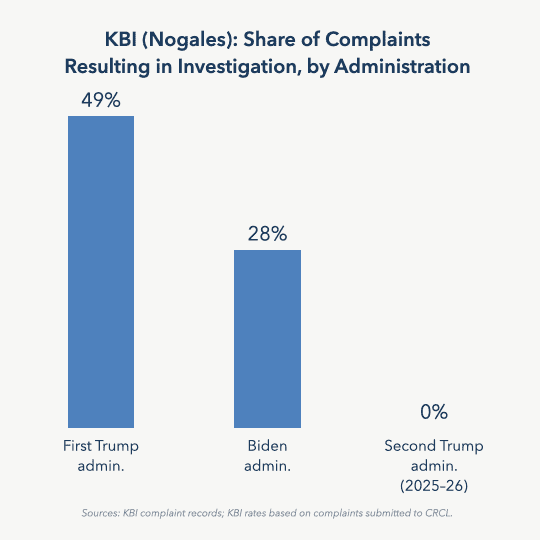
From KBI’s vantage point in Nogales, the past year has made clear how the partial dismantling of civil rights oversight has translated into near-total impunity on the ground. Over the past year, KBI staff have seen the rate of complaint investigation fall to zero, down from 28 percent during the Biden administration and 49 percent during the first Trump administration. Since January 20, 2025, KBI has submitted 21 complaints on behalf of migrants, yet not a single one has resulted in a formal investigation. Instead, 43 percent (nine complaints) have been closed without investigation after an average wait of more than three months for any response at all.
This collapse in accountability is occurring amid ongoing abuse: 83 percent of people KBI interviewed after deportation reported experiencing some form of abuse during detention or arrest, a rate that exceeds previous years, underscoring how widespread misconduct has become. Many people tell KBI staff they do not wish to file a complaint at all, citing increased fear of retaliation under the current administration, mistrust in U.S. institutions, and the belief that “nothing will change,” given their own experiences or those of others.
For those who do decide to seek redress, KBI first determines which DHS oversight bodies should be notified, including CRCL, OIG, OIDO, and OPR. In cases involving CRCL, OIG, and OIDO, complainants are requested to fill out an online form on each of these offices’ websites. The forms are currently available only in English. As a double-check on the system, KBI also emails the filed complaint to these offices. In practice, however, KBI has received no response from these systems and has only received a generic acknowledgment from CRCL as a response to the emails, often months after submission, informing that no further action will be taken on the case. Even basic information about whether an investigation was opened, or why a complaint was closed, cannot be obtained, leaving both victims and advocates in the dark.
The result is a complaints system that feels performative rather than protective, with devastating consequences for individuals. The case of one man, who had lived in Utah for 27 years working as a chef, illustrates this clearly. After being stopped by local police on his way home from work, he was turned over to ICE and detained for three months at the Florence Detention Center, where he developed a severe stomach illness, likely due to spoiled food and unsafe water. When he requested medical care and later reported the neglect, guards punished him by placing him in solitary confinement for several days, in a cell migrants call “el Hoyo” or “the hole.” His story mirrors reports from numerous people deported to Nogales who describe retaliation when they complain: guards threatening them with isolation, taking away privileges, or accelerating their deportation if they “cause problems.”
Faced with this kind of retribution, many migrants conclude that filing a complaint is too dangerous, further suppressing already low rates of reporting and reinforcing a cycle in which abuse goes unchallenged and unrecorded.
Judith’s case shows how this impunity can follow a person even beyond the moment of deportation, undermining their basic right to medical care. In May 2025, Judith was detained after entering the United States with a serious injury that required surgery to stabilize her wound. Doctors performed surgery, but Border Patrol discharged her without any information about the procedure, medications, or follow-up care, leaving Mexican doctors unable to properly continue her treatment when she was returned to Nogales. This violated CBP’s own hospital discharge policy, which it committed to develop following CRCL’s recommendations.66 Such policy requires that deported patients leave with clear documentation of their diagnosis and care plan.
KBI filed a complaint with CRCL and other appropriate offices and even sought assistance from Sen. Mark Kelly’s office, which formally inquired about the case. For months, neither KBI nor the Senator’s office received any substantive response; seven months later, KBI learned by email that the complaint had been closed without investigation. Under the current administration, this appears to be the default outcome for formal complaints, even when they allege clear violations of DHS’s own policies and implicate serious risks to life and health.
At the local level in Nogales, KBI has sometimes seen individual officials respond in ways that partially mitigate harm, though even these limited successes highlight how fragile and exceptional accountability has become. In one case, in March 2025, a woman was deported without her belongings, including important identity documents. KBI submitted a complaint and repeatedly visited and called the port of entry, while also contacting CBP’s Office of Professional Responsibility. OPR acknowledged receipt by email and indicated who to contact at the Port of Entry (POE). Eventually, CBP officers at the POE located and returned the woman’s belongings after sustained advocacy from KBI.
No corrective action was taken to address the underlying problem or ensure that others would not lose their property, and there was no indication that any central oversight body had taken up the case. These rare “success” stories depend almost entirely on individual goodwill at the local level, rather than on any predictable, institutionalized complaint process.
In fact, Nogales provides a stark before-and-after contrast that shows how dramatically the complaints system has deteriorated. In the case of a migrant called José Alfredo in March 2022, a Border Patrol agent struck him and then ran him over with an all-terrain vehicle (ATV), later deporting him without any medical information for follow-up care in Mexico. KBI filed complaints with CRCL and OPR in April 2022, both of which responded and opened an investigation. Within a few months, having demonstrated that he could not access adequate medical services in Nogales, José Alfredo was allowed to enter the United States with a humanitarian visa so that he could receive treatment for the injuries inflicted by Border Patrol. After a year, DHS OIG and CBP OPR informed KBI that they had completed an investigation and disciplined the officer involved, although they did not share details of the discipline.
This case showed that, while slow and limited, the oversight system could function: complaints could trigger investigations, and investigations could lead to some measure of redress and reform. Under the current administration, those same mechanisms have largely ground to a halt, and KBI has not seen similar outcomes since the March 2025 reductions in force.
The situation regarding CRCL’s recommendations for hospital discharge further illustrates both the potential and the fragility of DHS’s internal oversight.67 Several years ago, after at least three complaints from KBI about migrants being deported from a Tucson hospital without adequate medical documentation or coordination, CRCL opened an investigation into patterns of medical neglect and discharge failures. That investigation took years to complete, but it ultimately led to specific recommendations. In July 2024 DHS agreed to adopt four of CRCL’s five recommendations, including guidance requiring that people deported after hospitalization receive clear medical discharge paperwork.
This memo became an important tool for advocates, who could point to DHS’s own rules when challenging dangerous practices. Yet in Judith’s May 2025 case, discussed above, Border Patrol appears to have ignored the guidance entirely, sending her back to Mexico without any medical documentation despite her serious injury. Instead of investigating this apparent violation of its own accepted recommendations, DHS simply closed her complaint. What was once a slow but meaningful path from complaint to policy change has been replaced by a system that not only fails to enforce existing safeguards, but often refuses even to acknowledge when those safeguards are violated.
Taken together, KBI’s experience over the past year reveals a complaints system that is not merely weakened but in free fall. The sharp decline in investigations, the routine closure of complaints without explanation, the retaliatory environment that deters migrants from speaking out, and the abandonment of previously accepted reforms all point to a Department that has chosen impunity over accountability. The handful of cases in which local officials have intervened to correct errors—returning belongings, responding to urgent medical needs, or, in the past, disciplining abusive agents—are the exceptions that prove the rule: individual agents may still try to do the right thing, but the structures meant to support them have been hollowed out.
For people like Judith, José Alfredo, and the many deported migrants who receive services at KBI’s shelter each day, the message is clear: even when they take the considerable risk of filing a complaint, the system that should protect their rights is increasingly unwilling, or unable, to respond.
Recommendations
To the Trump administration (or its successor) and DHS
A. Reverse the “reductions in force” by rehiring, to the greatest extent possible, the experienced personnel who were fired on March 21, 2025, so that they may continue to fulfill their statutorily authorized duties. We echo the plaintiffs’ call, in the Robert F. Kennedy Human Rights v. Department of Homeland Security litigation, to:
- “Declare unlawful and set aside…actions to eliminate the DHS Oversight Offices, including the mass firing of employees and termination of contractors.”
- “Immediately…reverse the RIF and termination of contractors as to CRCL, OIDO, and/or CIS Ombudsman Office employees and contractors necessary to perform the DHS Oversight Offices’ statutory functions.”
- “Stop the administration from “taking any further steps that hinder the DHS Oversight Offices’ ability to perform their statutorily mandated tasks.”68
We note that the administration must rehire those who were fired, if they are willing to rejoin the agencies, and not fill the vacant positions with new personnel aligned with a political agenda.
B. Align and streamline DHS civil rights, civil liberties, and detention oversight, while balancing central coordination with local embedding and essential specialized expertise.
- The Office of the Inspector General’s “right of first refusal” to investigate cases continues to pose challenges, as delays in deciding whether to permit other agencies to investigate cost valuable time. We call on DHS to revise its Management Directive 810.1 and related policies, to clarify jurisdiction among oversight offices, set firm time limits for OIG to accept or decline cases, and prevent referrals that freeze or indefinitely delay other components’ investigations.
- Maintain and strengthen the embedding of specialized oversight personnel with medical, civil liberties and high level strategic expertise in the appropriate component agencies like ICE, CBP and Border Patrol. Require training for all oversight agency employees that clarifies the role of each oversight body and communication channels between the bodies when collaboration is needed. Offer parallel training for NGOs and other agencies that support migrants and detainees seeking redress.
C. Implement changes to the complaints process. A victim of abuse should not have to surmount unnecessary hurdles in order to submit a complaint and achieve redress, and deportation should not be an impetus for termination of an investigation. This creates a perverse incentive to rush abuse victims out of the country, potentially violating their due process in an effort to avoid scrutiny and accountability
The DHS oversight agencies should:
- Have the technical capacity and personnel necessary to receive and promptly process complaints submitted via web form, mail, or e-mail.
- Provide forms and instructions in the ten most common languages spoken by migrants encountered in recent years.
- Deploy a unified civil‑rights and misconduct complaint intake and tracking system across CRCL, OIG, OPR, and OIDO, including a single public-facing form, multilingual access, phone and online submission options, and a secure way for complainants or representatives to receive basic case‑status updates.expand in‑custody access to complaint mechanisms across the detention system through posted information, phone access, and exit interviews at release or removal, which should include standardized questions on treatment, family separation, and return of all property.
- Reverse the Trump Administration’s policy that investigations be terminated upon the complainant’s deportation..
D. Ensure oversight agency employees have the resources and authority to meaningfully investigate complaints in a timely manner, and effect swift changes when abuse allegations are substantiated.
- Agencies should have sufficient staffing and budgets to ensure small caseloads per employee, which would speed up investigations and responses.
- Budgets must be sufficient to allow investigators to travel to perform fieldwork.
- Oversight agencies should have access to a mechanism, like subpoena power, that would grant them the legal authority to compel law enforcement agencies to respond rapidly to their inquiries.
E. Improve transparency. As KBI’s experience over the past year makes clear, feedback to people who submit complaints is now beyond abysmal: little more than a form email with no way to follow up. Many interviewees, though, agreed that transparency was also an organizational weakness before March 2025, especially at CRCL.69
In this light, we repeat our 2023 recommendations to:
- Provide complainants with a unique complaint number, which they can enter into a secure online form to view the current status of their complaint, such as “received,” “pending investigation,” “under investigation,” “pending recommendation,” “added to information layer,” or “recommendation issued,” among other potential categories.
- Through that resource, provide complainants with a way to contact staff to offer new information about their cases, or to inquire about the process when the “current status” has not changed for an extended period.
- Make complainants aware when their complaints have contributed to recommendations, and provide the text of those recommendations (redacted if necessary) and whether the DHS component agency has concurred with them.
In addition, we call on DHS to immediately resume publishing all CRCL recommendations online, redacted if necessary, in its Library of Recommendations and Investigation Memos.
Transparency also means providing required oversight reports to Congress on time and in detail. As internal oversight agencies, CRCL and OIDO must model proper compliance with oversight requirements. If the “bottleneck” impeding timely releases is elsewhere, such as at DHS headquarters, then congressional oversight personnel must push harder on those responsible for delays, including through public statements or tying reporting more closely to the release of appropriated funds.
To the U.S. Congress
Though directed at DHS, several of the above recommendations may be difficult to implement without congressional action, appropriations, or even legislation. Some changes would require passage of authorizing or appropriation legislation.
A. Increase the salience of CRCL recommendations. Even before March 2025, CRCL had no effective way to compel DHS component agencies, such as CBP and ICE, to adhere to its recommendations, even when those agencies concurred. Repetition of behaviors or patterns that violate earlier recommendations carries no sanction, and CRCL can only open new investigations and perhaps refine its earlier recommendations.
In future authorizing language, therefore, Congress should amend existing statutes to compel adherence to these offices’ recommendations. There should be some sanction for practicing “business as usual” even after careful investigations and deliberative processes have led to the publication of recommendations. If Congress cannot give these agencies greater authority to compel behavior, it should at least give them more influence.
B. Reject deep appropriations cuts on DHS oversight, and demand that oversight funding increase at least by the same rate that H.R. 1 increased ICE and CBP capabilities. DHS oversight agencies’ budgets have never been commensurate with the task of monitoring the activities of a quarter of a million employees, many of them authorized to use force or detain people. Yet the 2026 Homeland Security Appropriations bill drafted by congressional appropriators, which remains before the U.S. Congress as of March 2026, calls for extremely deep cuts:
- CRCL’s budget would drop from $42,964,000 in 2025 to $10,000,000 in 2026, a 77 percent one-year cut.
- OIDO’s budget, $28,641,000 in 2025, would be zeroed out entirely in 2026, at a time of massive increases to ICE’s detention capacity.
- CISOMB’s budget would fall from $11,597,000 in 2025 to $5,000,000 in 2026, a 57 percent one-year cut.70
C. Lock in these agencies’ sizes and authorities, so that this cannot happen again. Volatile cycles of increases and cutbacks do harm to any organization, making long-term planning and capacity-building impossible. In the words of a former DHS oversight official, “You can’t switch integrity on and off every time the pendulum swings” electorally.71 To avoid that, CRCL and OIDO need authorizing legislation that clearly spells out their responsibilities, places CRCL more firmly within the policymaking process, and specifies that the “absolutely irreducible minimum” includes no less than one oversight employee for every 100 DHS employees and robust complaint submission and investigation infrastructure, as described above.
Legislation that passed the House of Representatives, but did not make it through the Senate in 2020, sought to do some of this for CRCL.72 The Department of Homeland Security Office for Civil Rights and Civil Liberties Authorization Act would have mandated the existence of a proper office—not just an “officer”—for civil rights and civil liberties at DHS. It would have integrated civil rights and civil liberties protections into all DHS programs and activities. It would have required assessments of the impact on rights, liberties, and privacy of all new regulations, initiatives, programs, or policies. It would have greatly increased transparency over complaints and investigations. A big step in the right direction, the CRCL Authorization Act has been reintroduced in past congresses, and deserves to pass if it is introduced again.
Conclusion
We offer these recommendations out of a deep belief that full and energetic defense of civil rights, civil liberties, and detention standards makes the U.S. government more effective in achieving its main objective: ensuring not just that our homeland is secure, but that the nation it is securing is a democracy founded in laws and the principles of our Constitution’s Bill of Rights.
Professionals who have worked at or with CRCL and OIDO are issuing dire warnings about what will happen in the absence of these recommendations, with agencies unable to properly investigate, respond to urgent calls for help, issue recommendations, and participate in policymaking.
- “The dissolution of CRCL, coupled with the Administration’s unprecedented efforts related to immigration, border enforcement, data-mining and information sharing, and other activities, pose a grave constitutional risk, as well as a health and safety risk for individuals who rely on CRCL’s processes related to urgent medical referrals and disability accommodations.” warned whistleblowers in a May 2025 Government Accountability Project disclosure.73
- “The humanitarian provisions in internal policies and procedures are very likely not being abided by. I do believe that,” a former CRCL employee told NPR.74
- “It is literally dangerous,” former CRCL and ICE official Scott Shuchart told Bloomberg Government. “People die in ICE custody. People die in CBP custody. And sometimes it happens for unpreventable reasons and sometimes it happens for preventable reasons.”75
- A whistleblower disclosure from Dr. Scott Allen and Dr. Pamela McPherson, two medical experts who contracted with CRCL between 2014 and 2025, warned, “Without this critical line of oversight and guidance, dangerous mismanagement that puts detained children, their families, and communities at risk will go unchecked. As medical professionals, we once more have a duty to warn the administration of imminent harm to children and their families.”76
We must heed these warnings. The current administration’s adoption of aggressive arrest, detention, and deportation tactics, along with a multiplication of law enforcement budgets and personnel with extreme rhetoric from top leadership, is creating a fertile climate for abuse.
That climate demands that all oversight bodies, even those with small budgets and circumscribed authorities, be empowered to do their utmost to prevent harm and protect the democratic, constitutional order of the United States as an open society. Instead of eviscerating CRCL and OIDO, this and future administrations should be empowering them. Failure to do so carries severe consequences.
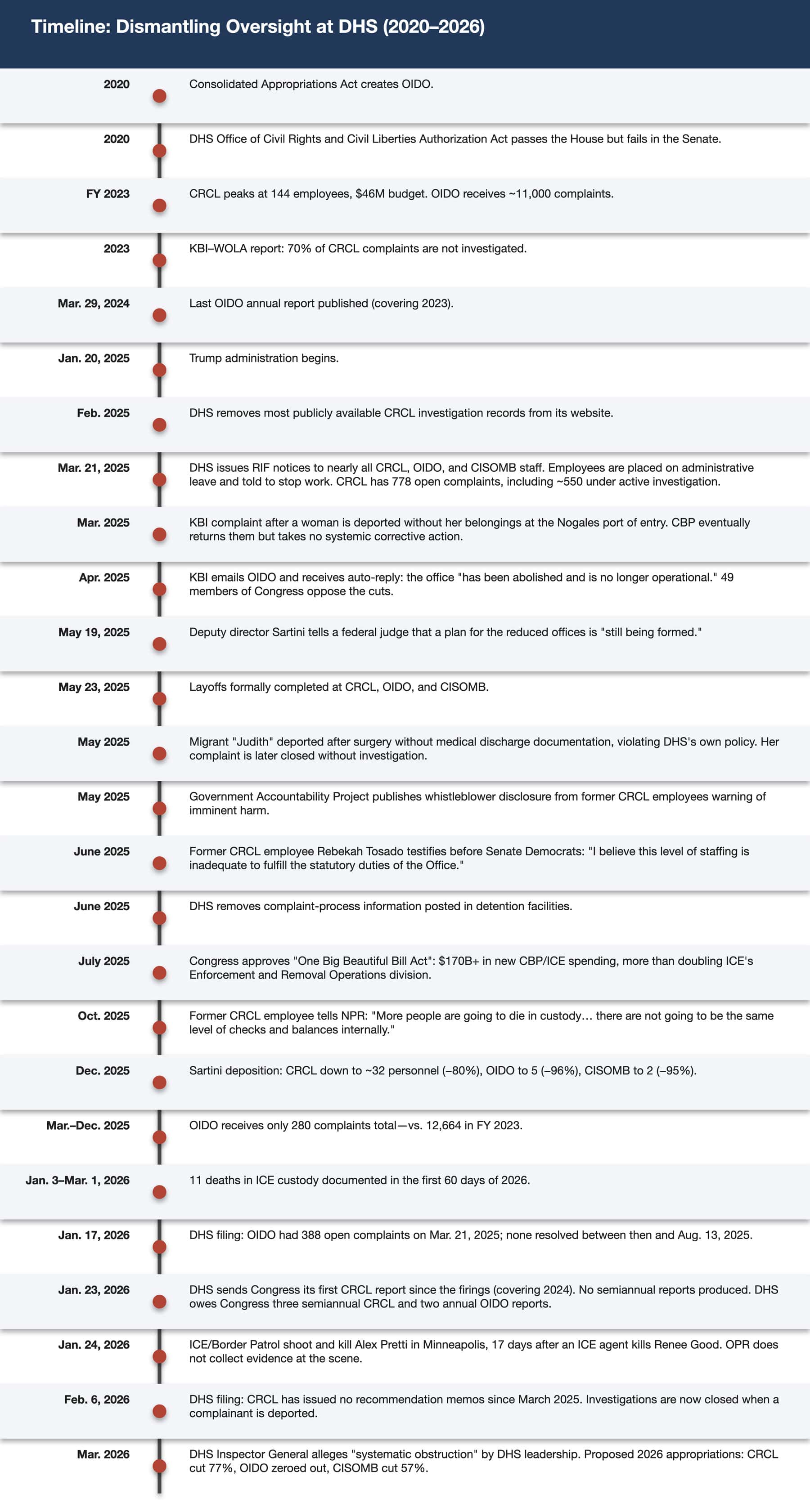
Annex: Timeline of Key Events
(Click to expand in a new window)
Endnotes
- U. S. Government Accountability Office, DHS Office of Inspector General: Actions Needed to Address Long-Standing Management Weaknesses, GAO-21-316 (U.S. Government Accountability Office, 2021), 135, https://www.gao.gov/products/gao-21-316.↩︎
- U. S. Government Accountability Office, DHS Office of Inspector General; Alex Nowrasteh, “ICE Could Prevent Some of the Coming Corruption, Criminal, and Misconduct Scandals That Will Plague the Agency,” Cato Institute, Cato Institute, August 14, 2025, https://www.cato.org/blog/ice-could-prevent-some-coming-corruption-criminal-misconduct-scandals-will-plague-agency; “Exhibit Defendants’ Initial Discovery Responses,” District Court, District of Columbia, January 17, 2026, https://storage.courtlistener.com/recap/gov.uscourts.dcd.279883/gov.uscourts.dcd.279883.64.3.pdf; Ellen M. Gilmer, “Trump Aides Shutter Homeland Security Civil Rights Office,” Bloomberg Government, Bloomberg Government, March 21, 2025, https://news.bgov.com/bloomberg-government-news/civil-rights-advocates-brace-for-cuts-in-homeland-security-unit; Randolph D. Alles, “Exhibit 2 Excerpts of Administrative Record,” District Court, District of Columbia, March 17, 2025, https://storage.courtlistener.com/recap/gov.uscourts.dcd.279883/gov.uscourts.dcd.279883.42.5.pdf.↩︎
- Interim Report of the CBP Integrity Advisory Panel (Homeland Security Advisory Panel, 2015), 40, https://www.dhs.gov/sites/default/files/publications/DHS-HSAC-CBP-IAP-Interim-Report.pdf.↩︎
- “Two Protected Whistleblower Disclosures Concerning the Dissolution of DHS’s Office for Civil Rights and Civil Liberties,” Government Accountability Project, May 15, 2025, https://whistleblower.org/wp-content/uploads/2025/05/05-15-2025-GovAcctProj-Whistleblower-Disclosures-to-Congress-re-CRCL.pdf.↩︎
- “Memorandum in Support Defendants’ Motion for Summary Judgment,” District Court, District of Columbia, February 6, 2026, https://storage.courtlistener.com/recap/gov.uscourts.dcd.279883/gov.uscourts.dcd.279883.66.1.pdf.↩︎
- Ellen M. Gilmer, “Trump Aides Shutter Homeland Security Civil Rights Office.”↩︎
- Randolph D. Alles, “Exhibit 2 Excerpts of Administrative Record.”↩︎
- Ellen M. Gilmer, “Trump Aides Shutter Homeland Security Civil Rights Office.”↩︎
- J. David McSwane and Hannah Allam, “‘They Don’t Care About Civil Rights’: Trump’s Shuttering of DHS Oversight Arm Freezes 600 Cases, Imperils Human Rights,” ProPublica, ProPublica, April 8, 2025, https://www.propublica.org/article/homeland-security-crcl-civil-rights-immigration-border-patrol-trump-kristi-noem.↩︎
- Ellen M. Gilmer, “Trump Aides Shutter Homeland Security Civil Rights Office”; Margo Schlanger, “What’s Behind DHS’s Abuses,” Democracy Journal, Democracy Journal, April 7, 2025, https://democracyjournal.org/arguments/whats-behind-dhss-abuses/.↩︎
- “Interview with House of Representatives Staff with Homeland Security Responsibilities,” (Online), February 17, 2026.↩︎
- “Two Protected Whistleblower Disclosures Concerning the Dissolution of DHS’s Office for Civil Rights and Civil Liberties.”↩︎
- “Interview with Senate Staff with Homeland Security Responsibilities,” (Washington), March 2, 2026.↩︎
- Margo Schlanger, “What’s Behind DHS’s Abuses.”↩︎
- Abuses at the U.S.- Mexico Border: How To Address Failures and Protect Rights (Kino Border Initiative and Washington Office on Latin America, 2023), https://www.wola.org/analysis/accountability-for-abuses-at-the-u-s-mexico-border-how-to-address-failures-and-protect-rights/.↩︎
- Margo Schlanger, “What’s Behind DHS’s Abuses.”↩︎
- Abuses at the U.S.- Mexico Border.↩︎
- Abuses at the U.S.- Mexico Border.↩︎
- “Two Protected Whistleblower Disclosures Concerning the Dissolution of DHS’s Office for Civil Rights and Civil Liberties.”↩︎
- McSwane and Allam, “‘They Don’t Care About Civil Rights.’”↩︎
- Zolan Kanno-Youngs et al., “Trump Shuts Down 3 Watchdog Agencies Overseeing Immigration Crackdown,” U.S., The New York Times (New York), March 21, 2025, https://www.nytimes.com/2025/03/21/us/politics/trump-civil-rights-homeland-security-deportations.html.↩︎
- Margo Schlanger, “What’s Behind DHS’s Abuses.”↩︎
- “Complaint for Declaratory and Injunctive Relief,” District Court, District of Columbia, April 24, 2025, https://storage.courtlistener.com/recap/gov.uscourts.dcd.279883/gov.uscourts.dcd.279883.1.0_1.pdf.↩︎
- Tracey Horan, “Declaration of Sr. Tracey Horan, SP,” District Court, District of Columbia, May 8, 2025, https://storage.courtlistener.com/recap/gov.uscourts.dcd.279883/gov.uscourts.dcd.279883.15.12.pdf.↩︎
- Margo Schlanger, “What’s Behind DHS’s Abuses.”↩︎
- “Transcript of Evidentiary Hearing Held Before the Honorable Judge Ana C. Reyes United States District Judge,” District Court, District of Columbia, May 19, 2025, https://storage.courtlistener.com/recap/gov.uscourts.dcd.279883/gov.uscourts.dcd.279883.69.10.pdf.↩︎
- “Deposition of Ronald Sartini,” District Court, District of Columbia, District Court, District of Columbia, December 5, 2025, https://storage.courtlistener.com/recap/gov.uscourts.dcd.279883/gov.uscourts.dcd.279883.66.13.pdf.↩︎
- Rebekah Tosado, “Testimony of Rebekah Tosado, Esq. Whistleblower, u.s. Department of Homeland Security Office for Civil Rights and Civil Liberties Spotlight Forum of u.s. Senate Democratic Whip Dick Durbin, Ranking Member of the Senate Judiciary Committee on ‘Cruel and Unamerican: The Abuse of Immigrants to Attack Our Constitutional Order’ Before the Senate Udiciary Committee Democrats and Senate Democrats,” Testimony, Government Accountability Project, June 11, 2025, https://whistleblower.org/wp-content/uploads/2025/12/061125-Rebekah-Tosado-Written-Statement-for-Sen-Durbin-forum-clean-2.pdf.↩︎
- Taylor Doe, “Declaration of Taylor Doe,” Declaration, District Court, District of Columbia, June 11, 2025, https://storage.courtlistener.com/recap/gov.uscourts.dcd.279883/gov.uscourts.dcd.279883.42.5.pdf.↩︎
- Austin Kocher, “Third ICE Custody Death This Week, 11th Since January 1,” Substack newsletter, Austin Kocher, March 6, 2026, https://austinkocher.substack.com/p/third-ice-custody-death-this-week; “Detention FY 2026 YTD, Alternatives to Detention FY 2026 YTD and Facilities FY 2026 YTD,” Immigration and Customs Enforcement, February 12, 2026, https://www.ice.gov/detain/detention-management.↩︎
- “Deposition of Ronald Sartini.”↩︎
- “Memorandum in Support.”↩︎
- “Exhibit Defendants’ Initial Discovery Responses”; “Two Protected Whistleblower Disclosures Concerning the Dissolution of DHS’s Office for Civil Rights and Civil Liberties.”↩︎
- “Two Protected Whistleblower Disclosures Concerning the Dissolution of DHS’s Office for Civil Rights and Civil Liberties.”↩︎
- “Fourth Declaration of Ronald J. Sartini,” District Court, District of Columbia, February 6, 2026, https://storage.courtlistener.com/recap/gov.uscourts.dcd.279883/gov.uscourts.dcd.279883.66.26.pdf; “Exhibit Defendants’ Initial Discovery Responses.”↩︎
- “Two Protected Whistleblower Disclosures Concerning the Dissolution of DHS’s Office for Civil Rights and Civil Liberties.”↩︎
- “Civil Rights Complaint to Department of Homeland Security’s Office of Civil Rights and Civil Liberties,” ACLU of Florida, November 14, 2024, https://www.aclufl.org/civil-rights-complaint-department-homeland-securitys-office-civil-rights-and-civil-liberties/.↩︎
- “Exhibit Defendants’ Initial Discovery Responses.”↩︎
- “Plaintiffs’ Statement of Undisputed Material Facts,” District Court, District of Columbia, January 17, 2026, https://storage.courtlistener.com/recap/gov.uscourts.dcd.279883/gov.uscourts.dcd.279883.64.2.pdf.↩︎
- “Fourth Declaration of Ronald J. Sartini.”↩︎
- “Designating English as the Official Language of The United States,” The White House, March 2, 2025, https://www.whitehouse.gov/presidential-actions/2025/03/designating-english-as-the-official-language-of-the-united-states/; “Deposition of Ronald Sartini”; “Memorandum in Support”; “Fourth Declaration of Ronald J. Sartini.”↩︎
- OIDO Annual Report 2023 (Office of the Immigration Detention Ombudsman, 2024), 67, https://www.dhs.gov/sites/default/files/2024-05/24_0329_oido_2023-annual-report-to-congress-508.pdf.↩︎
- “Memorandum in Support of Defendants’ Motion for Summary Judgment and in Opposition to Plaintiffs’ Motion for Summary Judgment,” District Court, District of Columbia, February 13, 2026, https://storage.courtlistener.com/recap/gov.uscourts.dcd.279883/gov.uscourts.dcd.279883.69.1.pdf.↩︎
- “Exhibit Excerpts of Deposition of Ronald Sartini, with Redactions,” District Court, District of Columbia, December 5, 2025, https://storage.courtlistener.com/recap/gov.uscourts.dcd.279883/gov.uscourts.dcd.279883.64.10.pdf.↩︎
- “Declaration of Sarah Gillman,” District Court, District of Columbia, June 18, 2025, https://storage.courtlistener.com/recap/gov.uscourts.dcd.279883/gov.uscourts.dcd.279883.44.1.pdf.↩︎
- “Memorandum in Support.”↩︎
- “CRCL Semiannual Reports,” Department of Homeland Security, accessed March 7, 2026, https://www.dhs.gov/publication/crcl-quarterly-reports; “CRCL Annual Reports,” Department of Homeland Security, accessed March 7, 2026, https://www.dhs.gov/publication/crcl-annual-reports.↩︎
- “OIDO Annual Reports to Congress,” Department of Homeland Security, accessed March 7, 2026, https://www.dhs.gov/publication/oido-annual-report-congress.↩︎
- “Interview with House of Representatives Staff with Homeland Security Responsibilities.”↩︎
- Hamed Aleaziz and Nicholas Nehamas, “Under Trump, a Shift Toward ‘Absolute Immunity’ for ICE,” U.S., The New York Times, January 15, 2026, https://www.nytimes.com/2026/01/15/us/politics/trump-ice-immunity.html; Jesus Jiménez, “‘It’s All About Us Now’: Video Shows Bovino’s Orders to Agents in L.A. Raids,” U.S., The New York Times, January 30, 2026, https://www.nytimes.com/2026/01/29/us/bovino-orders-video.html.↩︎
- Adam Isacson, “Trump Budget Bill Threatens Migrant Rights and Civil Liberties: Ugly Consequences of a Police State Agenda,” Washington Office on Latin America, July 11, 2025, https://www.wola.org/analysis/trump-budget-bill-threatens-migrant-rights-and-civil-liberties-ugly-consequences-of-a-police-state-agenda/.↩︎
- Ximena Bustillo, “Civil Rights Jobs Have Been Cut. Those Ex-Workers Warn of ICE Detention Violations,” Immigration, NPR, October 6, 2025, https://www.npr.org/2025/10/06/g-s1-91947/trump-ice-detention-civil-rights.↩︎
- Kocher, “Third ICE Custody Death This Week, 11th Since January 1.”↩︎
- Sen. Richard Blumenthal, “Blumenthal Releases Whistleblower Documents Showing Drastic Cuts to ICE Training & Testing for New Recruits,” U.S. Senate, February 23, 2026, https://www.blumenthal.senate.gov/newsroom/press/release/blumenthal-releases-whistleblower-documents-showing-drastic-cuts-to-ice-training-and-testing-for-new-recruits.↩︎
- Elizabeth Findell et al., “The White House Marching Orders That Sparked the L.A. Migrant Crackdown,” Politics, Wall Street Journal (New York), June 10, 2025, https://www.wsj.com/us-news/protests-los-angeles-immigrants-trump-f5089877; Charlie Savage, “The Supreme Court Decision on ICE and Racial Profiling, Explained,” U.S., The New York Times (New York), September 8, 2025, https://www.nytimes.com/2025/09/08/us/politics/supreme-court-immigration-racial-profiling.html.↩︎
- Sen. Richard Blumenthal, “Blumenthal Demands Accountability for Secret ICE Policy Authorizing Federal Agents to Enter Homes Without a Judicial Warrant,” U.S. Senate, January 21, 2026, https://www.blumenthal.senate.gov/newsroom/press/release/blumenthal-demands-accountability-for-secret-ice-policy-authorizing-federal-agentsto-enter-homes-without-a-judicial-warrant.↩︎
- Rachel Uranga, “Pregnant Immigrants Held for Months in Detention despite Rules against It,” The Los Angeles Times, December 3, 2025, https://www.latimes.com/california/story/2025-12-03/she-spent-her-pregnancy-in-a-detention-center-shes-not-alone.↩︎
- AT WHAT COST? Inside the Trump Administration’s Secret Deportation Deals (Senate Foreign Relations Committee Democrats, 2026), 30, https://www.foreign.senate.gov/imo/media/doc/(FINAL%20-%20web)%20At%20What%20Cost%20-%20Inside%20the%20Trump%20Administration%27s%20Secret%20Deportation%20Deals_SFRC%20Minority%20Report_Feb%202026%200213.pdf.↩︎
- “We Are in the Middle of a New Family Separation Crisis,” Washington Office on Latin America, August 14, 2025, https://www.wola.org/multimedia/we-are-in-the-middle-of-a-new-family-separation-crisis/.↩︎
- McSwane and Allam, “‘They Don’t Care About Civil Rights.’”↩︎
- Bustillo, “Civil Rights Jobs Have Been Cut. Those Ex-Workers Warn of ICE Detention Violations.”↩︎
- Rep. Debbie Wasserman Schultz, “Wasserman Schultz Leads House Dems to Demand DHS Restore Oversight Offices, Overhaul Inhumane Detention Conditions,” Congresswoman Debbie Wasserman Schultz, U.S. House of Representatives, April 8, 2025, https://wassermanschultz.house.gov/news/documentsingle.aspx?DocumentID=3327.↩︎
- Abuses at the U.S.- Mexico Border.↩︎
- U. S. Government Accountability Office, DHS Office of Inspector General.↩︎
- Alex Nowrasteh, “ICE Could Prevent Some of the Coming Corruption, Criminal, and Misconduct Scandals That Will Plague the Agency.”↩︎
- “Summary of CRCL’s Recommendations and CBP’s Response Hospital Discharge,” DHS Office of Civil Rights and Civil Liberties, September 6, 2024, https://drive.google.com/file/d/1tKOCT9wxHQ90bfkfZH5uXUv6BNWajD7H/view?usp=sharing&usp=embed_facebook.↩︎
- “Summary of CRCL’s Recommendations and CBP’s Response Hospital Discharge.”↩︎
- “Complaint for Declaratory and Injunctive Relief.”↩︎
- “Interview with Former DHS Oversight Official”; “Interview with House of Representatives Staff with Homeland Security Responsibilities.”↩︎
- “Joint Explanatory Statement on Department of Homeland Security Appropriations Act, 2026,” U.S. Congress, January 20, 2026, https://www.appropriations.senate.gov/imo/media/doc/fy26_homeland_jes.pdf.↩︎
- “Interview with Former DHS Oversight Official.”↩︎
- Rep. Al Green, “H.R.4713 – 116th Congress (2019-2020): Department of Homeland Security Office for Civil Rights and Civil Liberties Authorization Act,” legislation, U.S. Congress, October 19, 2020, 2019-10-17, https://www.congress.gov/bill/116th-congress/house-bill/4713.↩︎
- “Two Protected Whistleblower Disclosures Concerning the Dissolution of DHS’s Office for Civil Rights and Civil Liberties.”↩︎
- Bustillo, “Civil Rights Jobs Have Been Cut. Those Ex-Workers Warn of ICE Detention Violations.”↩︎
- Ellen M. Gilmer, “Trump Aides Shutter Homeland Security Civil Rights Office.”↩︎
- “Two Protected Whistleblower Disclosures Concerning the Dissolution of DHS’s Office for Civil Rights and Civil Liberties.”↩︎