
Weekly U.S.-Mexico Border Update: November 21, 2025

Adam Isacson
Weekly U.S.-Mexico Border Update: November 21, 2025
With this series of weekly updates, WOLA seeks to cover the most important developments at the U.S.-Mexico border. See past weekly updates here.
Your donation to WOLA is crucial to keeping these paywall-free and ad-free Updates going. Please contribute now and support our work.
Due to the Thanksgiving holiday, and then to staff work travel during the first week of December, WOLA will not publish Border Updates for the next two weeks. The next edition will appear on December 12.
THIS WEEK IN BRIEF:
- CBP’s migrant encounters changed little from September to October: Following a sharp increase from July to September, Border Patrol apprehensions of migrants leveled off in October, indicating a likely seasonal trend. Arrivals of migrants remain near 60-year lows as the Trump administration’s ban on asylum remains in place.
- Supreme Court to review “metering” policy: The Supreme Court assented to a Trump administration request to review lower courts’ ban on the practice of “metering”: stationing CBP officers on the border line at ports of entry to prevent asylum seekers from setting foot on U.S. soil. A decision could come by June.
- Gregory Bovino, the face of the roving Border Patrol contingent leading “mass deportations”: As an aggressive contingent of DHS “mass deportation” personnel, mainly Border Patrol agents, moves out of Chicago and into Charlotte, media are paying increasing attention to Border Patrol’s tactics, which are more confrontational and less discriminate than ICE’s, and to the contingent’s flashy leader, Border Patrol sector chief Gregory Bovino.
- Notes from elsewhere in the Americas: Updates include Ecuador’s signing of a “safe third country” agreement, contempt-of-court proceedings surrounding the administration’s March rendition of Venezuelan men to a prison in El Salvador, and continued deportation flights to Venezuela.
THE FULL UPDATE:
CBP’s migrant encounters changed little from September to October
CBP published statistics on November 14 detailing the agency’s encounters with undocumented migrants at the U.S.-Mexico border in October 2025. The data indicate that last month was quite similar to September.
October was the sixth straight month in which CBP did not release a single migrant into the U.S. interior. In the past, most releases were of people seeking asylum in the United States; now, a January 2025 White House proclamation has suspended access to the U.S. asylum system at the border. (This suspension continues to face judicial challenges.) Any migrants allowed to pursue protection at the border, for instance under the Convention Against Torture, appear to be awaiting adjudication while in detention.
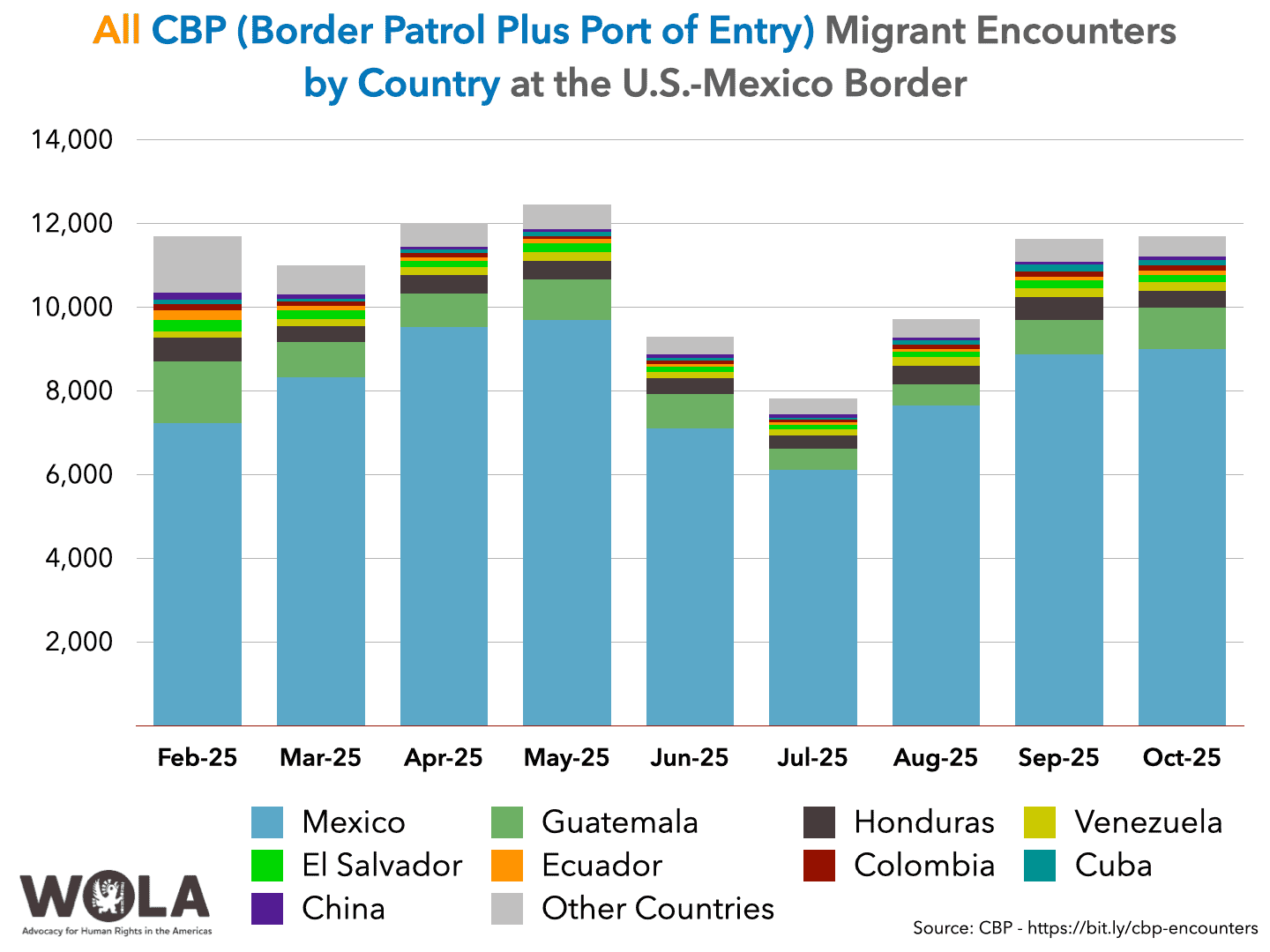
Combining Border Patrol apprehensions between ports of entry (official border crossings) with CBP’s encounters at the ports of entry, the agency encountered 11,710 people at the border in October, or 378 people per day, similar to 11,647 in September (388 people per day). CBP’s Border Patrol component apprehended 7,989 people between the ports of entry in October (258 people per day), down from 8,386 in September (280 people per day).
While all of these numbers are at or near 60-year lows, Border Patrol’s apprehensions had jumped 83 percent from July to September. That they leveled off in October may indicate a return to seasonal migration patterns among migrants who seek to avoid apprehension: migration increases, often sharply, in fall and spring, and declines in summer and winter. Unlike that apprehension-evading population, asylum seekers—who cannot access protection at the border right now under the Trump administration’s near-total suspension of asylum—tended to arrive regardless of weather conditions: those intending to turn themselves in to U.S. agents were less vulnerable to prolonged extreme weather exposure.
If chart is not visible, click here
October’s CBP encounter total, combining Border Patrol and ports of entry, was 9 percent greater than the monthly average during the Trump administration’s first eight full months (February-September). Most nationalities’ numbers were greater than the Trump-era average in October, although Honduras and CBP’s “Other Countries” category measured notable declines.
All CBP (Border Patrol plus ports of entry) encounters with migrants at the U.S.-Mexico border, by nationality
|
Nationality |
Oct-25 |
February-September Average |
October Variation from Average |
|
Mexico |
9,006 |
8,067 |
+12% |
|
Guatemala |
979 |
848 |
+15% |
|
Honduras |
410 |
441 |
-7% |
|
Other Countries |
220 |
349 |
-37% |
|
Venezuela |
210 |
178 |
+18% |
|
El Salvador |
164 |
172 |
-4% |
|
Ecuador |
120 |
103 |
+17% |
|
Colombia |
121 |
97.8 |
+24% |
|
Cuba |
124 |
94.8 |
+31% |
|
China |
76 |
86.9 |
-13% |
|
India |
37 |
61.9 |
-40% |
|
Russia |
57 |
45.5 |
+25% |
|
Nicaragua |
51 |
41.9 |
+22% |
|
Brazil |
32 |
32.5 |
-2% |
|
Peru |
34 |
31.9 |
+7% |
|
Turkey |
30 |
26.6 |
+13% |
|
Canada |
19 |
12.8 |
+49% |
|
Haiti |
9 |
9.4 |
-4% |
|
Romania |
6 |
8.1 |
-26% |
|
Ukraine |
4 |
2.8 |
+45% |
|
Philippines |
1 |
2.5 |
-60% |
|
Myanmar (Burma) |
0 |
0.3 |
-100% |
|
Total |
11,710 |
10,712 |
+9% |
Between the ports of entry, Border Patrol’s apprehensions were 10 percent above the February-September average.
Border Patrol apprehensions of migrants at the U.S.-Mexico border, by nationality
|
Nationality |
Oct-25 |
February-September Average |
October Variation from Average |
|
Mexico |
5,518 |
4,852 |
+14% |
|
Guatemala |
966 |
827 |
+17% |
|
Honduras |
399 |
431 |
-7% |
|
Other Countries |
158 |
274 |
-42% |
|
Venezuela |
199 |
167 |
+19% |
|
El Salvador |
162 |
163 |
-0% |
|
Ecuador |
115 |
99.1 |
+16% |
|
Cuba |
114 |
88.5 |
+29% |
|
Colombia |
110 |
87.9 |
+25% |
|
China |
56 |
56.6 |
-1% |
|
India |
30 |
55.3 |
-46% |
|
Nicaragua |
49 |
40.4 |
+21% |
|
Brazil |
24 |
29.3 |
-18% |
|
Turkey |
30 |
25.9 |
+16% |
|
Peru |
30 |
25.5 |
+18% |
|
Russia |
13 |
11.1 |
+17% |
|
Romania |
6 |
7.8 |
-23% |
|
Haiti |
6 |
5.9 |
+2% |
|
Philippines |
1 |
1.3 |
-20% |
|
Ukraine |
1 |
0.8 |
+33% |
|
Canada |
2 |
0.4 |
+433% |
|
Total |
7,989 |
7,249 |
+10% |
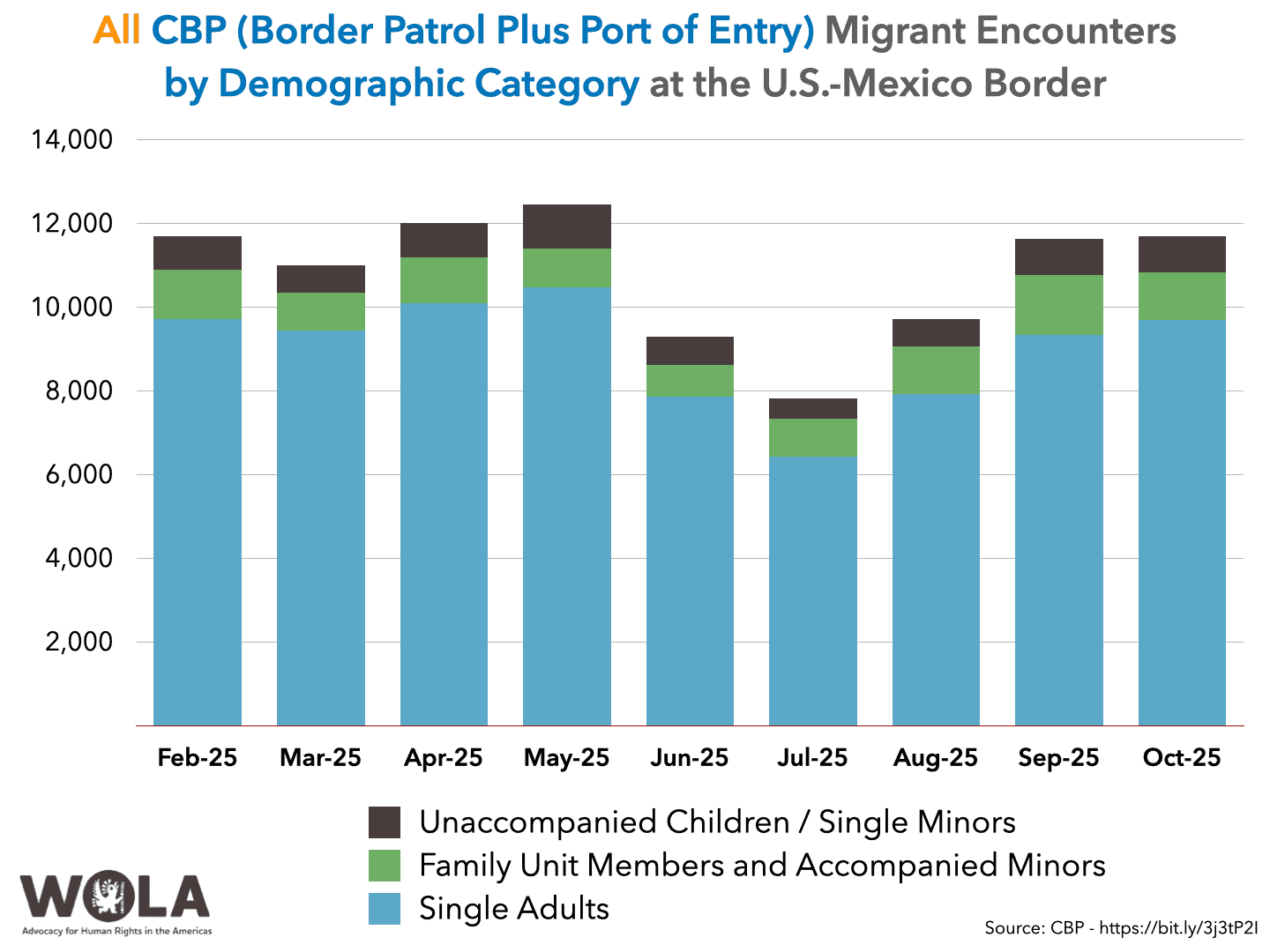
October’s all-CBP encounters with members of family units, and especially with unaccompanied children, were greater than the February-September average by double-digit margins, while encounters with single adult migrants were close to the Trump-era average.
If chart is not visible, click here
All CBP (Border Patrol plus ports of entry) encounters with migrants at the U.S.-Mexico border, by demographic
|
Demographic Category |
Oct-25 |
February-September Average |
October Variation from Average |
|
Single Adults |
9,695 |
8,917 |
+9% |
|
Family Unit Members |
1,095 |
982 |
+11% |
|
Unaccompanied Children / Single Minors |
867 |
755 |
+15% |
|
Accompanied Minors |
53 |
57.1 |
-7% |
|
Total |
11,710 |
10,712 |
+9% |
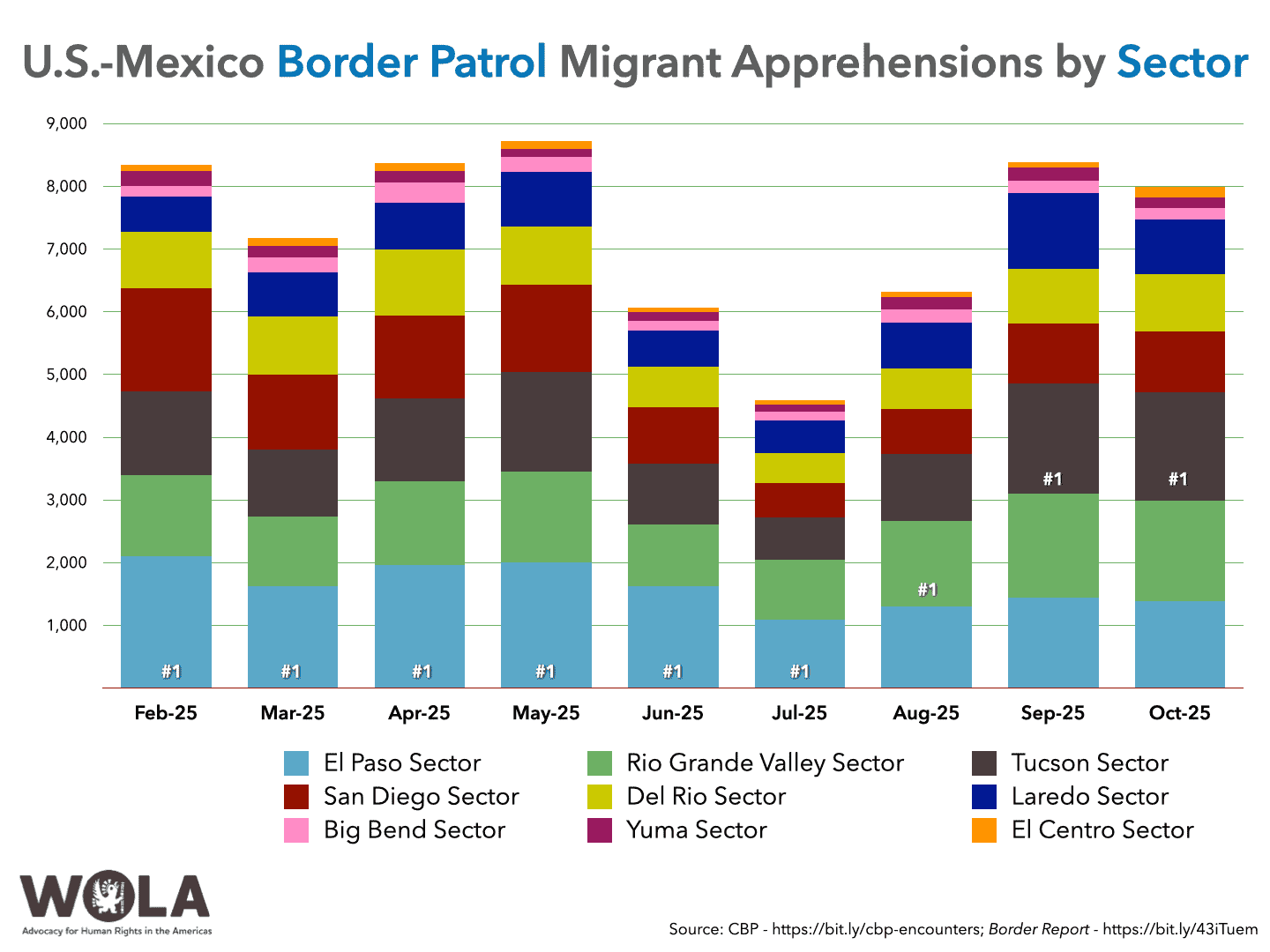
For the second straight month, Border Patrol’s Tucson Sector, in Arizona, led all of the agency’s nine U.S.-Mexico border geographic sectors in apprehensions. The number two through four sectors in October were all in Texas.
If chart is not visible, click here
Five sectors reported apprehensions in October that were higher than the February-September average. El Paso (west Texas and New Mexico) and San Diego (California) measured double-digit declines from the Trump-era average.
A Reuters report noted the quieter conditions in Border Patrol’s San Diego sector, with shelters nearly empty there and in Tijuana, and injuries from falling off the border wall dropping from 1,210 in all of 2024 to 44 through October 2025. Before the Trump administration eliminated the possibility of seeking asylum at the border, some asylum seekers would scale the first layer of San Diego’s double border fence and wait to turn themselves in to agents; many would fall from the 30-foot structure.
Border Patrol apprehensions of migrants at the U.S.-Mexico border, by sector
|
Geographic Area |
Oct-25 |
February-September Average |
October Variation from Average |
|
El Paso Sector |
1,381 |
1,648 |
-16% |
|
Tucson Sector |
1,741 |
1,222 |
+42% |
|
Rio Grande Valley Sector |
1,602 |
1,265 |
+27% |
|
San Diego Sector |
960 |
1,084 |
-11% |
|
Del Rio Sector |
910 |
807 |
+13% |
|
Laredo Sector |
875 |
742 |
+18% |
|
Big Bend Sector |
188 |
209 |
-10% |
|
Yuma Sector |
161 |
171 |
-6% |
|
El Centro Sector |
171 |
102 |
+68% |
|
Total |
7,989 |
7,249 |
+10% |
In the five sectors where apprehensions exceeded their Trump-era average (by a cross-sector total of 28 percent), the most significant growth was in apprehensions of citizens of Mexico, Guatemala, and northern South America.
Border Patrol apprehensions of migrants in the five U.S.-Mexico border sectors where October 2025 was above the Trump-era average, by nationality
|
Nationality |
Oct-25 |
February-September Average |
October Variation from Average |
|
Mexico |
3,584 |
2,701 |
+33% |
|
Guatemala |
642 |
454 |
+41% |
|
Honduras |
335 |
349 |
-4% |
|
Other Countries |
91 |
143 |
-36% |
|
El Salvador |
125 |
110 |
+14% |
|
Venezuela |
145 |
104 |
+39% |
|
Cuba |
82 |
68.1 |
+20% |
|
Colombia |
74 |
48.5 |
+53% |
|
Ecuador |
66 |
44.5 |
+48% |
|
Nicaragua |
37 |
24.6 |
+50% |
|
India |
26 |
23.1 |
+12% |
|
China |
34 |
21.6 |
+57% |
|
Brazil |
19 |
15.9 |
+20% |
|
Peru |
20 |
14.1 |
+42% |
|
Russia |
11 |
3.6 |
+203% |
|
Turkey |
3 |
4.4 |
-31% |
|
Haiti |
2 |
4.3 |
-53% |
|
Romania |
2 |
3.0 |
-33% |
|
Ukraine |
1 |
0.5 |
+100% |
|
Total |
5,299 |
4,138 |
+28% |
In those five sectors that experienced growth in October, family unit members increased the most (32%). However, 80 percent of the apprehended population in those sectors was single adults, a much greater share than during the 2014-2024 fiscal years (63%).
Border Patrol apprehensions of migrants in the five U.S.-Mexico border sectors where October 2025 was above the Trump-era average, by demographic
|
Demographic Category |
Oct-25 |
February-September Average |
October Variation from Average |
|
Single Adults |
4,242 |
3,295 |
+29% |
|
Family Unit Members |
444 |
337 |
+32% |
|
Unaccompanied Children / Single Minors |
613 |
506 |
+21% |
|
Total |
5,299 |
4,138 |
+28% |
Supreme Court to review “metering” policy
The U.S. Supreme Court will review an appeals court decision that had prohibited CBP from restricting asylum seekers’ access to the U.S.-Mexico border’s ports of entry. Under this practice, called “metering,” CBP officers stationed at the borderline—including in the middle of bridges over the Rio Grande—were preventing all who do not show proof of documented status in the United States, or some other official permission to enter, from setting foot on U.S. soil. Officers performing metering turn back all who cannot show such documentation, including those claiming fear for their lives or freedom in Mexico or their countries of origin.
Section 208 of the Immigration and Nationality Act affords the right to seek asylum to “any alien who is physically present in the United States or who arrives in the United States.” U.S. law and policy discourage asylum seekers from “arriving” by crossing the border between the official ports of entry, which is a misdemeanor even when the intent is to surrender to Border Patrol agents to seek protection. Instead, asylum seekers are expected to approach a port of entry and, once on U.S. soil, request protection from CBP officers inside the port facility.
That is impossible to do, however, when CBP officers are “metering.” The practice first emerged in 2016, when the Obama administration placed officers on the line in San Diego during a large-scale arrival of Haitian citizens. The first Trump administration revived metering in 2018, expanding it to the entire border.
“Metering” was later eclipsed, in most cases, by the pandemic-era “Title 42” policy that mandated the automatic expulsion of all asylum seekers, and then by the Biden administration’s adoption of a smartphone app, CBP One, that required asylum seekers to make appointments, often months ahead of time, at ports of entry. As officers on the line turned away nearly all asylum seekers who lacked CBP One appointments, rights advocates derided the policy as “digital metering.”
Litigation brought by the San Diego- and Tijuana-based group Al Otro Lado and several asylum seekers largely struck down the “metering” policy, as courts declared it illegal because it prevents people who may face a risk of grave harm from “arriving” as intended at ports of entry. (The plaintiffs in the Al Otro Lado v. Noem case are represented by the American Immigration Council, the Center for Gender and Refugee Studies (CGRS), the Center for Constitutional Rights, Democracy Forward, and the Institute for Constitutional Advocacy and Protection.)
The Ninth Circuit Court of Appeals in California upheld the ban on metering, even as subsequent policies—Title 42, CBP One, and now the Trump administration’s blanket ban on asylum discussed above—made it irrelevant. Still, the Trump administration in July requested that the Supreme Court review the lower courts’ decision, citing a desire to have flexibility in limiting access to ports of entry, to “retain the option of reviving that practice when border conditions justify doing so.”
The Supreme Court granted the administration’s request on November 17. Especially at issue will be what Section 208 means by “physically present” and “arriving” in the United States.
“The government’s turnback policy was an illegal scheme to circumvent these requirements by physically blocking asylum seekers arriving at ports of entry and preventing them from crossing the border to seek protection,” reads a statement from the plaintiffs. “Vulnerable families, children, and adults fleeing persecution were stranded in perilous conditions where they faced violent assault, kidnapping, and death. We look forward to presenting our case to the Court.”
“The court will hear arguments in the case next year,” probably in the spring, “and hand down a decision by the end of June,” CNN reported.
Gregory Bovino, the face of the roving Border Patrol contingent leading “mass deportations”
A masked, heavily armed DHS contingent made up mainly of Border Patrol agents, which reports directly to Secretary Kristi Noem, has begun aggressive “mass deportation” operations in Charlotte, North Carolina, after carrying out raids and sweeps in Los Angeles during June-September and Chicago during September-November. (See the “Links: ‘mass deportation’ and human rights in the U.S. interior” section below for links to extensive coverage.)
As in recent weeks, this roving unit and its high-profile and politically outspoken “at large” leader, Gregory Bovino, continue to be the subject of significant media coverage and analysis. A career Border Patrol agent who started the year as the chief of the agency’s quiet sector in El Centro, in southeast California, Bovino has risen quickly in an ultraconservative, immigration-restrictionist administration that values aggressive messaging and provocative, social media-ready imagery.
So far this year, Bovino has seen courts restrict his unit’s actions three times. A judge found fault with indiscriminate arrests in Kern County, California, when he was heading the El Centro Sector in January. In Los Angeles, a court limitedhis unit’s use of racial profiling (which Bovino denies, using the term “articulable facts”) until the Supreme Court allowedit to proceed while the case undergoes appeal. In Chicago, a judge placed limits on his unit’s use of force against protesters and required him to use a body-worn camera.
President “Trump has turned Bovino’s agents into a personal army as well as a political tool, picking which cities he wants them to strike based on shifting factors, including whether mayors are nice to him,” read a November 20 analysisfrom Nick Miroff at the Atlantic.
Miroff’s is one of several recent pieces highlighting the difference between the tactics used by ICE—a police force that usually tries to leave a lighter footprint in populated areas through targeted operations—and those of Border Patrol, which is accustomed to encountering people by chance in rural and wilderness areas and is quicker to use force. Border Patrol tactics are flashier when employed in cities, and may be more in line with the administration’s expectations of large arrest numbers regardless of captured migrants’ lack of criminal records. Andrea Guerrero of Alliance San Diego, a longtime advocate of accountability for Border Patrol abuses, calls the agency’s expanded role in the U.S. interior the “borderfication” of the country, noted Pedro Rios of the American Friends Service Committee of San Diego.
“Bovino is the only Border Patrol commander whose social-media profile photo shows him holding a weapon,” Miroff observed. “He represents a subculture within the agency that has tried to boost recruitment by making the job look more like military service.” An unnamed “longtime ICE official” told Miroff that “Bovino is ‘out of control,’ and warned that his expanding role will lead to the detention of more U.S. citizens and ‘more hate and more violence.’”
At his widely read Law Dork newsletter, legal analyst Chris Geidner took offense at Bovino’s choice of “Operation Charlotte’s Web” as the title of his unit’s new deployment in North Carolina’s largest city. “To use a book authored by E.B. White as your name is an offense to history. White was a leading voice for American democracy and freedom and against fascism and tyranny. Abusing his life’s work like this cannot stand without a response.”
At his newsletter, Garrett Graff, author of a much-cited 2014 Politico Magazine investigation of Border Patrol’s organizational culture, darkly compared Bovino to another figure from the United States’ past. “Bovino is basically leading a rebel cavalry, a la Confederate Gen. Nathan Bedford Forrest, who raided and terrorized communities in Kentucky and Tennessee in the Civil War. That latter analogy holds up particularly well in one specific respect: Forrest became the first Grand Wizard of the Ku Klux Klan after the war.”
The “at large” commander “is leading a mounted raiding unit,’ Graff continued, “that descends, unwanted, on targeted communities, terrorizes the residents, and then—unable to break and defeat the hostile residents and ill-positioned to fight a sustained losing battle—withdraws, always trying to stay just a couple steps ahead of the judicial orders and court showdowns that have blocked its worst tactics.” His column concludes that while they produce much dramatic video footage, Bovino’s unit’s tactics don’t work, as “targeted communities are fighting back faster and with a more tried-and-true playbook: Organize quickly, step up and document the abuses, protest loudly, and fight in the courtrooms.”
The conservative Daily Mail, a U.K. paper, published a mini-biography of Bovino, which asserts that a family tragedy when he was 11 years old in rural North Carolina—his father’s killing of a young woman in a drunk-driving accident—toughened him up through adversity and “turned him into the man he is today.”
“Until something changes, either in the courts or through an election, I think Bovino’s style and his influence is only going to grow,” said the New York Times’s Hamed Aleaziz in an episode of the newspaper’s popular Daily podcast featuring excerpts from Aleaziz’s recent interview with the at-large chief.
Notes from elsewhere in the Americas
- Ecuador has reached a “safe third country” agreement with the Trump administration. The South American nation will accept the U.S. deportation of up to 300 asylum seekers from third countries each year, according to media reports, who would then be allowed to apply for asylum in Ecuador’s system.
- The Trump administration acknowledged that it “inadvertently” deported a transgender woman to Mexico last week despite an immigration judge’s requirement that she not be deported there due to the likelihood that she might face torture. DHS told a federal judge that it is seeking to bring the woman, who lost her permanent residency in 2023 after pleading guilty to assault, back to the United States in order to remove her to a third country.
- James Boasberg, the chief judge of the Washington, DC District Court, is continuing with contempt-of-court proceedings against the Trump administration, as he seeks to “find out” whether administration officials deliberately misled him and disobeyed his March 15 order to halt flights sending 252 Venezuelan men, without due process, to a prison in El Salvador. The D.C. Circuit Court of Appeals had halted the contempt proceedings in April, but subsequent opinions have sent the issue back to Boasberg. “Justice requires me to move promptly on this,” the judge said at a November 17 hearing. “My intent is to begin the Monday after Thanksgiving,” December 1, he added.
- Citing the findings of a November Human Rights Watch and Cristosal report on the Venezuelans’ rendition to El Salvador, four Democratic legislators—the ranking members of the Foreign Relations and Foreign Affairs Committees and relevant subcommittees—led a letter to Secretary of State Marco Rubio and Secretary of Homeland Security Kristi Noem. It demands information about the agreement between the U.S. and Salvadoran governments; the $4.76 million transfer of funds to El Salvador for the Venezuelan men’s imprisonment; U.S. officials’ prior assessment of the likelihood that the men would be tortured in the Salvadoran prison, as the HRW-Cristosal report affirmed; and whether the reports’ findings will appear in the 2026 State Department human rightsreport on El Salvador, which did not acknowledge the Salvadoran government’s frequent use of torture.
- The OAS Inter-American Commission on Human Rights (CIDH) has issued precautionary measures in favor of three Salvadoran men, two of whom the U.S. government sent to El Salvador at the same time as it rendered the 252 Venezuelans. There, “they face a serious and urgent risk of suffering irreparable harm to their rights to life and personal integrity,” the Commission reported. The men were jailed upon their arrival in El Salvador, and their current whereabouts are unknown.
- In Mexico, members of the “Border Patrol Victims’ Network,” an organization of survivors of Border Patrol uses of force and relatives of people killed by Border Patrol agents, is petitioning the CIDH as an avenue for the redress that they have been unable to obtain in the U.S. justice system, reported Courthouse News. The U.S.-Mexico border was not a focus of hearings during the session that the Commission held during the week of November 17.
- The Salvadoran investigative site El Faro reported from the Guatemala City reception facility where people arrive after being deported from the United States: 398 planes between Donald Trump’s January 20 inauguration and October 15. “Some men resign themselves to contemplating robbery: ‘There are no opportunities here; all that’s left is to go steal.’ Others, with their savings, plan to start businesses in their villages: ‘Until Trump leaves, we’re not going back to that country,’ says one.”
- The New York Times reported on the deportation, and separation from her children, of Guatemalan citizen Maribel López, whom ICE sent to her country of origin in error, as she has a pending asylum case in the United States. “With immigration agents under intense pressure to deport thousands of people each day, Ms. Lopez was pushed through the system swiftly and was deported within four days of the factory raid” in upstate New York where she was captured.
- Milenio noted that as more migrants from elsewhere in the Americas choose to live and work in Mexico instead of the United States, financial remittances from Mexico to elsewhere in Latin America are a multiple of what they were in the early 2020s.
- As would-be migrants abandon plans to come to the United States, the cargo train that passes through Mexico’s northern state of Chihuahua en route to Ciudad Juárez and El Paso now runs with almost no people riding on its cars, the El Paso Times reported.
- The State Department is revoking and restricting visas for citizens of Nicaragua who have facilitated migration to the United States, a policy that began during the Biden administration in response to a smuggling route opening up due to the Nicaraguan government’s relatively lenient visa policies.
- The number of U.S. deportation flights to Venezuela since the Trump administration began now totals 88, with the most recent plane arriving in Caracas on November 19 with 167 people aboard. The administration has flown more than 16,000 people back to Venezuela this year.
Other news
- The October edition of Human Rights First’s ICE Flight Monitor found that ICE has run 1,701 flights removing people from the United States during the first 10 months of the year, far more than the 1,247—then probably a record—measured through October 2024. Domestic transfer or “shuffle” flights have more than doubled. The use of military planes appears to have paused, with no military flights in October. At the American Prospect, Gillian Brockell wrote about these flights’ “sloppy, dangerous” nature, citing “poor planning, cruel treatment, and serious safety lapses.”
- On November 17, Defense Department contractors aboard a boat arrived on a Mexican beach just south of where the Rio Grande meets the Gulf of Mexico, and proceeded to place the “Restricted Area” signs that the Department has been installing along much of the U.S. side of the border. The signs are part of the Trump administration’s effort to declare a fringe of border territory to be “National Defense Areas” where unauthorized people can be charged with trespassing on a military installation. Mexican marines later removed the signs, and Mexican President Claudia Sheinbaum called on the International Boundary and Water Commission (IBWC) to resolve the issue. While the beach in question is south of the river, the Rio Grande’s course often shifts but the borderline does not.
- Border Patrol and CBP have access to license plate data, monitoring the travel patterns of U.S. citizens and immigrants alike, from at least three private sector vendors, the Associated Press reported. Through one vendor, Flock, “Border Patrol for a time had access to at least 1,600 license plate readers across 22 states.” In some jurisdictions, including in the U.S. interior, local law enforcement officers are pulling over drivers based on tips provided by Border Patrol, without revealing the source.
- The southern African kingdom of Eswatini (formerly Swaziland) agreed to accept 160 U.S. deportees from third countries in exchange for $5.1 million to “build its border and migration management capacity,” reported Agénce France Presse, citing a document obtained by Human Rights Watch.
- A New York Times poll of immigrants living in the United States found that 60 percent of respondents (61% of citizens, 62% of lawfully present noncitizens, 47% of undocumented people) supported the Trump administration’s crackdown along the U.S.-Mexico border. Thirty-eight percent disapproved. Opinions are different regarding administration policies in the U.S. interior: 57 percent disapprove “of the Trump administration’s increasing efforts to deport people living in the U.S. illegally” (54% of citizens, 58% of lawfully present noncitizens, 71% of undocumented people). (For links to more results of this poll, see the “Public opinion” subsection of the “‘Mass Deportation’ links” section below.)
- A boat carrying migrants capsized off the coast of San Diego late on November 14. Four were reported dead and another four injured.
- Border Patrol agents extracted an individual who was ensnared by razor-sharp concertina wire attached to the border wall near El Paso. The person was taken into custody with “minor scrapes,” Border Report noted. A similar incident happened on October 30, when first responders in San Diego had to “create a pulley system” to extricate a woman who had become stuck on the wire. Border Patrol Chief Mike Banks posted a video and a photo of an individual tangled in wire at the top of the border wall; it is not clear whether that photo depicted a third recent incident.
- A new construction project is adding a second layer behind existing border wall in New Mexico just west of El Paso.
- The Arizona Republic covered the launch of a 27-mile border wall construction project in southeast Arizona, in “one of the few remaining migration corridors that endangered jaguars and ocelots traverse when exploring their northernmost outposts in Arizona’s Sky Islands.” Speaking at a 200-person protest opposing the project, newly sworn-in Rep. Adelita Grijalva (D) called the wall “a despicable symbol of hatred.”
- Local media in San Antonio reported that smugglers are increasingly using tunnels, sewer lines, and drainage systems to cross from Nuevo Laredo, Tamaulipas, into Laredo, Texas.
- An Arizona court sentenced Border Patrol agent Jorge Jimenez to 78 months in prison for allowing drug traffickers to smuggle their product through checkpoints in 2024. The ruling comes a week after the 15-year sentence handedto a San Diego CBP officer who similarly allowed traffickers to pass through his lane.
- The Mexican daily Milenio reported on the proliferation of social media videos, using graphics imitating news bulletins, falsely informing would-be migrants that “a federal judge has just suspended massive deportations” or “Tomorrow, October 31, the border will open so that thousands of migrants can come to work in the United States.”
Links: “mass deportation” and human rights in the U.S. interior
Border Patrol and ICE contingent begins operations in Charlotte, North Carolina
Tina Vasquez, North Carolina Immigration Raids Expected to Escalate (Prism, Wednesday, November 19, 2025).
As the impacts of the raids quickly ripple outward from Charlotte, North Carolinians are mobilizing to stem enforcement operations in their communities
Eduardo Medina, As Border Patrol Floods North Carolina, Charlotte Asks, ‘Why Us?’ (The New York Times, Wednesday, November 19, 2025).
Federal officials say they have arrested more than 200 people in Charlotte, shaking a budding metropolis far from any border that has welcomed waves of immigrants for decades
Dianne Gallagher, Zoe Sottile, Charlotte Is the Latest Stop on DHS’s Immigration Blitz. Locals Don’t Understand Why (CNN, Monday, November 17, 2025).
As dozens of people have been arrested in the Department of Homeland Security’s latest targeted immigration blitz in Charlotte, one question has emerged for residents and leaders in North Carolina’s largest city: Why Charlotte?
Eduardo Medina, Emily Cataneo, Meredith Honig, Border Patrol Expands North Carolina Operations to More Liberal Cities (The New York Times, Tuesday, November 18, 2025).
Agents were active in the Raleigh and Durham areas on Tuesday, though the scope of the immigration crackdown in the state’s Research Triangle region was not immediately clear
Jess Bidgood, The Charlotte Raids Pose a New Political Test of a Top Trump Priority (The New York Times, Monday, November 17, 2025).
Border Patrol agents descended on Charlotte over the weekend, searching for immigrants who are in the country illegally. It remains unclear how long the agents will stay
Eduardo Medina, Sonia A. Rao, Border Patrol Fans Out Across Charlotte, N.C., Arresting More Than 130 People in Two Days (The New York Times, Sunday, November 16, 2025).
Border Patrol agents descended on Charlotte over the weekend, searching for immigrants who are in the country illegally. It remains unclear how long the agents will stay
Bernard Mokam, Eduardo Medina, U.S. Border Patrol Launches Operation in Charlotte (The New York Times, Saturday, November 15, 2025).
It is unclear how long the operation will last in North Carolina’s largest city, which has a growing immigrant population
Camilo Montoya-Galvez, Border Patrol Plans to Expand Trump’s Immigration Crackdown to Charlotte and New Orleans, With Armored Vehicles and Special Agents (CBS News, Friday, November 14, 2025).
The Trump administration is planning to dispatch Border Patrol agents to Charlotte and New Orleans to oversee immigration operations that could involve armored vehicles and special operations teams
Soon, New Orleans
Camilo Montoya-Galvez, Trump Administration’s Immigration Crackdown in New Orleans Could Start as Early as Dec. 1, Sources Say (CBS News, Tuesday, November 18, 2025).
The Trump administration’s planned immigration enforcement crackdown in New Orleans could start as early as Dec. 1, Department of Homeland Security sources told CBS News
Chicago
Garrett M. Graff, Trump, Border Patrol Retreat in Failure From Chicago (Doomsday Scenario, Monday, November 17, 2025).
Five important lessons of the first six months of Trump’s immigration raids — and why CBP’s Greg Bovino is the Nathan Bedford Forrest of the Trump era
Gregory Royal Pratt, Laura Rodriguez Presa, Rebecca Johnson, Latino US Citizens Racially Profiled by Federal Immigration Agents in Chicago: ‘I Felt Like a Piece of Trash’ (The Chicago Tribune, Saturday, November 15, 2025).
The Tribune spoke to U.S. citizens and green card holders who have either been questioned or detained during Trump’s Operation Midway Blitz
Jodi S. Cohen, Mariam Elba, Melissa Sanchez, Sebastian Rotella, T. Christian Miller, “I Lost Everything”: Venezuelans Were Rounded Up in a Dramatic Midnight Raid but Never Charged With a Crime (ProPublica, Thursday, November 13, 2025).
Authorities said Tren de Aragua “terrorists” had taken over the building. A ProPublica investigation found little evidence to back up the government’s claims. For the first time, the Venezuelans arrested in a Chicago raid are telling their stories
al Letson, Ashley Cleek, “They Dragged Her Out in Front of the Kids”: Inside Chicago’s ICE Raid at a Bilingual Daycare (Mother Jones, Thursday, November 13, 2025).
When armed agents stormed Rayito de Sol, a Spanish-immersion daycare, parents like Maria Guzman say their children witnessed terror—not justice
Camillo Barone, Amid ICE Raids, Chicago Priests Support Immigrants With a Whistle and a Rosary (National Catholic Reporter, Thursday, November 13, 2025).
In Chicago’s Mexican neighborhood of Pilsen, fear runs deep and families have been torn apart by ICE. Some immigrants have found a “second family” at St. Pius V, where priests have been supporting immigrant parishioners
Melody Mercado, Mick Dumke, 400 Arrested by ICE in Chicago to Be Released Friday, but Feds’ ‘Risk’ List Remains Murky (Block Club Chicago, Wednesday, November 19, 2025).
A judge denied the Department of Homeland Security’s bid to delay releases, saying ICE failed to justify detentions or show it would win on appeal. Questions remain around how risk is calculated by the government
Gregory Royal Pratt, Jason Meisner, Laura Rodriguez Presa, Madeline Buckley, Rebecca Johnson, Only 2.6% on List of 614 ‘Operation Midway Blitz’ Arrestees Had Criminal Histories, DOJ Records Show (The Chicago Tribune, Friday, November 14, 2025).
Meanwhile, the other 598 people on the list had no listed criminal history at all
Austin Kocher, ICE’s Enforcement Blitz in Chicago Shows Familiar Pattern: 78% of Arrests Are “Low Risk” According to Government’s Own Data (Austin Kocher, Wednesday, November 19, 2025).
New federal disclosures through ongoing Castañon Nava Settlement reveal that Chicago’s immigration crackdown overwhelmingly targeted people who pose little to no public safety risk
Diana Novak Jones, Eric Cox, Nearly Two Dozen Arrested as Faith Leaders Protest Outside Chicago-Area ICE Facility (Reuters, Reuters, Friday, November 14, 2025).
New York (City and State)
Ana Ley, Luis Ferre-Sadurni, Trump’s Border Czar Threatens More Immigrant Arrests in New York City (The New York Times, Tuesday, November 18, 2025).
Thomas Homan said that additional federal agents would descend on the city if it did not help with President Trump’s deportation campaign
Benjamin Weiser, Luis Ferre-Sadurni, ICE Frees Blind Migrant Who Was Detained for Days in Isolation (The New York Times, Tuesday, November 18, 2025).
Carlos Anibal Chalco Chango, 40, was released on Monday from an upstate New York jail where he had been held without his cane. It was a surprising move by an agency that rarely frees detainees
Los Angeles area
Gustavo Arellano, Commentary: Car Wash Workers Already Had It Tough. Then Immigration Raids Slammed Them to the Ground (The Los Angeles Times, Tuesday, November 18, 2025).
Activists say immigration agents have raided at least 100 car washes across Southern California since June, detaining at least 340 mostly Latino workers in Trump’s deportation push
Jacob Sisneros, A Viral Arrest, a Drunken Brawl and an Overdose: The Last Days of a Notorious Border Patrol Agent (Long Beach Post News, Thursday, November 13, 2025).
We obtained hours of body-camera video that give the fullest — and perhaps last — glimpse of Agent Isaiah Hodgson’s mindset when he became a flashpoint in the fight over immigration raids
Florida
Syra Ortiz Blanes, US Border Patrol Chief: South Florida Getting More Agents for Crackdown (Miami Herald, Florida Courier, Friday, November 14, 2025).
There will soon be more Border Patrol agents roaming South Florida to enforce border security and immigration law, thanks to the Trump administration’s billion-dollar injection of federal funds
Jeffrey Schweers, Sanford Grandfather, Born in Refugee Camp, Nabbed by ICE After 70 Years in U.S. (The Orlando Sentinel, Sunday, November 16, 2025).
Paul Bojerski never gained official residency, but he checked in regularly with ICE for years. Then in July, at age 79, he was detained and sent to Alligator Alcatraz
Nationwide
Quinta Jurecic, The Trump Administration’s Favorite Tool for Criminalizing Dissent (The Atlantic, Tuesday, November 18, 2025).
Federal prosecutors have charged more than 100 people with Section 111 violations. Was their crime anything more than opposing Trump’s immigration policies?
Adam Cancryn, Priscilla Alvarez, Exclusive: Thousands of Parents, Guardians of Migrant Kids Arrested in Trump Administration Crackdown (CNN, Friday, November 14, 2025).
The Trump administration’s latest immigration enforcement initiative is an intense effort to crack down on parents and guardians who paid for children to come across the border
Gloria Rebecca Gomez, Native American Woman Nearly Deported After Polk County Jail Issues ICE Detainer by Mistake (Iowa Public Radio, Thursday, November 13, 2025).
A Native American woman from Arizona was nearly deported by federal immigration officials after a clerical error at the Polk County Jail. The woman’s family had to scramble to prove she was Indigenous and shouldn’t be turned over to ICE
Billy Witz, What to Know About Trump’s Federal Crackdown, City by City (The New York Times, Tuesday, November 18, 2025).
Charlotte and Raleigh in North Carolina became the latest cities to see federal forces move in. Here’s a rundown of what’s going on in each place
Aline Behar Kado, Haley Parsley, Raphael Romero Ruiz, How Blue State Maryland Plays Surprising Role in Implementing Trump’s Immigration Agenda (Capital News Service, The Daily Times, Monday, November 17, 2025).
Officials in Allegany, Carroll, Garrett, St. Mary’s and Washington counties signed 287(g) agreements. Wicomico County has tabled that drive for now
Jim Thomas, Michael Banks to Newsmax: Border Patrol Will Help ICE Anywhere in US (Newsmax, Saturday, November 15, 2025).
Border Patrol agents are expanding nationwide support for federal immigration enforcement by assisting Immigration and Customs Enforcement, Chief Michael Banks told Newsmax on Saturday
Immigration focus is undermining other DHS missions
Alexandra Berzon, Hamed Aleaziz, Michael H. Keller, Nicholas Nehamas, Zolan Kanno-Youngs, Homeland Security Missions Falter Amid Focus on Deportations (The New York Times, Sunday, November 16, 2025).
Border Patrol agents descended on Charlotte over the weekend, searching for immigrants who are in the country illegally. It remains unclear how long the agents will stay
Indiscriminate ICE arrests
Alexander Stockton, Ayman Soliman, Francesca Trianni, Jasmine Mooney, Jemmy Jimenez Rosa, Sarah Wildman, We Followed the Rules. ICE Jailed Us Anyway. (The New York Times, Monday, November 17, 2025).
The brutal detention of three people who came to the U.S. legally reveals a cruel system that operates with impunity
ICE may employ “bounty hunters” to track undocumented people
Joseph Cox, Contractor Recruiting People on Linkedin to Physically Track Immigrants for ICE, Will Pay $300 (404 Media, Tuesday, November 18, 2025).
“The more I listened to it, the more I’m like, something doesn’t sound right,” a person who was briefed on the pilot plans told 404 Media
Organizational culture and oversight
SHADOW HEARING – Unmasking the Truth: How Trump’s Immigration Raids Target U.S. Citizens and Terrorize Communities (Committee on Homeland Security Democrats, U.S. House of Representatives, Wednesday, November 19, 2025).
Alex Mierjeski, Joshua Kaplan, Justin Elliott, Firm Tied to Kristi Noem Secretly Got Money From $220 Million DHS Ad Contracts (ProPublica, Friday, November 14, 2025).
The company is run by the husband of Noem’s chief DHS spokesperson and has personal and business ties to Noem and her aides. DHS invoked the “emergency” at the border to skirt competitive bidding rules for the taxpayer-funded campaign
Pedro Rios, New ICE Leadership Brings More Violence, No Accountability and Zero Oversight (American Friends Service Committee, CalMatters, Tuesday, November 18, 2025).
If Border Patrol leaders take over ICE, it’s likely both agencies will continue avoiding repercussions for violence and deaths in custody
Geoff Hing, ICE Raids Kept on During the Shutdown, but the Detention Data Stayed Hidden (The Marshall Project, Saturday, November 15, 2025).
More than seven weeks have passed since the last comprehensive release of detention and deportation numbers
Detention
Judd Legum, Noel Sims, How the Trump Administration Sparked a Health Crisis for ICE Detainees (Popular Information, Tuesday, November 18, 2025).
An abrupt decision on October 3 left thousands of ICE detainees without access to vital medical care — a crisis that is ongoing
Dan Gooding, Man Detained by ICE Found Dead, Hanging With Hands and Feet Tied—Attorney (Newsweek, Tuesday, November 18, 2025).
The Chinese national died in Pennsylvania in August, but his family’s requests for answers from DHS have gone unmet
Jason Koebler, Two Weeks of Surveillance Footage From ICE Detention Center ‘Irretrievably Destroyed’ (404 Media, Tuesday, November 18, 2025).
“Defendants have indicated that some video between October 19, 2025 and October 31, 2025 has been irretrievably destroyed and therefore cannot be produced on an expedited basis or at all”
Immigration Detention Costs in a Time of Mass Deportation (National Immigration Forum, Monday, November 17, 2025).
Deportations
Gillian Brockell, ICE Air’s Sloppy, Dangerous Deportation Flights (The American Prospect, Monday, November 17, 2025).
Poor planning, mechanical issues, serious safety lapses, and the shutdown are taking a toll on Avelo, America’s most famous deportation airline, internal documents show
The military role
Eric Schmitt, Pentagon to Withdraw Some National Guard Troops From Chicago and Portland (The New York Times, Sunday, November 16, 2025).
The move comes amid court battles and objections by state and local leaders to President Trump’s deployment orders
Juliana Kim, Trump’s National Guard Deployments Face Mounting Legal Pushback (National Public Radio, Wednesday, November 19, 2025).
President Trump’s efforts to send National Guard troops to U.S. cities have been repeatedly met with resistance in the courts — most recently, in Tennessee
Ian Millhiser, The Supreme Court Is About to Rule on Whether Trump Can Use Troops Against Americans (Vox, Friday, November 14, 2025).
Thus far, the justices have signaled they may not let him — yet
Margy o\’herron, Mark Nevitt, Military Lawyers Should Not Serve as Immigration Judges (Brennan Center, Emory University School of Law, Just Security, Thursday, November 13, 2025).
DOJ’s decision to appointment several military lawyers, or JAGs to serve as immigration judges is not only against the law, but a bad idea
Celine Castronuovo, Suzanne Monyak, DOJ Memo Draws Doubts on Military Lawyers as Immigration Judges (Bloomberg Law, Tuesday, November 18, 2025).
The Trump administration’s legal opinion backing the use of military lawyers as immigration judges is drawing scrutiny from legal scholars who say the move represents an unprecedented expansion of the executive branch’s authority
Technology and civil liberties concerns, including license-plate readers
Byron Tau, Garance Burke, Border Patrol Is Monitoring US Drivers and Detaining Those With ‘Suspicious’ Travel Patterns (Associated Press, Associated Press, Thursday, November 20, 2025).
The U.S. Border Patrol is monitoring millions of American drivers nationwide in a secretive program to identify and detain people whose travel patterns it deems suspicious
Joseph Cox, This App Lets ICE Track Vehicles and Owners Across the Country (404 Media, Monday, November 17, 2025).
Material viewed by 404 Media shows data giant Thomson Reuters enriches license plate data with marriage, voter, and ownership records. The tool can predict where a car may be in the future
Joseph Cox, Google Has Chosen a Side in Trump’s Mass Deportation Effort (404 Media, Thursday, November 13, 2025).
Google is hosting a CBP app that uses facial recognition to identify immigrants, while simultaneously removing apps that report the location of ICE officials because Google sees ICE as a vulnerable group. “It is time to choose sides; fascism or morality? Big tech has made their choice”
Democrats’ “Bivens Act” would reverse Supreme Court decision restricting victims’ ability to sue federal officials
Rep. Hank Johnson (D-Georgia), Congressman Johnson Reintroduces Bills to Hold Federal Officials Accountable (U.S. House of Representatives, Wednesday, November 19, 2025).
Congressmen Johnson, Raskin reintroduce Bivens Act That Would Allow Citizens to Recover Damages for Constitutional Violations by Federal OfficialsSen. Sheldon Whitehouse (D-RI) Introduces Senate Companion
Public opinion, including a New York Times survey of immigrants living in the United States
Ana Ley, Ashley Cai, Luis Ferre-Sadurni, Ruth Igielnik, Under Trump, Immigrants Are More Fearful but Determined to Stay, Poll Finds (The New York Times, Tuesday, November 18, 2025).
A national survey found that half of all immigrants in the United States say they feel less safe since President Trump took office. Still, many say their future remains bright
Hamed Aleaziz, Ruth Igielnik, Most Immigrants Support Border Enforcement, but Not Mass Deportations, Poll Finds (The New York Times, Wednesday, November 19, 2025).
A survey by The New York Times and KFF shows that even many of those who support President Trump feel his approach has gone too far
Miriam Jordan, Ruth Igielnik, How Noncitizens, Anxious Under Trump, Are Altering Their Lives (The New York Times, Wednesday, November 19, 2025).
Months into the Trump deportation campaign, one-third of noncitizens, including about 60 percent of undocumented immigrants, say they are avoiding aspects of daily life
Caroline Soler, Christine Zhang, Ruth Igielnik, How Americans Feel About Immigrants and Immigration (The New York Times, Wednesday, November 19, 2025).
A review of polls of the general public shows how opinions on immigration vary widely based on the details included in poll questions
What to Know About How the Times/KFF Survey of Immigrants Was Conducted (The New York Times, Tuesday, November 18, 2025).
The survey provides a rare look at the lives and opinions of immigrants of varying backgrounds and legal statuses
Christian Paz, There’s a Curious Trend Dividing Latino Republicans (Vox, Monday, November 17, 2025).
How Trump is starting to make Hispanic Republicans uneasy
Adam Isacson (he/him), Director for Defense Oversight
WOLA: Advocacy for Human Rights in the Americas (www.wola.org)
Signal adamisacson.98 Mobile/WhatsApp +1 202 329-4985
Mastodon: elefanti.co/@adam BlueSky: @adamisacson.com