
U.S.-Mexico Border Update: January 23, 2026

Adam Isacson
U.S.-Mexico Border Update: January 23, 2026
With this series of updates, WOLA seeks to cover the most important developments at the U.S.-Mexico border. See past updates here.
Your donation to WOLA is crucial to keeping these paywall-free and ad-free Updates going. Please contribute now and support our work.
THIS WEEK IN BRIEF:
- Three deaths in two months at Fort Bliss facility—including a homicide: Three detained migrants died in a space of 44 days at a tent facility at Fort Bliss, an El Paso military base, that is currently the United States’ largest migrant detention facility. An autopsy report found that the second of those deaths was a homicide. Thirty people in 2025, and six more so far in 2026, have died in an ICE detention system that has seen vastly reduced oversight and a several-month cutoff in payments to medical providers.
- 2026 DHS appropriation nears passage, with a handful of Democrats supporting: The 2026 Department of Homeland Security appropriations bill passed the House of Representatives on January 22 with seven Democrats voting along with the Republican majority, despite outcry over recent ICE and CBP abuses and a lack of strong reforms in the bill. The bill now goes to the Senate, which must pass it before January 30 to avoid a partial government shutdown.
- Notes from DHS: A secret ICE memo purports to allow warrantless forcible entry into homes. Rumors are swirling of infighting at DHS and a possible shakeup of CBP management. Reporters’ accounts offer alarming glimpses into ICE and CBP recruitment efforts, which appear to be far from rigorous.
- December migration and drug-seizure data: CBP’s encounters with migrants declined slightly at the border between November and December. Amid a continued suspension of the right to seek asylum, the drop was likely seasonal. After a year and a half of declines, seizures of fentanyl have plateaued at the border. Seizures of cocaine are increasing, even after four months of lethal boat strikes in the Caribbean and Pacific.
- Links to in-depth analyses: Links to updates and reports about the state of the U.S.-Mexico border, and the state of the U.S. immigration system and migration trends, a year after Donald Trump’s inauguration.
THE FULL UPDATE:
Three deaths in two months at Fort Bliss facility—including a homicide
Camp East Montana
Serious concerns are mounting about Camp East Montana, a sprawling detention facility, made entirely of tents, that the Trump administration opened in August 2025 on the grounds of Fort Bliss, a large army base in El Paso, Texas.
The camp, which was holding 2,903 detained migrants on January 8, is the largest migrant detention facility in the country right now. It has already faced allegations of beatings, medical neglect, insufficient food, frequent emergency calls, and denial of meaningful access to counsel, amid concerns that the company given a $1.24 billion contract to run it, Acquisition Logistics, has little experience with detention management.
Alarms are sounding louder after three people detained at Camp East Montana died within the space of 44 days in December and January:
- Francisco Gaspar-Andres, a 48-year-old citizen of Guatemala who, according to Immigration and Customs Enforcement (ICE), died of liver and kidney failure on December 3; an autopsy is still pending.
- Geraldo Lunas Campos, a 55-year-old citizen of Cuba who, according to ICE, may have died of “medical distress” on January 3.
- Victor Manuel Diaz, a 34-year-old citizen of Nicaragua, who on January 14 was found “unconscious and unresponsive” in his room, with suicide a possible cause of death. ICE had detained Díaz in Minneapolis on January 6.
The El Paso County Office of the Medical Examiner issued an autopsy report on January 21 finding that the second death, of Lunas Campos, was a homicide, the Washington Post and other outlets reported.
In mid-January, ICE had informed that the death of Lunas Campos, a father of four with a criminal record who had lived in the United States since the 1990s, was a presumed suicide. The autopsy report, however, found that he died of “asphyxia due to neck and torso compression” and that he became “unresponsive while being physically restrained by law enforcement.”
Two other detainees told the Post that they witnessed at least five guards struggling with Lunas Campos after he refused to enter a segregation unit, claiming he needed his medication (he reportedly suffered from bipolar disorder and anxiety). One said that during the struggle, he heard Lunas Campos say, “I can’t breathe.”
Both witnesses were given deportation notices days after speaking to Washington Post reporter Douglas McMillan about what they saw. Lunas Campos’s children have gone to federal court in western Texas to try to stop the witnesses’ removal from the United States, and a hearing is scheduled for January 27.
Record pace of deaths nationwide
Across the United States, at least 30 people died in ICE detention during the 2025 calendar year, the most in more than 20 years. Another six died in the first two weeks of 2026, including two at Fort Bliss.
The Guardian reported on the September 2025 case of Randall Gamboa Esquivel, who entered the United States at the U.S.-Mexico border while in good health in December 2024. He spent 10 months in detention, only to be flown back to Costa Rica in an air ambulance from the Port Isabel Detention Center in south Texas. Gamboa died a few weeks later.
Medical funding halted
On October 3, ICE halted payments to contractors providing medical care in its detention facilities, and is unlikely to resume those payments until the end of April, even as the size of the nationwide detained population continues to break records. “ICE’s failure to pay its bills for months has caused some medical providers to deny services to ICE detainees,” a Trump administration source told Judd Legum of Popular Information, who broke the story. The stoppage is the result of a lawsuit brought by a small right-wing advocacy group that halted a “small but crucial” claims-processing role played by the Veterans Administration.
Inspections and oversight of detention facilities
The ICE detained population stood at 68,990 people on January 3, up from 39,152 a year earlier. Silky Shah of Detention Watch reported the current population at over 73,000 in a January 20 column.
Even amid that growth, ICE sharply reduced the frequency of detention facility inspections carried out by its Office of Detention Oversight (ODO) in 2025: the Project On Government Oversight and American University’s Investigative Reporting Workshop revealed a 36.25 percent year-over-year decline in inspections.
In December, a Washington, DC federal judge had ruled that, as spelled out in a prior year’s appropriations law, ICE had to permit members of Congress to carry out unannounced oversight visits to detention facilities. However, on January 8, Department of Homeland Security (DHS) Secretary Kristi Noem sent the court a memorandum reinstating a requirement that members of Congress seek approval from ICE seven days in advance of any visits.
The original appropriations law had prohibited ICE from using regular appropriations funds to deny access to members of Congress. But now that ICE has an enormous amount of money from a “non-regular” appropriations bill, the “Big Beautiful Bill” that Congress passed in July 2025, Noem’s memo instructs the agency to ban unannounced congressional visits using funds from that bill. The judge who upheld legislators’ right to unannounced visits in December ruled that Noem’s memo was valid, at least until it faces a separate court challenge.
For now, members of Congress must give a week’s notice before seeking to observe detention conditions. Oversight is minimal even as the detained population grows and reports of deaths mount, along with accounts of abuse and neglect.
2026 DHS appropriation nears passage, with a handful of Democrats supporting
Passage
The Republican-majority Congress needs to pass several appropriations bills by January 30 to avoid a partial government shutdown. Among them is the bill that would fund DHS for the remainder of the 2026 fiscal year (bill text – explanatory statement)
Two law enforcement agencies within DHS—ICE and Customs and Border Protection (CBP)—are not in danger of shutting down, though, because they already have about $170 billion from the “Big Beautiful Bill” that Congress passed in July.
Most congressional Democrats are refusing to support the DHS appropriation because it lacks deep reforms or cuts to ICE, at a time when a torrent of citizen videos show the fast-growing agency’s masked personnel treating people, including U.S. citizens, with violence and cruelty.
Despite that, seven Democrats in the House, all but one from districts that Donald Trump won in 2024, joined 213 Republicans (of 214 Republicans who voted) in passing the DHS appropriation on January 22. The bill now goes to the Senate.
Noteworthy provisions
As hammered out in both houses’ appropriations committees, the 2026 Homeland Security appropriation would give the Department $64.4 billion. It leaves out most or all funding for especially controversial items like border wall construction, ICE detention and deportation, and new hiring, all of which got pushed through Congress in last July’s “big bill” and is already available to spend between now and 2029.
The 2026 bill would provide $10 billion in new funding for ICE, including $3.8 billion for its Enforcement and Removal Operations (ERO) division, which is about $400 million more than 2024 and about $100 million less than 2025.
The 2026 bill lacks language mandating changes to ICE and CBP tactics, training, and accountability that are deep enough to be considered meaningful reforms, even as accounts of those agencies’ abuse and brutality, especially in Minnesota, dominate news coverage and national discourse.
The bill’s important, but less fundamental, accountability and transparency provisions include:
- $20 million for body-worn cameras.
- A requirement that, with exceptions like undercover operations, DHS law enforcement personnel wear standard uniforms. This might, if obeyed as intended, put an end to ICE agents’ practice of dressing in jeans and sweatshirts while carrying out arrests. The bill would not affect agents’ use of face masks and does not require them to wear name labels, QR codes, or any other means of identifying them.
- A requirement that agents receive more training in humane crowd control and de-escalation tactics, and on citizens’ right to record their activities if not interfering with them. While useful, the current administration’s full-throated rhetorical embrace of harsh tactics, refusal to investigate many abuses, and demonization of victims provide strong incentives for agents to ignore this training.
- Funding for the ICE Office of Detention Oversight, and for the DHS Inspector-General’s Office’s detention facility inspections.
- Modest limitations on the DHS Secretary’s ability to transfer funds within the DHS budget, for instance, to support CBP and ICE above their congressionally mandated levels. Those limitations would have little effect, however, if the Republican leaders of relevant congressional committees refuse to enforce them. Meanwhile, Section 214 of the bill allows the Secretary to reprogram funds from other sections of the bill to ICE with few restrictions.
- A requirement that the DHS Office of Homeland Security Statistics (OHSS) resume providing monthly public statistical reports about immigration enforcement.
- A requirement to produce a report about CBP’s often dangerous high-speed vehicular pursuits.
The Democrats
In the current climate of anger about ICE and CBP operations and mistreatment of migrants and citizens, the overwhelming majority of congressional Democrats oppose the bill. In the House, minority leader Hakeem Jeffries (D-New York) came out against the bill, but did not formally “whip” his caucus to oppose it, a step that would have made clear to rank-and-file Democrats that “yes” votes would be considered defiance of party leadership.
The seven Democrats who joined Republicans in voting for the bill on January 22 were Henry Cuellar (D-Texas), Don Davis (D-North Carolina), Laura Gillen (D-New York), Jared Golden (D-Maine), Vicente Gonzalez (D-Texas), Marie Gluesenkamp Perez (D-Washington), and Thomas Suozzi (D-New York).
Six of those seven represent districts where a majority of voters supported Donald Trump in 2024, and Trump only lost Gillen’s district by one percentage point. Thirteen House Democrats represent Trump-won districts, though, and seven of them voted against the bill. One, Gabe Vásquez, whose district includes all of New Mexico’s border with Mexico, toldreporters his position was “hell no.”
The ranking Democrat on the full House Appropriations Committee, Rep. Rosa DeLauro (D-Connecticut), issued a statement tepidly defending the bill because “the Homeland Security funding bill is more than just ICE” and employees of other DHS agencies like FEMA, the Coast Guard, the TSA, and the Secret Service would be hit hard by a second shutdown, following the lapse that kept them from being paid in October and part of November.
Still, DeLauro voted against the bill on January 22. By contrast, the ranking Democrat on the House Appropriations Homeland Security Subcommittee, Rep. Cuellar, was one of the seven Democrats who voted for the bill. Cuellar represents a Texas border district and is one of the House’s most conservative Democrats.
On to the Senate
The Senate will vote on the Homeland Security appropriation next week, as the January 30 deadline (next Friday) looms. Senate rules require 60 votes to end debate and proceed to a final vote on a bill, and the Republican majority holds 53 seats minus any “no” votes, so at least seven Democrats (or independents who caucus with them) would have to vote with the Republicans for the bill to pass.
The ranking Democrat on the Senate’s full Appropriations Committee, Patty Murray (D-Washington), put out a statementrecognizing the bill’s flaws but arguing that its passage would be preferable to a shutdown or a “continuing resolution” keeping 2025 funding levels in place without the modest new reforms listed above. “The hard truth is that Democrats must win political power to enact the kind of accountability we need,” the statement contended.
The ranking Democrat on the Senate’s Homeland Security Appropriations Subcommittee does not share that view: Sen. Chris Murphy (D-Connecticut) has come out strongly against the bill. “Democrats have no obligation to support a bill that not only funds the dystopian scenes we are seeing in Minneapolis but will allow DHS to replicate that playbook of brutality in cities all over this country,” Murphy told Migrant Insider, whose reporter Pablo Manríquez noted that the Connecticut senator “was largely sidelined during the final negotiations” on the bill.
The Bulwark’s Joe Perticone could not get Sens. Mark Warner (D-Virginia), Andy Kim (D-New Jersey), or Tammy Baldwin (D-Wisconsin) to say clearly whether they would vote against the bill. Sen. Rubén Gallego (D-Arizona), a moderate who supported the punitive Laken Riley Act last year, is now a firm “no”: he posted on January 22, “ICE is no longer enforcing the law. They’re breaking it. I will not vote to give this goon squad more taxpayer money to terrorize our communities.”
All seven Democratic members of the Senate Homeland Security and Governmental Affairs Committee (which does not appropriate funds), including Kim and Gallego, signed a January 15 letter calling on Chairman Rand Paul (R-Kentucky) “to immediately conduct needed oversight of this Administration, including, if necessary, to issue a subpoena for records and information regarding the Administration’s diversion of resources from critical homeland security missions, as well as the excessive use of force against and arrest of U.S. citizens.”
Notes from DHS
Secret ICE memo purports to allow warrantless forcible entry into homes
A May 2025 ICE memo purports to authorize agents to enter homes by force without a judicial warrant, in apparent violation of the U.S. Constitution’s Fourth Amendment, according to a whistleblower complaint first reported by the Associated Press and Sen. Richard Blumenthal (D-Connecticut), a member of the Senate Homeland Security and Governmental Affairs Committee.
The memo, so secret that those briefed on or trained in it have not been allowed to keep a copy, authorizes forcible entry in some circumstances if ICE personnel have an administrative warrant, which is not signed by a judge. That goes against Supreme Court rulings and the Homeland Security Department’s own guidance and training materials.
Sen. Blumenthal sent a letter to DHS Secretary Kristi Noem demanding an explanation for the secret policy, noting, “Government agents have no right to ransack your bedroom or terrorize your kids on a whim or personal desire.”
Rumors of a possible management shift at CBP
Two reports pointed to internal strife between Secretary Noem and CBP Commissioner Rodney Scott, a former career Border Patrol agent and chief.
In a bombshell report, sources told the Washington Examiner’s Anna Giaritelli that “Noem and Corey Lewandowski, a special government employee at DHS and Noem’s close ally, have waged an aggressive campaign to make U.S. Customs and Border Protection Commissioner Rodney Scott so uncomfortable at work that he would resign. The lengths that the officials have gone to nudge Scott toward the exit were described by two people as ‘evil.’”
Lewandowski, who ran Donald Trump’s 2016 presidential campaign for several months, is not an official DHS employee. As a “special government employee,” his tenure should have been capped at 130 days, which expired months ago. Rumors persist that Noem and Lewandowski are romantically involved, which both deny.
Scott, the Senate-aproved CBP commissioner, is a border hardliner who headed Border Patrol during the latter part of the Trump administration then clashed with the Biden administration, which ultimately dismissed him, in its initial months. He went on to work for the archconservative Texas Public Policy Foundation.
While he shares the Trump administration’s hardline stance, Scott does not share its preference for the flashy, media- and social-media-friendly messaging and tactics favored by Noem (who, among other stunts, recorded a video from El Salvador’s notorious CECOT prison) or Border Patrol “at large commander” Greg Bovino, who now reports directly to Noem.
DHS political leadership, including Noem and Lewandowski, “have told people they’re frustrated that Scott is not delivering results at the speed that they want” and “appears to have trouble focusing on Trump’s priorities” like rapid border wall construction, Daniel Lippman reported at Politico. Scott has also turned down requests from top leadership to appear on conservative cable news networks.
In an effort to encourage Scott to resign, Giaritelli reported, Noem and Lewandowski have been firing or transferring Scott’s chosen subordinates. Whether he will be pushed out of CBP is unclear, but the infighting rumors likely explain President Trump’s January 20 social media post praising Scott for a recent Fox News interview.
Seven sources told Giaritelli that if Scott leaves the CBP commissioner’s job, he would be replaced by Michael Banks, the current Border Patrol chief. Border Patrol is a component of CBP; if Banks is promoted, the sources said that Gregory Bovino, the hardline, controversial sector chief who has led raids in Los Angeles, Chicago, Minneapolis, and elsewhere, would fill the Border Patrol chief’s position.
Alarming glimpses into the recruitment process
As funds from the “big bill” that Congress passed in July rapidly expand ICE and CBP hiring, two entertainingly written but alarming firsthand accounts from reporters point to concerns about the agencies’ standards. In both pieces—one at Slate and one at Tampa Bay Creative Loafing, reporters who attended ICE and CBP recruitment events received job offers with little effort and minimal vetting.
- Slate’s Laura Jedeed, who is an army veteran, ended up listed as “entered on duty” and having accepted a job offer with ICE (she had not), despite failing to complete much paperwork or a background check. Jedeed noted that the Dallas recruitment “expo” she attended was sparsely attended.
- In Tampa, Valerie Smith attended a CBP “expo” at a Hilton hotel. “By never saying ‘no,’” Smith wrote, “I was corralled from standing near the recruitment table to having a completed application submitted on my behalf, and I was told to expect a tentative job offer within weeks.” The recruiter basically filled out her application for her, using an AI resume-generating website.
Meanwhile, at NBC News, Julia Ainsley reported on errors in an ICE artificial intelligence resume-scanning tool that led to new recruits being sent into the field, bypassing required instruction at the Federal Law Enforcement Training Center, despite having no prior law enforcement experience.
Contracting
- In 2023, Todd Miller wrote at the Border Chronicle, the Biden administration had set a record with $9.8 billion in contracts to private industry working with CBP and ICE. The Trump administration smashed that record in 2025, Miller reported, with “7,331 contracts worth $14.2 billion.”
- Phoenix New Times reported on a $1 million grant awarded to the Sheriff’s Office of southeastern Arizona’s Cochise County, where Sheriff Mark Dannels is an outspoken supporter of Donald Trump, through a DHS “Targeted Violence and Terrorism Prevention” grant program. About $250,000 of the grant is allocated to “travel” expenses, which may cover Sheriff Dannels’ increasingly high-profile attendance at conferences and other events.
Human rights and organizational culture concerns
For links to coverage of human rights issues away from the border—for instance, in Minneapolis—see the “‘mass deportation’ and human rights in the U.S. interior” section below.
- A report from Kids in Need of Defense (KIND) found a sharp nationwide increase in family separations and harm to unaccompanied migrant children, noting that “efforts prioritizing the removal of thousands of children from the United States are disregarding children’s rights and safety, deepening trauma, and mounting new barriers to children’s reunification with family and access to humanitarian protection.”
- A report from the Project on Government Oversight (POGO) contended that Border Patrol’s station in Ajo, Arizona (within the Tucson Sector) exemplifies an institution-wide pattern of excessive use of force, weak accountability, and normalization of violence. Records that POGO obtained through the Freedom Of Information Act indicate that even trained agents are often unclear about use-of-force standards. “Lot of new opr folks. Can’t let them run over us,” an agent texted after a migrant was assaulted in a holding cell, referring to CBP’s internal-affairs office (Office of Professional Responsibility, or OPR, which expanded during the Biden administration).
- The New York Times recalled the Border Patrol raids in agricultural communities in Kern County, California, that took place just before Joe Biden left office in January 2025. The controversial “Operation Return to Sender,” which earned a rebuke from a federal judge, laid out the template for the Trump administration’s mass deportation campaigns in Los Angeles, Chicago, Minneapolis, and elsewhere. Like those operations, “Return to Sender” was led by Gregory Bovino, who was then the chief of Border Patrol’s El Centro Sector in southeastern California but is now an “at-large commander” reporting directly to DHS Secretary Kristi Noem.
December migration and drug-seizure data
CBP published data on January 16 about migrant encounters and drug seizures at the U.S.-Mexico border through December 2025. The updated information shows little change from trends in place since Donald Trump’s January 2025 inauguration.
Migration remains at a 60-year low, as the right to seek asylum remains suspended under a January 20 proclamation that continues to face judicial challenges. Seizures of fentanyl remain at three-year lows, though they have plateaued over the past year, and seizures of cocaine are up.
Encounters with migrants—Border Patrol’s apprehensions between official ports of entry (border crossings) and parent agency CBP’s encounters at the ports of entry—declined from 10,956 to 10,000 from November to December (-9%). The portion that were Border Patrol apprehensions fell from 7,348 in November to 6,478 in December (-12%).
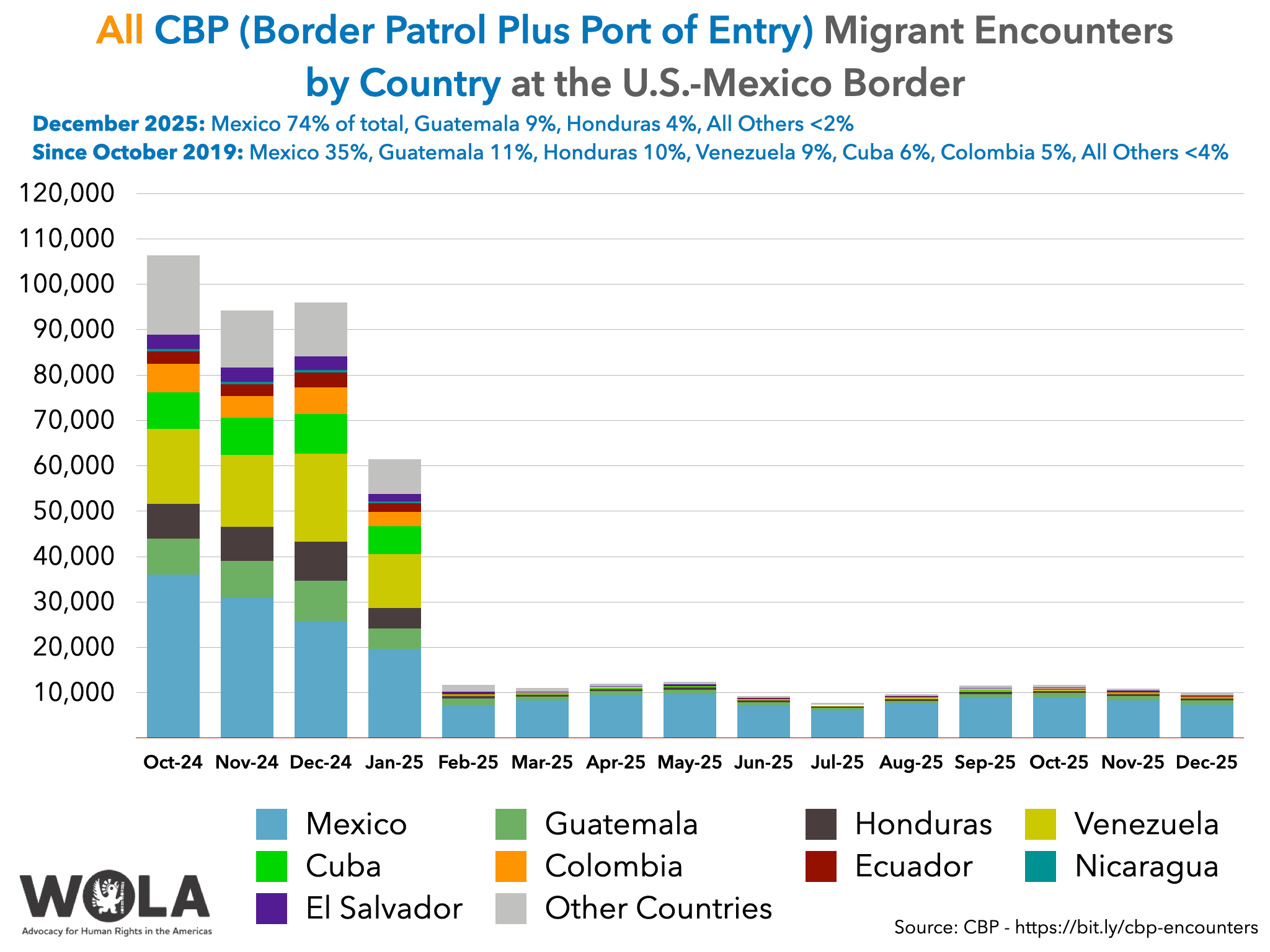
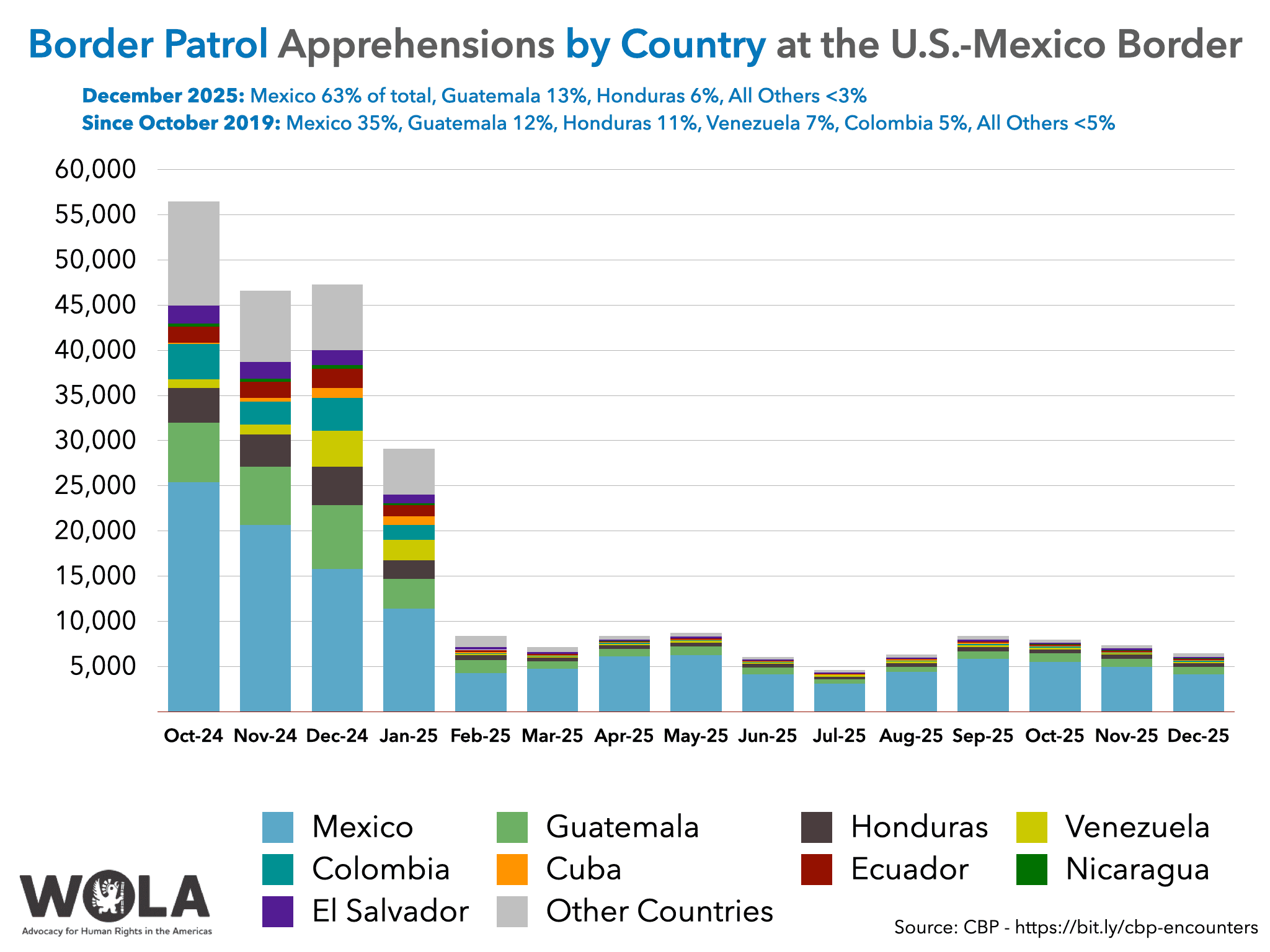
The decline was most likely seasonal: since the Trump administration took office, migrant encounters have increased in the spring and fall and decreased in the summer and winter, which reflects historical patterns when the migrant population includes few asylum seekers.
Of Border Patrol apprehensions, 63 percent were citizens of Mexico, the lowest share of Mexican citizens in any full month since February 2025. Apprehensions of people from Mexico fell 17 percent from November to December, faster than the border-wide decline of 12 percent. Apprehensions of people from Colombia (+40 percent) and Venezuela (+29 percent) increased, as did those of citizens of Ecuador, India, China, Brazil, and Peru—though all represented monthly increases of perhaps a few dozen people.
Of Border Patrol apprehensions, 86 percent were single adults, far more than in the years (2014-2024) when much of the migrant population consisted of families and children.
Border Patrol’s Rio Grande Valley sector, in south Texas, led all of the agency’s nine geographical U.S.-Mexico border sectors with the most apprehensions, for the second consecutive month. It was followed by the El Paso, Tucson, San Diego, and Laredo sectors.
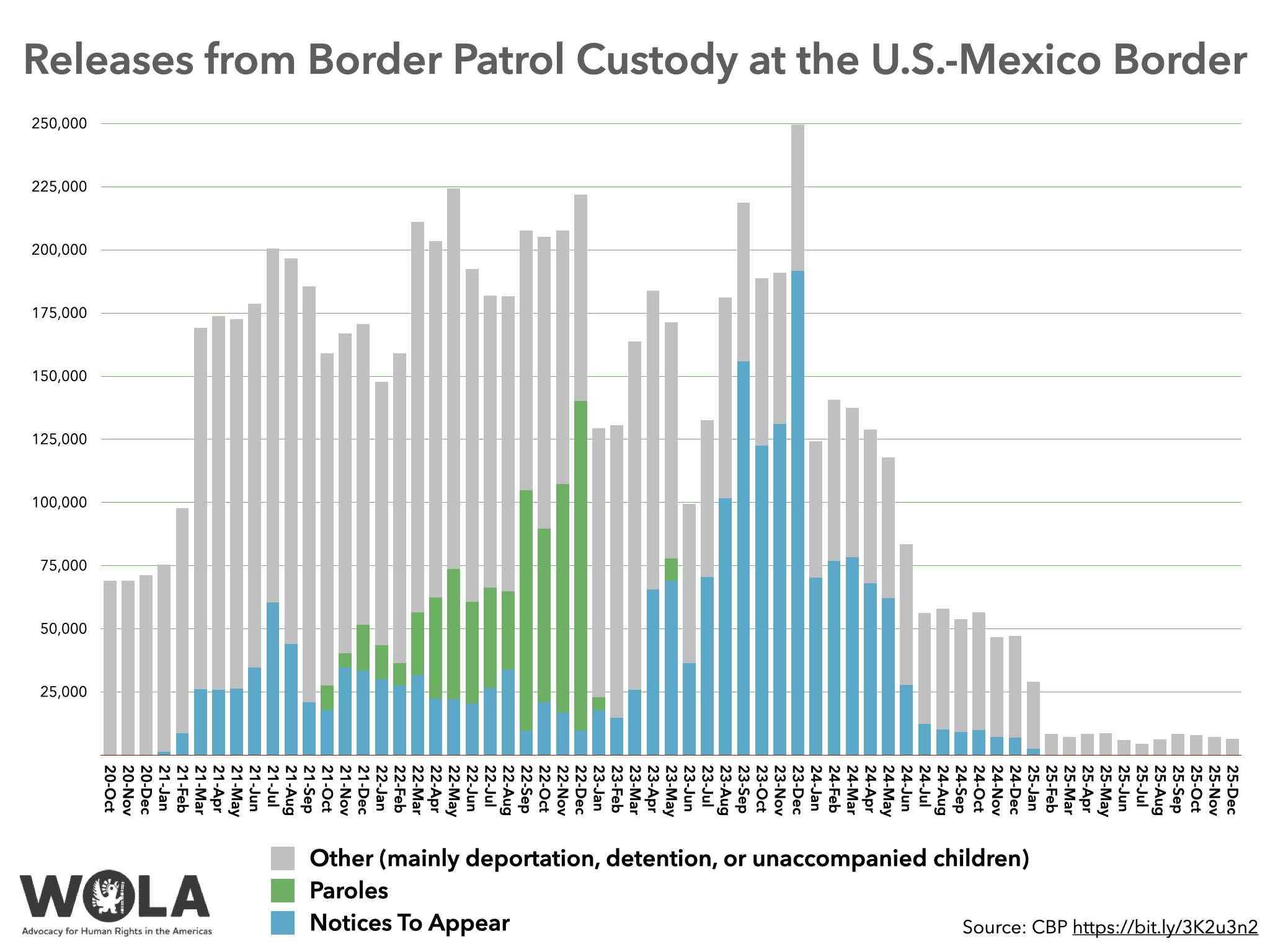
For the eighth consecutive month, Border Patrol reported zero releases of migrants into the U.S. interior, a practice that used to be common for asylum seekers. The Trump administration has suspended asylum and built up enough detention space to hold anyone else who is permitted to seek protection.
Border-zone seizures of fentanyl remain near lows not seen since the first half of 2022 (849 pounds in December). After declining sharply between mid-2023 and the end of 2024 (a 59% drop from fiscal 2023 to 2025), fentanyl seizures hovered between about 600 and 1,000 pounds (with two months exceeding that) during all of the 2025 calendar year. However, they appear to be plateauing at this level, with no further reductions all year. In fact, the 3,353 pounds of fentanyl seized during the fourth quarter of 2025 was the highest quarterly total of the calendar year.
During the past quarter, 85 percent of fentanyl seizures occurred at the ports of entry, similar to previous years.

Seizures of cocaine, which jumped 42 percent from fiscal 2024 to 2025, continue to increase. During the October-December 2025 quarter, CBP seized 10,593 pounds of cocaine, 34 percent more than during the October-December 2024 quarter (7,764 pounds).
CBP is finding more cocaine at the border, even though since September 2, the Trump administration’s Defense Department has used lethal force on 33 occasions to kill at least 126 people aboard small craft suspected of trafficking cocaine in the Caribbean Sea and Pacific Ocean. The border data do not suggest any decline in cocaine supplies as a result of these extrajudicial killings.
During the past quarter, 84 percent of cocaine seizures occurred at the ports of entry, similar to previous years.

Links to in-depth analyses
The state of the border a year into the Trump administration
- The Washington Post’s Arelis Hernández caught up with Margelis Tinoco, a Venezuelan woman who appeared in press coverage nationwide a year ago, when she wept at the border upon learning that the just-inaugurated Trump administration had canceled her CBP One appointment to enter the United States. “One year later, Tinoco is still seeking safety. She lives in a refuge for migrants in Mexico but is fearful of going outside.”
- At Spain’s El País, Beatriz Guillén reported on Ciudad Juárez a year after Trump’s inauguration. There, the presence of third-country migrants may now be as low as 1,500, organized crime has turned to kidnapping to replace lost smuggling income, and the Chihuahua state government is building a massive surveillance system including a “sentinel tower” that will include offices for U.S. law enforcement agencies.
- Reporting from Reynosa, Tamaulipas, across from McAllen, Texas, Adolfo Muñiz of Spectrum News found migrant shelters with significant vacancy as the Trump administration’s suspension of the right to asylum caused numbers to plummet. However, Héctor Silva, the longtime director of the Senda de Vida shelter, warned against being “overconfident” about the migration numbers remaining low.
Immigration policy reviews
- The American Immigration Council published a report about the expansion of ICE detention since Donald Trump took office. The detained population began Trump’s term at about 40,000 people, and the administration “according to leaked plans originally hoped to have nearly 108,000 immigration detention beds online by January 2026.” That goal is behind schedule, as the detained population is now roughly 70,000, but it continues to grow. As ICE is under pressure to detain more people, it is focusing far less on migrants with criminal records; the report notes “a 2,450 percent increase in the number of people with no criminal record held in ICE detention on any given day.”
- Human Rights Watch’s Refugee and Migrant Rights director, Bill Frelick, laid out thirteen grim immigration, citizenship, and refugee policies that the Trump administration has implemented in its first year.
- The Migration Policy Institute published a report summarizing the Trump administration’s principal changes to immigration policy, noting that “the net change has been dizzying in its scope and speed,” and that some policies may be difficult for future administrations to reverse.
- A detailed post by analyst Austin Kocher dismantled the Trump administration’s recent claim that it has deported over 622,000 people in less than a year. Kocher came up with a total in the 400,000s.
- A Brookings Institution report explored demographic and economic effects of the Trump administration’s immigration crackdown. It found that net migration to the United States was negative in 2025 “for the first time in at least half a century,” and that the U.S. economy can expect weaker growth in employment, GDP, and consumer spending as a result.
Other news
- “I am astounded by the now-routine abuse and denigration of migrants and refugees,” read a strong January 23 statement about the United States from Volker Türk, the UN High Commissioner for Human Rights. “Where is the concern for their dignity, and our common humanity?”
- The ICE Flight Monitor project published its December 2025 monthly report, finding that the U.S. government removed migrants aboard 2,138 flights between January 20 and December 31, 2025, a 44 percent increase over the same period in 2024.
- ICE Flight Monitor separately noted that so far in January 2026, at least 31 ICE flights have transported people from Minnesota to Texas, mainly El Paso. “This surge reflects the transfer of people with valid refugee status from their homes in Minnesota to detention centers in Texas.”
- ICE deported to Colombia a woman in her eighth month of pregnancy, who was suffering medical distress, just ahead of a judge’s order prohibiting her removal. The agency put her on a commercial flight from Atlanta to Bogota. “There are serious concerns about what kind of company would allow someone at this late stage of pregnancy and distress to fly,” Anthony Enriquez of Robert F. Kennedy Human Rights told the Guardian.
- Deportation flights to Venezuela restarted on January 16, after a five-week pause before and after the January 3 military operation that extracted dictator Nicolás Maduro. ICE Flight Monitor counted three flights between January 16 and January 22, carrying 617 people back to Caracas.
- “The removal of Nicolás Maduro represents a political rupture, but it does not in itself create the conditions for large-scale or sustainable return” of Venezuelan migrants to their homeland, according to a Mixed Migration Center report that lays out likely scenarios for Venezuelan migration following the January 3 U.S. military operation.
- In a January 12 court filing, Secretary of State Marco Rubio toldDistrict Court Judge James Boasberg that it would be impossible to return 138 Venezuelan migrants to the United States to receive due process because doing so would jeopardize “extraordinarily delicate” discussions with the post-Maduro government in Caracas. The Trump administration rendered the 138 men to El Salvador’s notorious CECOT prison in March 2025 using a rare invocation of the Alien Enemies Act, despite an order from Boasberg to cease the flights. Boasberg ordered in December that the men be given another chance at due process.
- Two Canadian professors published conclusions at The Conversation from late-2025 interviews with Venezuelan migrants stranded in Costa Rica after giving up on seeking protection in the United States following Donald Trump’s inauguration. They found that interviewees “experienced physical exhaustion from long periods of waiting, economic hardship, fear, and incidents of violence in Mexico, as well as fraud and theft, while access to institutional or humanitarian support steadily declined.”
- A State Department memo mandated a pause in all processing of immigrant visas for citizens of 75 countries, starting January 21, “while the department reassesses screening and vetting procedures,” Fox News and other outlets reported. The Trump administration is demanding that visa processing include tighter scrutiny to deny visas to people judged likely to become a “public charge,” relying on government benefits. “Older or overweight applicants could be denied, along with those who had any past use of government cash assistance or institutionalization,” Fox reported.
- In Mexico’s state of Baja California, which includes Tijuana and Mexicali, “around 40,000 U.S. citizens, mostly children of Mexican migrants, are studying within the public education system,” reported Nómadas.
- In Mexico’s northeastern border state of Tamaulipas, one of the most violent regions of the country, the state government reported that it is making progress toward installing 15 new security posts along the border, each about 25 kilometers apart.
- Five years later, the relatives of Guatemalan migrants who were among 19 people massacred by a police unit near the U.S. border in Tamaulipas have not received promised reparations, the Guatemalan daily La Hora reported.
- A Miami-based group of exiled Venezuelan citizens warned that Germán Rodolfo Varela, a dissident former Venezuelan army lieutenant who fled in 2002, faces a likely transfer to the Fort Bliss detention facility, from where U.S. “migratory authorities intend to deport him to a third country like Mexico, which could lead to a chain deportation back to Venezuela, where he faces mortal persecution.” In 2005 an immigration judge had granted Varela protection under the Convention Against Torture, which prevents his direct removal to Venezuela but not to a third country.
- Mexico’s government reported seizing 7,869 southbound-smuggled firearms, including 44 powerful Barrett .50 rifles, as part of the “Northern Border Operation” that it launched in February 2025 following Donald Trump’s first tariff threat. The operation, involving about 10,000 Mexican National Guard and 2,100 Army personnel in the country’s northern border states, also reportedly yielded seizures of over 600 kilos of fentanyl.
- CBP contractors have begun detonating parts of the south slope of Mt. Cristo Rey, the iconic mountain straddling the border west of El Paso, to enable border wall construction.
- In New Mexico, Rep. Gabe Vásquez, whose district includes all of the state’s border with Mexico, called on DHS to cancel plans to build 49 miles of new border wall and 60 miles of new secondary border wall in the state’s remote southwestern “Bootheel” region. DHS has awarded a $1.6 billion contract to North Dakota-based Fisher Sand and Gravel to build the barrier.
- “The Trump administration installed 20 miles of wall in its first year,” the Washington Examiner reported, noting that half was funded through the “big, beautiful” spending bill that Congress passed in July and half “came from unused money from fiscal 2018.”
- At the American Prospect, Elena Bruess reported from south Texas’s Rio Grande Valley about the environmental and cultural harms of ongoing border wall construction. The New York Post covered environmental groups’ outrage over the inclusion of about 50 8-by-10-inch “doggie doors” to allow some—but certainly not all—animals to pass through new border wall segments in Arizona and California.
- With the approval of the local city council after residents voiced privacy concerns, CBP is installing a surveillance system in the coastal Southern California city of San Clemente to detect pangas, boats used by migrants and smugglers to cross the border via the Pacific.
- Border Patrol installed a new “semi-autonomous vehicle barrier system” called the “GRAB 350” at an interior highway checkpoint in Sierra Blanca, east of El Paso, Texas. CBP’s release informed that the agency maintains 45 permanent checkpoints nationwide.
- The Defense Department is sending five military lawyers and paralegals to southern New Mexico, where they will work for the Justice Department, assisting prosecutions of accused smugglers. It is very unusual for uniformed attorneys to prosecute civilians in the United States.
- The Trump administration deported more than 1,600 people back to Cuba in 2025, according to the Cuban government. “That is about double the number of Cubans who were repatriated in 2024,” the New York Timesreported.
- Storms destroyed the now-unused tent station that San Diego’s American Friends Service Committee chapter had set up, during the Biden years, to provide humanitarian assistance to asylum seekers waiting by the border fence to turn themselves in to Border Patrol agents.
Links: “mass deportation” and human rights in the U.S. interior
Human rights, misuse of force, and democracy
- Radley Balko, “I’ve Covered Police Abuse for 20 Years. What ICE Is Doing Is Different” (The New York Times, January 21, 2026).
We can still stop these abuses of power, but we need to be clear about what we’re facing. This is no longer a conversation about law enforcement or immigration policy. This is about authoritarianism
- Erik Ortiz, Jon Schuppe, “Trump’s DHS Has Shot 11 People During Immigration Enforcement Operations Since September. Here’s What to Know.” (NBC News, January 16, 2026).
The ICE and Border Patrol shootings show a pattern that policing experts say is alarming: officers firing into cars and injuring and killing drivers
- Mckenzie Funk, Nicole Foy, “We Found More Than 40 Cases of Immigration Agents Using Banned Chokeholds and Other Moves That Can Cut Off Breathing” (ProPublica, January 13, 2026).
Civilians have had apparent seizures. One had his eyes roll back. Another had ribs broken. “I felt like I was going to pass out and die,” said a 16-year-old citizen put in a chokehold. The government won’t say if any agents have been punished
- Jason Houser, “I Worked for ICE and CBP. Our Current System Makes Everyone Less Safe.” (USA Today, January 13, 2026).
Immigration enforcement is not focused on serious threats. It’s become politicized, disconnected from reality and increasingly dangerous for everyone
- Isaac Chotiner, “How Donald Trump Has Transformed ICE” (The New Yorker, January 14, 2026).
A former D.H.S. oversight official on what, legally, the agency can and can’t do—and the accountability mechanisms that have been “gutted beyond recognition”
- Isabela Dias, “Former Members of ICE Say Recent Violence Is “By Design”” (Mother Jones, January 14, 2026).
“What has changed is there has been an encouragement from the top to be much more aggressive in enforcement”
- Lauren Villagran, “Immigration Agents Have Clashed With the Public Before. What to Know” (USA Today, January 18, 2026).
Border Patrol has a history of tough law enforcement near the U.S.-Mexico border. Now they’re using the same tactics in cities nationwide
- Alain Stephens, “ICE Agents Are Even Worse at Being Cops Than You Think” (The Intercept, January 16, 2026).
Videos of agents falling down and dropping their guns feel beyond parody. But under-trained law enforcement officers are a real danger to the public
- Christian Paz, “The Violent “Randomness” of ICE’s Deportation Campaign” (Vox, January 12, 2026).
What ICE is doing in American cities is very distinct
- Riya Misra, “‘It’s Going to Take ICE a Long Time to Dig Out of This’” (Politico, January 11, 2026).
After controversial shootings in Minneapolis and Portland, a former ICE chief breaks down how the agency ended up here — and what has to change
- David Ovalle, Derek Hawkins, Maria Sacchetti, Mark Berman, “ICE Tactics and Training Under Scrutiny After Minneapolis Shooting” (The Washington Post, January 10, 2026).
Policing experts say officer who fired fatal shots may have placed himself at needless risk by standing in front of Renée Good’s vehicle
- Hamed Aleaziz, “Amid Protests, ICE Told Agents to Take ‘Decisive Action’ if Threatened” (The New York Times, January 8, 2026).
The guidance comes as immigration officers have been met with increasingly hostile protesters in cities
- Michelle Goldberg, “By Killing Renee Good, ICE Sent a Message to Us All” (The New York Times, January 8, 2026).
Not even citizens are safe in Trump’s America
- Alan Elrod, “ICE’s Violence Is No Accident” (The Pulaski Institution, MS NOW, January 8, 2026).
The killing of a woman by an immigration enforcement officer in Minneapolis was the raw application of Trumpist authoritarianism
- Adam Serwer, “First the Shooting. Then the Lies.” (The Atlantic, January 8, 2026).
The Trump administration has perfected the smear campaign
- Priscilla Alvarez, “DHS Officials Privately Express Shock at Department’s Immediate Response to Minneapolis Shooting” (CNN, January 8, 2026).
Multiple Department of Homeland Security officials privately expressed shock Wednesday over the department’s immediate response to the fatal shooting of a woman by an ICE agent, seeing it as a break from precedent that generally points to an investigation before reaching a firm conclusion
- Steven Monacelli, “ICE Prosecutor Who Runs Racist X Account Returns to Dallas Immigration Court” (The Texas Observer, January 14, 2026).
James Rodden, identified by the Observer last year as the operator of an account that routinely posted hateful statements, appeared to be back at work Tuesday
- Will Bunch, “Yo, Dems: You Can’t ‘Reform’ Fascism” (The Philadelphia Inquirer, January 20, 2026).
Plus, America’s appalling betrayal of the Hmong
- Silky Shah, “Trump Has Made ICE the Largest Law Enforcement Agency in the Country” (Detention Watch Network, Truthout.org, January 20, 2026).
With Congress-approved funding, ICE detention is expected to triple in size, mirroring the scale of Japanese internment
- Toby Buckle, “Memo to Moderate Democrats: “Abolish ICE” Is Not a Fringe Position” (The New Republic, January 15, 2026).
For goodness’ sake, Democrats: Bill Kristol is in favor of ICE abolition. Can you really not get there?
- Jennifer Medina, “Abolish ICE? It’s a Slogan Some Democratic Critics of ICE Would Abolish.” (The New York Times, January 15, 2026).
As Democrats grow more alarmed about the Trump administration’s aggressive immigration raids in American cities, some worry that calls to eliminate the agency will distract from efforts to rein it in
Minneapolis
- Lydia Polgreen, “In Minneapolis, I Glimpsed a Civil War” (The New York Times, January 19, 2026).
Minneapolis stands in defiance against Trump’s dark vision of America
- Hamed Aleaziz, Nicholas Nehamas, “Under Trump, a Shift Toward ‘Absolute Immunity’ for ICE” (The New York Times, January 15, 2026).
Since the fatal shooting of Renee Good in Minneapolis, administration officials have defended the use of deadly force, which agency guidelines say should be a last resort
- Stephanie Saul, “In Minneapolis, a Pattern of Misconduct Toward Protesters” (The New York Times, January 19, 2026).
Legal and criminal justice experts said a ruling by a federal judge last week revealed conduct by immigration agents that evokes the civil rights era
- Maanvi Singh, “Minneapolis Leaders Call the ICE Surge a ‘Siege’. My Reporting From There Concurs” (The Guardian (Uk), January 21, 2026).
After covering Trump’s immigration policies from Chicago and LA, the Twin Cities operation feels like a marked escalation
- “Editorial: Minnesota Is Under Siege. This Cannot Stand” (The Minneapolis Star-Tribune, January 15, 2026).
ICE presence has disrupted all aspects of life in Minnesota, and led tragically to the death of Renee Good. It’s the outcome of government overreach that favors force over legitimacy
- Scott Meslow, “It’s Worse Than It Looks in Minneapolis” (The Verge, January 19, 2026).
But locals are organizing to keep each other safe from ICE agents
- Jazmine Ulloa, “Inside Minnesota Hospitals, ICE Agents Unnerve Staff” (The New York Times, January 19, 2026).
As federal agents swarm the Twin Cities, their presence has also grown in medical centers. Health care workers are pushing back
- Jon Collins, “Fear Factor: Intimidation Becomes a Calling Card as Twin Cities ICE Surge Widens”(Minnesota Public Radio, January 16, 2026).
Six weeks into the immigration enforcement surge in the Twin Cities, observers say federal agents are employing violence more frequently and with little apparent restraint against citizens and noncitizens
- Jazmine Ulloa, Thomas Fuller, “‘Like a Military Occupation’: Clashes Rise With Federal Agents in Minneapolis” (The New York Times, January 13, 2026).
Arrests and aggressive tactics by ICE and the Border Patrol, many seen on viral videos, have intensified the frustration and fear among residents
- Katie J.M. Baker, “Agent Who Shot Renee Good Was Trained to Track and Apprehend Fugitives” (The New York Times, January 16, 2026).
From Iraq to ICE, Jonathan Ross’s career reflects a 20-year government effort to reshape immigration enforcement with a military mind-set
- “Video Analysis of ICE Shooting Sheds Light on Contested Moments” (The New York Times, January 15, 2026).
Newly available videos and existing footage synchronized and assessed by The Times provide a frame-by-frame look at how an ICE officer ended up shooting and killing a motorist in Minneapolis
- Anushka Patil, “Trump Calls Renee Good’s Killing a ‘Tragedy’ and Says ICE Agents Will Make Mistakes”(The New York Times, January 20, 2026).
The change in tone was stark for the president, who said he had been told that Ms. Good’s father was a strong Trump supporter
- Nick Miroff, “From ‘I’m Not Mad at You’ to Deadly Shots in Seconds” (The Atlantic, January 9, 2026).
Frazzled agents, quick triggers, and a motor-powered protest movement are creating a uniquely dangerous moment on U.S. streets
- Hamed Aleaziz, Madeleine Ngo, “Trump Officials Are Sending 1,000 More Immigration Officers to Minnesota” (The New York Times, January 12, 2026).
The Customs and Border Protection officers are joining 2,000 other officers and agents at the Department of Homeland Security who have recently been deployed to the Minneapolis region
- “North Minneapolis ICE Shooting: Children Hospitalized After Flash Bang, Tear Gas Hits Van” (FOX 9 Minnesota, January 15, 2026).
A family was caught in clashes between protesters and law enforcement during protests in north Minneapolis, leading to three of their six children, including a 6-month-old baby, being hospitalized
- Alaa Elassar, Caroll Alvarado, Diego Mendoza, “Aftermath Video of Latest ICE Shooting in Minneapolis Involving an Undocumented Venezuelan National” (CNN, January 18, 2026).
Newly obtained videos of the moments right after the Wednesday incident in which an Immigration and Custom Enforcement agent shot a Venezuelan man in the leg for allegedly assaulting an officer in Minneapolis appear to contradict at least some of ICE’s claims about events leading up to the shooting
- Mariana Alfaro, “More Federal Officers Headed to Minnesota; Officials Point Fingers Over ICE Shooting”(The Washington Post, January 11, 2026).
Homeland Security Secretary Kristi Noem remained adamant that Renée Good was responsible for her own death, as Democrats insisted on a full investigation before drawing conclusions
- Aliza Chasan, Andy Court, Annabelle Hanflig, Camilo Montoya-Galvez, Cecilia Vega, Michael Rey, “Top ICE Official Is Asked Whether Americans Can Trust Investigation Into Renee Good’s Killing” (CBS News, January 18, 2026).
Senior ICE official Marcos Charles said videos of immigration enforcement in Minneapolis don’t tell the entire story. He said officers are acting lawfully and with professionalism
- Miriam Jordan, “ICE Arrested Dozens of Refugees in Minnesota and Sent Them to Texas, Lawyers Say” (The New York Times, January 13, 2026).
The refugees, many of them from Somalia, had passed security screenings before coming to the United States. The Trump administration has vowed to “re-examine thousands of refugee cases”
- Christopher Armitage, “My First 72 Hours in Minneapolis and How I Got an ICE Agent to Scream “Make America Great Again”” (The Existential Republic, January 12, 2026).
The activists on the ground are doing the work, that should give you hope
- Haley Britzky, Natasha Bertrand, “Pentagon to Dispatch Dozens of Military Lawyers to Minneapolis Amid Immigration Crackdown” (CNN, January 14, 2026).
The Pentagon is working to surge dozens of military lawyers to Minneapolis to assist in federal prosecutions amid an immigration enforcement crackdown there, according to two officials familiar with the matter and a written request that has circulated inside the Defense Department
- Christian Paz, “How Right-Wing Influencers Are Bending Reality in Minneapolis” (Vox, January 15, 2026).
The MAGA media system is going into overdrive
- Chris Farrell, “Minnesota’s Corporate Silence on ICE Surge” (Minnesota Public Radio, January 14, 2026).
For a state that prides itself on a long history of ethical corporate leadership, the silence is notable
Elsewhere in the U.S. interior
- Anna Griffin, “Justice Department Charges the Man Shot by Agents in Portland, Ore.” (The New York Times, January 12, 2026).
Last week’s shooting of two Venezuelan immigrants put the city on edge. Federal officials said the man who was shot had repeatedly backed into a Border Patrol car
- Jack o’connor, Jason Meisner, “Illinois and Chicago Sue DHS Over ‘Militarized’ Immigration-Enforcement Tactics” (The Chicago Tribune, January 12, 2026).
Saying immigration agents have acted more like an occupying military force than law enforcement, lawyers for the state of Illinois and Chicago sued the Trump administration in federal court Monday
- Juan Benn Jr., “Department of Homeland Security Changes Account of ICE Shooting in Maryland” (The Washington Post, January 10, 2026).
The federal agency changed some details of the Dec. 24 shooting that left two men injured after a local police department contradicted its initial version
- Antonia Hylton, Kay Guerrero, Kyla Guilfoil, “A Car Ramming, a Violent Arrest and an Emboldened Immigration Agency” (MS NOW, January 20, 2026).
Far from the border, a father and son met Border Patrol tactics. They haven’t seen each other since
- Ana Goñi-Lessan, “Why Were Immigrants Pepper Sprayed at Florida’s Deportation Depot on Christmas Eve?” (The Tallahassee Democrat, January 21, 2026).
Immigrants at Deportation Depot were pepper sprayed on Christmas Eve after they refused orders from officers, the state says
- Emily Kenny, “Upstate Worker Detained by Feds to Be Deported to Ecuador Despite No Ties” (Spectrum News, January 13, 2026).
During a hearing today, a federal judge ruled that Alex Ramirez Gonzalez must seek his asylum claim from Ecuador
Oversight and accountability efforts
- Jessica Washington, “New Bill Would Put Basic Limits on ICE Use of Force After Minneapolis Killing” (The Intercept, January 15, 2026).
Rep. Delia Ramirez called her bill “the bare minimum” to rein in ICE while Democratic leadership remains resistant to abolishing the agency
- Eric Bazail-Eimil, “Push for Greater ICE Training Grows on Some Republicans” (Politico, January 15, 2026).
Criticism of ICE has grown among influential voices for the president’s coalition in the wake of the Minneapolis shooting
- Paul Rosenzweig, “The Court Case That Is Allowing ICE to Stop Just About Anyone It Wants” (The Atlantic, January 12, 2026).
Whren v. United States needs to go
- Samantha Michaels, “An Expert Weighs in on Hurdles to Suing the ICE Officer Who Fatally Shot Renee Good” (Mother Jones, January 12, 2026).
The paths to civil court are “narrow, and…complicated”
- Maxine Bernstein, “Feds Pay $125k After Border Patrol Agent Pointed Gun at Portland Hotel Worker”(Oregonlive, January 10, 2026).
The payout amount was finalized during a settlement conference Friday after a judge found the officer civilly liable for assault
Minnesota in the courts
- Jonathan Allen, Nate Raymond, “US Appeals Court Lifts Order Curbing Immigration Agents’ Tactics Against Minnesota Protesters” (Reuters, Reuters, January 21, 2026).
- Mitch Smith, “Judge Restricts Immigration Agents’ Actions Toward Minnesota Protesters” (The New York Times, January 16, 2026).
A federal judge ordered agents not to retaliate against people “engaging in peaceful and unobstructive protest activity” in the state and not to stop drivers who are not “forcibly obstructing” officers
- Camilo Montoya-Galvez, Sarah N. Lynch, “DOJSubpoenas Walz, Ellison, Frey, Minnesota Officials in Probe Alleging Immigration Obstruction, Sources Say” (CBS News, January 20, 2026).
Minnesota Gov. Tim Walz, Minneapolis Mayor Jacob Frey and others were subpoenaed in connection with a DOJ probe into an alleged conspiracy to impede federal immigration officers, three sources said
Detention
- Douglas Macmillan, “Trump Administration Jails Migrant Teens in Facility Known for Child Abuse” (The Washington Post, January 8, 2026).
Pennsylvania recently revoked a license for the secure juvenile detention center where the administration sends some migrant children, even some with no pending criminal charges
- Jonathan Blitzer, “The Congresswoman Criminalized for Visiting ICE Detainees” (The New Yorker, January 19, 2026).
LaMonica McIver went to tour an immigration jail in her district. Now she faces seventeen years in prison
- Ignacio Calderon, Jennifer Borresen, Lauren Villagran, “Five Key Ways ICE Detention Centers Are Booming Under Trump” (USA Today, January 14, 2026).
ICE detention has expanded rapidly under Trump, both in terms of the number of facilities and people held
- Lauren Villagran, “ICE Is Freeing Some Detained Families Despite Vowing ‘Zero Releases’: Exclusive” (USA Today, The Arizona Republic, January 20, 2026).
The Trump administration has promised to arrest and deport millions. Now ICE is releasing detained families
- Andrea Pitzer, “Into the Abyss” (Degenerate Art, January 19, 2026).
The correct response to Dachau was not better training for the guards
Citizen response and resistance
- Anna Lekas Miller, “Watching Out While Watching ICE” (Truthdig, January 13, 2026).
As ICE escalates its operations, advocates say it’s more important than ever to use best practices while observing enforcement activities.
- Madison Mcvan, “In the Car With the Minneapolis Community Patrols Working to Disrupt ICE Operations”(Minnesota Reformer, January 13, 2026).
More people are joining the movement after the fatal shooting of Renee Good
- Erin Patrick o’connor, Molly Hennessy-Fiske, Robert Klemko, Teo Armus, “They Say They’re Monitoring ICE Arrests. Feds Say They’re Breaking the Law.” (The Washington Post, January 12, 2026).
Volunteer efforts to track and protest federal immigration enforcement are in the spotlight after the killing of Renée Good in Minneapolis last week
- Nicole Bedara, “I’m a Minneapolis Sociologist Who Studies Violence. Here’s How ICE Observers Are Helping.” (Beyond Compliance, MS NOW, January 16, 2026).
Research into how violence occurs shows that disapproval from the people around you can help reduce it
- Orlando Mayorquin, “Volunteers in Minnesota Deliver Groceries So Immigrants Can Hide at Home” (The New York Times, January 20, 2026).
Thousands of Minneapolis residents have joined a church-run effort to deliver donated groceries to immigrant families who fear being caught in public by federal agents
- Todd Heisler, Vivian Yee, “The People of Minneapolis vs. ICE: A Street-Level View” (The New York Times, January 17, 2026).
An intense cat-and-mouse game is putting enraged residents face to face with heavily armed federal agents
- Christian Paz, “ICE Is Forcing a Reckoning Among America’s Religious Leaders” (Vox, January 22, 2026).
A moment of truth in Minnesota
- Aymann Ismail, “What Trump and ICE Are Doing in Minneapolis Is Obvious. They Don’t Seem to Grasp What’s Happening Instead.” (Slate, January 16, 2026).
ICE declared war on Minneapolis. The city had its own ideas
- Adrian Carrasquillo, “Why Renee Good Was, and Is, So Dangerous to Trump” (Huddled Masses, The Bulwark, January 16, 2026).
There are many ways to define an enemy. One is someone who isn’t afraid of you
- C.J. Ciaramella, “The Trump Administration Says It’s Illegal to Record Videos of ICE. Here’s What the Law Says.” (Reason, January 8, 2026).
“Violence is anything that threatens them and their safety, so it is doxing them, it’s videotaping them where they’re at when they’re out on operations,” Homeland Security Secretary Kristi Noem said
- Alexandria Shaner, “Social Strikes Are Emerging as a Defense Against ICE and Authoritarianism”(ZNetwork.org, Waging Nonviolence, January 16, 2026).
Labor historian Jeremy Brecher on the strategy, potential and challenges of mass social strikes following ICE’s murder of Renee Good
- Rebecca Solnit, “Weak Violence, Strong Peace: Who We Are in This Crisis” (Meditations in an Emergency, January 14, 2026).
I do not know what will come of this weakness, but it will not sweep them away by itself. It will create the possibility for us to do so
- Richard T. Herman, “Do GOP Voters Support Aggressive Immigration Enforcement?” (Herman Legal Group LLC, January 19, 2026).
Explore the complexities of immigration issues and answer the question: Do GOP voters support aggressive immigration enforcement?
Civil liberties and cybersecurity
- Audrey Ash, Evan Perez, Isabelle Chapman, Priscilla Alvarez, Sean Lyngaas, Thomas Bordeaux, Yahya Abou-Ghazala, “ICE Shunned Body Cams in Minnesota. So Why Are They Using Phones?” (CNN, January 21, 2026).
Federal immigration agents are using phone cameras for facial recognition software, to document their actions and to produce social media videos
- Joseph Cox, “‘Elite’: The Palantir App ICE Uses to Find Neighborhoods to Raid” (404 Media, January 15, 2026).
Internal ICE material and testimony from an official obtained by 404 Media provides the clearest link yet between the technological infrastructure Palantir is building for ICE and the agency’s activities on the ground
- Ken Klippenstein, “Exclusive: Secret ICE Programs Revealed” (Ken Klippenstein, January 14, 2026).
Leaked documents detail the dizzying scope of ICE operations
- Cooper Quintin, “ICE Is Going on a Surveillance Shopping Spree” (TechDirt, January 14, 2026).
U.S. Immigration and Customs Enforcement (ICE) has a new budget under the current administration, and they are going on a surveillance tech shopping spree
- Joseph Cox, “ICE’s Facial Recognition App Misidentified a Woman. Twice” (404 Media, January 19, 2026).
In testimony from a CBP official obtained by 404 Media, the official described how Mobile Fortify returned two different names after scanning a woman’s face during an immigration raid. ICE has said the app’s results are a “definitive” determination of someone’s immigration status
- Jason Koebler, “Feds Create Drone No Fly Zone That Would Stop People Filming ICE” (404 Media, January 20, 2026).
The FAA has altered a no fly zone designation that was originally created for US military bases to apply to DHS units
Political fallout
- Mariana Alfaro, Patrick Marley, Yasmeen Abutaleb, “Voters Oppose ICE Amid Shootings in Minneapolis, Polls Show” (The Washington Post, January 19, 2026).
As President Donald Trump cracks down on immigration in Minneapolis, a majority of voters disapprove of Immigration and Customs Enforcement’s work
- Nick Miroff, “‘Maybe DHS Was a Bad Idea’” (The Atlantic, January 17, 2026).
Two decades after its founding, the department has become what its critics feared
- Hamed Aleaziz, “D.H.S.’s Role Questioned as Immigration Officers Flood U.S. Cities” (The New York Times, January 18, 2026).
The Department of Homeland Security was formed after 9/11 amid international terrorism threats. Now, its most visible targets are domestic
- Greg Sargent, “Trump’s Own Advisers Suddenly Unnerved as ICE Raids Take Horrific Turn” (The New Republic, January 16, 2026).
So the president doesn’t like the “optics” of what ICE is doing. But there’s no such thing as sanitized, popular mass deportations—and this is by design
- Alex Isenstadt, Marc Caputo, “Trump’s Immigration Erosion Worries His Team” (Axios, January 16, 2026).
President Trump’s team recently reviewed private GOP polling that showed support for his immigration policies falling
- Philip Bump, “Trump Doesn’t Care That You Hate His Immigration Policy” (Pbump.net, January 21, 2026).
Republicans still like it, and that’s good enough for him
- Greg Sargent, “Joe Rogan’s Harsh New Takedown of Trump ICE Raids Hands Dems a Weapon” (The New Republic, January 14, 2026).
When a Trump supporter refers to ICE as the “gestapo,” a door has definitely opened. Will Democrats charge through it?
- Nikki Mccann Ramirez, “South Texas Hispanics Flipped for Trump. Some Have Buyer’s Remorse” (Rolling Stone, January 14, 2026).
Donald Trump’s chaotic tariff policy and immigration crackdowns have wrought havoc on South Texas, where Hispanic voters swung right in 2024.
Adam Isacson (he/him), Director for Defense Oversight
WOLA: Advocacy for Human Rights in the Americas (www.wola.org)
Signal adamisacson.98 Mobile/WhatsApp +1 202 329-4985
Mastodon: elefanti.co/@adam BlueSky: @adamisacson.com