
U.S.-Mexico Border Update: April 4, 2026

Adam Isacson
U.S.-Mexico Border Update: April 4, 2026
With this series of updates, WOLA seeks to cover the most important developments at the U.S.-Mexico border. See past updates here.
Your donation to WOLA is crucial to keeping these paywall-free and ad-free Updates going. Please contribute now and support our work.
THIS WEEK IN BRIEF:
- Migrant encounter data: numbers remain low, though a spring uptick is likely: Border Patrol’s apprehensions of migrants along the U.S.-Mexico border remain at their lowest levels since about 1966 amid a shutdown of the right to asylum and fear of the Trump administration’s “mass deportation” crackdown. Encounters remain quite low in Mexico and Panama as well. Apprehensions inched up in February in what may be a seasonal springtime uptick.
- DHS remains partially shut down as Republicans consider funding ICE and CBP for three years: Democratic legislators’ demands for reforms to the Homeland Security Department’s ICE and Border Patrol components have held up 2026 funding for all of DHS, even as those specific agencies have separate funding from the giant appropriation that Congress passed last July. Passage of a bill to fund everything but ICE and Border Patrol appears imminent, while Republican leaders are considering using the “reconciliation” budget maneuver to guarantee three years of funding for ICE and Border Patrol without reforms.
- DHS has new management and lower profile, but the mission is unchanged: As Markwayne Mullin takes over as DHS secretary, Greg Bovino retires, and investigations look into allegations of unethical contracting practices, much coverage speculates that Mullin and White House “Border Czar” Tom Homan will be more effective in carrying out “mass deportation” but without the high-profile stunts and provocative rhetoric that marked the tenure of former secretary Kristi Noem. Mullin is pausing, for re-evaluation, a $38 billion plan to build a network of giant warehouses to detain people.
- Deaths in ICE custody at record-setting pace: Fourteen people have died in ICE’s detention centers so far in 2026: one every six days, as concerns proliferate about abusive and neglectful conditions in the agency’s network of mostly contractor-run facilities.
- Mounting evidence of harm to children: Data show that at least 11,000 U.S. citizen children had their parents arrested or deported during the Trump administration’s first seven months. The population held at the Dilley, Texas family detention center has dropped sharply amid a major public outcry about conditions and about the idea of “family detention.” DHS detained and deported at least 363 pregnant, postpartum, or nursing mothers during the first 13 months of the Trump administration.
- Updates about deportations: Because of the sharp drop in border encounters and the gradual nature of ICE’s increasing capacity inside the United States, the Trump administration has been deporting fewer people to Mexico than the Biden administration. However, Mexico has been receiving about 1,000 people per month deported from third countries, nearly half of them citizens of Cuba. Costa Rica has agreed to accept removals of about 25 third-country citizens per week.
- Asylum and TPS, in the courts and Congress: The Supreme Court heard arguments about “metering” asylum seekers at the border and birthright citizenship, and will soon hear arguments about the Trump administration’s attempt to end Temporary Protected Status for citizens of Haiti. Another conservative appellate court has upheld the administration’s memo ordering mandatory detention for potentially millions of people who arrived in the United States by crossing the border improperly.
- Border walls and buoys: Three miles of new border wall are now being built every week. Links to coverage, going west to east, point to activity at the terminus of the Continental Divide Trail; on Mt. Cristo Rey west of El Paso; in Big Bend National Park; in Laredo; and in the Rio Grande Valley.
THE FULL UPDATE:
Migrant encounter data: numbers remain low, though a spring uptick is likely
On March 20, just after WOLA published its most recent Border Update, Customs and Border Protection (CBP) released data on migration and enforcement at the U.S.-Mexico border through February 2026. It showed U.S. authorities’ encounters with migrants along the U.S.-Mexico border remaining near 60-year lows.
The sharp decline is the result of the Trump administration’s suspension of the right to seek asylum at the U.S.-Mexico border, which remains before the federal courts, and a climate of fear that “mass deportation” operations have spread among migrants within the United States.
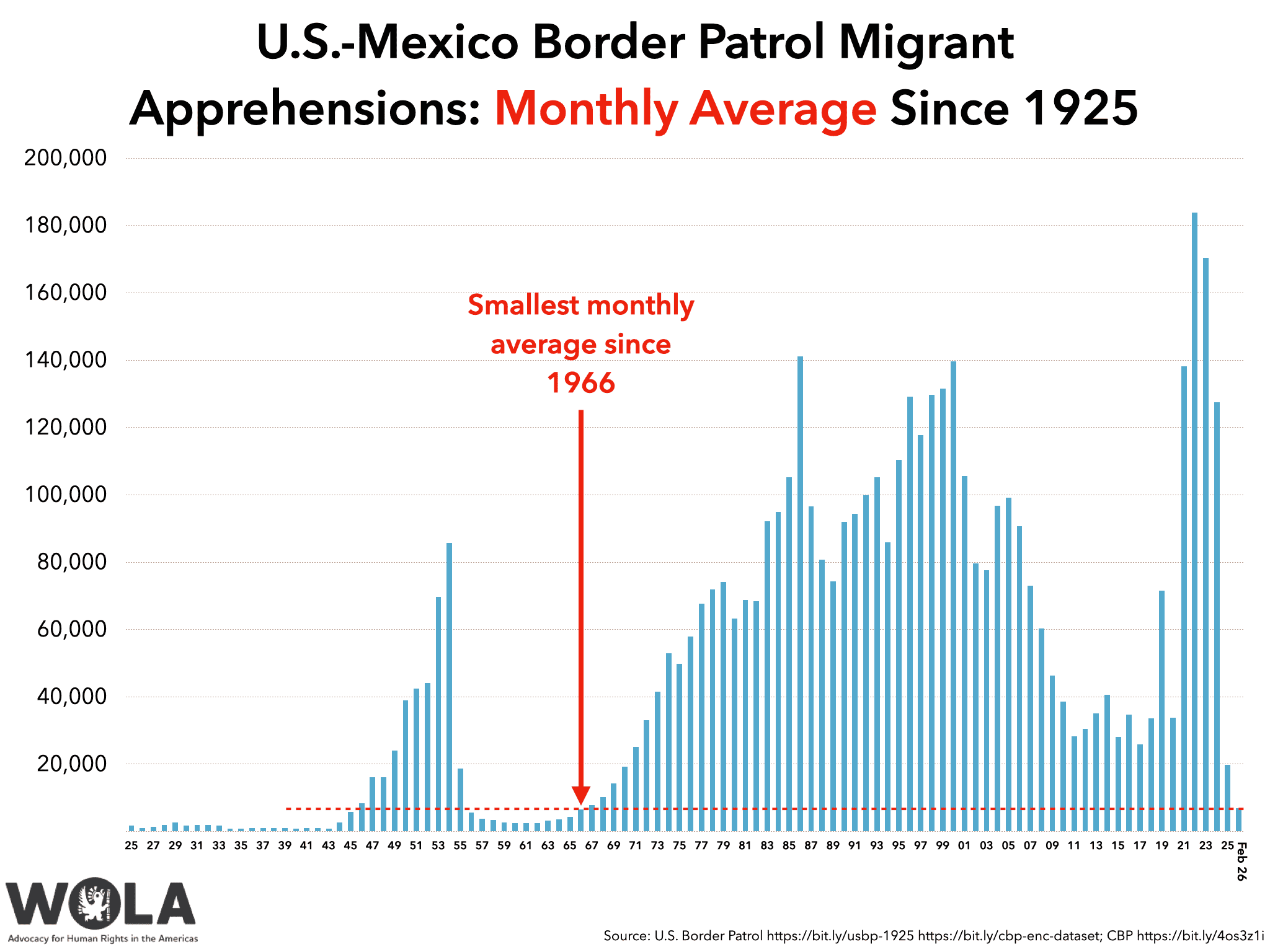
During the first five months of fiscal year 2026 (which began in October 2025), Border Patrol reported apprehending an average of 6,897 people per month near the U.S.-Mexico border. That is the lowest monthly average since 1966.
Despite this, a March 26 Federal Register notice from the Department of Homeland Security (DHS) proclaimed that “an actual or imminent mass influx of aliens is arriving at the southern border of the United States and presents urgent circumstances requiring a continued federal response.” That notice is “a legal trigger that expands federal authority, especially the ability to deputize state and local law enforcement under an ‘immigration emergency,’” immigration attorney Chris Thomas explained to Forbes.
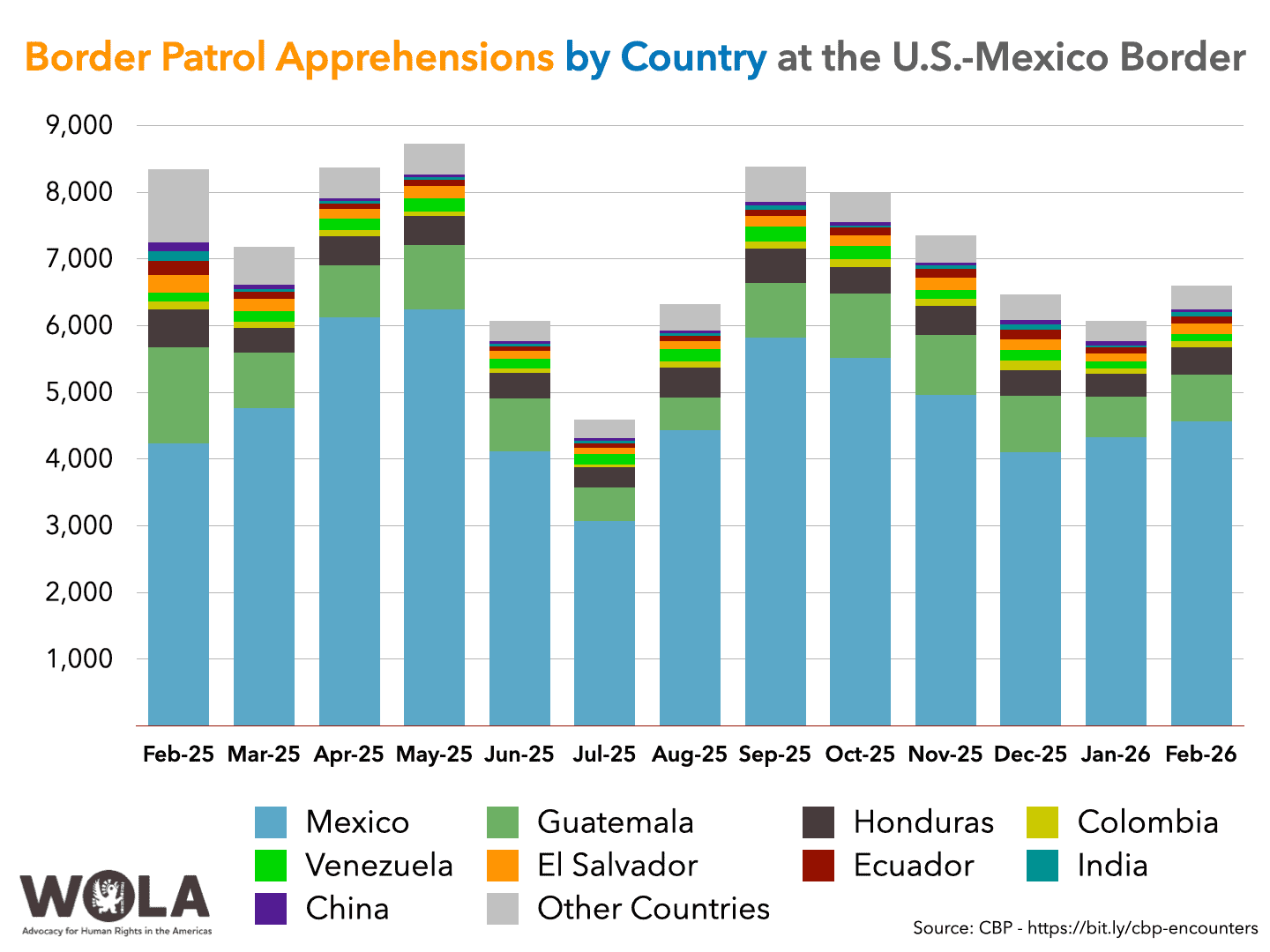
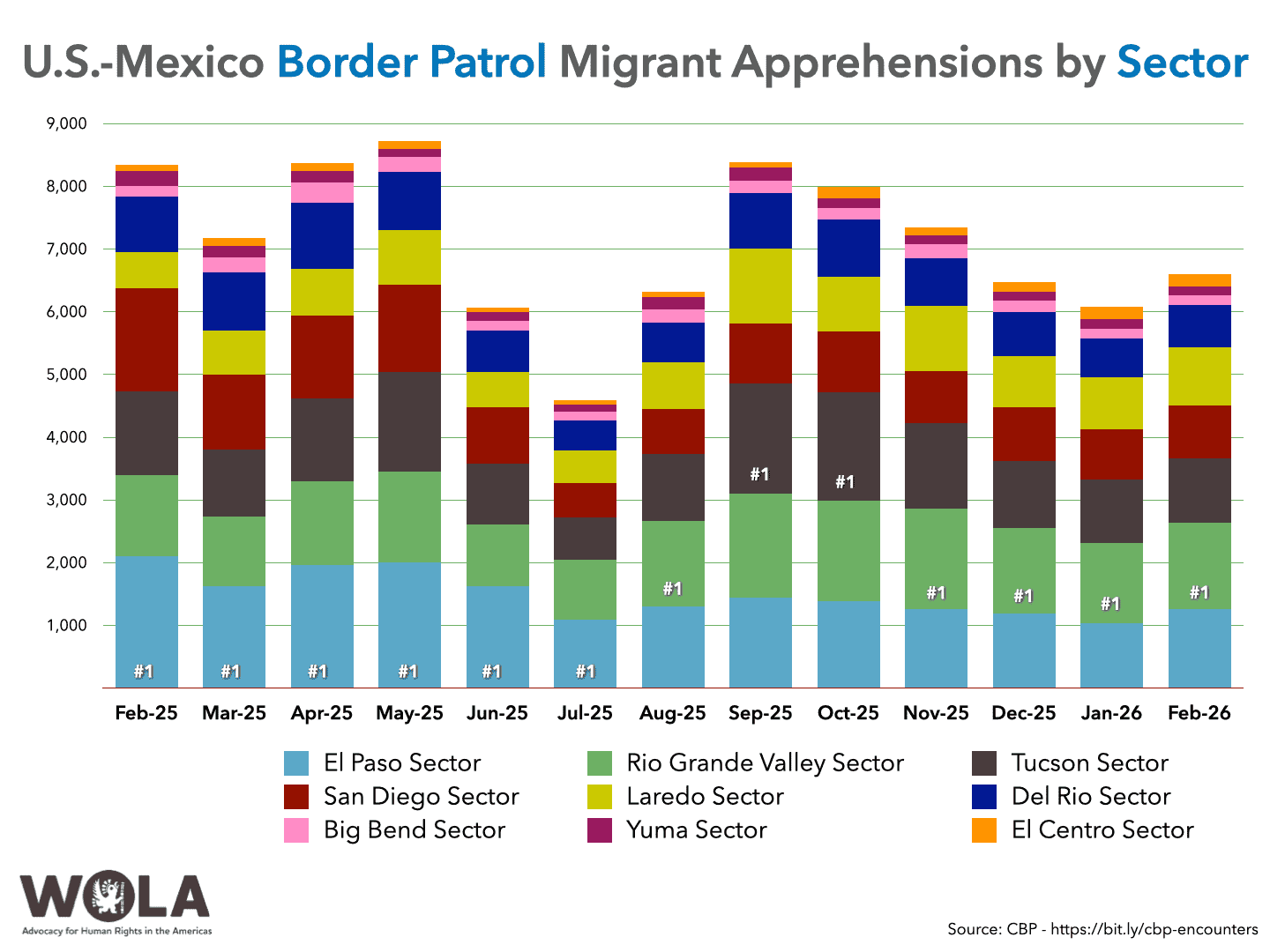
Border Patrol’s apprehensions of migrants did increase in February, for the first time in five months, to 6,603 from 6,074 in January (9%). As has been the pattern since the Trump administration began, most of those apprehended were from Mexico (69%), and 88 percent were from Mexico or the three northernmost Central American countries (Guatemala, Honduras, and El Salvador).
The January-to-February increase probably indicates a reversion to a seasonal pattern that appears typical of non-asylum-seeking migration. This is evident in the graphic below, which depicts Border Patrol apprehensions by geographic sector since October 1999.
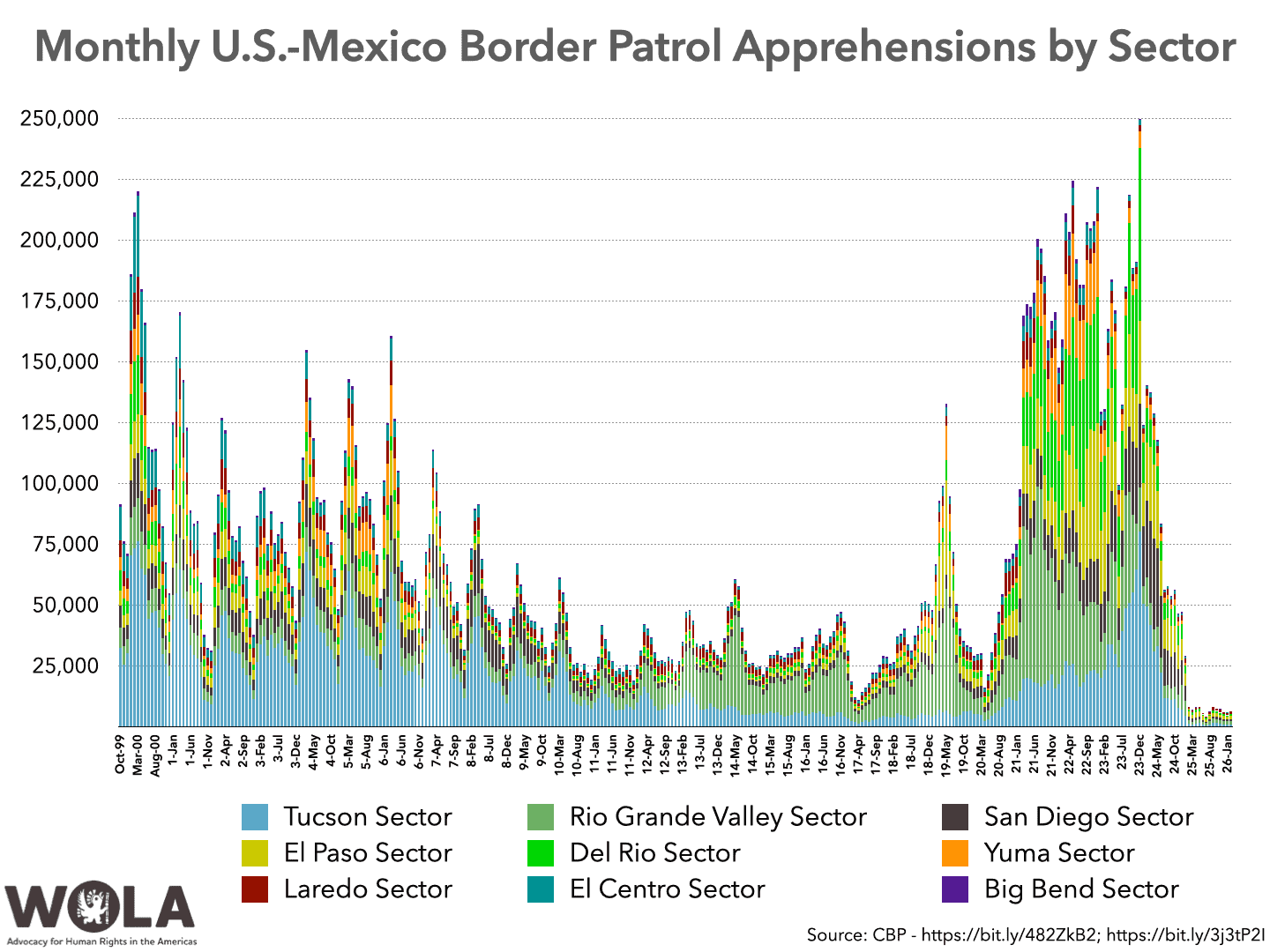
A close look at that chart shows that from the beginning of the century until the mid-2010s, migrant apprehension totals exhibited regular spikes in apprehensions each spring, followed by drops during the hot summer months, a leveling off or a small increase in the fall, and another drop during the cold winter months.
That pattern became blurred starting in the mid-2010s as asylum seekers began to make up a larger share of the migrant population. Unlike migrants who seek to evade Border Patrol, people seeking to apply for asylum aim to turn themselves in to CBP officers or Border Patrol agents. As that method of entry does not involve long desert or wilderness journeys on the U.S. side of the border, asylum seekers have tended to arrive regardless of season.
While it is a small data sample, the chart of the last 13 months’ Border Patrol apprehensions further above points to a possible return to a seasonal pattern: numbers inched up during the spring of 2025 (though not dramatically, as the new administration launched its initial crackdown), fell during the summer, rose in the fall, and fell again in the winter.
If this “seasonal” hypothesis is correct, then CBP will report increased migrant encounters in March through May, and we may even see reports speculating that the Trump administration’s border crackdown is softening. However, the non-asylum-seeking migrant population is likely to decline again in the summer.
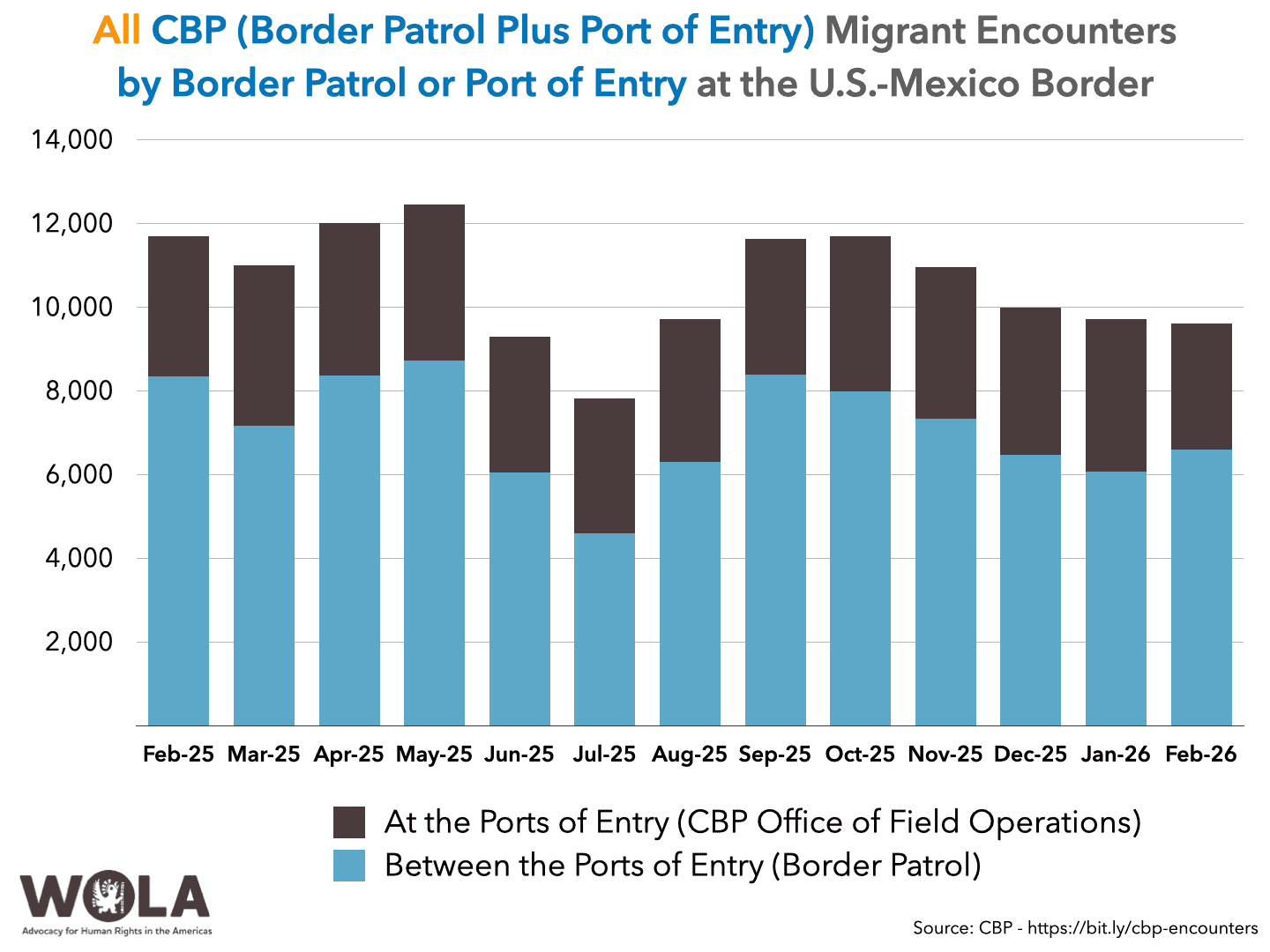
In February, the increase in Border Patrol apprehensions between the border’s ports of entry (official border crossings) was offset by a drop in migrant encounters at the ports of entry themselves, from 3,665 to 3,018 encounters. As a result, the parent agency CBP—which incorporates both Border Patrol and Office of Field Operations personnel at the ports—saw 108 fewer migrants in February (a shorter month) than in January.
Of those who ended up in CBP custody in February, 90 percent were single adults, the largest proportion of adults since the initial months of the COVID-19 pandemic in mid-2020. The drop in the number of families and children owes to the unavailability of asylum: while single adults seek asylum too, the vast majority of families and children arriving at the border were asylum seekers, not people seeking to avoid Border Patrol in the desert.
With no possibility of applying for protection at the U.S. border, the share of families and children has plummeted. So far in fiscal 2026, just 14 percent of people apprehended between the ports of entry by Border Patrol have been children or families.
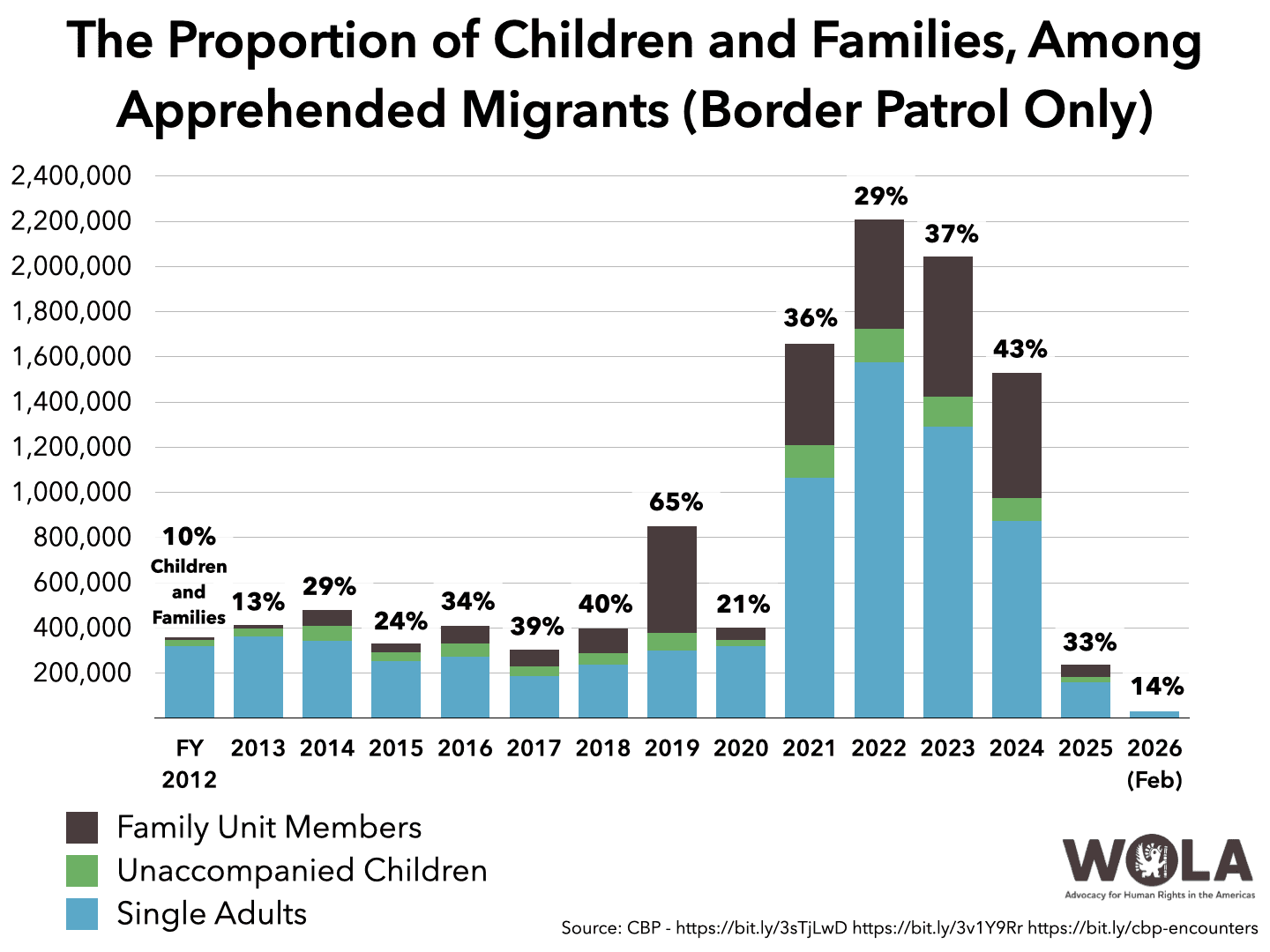
That is the smallest share since 2013. A year after that, in the spring of 2014, the Obama administration was surprised by a large-scale arrival of families and children from Central America; significant numbers of asylum seekers, particularly families and children, were a large part of the migrant population from then until the Trump administration’s January 20, 2025 proclamation suspending asylum.
In February, for the fourth straight month, the Rio Grande Valley Sector in southeast Texas ranked first in Border Patrol apprehensions (1,377) among the nine sectors into which the agency divides the U.S.-Mexico border. Apprehensions increased there by 8 percent over January. The fastest month-on-month growth, though, occurred in the El Paso Sector, at the opposite end of Texas and New Mexico, where apprehensions rose by 22 percent over January, totaling 1,264.
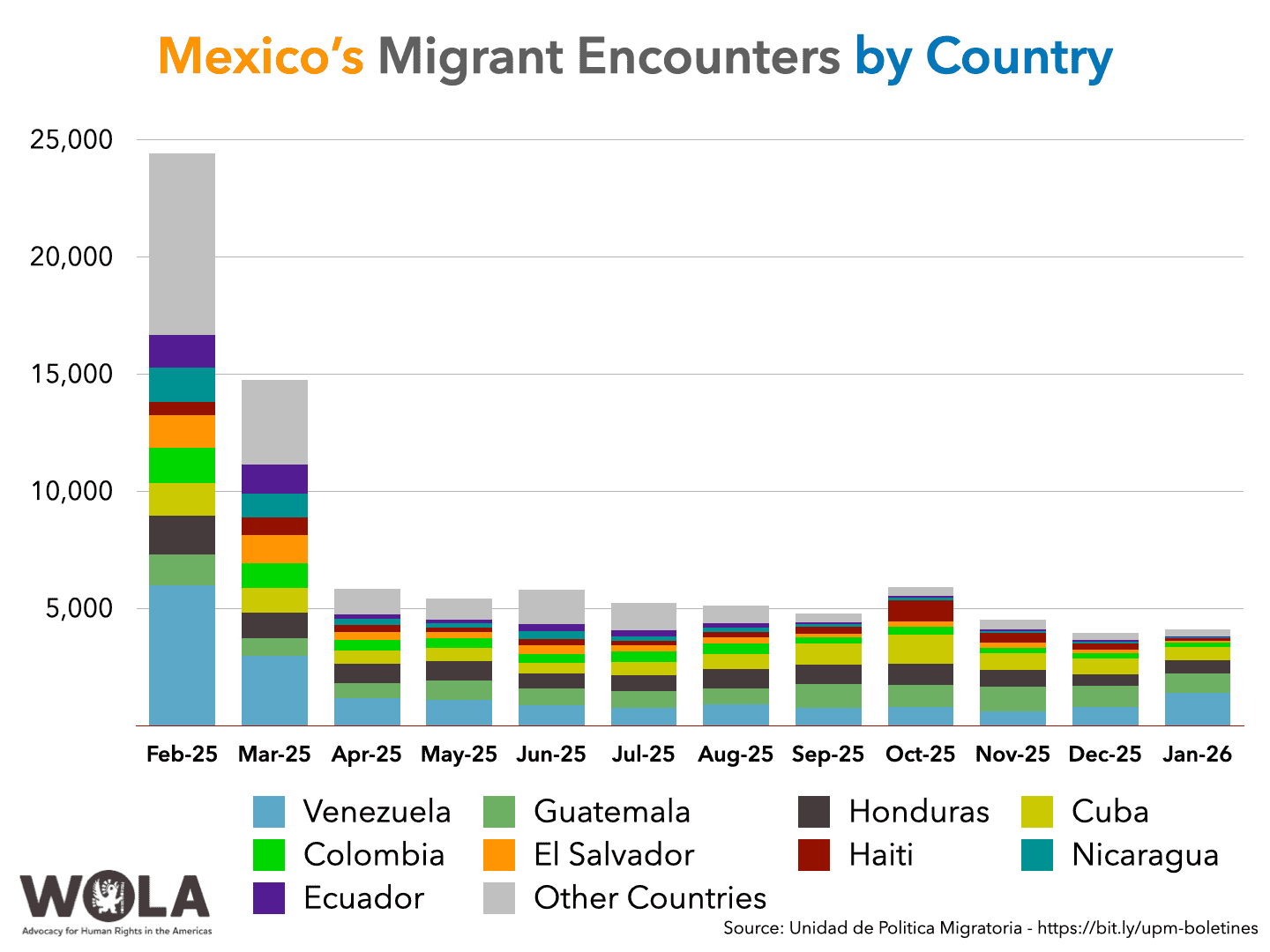
Migrant encounters remain near longtime lows further south along the U.S.-bound migration route. Through January 2026, Mexico’s authorities have reported encounters at their lowest level in about 15 years.

Since March 2025, Mexico has apprehended between 3,900 and 6,000 migrants per month, down from totals that exceeded 120,000 during a spring 2024 crackdown. Most have been from Venezuela, Guatemala, Honduras, or Cuba.
Some signals point to a modest increase in non-Mexican migration in Mexico.
- In Veracruz, Mexican authorities found 229 mostly Central American migrants packed into a truck, described by CBS News as “the first such encounter in months.”
- In Mexico’s southern border-zone city of Tapachula, Chiapas, about 500 migrants staged a so-called “caravan” protest, departing northward from the city. As with all caravans over the past seven years, their participants have almost zero hope of reaching the U.S.-Mexico border; instead, they are pressuring the Mexican government to permit them to find work elsewhere in the country while the Mexican government’s backlogged agencies process their asylum or other immigration claims.
- CBS, citing the Associated Press, noted that shelters in southern Mexico “have once again begun to take in Central Americans heading north, although in very small numbers.”
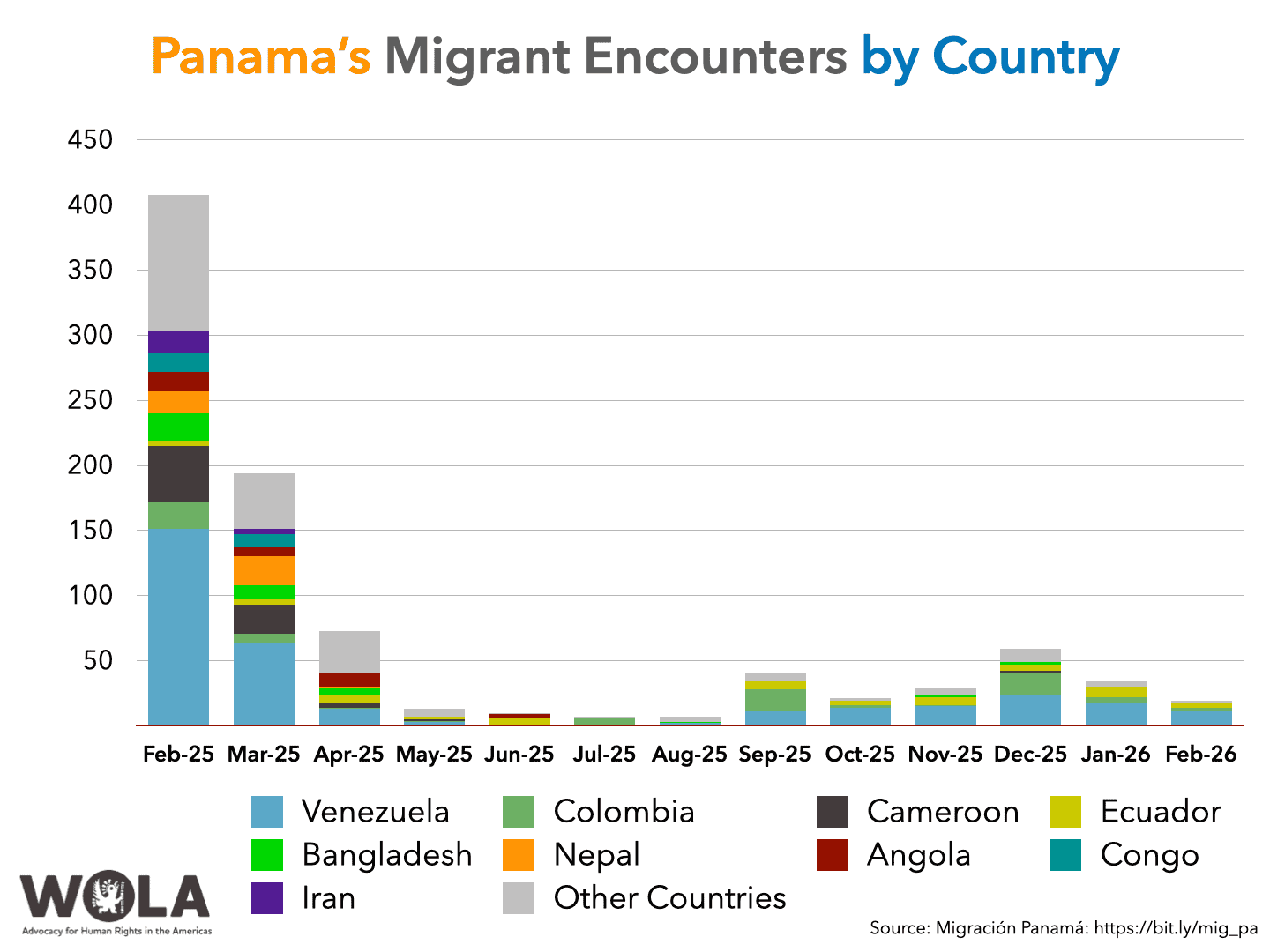
In the treacherous Darién Gap region between Panama and Colombia, where migrant encounters peaked at over 80,000 in August 2023, migration has all but stopped. Between April 2025 and February 2026, Panamanian authorities reported an average of just 28 northbound encounters per month.
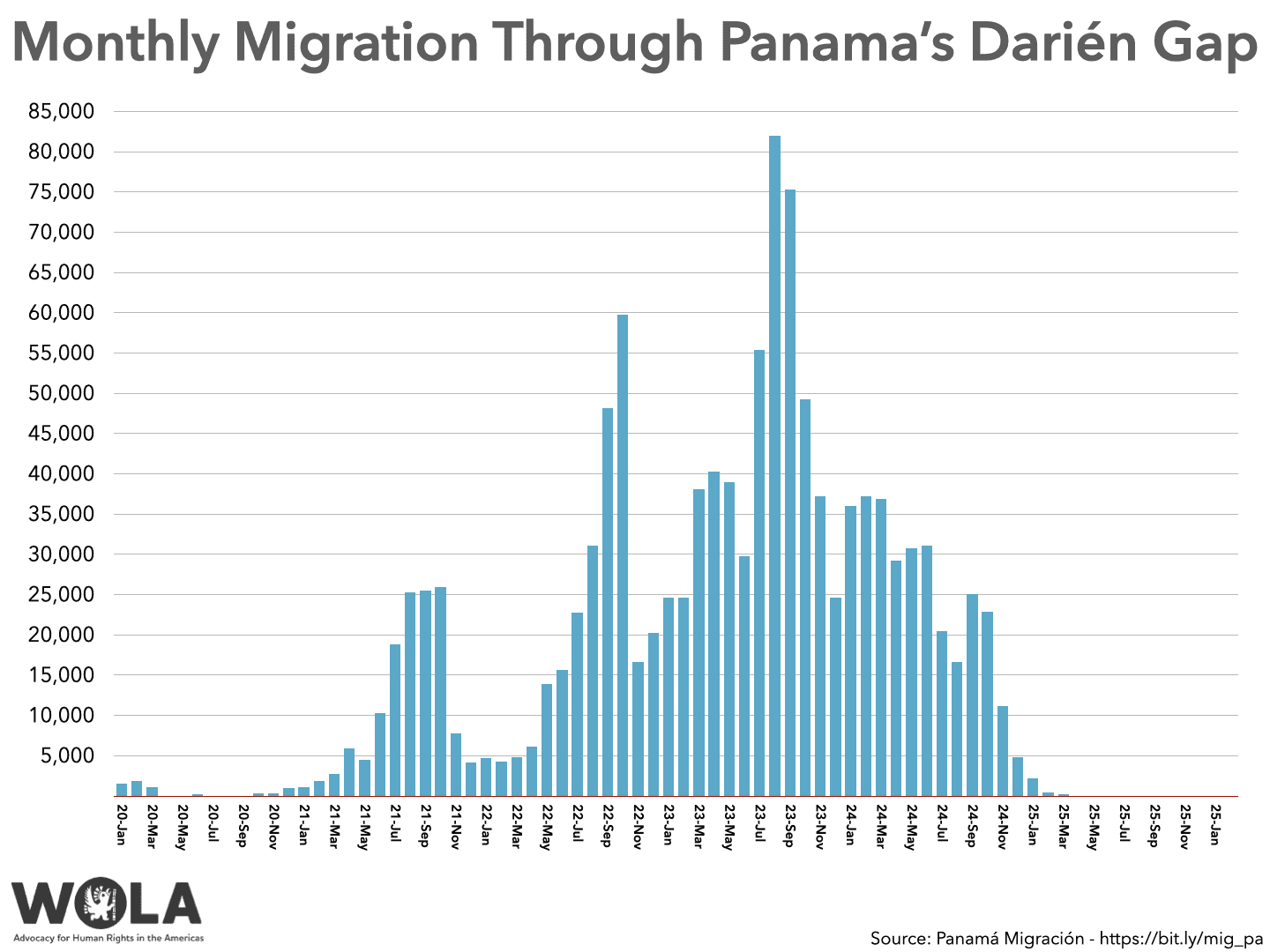
Of 53 migrants reported in January and February, all but 5 were from Venezuela, Colombia, or Ecuador, indicating a near-total halt to U.S-bound migration from continents beyond the Americas.
DHS remains partially shut down as Republicans consider funding ICE and CBP for three years
Much of DHS has been shut down since February 13, as Senate Democrats—demanding reforms to DHS law enforcement agencies in the wake of the January killings of two U.S. citizen protesters in Minneapolis—have refused to vote to allow debate to begin on the Department’s 2026 budget appropriation. Under the Senate’s “filibuster” rule, 60 senators must vote to allow a bill to move forward; Republicans hold 53 seats, so at most seven Democrats’ objections are enough to block a bill.
The DHS shutdown is partial because Immigration and Customs Enforcement (ICE) and CBP have a mammoth amount of separate funding available through 2029 as a result of the “One Big Beautiful Bill Act” that Congress passed last July. Rep. Henry Cuellar (D-Texas), the ranking Democrat on the House Homeland Security Appropriations Subcommittee, revealed that 62 percent of DHS employees have been getting paid during the shutdown, including 86 percent of ICE personnel, 85 percent of CBP and Border Patrol, and 85 percent of the Coast Guard.
However, only 4 percent of Transportation Security Administration (TSA) workers have been receiving paychecks. The resulting chaos at airports as TSA personnel quit and called in sick led President Donald Trump to order ICE agents to help screen passengers, and then to issue a dubiously legal executive order to pay TSA workers.
As noted in WOLA’s March 20 Border Update, slow-moving negotiations on ICE reforms had appeared to show Republicans giving a bit of ground on body-worn cameras, limiting enforcement at sensitive locations, visible officer identification, and congressional oversight visits to detention facilities. However, they remained unmoved on other issues, like agents’ masking and entering homes without judicial warrants.
On March 27, as legislators prepared to exit Washington for a two-week Easter recess, the Senate passed a bill—similar to what Democratic leaders had been proposing while negotiations over reforms continued—that would fund all of DHS except ICE and Border Patrol for the rest of the fiscal year. House Republicans rejected that bill later in the day, as President Trump told Fox News, “In my opinion, you can’t have a bill that’s not going to fund ICE.” The DHS shutdown persists.
As of April 2, it appeared that House Republicans had reversed themselves, with Trump’s support, and endorsed passing a bill without funding for ICE and Border Patrol. This is an outcome of a general perception that the Republicans, amid a spectacle of disarray and infighting, were bearing most of the political damage from the shutdown. “Let’s be abundantly clear—this record-breaking, 44-day DHS funding impasse has turned into a political disaster for Republicans,” read a multi-author March 30 piece at Punchbowl News, which focuses on congressional politics. “At one point, Republicans seemed to be breaking through with their message that Democrats instigated the DHS fight over undocumented immigrants. But now, House and Senate Republicans are publicly warring with each other over who’s at fault for last week’s debacle.”
Trump called on congressional Republicans to send him a “reconciliation” bill by June 1 that would, among other priorities like the Iran war, fund ICE and Border Patrol (if not all of DHS) for the remainder of his term. The term “reconciliation” refers to an infrequently invoked budget maneuver that—to simplify a complex process—allows a bill with strictly budgetary implications to skirt the filibuster and pass by a simple majority. This was the vehicle used to pass last year’s “One Big Beautiful Bill Act.” It has never been used before as a substitute for a regular annual appropriations bill.
This is an idea that Senate Republicans have been floating over the past two weeks. “We’re taking this off the table. That’s enough of this with the Democrats,” Sen. John Hoeven (R-North Dakota), an appropriator, said on March 30. “What’s coming next is going to supercharge deportations,” Sen. Eric Schmitt (R-Missouri) said in Senate floor remarks.
As the midterm elections draw near and President Trump’s popularity wanes, a reconciliation bill’s passage by June 1, if at all, is far from guaranteed. “A few Republicans, including Senator Mitch McConnell of Kentucky, the former party leader, have expressed reservations about funding agencies this way,” the New York Times observed. Sen. Rick Scott (R-Florida), an immigration policy hawk, said, “This idea that they’ll get funded through a reconciliation package is a pipe dream. We’re not going to get a reconciliation package done,” according to Migrant Insider.
DHS has new management and lower profile, but the mission is unchanged
Mullin takes over
On March 23 the Senate confirmed Markwayne Mullin, a senator from Oklahoma, as Trump’s pick to succeed Kristi Noem as Secretary of Homeland Security. Mullin lost one Republican vote—that of Homeland Security Committee Chairman Rand Paul (R-Kentucky), with whom he has feuded—but gained two Democratic votes, those of John Fetterman (D-Pennsylvania) and Martin Heinrich (D-New Mexico).
Much press coverage indicated that, though Mullin is no less conservative or loyal to Donald Trump than Noem was, he is expected to carry out the administration’s hardline border and immigration agenda in a more low-key, less flashy, and less controversial manner.
Among immediate changes at the Department:
- Rescinding Noem’s policy of requiring the Secretary’s personal approval of all contracts over $100,000—a threshold that held up about 31 percent of all DHS contracts. Mullin is raising the “secretary’s signoff” level to $25 million, covering about 1 percent of contracts.
- Bringing several members of his Senate staff to the Department, and reinstating Troy Edgar, who had been deputy DHS secretary until being nominated to be ambassador to El Salvador (still pending Senate confirmation).
- “Department officials believe Mr. Mullin will allow heads of agencies like ICE and U.S. Customs and Border Protection to have more latitude to make key decisions,” unnamed officials told the New York Times.
- As a nominee, Mullin told senators that he would instruct ICE agents not to enter residences without a judicial warrant, except in cases of hot pursuit. ICE has been using self-issued “administrative warrants” to enter homes when the agency believes that undocumented immigrants are inside. If the new Secretary has announced that policy change, though, WOLA has not seen it.
- Pausing a plan to build a network of giant warehouses in which to hold detained migrants, in order to re-evaluate it (see below).
Career DHS management is relieved to see Noem go, reported Anna Giaritelli of the Washington Examiner. Mullin “has the opportunity to be like a prince or knight in shining armor as he comes riding over the hill and saves everybody from this freaking chaos,” a senior DHS official told Giaritelli on March 25. “All he has to do, literally, is put things back in a normal order.”
“Pay-to-play” allegations
In particular, Noem and her close advisor, Corey Lewandowski, are under scrutiny about alleged contracting irregularities. Lewandowski, who managed Donald Trump’s campaign for some of 2016, served as a “special government employee”—a status that is meant to last for 130 days—but enjoyed significant power at the top of DHS.
NBC News reported that, during the 2024-25 presidential transition, Lewandowski allegedly told George Zoley, founder of the GEO Group—a massive private detention company—that he wanted payment (a “success fee”) in exchange for protecting contracts. Zoley refused twice, calling it improper, and two GEO contracts subsequently shrank, and some of its migrant detention facilities have remained unused despite the administration’s “mass deportation” buildup.
Lewandowski denies this and other allegations detailed in the NBC News investigation. A senior White House official told NBC that complaints about Lewandowski’s alleged “pay-to-play” demands “touched off discussions among White House aides.”
The allegations are now a key subject of a DHS Inspector General investigation, and were discussed at a March 25 “shadow hearing” hosted by Democrats on the House Homeland Security Committee.
Bovino retires
“I wish I’d caught even more illegal aliens,” Greg Bovino, the former Border Patrol sector chief who until January was a roving “at large commander” of Secretary Noem’s mass deportation efforts, told the New York Times upon his retirement from the force. The same profile noted that “six current and former homeland security officials described him as a chronic institutional headache whose theatricality, combativeness, and disregard for rules and protocol sometimes alienated even those who generally shared his politics.”
The Washington Examiner documented how in mid-2025 Bovino, over CBP Commissioner Rodney Scott’s direct order, refused to return three government Facebook, Instagram, and Twitter accounts with 850,000 combined followers. Those accounts have since been closed; the Border Patrol sector in El Centro, California, where Bovino was chief for most of the past six years, has a new account.
Less than 24 hours after retiring, Bovino received a “rock star welcome” at a sparsely attended Conservative Political Action Conference (CPAC) in Grapevine, Texas, where he called for the mass deportation of “100 million” people, which would be two out of every seven people currently in the United States (population just over 340 million).
Changing the tone
Noem is now at the State Department, where she is the Trump administration’s special envoy to its “Shield of the Americas” initiative. This role took her on a late-March trip to Honduras, Costa Rica, Guyana, and Ecuador. She took to the State Department 10 of her former DHS staffers, including the directors of the Department’s vastly reduced Office of Civil Rights and Civil Liberties and Office of Immigration Detention Ombudsman, as well as Deputy CBP Commissioner Joseph Mazzara.
The latter official, Mazzara, had suggested in a June 2025 email exchange that federal agents should have “just started hitting the rioters and arresting everyone that couldn’t get away,” in reference to an anti-ICE protest in Los Angeles. The sentence comes from incorrectly redacted documents obtained through the Freedom of Information Act by the nonprofit American Oversight and reported by the Los Angeles Times.
This is a tone that the Trump administration now appears to be seeking to avoid, even as it pursues “mass deportation” as energetically as ever. “In conversations with top advisers and his wife Melania, Trump has become convinced that some of his administration’s deportation policies have gone too far, and voters don’t like the term ‘mass deportation,’” the Wall Street Journal reported, adding that White House chief of staff Susie Wiles “believes the president’s immigration team has turned one of his marquee issues into more of a challenging issue ahead of the midterms” and that “Border Czar” Tom Homan—who rarely spoke to Noem—is leading the shift.
While it is unclear whether this is an effect of the shift, the pace of ICE arrests in the U.S. interior has remained at an average of just over 1,100 per day so far in 2026. That is similar to the pace set since June 2025, and slightly below that of late 2025. While roughly four times the Biden administration’s final-year pace, it is far short of the 3,000-per-day target that Deputy White House Chief of Staff Stephen Miller reportedly began pushing for last May.
The mission remains the same
Mullin’s quieter, more conciliatory tone masks an unchanged mission. ICE’s Enforcement and Removal Operations (ERO) division, fortified with tens of billions in “Big Beautiful Bill” funding, is expanding rapidly, as is the massive detention expansion discussed below.
The administration’s goal, the Atlantic’s Nick Miroff recalled, remains “to remove 1 million people a year from the United States.” While Homan, Mullin, Scott, and others are less “loud and flashy” than Noem, Lewandowski, and Bovino’s cohort, Miroff added, they “may prove to be more effective at delivering what Trump wants.”
“So what does it mean when Tom Homan says they wanna do targeted enforcement? It means you’re not gonna have Greg Bovino strutting around Los Angeles and Chicago like a rooster. But Tom Homan has been an advocate of mass deportations pretty much his entire 40-year career in federal law enforcement; he knows how to pull the levers. And what he represents is—think of it as, like, institutional ICE on steroids.”
The New York Times cited an internal ICE document showing that the agency has more than seven million people in the United States on its “non-detained docket” of “people ICE believes can be deported but who are not currently in detention.” These people, who include hundreds of thousands from whom the administration has stripped protections such as Temporary Protected Status and humanitarian parole, could be caught up in the new DHS management’s less-publicized “targeted enforcement” operations.
With Mullin adopting a lower-profile, more managerial role, Miller and Homan—both of them immigration hardliners—are more firmly in charge than before. Miller runs daily 10:00 am conference calls to hold DHS leaders accountable to the White House’s hiring, contracting, arresting, detaining, and deporting goals. Four officials told Politico that Miller’s shrill, frequent berating of officials may have sent Acting ICE Director Todd Lyons to the hospital at least twice for stress-related issues over the past year.
The warehouses
Under Mullin’s direction, DHS has paused the “ICE Detention Reengineering Initiative,” an ongoing plan to purchase and rapidly convert 24 warehouses around the country into a “hub and spoke” network of giant detention centers. The plan would use $38.3 billion in funds from the “One Big Beautiful Bill Act,” which devoted a staggering $45 billion to expanded ICE detention.
Project Salt Box, a citizen initiative carrying out detailed oversight of the warehouse plan, reported that “the Enforcement and Removal Operations arm of ICE—the agency actually tasked with running the facilities—has grown increasingly resistant to the program,” but Stephen Miller “is pressing hard to keep it alive.”
ICE has already spent about $1 billion on 11 warehouses across the country; the original plan was to begin sending detainees to the first site in April, and “to activate all facilities by November 30, 2026.” Now, though, ICE “is planning to revise its proposals and incorporate feedback from stakeholders before issuing contracts for the remaining buildings,” according to a memo viewed by the Washington Post.
In Salt Lake City, Utah, Mayor Erin Mendenhall disclosed, after a March meeting with ICE officials, that the agency’s recently purchased $145.4 million warehouse would be one of eight nationwide “mega centers” with a capacity of 7,500 to 10,000 people. ICE told the city that work will begin “in weeks and months.”
Congressional Democrats have launched at least two investigations into the warehouse plan’s contracting mechanisms: ICE has been using sole-source contracts instead of competitive bids and paying well over market rates for the warehouse properties.
Rep. Jamie Raskin (D-Maryland), the ranking member of the House Judiciary Committee, and Sen. Elizabeth Warren (D-Massachusetts) led 52 Democratic legislators on “a new investigation into whether government contractors, real estate brokers, and property owners are corruptly profiting from the White House’s fast-tracked expansion of inhumane warehouse-based immigration detention facilities,” sending lists of questions to six companies. Warren and Sen. Jeanne Shaheen (D-New Hampshire) sent a separate letter to Defense Secretary Pete Hegseth asking about ICE’s use of a Navy contracting vehicle known as WEXMAC TITUS to award massive contracts with less scrutiny.
Deportation Data Project release
Nearly a gigabyte of new ICE data covering October 2022 through March 2026, obtained through a Freedom of Information Act lawsuit and released by the Deportation Data Project, offers a detailed (though not always “cleaned up” and reliable) look at the agency’s arrests and detentions in the U.S. interior. It confirms that “other immigration violators” (people with no criminal history beyond immigration status) are the largest arrest category, contradicting “worst of the worst” public-safety justifications for mass detention.
The data shows spikes in arrests resulting from the Trump administration’s targeting of Democratic-led urban areas over the past year, especially Los Angeles, Chicago, and Minneapolis, plus a surprising spike in West Virginia that has received little media attention. In Chicago, a Chicago Tribune analysis of the data found, 60 percent of those detained by the Greg Bovino-led “Operation Midway Blitz” had no criminal history.
Deaths in ICE custody at record-setting pace
On March 25, guards at California’s Adelanto ICE detention center found José Guadalupe Ramos Solano “unconscious and unresponsive” in his bunk. He became the 14th person to die in ICE custody so far in 2026. He was the 43rd to die in custody, and the 4th to die at the GEO Group-run Adelanto facility, during the Trump administration.
The current ICE custody death rate so far this calendar year—one every six days, 11 deaths per 100,000 admissions—far exceeds that of any previous year in ICE’s mostly contractor-managed detention system.
The nature of these deaths is raising serious questions about detention conditions. Several recent examples are quite troubling.
- Emmanuel Damas, a 56-year-old citizen of Haiti, died of septic shock after failing to obtain adequate care for a toothache.
- Mohammad Nazeer Paktiawal, a 41-year-old Afghan refugee who fought alongside U.S. forces, died within 24 hours of arrest.
- Royer Perez-Jimenez, a 19-year-old indigenous man from Chiapas, Mexico, died in Florida’s Glades County facility; police body-worn camera footage showed officers kneeling on his back after a scooter stop; a Tzotzil speaker, he was unable to communicate with the police. ICE called his death a “presumed suicide.”
Senators Jon Ossoff (D-Georgia) and Dick Durbin (D-Illinois), meanwhile, launched a Senate Judiciary Committee minority investigation into the Florida state government’s so-called “Alligator Alcatraz” facility, which coordinates closely with ICE. It cites “credible allegations” of detainees held in ‘the box,” a cage-like structure, in which they are shackled, in direct sunlight without food or water.
Spurred by the deaths of 14 of its citizens, the government of Mexico is moving toward more formal diplomatic protest. President Claudia Sheinbaum announced plans to file a brief supporting a federal detention-conditions lawsuit, to raise the issue at the Organization of American States, and to have Mexican senators send letters to U.S. lawmakers.
Mounting evidence of harm to children
Taking parents away
In just seven months (January through August 2025), DHS detained or deported parents of at least 11,000 U.S. citizen children, according to a ProPublica analysis of ICE data that the University of Washington Center for Human Rights obtained through a public records lawsuit. That is over 50 children per day potentially separated from their parents, a rate four times higher than during the Biden administration.
While ICE deported about 31 percent of arrested mothers during the Biden years, during the first seven months of Trump’s administration the agency deported nearly 60 percent, with only 24 percent released. Over half of detained fathers and roughly three-quarters of detained mothers had no criminal convictions beyond traffic or immigration-related offenses.
This data, along with 128 cases of direct harm to children compiled by the staffs of Sen. Richard Blumenthal (D-Connecticut) and Rep. Robert Garcia (D-California), was featured in a March 27 shadow hearing hosted by Rep. Pramila Jayapal (D-Washington). At that event, pediatricians testified that “no amount of time spent in ICE detention is safe for a child.”
ProPublica noted that the Trump administration revised a key ICE directive, the Parental Interests Directive, which was originally established during the Obama administration to balance immigration enforcement with parental rights. The new “Detained Parents Directive” removed the word ”humane” from its preamble.
Dilley
The population at the Dilley Immigration Processing Center in Texas, the only federal detention facility used to hold families, has plummeted. As of mid-March, Dilley was holding 53 children and 49 parents, down sharply from a mid-January population of about 500 children and 450 parents, the New York Times reported, citing the legal aid group RAICES.
While it is unclear how much of the drop owes to deportations and how much to releases, it appears to be part of the Trump administration’s effort to alter the profile and tone of its mass-deportation campaign. It follows several alarming reports about abusive and neglectful conditions at the family facility operated by the private detention company CoreCivic.
Those conditions—very long stays, inedible and wormy food, difficulty accessing medical care, threatening guards, confiscations of paper and crayons, and more—are referenced in several recent WOLA Border Updates. Most prominent was reporting by ProPublica based on video conversations with detained kids, as well as drawings and letters smuggled out of Dilley. On March 25, Mother Jones published a wrenching series of excerpts of oral declarations, collected by RAICES, from children and parents held at Dilley. On April 1, RAICES and Human Rights First published A New Era of ICE Family Prisons, a report detailing miserable conditions based on RAICES’ oral declarations, plus “50 in-depth interviews with 15 legal service providers and 35 families following their arrest and incarceration at Dilley.”
Much attention to the families’ plight came from “Ms. Rachel” (Rachel Griffin Accurso), a very popular children’s educator with 5 million Instagram followers, who featured some detained kids on her channel. “I never thought I’d be on a call with a 9-year-old who was begging me for help to get out of a prison-like detention center,” Accurso told Mother Jones. Dozens of celebrities—Pedro Pascal, Madonna, Javier Bardem, Mark Ruffalo, America Ferrera, Elliot Page, Jane Fonda, and many more—have signed a petition calling for Dilley’s closure.
For the smaller number of children and parents who remain at Dilley, there is no indication that conditions have improved, and the New York Times recalled that “immigration lawyers and advocates cautioned that the numbers could quickly surge once again, and even families who were released could be redetained and sent back to Dilley.”
Pregnant detainees
In response to questions submitted by Sen. Patty Murray (D-Washington), the ranking Democrat on the Senate Appropriations Committee, DHS confirmed that it deported 363 pregnant, postpartum, and nursing mothers between January 2025 and February 2026. The Department recorded 16 miscarriages during that period.
Although federal guidelines restrict detention of pregnant women to exceptional circumstances and mandate specialized care, multiple cases show prolonged detention, use of restraints, and insufficient prenatal services, the New York Times reported. Women as much as eight months pregnant have been held “without adequate food or medical care.” Several women reported being shackled during arrest and transport—even while visibly pregnant or in distress—contrary to established detention standards. In five cases, agents or contractors wrapped chains around pregnant women’s bellies.
Updates about deportations
Mexico
Mexican government data from the first 13 full months of the Trump administration show that U.S. authorities deported 172,860 Mexican citizens back to their homeland during that period. During the last 13 full months of the Biden administration (December 2023-December 2024), deportations were, in fact, more numerous: 219,369 Mexican citizens.

The reason is the decline in border-zone apprehensions noted above, in this update’s first section. ICE has been ramping up its deportations, and the deported population now includes many more Mexican nationals who had been living in the United States for some time. Still, ICE’s deportation increases have been less rapid than the drop in recent border arrivals repatriated by CBP.
The Los Angeles Times, drawing in part on a late February report from Refugees International, noted that Mexico has accepted the deportations of nearly 13,000 citizens of countries other than Mexico since Trump took office. The largest nationality is Cuban citizens, whose government permits few deportation flights. The Mexican government continues to bus most of these third-country deportees across the country to two cities near its southern border: Villahermosa, Tabasco, and Tapachula, Chiapas.
The main organization in Tapachula that defends migrants’ rights, the Fray Matías de Córdova Human Rights Center, was broken into twice in under a week in late March. Unknown individuals thoroughly raided the group’s offices in downtown Tapachula, stealing computer equipment with its thousands of case files. Fray Matías has temporarily closed its doors, and officials have said nearly nothing.
“Banished from the U.S., undocumented in Mexico and unable to go home, deportees are stuck in ‘a quasi-stateless limbo,’” the Los Angeles Times reported.“They’re dumping people in a dangerous place who are extremely vulnerable,” said Gretchen Kuhner of the Mexico City-based nonprofit Institute for Women in Migration (IMUMI). Andrés Ramírez, who headed the Mexican government’s Refugee Assistance Commission (COMAR) during Andrés Manuel López Obrador’s 2018-24 government, said that even though President Claudia Sheinbaum needs to avoid fights with Trump, it could do more to help the third-country citizens being sent across the border: “If you truly were acting on humanitarian grounds, you would presumably implement a much more humane policy regarding these people.”
In Boston, U.S. District Judge William Young, sounding perplexed, demanded more details in writing from the Trump administration about the apparently “unwritten” agreement with Mexico that has led it to deport about 6,000 Cuban people to Mexico. The Biden administration had a similar arrangement with Mexico since 2023, but that was contingent on the U.S. government’s maintenance of a humanitarian parole program for citizens of Cuba, Haiti, Nicaragua, and Venezuela, which Trump canceled in January 2025.
Costa Rica
While in Costa Rica on March 23, Special Envoy Kristi Noem secured an agreement with that country’s government to accept about 25 third-country deportees per week, with the understanding that Costa Rica would then deport them to their countries of origin.
A statement from several human rights organizations warned that the agreement could lead to refoulement—the forcible return of a person to a country where their life or freedom would be threatened—if adequate risk assessments aren’t conducted before onward returns.
Costa Rica’s migration director publicly admitted he wasn’t briefed on the agreement, which appears to be in the hands of the Public Security Ministry, and no implementation timeline has been set. Security Minister Mario Zamora said that his government might house people deported from the United States in hotels, and they would be free to move around the country pending their subsequent deportation.
The organizations’ statement voiced concern about a grim precedent: Costa Rica’s February 2025 acceptance from the Trump administration of about 200 people from Russia, Armenia, Yemen, Afghanistan, Uzbekistan, and elsewhere, many of whom, it turned out, feared returning to their home countries. For months, the government of President Rodrigo Chaves held them at a camp near the Panamanian border; the country’s Constitutional Chamber put a stop to that. A year later, 110 were sent to their countries of origin, 55 left Costa Rica on their own, 30 sought asylum, and five escaped.
Guatemala
In Quetzaltenango, Guatemala’s second-largest city nestled in its western highlands, El Faro reported on the work of the Garibaldi Association of Migrants and Deportees (AMIDEGA), a community organization founded by deported migrants. AMIDEGA is quite busy helping to reacclimate and support people, many of whom have long resided in the United States, who have been caught up in the Trump administration’s deportation push.
Asylum and TPS, in the courts and Congress
Metering
The Supreme Court heard oral arguments on March 24 in Noem v. Al Otro Lado, a challenge to the legality of “metering”: the placement of CBP officers on the borderline outside of ports of entry to prevent asylum seekers from setting foot on U.S. soil to ask for protection in the United States.
Lower courts, including the Ninth Circuit Court of Appeals, have sided with opponents of the practice, which risks sending people back into situations where they face threats to their lives or freedom. Nonetheless, press reports indicated that most justices on the conservative Supreme Court appeared sympathetic to the Trump administration’s position in favor of preventing asylum seekers from setting foot on U.S. soil.
Section 208 of the Immigration and Nationality Act states that any non-citizen who “arrives in the United States” has the right to apply for asylum if they fear persecution “on account of race, religion, nationality, membership in a particular social group, or political opinion.” At issue is whether someone who comes up to the borderline but is turned away by CBP has still, in fact, “arrived in the United States.”
“I’m not sure how you can say we’re not violating our treaty obligations with your position,” Justice Sonia Sotomayor said, referring to U.S. accession to the 1967 Refugee Protocol. Conservative justices, however, focused instead on the meaning of “arrive,” offering up a variety of hypothetical scenarios and metaphors.
The judges’ decision on “metering” is likely to come later this year, probably in June or July.
Mandatory detention again upheld at the appellate level
In Minnesota on March 25, a three-judge panel of the Eighth Circuit Court of Appeals ruled 2-1 that a 29-year-old immigration law requires the mandatory detention of all undocumented migrants who entered the United States by crossing a border improperly. This, along with an earlier Fifth Circuit decision, upholds a July 2025 ICE memo that reinterpreted existing law in a way that could enable millions of people to be detained.
Chris Geidner, author of the Law Dork site, explained:
Prior to [the Trump administraton], the understanding of the Illegal Immigration Reform and Immigrant Responsibility Act of 1996 (IIRIRA) has been that people present in the country who were never legally admitted here are subject to a section of law that allows release and requires bond hearings [8 U.S.C. 1226] (absent exceptions in the law) if the government seeks to deport them — and not a different section of law that requires [8 U.S.C. 1225] mandatory detention. That second section has been applied only to “arriving aliens,” which just so happens to be the language used in that title of the U.S. Code.
Since 2025, more than 400 federal district judges have defied that memo by granting habeas corpus petitions to free migrants subjected to the new mandatory detention policy. At the appellate level, however, the judiciary’s two most conservative circuits have ruled the other way.
The two Eighth Circuit judges who upheld mandatory detention were appointed by George W. Bush and Donald Trump. The dissenting judge, Ralph Erickson, was also a Trump appointee. The earlier Fifth Circuit decision is pending an “en banc” review (by the entire court’s judges, not just a randomly selected three-judge panel).
CBP One
CBS News reported that a federal judge in Boston ruled on March 31 that the Trump administration had to restore the humanitarian parole status of migrants who entered the United States with appointments at border ports of entry using the Biden-era “CBP One” smartphone app.
More than 900,000 people were allowed into the country using the app, with the expectation that they would apply for asylum or otherwise adjust their status. In the meantime, they had temporary humanitarian parole, a status that the law allows the President to confer. President Trump revoked that status early in his term, but District Court Judge Allison Burroughs ruled that his administration did so in violation of administrative procedures spelled out in law.
The administration is very likely to appeal the ruling.
TPS
The Supreme Court will hear arguments on April 29 on the Trump administration’s cancellation of Temporary Protected Status (TPS) for about 350,000 citizens of Haiti, which lower courts have blocked.
In the meantime, legislation mandating a restoration of TPS for Haitians through at least April 2029 will soon head to the floor of the House of Representatives, despite opposition from leadership of the chamber’s Republican majority. Rep. Ayanna Pressley (D-Massachusetts) led a “discharge petition”—a document forcing a vote on a bill if more than half of the House signs it—that reached its 218-signature threshold on March 27, and a vote will occur in April. Four Republicans (Mike Lawler of New York, María Elvira Salazar of Florida, Don Bacon of Nebraska, and Brian Fitzpatrick of Pennsylvania) signed the petition.
A similar discharge petition to move legislation mandating TPS for Venezuelans, led by Rep. Darren Soto (D-Florida), has 40 signatures. An article in the independent Venezuelan news outlet Tal Cual raised concerns that the Trump administration’s restoration of relations with the post-Maduro regime in Caracas could create an impression of stability that DHS lawyers might use to oppose Venezuelans’ asylum claims in U.S. immigration courts.
Other legal items
- One of 252 Venezuelan men whom the Trump administration shipped without due process to El Salvador’s brutal CECOT prison in March 2025, Neiyerver Adrián León Rengel, became the first to file a Federal Tort Claims Act lawsuit against the U.S. government. León Rengel, who entered the United States via CBP One and had a 2028 immigration court date pending, seeks $1.3 million in damages for the torture he suffered at CECOT.
- The Washington DC district judge who sought to stop the CECOT transfers, James Boasberg, dismissed a lawsuit targeting the Trump administration’s agreement with El Salvador to accept and imprison third-country nationals. Boasberg found that the plaintiffs, a group of non-profits representing several of those sent to the CECOT, lacked standing because their clients might still have suffered harm even without a specific diplomatic agreement with the Salvadoran government.
- A coalition of human rights organizations filed a petition with the Inter-American Commission on Human Rights on behalf of 18 Venezuelan nationals who the Trump administration sent to El Salvador. It is the first case to demand international accountability; the Commission could recommend that it be brought before the Inter-American Court of Human Rights.
- An ICE court filing insists on deporting Kilmar Abrego Garcia to the African nation of Liberia, even though the government of Costa Rica has indicated that it would accept him. Acting ICE Director Todd Lyons claimed a necessity to send Abrego to Liberia because “significant U.S. Government resources and political capital have been expended negotiating with the Republic of Liberia.” That argument does not dispel concerns that the administration’s choice of destination is vindictive.
- President Trump was on hand for April 1 Supreme Court arguments regarding his effort to undo birthright citizenship, a right conferred by the Constitution’s 14th Amendment. Justices appeared to be skeptical of the administration’s position.
Border walls and buoys
- The administration is now building about three miles of new border wall per week, according to a detailed report by the Washington Post. CBP has awarded $22 billion in contracts to construction companies, from a total “Big Beautiful Bill Act” appropriation of $46.5 billion for new barriers. “This is one of the largest public works projects in recent history for the U.S.,” Eamon Harrity of the Sky Island Alliance, an Arizona-based environmental group, told the Post. “It’s fairly scary to think about the lack of oversight, the complete authority to build these walls without considering the environmental impacts.”
- The southern terminus of the Continental Divide Trail, which runs from the New Mexico Bootheel all the way to Canada, is off limits, for now, to hikers without a permit from the U.S. Army. The Trump administration placed it within a military zone, or “National Defense Area”: a narrow fringe of land along about 40 percent of the border that is now considered part of nearby military bases. However, the Santa Fe New Mexican reported that by 2027, once nearby border wall construction in this very remote area is complete, the administration plans to make the trail’s first mile accessible to hikers again.
- Contractors continued detonating explosives on the slopes of Mount Cristo Rey just west of El Paso, preparing terrain for a 1.3-mile, 30-foot-tall, $95 million wall segment. The iconic mountain, which straddles the border where the land boundary meets the Rio Grande, is owned largely by the Catholic Diocese of Las Cruces, New Mexico, and is the site of an annual Good Friday pilgrimage. The Diocese opposes the wall-building project, Inside Climate News reported.
- CBP appears to be backing off on plans to build border wall segments within Big Bend National Park and an adjacent state park, in what may be the most remote part of the border, in west Texas. The borderland park is a major U.S. tourist destination. Faced with an outcry from a wide range of stakeholders, including conservative ranchers and sheriffs who usually support Donald Trump, CBP has removed the planned border wall from an online map. While Border Patrol Chief Mike Banks reportedly told Texas’s governor that there will be no wall in the Big Bend park, the agency has made no public commitment, and plans continue for 175 miles of barriers nearby.
- In Laredo, Texas, the Trump administration is moving ahead with plans to fence off the city’s riverfront, despite opposition from the local government and a vigorous activist movement. Mayor Victor Trevino said that, in a concession, Border Patrol has at least agreed to consult with the city on the barrier’s design and share technical data.
- In the Rio Grande Valley, the border’s easternmost region, a $1.2 billion contract awarded on March 18 will enable construction of border wall segments in sacred and environmentally sensitive areas, including the historic La Lomita Chapel, the Santa Ana Wildlife Refuge, and the National Butterfly Center. Appropriations laws during Trump’s first term had specifically exempted these sites from border wall construction, but the “One Big Beautiful Bill Act” did not.
- The administration is rapidly deploying a planned 536-mile system of cylindrical buoys anchored with concrete blocks along the center of the Rio Grande. The first segment, 17 miles near Brownsville, is underway. The project is raising concerns about humanitarian, environmental, and flooding impacts, as well as boundary treaty violations. A review of federal contracts by Martha Pskowski of Inside Climate News identified “seven along the Texas-Mexico border, totaling over $2.5 billion, that reference either ‘waterborne barriers’ or ‘waterborne buoys.’” In Zapata County, commissioners passed a unanimous resolution opposing the project and ordered an independent study of flooding impacts.
- Defence Blog reported that troops from the Defense Department’s Joint Task Force–Southern Border are using TRV-150C quadcopter drones to position concertina wire along the border in terrain that is inaccessible by vehicle. Military personnel and Border Patrol agents are also using “unmanned surface vessels”—river drones—to patrol parts of the Rio Grande; the article notes, “These solar-powered watercraft can reportedly remain operational for up to six months without refueling or major maintenance.”
Other news
- A ProPublica examination of Justice Department data found that the Trump administration quietly closed over 23,000 criminal cases in the first six months of 2025, abandoning investigations into terrorism, white-collar crime, drug offenses, and similar crimes. Instead, the Department redirected prosecutors’ and investigators’ resources toward immigration enforcement, with 32,000 new cases prosecuted.
- The War Horse and the Border Chronicle commemorated a year of the Trump administration’s military buildup at the border with an assessment of its impact, the blurring of civilian and military law enforcement roles, the use of counterterrorism technology for migration control, and the “National Defense Areas” restriction of public access to borderlands.
- The cutoff of access was a theme of an analysis by the Center for Western Priorities, which found, “Under the banner of border security, the Trump administration is overriding decades of conservation work to build military infrastructure, dismantling environmental protections and stripping away public access.”
- A policy brief by Rice University’s Baker Institute highlighted the impact of the Trump administration’s immigration policies on countries along the U.S.-bound migration route, including human rights costs, economic strains, and consequences of third-country deportations.
- The U.S. Embassy in Mexico generated anger by posting to social media an AI-generated video of a band playing a corrido encouraging migrants to “return to your roots,” with a link to the CBP Home app that facilitates self-deportations. President Claudia Sheinbaum announced plans to ban foreign governments from running political ads in Mexico.
- A Border Chronicle investigation narrated the tragic and frustrating demise of the Tucson-based Colibrí Center for Human Rights, which worked to identify the remains of migrants who died crossing the border and bring closure to their families. Alarmingly, “Colibrí’s missing-persons database has itself gone missing.”
- A Cato Institute briefing paper analyzed 2024 American Community Survey (ACS) criminality data and found that immigrants are far less likely to be incarcerated than native-born Americans. Undocumented immigrants’ incarceration rate is about 44 percent lower than that of U.S.-born citizens, and documented immigrants’ rate is 75 percent lower.
- A federal grand jury in New Mexico indicted Border Patrol agent Eduardo Prat for allegedly choking a handcuffed detainee in May 2023, then covering up the incident and concealing a body-worn camera recording.
- CBP plans to build a new Border Patrol station in Las Cruces, New Mexico; city officials said that they have been told little about the proposed 30-40-acre project.
- Border Report reported recent incidents of migrants being apprehended while their smugglers guided them remotely, using commercial drones flying overhead.
- The month of March was violent in Ciudad Juárez, Chihuahua, the city across from El Paso, Texas, with 62 homicides: up sharply from 41 in January and 43 in February. In response to an uptick in organized-crime violence, Mexico’s government sent dozens of Army personnel to both Ciudad Juárez and Tijuana, Baja California.
- The Associated Press profiled the work of Rev. Brian Strassburger of the Del Camino Jesuit Border Ministries, based in the Rio Grande Valley region of southeast Texas. There and across the border in Tamaulipas, Mexico, Strassburger had been ministering to large numbers of asylum seekers in shelters; now, amid the Trump administration’s crackdown, he is working with detained migrants in the United States and deported migrants in Mexico. (Readers may also know Strassburger as the co-host of the Jesuit Border Podcast.)
- Mother Jones published a deep dive into the seemingly unstoppable spread of Arundo donax, or carrizo cane. The aggressively invasive plant has colonized much of the Rio Grande’s banks, often frustrating Border Patrol agents’ efforts to locate and apprehend migrants.
Links: “mass deportation” and human rights in the U.S. interior
Essays, analyses, and reform proposals
- Christian Paz, “How ICE Has Changed American Life” (Vox, March 30, 2026).
Immigrant or not, Trump’s mass deportation pledges have fundamentally changed how regular people live
- Aaron Reichlin-Melnick, Chris Geidner, “Immigration in the Trump Era, With Aaron Reichlin-Melnick” (Law Dork, March 27, 2026).
On the birthright citizenship case being heard at the Supreme Court on April 1: “I continue to believe that this is an easy case. The 14th Amendment says what it says”
- Hanna Rosin, “Meet the New ICE” (The Atlantic, March 26, 2026).
Same as the old ICE?
- David Masciotra, ““ICE Is Too Bloated, Politicized, and Corrupt to Continue”” (Washington Monthly, March 26, 2026).
A former Republican insider argues Democrats must abolish ICE if they want to restore constitutional governance
- Donell Harvin, “DHS’s Revolving Door: The Need for Experienced Leadership in Dangerous Times” (George Mason University, Just Security, March 25, 2026).
To restore DHS’ credibility, Congress must strengthen oversight and push for a leadership team grounded in expertise
- Blas Nunez-Neto, “No More Back Doors: Recapturing the Public’s Trust on Immigration” (Searchlight Institute, March 23, 2026).
It is time to close all of the back doors and loopholes in our system even as we expand our legal pathways. There should only be one way into America—through the front door
- Paul Rosenzweig, “How to Fix DHS” (The Atlantic, March 22, 2026).
The answer to the agency’s abuses is not reform; it is wholesale disassembly and restructuring
Human rights
- Courtney Kube, Julia Ainsley, “ICE Agents Will Be Stationed Outside Marine Corps Graduation Events in South Carolina” (NBC News, March 30, 2026).
As the U.S. continues to fight the war in Iran, the Marine Corps has boosted protection measures on bases, requiring everyone to present REAL IDs, passports or birth certificates to access any sites
- Colleen Deguzman, Dan Keemahill, Stephen Simpson, Terri Langford, “Undocumented Immigrants in Texas Are Delaying Medical Care” (The Texas Tribune, March 30, 2026).
Since Gov. Greg Abbott ordered Texas hospitals to start asking patients for their citizenship status in November 2024, reported visits by undocumented immigrants have dropped
- Quinta Jurecic, “Does the Constitution Protect This Congresswoman From Trump?” (The Atlantic, March 30, 2026).
LaMonica McIver of New Jersey is arguing that the Department of Justice can’t prosecute her for an incident last May at an ICE facility
- Steve Held, “Border Patrol Agents Ignored Orders to End Car Chase Before Gassing Chicago Neighborhood” (Unraveled, March 26, 2026).
DHS claimed federal agents intentionally hit a fleeing vehicle to try to stop the driver in Chicago’s East Side neighborhood last October—but videos of the 18-minute high-speed pursuit show they actually blew a tire and crashed after ignoring a supervisor’s commands to end the chase
- Vittoria Elliott, “Why ICE Is Allowed to Impersonate Law Enforcement” (Wired, March 26, 2026).
“There’s no accountability,” one expert tells WIRED of ICE’s ability to lie to the public. “The consequence of this is that it’s going to be a systemic harm across all law enforcement”
- Priyanka Menon, “ICE Might Be Violating America’s Other Bill of Rights” (ACLU of Illinois, The Atlantic, March 26, 2026).
To keep rogue agents in check, we need to look beyond the Constitution
- Rachel Monroe, “The Trial of Anti-ICE Protesters Accused of Terrorism” (The New Yorker, March 26, 2026).
When a demonstration at an ICE facility ended in a shooting, protesters were charged with attempted murder—then the government added terrorism charges. Rachel Monroe reports on the Trump Administration’s alarming strategy for turning left-wing activism into domestic terrorism
- Ed Pilkington, “The ‘Self-Deportee’ Hounded Out of the US to Mexico: ‘There Are Days When I Feel Literally Insane’” (The Guardian (Uk), March 24, 2026).
Abel Ortiz lived in LA since he was a newborn. The Guardian filmed him as he left after 38 years. Now, we catch up with him in Mexico City, fired up and grieving in his new life
- Lauren Mcgaughy, “Stephen Miller Asks Why Texas Pays to Teach Undocumented Children” (The New York Times, March 24, 2026).
Citing gridlock in Washington, President Trump’s top immigration adviser encouraged Texas lawmakers to lead on conservative priorities
- Nate Raymond, “Immigration Court Bond Hearings Plummet Amid Trump Detention Policy, Analysis Finds” (Reuters, Reuters, March 23, 2026).
70% fewer bond hearings held by US immigration judges in February
- Jose Olivares, “How the Trump Administration Is Undermining Legal Immigrants” (The Guardian (Uk), March 21, 2026).
The US has been targeting not only people who have violated the law but many who are in the country legally
- Hamed Aleaziz, Megan Twohey, Shawn Mccreesh, “Trump Friend Asked ICE to Detain the Mother of His Child” (The New York Times, March 20, 2026).
Paolo Zampolli, a former modeling agent and a longtime Trump ally, was in a custody battle over his son. An ICE official agreed to help
- Rahul Mukherjee, Ximena Bustillo, “An Immigration Court Few Have Heard of Is Quietly Shaping Policy Behind the Scenes” (National Public Radio, March 20, 2026).
President Trump has slashed the number of people on the Board of Immigration Appeals and stacked it with his appointees, tightening the due process available for immigrants, an NPR analysis shows
- Kyle Cheney, “Trump Administration Waves the White Flag in Some ICE Cases” (Politico, March 20, 2026).
The Justice Department is increasingly telling judges it can’t defend ICE’s actions
- Me Me Khant, “A Profoundly Tragic Refugee Death in Buffalo Adds to a Grim Border Patrol Toll in 2026” (Slate, March 19, 2026).
Nurul Amin Shah Alam crossed the world to flee profound persecution
- Meg Anderson, “ICE Officers Are Taking DNA Samples From Protesters They’ve Arrested” (National Public Radio, March 19, 2026).
People arrested while protesting ICE say federal agents took samples of their DNA. It’s legal, but experts say the practice raises questions about what the government is doing with that genetic data
Courthouse arrests “error”
- Priscilla Alvarez, “Trump Administration Admits Error in Lawsuit Over Immigration Court Arrests It Justified With ICE Memo” (CNN, March 26, 2026).
The Justice Department admitted to a federal judge Tuesday it’s been incorrectly relying on an Immigration and Customs Enforcement memo to justify arrests at immigration courts, according to a new court filing in an ongoing lawsuit
- Zoe Tillman, “DOJ Blames ICE for ‘Regrettable Error’ in Immigration Lawsuit” (Bloomberg, Bloomberg Law, March 25, 2026).
US Justice Department lawyers told a federal judge that they’ve been relying on incorrect information for months in a fight over the Trump administration’s migrant arrest tactics, and blamed Immigration and Customs Enforcement for the “regrettable error”
Cybersecurity, privacy, and civil liberties
- Brendan I. Koerner, “Opposing ICE Might Save the Country. It Could Also Ruin Your Life” (Wired, March 31, 2026).
For months, lone vibe coder Rafael Concepcion has obsessively built tools to counter the federal immigration crackdown—pivoting as he’s been outmatched. He’s also lost his job and become a target
- Oriana Van Praag, “ICE-Tracking Apps Have Helped People Avoid Immigration Agents. Are They Legal?” (The New Yorker, March 28, 2026).
ICEBlock was meant to help people avoid immigration enforcement. The Trump Administration claims that the app endangered the agents of its mass-deportation campaign
Citizen oversight
- Caroline Kubzansky, “Immigration Court Observers — and Their Oversight — Routinely Locked Out of Process” (The Chicago Tribune, March 30, 2026).
Legal observers are being digitally shut out of immigration court hearings at a moment of uncertainty for immigrants who are seeking to obtain legal status around the country against a tide of new policies from the Trump administration
- Jeff Abbott, “El Paso March Protests ICE Mass Detention, Deportation” (The El Paso Times, March 25, 2026).
Nearly 1,000 people marched in El Paso against Trump’s mass deportation policies, calling for an end to family separation
- Eric Westervelt, “Mapping ICE’s Expanding Footprint, and the Communities Fighting Back” (National Public Radio, March 23, 2026).
Resistance in both Democratic and Republican cities points to broader unease with the direction of immigration enforcement
ICE at airports
- Daniel Wu, Mariana Alfaro, “ICE Agents May Remain at Airports Even After TSA Agents Get Paid” (The Washington Post, March 29, 2026).
As the partial government shutdown drags on, border czar Tom Homan says immigration agents might not leave airports
- Aishvarya Kavi, “IcE May Remain at Airports Even After T.S.A. Pay Resumes, Border Czar Says” (The New York Times, March 29, 2026).
Transportation safety officers are set to be paid on Monday, but Tom Homan, the White House’s border czar, said ICE agents may stay where there are shortages
- Mathew Rodriguez, “ICE at Airports Trains Us to Accept Being Terrorized in Our Daily Lives” (The Intercept, March 28, 2026).
I had an ultimately harmless encounter with ICE at an airport TSA checkpoint. It was a preview of a new, more sophisticated way to terrorize people
- Hamed Aleaziz, “When Trump Wants Something Done, He Dispatches ICE to Do It” (The New York Times, March 24, 2026).
President Trump has increasingly used Immigration and Customs Enforcement to push personal and political objectives, and on Monday sent agents to airports across the country to help deal with long security lines
- Aileen Graef, Alison Main, Riane Lumer, “Immigration Agents Deploying to Airports Under Border Czar as TSA Staffing Falls Short” (CNN, March 22, 2026).
President Donald Trump said border czar Tom Homan will be in charge of deploying Immigration and Customs Enforcement agents to airports on Monday, with Homan telling CNN the agents will help with security at entrances and exits to ease the Transportation Security Administration’s workload
Asylum
- Camilo Montoya-Galvez, “Trump Administration Scaling Back Asylum Crackdown Enacted After D.C. National Guard Shooting, Sources Say” (CBS News, March 29, 2026).
The unprecedented move amounted to an indefinite suspension of all asylum requests filed outside of immigration court, regardless of the applicant’s nationality
- David Kurtz, “Exclusive: Trump Admin Wrongfully Deported More Than 100 Asylum Seekers” (Talking Points Memo, March 19, 2026).
In surprise testimony in federal court Thursday, an immigration officer revealed that more than 100 asylum seekers were wrongfully deported in violation of a court-ordered settlement agreement
Immigration
- Alexandra Mendoza, Lori Weisberg, “San Diego Loses Population as Immigration Nosedives. What Are the Consequences?” (San Diego Union-Tribune, March 29, 2026).
A continuing decline in immigration could have serious ramifications for the county’s economy
States’ opposition
- Lauren Gill, “New Jersey Becomes the 10th State With a Law Barring Local ICE Contracts” (Bolts, March 25, 2026).
New Jersey Governor Mikie Sherrill on Wednesday signed legislation banning local law enforcement agencies from partnering with federal immigration authorities, making it the 10th state
- Andy Mannix, “Minnesota Kicks Off Legal Battle With Trump Administration to Hold ICE Shooters Accountable” (ProPublica, March 25, 2026).
With the Trump administration refusing to identify agents or share evidence, the case is a game of constitutional chicken: states’ rights versus federal immunity
Detention
- Nigel Duara, Wendy Fry, “Exclusive: Rape Calls at ICE Detention Center Aren’t Investigated by San Diego Sheriff’s Office” (CalMatters, March 24, 2026).
The warden at an immigrant detention center in San Diego County has authority to decide how to investigate rape reports there under an agreement with the local sheriff’s office
- Kate Morrissey, “San Diego Woman Says Her Credit Card Information Was Stolen While She Was in ICE Custody” (Daylight San Diego, March 24, 2026).
Hanne Engan, whom ICE arrested at her green card appointment, said her diabetes quickly escalated while at Otay Mesa Detention Center due to medical negligence
The military’s role
- Austin Campbell, Noah Hurowitz, “Pentagon Implores Civilian Workers to Join ICE “Volunteer Force”” (The Intercept, March 20, 2026).
DHS is facing public backlash over immigration enforcement and an ongoing government shutdown. The Defense Department wants to help
Adam Isacson (he/him), Director for Defense Oversight
WOLA: Advocacy for Human Rights in the Americas (www.wola.org)
Signal adamisacson.98
Mastodon: elefanti.co/@adam BlueSky: @adamisacson.com