
Fwd: Ponoko - Blog

magicclockshop
From: Ponoko - Blog <bl...@ponoko.com>
--Date: Fri, Apr 20, 2012 at 8:12 AM
Subject: Ponoko - Blog
To: magiccl...@gmail.com
Ponoko - Blog
|

|
Posted: 19 Apr 2012 10:51 PM PDT Sculptural artefacts created with 3D technologies Initially Sophie used wax stereolithography for lost wax casting in bronze. More recently, she has been experimenting with full color 3D printing where the digital model was generated using a laser scan and a photograph of a model. The final 3D print then required sandblasting and sanding to create “the appearance of an unearthed ancient artifact.” The option of on demand online fabrication has allowed the artist to experiment, and test ideas quickly without much capital. Earlier work involved using large service bureaus that were often prohibitively expensive. Sophie’s fabrication process is an involved one that expands beyond the computer screen and various scanning and printing technologies. Often 3D printing is only an intermediate phase in creating the final art piece. The artist uses 3D prints for molds as part of wax casting or ceramic clip casting. She’s hoping to be able to 3D print in ceramic, once it is possible to print larger objects. The goal is “to move away from plastic and towards more natural materials with longer histories”. Sophie’s most recent project was a miniature printed in stainless steel. In this case the print was intended as the artefact. How would you describe your creative process? Both photography and scanning involve light and a lens, and they ‘capture’ and freeze a few seconds in time. What fascinates me about 3d scanning is the way it reveals the incompleteness of our own vision. Many of the holes and gaps in my sculptures are due to occlusion: the parts of the face that are hidden from view at any one time. My sculptures can look complete from one angle and very incomplete from another. I’m also interested in the art-historical resonances in technology, like the fact that 3d scans can look like fragmented classical sculptures, or plaster death masks, for example. I’m trying to make a connection between the digital and the handmade object. Do you have any tips for other makers? I recommend Netfabb Pro to everybody. It’s so much more user-friendly and accessible than some of the more expensive programs out there, and it’s really revolutionized my ability to prepare laser scan files for 3d printing. Posted in 3D Printing, Art, Maker Stories, Yana Skaler by yana | No Comments  |
|
Posted: 19 Apr 2012 10:50 PM PDT Time to go dotty with your CNC artwork
Halftone-styled images have a compelling power to them. Perhaps it’s the retro-nostalgia of 1960’s Pop Art, the grainy speckles of old newsprint, or maybe it’s something else entirely? Either way, there is just something about all those dots. Evil Mad Scientists (you know, the guys behind the Egg-Bot amongst other things) have released StippleGen, a stand-alone program that converts any image into CNC-friendly SVG format. There is a considerable amount of control as you tweak the algorithms, whether you are after a specific number or style of dots, or even a continuous TSP path. It’s all geared towards use on small CNC devices such as the Egg-Bot, but don’t let that stop you if you have larger aspirations.
Click through to EMSL for a thorough run-down on just what this neat little software package is capable of. via Evil Mad Scientist Laboratories Posted in CNC Routing, Guy Blashki, Software by Guy Blashki | No Comments  |
|
ShapeOko CNC/3D printer kit winner announced! Posted: 19 Apr 2012 11:31 AM PDT + 3 days to pre-order one from Inventables
Anyone who placed a CNC routing or 3D printing order with Ponoko during the promotional period was automatically entered to win. Our randomly chosen winner was David Profitt who just so happens to run an instrumentation shop at Stanford University’s School of Medicine. David told us a little about it: “[It's] a very unique operation in that as the sole proprietor I am responsible for all aspects of design and fabrication, both mechanical and electronic. The work I do is for non-profit and is in direct support of the research labs on campus.” Congratulations to David, and we hope to catch up soon to find out what he’s been making with Ponoko and how he’ll use his ShapeOko. It was our first hardware giveaway, and judging by the number of entries we got — you guys like hardware! So we’re doing another hardware promotion! This time, you can win a FREE Silhouette Cameo electronic cutting tool. It’s like a desktop injket printer, except it cuts stuff! To enter, all you have to do is make a lasercut paper project with Ponoko. Get the details here. For those of you interested in a ShapeOko of your own, they are now available for pre-order from Inventables, a Chicago-based hardware store dedicated to supplying DIY manufacturing. There are just 3 days left to pre-order a ShapeOko from Inventables.
Posted in Ponoko News by Ponoko Team | No Comments  |
 www.sophiekahn.net


| You are subscribed to email updates from Ponoko - Blog
To stop receiving these emails, you may unsubscribe now. |
Email delivery powered by Google |
| Google Inc., 20 West Kinzie, Chicago IL USA 60610 | |

Dave Hempy
Neat stuff! Thanks for sharing, Edgar.
-dave
From: coll...@googlegroups.com [mailto:coll...@googlegroups.com]
On Behalf Of magicclockshop
Sent: Friday, April 20, 2012 11:08 AM
To: coll...@googlegroups.com
Subject: Fwd: Ponoko - Blog
Here's info on a stipple program for rendering pix via CNC--edgar
---------- Forwarded message ----------
From: Ponoko - Blog <bl...@ponoko.com>
--Date: Fri, Apr 20, 2012 at 8:12 AM
Subject: Ponoko - Blog
To: magiccl...@gmail.com

|
Posted: 19 Apr 2012 10:51 PM PDT |
Sculptural artefacts created with 3D technologies |
Initially Sophie used wax stereolithography for lost wax casting in bronze. More recently, she has been experimenting with full color 3D printing where the digital model was generated using a laser scan and a photograph of a model. The final 3D print then required sandblasting and sanding to create “the appearance of an unearthed ancient artifact.” The option of on demand online fabrication has allowed the artist to experiment, and test ideas quickly without much capital. Earlier work involved using large service bureaus that were often prohibitively expensive. |
Sophie’s fabrication process is an involved one that expands beyond the computer screen and various scanning and printing technologies. Often 3D printing
is only an intermediate phase in creating the final art piece. The artist uses 3D prints for molds as part of wax casting or ceramic clip casting. She’s hoping to be able to 3D print in ceramic, once it is possible to print larger objects. The goal is “to
move away from plastic and towards more natural materials with longer histories”. Sophie’s most recent project was a miniature printed in stainless steel. In this case the print was intended as the artefact. |
How would you describe your creative process? Both photography and scanning involve light and a lens, and they ‘capture’ and freeze a few seconds in time. What fascinates me about 3d scanning is the way it reveals the incompleteness of our own vision. Many of the holes and gaps in my sculptures are due to occlusion: the parts of the face that are hidden from view at any one time. My sculptures can look complete from one angle and very incomplete from another. I’m also interested in the art-historical resonances in technology, like the fact that 3d scans can look like fragmented classical sculptures, or plaster death masks, for example. I’m trying to make a connection between the digital and the handmade object. |
Do you have any tips for other makers? I recommend Netfabb Pro to everybody. It’s so much more user-friendly and accessible than some of the more expensive
programs out there, and it’s really revolutionized my ability to prepare laser scan files for 3d printing. |

Posted in 3D Printing, Art, Maker Stories, Yana Skaler by yana | No Comments |
|

|
Posted: 19 Apr 2012 10:50 PM PDT |
Time to go dotty with your CNC artwork |
|
Halftone-styled images have a compelling power to them. Perhaps it’s the retro-nostalgia of 1960’s Pop Art, the grainy speckles of old newsprint, or maybe it’s something else entirely? Either way, there is just something about all those dots. Evil Mad Scientists (you know, the guys behind the Egg-Bot amongst other things) have released StippleGen, a stand-alone program that converts any image into CNC-friendly SVG format. There is a considerable amount of control as you tweak the algorithms, whether you are after a specific number or style of dots, or even a continuous TSP path. It’s all geared towards use on small CNC devices such as the Egg-Bot, but don’t let that stop you if you have larger aspirations.
Click through to EMSL for a thorough run-down on just what this neat little software package is capable of. via Evil Mad Scientist Laboratories Posted in CNC Routing, Guy Blashki, Software by Guy Blashki | No Comments |
|
|
ShapeOko CNC/3D printer kit winner announced! Posted: 19 Apr 2012 11:31 AM PDT |
+ 3 days to pre-order one from Inventables |
|
|
Anyone who placed a CNC routing or 3D printing order with Ponoko during the promotional period was automatically entered to win. Our randomly chosen winner was David Profitt who just so happens to run an instrumentation shop at Stanford University’s School of Medicine. David told us a little about it: “[It's] a very unique operation in that as the sole proprietor I am responsible for all aspects of design and fabrication, both mechanical and electronic. The work I do is for non-profit and is in direct support of the research labs on campus.” Congratulations to David, and we hope to catch up soon to find out what he’s been making with Ponoko and how he’ll use his ShapeOko. It was our first hardware giveaway, and judging by the number of entries we got — you guys like hardware! So we’re doing another hardware promotion! This time, you can win a FREE Silhouette Cameo electronic cutting tool. It’s like a desktop injket printer, except it cuts stuff! To enter, all you have to do is make a lasercut paper project with Ponoko. Get the details here. For those of you interested in a ShapeOko of your own, they are now available for pre-order from Inventables, a Chicago-based hardware store dedicated to supplying DIY manufacturing. There are just 3 days left to pre-order a ShapeOko from Inventables. |
|
Posted in Ponoko News by Ponoko Team | No Comments |
|
|
You are subscribed to email updates from
Ponoko - Blog |
Email delivery powered by Google |
|
Google Inc., 20 West Kinzie, Chicago IL USA 60610 |
|
--
You received this message because you are subscribed to the Google Groups "Collexion" group.
To post to this group, send email to coll...@googlegroups.com.
To unsubscribe from this group, send email to collexion+...@googlegroups.com.
For more options, visit this group at http://groups.google.com/group/collexion?hl=en.

Vincent Purcell
Neat stuff! Thanks for sharing, Edgar.-daveFrom: coll...@googlegroups.com [mailto:coll...@googlegroups.com] On Behalf Of magicclockshop
Sent: Friday, April 20, 2012 11:08 AM
To: coll...@googlegroups.com
Subject: Fwd: Ponoko - BlogHere's info on a stipple program for rendering pix via CNC--edgar
---------- Forwarded message ----------
From: Ponoko - Blog <bl...@ponoko.com>
--Date: Fri, Apr 20, 2012 at 8:12 AM
Subject: Ponoko - Blog
To: magiccl...@gmail.com
Posted: 19 Apr 2012 10:51 PM PDT
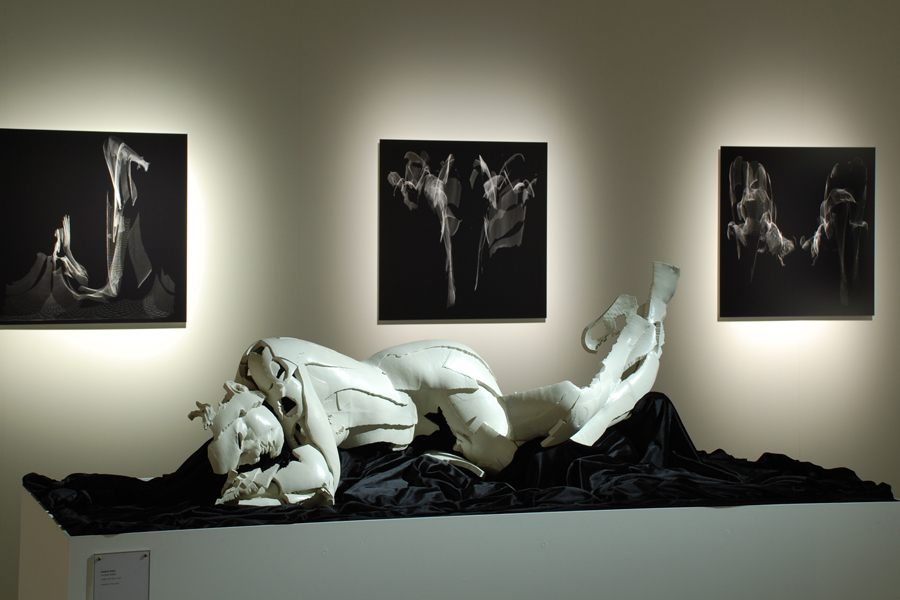
Sculptural artefacts created with 3D technologies<image001.jpg>The world of Chicago based digital artist Sophie Kahn is firmly embedded in 3D. Originally from Australia, Sophie trained as a photographer and came to perceive 3D scanning and 3D printing as post-photographic processes. Much of her work over the last eight years has revolved around these digital processes, either in the course of project progression or form of project resolution.
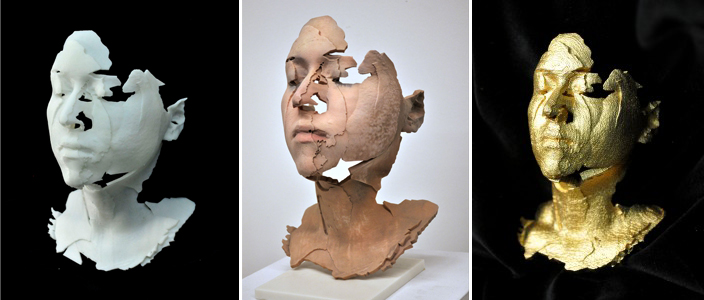
Initially Sophie used wax stereolithography for lost wax casting in bronze. More recently, she has been experimenting with full color 3D printing where the digital model was generated using a laser scan and a photograph of a model. The final 3D print then required sandblasting and sanding to create “the appearance of an unearthed ancient artifact.” The option of on demand online fabrication has allowed the artist to experiment, and test ideas quickly without much capital. Earlier work involved using large service bureaus that were often prohibitively expensive.
Sophie’s fabrication process is an involved one that expands beyond the computer screen and various scanning and printing technologies. Often 3D printing is only an intermediate phase in creating the final art piece. The artist uses 3D prints for molds as part of wax casting or ceramic clip casting. She’s hoping to be able to 3D print in ceramic, once it is possible to print larger objects. The goal is “to move away from plastic and towards more natural materials with longer histories”. Sophie’s most recent project was a miniature printed in stainless steel. In this case the print was intended as the artefact.<image001.jpg>A few words from the artist after the jump”
How would you describe your creative process? Both photography and scanning involve light and a lens, and they ‘capture’ and freeze a few seconds in time. What fascinates me about 3d scanning is the way it reveals the incompleteness of our own vision. Many of the holes and gaps in my sculptures are due to occlusion: the parts of the face that are hidden from view at any one time. My sculptures can look complete from one angle and very incomplete from another. I’m also interested in the art-historical resonances in technology, like the fact that 3d scans can look like fragmented classical sculptures, or plaster death masks, for example. I’m trying to make a connection between the digital and the handmade object.
Do you have any tips for other makers? I recommend Netfabb Pro to everybody. It’s so much more user-friendly and accessible than some of the more expensive programs out there, and it’s really revolutionized my ability to prepare laser scan files for 3d printing.<image001.jpg>www.sophiekahn.net
Posted in 3D Printing, Art, Maker Stories, Yana Skaler by yana | No Comments
Posted: 19 Apr 2012 10:50 PM PDT
Time to go dotty with your CNC artwork
Halftone-styled images have a compelling power to them. Perhaps it’s the retro-nostalgia of 1960’s Pop Art, the grainy speckles of old newsprint, or maybe it’s something else entirely? Either way, there is just something about all those dots.
Evil Mad Scientists (you know, the guys behind the Egg-Bot amongst other things) have released StippleGen, a stand-alone program that converts any image into CNC-friendly SVG format.
There is a considerable amount of control as you tweak the algorithms, whether you are after a specific number or style of dots, or even a continuous TSP path. It’s all geared towards use on small CNC devices such as the Egg-Bot, but don’t let that stop you if you have larger aspirations.
StippleGen is designed to be easy to install, easy to use, and easy to modify. It is capable of producing excellent quality output with up to 10,000 points.
Click through to EMSL for a thorough run-down on just what this neat little software package is capable of.
via Evil Mad Scientist Laboratories
Posted in CNC Routing, Guy Blashki, Software by Guy Blashki | No Comments
ShapeOko CNC/3D printer kit winner announced!
Posted: 19 Apr 2012 11:31 AM PDT
+ 3 days to pre-order one from Inventables
<image001.jpg>
Last month we gave Ponoko customers a chance to win the brand spanking new and completely sold-out ShapeOko CNC/3D printer kit.
Anyone who placed a CNC routing or 3D printing order with Ponoko during the promotional period was automatically entered to win.
Our randomly chosen winner was David Profitt who just so happens to run an instrumentation shop at Stanford University’s School of Medicine.
David told us a little about it: “[It's] a very unique operation in that as the sole proprietor I am responsible for all aspects of design and fabrication, both mechanical and electronic. The work I do is for non-profit and is in direct support of the research labs on campus.”
Congratulations to David, and we hope to catch up soon to find out what he’s been making with Ponoko and how he’ll use his ShapeOko.
It was our first hardware giveaway, and judging by the number of entries we got — you guys like hardware!
So we’re doing another hardware promotion! This time, you can win a FREE Silhouette Cameo electronic cutting tool. It’s like a desktop injket printer, except it cuts stuff! To enter, all you have to do is make a lasercut paper project with Ponoko. Get the details here.
For those of you interested in a ShapeOko of your own, they are now available for pre-order from Inventables, a Chicago-based hardware store dedicated to supplying DIY manufacturing. There are just 3 days left to pre-order a ShapeOko from Inventables.
Posted in Ponoko News by Ponoko Team | No Comments
To stop receiving these emails, you may unsubscribe now.
--
You received this message because you are subscribed to the Google Groups "Collexion" group.
To post to this group, send email to coll...@googlegroups.com.
To unsubscribe from this group, send email to collexion+...@googlegroups.com.
For more options, visit this group at http://groups.google.com/group/collexion?hl=en.