
Containing Loops in Models
161 views
Skip to first unread message

Jason F
Jul 18, 2013, 5:23:54 PM7/18/13
to cobra-...@googlegroups.com
Is one particular optimizing program (gurobi or tomlab cplex or other) better at containing loops in a models? I am using gurobi, and despite not allowing loops in my call to optimizeCbModel, I still get these infeasible high flux loops that cause un-realistic results.
Thanks in advance for any help,
Jason

Jan Schellenberger
Jul 18, 2013, 11:24:25 PM7/18/13
to cobra-...@googlegroups.com
Hi Jason, Could you give some more details about what you are seeing? In general, the choice of solvers should not make a difference. If loops are off, there should not be any loops.
I have seen flux distributions that are look like loops but aren't. Loops do not have any exchange with the environment. Another possibility is that the model is not mass/charge balanced and in this case the algorithm may not detect "loops" because mathematically they aren't loops.
-Jan
--
---
You received this message because you are subscribed to the Google Groups "COBRA Toolbox" group.
To unsubscribe from this group and stop receiving emails from it, send an email to cobra-toolbo...@googlegroups.com.
For more options, visit https://groups.google.com/groups/opt_out.

Ronan M.T. Fleming
Jul 24, 2013, 5:40:21 AM7/24/13
to cobra-...@googlegroups.com
Hi Jason,
you can use checkStoichiometricConsistency.m to see if the model is
mass balanced.
Ronan
--
--
Mr. Ronan MT Fleming B.V.M.S. Dip. Math. Ph.D.
-----------------------------------------------------------------
Senior research associate (EN) == Chercheur (FR)
Luxembourg Centre for Systems Biomedicine,
University of Luxembourg,
Campus Belval,
7, avenue des Hauts-Fourneaux
Esch-sur-Alzette,
Luxembourg,
L-4362.
-----------------------------
Mobile: +352 621 175 112
Office: +352 466 644 5528
Skype: ronan.fleming
wwwen.uni.lu/lcsb/research/systems_biochemistry
-----------------------------------------------------------------
(This message is confidential and may contain privileged information.
It is intended for the named recipient only. If you receive it in
error please notify me and permanently delete the original message and
any copies.)
you can use checkStoichiometricConsistency.m to see if the model is
mass balanced.
Ronan
--
Mr. Ronan MT Fleming B.V.M.S. Dip. Math. Ph.D.
-----------------------------------------------------------------
Senior research associate (EN) == Chercheur (FR)
Luxembourg Centre for Systems Biomedicine,
University of Luxembourg,
Campus Belval,
7, avenue des Hauts-Fourneaux
Esch-sur-Alzette,
Luxembourg,
L-4362.
-----------------------------
Mobile: +352 621 175 112
Office: +352 466 644 5528
Skype: ronan.fleming
wwwen.uni.lu/lcsb/research/systems_biochemistry
-----------------------------------------------------------------
(This message is confidential and may contain privileged information.
It is intended for the named recipient only. If you receive it in
error please notify me and permanently delete the original message and
any copies.)
Jason F
Jul 24, 2013, 3:07:47 PM7/24/13
to cobra-...@googlegroups.com
Jan and Ronan,
Thanks! Despite trying to be really careful, I did discover some reactions that were not mass balanced.
I first ran checkStoichiometricConsistency, and it did find it infeasible, but the m vector only pointed me to some metabolites that were simply dead ends. Then I ran checkMassChargeBalance, and it found several rxns. Not sure how I missed those, but thanks.
I will make these corrections and hopefully, it will be corrected.
Thanks again!
Jason
Jason F
Jul 25, 2013, 5:03:37 PM7/25/13
to cobra-...@googlegroups.com
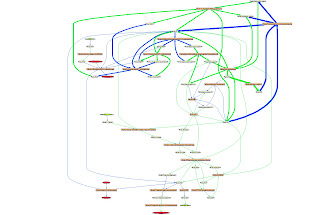
Well, fixing the stoichiometric balance did not help. After making several adjustments, and it passing both tests (checkStoichiometricConsistency and checkMassChargeBalance). It still has apparent loops. I am not sure if it helps to provide perspective, but I including an image (produced by paint4net that includes fluxes above 3 units with the input carbon source set at 10). Most of the high fluxes are > 100 units. I am at a loss. Sorry. Jason

Moritz Emanuel Beber
Aug 28, 2013, 6:27:02 PM8/28/13
to cobra-...@googlegroups.com
Hi Jason,
On 07/25/2013 11:03 PM, Jason F wrote:
Well, fixing the stoichiometric balance did not help. After making several adjustments, and it passing both tests (checkStoichiometricConsistency and checkMassChargeBalance). It still has apparent loops. I am not sure if it helps to provide perspective, but I including an image (produced by paint4net that includes fluxes above 3 units with the input carbon source set at 10). Most of the high fluxes are > 100 units. I am at a loss. Sorry. Jason
Have you tried parsimonious FBA? Check out the following paper:
Basically, after a maximization of, for example, biomass, that value is fixed and all other fluxes are minimized, is that what you want?
Lewis, Nathan E, Kim K Hixson, Tom M
Conrad, Joshua A Lerman, Pep Charusanti, Ashoka D Polpitiya,
Joshua N Adkins, et al. 2010. “Omic Data from Evolved E. Coli
Are Consistent with Computed Optimal Growth from Genome-scale
Models.” Mol Syst Biol 6 (July 27).
doi:10.1038/msb.2010.47. http://dx.doi.org/10.1038/msb.2010.47.
Basically, after a maximization of, for example, biomass, that value is fixed and all other fluxes are minimized, is that what you want?
Best,
Moritz
Moritz
Reply all
Reply to author
Forward
0 new messages