
John Martin Reservoir CBC

Duane Nelson
Birders,
The John Martin Reservoir CBC was conducted on December 14th. Due
to concerns about covid, the count this year was deliberately kept
small, with eight participants (plus one driver). The participants
were mostly local. The count was held two days after a major
winter storm deposited about five inches of very wet snow. With
temperatures on count day dropping to 6 degrees F, a lot of water
flash froze prior to the count, and some land birds apparently
departed because of the snow. As a result, some staked out birds
were not present on count day. Complicating the count, one local
party cancelled at the last minute when a participant fell ill.
The rest of us amended our segments of the count, and we were able
to have a complete count.
The unofficial tally for the count is 109 species, plus 10
additional species during the count week. The official count was
on the upper end of average for this count, while the number of
Count Week (CW) birds was much larger than normal due to the rapid
change from late fall to winter during CW. Although the number of
Hooded and Common Mergansers and Common Goldeneyes were in the
thousands, it was hard to find many other species of waterfowl,
which mostly came in small numbers. Perhaps the most uncommon duck
was a Long-tailed Duck. There were still some Eared Grebes,
American White Pelicans and Double-crested Cormorants around, but
a lone Western Grebe was present only through the 13th.
I found a group of 14 Killdeer CW, standing on newly formed ice.
They were a no-show on Count Day. Our hard-working Reservoir
scoper had a number of gull species, including Bonaparte's (they
almost always leave the day ice starts to form, expected Iceland
(Thayer's), Lesser Black-backed, California, and a Glaucous-winged
thingy.
Unexpected were four White-winged Doves, and scattered Mourning
Doves. Good woodpeckers included Ladder-backed, Lewis's and Rocky
mountain race Hairy. A Say's Phoebe, very rare this far east in
winter, was only the second for the count.
A staked out Steller's Jay did not disappoint in the woodlands
near the junction of the Arkansas and Purgatoire Rivers. In close
proximity were three Northern Cardinals, two Brown Thrashers, four
Woodhouse's Scrub-Jays and 14 Eastern Bluebirds. Two groups found
Mountain Bluebirds, rare away from canyonlands this time of year
here. Somehow, Mountain Chickadee and White-breasted Nuthatch were
missed, having been seen the day before.
A resident Carolina Wren, present for at least three years,
finally graduated from CW status to the Big Day.
Sparrows were sparse, but one white-striped White-throated
Sparrow showed up at a woodland site where I'd scattered seed the
day before. An unexpected Vesper Sparrow was photographed,
elevating it's status from CW to the big show. One party found
Rusty Blackbird, always hard to find.
There was one new bird for the count, two Purple Finches that
were found while scouting on December 13th, and still present on
Count Day. Two other parties saw the Purple Finches, Northern
Cardinal and Brown Thasher in the afternoon. I'm sure all got
better pictures than me.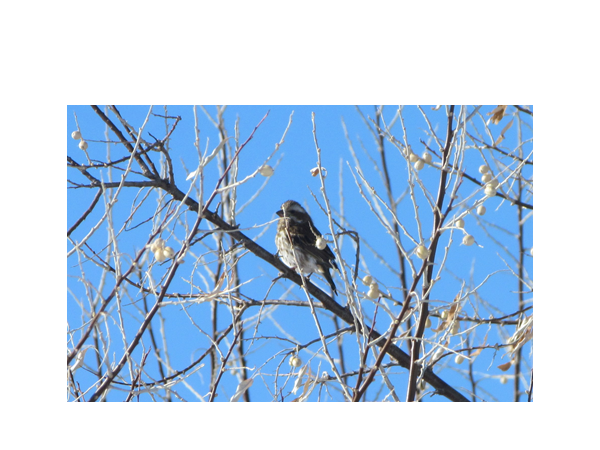
Our big miss was a Yellow-billed Loon, found in November by Steve
Mlodinow. We got it for CW, but settled for a Common Loon still
present on Count Day.
We missed a number of species that are almost guaranteed most
years here: Rock Wren, Canyon Wren, Greater Roadrunner,
Yellow-headed Blackbird, Western Screech-Owl (although I got an
Eastern in the fog and rime before sunrise), Sora and I'm sure
more. Although this was an extremely satisfying count, we can't
help but wonder what the upper limit of this count could be if all
the stars aligned just once.
Duane Nelson
Las Animas, Bent County, CO
