
What Math Can and Can't Do

JohnEB
“It would be amazing that in effect we don’t need a quantum theory of gravity” - Dr. Mario Livio
Einstein's Cosmic Speed Limit http://www.nasa.gov/mp4/399027main_Einsteins_Cosmic_Speed_Limit_320x240.mp4
NASA Goddard said: "Because Fermi saw no delay in the arrival time of the two photons, it confirms that space and time is smooth and continuous as Einstein had predicted."
________________________________________________
Livio wrote a great book on math named The Equation That Couldn't Be Solved.
Praise for The Equation That Couldn't Be Solved:
"A lively and fascinating read for a broad audience"—Nature
"Mario Livio tells the story of symmetry with insight and literary skill, producing a highly readable and illuminating book."—Sir Michael Atiyah, Fields Medalist 1966, and Abel Prize in Mathematics Laureate 2004
"Mario Livio tells a gripping tale of humanity's discovery of the language of symmetry, with its colorful, romantic characters and dramatic historical incident. Essential reading for anyone who wants to understand how the apparently remote concerns of pure mathematics can lead to deep and practical insights into the natural world."—Ian Stewart, author of Does God Play Dice? The New Mathematics of Chaos and professor of mathematics, University of Warwick, UK
"Mario Livio has done a marvelous job combining the gripping human saga of the lives of two mathematical geniuses who died young with the key mathematical ideas of symmetry and structure. He explains important mathematical concepts with both clarity and precision, making them understandable to every reader. This is one of the best books about mathematics I have ever read."—Amir D. Aczel, author of Chance: A Guide to Gambling, Love, the Stock Market, and Just About Everything Else and Fermat's Last Theorem: Unlocking the Secret of an Ancient Mathematical Problem
"A summary of the origins of group theory and symmetry for lay readers ... no other book covers such a wide range of topics." —Library Journal (also one of Library Journal's Best Sci-Tech Books 2005
"A wide-ranging exploration of the phenomenon of symmetry... . There's math, yes, but there are also tales of love, violence, history —and the whole, in this case, turns out to be greater than the sum of those parts."—Mary Carmichael, Newsweek
"An entertaining exploration of how the laws of symmetry have shaped our chaotic little world, and how they inform our appreciation of art and music.—Kirkus Reviews
"Fascinating.... [Livio] writes passionately about the role of symmetry in human perception and the arts."—The Economist
"A lively and fascinating read for a broad audience."— Istvin Hargittai, Nature
"Livio, an astrophysicist, deftly intertwines [Evariste Galois's] tale with an exploration of symmetry itself, touching upon topics that include Rubik's cube, quantum physics, and our tendency to seek mates with symmetrical faces."— Josie Glausiusz and Brad Lemley, Discover (also one of Discover's Top Science Books of the Year 2005)
"Engaging."—Publishers Weekly
"Livio captures the brilliant intuitions of Abel and Galois.... This admirable presentation of a mathematical revolution will challenge general readers but will deliver ample rewards."—Booklist
"A lively, entertaining book. Mario Livio has written what is probably one of the most accessible books that explains symmetry and the order of both natural and human-made worlds."—Larry Cox, Tucson Citizen
"[Livio's] passion for his subject is contagious.... [He] has the rare ability to explain complex ideas in terms simple enough to remember and later wax lyrically about across your coffee table or local pub. It's a book to make you feel (if only temporarily) like a genius yourself."—Charlotte Mulcare, Plus
"Livio is a very engaging writer.... The fact that much of the book is not very technical might trick a few civilians (by- which I mean non-mathematicians into learning some of the ideas of group theory and seeing the beauty of abstract mathematics."—Darren Glass, Mathematical Association of America Online
"A wide-ranging exploration of the phenomenon of symmetry.... There's math, yes, but there are also tales of love, violence, history—and the whole, in this case, turns out to be greater than the sum of those parts." —Mary Carmichael, Newsweek
"Fascinating.... [Livio] writes passionately about the role of symmetry in human perception and the arts."—The Economist
________________________________________________
What do Bach's compositions, Rubik's Cube, the way we choose our mates, and the physics of subatomic particles have in common? All are governed by the laws of symmetry, which elegantly unify scientific and artistic principles. Yet the mathematical language of symmetry–known as group theory – did not emerge from the study of symmetry at all but from an equation that couldn't be solved.
For thousands of years mathematicians solved progressively more difficult algebraic equations, until they encountered the quintic equation, which resisted solution for three centuries. Working independently, two great prodigies ultimately proved that the quintic cannot be solved by a simple formula. These geniuses, a Norwegian named Niels Henrik Abel and a romantic Frenchman named Evariste Galois both died tragically young. Their incredible labor, however, produced the origins of group theory.
The first extensive, popular account of the mathematics of symmetry and order, The Equation That Couldn't Be Solved is told not through abstract formulas but in a beautifully written and dramatic account of the lives and work of some of the greatest and most intriguing mathematicians in history.
________________________________________________
Mario Livio is a Senior Astronomer and the former head of the Science Division at the Space Telescope Sciencc Institute (STScl) in Baltimore Maryland. He is the author of The Golden Ratio, a highly acclained book about mathematics and art for which he received the International Pythagoras Prize and the Peano Prize and The Accelerating Universe.
________________________________________________
We will look at a few examples from The Equation That Couldn't Be Solved that show "What Math Can and Can't Do."
JohnEB
a b c
a c b
JohnEB
How Mathematical Genius Discovered the Language of Symmetry.
JohnEB
Never Forget This in the Midst of Your Equations
In an address entitled "Science and Happiness" that was presented at the California Institute of Technology on February 16, 1931, Albert Einstein remarked, "Concern for man himself and his fate must always constitute the chief objective of all technological endeavors ... in order that the creations of our mind shall be a blessing and not a curse to mankind. Never forget this in the midst of your diagrams and equations." Even Einstein himself could not have imagined how prophetic this admonition would become less than a decade later, during the dark days of World War II and the horrors of the Holocaust. The history of mathematical equations did start, however, solely with the benefit of humankind in mind. The first equation solvers attempted nothing more than to address specific everyday needs.
"US" AND "AHA"
Sometime in the fourth millennium BC the first Sumerian urban communities came into existence in Mesopotamia, the land between the Tigris and Euphrates rivers. Nearly half a million cuneiform tablets and other archeological artifacts found in this area tell the story of a society with organized agriculture, impressive architecture, and vibrant political and cultural history. Then, as today, this fertile land was prone to invasion from many directions, resulting in a frequent change of ruling populations. A few centuries after falling before the Akkadian king Sargon I (ca. 2276-2221 BC), Semitic Amorites took over the land of Sumer and established their capital in the commercial city of Babylon. Consequently, the culture of the entire region between roughly 2000 and 600 BC is conventionally referred to as "Babylonian." The rapidly evolving Babylonian society required massive records of supplies and distribution of goods. Computational tools were also needed for business transactions, for agricultural projects involving the partitioning of lots, and for the making of wills. To this end, the Babylonians developed the most sophisticated mathematics of that time. The texts of scores of cuneiform tablets demonstrate that the Babylonians not only mastered a variety of arithmetic manipulations, but literally anticipated more advanced algebra. Here I shall concentrate only on the emergence of "equations," since this is the most relevant part for the history of group theory. The reason I have put the word equations in quotation marks is that the Babylonians did not truly use the concept of algebraic equations in the same way we do today. Rather, they stated problems and solved them rhetorically, in the language of ordinary discourse. In other words, one problem after another was solved by precise verbal instructions, but no pattern or formula was ever identified as a general procedure.
There is little doubt that these mathematical problems first appeared in the context of the society's need to divvy up lots of land. The words used for the unknown quantities one needed to solve for were us (length), sag (width), and asa (area), even when no mensuration was involved.
The simplest equations one can formulate are the ones called linear (they are represented by straight lines when graphed). In modern notation these are equations of the type 2x + 3 = 7, where x represents the unknown. To solve an equation means to find a value of x for which the equation holds true (in the above example, the solution is x = 2, since 2 x 2 + 3 = 7). Several tablets contain problems that need to be solved using linear equations.
Sometimes to find the answer, one needed to solve for the value of two unknowns. For instance, in one problem the values of the width and length are called for if one-quarter of the width plus the length are equal to 7 hands (a unit of length), and the length plus the width are equal to 10 hands. Using the algebra we learn in school, if we denote the length by x and the width by y, this problem translates into the system of two linear equations: (1/4)y + x = 7, x + y = 10. The Babylonian scribe notes correctly that a length of 6 hands (or 30 fingers, one hand being equal to 5 fingers) and a width of 4 hands (20 fingers) satisfy both equations (in appendix 2, I present for the interested reader a brief reminder of how one solves such systems of equations).
Linear equations featured even more prominently in the mathematics of ancient Egypt. Apparently the Babylonians found them too elementary to deserve detailed documentation. Much of our knowledge of Egyptian mathematics comes from the fascinating Ahmes Papyrus. This large papyrus (about eighteen feet long) currently resides in the British Museum (except for a few fragments, discovered unexpectedly in a collection of medical papers, that are in the Brooklyn Museum).

Not all the mathematical problems in the Ahmes Papyrus address pressing questions of the time. Some were clearly introduced as exercises for students, and at least one was chosen purely for its charm. Problem 79 reads: "Houses 7, Cats 49, Mice 343, Spelt 2,401, Hekats 16,807, Total 19,607." Evidently, a playful Ahmes describes here a puzzle, in which each of seven houses there are seven cats, each of which ate seven mice, each of which would have eaten seven ears of wheat, each of which would have produced seven hekats (measures) of grain. The unknown called for in this problem is the total, which, being the sum of all houses, cats, mice, spelts, and hekats, is clearly of no practical worth. Many have speculated that this ancient brain twister metamorphosed over the centuries into two other known puzzles. In 1202, the famous Italian mathematician Leonardo of Pisa (nicknamed Fibonacci; lived ca. 1170-1240) published a book entitled Liber abaci (Book of the Abacus). In this book he poses a problem that reads, "Seven old women are traveling to Rome, and each has seven mules. On each mule there are seven sacks, in each sack there are seven loaves of bread, in each loaf there are seven knives, and each knife has seven sheaths. Find the total of all of them."
Half a millennium later still, in the eighteenth-century Mother Goose collection of nursery rhymes, we find:
As I was going to St. Ives,I met a man with seven wives.Every wife had seven sacks,Every sack had seven cats,Every cat had seven kits;Kits, cats, sacks, and wives,How many were going to St. Ives?
Was this nursery rhyme truly inspired by the Ahmes Papyrus of more than three thousand years earlier? Hard to believe. Note, incidentally, that depending on the interpretation, the correct answer to the nursery rhyme puzzle is either one (the narrator; all others were coming from St. Ives) or none (the narrator does not belong in the group or "kits, cats, sacks, and wives"). Geometrical series of this type, in which every, successive number is increased by the same multiplier, have always fascinated humans. Furthermore, spiritual qualities have been associated with the number seven in both Eastern and western traditions (e.g., seven days of the week, seven gods of luck in Japan, seven deadly sins). The three puzzles might therefore have been the independent creations of three imaginative brains, separated by centuries.
The knowledge of how to solve linear equations was not exclusive to the Middle East. The impressive Chinese collection Nine Chapters on Mathematical Art (Jiu zhang suan shu) was composed sometime between 206 BC and AD 221 and was based on a yet earlier collection. In chapter 8 of Nine Chapters, we find problems that involve no fewer than three linear equations with three unknowns, all solved brilliantly.
The next level up, in terms of the intricacy of algebraic equations, is represented by quadratic equations. The extra complication is introduced by the fact that in such equations the unknown, x, appears squared, as in 3x^2 + x = 4. To the novice this may not look like a dramatic change, yet quadratic equations are actually more difficult to solve than linear ones. As incredible as this may sound, the topic of equations in general and of quadratic equations in particular became the subject of a heated debate in the British parliament in 2003. In a brilliant speech on the curriculum at school, member of Parliament Tony McWalter explained:
Why should anyone feel passionate about the xs and ys in a system of equations? One answer is this: because if one does not make the effort to see what those xs and ys conceal, one will be cut off from having any real understanding of science.... Why should anyone try to understand quadratic equations and the principles that lie behind solving them? They underpin modern science as surely as the smelting methods of the Romans were the key to their building culture.
However, you may wonder, who were the first to have encountered the need to formulate and solve such equations?
THE PROTECTORS OF THE PUBLIC

Let us examine for a moment what is involved in resolving the perimeter-area confusion. Suppose we have a rectangle with a perimeter of 18 units. If we denote its length by x and its width by y, then x + y = 9 (since the perimeter is composed of twice the length and twice the width). Assume further that the area is given as 20 square units. This means that xy = 20 (the area is the product of the length and width). we therefore have the system of two equations with two unknowns:
x + y = 9
xy = 20
A straightforward way to solve this problem would be to isolate the unknown y from the first equation (by subtracting x from both sides), y = 9 — x, and to substitute this expression for y in the second equation:
x(9 – x) = 20.
If we now multiply through, on the left-hand side, obtain the quadratic equation 9x – x^2 = 20. Many Babylonian problems leading to quadratic equations are broadly of this general form. For instance, problem 2 in tablet 13901 in the British Museum reads, "I subtracted the side from the area of my square. 870." This corresponds the quadratic equation x^2 – x = 870. One speculation is, therefore, that quadratic equations came to light as an attempt by conscientious Babylonian mathematicians to protect the public from manipulators and scheming land thieves. How these mathematicians discovered the solution to the quadratic equation remains a mystery, since, while the Babylonians always spell out in great detail the steps of the procedure leading to a solution, they never tell us how they derived that procedure.
The ancient Egyptians could handle only the simplest of the quadratic equations, of the type x^2 = 4, but not "mixed" equations that included both x^2 and x. What is the solution to x^2 = 4? It is the square root of 4. One obvious answer is 2, since 2 x 2 = 4. That was all the Egyptians cared about, since the number was supposed to represent quantities such as length or loaves of bread, which have to be positive. However, the equation x^2 = 4 actually admits a second, less obvious solution: –2. When one negative number is multiplied by a second negative number, the result is a positive number. In other words, (-2) x (-2) = 4, and therefore the equation x^2 = 4 has two solutions: x = 2 and x = –2. This is the first indication that quadratic equations may have two different solutions, not just one. While the Babylonians knew how to solve mixed quadratic equations, they were still interested only in positive solutions, since the unknowns typically represented lengths. They also avoided those cases in which two different positive solutions could be found, since those must have struck them as illogical absurdities.
In spite of their superb mathematical abilities, the very early Greek mathematicians concentrated primarily on geometry and logic and paid relatively little attention to algebra. The clear perception of form and number as two aspects of one mathematics had to await the brilliant mathematical minds of the seventeenth century. The great Euclid of Alexandria, whose monumental work The Elements (published ca. 300 BC) laid the foundations of geometry, addresses quadratic equations only obliquely. He solves the equations geometrically, by formulating methods for finding lengths, which are in fact solutions to quadradic equations. Arab mathematicians were to further expand upon this type of geometric algebra centuries later.
THE FATHERS OF ALGEBRA
The great Greek school of Alexandria produced many outstanding mathematicians during two golden ages. Notwithstanding many ups and downs, the city of Alexandria, its school (known as the Museum), and the associated library, reputed to hold some seven hundred thousand books (many confiscated from ill-omened tourists), endured for almost seven hundred years. One of the most original thinkers of the Alexandrian school was Diophantus, a man sometimes called the "father of algebra." Details of the life of Diophantus are so veiled in obscurity that we don't know with certainty even in which century he lived, except that it has to be later than about 150 BC (since he quotes the mathematician Hypsicles, who lived ca. 180 BC to 120 BC) and earlier than about AD 270 (since he is mentioned by Anatolius, bishop of Laodicea, who took office around that time). Generally, Diophantus is assumed to have flourished around AD 250, although the possibility that he had lived a century earlier cannot be ruled out. We know of Diophantus's ingenious work mostly through his major treatise, Arithmetica, which originally contained thirteen books. Only six books in Greek have survived the onslaught of the Muslims on the Alexandrian library in the seventh century. An Arabic translation of what may be four more books (attributed to the ninth-century mathematician Qusta Ibn Luqa) was miraculously discovered in 1969.
Despite the honorific "father of algebra," most of Arithmetica actually deals with problems from the theory of numbers. Nevertheless, Diophantus certainly represents a crucial stage in the evolution of algebra that is intermediate between the purely rhetorical style of the Babylonians and the symbolic forms of equations (e.g., 2x^2 + x = 3) we use today. The German mathematician and astronomer Johannes Regiomontanus could not curb his admiration for Arithmetica in 1463: "In these old books the very flower of the whole of arithmetic lies hid, the ars rei et census [art of the "thing" and enumeration; referring to equations with unknowns and arithmetic] which today we call by the Arabic name of algebra." Diophantus demonstrated incredible creativity and skill in his solutions to many problems. Yet he only considered positive answers, and even among those, only the ones that could be expressed as whole numbers (such as 1, 2, 3, ... ) or as fractions (such as 2/3, 4/9, 5/13; collectively, the whole numbers and the fractions are known as rational numbers). As an example of Diophantus's ingenuity, consider problem 28 from the first book: "To find two numbers such that their sum and sum of their squares are given numbers." Clearly, this is a problem with two unknowns (the two numbers). Yet, Diophantus succeeds by a brilliant trick to reduce the number of unknowns from two to one, and to obtain for it a simple equation. (For the interested reader I present Diophantus's solution in appendix 3.) The Arithmetica makes it abundantly clear that Diophantus knew how to solve quadratic equations of the three types: ax^2 + bx = c (where a, b, c are given positive numbers, as in 2x^2 + 3x =14); ax^2 = bx + c; and ax^2 + c = bx. These were precisely the types of equations revisited by Arab mathematicians more than five centuries later.
Diophantus is best known today for a special class of equations that bears his name—Diophantine equations—and also because of his very unusual epitaph. Diophantine equations are truly bizarre in that, on the face of it, they appear to admit any number as a solution. Consider, for instance, the equation: 29x + 4 = 8y. For what values of x and y does the equality hold true? If we choose, say, y = 5, we obtain x = 36/29. If we choose y =1, we obtain x = 4/29, and so on. We have an infinity of values to choose from for y, and for any value we happen to choose, we can find a corresponding x that satisfies the equation. What makes Diophantine equations special is that we are actually supposed to be seeking only solutions for x and y that are both whole numbers (such as 1, 2, 3, ... ). This immediately limits the possible solutions and makes them much harder to find. Can you discover a solution for the Diophantine equation above? (If not, I present it in appendix 4.)
The most famous Diophantine equation in history is the one known as Fermat's Last Theorem, the celebrated statement by Pierre de Fermat (1601-55) that there are no whole number solutions to the equation x^n + y^n = z^n, where n is any number greater than 2. When n = 2, there are many solutions (in fact an infinite number). For instance, 3^2 + 4^2 = 5^2 (9 + 16 = 25); or 12^2 + 5^2 = 13^2 (144 + 25 = 169). Miraculously, when we go from n = 2 to n = 3, there are no whole numbers x, y, z that satisfy x^3 + y^3 = z^3, and the same is true for any other value of n that is greater than 2. Appropriately, it was in the margin of the second book of Diophantus's Arithmetica, which Fermat was eagerly reading, that he wrote his extraordinary claim—one that took no fewer than 356 years to prove.
A sixth-century collection known as The Greek Anthology contains some six thousand epigrams. One of these supposedly gives us a scanty record of the life of Diophantus:
God granted him to be a boy for the sixth part of his life, and adding a twelfth part to this, He clothed his cheeks with down; He lit him the light of wedlock after a seventh part, and five years after his marriage He granted him a son. Alas! late-born wretched child; after attaining the measure of half his father's life, chill Fate took him. After consoling his grief by this science of numbers for four years he ended his life.
Diophantus himself would have probably been somewhat offended by the fact that his life story has been reduced to a mere linear equation, of the type that had never really interested him. If the description is correct, he lived to be eighty-four years old.
(-b ± SquareRoot( b2 — 4ac)) / 2a
In spite of its somewhat disconcerting appearance, this is really a simple formula, which when the given values of the numbers a, b, c are substituted into it, yields immediately the values of x for which the equation holds true. For instance, suppose we need to solve the equation: x^2 - 6x + 8 = 0, where a =1, b = -6, c = 8. All we need to do is put these values of a, b, and c into the formula above and we find the two possible solutions: x = 2 or x = 4 (the symbol ± means that we choose plus to obtain one solution and minus to obtain the other).
Following the decline and fall of the Alexandrian school, European mathematics seems to have gone into hibernation for almost a milleninium. The baton of keeping mathematics, and indeed science in general alive was passed on to India and the Arab world. Accordingly, the path from Diophantus to the modern solution of the quadratic equation passes through non-European mathematicians. The Indian mathematician and astronomer Brahmagupta (598-670) managed to solve a few impressive Diophantine equations, as well as quadratic equations that for the first time involved negative numbers. He referred to such numbers as "debts," realizing that negative numbers appear most frequently in monetary transactions. In the same spirit, he called positive numbers "fortunes." The rules for multiplying or dividing positive and negative numbers were therefore stated as, "The product or ratio of two debts is a fortune; the product or ratio of a debt and a fortune is a debt."
The man who literally gave algebra its name was Muhammad ibn Musa al-Khwarizmi (ca. 780-850). The book he composed in Baghdad—Kitab al jabr wa al-mugabalah (The Condensed Book on Restoration and Balancing)—became synonymous with the theory of equations for centuries. From one of the words in the title of this book (aljabr) comes the word "algebra." Even the word "algorithm," used today to describe any special method for solving a problem by following a succession of procedural steps, comes from a distortion of al-Khwarizmi's name. While al-Khwarizmi's book was not particularly groundbreaking in terms of its contents, it was the first to expose in a systematic way the solutions of quadratic equations. The word al jabr, meaning "restoration" or "completion," referred to moving negative terms from one side of the equation to the other, as in transforming x^2 = 40x — 4x^2 (by adding 4x^2 to both sides) into 5x^2 = 40x. So great was the influence of al-Khwarizmi's book that even eight centuries later, in the masterful burlesque of the popular romance of chivalry Don Quixote de la Mancha, we find that the bone-setter is called "algebrista," because of his job of restoration.
The first book to include the full solution to the most general quadratic equation appeared in Europe only in the twelfth century. The author was the eclectic Spanish Jewish mathematician Abraham bar Hiyya Ha-nasi (1070-1136; "Ha-nasi" means "the leader"). As if to remind us of the early origins of quadratic equations, the book was entitled: Hibbur ha-meshihah ve-ha-tishboret (Treatise on Measurement and Calculation). Abraham bar Hiyya explains:
Who wishes correctly to learn the ways to measure areas and to divide them, must necessarily thoroughly understand the general theorems of geometry and arithmetic, on which the teaching of measurement ... rests. If he has completely mastered these ideas, he ... can never deviate from the truth.
This brought to an end a long era during which Arab mathematicians acted as the safe custodians of mathematics. Progress during the three thousand years that followed the Old Babylonian period has been only incremental. With the tremendous intellectual awakening of the Renaissance, however, the center of gravity was about to move to northern Italy, with other western European countries soon to follow. Humanists discovered ancient Greek works and encouraged a process of delving into all the Greeks' accumulated knowledge, including mathematics. As the copying of manuscripts became a major industry (according to one report the influential Florentine banker Cosimo de Medici employed forty-five scribes), the invention of printing with moveable type was only to be anticipated, with the ensuing proliferation of scientific knowledge.
There was nothing in the relatively tranquil and rather sluggish history of the quadratic equation to indicate that the next stage in the solution of equations was going to be particularly dramatic. This was, however, only the calm before the storm. The next chapter was about to begin.
JohnEB
THE CUBIC
In the same way that problems dealing with areas result in quadratic equations (because one length is multiplied by the other, producing length squared), the calculation of volumes of solids such as the cube (where one multiplies length by width and by height) leads to cubic equations. The most general cubic equation has the form ax^3 + bx^2 + cx + d = 0, where a, b, c, d are any given numbers (a has to be different from zero). The goal of all the aspiring equation solvers was clear: to find a formula, similar to the one for the quadratic equation, that upon substitution of a, b, c, d would give the desired solutions. The ancient Babylonians did generate some tables that allowed them to solve a few very specific cubics, and the Persian poet-mathematician Omar Khayyam presented a geometric solution to a few more in the twelfth century. However, the solution to the general cubic equation defied mathematicians until the sixteenth century. This was not for lack of trying. Three famous Florentine algebraists, Maestro Benedetto in the fifteenth century and his two fourteenth-century predecessors, Maestro Biaggio and Antonio Mazzinghi, had put considerable toil into the understanding of equations and their solutions. Their efforts, however, proved insufficient for the cubic. The fourteenth-century mathematician Maestro Dardi of Pisa also presented ingenious solutions to no fewer than 198 different types of equations — but not to the general cubic. Even the famous Renaissance painter Piero della Francesca, who was also a gifted mathematician, contributed his part to the attempts to find a solution. In spite of these and other valiant efforts, the answer remained elusive. No wonder that mathematician and author Luca Pacioli (1445-1517) concluded his 1494 influential book Summa de arithmetica, geometria, proportioni et proportionalita (The Collected Knowledge of Arithmetic, Geometry, Proportion and Proportionality) in a defeatist mood. "For the cubic and quartic [involving x^4] equations," he said, "it has not been possible until now to form general rules." The good news was that Pacioli's encyclopedic six-hundred-page work was written in the accessible Italian. Consequently, the book promoted algebraic studies even among those not versed in Latin. At that point, practicality gave way to ambition. No one was searching for a solution to the cubic for some practical purposes. Solving the cubic equation had become an intellectual challenge worthy of consideration by the best mathematical minds. Enter a modest hero-a mathematician from Bologna named Scipione dal Ferro (1465-1526) who unknowingly becomes part of an unfolding drama.


Bologna of the sixteenth century experienced a surge of interest in mathematics. Mathematicians and other scholars were sometimes involved in public debates and oral disputations that attracted large crowds. In attendance were not only university officials and appointed judges, but also students, supporters of the contestants, and spectators who came for entertainment and for a betting opportunity. Often, the disputants themselves would wager considerable amounts of money on their anticipated victory. According to one description by a nineteenth-century historian of mathematics, mathematicians were interested in such confrontations of wits, because on their results
depended not only their reputation in the city or in the University, but also tenure of appointment and increase in salary. Disputations took place in public squares, in churches, and in the courts kept by noblemen and princes, who esteemed it an honor to count among their retinue scholars skilled not only in the casting of astrological predictions, but also in disputation on difficult and rare mathematical problems.
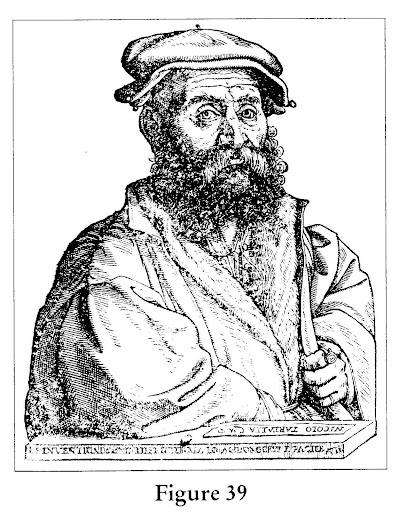
Niccolo Tartaglia (figure 39) was born in Brescia in 1499 or 1500. His original surname was probably Fontana, but he was nicknamed Tartaglia (meaning "the stammerer") because of a saber cut to his mouth that he had received at age twelve from a French soldier. The young boy was left for dead in the cathedral in which he sought sanctuary, and he was slowly nursed back to health by his mother. As an adult, he always wore a beard to hide the disfiguring scars. Tartaglia came from a very poor family. His father Michele, a postal courier, died when Niccolo was about six years old, leaving the widow and her children in heartbreaking misery. Tartaglia had to stop his studies of reading and writing of the alphabet upon reaching the letter k because the family ran out of money to pay for the tutor. In his later retrospection, Tartaglia described the completion of his education: "I never returned to a tutor, but continued to labor by myself over the works of dead men, accompanied only by the daughter of poverty that is called industry." In spite of these ill-starred circumstances, Tartaglia proved to be a talented mathematician. Eventually he moved to Venice in 1534 as a teacher of mathematics, after having spent some time in Verona. In his mathematical memoirs Tartaglia states that in 1530 he managed after considerable effort to solve the cubic equation x^3 + 3x^2 = 5. This was a challenge posed to him by a fellow Brescian, Zuanne de Tonini da Coi. Rumors of Tartaglia's claim that he was able to solve cubics must have reached the ears of Maria Fiore, but the latter greeted the information with skepticism, thinking that Tartaglia was bluffing. Confident in his ability to defeat Tartaglia due to his secret knowledge of dal Ferro's solution, Fiore issued the challenge. Shortly afterward, Fiore and Tartaglia reached agreement on the precise conditions of the contest. Each side was to propose thirty problems for his opponent to solve. The problems were they to be sealed and deposited with the notary Master Per Iacomo di Zambelli. The two contestants fixed a term of forty to fifty days for each to attempt to solve the problems, once the seals were opened. They agreed that whoever solved more problems would be considered the winner, and in addition to honors, would receive a handsome reward suggested for each problem (according to some sources the loser was supposed to pick up the tab for a feast attended by the winner and thirty of his friends). As it turned out, Fiore indeed had only one arrow to his bow—all the problems he put forward were of the form for which he knew the solution from dal Ferro, ax^3 + bx = c. Tartaglia's list, on the other hand, contained thirty diverse problems, each one of a different kind, in his words, "to show that I thought little of him and had no cause whatever to fear him."
The date of the contest was set for February 12, 1535. Various university dignitaries and some of the Venetian intellectual high society must have been in attendance. As the problems were presented to the two adversaries, something totally unexpected happened. To the spectators' amazement, Tartaglia blasted through all the problems thrown at him in the space of two hours! Fiore failed to solve even one of Tartaglia's problems. In his account of the events some twenty years later, Tartaglia recalled:
The reason why I was able to solve his 30 [problems] in so short a time is that all 30 concerned work involving the algebra of unknowns and cubes equaling numbers [equations of the form ax^3 + bx = c]. [He did this] believing that I would be unable to solve any of them, because Fra Luca [Pacioli] asserts in his treatise that it is impossible to solve such problems by any general rule. However, by good fortune, only eight days before the time fixed for collecting from the notary the two sets of 30 sealed problems, I had discovered the general rule for such expressions.
In fact, a day after discovering the solution to ax^3 + bx = c, Tartaglia also discovered the solution to ax + b = x^3. Since he also already knew how to solve x^3 + ax^2 = b (the challenge posed to him by da Coi), Tartaglia became overnight literally the world expert on the solution of cubic equations. Nevertheless, he waved aside a suggestion from da Coi to publish his solution immediately, explaining that he intended to write a book on the subject. The formulae Tartaglia discovered were so complicated that he found it hard to remember his own rules for the three cases. To help himself memorize them, he composed some verses that started with:
In cases where the cube and the unknownTogether equal some whole number, known;Find first two numbers dif f'ring by that same;Their product, then, as is the common fame . .
Tartaglia's complete verses and his formula are presented in appendix 5.
Tartaglia was now no longer an anonymous math teacher—he was a mathematical celebrity. But in Renaissance Italy no story, even a story of mathematics, comes without its operatic moments.
THE PLOT THICKENS
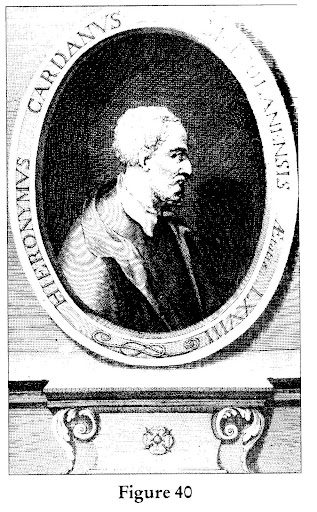
Even compared to the many colorful geniuses of the Renaissance, Cardano's life readily catches the imagination. He was the illegitimate son of the Milanese lawyer Fazio Cardano and the much younger widow Chiara Micheri. In his later autobiography, De vita propria liber (The Book of My Life), Cardano delights in describing in great and unnecessary detail all the medical problems from which he suffered early in life, including his sexual impotence between the ages of twenty-one and thirty-one. Encouraged by his educated father, who advised Leonardo da Vinci in geometry on several occasions, Gerolamo studied mathematics, the classics, and medicine at the universities of Pavia and Padua. During his student days, gambling became his chief source of financial support. He played cards, dice, and chess, turning his knowledge of probability theory into profits. Later in life he would transform his addiction to gambling into an interesting book: Liber de ludo aleae (The Book on Games of Chance), the first book on the calculation of probabilities. Having a very loud voice and a rude attitude, Cardano managed to alienate many of his professors, and at the end of his studies, the first ballot denied him the doctorate of medicine with the overwhelming vote of 47 against 9. Only after two more rounds of votes did he finally get the degree. While Cardano's first attempts to obtain a position as a physician in Milan failed miserably, his luck soon changed drastically. In 1534 he was appointed, through the influence of his father's acquaintances, lecturer of mathematics at the Piatti Foundation. Simultaneously, he started a clandestine practice of medicine, in which he was extremely effective. His success did not, however, gain him the support of the College of Physicians in Milan. In 1536 Cardano decided to bring his dispute with the college to a showdown. He published a viciously aggressive book entitled De malo recentiorum medicorum medendi usu libellus (On Bad Practices of Medicine in Common Use). In particular, Cardano ridiculed the grandiloquent manners of the physicians of his time: "The things which give most reputation to a physician nowadays are his manners, servants, carriage, clothes, smartness and caginess, all displayed in a sort of artificial and insipid way; learning and experience seem to count for nothing." Incredibly enough, not only did Cardano's offensive get him a physician's position, but by the middle of the century he was to become one of Europe's best-known medical practitioners, second only to the legendary anatomist Andreas Vesalius.
Cardano appears to have thrived on controversy and competition. This may have stemmed from his passion for gambling. He once noted, "Even if gambling were altogether an evil, still, on account of the very large number of people who play, it would seem to be a natural evil. For that very reason it ought to be discussed by a medical doctor like one of the incurable diseases." Quick-witted and sharp-tongued, Cardano won many disputes, both during his student days and as a mature scholar. No wonder then that the news of the Tartaglia-Fiore contest kindled his curiosity. At the time, he was completing his second mathematical book, Practica arithmeticae generalis et mensurandi singularis (The Practice of Arithmetic and Simple Mensuration), and he found the idea of including the solution to the cubic in the book very attractive. In the few years that followed, Cardano must have tried in vain to discover the solution by himself. Having failed, he decided to send the bookseller Zuan Antonio da Bassano to Tartaglia to convince the latter to reveal his formula. Tartaglia later described his own reply in no uncertain terms: "Tell his Excellency that he must pardon me, that when I publish my invention it will be in my own work and not in that of others, so that his Excellency must hold me excused." After a few rather lengthy and quite acrimonious exchanges, in which Tartaglia brushed aside all of Cardano's overtures, he finally was lured into accepting an invitation to visit Cardano in Milan. The bait that did the trick was a promise by Cardano to introduce Tartaglia to the Spanish viceroy and commander in chief in Milan, Alfonso d'Avalos. Tartaglia had written a book on artillery and such a contact could guarantee him a nice income.
In Milan, Cardano subjected Tartaglia to a heavy dose of charming hospitality, still attempting to schmooze the solution out of him. But Tartaglia's lips remained sealed, at least for a while. He even rejected a proposal that Cardano would include a special chapter in the book heralding Tartaglia as the discoverer of the solution.
Unfortunately, from this point on, our information of the subsequent events relies almost exclusively on Tartaglia's far from objective testimony. According to Tartaglia, he eventually did agree to divulge the secret to Cardano, but only after the latter had taken the following solemn oath: "I swear to you by the Sacred Gospel, and on my faith as a gentleman, not only never to publish your discoveries, if you tell them to me, but I also promise and pledge my faith as a true Christian to put them down in cipher so that after my death no one shall be able to understand them." This weighty conversation took place on March 25, 1539. Ludovico Ferrari, then a young secretary in Cardano's household, tells a rather different story. According to Ferrari, Cardano took no oath of secrecy. Ferrari claimed to have been present at the conversation and said that Tartaglia revealed the secret simply in return for Cardano's hospitality. However, as we shall soon see, Ferrari's own objectivity is at least as questionable as that of Tartaglia. The fact remains, nevertheless, that the Practica arithmeticae generalis appeared in May 1539 without Tartaglia's solution.

In our own days Scipione dal Ferro of Bologna has solved the case of the cube and the first power equal to a constant, a very elegant and admirable accomplishment. Since this art surpasses all human subtlety and the perspicuity of mortal talent and is a truly celestial gift and a very clear test of the capacity of men's minds, whoever applies himself to it will believe that there is nothing that he cannot understand. In emulation of him, my friend Niccolo Tartaglia of Brescia, wanting not to be outdone, solved the same case when he got into a contest with his [Scipione's] pupil, Antonia Maria Fior, and, moved by my many entreaties, gave it to me. For I had been deceived by the words of Luca Pacioli, who denied that any more general rule could be discovered than his own. Notwithstanding the many things which I already discovered, as is well known, I had despaired and had not attempted to look any further. Then however, having received Tartaglia's solution and seeking for the proof of it, I came to understand that there were a great many other things that could also be had. Pursuing this thought and with increased confidence, I discovered these others, partly by myself and partly through Ludovico Ferrari, formerly my pupil.
In chapter XI ("On the Cube and First Power Equal to the Number") Cardano repeats briefly the same credit:
Scipio Ferro of Bologna well-nigh thirty years ago discovered this rule and handed it on to Antonia Maria Fior of Venice, whose contest with Niccolo Tartaglia of Brescia gave Niccolo occasion to discover it. He [Tartaglia] gave it to me in response to my entreaties, though withholding the demonstration. Armed with this assistance, I sought out its demonstration in [various] forms. This was very difficult. My version of it follows.
Tartaglia was far from being appeased by the acknowledgment Cardano granted him. In fact, the battle of offenses had not only heated up, but turned into an ugly show of insults played with great ferocity before the entire Italian public. While Cardano himself stayed clear of the feud, his ill-tempered collaborator, Ludovico Ferrari, gladly jumped into the role of intellectual gladiator to defend his (in his words) "creator." In response to Tartaglia's book, Ferrari issued a cartello—a letter of challenge—that he distributed to fifty-three scholars and dignitaries across Italy. Ferrari adopted a viciously degrading style: "By reading your nonsense one has the impression of reading the jokes of Piovano Arlotto [a priest who lived in the fifteenth century, known for his practical jokes]." He then goes on contemptuously and accuses Tartaglia himself of plagiarism: "Among the more than one thousand errors in your book I note first that in section eight you give a result by Giordano [referring to the thirteenth-century German mathematician Jordanus Nemorarius, also known as Jordanus de Nemore] as your own, without mentioning him, and this is theft." The first cartello was sent on February 10, 1547. Tartaglia received it on the thirteenth and took only six days for a counterattack. He first complained about the fact that Cardano himself did not bother to answer:
This I advise you again that in case the said Signor Gerolamo Cardano does not intend to write to me, acknowledging wisely that he was wrong, then he has no reason for complaint against me... . You should at least make certain that he also signs your cartel in his own hand as your associate in this dispute.
In response to Ferrari's invitation for a public dispute on mathematics, Tartaglia declared that he would gladly dispute with Cardano himself. Clearly, Tartaglia saw no point in entering a contest with a youngster of no particular distinction, where even a victory would not mean much, and he preferred to battle with Cardano, whose reputation on the continent was on a spectacular rise. Cardano, however, was at a stage in life where he was anxious to promote a more balanced temperament (he advocated that scholars adopt a lifestyle of "reading love stories"), and he remained silent.
Between February 10, 1547, and July 24, 1548, Tartaglia and Ferrari exchanged no fewer than twelve cartelli (six challenges and six responses), all circulated to the entire intellectual high society. In spite of the generally disparaging style, the cartelli also serve as an interesting documentation of the knowledge of two leading Renaissance mathematicians. Tartaglia's continuing attempts to drag Cardano into the dispute failed miserably. In 1548, Tartaglia was offered the position of lecturer in geometry in his hometown, Brescia. Due to the high profile of his exchanges with Ferrari, however, the appointment was most probably made on the condition of him defeating Ferrari in a public contest. Consequently, Tartaglia was forced, reluctantly, to commit to a debate. The agreed-upon topics of the debate were sixty-two problems proposed by the two disputants (thirty-one by each)—the ones presented in the exchanged cartelli. Most of the problems were in mathematics, but in the Renaissance spirit, there were also questions in other areas, such as architecture, astronomy, geography, and optics.
The debate took place on August 10, 1548.
JohnEB
As for the triumphant Ludovico Ferrari, his career skyrocketed. Following his victory, offers for positions started to pour in. Ferrari even declined the opportunity to tutor the emperor's son for the more lucrative appointment as a tax assessor for the governor of Milan. His life, however, was to end unexpectedly, providing the final act to this drama.
Upon his return to Bologna sometime after 1556, Ferrari was accompanied by his sister Maddalena, a poor widow. While no direct proof of her poisoning him in 1565 exists, her subsequent behavior and the ensuing circumstances raise serious suspicion. Maddalena married two weeks after Ferrari's death, and she transferred to her husband all the money and property she had inherited from her brother. When Cardano came to Bologna to retrieve some of his own books and notes, he found nothing. Maddalena's husband took possession of everything, apparently intending to publish some material in the name of his son from a previous marriage.
The history of the solutions to the cubic and quartic equations raises interesting questions beyond the realm of mathematics. This story would be incomplete without some contemplation on the questions of intellectual property and proprietary rights on scientific information. During the bitter Tartaglia-Ferrari exchanges, Ferrari claimed that Cardano had actually done Tartaglia a service by rescuing his formula from oblivion and planting it in a "fertile garden" —the Ars magna. But was this true? Or was Tartaglia right in replying that without his formula Cardano's garden would have remained an obscure, weedy field? There is no question that from Tartaglia's perspective Cardano was the devil. Not only had he broken an oath, but by doing so, he had denied Tartaglia the recognition and fame the latter felt were rightfully his. No credit lines in Cardano's book could have healed this wound. The fact remained that all references from that point on were to "Cardano's formula," and to his book. Worse yet, since Cardano added many solutions and proofs of his own to all the forms of the cubic and quartic equations, the breakthrough nature of Tartaglia's formula was lost in the shuffle.
But what about Cardano's viewpoint? Solemn oath or not, surely he felt that he was entitled at the very least to publish his own seminal work on the subject. Cardano's standpoint is even more understandable once we realize (as did he) that Tartaglia was not the original discoverer of the formula— Scipione dal Ferro was. What right did Tartaglia have to suppress the publication of a formula that dal Ferro himself had left for posterity? Tartaglia's claim that he was about to publish a book on new algebra himself also does not hold water. In fact, in spite of the substantial head start that Tartaglia had on Cardano, he got distracted by the pursuit of other projects and the book on new algebra never got off the ground.
A couple of present-day examples of common scientific practices concerning publication of discoveries can help to demonstrate that the issue of ownership of discoveries is not simple. Astronomers propose on a yearly basis for observations to be performed by the Hubble Space Telescope. After avery detailed process of evaluation of the proposals by panels of experts, only about one out of seven proposals is actually selected for the observations to be executed. The data collected are made available to the proposer within a few days after the observation takes place. Following that, there is a proprietary period of one year, during which only the proposer has access to the data. The proposer can use this time to analyze the data and publish the results. After one year the data become public, for all the astronomers in the world to use. This process .has been established first and foremost in recognition of the fact that scientific discoveries (especially those made with taxpayers' funding) belong to the community at large and should not be treated as private property. Second, the procedures have been designed so as to discourage scientific procrastinators from merely sitting on important data.
At the same time, private companies that deal with, say, mathematical modeling of stock market behavior are extremely secretive about their findings, but not more so perhaps than some chefs about their secret recipes.
From a purely scientific point of view it would make the most sense to refer to the formula for solving the cubic as "dal Ferro's formula," since there is no doubt that he was the first to discover it. This is neither the first nor the last case, however, where scientific innovations are not named after the true discoverer. Tartaglia's attitude with regard to intellectual property appears somewhat hypocritical when one considers his own practices. For instance, Tartaglia produced a translation of some of Archimedes' works under his own name, when in fact he merely published a thirteenth-century Latin translation by the Flemish scholar William of Moerbeke. Similarly, he presented a solution to the mechanics of a heavy body on an inclined plane without crediting the originator of that solution, the German mathematician Jordanus de Nemore.
The entire dal Ferro-Tartaglia-Cardano-Ferrari sequence of events remains one of the most controversial affairs in the history of mathematics. No wonder that many historians of science have enjoyed sinking their teeth into it. From the point of view of the present book, what is important is that as the curtain fell on this drama, mathematicians knew how to solve cubic and quartic equations, even if a general theory of equations was still missing.
Cardano never denied his good fortune. In The Book of My Life he writes:
Although happiness suggests a state quite contrary to my nature, I can truthfully say that I was privileged from time to time to attain and share a certain measure of felicity. If there is anything good at all in life with which we can adorn this comedy's stage, I have not been cheated of such gifts.
Given the role that the solution of equations was to play centuries later in the formulation of group theory as the "official" language of symmetry in nature and in the arts, the following historical fact stands out as an amusing curiosity. Cardano published horoscopes of one hundred prominent men of his century. Only one of those, the German painter Albrecht Durer, was an artist.
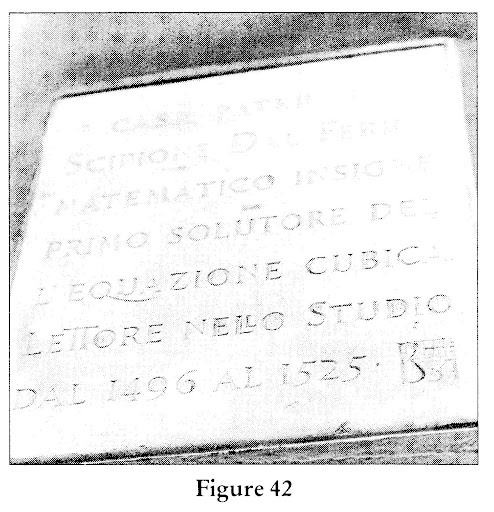
To conclude this story I must add a personal note. In the summer of 2003 I decided that I had to find the birthplace of the true hero of the cubic equation -Scipione dal Ferro. After some effort I discovered the place. Today it is located at the corner of via Guerrazzi and via S. Petronio Vecchio in Bologna. An easy-to-miss plaque on the side wall marks the house as dal Ferro's birthplace (figure 42). I rang the entrance buzzer at a few apartments randomly, and an old lady showed up at the window of a third-floor apartment. I explained to her in my pathetic Italian that I was researching the life of Scipione dal Ferro. She told me to wait for her husband to descend. The pleasant old gentleman explained to me in a broken mixture of Italian and English that there was nothing else in the building to indicate the fact that the man responsible for one of the major breakthroughs in algebra had lived there. We both stared silently at the plaque for a few minutes and then parted.
After the brilliant dal Ferro-Cardano-Ferrari work, it was only natural to believe that the quintic equation, of the form ax^5 + bx^4 + cx^3 + dx^2 + ex + f = 0, could also be solved by a formula. In fact, with the confidence gained from the Ars magna, the expectation was that the solution was right around the corner, and it prompted some of the sharpest mathematical minds to hunt for this treasure.
WILL TELL ALOUD YOUR GREATEST FAILING
The satirical author Jonathan Swift (1667-1745), best known for Gulliver's Travels, wrote an amusing poem in 1727 entitled "The Furniture of a Woman's Mind." A few lines read:
For conversation well endu'd,
She calls it witty to be rude;
And, placing raillery in railing,
Till tell aloud your greatest failing
The story of the search for a formulaic solution to the quintic equation in the 250 years following Cardano is one of great failing. It started with another Bolognese, Rafael Bombelli (1526-72). By a historical coincidence, Bombelli was born precisely in the year that dal Ferro died. Having studied with great admiration the Ars magna, Bombelli felt that Cardano's exposition had not been sufficiently clear and self-contained; in Bombelli's words, "In what he said it was obscure." Consequently, he spent two decades writing an influential book called L'algebra. Unlike the other Italian mathematicians, Bombelli was not a university professor, but rather a hydraulic engineer. Bombelli's greatest original contribution was the realization that one cannot avoid having to deal with square roots of negative numbers. This truly required a mental leap. After all, what is the square root of -1 ? Clearly, no ordinary (real) number multiplied by itself gives -1, since even the multiplication of a negative number by itself gives a positive result. Nevertheless, the solution to the cubic equation (see appendix 5) sometimes produced a square root of a negative number as an intermediate step, even when the final solution was a real number. Cardano, who was puzzled by these "sophistic" numbers, concluded that they were "so subtle that they were useless," and when he needed to calculate with them he said he was doing so by "dismissing mental torture." Bombelli, on the other hand, had the remarkable insight to understand that these new numbers, which he called "plus of minus," were a necessary vehicle that could bridge the gap between the cubic equation (which was expressed in real numbers) and the final solutions (which were also real numbers). In other words, while both the beginning and the end involve real numbers, the solution has to traverse the new world of "imaginary" numbers. The square root of -1 was denoted by i in 1777 by the great Swiss mathematician Leonhard Euler. The numbers in the new vistas revealed by Bombelli's work are now called complex numbers— these are sums of real numbers (all the ordinary numbers) and imaginary numbers (which involve square roots of negative numbers).
There was also an important historical lesson to be learned here. The study of equations had afforded mathematicians a first glimpse of new kinds of numbers several times throughout history. There were the negative numbers, such as -1 and -2; the irrational numbers, such as SquareRoot(2) that could not be expressed as fractions; and through Bombelli's work, even imaginary numbers, such as SquareRoot(-1). Who knew what insights might emerge out of the solution of the quintic?
In the centuries that followed, cracking the enigma of the quintic became one of the most intriguing challenges in mathematics. Unfortunately, the solutions discovered by dal Ferro and Ferrari (for the cubic and quartic, respectively) did not offer much help. These represented brilliant but ad hoc tricks rather than methodical studies that could be extended to equations of higher degrees. What was badly needed was a more comprehensive theory of equations in general, rather than experiments with isolated cases. To use a medical metaphor, mathematics had to move on from the treatment of the symptoms to the understanding of the causes and the associated side effects.
The French lawyer Francois Viete (1540-1603) and the English astronomer Thomas Harriot (1560-1621) took steps in the right direction. They introduced improvements to both the notation used to describe algebraic equations (which was extremely cumbersome in Cardano's work) and to the methods of solution themselves. Viete was also the person responsible for the word coefficients, used to define the numbers that describe an equation (e.g., a, b, c in ax^2 + bx + c = 0). Although not a mathematician by profession, Viete came on one occasion to the rescue of the honor of the entire French mathematical society. In 1593, at the end of the preface of his book Ideae mathematicae, the Belgian mathematician Adriaan van Roomen (1561-1615) challenged all the mathematicians of his time to decipher a problem that involved no less than solving an intimidating equation of degree 45 (see appendix 6). The ambassador to Paris from the Netherlands was only too delighted to remark mockingly to King Henry IV that there was no French mathematician who could solve the problem. The embarrassed king called upon Viete for help and was pleasantly surprised when the latter was able (according to legend) to find the positive solutions within a few minutes, upon discovering that a trigonometric relation was underlying the problem. In fact, Viete did much more—he showed that the equation has twenty-three positive solutions and twenty-two negative ones.
The first serious, but alas unsuccessful, attempt at a solution of the quintic was made by the Scot James Gregory (1638-75). Gregory is known primarily for a reflecting telescope (the Gregorian telescope) that he invented. During the year before he died (at the young age of thirty-six), he had begun to doubt whether a formula for the quintic could be found at all. Nevertheless, he did discover relations between the solutions of various equations and their coefficients. The next step was taken by the German Count Ehrenfried Walther von Tschirnhaus (1651 -1708). A man of many accomplishments, from glasswork to algebra, Tschirnhaus elaborated on an interesting method that for a while gave hope that there was light at the end of the tunnel. The basic idea was simple. If one could somehow reduce the quintic equation to equations of a lower degree (such as the quartic or cubic), then one could use known solutions to those equations. In particular, Tschirnhaus was able by some clever substitutions to get rid of the x^4 and x^3 terms in the quintic. Unfortunately, there was still a major obstacle in Tschirnhaus's method, which was soon noticed by the mathematician Gottfried Wilhelm Leibniz (1646-1716), and after much effort in this direction Tschirnhaus conceded defeat.
The eighteenth century brought about a renewed interest and a vigorous series of attacks on the problem. The Frenchman Etienne Bezout (1730-83), who published several works on the theory of algebraic equations, adopted methods somewhat similar to those of Tschirnhaus, but again to no avail. At that point, the most prolific mathematician of all time entered the race.

Leonhard Euler (figure 43) was so productive that an entire volume is needed merely to reproduce the list of his publications. Euler's body of published works in mathematics and mathematical physics constitutes about one third of all the work published in these areas during the last three-quarters of the eighteenth century. Euler conjectured that the solution to the quintic could be expressed in terms of some four quantities, and he concluded in a hopeful tone: "One might suspect that if the elimination were done carefully, it might possibly lead to an equation of degree 4." In other words, he also optimistically believed that the problem could be reduced to one that had already been solved. This general philosophy is characteristic of advances in mathematics. In an old joke, aphysicist and a mathematician are asked what they would do if they needed to iron their pants, but although they are in possession of an iron, the electric outlet is in the adjacent room. Both answer that they would take the iron to the second room and plug it in there. Now they are asked what they would do if they were already in the room in which the outlet is located. The physicist answers that he would plug the iron into the outlet directly. The mathematician, on the other hand, says that he would take the iron to the room without the outlet, since that problem has already been solved.
In spite of Euler's optimism, he failed to solve the general quintic. He did manage to show, however, that a few special quintics, such as x^5 – 5px^3 + 5p^2x– q = 0 (where p and q are given numbers), were solvable by a formula. This left the door open for potential future endeavors. Next in line was the Swede Erland Samuel Bring (1736-98). A teacher of history at Lund University by profession, Bring's favorite pastime was mathematics. And what better riddle to solve than the quintic? Bring achieved what appeared to be a huge step toward a solution. He found a mathematical transformation that could reduce the general quintic (ax^5 + bx^4 + cx^3 + dx^2 + ex + f = 0) to the much simpler form x^5 + px + q = 0. Unfortunately, not only did even this shorter and seemingly much more tractable form still present an insurmountable obstacle, but Bring's remarkable transformation went entirely unnoticed, only to be independently rediscovered by the English mathematician George Birch Jerrard in the nineteenth century.
Three further undertakings, by mathematicians working nearly simultaneously in three different countries, also fell short of producing a solution. Still, the profound works of these mathematicians introduced an exciting new idea into the search. In particular, they showed that properties of the permutations of the putative solutions of equations might have something to do with whether the equations are solvable by a formula or not. Since this was historically the first point of connection between the solutions of equations and the concept of symmetry, let me give a brief explanation of the basic principle. Examine, for instance, the quadratic equation ax^5 + bx + c = 0 (where a, b, c are known numbers).
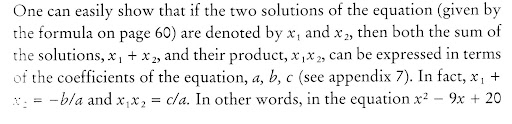
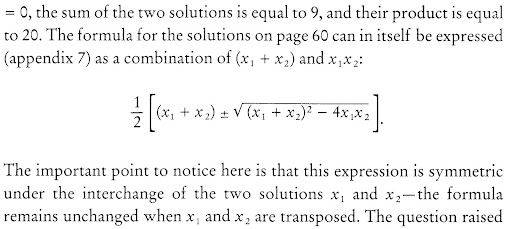
The question raised by the Frenchman Alexandre-Theophile Vandermonde (1735-96) and the Englishman Edward Waring (1736-98) was whether the solution to the quintic, and indeed equations of any degree, could not be represented by a similar, symmetric expression. This could, in principle, lead to a formula for the solutions. The idea was picked up by the person considered by Napoleon Bonaparte to be "the lofty pyramid of the mathematical sciences" —Joseph-Louis Lagrange (1736-1813).
JohnEB

In his outstanding treatise (published in Berlin) Reflections on the Resolution of Algebraic Equations, Lagrange first reviewed carefully the contributions of Bezout, Tschirnhaus, and Euler. He then showed that all the tricks by which solutions had been obtained for the linear, quadratic, cubic, and quartic equations could be replaced by a uniform procedure. Here, however, came a nasty surprise. For degrees 2, 3, and 4, the equations had been solved by reducing the equation to one of a lower degree than the one being discussed (i.e., reducing the quartic to a cubic, and so on). When precisely the same process was attempted on the quintic, something unexpected happened. The resulting equation, instead of being a quartic, turned out to be one of degree 6! The method that had worked beautifully for degrees 2, 3, 4 failed utterly at the quintic.
Disappointed, Lagrange concluded that "it is therefore unlikely that these methods will lead to the solution of the quintic — one of the most celebrated and important problems of algebra."
As a way out of the impasse, Lagrange introduced a more general discussion of permutations. Recall that permutations are the operations that produce different arrangements of objects, such as the transformations of ABC into BAC or CBA. Lagrange made the important discovery that the properties of equations and their solubility depend on certain symmetries of the solutions under permutations.
Even Lagrange's new insights, as groundbreaking as they were, proved insufficient for a solution to the quintic. Remaining optimistic that his analysis would generate the necessary breakthrough, he wrote, "We hope to return to this question at another time and we are content here in having given the fundamentals of a theory which appears to us new and general." As history would have it, Lagrange never returned to the quintic. Two days before his death he summarized his life thus: "My career has come to an end; I have acquired a modicum of renown in mathematics. I have not hated anyone, nor have I done ill by anyone; it is good to come to the end."

Gauss's genius was recognized already at age seven, when he was able to sum the whole numbers from 1 to 100 instantly in his head, simply by noticing that the sum consists of fifty pairs of numbers, each totaling 101. In his doctoral dissertation in 1799, Gauss gave his first proof of what has become known as the fundamental theorem of algebra—the statement that every equation of degree n has precisely n solutions (which can be real or complex numbers). Gauss's first proof had some logical gaps in it, but he would end up giving three more proofs during his life, all rigorous. Argand's proof, published in 1814, was actually the first correct proof.
The fundamental theorem demonstrated unambiguously that the general quintic equation must have five solutions. But could those be found by a formula? In the same year that Gauss published his first proof for the fundamental theorem he also expressed his skepticism about a formulaic solution to the quintic: "After the labors of many geometers left little hope of ever arriving at the resolution of the general equation algebraically, it appears more and more likely that this resolution is impossible and contradictory." He then added an intriguing note: "Perhaps it will not be so difficult to prove, with all rigor, the impossibility for the fifth degree." Gauss would never publish another word on this topic.
The repeated frustrations of the quintic hunters for more than two centuries prompted the French historian of mathematics Jean Etienne Montucla (1725-99) to use military metaphors in describing the attack on the quintic: "The ramparts are raised all around, but, enclosed in its last redoubt, the problem defends itself desperately. Who will be the fortunate genius who will lead the assault upon it or force it to capitulate?
By another historical coincidence, the final and conclusive series of offensives on the quintic was about to begin in the year Montucla died. As in the case of the cubic and the quartic, this phase started with another Italian.

We have to pause here for a moment to appreciate the magnitude of Ruffini's claim. The formula for the solutions of the quadratic equation had been known essentially since Babylonian times. The formula for the solutions of the cubic was discovered by dal Ferro, Tartaglia, and Cardano. Ferrari came up with the solutions to the quartic. All of these formulae were expressed by simple arithmetic operations and the taking of roots. Then came two and a half centuries of failed expectations, during which some of the most brilliant mathematicians tried in vain to find such a formula for the quintic. Now Ruffini was claiming that he could prove that the quintic equation could not be solved by a formula of this type, no matter how hard one tried. This represented a dramatic revolution in the thinking about equations. Mathematicians have grown accustomed to the fact that some equations are very difficult to solve, but here Ruffini's proof was supposed to show that in the case of the quintic, the effort was doomed from the start.
Ruffini published his proof in a two-volume treatise entitled Teoria generale delle equazioni (General Theory of Equations), which appeared in 1799. However, the proof was extremely intricate, and the tortuous reasoning made it difficult to follow through the 516 pages of the book. Not surprisingly, the reaction from the mathematical world was one of skepticism and suspicion at best. Ruffini sent a copy of Teoria to Lagrange around 1801 but received no reply. Still not discouraged, he sent a second copy, noting:
Because of the uncertainty that you may have received my book, I send you another copy. If I have erred in my proof, or if I have said something which I believed new, and which is really not new, finally if I have written a useless book, I pray you point out to me sincerely.
Lagrange did not respond to this letter either. Ruffini tried one last time in 1802, starting with praise for Lagrange's work:
No one has more right ... to receive the book which I take the liberty of sending to you.... In writing this book, I had principally in mind to give proof of the impossibility of solving equations of degree higher than 4.
Still no reply.
Thwarted by the reception his work had received, Ruffini attempted to publish more rigorous and somewhat less abstruse proofs in 1803 and 1806. He also discussed the proof with fellow mathematicians Gianf rancesco Malf atti (who published a treatise about the quintic in 1771) and Pietro Paoli. The latter conversations led to a final version of the proof that was published in 1813, in a paper entitled "Reflections on the Solution of General Algebraic Equations." Unfortunately, even this supposedly more transparent proof did not make headlines in the mathematical community.
In a report to the king entitled "Historical Report on the Progress of the Mathematical Sciences since 1709," the French mathematician and astronomer Jean-Baptiste Joseph Delambre (1749-1822) did mention Ruffini's work briefly. He used, however, rather tentative language: "Ruffini proposes to prove that it is impossible." The exasperated Ruffini was quick to protest: "I not only proposed to prove but in reality did prove." Even this exchange did not result in a general acceptance of Ruffini's proof by his contemporaries and successors. Worse yet, Delambre explained to Ruffini that it was hopeless to expect a definitive answer because "whatever decision your Referees [mathematicians Lagrange, Lacroix, and Legendre] would have reached [concerning the validity of the proof], they had to work considerably either to motivate their approval or to refute your proof." From some comments the elderly Lagrange made to the scientist and pharmacist Gaultier de Claubry, we may gather that while he was generally impressed with Ruffini's work, even he was not quite intellectually inclined to accept such a revolutionary concept as the impossibility of solving the quintic by a formula. Consequently, Lagrange never made any public statements concerning Ruffini's proof.
In desperation, Ruffini sent his proof to the Royal Society in London. He received a polite reply stating that while a few members who had read his work found it satisfactory, it was not the society's policy to publish official approvals of proofs. The one distinguished mathematician who accorded credence to Ruffini's result was Augustin-Louis Cauchy (1789-1857). Cauchy's productivity was so prodigious (he published a staggering 789 mathematical papers) that at one point he had to found his own journal. In a letter received about six months before Ruffini's death, Cauchy, generally reserved with compliments, writes:
Your memoir on the general resolution of equations is a work which has always seemed to me worthy of the attention of mathematicians and which, in my judgment, proves completely the insolvability of the general equation of degree greater than 4.... I add moreover, that your work on the insolvability is precisely the title of a lecture which I gave to several members of the academy.
Even with Cauchy's appreciation, Ruffini's proof became neither widely known nor accepted. Most mathematicians still found his arguments so convoluted that they were unable to ascertain their soundness.
But did Ruffini truly prove that the quintic cannot be solved by a formula that involves simple operations? With the wisdom of hindsight, we can say that he did not quite prove it. There was still a significant gap in the proof, where Ruffini made an assumption, without realizing that it was necessary to prove his assumption. Instead, he was satisfied to note that any other assumption would lead to a more complicated situation, so that "we can completely abandon it." This imperfection, however, takes nothing away from the originality of his discovery. In fact, none of Ruffini's contemporaries located the gap in his proof. Ruffini was the person responsible for a revolutionary change in the approach to equations. Instead of trying to solve the quintic, the effort was soon to turn to attempts to prove that it cannot be solved.
When we come today to evaluate Ruffini's work, we realize that he actually did much more than merely change ideas about the quintic equation. He took the relations between solutions of the cubic and quartic and certain permutations one step further. This marked the beginning of the transition from the traditional algebra, which deals only with numbers, to the roots of group theory, which involves operations between elements of any sort. Recall that members of groups can be anything from integer numbers to the symmetries of the human body. The birth of abstract algebra was on the horizon.
Ruffini was always conscientious to a fault. He once refused a chair in mathematics at Padua because he did not want to forsake all the families he was treating as a physician. Infinitely devoted to his patients, Ruffini contracted severe typhoid fever during the 1817-18 epidemic. He used that traumatic experience to write Memoir of Contagious Typhus. Although greatly weakened, he continued to visit patients and did not abandon his mathematical research. In April 1822, he was struck by chronic pericarditis and passed away the following month. Strangely, after his death, his work was all but forgotten, and with the exception of Cauchy, the mathematicians who followed him essentially had to rediscover his ideas.
This was the setting into which two young men, perhaps the most tragic figures in the history of science, appeared. The Norwegian Niels Henrik Abel and the Frenchman Evariste Galois were about to change the course of algebra forever. The life stories of these two remarkable individuals are so heartrending that I feel compelled to describe them in some detail in the next two chapters.
JohnEB
Abel & Galois
The following is from Chapter 4 of The Equation That Couldn't Be Solved by Dr. Mario Livio:
________________________________________________
Niels Henrik Abel
http://en.wikipedia.org/wiki/Niels_Henrik_Abel
Evariste Galois
http://en.wikipedia.org/wiki/Evariste_Galois
Group (mathematics)
http://en.wikipedia.org/wiki/Group_(mathematics)
JohnEB
Chapter -SEVEN-
Symmetry Rules
Nature and Nature's laws lay hid in night:
God said, Let Newton be! and all was light.

The world around us appears as transient as the clouds. The histories of humankind, of the Earth, of the solar system, of the entire Milky Way galaxy, and even of the universe as a whole are marked by relentless, sometimes violent changes, albeit on different time scales. Fortunately, the laws of nature are less ephemeral. When astronomers observe a galaxy that is a billion light-years away, the light entering the aperture of their telescope at that moment has been on its way for a billion years. In other words, telescopes are true time machines—they give glimpses of the universe's distant past. As far as we can tell, Mother Nature does not allow any amendments to her constitution—the laws of nature have not changed in any noticeable way, at least since the time the universe was no more than a second old. Laws with a more fleeting existence would have made it very difficult for physicists (if those existed at all) to unravel the cosmic history.
SPACETIME
The symmetry of the laws of nature extends well beyond mere translations and rotations. The laws don't care, for instance, how fast or in which direction we move. You must have encountered the simplest manifestation of this fact in a train station. You sometimes can hardly tell whether it is your train or the one on the adjacent track that is moving. Two observers moving at constant velocities (i.e., with neither the speed nor the direction of motion changing) will find nature to obey precisely the same laws, irrespective of whether one is shooting for the sky in a futuristic rocket at 99 percent of the speed of light while the other is sitting lazily on the back of a giant turtle. Galileo and Newton had already recognized this important symmetry between observers moving at constant velocities, but Einstein gave it an enormous emphasis and a totally unanticipated twist in his theory of special relativity. One part of this symmetry is relatively straightforward. The question, "When does New York stop at this train?" may be phrased surrealistically but is in fact perfectly legitimate even in Newtonian physics. A person on a train could definitely regard that train as standing still while everything else is moving. Einstein, however, formulated this symmetry so as to agree with the unexpected experimental result that the speed of light always comes out to be the same, irrespective of how the source of light or the observer is moving. In other words, to the symmetry dictating that the laws of physics (including the laws of electromagnetism and light) should appear the same to all uniformly moving observers, he added another one: The speed of light is precisely the same for all observers.

To ensure the symmetry of the laws of physics for uniformly moving observers, as well as the invariance of the speed of light, the theory of special relativity had to pay a price. Einstein discovered that space and time cannot be treated as separate entities. Rather, they are inseparably tethered together by symmetry. Einstein's original paper on special relativity had the unassuming title "On the Electrodynamics of Moving Bodies" (figure 88 shows the front page), yet, as the following example will show, it literally changed our perception of reality.
Imagine that over a period of a few years you are videotaping an apple resting on a table as it ages and disintegrates. What this (none too exciting) film is really capturing is the "motion" of the apple through time, as opposed to its motion through space. Time, according to special relativity, is a fourth dimension that has to be added to the familiar three dimensions of space. When the apple is propelled at some speed, it necessarily travels through all four dimensions, since as the apple cruises through space, time is progressing too. Will the moving apple age at the same rate as the stationary apple? The surprising answer of special relativity is that it will not. The faster the apple journeys through space, the slower its "clock" will tick, as seen by an observer at rest. As the apple's speed approaches the speed of light, its time (for an observer at rest) will slow down to a crawl. This might sound utterly unbelievable had it not been unambiguously confirmed by a multitude of experiments. For instance, an elementary particle called a muon is constantly being produced in the Earth's upper atmosphere by the bombardment of high-energy particles known as cosmic rays. The fact that these muons can travel through tens of miles of the atmosphere is due entirely to the relativistic slowing down of the muons' internal "clocks." At rest, muons live only about two-millionths of a second before decaying into lighter particles. For such short lives, even had they whizzed through space at the speed of light, the travel time through the atmosphere would be more than ten times longer than the muon lifetime (in the absence of relativistic effects). Researchers who timed and counted such muons between the summit and foot of Mount Washington in New Hampshire in 1941 confirmed that the traveling muons lived longer, just as predicted by special relativity. Experiments in 1975, in which muons were accelerated to 99.94 percent of the speed of light, showed that such fast-lane muons lived twenty-nine times longer than their counterparts at rest, again in full agreement with the expectations from special relativity.
OK, you may think, but muons are bizarre elementary particles and not normal clocks. Would the watches on our wrists or our heartbeats also slow down if we were to move at speeds approaching the speed of light? Well, an experiment in 1971 used actual clocks. Physicists Joseph Carl Hafele and Richard Keating flew around the globe in opposite directions on commercial Pan Am flights. They carried with them four atomic clocks that were synchronized at the beginning of the trip with a stationary clock in Washington, D.C. At the end of the trip, the clocks that traveled eastward (and therefore faster than the Earth's spin) showed, as expected, an elapsed time shorter by 59 billionths of a second, while those that traveled west (effectively moving slower than the clock in D.C.) recorded times that were longer by 273 billionths of a second.
One of the key predictions of special relativity is that the velocities of a body through the space and time dimensions always combine to give precisely the speed of light. A muon at rest, for instance, has its entire "velocity" pointing in the time direction, as it "travels" only through the time dimension. For muons in motion, the larger the component of their velocity through space, the slower they "age," with their time coming effectively to a halt (for observers at rest) as the muons' speed approaches the speed of light. Light itself always travels through three-dimensional space at precisely the speed of light. Special relativity tells us that nowhere can light travel at any other speed, nor is it ever possible to catch up with light—light can never be at rest. In this sense, perceiving light is a bit like the perception of motion in a movie. Each frame in the film captures a slightly different scene, and when these frames are flashed rapidly and successively before our eyes we can see the motion. When the film is stopped, the motion disappears. We can see light only when it is moving at the speed of light.
Oddly enough, in spite of his incredible intuition and deep insights in physics, Einstein's attitude toward pure mathematics was at first rather lukewarm. As a student in Zurich, his less-than-perfect attendance in the math classes of mathematician Hermann Minkowski (1864-1909) gained him the title "lazy dog." Through an ironic twist of history, once Einstein published his theory of special relativity, it was none other than Minkowski himself who used symmetry to put the theory on a firm mathematical basis. Minkowski showed that space and time may be "rotated" as a four-dimensional entity, just as a sphere can be rotated in three-dimensional space. More important, in the same way that a sphere is symmetric (i.e., it does not change) under rotation through any angle about any axis, Einstein's special relativity equations are symmetric ("covariant" in the physics lingo) under these spacetime rotations. This remarkable symmetry of the equations has become known as Lorentz covariance, after the Dutch physicist Hendrik Antoon Lorentz (1853-1928), who first described these transformations in 1904. You will probably not be too surprised to hear that the collection of all the symmetry transformations of the Minkowski spacetime forms a group, similar to the group of ordinary rotations and translations in three dimensions. This group is known as the Poincare group, after the outstanding French mathematician who refined the mathematical basis of special relativity.
Suspicious at first ("ever since the mathematicians have invaded the relativity theory, I myself no longer understand it"), Einstein slowly began to grasp the incredible power of symmetry. If the laws of nature are to remain unchanged for moving observers, not only do the equations describing these laws need to obey Lorentz covariance, the laws themselves may actually be deduced from the requirement of symmetry.
This profound realization has literally reversed the logical process that Einstein (and many of the physicists who followed him) employed to formulate the laws of nature. Instead of starting with a huge collection experimental and observational facts about nature, formulating a theory, and then checking whether the theory obeys some symmetry principles. Einstein realized that the symmetry requirements may come first and dictate the laws nature has to obey. Let me demonstrate this type of input-output reversal using a few simple analogies.

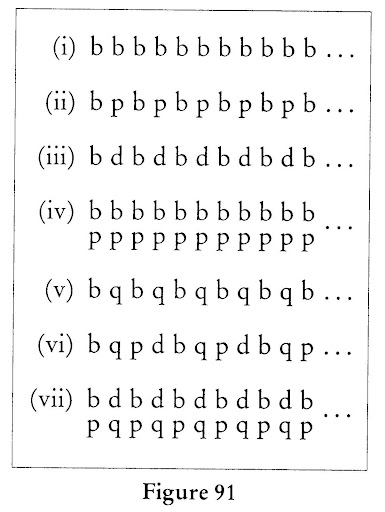
The symmetries' of the laws of physics under translations, rotation and uniform motion (including the invariance of the speed of light) absolutely essential to our understanding of space and time, but they do not in themselves impose the existence of new forces or new particles. As we shall soon see, however, the attempts to understand gravity, and to unify all of the basic forces of nature, have elevated the significance of symmetry principles to a yet higher level—symmetry has become the source of forces.
JohnEB
A WEIGHTY SYMMETRY
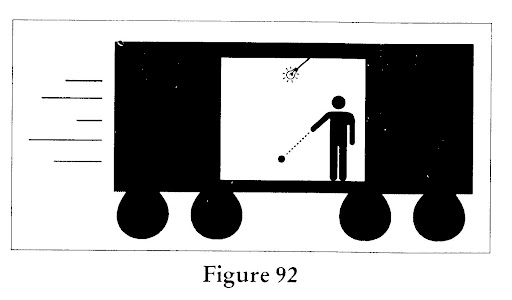
Imagine life in an accelerating boxcar (figure 92). If the boxcar is constantly accelerating to the right, we know from everyday experience that everything will be pushed backward (to the left in the figure). The lamp hung from the ceiling, for instance, would be tilted from the vertical direction. Every object dropped to the floor would fall at an angle, and every person sitting in a chair facing forward would feel pressure both from the seat underneath and from the back of the chair. This is very easy to understand. If a man in the boxcar drops his keys, the horizontal speed of the keys remains unchanged (apart from small changes due to the air's resistance) and equal to the speed the keys had at the instant they were dropped. At the same time, the boxcar itself continuously accelerates to higher and higher speeds. The keys are therefore left behind, resulting in a path that is tilted backward. Here, however, comes an important realization. The experiences of the person in the accelerating boxcar are no different from those one would have if gravity itself were stronger and were tilted, instead of pointing straight down. Put differently, the gravitational force produces precisely the same phenomena as those observes in accelerated motion.
Consider another situation. When you stand on a bathroom scale inside an elevator that is accelerating upward, the scale will register a higher weight (because your feet exert a greater pressure on the scale) —as if gravity became stronger. An elevator accelerating downward would feel like a weaker gravity. In the extreme case that the elevator's cable snaps, you and the scale would be free-falling in unison, and the scale would register zero weight. (This is not a recommended weight-loss procedure, however — think of what the scale would record when the elevator does eventually hit the bottom of the shaft!) Astronauts float "weightless" inside the space station not because they are outside the reach of the Earth's gravity, but because both the station and the astronauts undergo the same acceleration toward the Earth's center—they are both free-falling.
While pondering various thought experiments of this type, Einstein was eventually led in 1907 to an electrifying conclusion: The force of gravity and the force resulting from acceleration are in fact the same. This powerful unification was dubbed the equivalence principle—acceleration and gravity are two facets of the same force; they are equivalent. Inside a free-falling elevator it is impossible to tell whether you are weightless because the elevator is accelerating downward or because gravity has been miraculously "switched off." Einstein described that moment of epiphany he had in 1907 in a lecture delivered in Kyoto in 1922: "I was sitting in the patent office in Bern [Switzerland] when all of a sudden a thought occurred to me: If a person falls freely, he won't feel his own weight. I was startled. This simple thought made a deep impression on me. It impelled me toward a theory of gravitation." Medical laboratories take advantage of the equivalence principle all the time. They use centrifuges to whirl fluids rapidly to separate substances of different densities. The centrifuges act as artificial-gravity machines. The acceleration of the rotational motion is equivalent to an increased gravitational force.
A statement of a pervasive symmetry accompanied the equivalence principle—the laws of physics, as expressed by Einstein's equations of general relativity, are precisely the same in all systems, including accelerating ones. That is, the laws are symmetric under any change in the spacetime coordinates. So why are there apparent differences between what is observed, say, on a merry-go-round and in a laboratory at rest? Those, general relativity tells us, are only differences in the environment, not in the laws themselves. In the same way that up and down appear to be different on Earth (in spite of the symmetry of the laws under rotations) because of the Earth's gravity, observers on the merry-go-round feel the centrifugal force that is equivalent to gravity. In other words, the symmetry among all frames of reference, including accelerating ones, necessitates the existence of gravity. As the examples of the accelerating boxcar and the elevator have shown us, the laws of physics in an accelerating frame are indistinguishable from those in a frame that experiences gravity.
Armed with the powerful insights afforded by the equivalence principle, Einstein felt that he was finally ready to tackle the two most intriguing questions that Newton's theory of gravitation had left totally unanswered. First and foremost was the million-dollar "how" question: How does gravity do its trick? Or alternatively: How can the Sun, which is at a distance of almost a hundred million miles from Earth, exert an inescapable gravitational pull that holds the Earth in its orbit?
Newton was fully aware of the fact that he had no answer:
Hitherto we have explained the phenomena of the heavens and of our sea by the power of gravity, but have not yet assigned the cause of this power [emphasis added]. This is certain, that it must proceed from a cause that penetrates to the very centres of the Sun and planets, without suffering the least diminution of its force ... and propagates its virtue on all sides to immense distances, decreasing always as the inverse square of the distances.... But hitherto I have not been able to discover the cause of those properties of gravity from phenomena, and I frame no hypotheses.
Second, there was the disturbing conflict between special relativity and Newton's notion of gravity. While the former states definitively that no mass, energy, or information of any sort can propagate faster than light, Newton envisaged gravity as exerting its force instantaneously across the vast expanses of space. Such a "speedy" gravity could have opened the door to some truly bizarre and undesired phenomena. For instance, if the Sun were to suddenly disappear, all the planets in the solar system would immediately start to move along nearly straight lines, since the force holding them in elliptical orbits would vanish. However, the Sun would actually disappear from view to people on Earth only about eight minutes later, since it takes light that long to traverse the Sun-Earth distance. If inhabitants of Neptune existed, they would start their journey into cold space a full four hours before they would see the Sun disappearing. Such cause-and-effect topsy-turviness would turn our perception of reality into an incomprehensible nightmare. Being a firm believer in the correctness of both special relativity and the equivalence principle, Einstein realized that the time had come for a complete overhaul of Newton's theory of gravitation.
The first hints of the possibility of a warped spacetime may have dawned upon Einstein from another intriguing thought experiment. This had originally been proposed by physicist Paul Ehrenfest (1880-1933) and later became known as Ehrenfest's paradox. One of the known results of special relativity is that the length of moving bodies, as measured by observers at rest, contracts along their direction of motion. The contraction is larger the higher the speed. This is no illusion—a moving rod can be momentarily confined in a space in which it would not fit when at rest. Consider then what happens to a flat object, such as a compact disc, when it is spinning very rapidly. Since the circumference rotates faster than the interior, it would contract more. This would distort and warp the shape of the disk. Once the idea of acceleration as a source of warps was introduced, Einstein would not let go of it. He concluded that acceleration would warp the very fabric of spacetime. And, according to the equivalence principle, if acceleration can cause space to be curved, so can gravity. This became the essence of general relativity—gravity warps and bends spacetime in the same way that circus trapeze artists cause the safety net on which they land to sag. Just as heavier objects would cause a more pronounced distortion in a trampoline, the higher the mass of a body, the more curved spacetime becomes in its vicinity. The path of a Jeep negotiating sand dunes in the Sahara is determined by the shape of the undulating terrain. Similarly, the paths of the planets around the Sun are a consequence of the curvature the Sun produces in spacetime. The planets are simply seeking the most direct route, and the shapes of their orbits reveal the curved geometry of spacetime. Within the framework of a warped spacetime, gravity's influence is definitely not instantaneous. Einstein calculated that disturbances in the shape of spacetime propagate like ripples in a pond, precisely at the speed of light. If the Sun were to miraculously disappear, the vanishing of its gravitational influence would reach Earth in eight minutes — simultaneously with its visual disappearance. This gratifying result eliminated the last nagging problem of Newtonian physics.
The fact that Einstein turned curved spacetime into the cornerstone of his new theory of the cosmos created a need for mathematical tools to describe such spaces. The math classes he had missed at school came back to haunt him. Fortunately, the former math skeptic had someone to turn to—Marcel Grossman (1878-1936), Einstein's old classmate, and an accomplished mathematician. In an uncharacteristically helpless tone Einstein repented: "I have become imbued with great respect for mathematics, the more subtle parts of which I had previously regarded as sheer luxury!" The ever-reliable Grossman did not fail to deliver. He pointed Einstein both to the non-Euclidean geometry of Riemann and to mathematical methods developed by the mathematicians Elwin Christoffel, Gregorio Ricci-Curbastro, and Tullio Levi-Civita. Recall that Riemann had in fact "anticipated" precisely the machinery that Einstein needed — a geometry of curved spaces in any number of dimensions. The introduction of calculus into geometry through the branch known as differential geometry, and the development of tensor calculus further allowed for precise calculations to be carried out (tensors are "boxes of numbers" that can represent spaces in any number of dimensions). After a few dead ends in the years 1912-15, Einstein decided to follow his main guiding light —the symmetry of all frames implied by the principle of general covariance. His intuition bore fruit, and at the end of 1915, general relativity, an all-embracing theory of spacetime and gravity, was born (figure 93 shows the front page of the paper). In a note to theoretical physicist Arnold Sommerfeld, Einstein could not hide his exuberance: "Be sure you take a good look at them [the equations of general relativity]; they are the most valuable discovery of my life."
Almost from the day of its first appearance, the underlying symmetry and logical simplicity of general relativity won it many admirers among the greatest physicists of the time. Ernest Rutherford (who discovered the atomic nucleus) and Max Born (a quantum mechanics pioneer) later compared the theory to a work of art.
One of the key predictions of general relativity was the bending of light rays under the influence of gravity. In particular, the Sun was predicted to bend starlight from distant stars positioned directly behind it. For the lightfrom the Sun not to totally overwhelm the light from the stars, the observations had to be carried out during a total solar eclipse, when the Moon blocks out the Sun's light. The idea at the basis of the experiment was simple; By comparing a photograph taken during a solar eclipse to a photograph of the same patch of the sky taken when the starlight is undeflected, one could attempt to measure the apparent slight shifts in stellar positions caused by the bending of light.

Even today, I am in total awe of the following wondrous chain of ideas and interconnections. Guided throughout by principles of symmetry, Einstein first showed that acceleration and gravity are really two sides of the same coin. He then expanded the concept to demonstrate that gravity merely reflects the geometry of spacetime. The instruments he used to develop the theory were Riemann's non-Euclidean geometries—precisely the same geometries used by Felix Klein to show that geometry is in fact a manifestation of group theory (because every geometry is defined by its symmetries — the objects it leaves unchanged). Isn't this amazing?
Recall that Galois was rather uncertain about the potential applications of his group-theoretical ideas. The combined power of the imaginations of mathematicians such as Klein, Lie, Riemann, Minkowski, Poincare, and Hilbert "joined forces" with the unsurpassed physical intuition of Einstein to turn symmetry and group theory into the most basic descriptors of spacetime and gravity.
JohnEB
On May 24, 2000, the Clay Mathematics Institute established The Millennium Prize Problems:
--------------------------------------------------------------------------------
In order to celebrate mathematics in the new millennium, The Clay Mathematics Institute of Cambridge, Massachusetts (CMI) established seven Prize Problems. The Prizes were conceived to record some of the most difficult problems with which mathematicians were grappling at the turn of the second millennium; to elevate in the consciousness of the general public the fact that in mathematics, the frontier is still open and abounds in important unsolved problems; to emphasize the importance of working towards a solution of the deepest, most difficult problems; and to recognize achievement in mathematics of historical magnitude.
The prizes were announced at a meeting in Paris, held on May 24, 2000 at the Collège de France. Three lectures were presented: Timothy Gowers spoke on The Importance of Mathematics; Michael Atiyah and John Tate spoke on the problems themselves.
The seven Millennium Prize Problems were chosen by the founding Scientific Advisory Board of CMI, which conferred with leading experts worldwide. The focus of the board was on important classic questions that have resisted solution for many years.
Follwing the decision of the Scientific Advisory Board, the Board of Directors of CMI designated a $7 million prize fund for the solution to these problems, with $1 million allocated to the solution of each problem.
It is of note that one of the seven Millennium Prize Problems, the Riemann hypothesis, formulated in 1859, also appears in the list of twenty-three problem discuss in the address given in Paris by David Hilbert on August 9, 1900.
--------------------------------------------------------------------------------
Einstein's work on relativity led to the concept of Ricci flow which in turn led to the Mathematical Breakthrough of the Century:
Grigory Perelman, who did the Breakthrough of the Century, is explained in the book named
MASHA GESSEN opens for us two windows, one into the mind of a genius, and the other into the world of mathematics in Russia. Both offer fascinating views -- Mario Livio, author of Is God a Mathematician? and The Golden Ratio
A Problem for a Million Dollars
True, some mathematicians conceal their preoccupations when they're working on famous problems—as Wiles had done while he was working on Fermat's Last—but generally they stay abreast of one another's research. And though putative proofs of the Poincare Conjecture had appeared more or less annually, the last major breakthrough dated back almost twenty years, to 1982, when the American Richard Hamilton laid out a blueprint for solving the problem. He had found, however, that his own plan for the solution—what mathematicians call a program—was too difficult to follow, and no one else had offered a credible alternative. The Poincare Conjecture, like Clay's other Millennium Problems, might never be solved.
Solving any one of these problems would be nothing short of a heroic feat. Each had claimed decades of research time, and many a mathematician had gone to the grave having failed to solve the problem with which he or she had struggled for years. "The Clay Mathematics Institute really wants to send a clear message, which is that mathematics is mainly valuable because of these immensely difficult problems, which are like the Mount Everest or the Mount Himalaya of mathematics," said the French mathematician Alain Connes, another twentieth-century giant. "And if we reach the peak, first of all, it will be extremely difficult—we might even pay the price of our lives or something like that. But what is true is that when we reach the peak, the view from there will be fantastic."
As unlikely as it was that anyone would solve a Millennium Problem in the foreseeable future, the Clay Institute nonetheless laid out a clear plan for giving each award. The rules stipulated that the solution to the problem would have to be presented in a refereed journal, which was, of course, standard practice. After publication, a two-year waiting period would begin, allowing the world mathematics community to examine the solution and arrive at a consensus on its veracity and authorship. Then a committee would be appointed to make a final recommendation on the award. Only after it had done so would the institute hand over the million dollars. Wiles estimated that it would take at least five years to arrive at the first solution—assuming that any of the problems was actually solved—so the procedure did not seem at all cumbersome.
Just two years later, in November 2002, a Russian mathematician posted his proof of the Poincare Conjecture on the Internet. He was not the first person to claim he'd solved the Poincare--he was not even the only Russian to post a putative proof of the conjecture on the Internet that year—but his proof turned out to be right.
And then things did not go according to plan—not the Clay Institute's plan or any other plan that might have struck a mathematician as reasonable. Grigory Perelman, the Russian, did not publish his work in a refereed journal. He did not agree to vet or even to review the explications of his proof written by others. He refused numerous job offers from the world's best universities. He refused to accept the Fields Medal, mathematics' highest honor, which would have been awarded to him in 2006. And then he essentially withdrew from not only the world's mathematical conversation but also most of his fellow humans' conversation.
Perelman's peculiar behavior attracted the sort of attention to the Poincare Conjecture and its proof that perhaps no other story of mathematics ever had. The unprecedented magnitude of the award that apparently awaited him helped heat up interest too, as did a sudden plagiarism controversy in which a pair of Chinese mathematicians claimed they deserved the credit for proving the Poincare. The more people talked about Perelman, the more he seemed to recede from view; eventually, even people who had once known him well said that he had "disappeared," although he continued to live in the St. Petersburg apartment that had been his home for many years. He did occasionally pick up the phone there—but only to make it clear that he wanted the world to consider him gone.
When I set out to write this book, I wanted to find answers to three questions: Why was Perelman able to solve the conjecture; that is, what was it about his mind that set him apart from all the mathematicians who had come before? Why did he then abandon mathematics and, to a large extent, the world? Would he refuse to accept the Clay prize money, which he deserved and most certainly could use, and if so, why?
This book was not written the way biographies usually are. I did not have extended interviews with Perelman. In fact, I had no conversations with him at all. By the time I started working on this project, he had cut off communication with all journalists and most people. That made my job more difficult—I had to imagine a person I had literally never met—but also more interesting: it was an investigation. Fortunately, most people who had been close to him and to the Poincare Conjecture story agreed to talk to me. In fact, at times I thought it was easier than writing a book about a cooperating subject, because I had no allegiance to Perelman's own narrative and his vision of himself—except to try to figure out what it was.
--------------------------------------------------------------------------------
JohnEB
Hamilton's mathematical contributions are primarily in the field of differential geometry and more specifically geometric analysis.
He is best known for having discovered the Ricci flow and suggesting the research program that ultimately led to the proof, by
Grigori Perelman, of the Thurston geometrization conjecture and the solution of the Poincaré conjecture.
JohnEB
The quest for the elusive Higgs boson seemed over in April, when an unexpected result from an atom smasher seemed to herald the discovery of the famous particle -- the last unproven piece of the physics puzzle and one of the great mysteries scientists face today.
Researchers were cautious, however, warning that it would take months to verify the finding.
Their caution was wise.
JohnEB
Why Math Works
Is math invented or discovered? A leading astrophysicist suggests that the answer to the millennia-old question is both