
** 1/15/26 - Iran’s Revolutionary Guards brutally cracked down on the protests — and will wield power going forward + 1/14/26 - Iranians Just Want a Normal Country - A complex—and radical—ideology undergirds the current uprising.

Buzz Sawyer
"The organization has made itself indispensable to Supreme Leader
Ayatollah Ali Khamenei and his efforts to keep a grip on power.
It sits atop a sprawling empire that stretches from the defense sector
— everything from policy to the navy and cyber — to construction
and critical infrastructure through its major engineering arm.
It controls transport hubs and the energy sector, where it's a
key interlocutor for buyers of sanctioned oil.
If this proves to be the beginning of the end for the Islamic Republic,
armed, and well funded. It has around 200,000 active troops,
according to US assessments, and another 600,000 volunteers
including the Basij paramilitary militia. But that doesn't come
close to showing the reach of the organization whose former
members permeate every aspect of Iranian society."
What Happens Next in Iran: Strongman, Coup, Collapse?
Iran’s Revolutionary Guards brutally cracked down on the protests — and will wield power going forward.
“How long should we watch with tears and regurgitate our own blood while we practice ‘democracy’ laden with chaos and insults?” Those words were written by members of Iran’s Islamic Revolutionary Guard Corps in 1999, part of an open letter to reformist President Mohammad Khatami urging him to reconsider his “inaction” against student protests.
Fast forward to today, amid the deadliest anti-government unrest in the country since the 1979 revolution, and the balance of power has shifted: the Guards are firmly in control, and have dropped any pretense of deference toward elected officials.
“The continuation of this situation is unacceptable,” the IRGC said in a final blunt warning on Jan. 9, hours into an internet blackout. It heralded a brutal crackdown.
Decades of Western sanctions, most recently over Iran’s nuclear program, have supercharged the organization’s rise from a branch of the military established to protect the 1979 Islamic revolution — and which forged its reputation in the 1980-88 war with Iraq — to a gargantuan economic and political force.
It means the IRGC is not just the iron fist deployed to put down demonstrations; it’s also the group with the most to lose if the system falls, and a key power broker in what happens next.
As successive waves of sanctions were imposed, smaller companies couldn’t keep up with the rise in the cost of doing business and foreign firms pulled out. The only entity big, rich and influential enough to step in was the IRGC — and step in they did.
The organization has made itself indispensable to Supreme Leader Ayatollah Ali Khamenei and his efforts to keep a grip on power. It sits atop a sprawling empire that stretches from the defense sector — everything from policy to the navy and cyber — to construction and critical infrastructure through its major engineering arm. It controls transport hubs and the energy sector, where it's a key interlocutor for buyers of sanctioned oil.
While reformist politicians like Khatami have been sidelined, the 24 signatories of the 1999 letter became a who’s who of the most powerful men in the Islamic Republic.
Among them was Qasem Soleimani who, as commander of the expeditionary Quds Force, led Iran's regional military strategy of power projection abroad via proxies in Iraq, Lebanon and Syria until he was killed in a US drone strike in 2020. At least three other signatories were killed by Israel in the 12-day war last June, and a fourth, Parliament Speaker Mohammad Baqer Qalibaf, is thought to have taken over command and control in the initial chaos that followed.
A decentralized command structure allowed the IRGC to endure Israel’s decapitation campaign — the culmination of a series of blows to the Guards' military might that began with the war in Gaza in October 2023. But domestically, it closed ranks to consolidate power.
Read More: Iran’s Military Elite Emerges From War Bruised and Emboldened
The IRGC’s approach to dealing with domestic unrest was set much earlier — by the student demonstrations in 1999, when it established that protesters were a national security threat to be met with zero tolerance.
The crackdown in the past week has been “apocalyptic,” according to one Tehran resident, and coincided with a step-up in rhetoric by the regime, which threatened “rioters” with the death penalty and characterized the unrest as “terrorism” instigated by the US and Israel to start a civil war.
At least 3,400 people have been killed, according to the Iran Human Rights group, and many activists warn the actual number may be much higher.
Even if the IRGC puts down the protests, its influence won’t end there. In the event of a military confrontation with the US, its commanders will lead the fight. If there’s a diplomatic settlement or domestic leadership reshuffle, it will run through its ranks of members and veterans who span all key branches of the state.
For all their influence, the one thing they can’t control is US President Donald Trump and his shifting red lines for military intervention. He warned the government earlier this week: kill protesters and face consequences, but by Wednesday he appeared to have dampened expectations of a military strike — as he did before the attacks on Iran’s nuclear facilities last summer — by saying he’d been reassured that the “shooting has stopped.”
Importantly, the IRGC is not a single entity. Some factions are more militaristic and ideological, adamant that the Islamic Republic shouldn’t deal with the US — the “Great Satan” — while others are more pragmatic, willing to contemplate anything that allows them to keep their privileged position within the system.
It’s also no longer as wedded to the religious ideology that spawned it, though it draws on it when useful.
“The society is post-ideological, and so is the IRGC,” says Ali Alfoneh, a senior fellow at the Arab Gulf States Institute. “If there is some ideology to be found, it’s nationalism, not Islamism.”
If this proves to be the beginning of the end for the Islamic Republic, the IRGC will be pivotal to what comes next. Here are three scenarios of what that might look like.
Strongman: Islamic Republic But With a Twist
There’s no shortage of strongmen within the IRGC’s current and former ranks. Its veterans run the most sensitive parts of Iran’s military, from ballistic missiles to drones, and the nuclear program that has put Tehran at odds with the West for decades. Many are prominent in politics too, including Foreign Minister Abbas Araghchi, national security chief Ali Larijani and Ali Shamkhani, an adviser to the supreme leader.
An insider, or a group of them, could emerge as candidates to take over the reins. But they would need to win the support of influential individuals and state institutions to have any chance of dislodging the supreme leader — widely blamed for the Islamic Republic’s decay — and getting him to step down.
In itself this wouldn’t be enough to assuage demonstrators.
To survive and stave off more protests, these new leaders would need to address the grievances of those who have taken to the streets in recent weeks, starting with inflation running at over 40% and a currency that’s lost more than half of its value in the past year. That would mean dealing with Trump — only he can provide much-needed sanctions relief to help revive the economy. That would be a hard pill to swallow for the IRGC. Other costly decisions would also be required, including tackling economic mismanagement and corruption, and easing political and social restrictions. But what matters to the organization is survival, and money and Trump could be the key to unlocking both.
Countries close to Iran like the Gulf Arab states and Russia, which don't want to see instability and chaos on their doorsteps, much less a new leadership whom they don't know, may also benefit from seeing parts of the system survive and take control, if it lends a sense of continuity to the regional order.
“The de facto collective leadership may pursue a ‘Venezuelan-style’ survival strategy,” says Alfoneh, referring to the aftermath of the detention of the then Venezuelan President Nicolas Maduro by the US. “Removing Khamenei, reaching out to Trump, seeking sanctions relief, inviting US oil companies back into Iran, stabilizing the economy, and preserving the system.”
“The IRGC would be part of this arrangement,” he adds, “to protect its vast economic interests.”
Coup: Under New Management
The Guards have the means to take over — they are ubiquitous, armed, and well funded. It has around 200,000 active troops, according to US assessments, and another 600,000 volunteers including the Basij paramilitary militia. But that doesn't come close to showing the reach of the organization whose former members permeate every aspect of Iranian society.
After watching Lebanon’s Hezbollah struggle to transition from armed militia to formally participating in government, however, the IRGC doesn’t necessarily have the appetite. Governing would saddle them with responsibility for Iran’s overlapping economic, political, social and environmental crises, and would mean tough choices they are loath to take. That’s a far cry from their current privileged position as an influential political, military and foreign policy player, wielding power from the shadows, and acting as middleman for an economy which the World Bank values at $475 billion.
If forced to choose between losing their grip on power and directly governing to maintain it, the Guards would likely opt for the latter, but it's not their preferred outcome.
What would an Iran under the Guards look like? That would depend on who wins out within the organization. “They’re not a monolith, they are also factionalized, with different views on how the system of government should evolve,” says Sanam Vakil, director of the Middle East and North Africa Programme, at the Chatham House think-tank.
What we do know is that the IRGC aren’t clerics: they may be willing to contemplate social reforms like greater liberalization for women. But that might come at the expense of the political space, which could shrink further — even less room for protests, tighter internet restrictions, harsher sentences for dissent — as they consolidate their grip on power. And externally, they’re likely to rebuild their proxies.
Some within the system only see the setbacks in the region as temporary. “This is like a tennis match,” says one high-level Iranian official, “we lost the set, but we’re still playing the game,” referring to Iran’s network of proxies in the region.
Read More: Iran’s Battered Regional Proxies Still a Menace in US Fight
Inevitably some will be more willing than others to engage Washington and its allies. But the Guards are designated as a terrorist organization in the US, which is likely to give some pause when contemplating improved relations.
Slow Death: End of the Road
The Islamic Republic is used to protest. It has dealt with several waves before: 2009 over alleged rigged elections, 2017-18 over food inflation, 2019 when fuel prices rose, and over the wearing of the hijab in 2022. It smothered all of them through brute force, sometimes coupled with a small “give” in the social space. Several months after the ‘Women, Life, Freedom’ protests in 2022 that followed Mahsa Amini’s death in detention after she was arrested for not wearing hijab, the government stopped enforcing its strict religious dress codes.
Brute force is what’s being used again today. And it appears to be working, with reports on Thursday of protests seemingly tapering off with Iranians reluctant to attend. That would buy time for the government, but that’s of little use if it doesn’t have the tools and options for dealing with the underlying economic discontent.
So the Islamic Republic as we know it will struggle to survive, though it could continue on life support.
Every attempt at building a grassroots movement has been quashed by the government. External opposition figures — such as Reza Pahlavi, the son of the last shah — are few, and divisive. A collapse of the Islamic Republic could result in chaos instead, as groups and individuals jostle for power in the vacuum left behind.
This is the IRGC’s worst-case scenario. For now, the government remains in control as it cracks down hard in the hope that it will knock the wind out of the protests. Without defections from the IRGC and security forces unwilling to fire on fellow Iranians, it's unlikely to fall.
Trump: The Wildcard
Unlike past protests, these come with the risk of war. The Trump administration appears to be set on a psychological conflict against Iran: locked in a cycle of threatening strikes and stepping back from them.
US strikes on state and Guards’ facilities would weaken the government’s capabilities, but are unlikely to bring it down. Instead it would potentially leave a battered, more militarized IRGC.
The US has other options, from greater economic pressure to covert action, including targeted assassinations of leadership figures and arming protesters — all of which would further weaken the Islamic Republic, but not necessarily topple it. External involvement, meanwhile, risks splitting Iranians: some welcome that, others reject it.
So what comes next? Much depends on the Guards and the wildcard that is Trump. Left to the IRGC alone, the crackdown would continue. Only when the threat becomes existential is it likely to consider cutting a deal with Trump to save itself.
“If the regime were to fall the most likely scenario is not that there would be the son of the former shah or an element of that kind from the outside to take over,” Trita Parsi, Quincy Institute executive vice-president, told Bloomberg TV this week. “It would likely be other elements from within the regime that would take over and that could very well be more hardline elements.”
— With assistance from Arsalan Shahla
Iranians Just Want a Normal Country
A complex—and radical—ideology undergirds the current uprising.
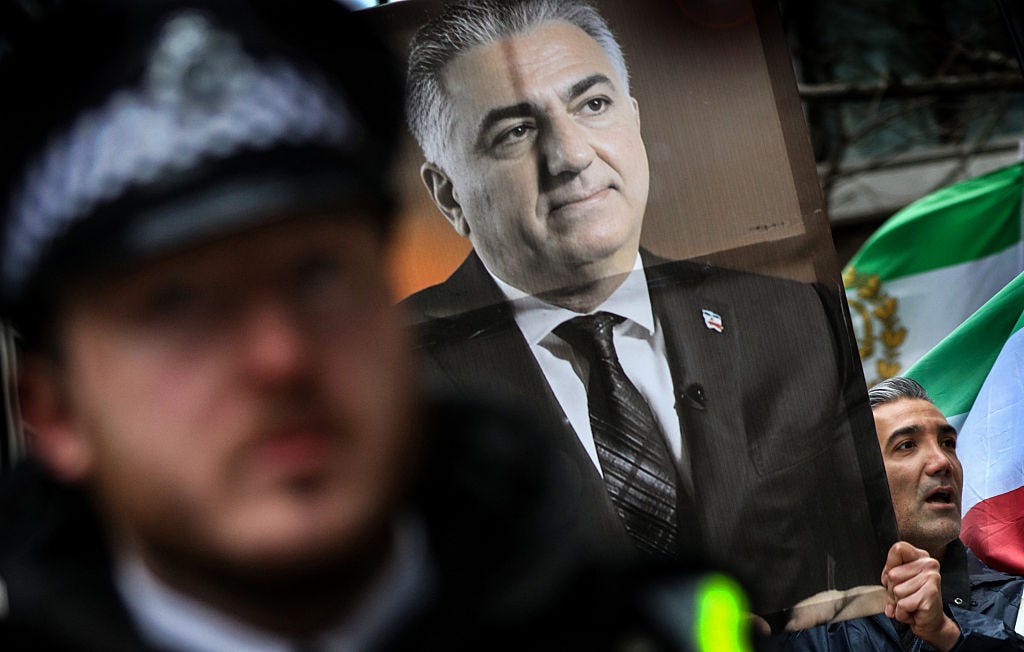
As the Iranian regime faces the greatest ever challenge to its authority, we are pleased to publish this piece by Roohola Ramezani, a journalist and philosopher who left the country a few days after the government imposed a total information blackout. Having witnessed firsthand the uprising taking place inside Iran, Roohola analyzes the new ideology of resistance that has seized the streets.
—The editors.
For decades, the world has viewed Iran through a series of familiar, if increasingly obsolete, lenses. From the “clash of civilizations” to the “struggle for reform” and the poignant aesthetics of “Women, Life, Freedom,” Western observers have sought a narrative that fits their own political taxonomy.
But today, as the Islamic Republic plunges the country into total digital darkness—cutting fiber optics and cellular signals alike—a new reality is hardening in the silence. The information that trickles out via Starlink and clandestine dispatches reveals a fundamental shift that many in the West find difficult to reconcile with their existing frameworks: Iranians are no longer asking for a seat at the table. They are demanding a different table entirely.
The movement that has gripped Iran since December 28 is not a plea for human rights within a theological framework, nor is it a subset of global identity politics. It is a profound, pragmatic, and increasingly radical return to secular nationalism. The protests originated in the bazaars and spread to the most conservative provinces; in doing so, they moved past the reformist nuances that have enchanted liberal Western media for 20 years. This is a movement of ideological exhaustion. Almost 50 years after an “Islamic Revolution” that has delivered only economic ruin and international pariah status, the Iranian street has embraced a blunt realism.

Central to this new political imagination is a surprising turn toward “restorationism.” Where Western commentators see a feminist uprising, the people on the ground are increasingly chanting for the return of the Pahlavi monarchy—not as a return to absolute autocracy, but as a symbolic and institutional bulwark against the perceived failure of clerical “republicanism.” What Iranians want is to cease being an extraordinary ideological project and to finally become a “normal” country.
The global embrace of the “Women, Life, Freedom” slogan following the death of Mahsa Amini and the protests of 2022 was a masterclass in Western media consumption. It provided a clean narrative: brave women burning headscarves in defiance of a bearded, medieval patriarchy. While this feminist core was—and remains—a vital catalyst of dissatisfaction with the regime, the Western focus often acted as a filter, screening out the more uncomfortable, systemic demands of the movement.
For the shopkeeper in Isfahan or the laborer in Khuzestan, the hijab is not just an oppressive piece of clothing; it is the most visible thread in a tapestry of ideological control that has strangled the national economy. To many Iranians, framing this exclusively as a “rights-based” struggle feels like a simplification. They see a Western media landscape that is eager to support Iranian women’s right to show their hair, yet remains hesitant to cover the burning of mosques or explicit calls for the total dismantling of the clerical state.
This disconnect reveals a deeper tension between Iranian aspirations and Western progressive sensibilities. The movement has moved beyond “reform”—the hope that the system can be fixed from within—to a desire to “overthrow” (barandazi) the system entirely, reclaiming the state from an entity they view as an occupying ideological force.

Perhaps the most challenging aspect of this movement for Western intellectuals to digest is the surge in monarchist sentiment. In the squares of Tehran and the streets of smaller, traditionally religious towns, the chant “this is the last battle; Pahlavi is returning” has become a staple. This reference to Reza Pahlavi—exiled son of the Western-backed Shah deposed by the 1979 Islamic revolution—is not a collective amnesia regarding that era. It is a calculated, pragmatic response to the failure of “republicanism”—a word that, in the Middle East, has become synonymous with either Islamic fundamentalism or military dictatorship.
Many Iranian intellectuals now argue that in a society where religious institutions have been deeply entrenched for centuries—and radically weaponized for the last half-century—any future republic inevitably risks collapsing back into an “Islamic Republic.” They point to the grim reality that the current theocracy already claims the title of a republic, using its mechanisms to give a veneer of popular mandate to clerical rule. The growing consensus among the opposition, therefore, is that democracy is perfectly compatible with monarchy. By pointing to stable, secular democracies like Sweden, Japan, or the United Kingdom, they argue that a constitutional monarchy can serve as a neutral institutional anchor that a fragile, newly-formed republic might lack. The throne is reimagined not as a seat of power, but as a secular shield—a protective shell ensuring that the national interest takes precedence over sectarian interest.
This movement does not align with the political “right” as this term is understood in the West. Rather, it claims that in the specific context of Iran, liberal ends—human rights, individual autonomy, and the rule of law—can only be secured through what Westerners might call the “conservative” means of constitutional monarchy.
Consequently, Pahlavi has emerged as the focal point for this aspiration—not necessarily as a king in the traditional sense, but as a symbol of a “normal,” secular, pro-Western country. His supporters view him as the only figure capable of uniting disparate groups and managing a transition that avoids the chaos of a power vacuum.
For decades, Western diplomacy has been predicated on the idea that the Iranian people are caught between “hardliners” and “reformists.” Today, that binary is dead. The current movement is characterized by a visceral, almost existential rejection of the clerical establishment as a whole.
The sense of betrayal has been fueled by recent revelations about the national budget, showing massive increases for unproductive religious institutions and ideological propaganda machines even as the country faces a staggering deficit. Iranians see their national wealth being cannibalized to fund a “theological vanity project” that has no interest in the welfare of the citizenry.
This “New Iranism” places the movement in direct friction with the international progressive movement. The increasingly prominent slogan “Neither Gaza, nor Lebanon, my life only for Iran” is the phrase that’s perhaps the most misunderstood. To Western leftists, this sounds like parochialism or even heartless isolationism. To an Iranian, it is a cry of anti-colonial resistance against their own government. The Iranian street has increasingly come to view the Palestinian cause—to which the Iranian regime has dedicated massive resources—as a black hole into which their life savings, infrastructure, and international standing are disappearing.
This is why, during last year’s twelve-day war between the Islamic Republic and Israel, many Iranians openly celebrated strikes against regime infrastructure, viewing foreign military pressure as a potential catalyst for liberation. This is not “pro-war” sentiment in the traditional sense; it is the desperation of a captive population.

Likewise, a widely-held view among the protesters today is that the current regime structure is fundamentally incapable of economic reform because its very survival depends on an anti-Western, anti-American ideology that necessitates isolation. This realization has led to a controversial shift in the Iranian political imagination: a growing openness to external pressure. When segments of the Iranian intelligentsia, including liberals and former leftists, sign letters to Western leaders asking for “maximum pressure” and “targeted strikes,” they are not abandoning their country’s sovereignty. They are articulating a belief that the internal mechanism for change has been so thoroughly crushed by digital blackouts and paramilitary violence that only an external shock can break the stalemate.
Iranians want neither a better version of the Islamic Republic nor a utopian revolution. They want the extraordinary era of Iranian history to end. They want to return to being a normal nation state that prioritizes its borders over ideological “frontiers,” its citizens over “martyrs,” and its future over seventh-century grievances.
A fierce, secular realism is emerging. The protest movement is redefining Iranian identity not through the lens of a “Global South” struggle against the West, but as a struggle to rejoin the West’s political and economic orbit. It’s a movement that does not fit neatly into the categories of anti-imperialism or identity politics; but it is, nevertheless, perhaps the most authentic democratic project of our time.
Roohola Ramezani is an Iranian journalist and writer with a PhD in philosophy. He writes on ideology, political discourses, and Middle Eastern politics.
Follow Persuasion on X, Instagram, LinkedIn, and YouTube to keep up with our latest articles, podcasts, and events, as well as updates from excellent writers across our network.
And, to receive pieces like this in your inbox and support our work, subscribe below: