
Source of this shloka
2,826 views
Skip to first unread message

Ashish Sharma
Jan 10, 2014, 5:03:32 AM1/10/14
to bvpar...@googlegroups.com
Dear Learned Scholars and Guruvars
Pranaam
Can anyone tell me the source of this following shloka:
यद् यद् चिन्तयति तम तम भावयति |
यम यम भावयति तम तम करोति ॥
I also request if someone can suggest more shlokas containing same meaning along with their sources.
I found above shloka in some commentary on ramcharitmanas but he/she had not mentioned the source.
Rgards
Ashish Sharma
Pranaam
Can anyone tell me the source of this following shloka:
यद् यद् चिन्तयति तम तम भावयति |
यम यम भावयति तम तम करोति ॥
I also request if someone can suggest more shlokas containing same meaning along with their sources.
I found above shloka in some commentary on ramcharitmanas but he/she had not mentioned the source.
Rgards
Ashish Sharma

Hnbhat B.R.
Jan 10, 2014, 6:57:56 AM1/10/14
to bvpar...@googlegroups.com
यद् यद् चिन्तयति तम तम भावयति |
यम यम भावयति तम तम करोति ॥
यम यम भावयति तम तम करोति ॥
It seems to be unmetrical and wrong as it is typed.
यद्यच् चिन्तयति [???] [???] तं(?) तं(?) भावयति।
यं यं भावयति [???] [???] तं तं करोति।
तम तम is meaningless repetition evewn though it fills some sort of line, but does not make any sense.
--
निराशीर्निर्ममो भूत्वा युध्यस्व विगतज्वरः।। (भ.गी.)
---
You received this message because you are subscribed to the Google Groups "भारतीयविद्वत्परिषत्" group.
To unsubscribe from this group and stop receiving emails from it, send an email to bvparishat+...@googlegroups.com.
To post to this group, send email to bvpar...@googlegroups.com.
Visit this group at http://groups.google.com/group/bvparishat.
For more options, visit https://groups.google.com/groups/opt_out.

V Subrahmanian
Jan 10, 2014, 6:56:23 AM1/10/14
to BHARATIYA VIDVAT
On Fri, Jan 10, 2014 at 3:33 PM, Ashish Sharma <cools...@gmail.com> wrote:
Here is a part of a mantra from the Brihadaranyaka upanishad 4.4.5:
― Laozi
           काममय एवायं पुरुष इति।
        स यथाकामो भवति तत्क्रतुर्भवति।
          यत्क्रतुर्भवति तत्कर्म कुरुते।
         यत्कर्म कुरुते तदभिसंपद्यते॥
You are what your deep, driving desire is
        As your desire is, so is your will
        As your will is, so is your deed
        As your deed is, so is your destiny
“Watch your thoughts; they become words. Watch your words; they become actions. Watch your actions; they become habits. Watch your habits; they become character. Watch your character; it becomes your destiny.”
― Laozi
regards
subrahmanian.v

Vrittamani Ramapriya
Jan 18, 2014, 8:57:20 PM1/18/14
to bvpar...@googlegroups.com
Dear Scholars,
I am looking for the source and completion of the sloka that runs like:
dEha budhyA tavadAsO4smi
jIva budhyA tvadamsha:
Atma budhyA tvAmEvA4smi...
I understand this is a reply by Hanuman to Rama, but I could not locate that in the following Ramayana texts:
1.Valmiki Ramayana, 2. Adhyatma Ramayana, 3. Ananada Ramayana and 4. Adbhuta Ramayana.
I do feel obliged by your response (s).
Ramapriya
On Friday, January 10, 2014 6:57:56 AM UTC-5, hnbhat wrote:
यद् यद् चिन्तयति तम तम भावयति |
यम यम भावयति तम तम करोति ॥
It seems to be unmetrical and wrong as it is typed.यद्यच् चिन्तयति [???] [???] तं(?) तं(?) भावयति।यं यं भावयति [???] [???] तं तं करोति।
तम तम is meaningless repetition evewn though it fills some sort of line, but does not make any sense.
On Fri, Jan 10, 2014 at 3:33 PM, Ashish Sharma <cools...@gmail.com> wrote:
Dear Learned Scholars and Guruvars
Pranaam
Can anyone tell me the source of this following shloka:
यद् यद् चिन्तयति तम तम भावयति |
यम यम भावयति तम तम करोति ॥
I also request if someone can suggest more shlokas containing same meaning along with their sources.
I found above shloka in some commentary on ramcharitmanas but he/she had not mentioned the source.
Rgards
Ashish Sharma
--
निराशीर्निर्ममो भूत्वा युध्यस्व विगतज्वरः।। (भ.गी.)
---
You received this message because you are subscribed to the Google Groups "भारतीयविद्वत्परिषत्" group.
To unsubscribe from this group and stop receiving emails from it, send an email to bvparishat+unsubscribe@googlegroups.com.

sunil bhattacharjya
Jan 21, 2014, 2:29:37 PM1/21/14
to BHARATIYA VIDVAT
This is said to be from Mahanatakam (i.e. Hanumana Ramayanam). There are two editions of it by two different Mishras. I have one version and it is not there in that. May be those scholars who saw both the versions may know about it.
Sunil KBTo unsubscribe from this group and stop receiving emails from it, send an email to bvparishat+...@googlegroups.com.

Anand S
Jan 29, 2014, 7:59:59 AM1/29/14
to bvpar...@googlegroups.com
Might be from the Muktikopanishad.
To unsubscribe from this group and stop receiving emails from it, send an email to bvparishat+...@googlegroups.com.

K S Kannan
Jan 29, 2014, 12:17:15 PM1/29/14
to bvpar...@googlegroups.com
The reading I have come across is
deha-buddhyA tu dAso'haM
jIva-buddhyA tvad-aMs'akaH |
Atma-buddhyA tvam evAhaM
-
iti me nis'cayA matiH ||
(nis'citA matiH may be a better reading)
I can't find the source immediately.
Regards,
Kannan
Please write to my new email id ks.kann...@gmail.com
Dr. K.S.Kannan
Ex-Director, Karnataka Samskrit University,
Principal, Samskrit Evening College, Karnataka Samskrit University,
Chamarajapet, Bangalore - 560018
Dr. K.S.Kannan
Ex-Director, Karnataka Samskrit University,
Principal, Samskrit Evening College, Karnataka Samskrit University,
Chamarajapet, Bangalore - 560018
To unsubscribe from this group and stop receiving emails from it, send an email to bvparishat+...@googlegroups.com.
Hnbhat B.R.
Jan 29, 2014, 9:23:33 PM1/29/14
to bvpar...@googlegroups.com
On Wed, Jan 29, 2014 at 10:47 PM, K S Kannan <ks_k...@yahoo.com> wrote:
The reading I have come across isdeha-buddhyA tu dAso'haMjIva-buddhyA tvad-aMs'akaH |Atma-buddhyA tvam evAhaM- iti me nis'cayA matiH ||(nis'citA matiH may be a better reading)I can't find the source immediately.
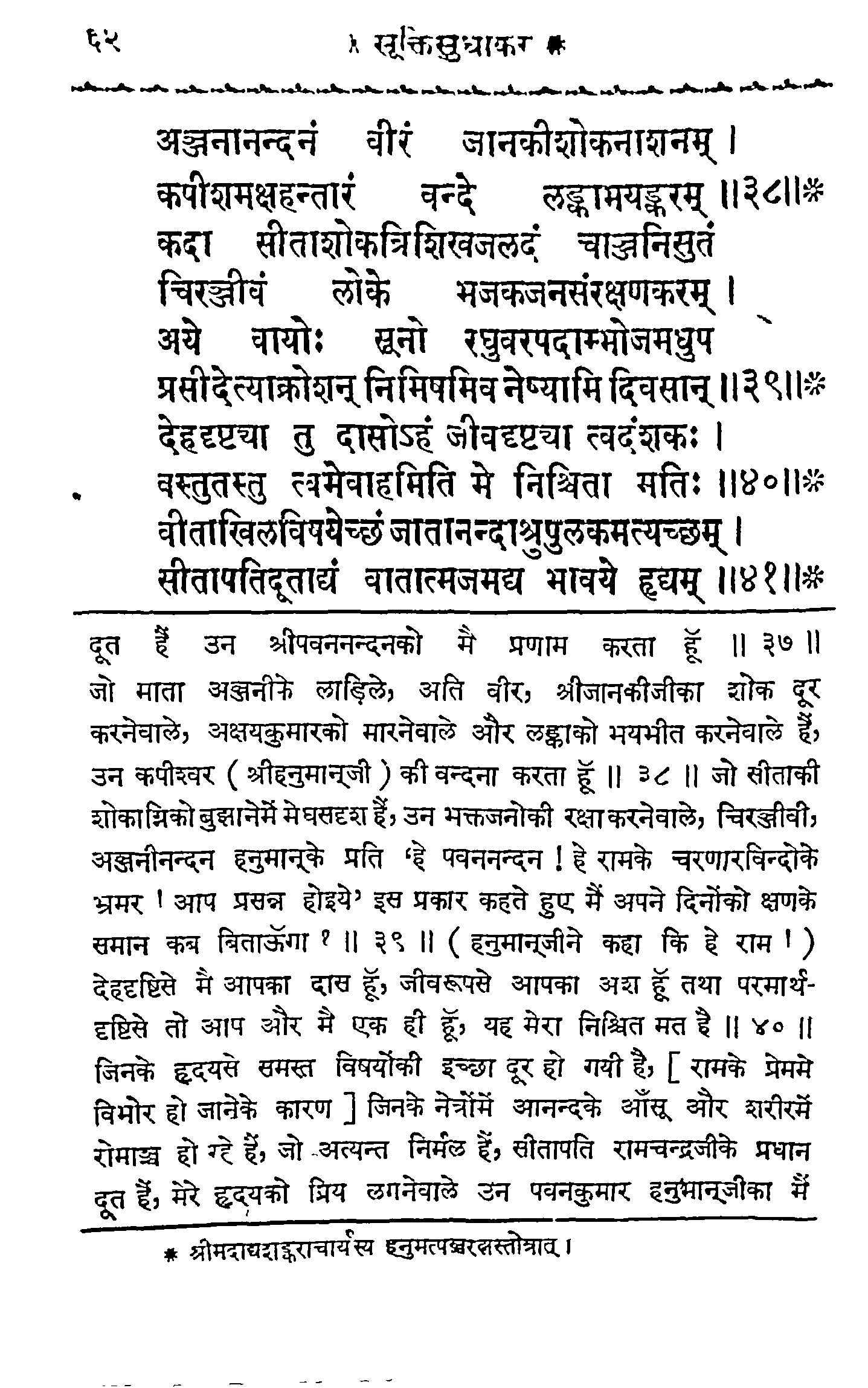
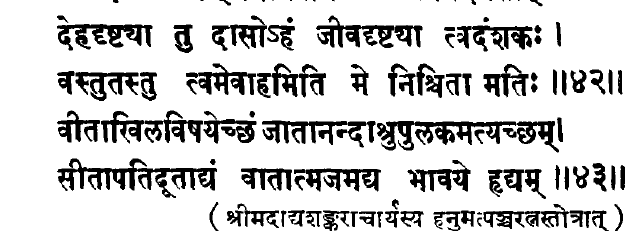
Just by googling, for the verse, I landed on many blogspots with the enquiry about the source, but landed the on a site with Hanumatsukti, where this occurs exactly and it is attributed to हनूमत्पञ्चरत्न attributed to Shankaracharya in some book of Sukti-s published by the Gitapress:
as the source book for the attribution.
पुस्तक - सुक्तिसुधाकर
प्रकाशक - गीता प्रेस. गोरखपुर
सौजन्य - श्री. सप्रे, पुणे, महाराष्ट्र.
The same opinion is expressed by some member in this forum in an earlier discussion on the source of this verse:
and another member had suggested the name of Hanumannataka.
I could not look into both the sources. And it is almost certain it is not from any editions of Ramayana.
It may be true both could contain the verse.
The source for the attribution of the verse to Hanumatpancaratna is either Suktisudha or Suktisudhakara published by Gitapress.
and Hanumannaataka has to be checked.

Durga Prasada Rao
Jan 30, 2014, 5:03:23 AM1/30/14
to bvpar...@googlegroups.com
The sloka " dehabudhya etc. is from Sitaramanjaneya samvada, a philosophical work.
--
निराशीर्निर्ममो भूत्वा युध्यस्व विगतज्वरः।। (भ.गी.)
---
You received this message because you are subscribed to the Google Groups "भारतीयविद्वत्परिषत्" group.
To unsubscribe from this group and stop receiving emails from it, send an email to bvparishat+...@googlegroups.com.
To post to this group, send email to bvpar...@googlegroups.com.
Visit this group at http://groups.google.com/group/bvparishat.
For more options, visit https://groups.google.com/groups/opt_out.
Best Regards
Durga Prasada Rao Chilakamarthi
Hnbhat B.R.
Jan 30, 2014, 6:56:19 AM1/30/14
to bvpar...@googlegroups.com
Thanks for the reference.
sunil bhattacharjya
Jan 30, 2014, 4:20:30 PM1/30/14
to BHARATIYA VIDVAT
If this appears in the book "Sitaramanjaneya " in the Telegu language, it could be that the author Shri Parasuramapantula Lingamurthi
Gurumurthi had taken the Sloka "dehabuddhya- - - -" from another Sanskrit book.
Hnbhat B.R.
Jan 30, 2014, 9:50:17 PM1/30/14
to bvpar...@googlegroups.com
Yes. I don't think the verse appears in the Telugu work written in Telugu language in Champu format with both verses and prose sections in Telugu language throughout in three Ashvasa-s and I checked the beginning few pages and last pages and could not find any verse in Sanskrit language.
It contains two commentaries two in Telugu language and the commentary may contain some verse in Sanskrit quoted, but the member has not given any reference to the page number or verse number to check. I doubt whether he has read the work completely and really located the verse or just by guess he had written it is found, like other replies. Anyway, it is a philosophical work compiled from contents extracted from Sanskrit Brahmanda Purana, Adhyatmaramayana, and may be some other Samskrit Purana-s and composed completely in Telugu language.
For, Sankarachartya's Pancaratna has only five verses and there is not any such verse as available on the net. And Hanumannataka also doesn't contain it for the first look and one will have to go through about more than 200 pages and 14 Acts as there is no alphabetical verse Index.
The Anthology called Suktisudha or Suktisudhakara of Gitapress is not available online and could not be checked.
I request the member to provide the exact location of the Sanskrit verse in the book "Sriramanjaneya samvaadamu" .

shankara
Jan 30, 2014, 10:11:05 PM1/30/14
to bvpar...@googlegroups.com
Namaste!
Suktisudhakar published by Gita Press is available at DLI. But, it simply states that this sloka is from Sankaracharya's Hanumat Pancharatna.
SUKTISUDHAR., 99999990830572. . 0. Hindi . . 290 pgs.
From: Hnbhat B.R. <hnbh...@gmail.com>
To: bvpar...@googlegroups.com
Sent: Friday, 31 January 2014 8:20 AM
Subject: Re: {भारतीयविद्वत्परिषत्} Source of this shloka
Suktisudhakar published by Gita Press is available at DLI. But, it simply states that this sloka is from Sankaracharya's Hanumat Pancharatna.
SUKTISUDHAR., 99999990830572. . 0. Hindi . . 290 pgs.
regards
shankara
shankara
From: Hnbhat B.R. <hnbh...@gmail.com>
To: bvpar...@googlegroups.com
Sent: Friday, 31 January 2014 8:20 AM
Subject: Re: {भारतीयविद्वत्परिषत्} Source of this shloka
Hnbhat B.R.
Jan 30, 2014, 10:26:11 PM1/30/14
to bvpar...@googlegroups.com
Thanks. Ok. I too expected only that much. Here is the Hanumatpancharatna links:
Text:

shankara
Jan 31, 2014, 12:44:02 AM1/31/14
to bvpar...@googlegroups.com
Bhat Mahodaya,
This is not so in other editions of the book. Attaching page 62 of 1950 edition of Sukti Sudhakar. There are 5 slokas including 'dahabuddhya..." marked as belonging to 'Hanumat Pancharatna Stotra' of Sankaracharya.
This is not so in other editions of the book. Attaching page 62 of 1950 edition of Sukti Sudhakar. There are 5 slokas including 'dahabuddhya..." marked as belonging to 'Hanumat Pancharatna Stotra' of Sankaracharya.
regards
shankara
shankara
Sent: Friday, 31 January 2014 9:05 AM
Hnbhat B.R.
Jan 31, 2014, 1:46:58 AM1/31/14
to bvpar...@googlegroups.com
OK. It seems they also have mistaken the Gitapress Edition. But it is a fact that only the last verse is from Hanumatpancaratna and it does not contain any more verses those the five as given in the text available online.
I could not check in any other editions of Hanumatpancaratna and it is obvious that Hanumatpancaratna has got only Five verses plus phalastuti as given in the page.
sunil bhattacharjya
Jan 31, 2014, 2:21:17 AM1/31/14
to BHARATIYA VIDVAT
Namaste,
What I understand that historically when Hanuman, as the representative of Sugriva, assumed the form of a (normal) human being and met Lord Ram for the first time in Kiskindhya, the latter asked him "Kostvam?". It was then that Hanuma told him that verse "deha - - - -". Thus this verse seems to have some Ramayana context.Sunil KB
Hnbhat B.R.
Jan 31, 2014, 2:42:54 AM1/31/14
to bvpar...@googlegroups.com
On Fri, Jan 31, 2014 at 12:51 PM, sunil bhattacharjya <skbhatt...@gmail.com> wrote:
Regards,Namaste,What I understand that historically when Hanuman, as the representative of Sugriva, assumed the form of a (normal) human being and met Lord Ram for the first time in Kiskindhya, the latter asked him "Kostvam?". It was then that Hanuma told him that verse "deha - - - -". Thus this verse seems to have some Ramayana context.
Sunil KB
There are two readings entirely changing ihe meaning.
dehabuddhyaa tvadaasosmi jeeva buddhyaa tvadamshaka: aatmabuddhya tvameyvaaham iti mey nishcitaa mati:
as appears in the above blog.
" dehabuddhyaa tu daaso'ham jeevabuddhyaa tvada.nshakah | Aatmabuddhyaa tvamevaaham iti me nishchitaa matih || This
describes the situation of dvaita, Vishishtadvaita and Advaita.
In the first it clearly means I am not your servant tu+adaasa.h
and in the second, tu daasa:
This is from another group with both the readings, but without any reference to the context:
rAmaH hanumantaM p^Ricchati konvasihanumaanuvaaca:dehabuddhayaa tvadaaso'smi jiivabuddhayaa tvadaMshakaHaatmabuddhayaa tvamevaahamiti me nishcitaa matiH ||rAvaNaH hanumantaM p^Ricchati konvasihanumaanuvaaca:dehabuddhayaa tvadaaso'smi jiivabuddhayaa tvadaMshakaHaatmabuddhayaa tvamevaahamiti me nishcitaa matiH ||(Rama asks Hanuman 'who are you really?' Hanuman replies.Again Ravana asks Hanuman 'who are you really?' Hanuman replies.)Now you guys have to figure out what Hanuman meant remembering the fact that Hanumanis the expert on words (vaakkovidaH).
देहबुद्ध्या त्वदासोऽहं जीवबुद्ध्या त्वदंशकः। आत्मबुद्ध्या त्वमेवाहम् इति मे निश्चिता मतिः॥

Shrisha Rao
Jan 31, 2014, 3:36:31 AM1/31/14
to Bharatiya Vidvatparishat
On Fri, Jan 31, 2014 at 1:12 PM, Hnbhat B.R. <hnbh...@gmail.com> wrote:
> " dehabuddhyaa tu daaso'ham jeevabuddhyaa tvada.nshakah | Aatmabuddhyaa
> tvamevaaham iti me nishchitaa matih || This
> describes the situation of dvaita, Vishishtadvaita and Advaita.
Beg your pardon, but the questionable provenance of the verse (and
> " dehabuddhyaa tu daaso'ham jeevabuddhyaa tvada.nshakah | Aatmabuddhyaa
> tvamevaaham iti me nishchitaa matih || This
> describes the situation of dvaita, Vishishtadvaita and Advaita.
thus its uncertain standing as a normative text) aside, it is hardly
right to say that Dvaita is to be characterized as "dehabuddhyA."
While one can (dis)agree with any Vedantic school on whatever grounds,
one must admit that they are all "AtmabuddhyA" only; the Dvaita
objection to being characterized as dehabuddhyA could be, for example,
on the strength of न त्वेवाहं जातु नासं न त्वं नेमे जनाधिपाः, न चैव न
भविष्यामः सर्वे वयमतः परम् -- i.e., that though the kings' bodies are
to be destroyed (when they expire in the war about to begin), the
entire multitude present is described as eternal.
Regards,
Shrisha Rao
sunil bhattacharjya
Jan 31, 2014, 11:55:23 AM1/31/14
to BHARATIYA VIDVAT
dehabuddhyA interpreted alone seems to preclude the conception of the state of videhamukti,
which is the precursor to Ekatva. Vedanta (Muktika upanishad) and Bahagavatam do say that the Ekatva (Advaita) is the ultimate and real mukti.Regards,
Sunil KB
V Subrahmanian
Feb 1, 2014, 1:56:43 AM2/1/14
to BHARATIYA VIDVAT
Even without bringing in the three schools of Vedanta, one could look at this verse in the light of some verses of the Bh.GitA:
dehabuddhyA tu dAsaH -"मन्मना भव् मद्भक्तो मद्याजी मां नमस्कुरू |
मामेवैष्यसि सत्यं ते प्रतिजाने प्रियोऽसि मे || 9.34
Devote your heart, mind, religious sacrifices and prayers to Me for eternity O Partha, and you shall, without fail, attain Me forever. This is My promise to you, My devotee.
यत्करोषि यदश्नासि यज्जुहोषि ददसि यत् ।
यत्तपस्यसि कौन्तेय तत्कुरुष्व मदर्पणम् ॥
Whatever you do, whatever you eat, whatever you offer in sacrifice, whatever you give, whatever you practice as austerity, O Kaunteya, do it as an offering to Me. (9.27)
ममैवांशो जीवलोके जीवभूतः सनातनः ।
मनःषष्ठानीन्द्रियाणि प्रकृतिस्थानि कर्षति "॥15-7॥
"The Eternal; Jivatma in this body is a part, amsha, of My Own being; and it is that alone that draws around itself the Mind and the five senses, which rest in Prakrti."
उदाराः सर्व एवैते ज्ञानी त्वात्मैव मे मतम् ।
आस्थितः स हि युक्तात्मा मामेवानुत्तमां गतिम् "॥
Lord Krsna instructs Arjuna : B.G. 7.18.
"Indeed all these are noble, but the man of wisdom is My very Self; such is My view. For such a devotee, who has mind and intellect merged in Me, is firmly established in Me alone, the highest goal."
The Lord has also said:
अहमात्मा गुडाकेश सर्वभूताशयस्थित: ।
अहमादिश्च मध्यं च भूतानामन्त एव च ।। 10. 20 ||
O Arjuna!, I am the Ultimate Consciousness situated within the heart of all living entities and I am the beginning, the middle and the end as well of all the living entities.
The aspirant who also knows to discriminate the Self, AtmA, from the body-mind complex and the transmigrating soul, jIva, identifies himself with the Atman, Consciousness.
regards
subrahmanian.v
The advanced mumukShu identifies himself with the above feeling.



Shrisha Rao
Feb 1, 2014, 1:56:24 PM2/1/14
to Bharatiya Vidvatparishat
El ene 31, 2014, a las 10:25 PM, sunil bhattacharjya <skbhatt...@gmail.com> escribió:
> dehabuddhyA interpreted alone seems to preclude the conception of the state of videhamukti,
> which is the precursor to Ekatva. Vedanta (Muktika upanishad) and Bahagavatam do say that the Ekatva (Advaita) is the ultimate and real mukti.
Why then would the Brahmasutra state वैधर्म्यात् च न स्वप्नादिवत्, I wonder? The same thought is also found in the माण्डूक, cf. स्वप्नमायासरूपेति सृष्टिरन्यैर्विकल्पिता, as well, and, e.g., Swami Gambhirananda's remarks in both instances contain some food for thought.
> dehabuddhyA interpreted alone seems to preclude the conception of the state of videhamukti,
> which is the precursor to Ekatva. Vedanta (Muktika upanishad) and Bahagavatam do say that the Ekatva (Advaita) is the ultimate and real mukti.
Regards,
Shrisha Rao
> Sunil KB
Reply all
Reply to author
Forward
0 new messages