
Assyrian goat-fish on a seal; compared with crocodile-fish hieroglyphs on Indus Script
45 views
Skip to first unread message

S. Kalyanaraman
Nov 21, 2011, 9:53:58 PM11/21/11
to
http://bharatkalyan97.blogspot.com/2011/11/assyrian-goat-fish-on-seal-interaction.html
21.11.11
Assyrian goat-fish on a seal; compared with crocodile-fish hieroglyphs on Indus Script
Continued from: http://bharatkalyan97.blogspot.com/2011/11/susa-ritual-basin-decorated-with.htmlGoat and fish as hieroglyphs of Indus script: Susa-Meluhha interactions. Meluhhan interpreter 'may have been literate and could read the undeciphered Indus script.'mr̤ēka, mēka 'goat' (Te.); mlekh (Brahui) rebus: meluhha (cognate mleccha) has been decoded as a phonetic determinant of the Meluhhhan merchant carrying a goat on his hands accompanied by a woman carrying a kamaṇḍalu on Shu-Ilishu cylinder seal. (It is notable that the word milakkhu denotes copper in the Pali lexeme: milakkhurajanam 'copper colour'.) (The Thera and Therigāthā, PTS, verse 965: milakkhurajanam rattam garahantāsakam dhajam; tithiyānam dhajam keci dhāressanty avadātakam; K.R.Norman, tr., Theragāthā: Finding fault with their own banner which is dyed the colour of copper, some will wear the white banner of sectarians).
The context is related to the repertoire of smiths and artisans depicted as hieroglyphs of Indus Script. The hieroglyphs of the script include goat and fish glyphs and many other ligatured glyphs comparable to the ligatured goat-fish of Susa ritual basin and other artifacts discussed in the embedded article of Anthony Green (1986).
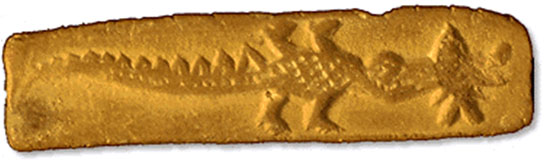
Ayo ‘fish’ (Mu.) aya = iron (G.);
ayah, ayas = metal (Skt.)
kāru a wild crocodile or alligator (Te.) ghariyal id. (H.)
khār a blacksmith, an iron worker (Kashmiri)
ayakāra ‘iron-smith’ (Pali)
While the goat-fish enters into myths of Sumer and later Assyrian traditions, the hieroglyphs of goat and fish on Indus script have been decoded in the context of metallurgy [metal (copper?) and cast metal -- ayas, perhaps bronze]. The emphatic depiction of fish ligatured with a crocodile on Indus Script is decoded as ayakara 'metalsmith' (aya 'fish'; kara 'crocodile' of the underlying Meluhha (Mleccha) lexemes of Indian linguistic area).

In Fig. 1 in the following embedded document, a pair of goat-fish images appear, flanking a door entrance, on a Middle Assyrian seal. Sumerian SUHUR.MASH, Akk. suhurmashu/i is sometimes interpreted as 'sea-goat'.
Assyrian goat-fish, fish-man and fish-woman (Anthony Green in Iraq, Vol. 48, 1986)
Kalyanaraman
Member, Action Committee Against Corruption in India (ACACI)
Reply all
Reply to author
Forward
0 new messages