

Mārcis Gasūns

G S S Murthy
--
You received this message because you are subscribed to the Google Groups "भारतीयविद्वत्परिषत्" group.
To unsubscribe from this group and stop receiving emails from it, send an email to bvparishat+unsubscribe@googlegroups.com.
To post to this group, send email to bvpar...@googlegroups.com.
For more options, visit https://groups.google.com/d/optout.
and also my Sanskrit blog :

shankara
shankara
You received this message because you are subscribed to the Google Groups "भारतीयविद्वत्परिषत्" group.

Narasimhan Subbaraman
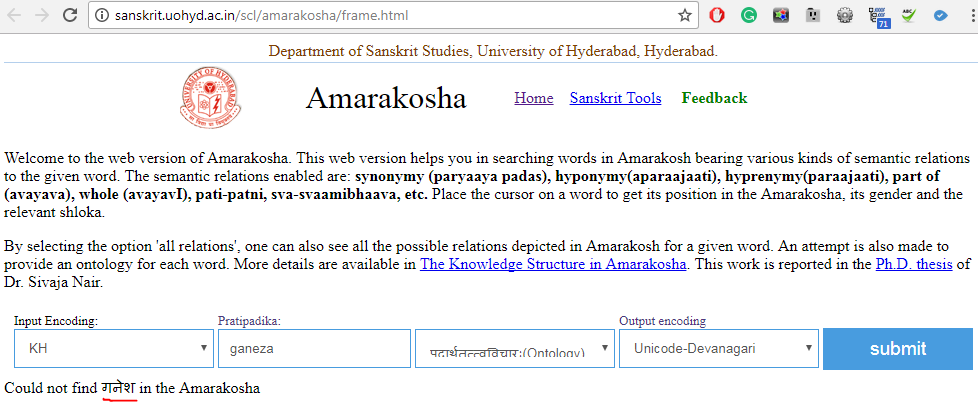
Namaste,Amarakosa Index also does not show गणेश. One has to search only those words that are in the Amarakosa.regards
shankara
--Namaste,What am I doing wrong at http://sanskrit.uohyd.ac.in/scl/amarakosha/frame.html when I get "Could not find गनेश in the Amarakosha"? 'all relations' gives a blank screen.M.G.
You received this message because you are subscribed to the Google Groups "भारतीयविद्वत्परिषत्" group.
To unsubscribe from this group and stop receiving emails from it, send an email to bvparishat+unsubscribe@googlegroups.com.
To post to this group, send email to bvpar...@googlegroups.com.
For more options, visit https://groups.google.com/d/optout.
--
You received this message because you are subscribed to the Google Groups "भारतीयविद्वत्परिषत्" group.
To unsubscribe from this group and stop receiving emails from it, send an email to bvparishat+unsubscribe@googlegroups.com.

ajit.gargeshwari
Regards
Ajit Gargeshwari
Mārcis Gasūns
On Sunday, 29 October 2017 18:25:08 UTC+3, ajit.gargeshwari wrote:
The word गणेश is not listed in Amarakosha and I don't know about the word गनेश which you are searching for.

S. L. Abhyankar
Mārcis Gasūns
On Monday, 30 October 2017 09:57:57 UTC+3, अभ्यंकरकुलोत्पन्नः श्रीपादः | wrote:
The link given by you to "amara101"-html page seems to be a German interpretation of the अमरकोश.
An interpretation will always have the bias of the interpreter. Hence we need to be cautious about treating any interpretation to be the only interpretation or the final word.
Your query about the word गणेश being in the original text of अमरकोश itself is good.
So one needs to search the original text of अमरकोश only, not in any interpretation of अमरकोश.The problem with अमरकोश would be that it cannot be expected to list all the names of all deities. For example, there is विष्णुसहस्रनामस्तोत्रम् where one gets 1000 names of Lord Vishnu.
Can one expect अमरकोश to give all those 1000 names ?
Likewise there is महागणपतिस्तोत्रम् excerpted from नारदपुराणम्, wherein we have at least twelve names of Lord Ganesh.
The fact of the matter also is that most of the names of deities are adjectival.
Adjectives tend to become names by ardent association. गणेश has become name of गणपति the elephant-headed deity.
As such there is no difference in the meanings of the two words गणेश and गणपति also. Even the other well-known name विनायक is also adjectival only (विशेषः नायकः इति विनायकः) one, who is special among leaders.
Can we not grant that Alexander the Great was also विनायकः ?
My humble submission would be that let us take अमरकोश to be what it is, not attaching too much of expectations, which may often prove to be extraneous.

Amba Kulkarni
--
You received this message because you are subscribed to the Google Groups "भारतीयविद्वत्परिषत्" group.
To unsubscribe from this group and stop receiving emails from it, send an email to bvparishat+unsubscribe@googlegroups.com.
To post to this group, send email to bvpar...@googlegroups.com.
For more options, visit https://groups.google.com/d/optout.
--
Fellow,
Indian Institute of Advanced Study,
Shimla
आ नो भद्रा: क्रतवो यन्तु विश्वत: ll
Let noble thoughts come to us from every side.
- Rig Veda, I-89-i.
Prof. (On leave)
Department of Sanskrit Studies
University of Hyderabad
(91) 040 23133802(off)
http://sanskrit.uohyd.ac.in/scl
http://sanskrit.uohyd.ac.in/faculty/amba
Mārcis Gasūns
On Monday, 30 October 2017 17:00:45 UTC+3, ambapradeep wrote:
I think by now you got the explanation.
G S S Murthy
--

Hnbhat B.R.
( १. १. २७) षडभिज्ञो दशबलोऽद्वयवादी विनायकः|
S. L. Abhyankar

Dr. Yadu Moharir
yasmāja jātasa tato nāmnā bhaviṣyati vināyakaḥ ॥vamana purāṇ 28.71-72
vinā kṛtā nāyakena yat tvaṃ devi mayā śubhe ।
eṣa tatra samutpannas tava putro rkasamnibhaḥ ॥
nāyakena vinā jāto yasmād eva gajānanaḥ ।
tammad vināyako nāmanā bhaviṣyati sureśvari ॥ skanda purāṇa
You received this message because you are subscribed to the Google Groups "भारतीयविद्वत्परिषत्" group.

Achyut Karve
Dear Scholars,
It is my feeling that this is not a forum to score points.
Sanskrit is a generative language. To look at it as a language of the day is doing disservice to Sanskrit because today languages create a vast vocabulary by importing words from other languages as they do not have a mechanism of generating new words. But to be capable of generating new words in Sanskrit one not only needs to have a good grip over Sanskrit grammar but also an aesthetic ear so that one is capable of distinguishing between a word (शब्द) and a non word (अपशब्द).
The question is not whether गणेश appears in the Amarkosha or not but whether it is a well formed word or not and whether it conveys the intended sense or not.
With regards,
Achyut Karve.
Achyut Karve
Dear Scholars,
Patanjali in his Mahabhashya says that as it is not possible to list all the words (chaste) of a language therefore as a remedy this can be achieved by the rules of grammar.
We should also remember that Amarkosha is not a dictionary. It was a first attempt at a Thesaurus and that too poetic, so that it can be easily committed to memory.
With regards,
Achyut Karve.
--
Achyut Karve
Dear Marcis Gasuns,
The following para I had drafted in response to your previous mail. The system of interpreting one language by means of another is a flawed one. One will only appreciate the nicities of a language in terms of another when one is proficient in both of them.
"The attempt to interpret words without the context ie. that of the sentence, through a dictionary is primarily the work of the West and is the main cause for all the doubts. The West designed this practice in the colonial era for the sake of administration and extended it for literary works. Thus the system of appreciating Sanskrit in the West is basically flawed. Patanjali in his first Anhik of the Mahabhashya has explained the purpose of the Ashtadhyayi in detail."
With regards,
Achyut Karve.
Dear Scholars,
It is my feeling that this is not a forum to score points.
Sanskrit is a generative language. To look at it as a language of the day is doing disservice to Sanskrit because today languages create a vast vocabulary by importing words from other languages as they do not have a mechanism of generating new words. But to be capable of generating new words in Sanskrit one not only needs to have a good grip over Sanskrit grammar but also an aesthetic ear so that one is capable of distinguishing between a word (शब्द) and a non word (अपशब्द).
The question is not whether गणेश appears in the Amarkosha or not but whether it is a well formed word or not and whether it conveys the intended sense or not.
With regards,
Achyut Karve.
Hello Amba,
On Monday, 30 October 2017 17:00:45 UTC+3, ambapradeep wrote:
I think by now you got the explanation.
Not exactly, but sure a lot I understood. The links on the page to .pdfs are not working.
So there is no additional markup as of who is the object of description, right? Thanks.
And last thing, a possible improvement in the search UI https://github.com/sanskrit-lexicon/Cologne/issues/156
--
You received this message because you are subscribed to the Google Groups "भारतीयविद्वत्परिषत्" group.
To unsubscribe from this group and stop receiving emails from it, send an email tobvparishat+...@googlegroups.com.
Hnbhat B.R.
Hence it cannot be expected to contain each and every word like the dictionary.

Dr.BVK Sastry(G-MAIL)
Namaste
1. Nirukti using Prakriyaa is the way to decode and extract meaning from ‘Samskrutham –Padam’ which is defined as ‘Sup-ting antam’ by Panini.
2. This is different from the Dictionary usage listing and Thesaurus model of ‘ Dictionary’; In short, Kosha does not translate to ‘ Dictionary or Thesaurus’!
This what Dr. Yadu and Abhyankar , Karve, Joshi and many others are pointing out in this discussion.
3. It would be a worth while question to ponder :
Do we have / Did WE have any time in the history of SAMSKRUTH STUDIES and USAGE at India, a concept, Design frame work comparable to a ‘ (English language) DICTIONARY FOR SANSKRIT’, if it is not/ can not be backed by the authority of :
- VYAKARANA (Pada Shaastra)-
- NIRUKTA ( PRAKRIYAA VYUTPATTI – NIRVACHANA)
- ANVAYA- SAMANVAYA Shaastra ( As KAAVYA – Shaastra / Meemaamsaa – Nyaya Paddhati )?
- NYAYA as PRAMANA Shaastra ?
Without this ‘ Shaastreeyataa’ bearing, What is the pedagogy of ‘ SANSKRIT TEACHING and RESEARCH / TRANSLATION’ ? Beyond a ‘ Opinionating’ (= matam) which does not truly bring out the ‘VIVAKSHITAARTHA – through VYUTPATTI’ ?
Thanks in advance for helping me to get this clarity in the Sanskrit studies.
Regards
BVK Sastry
Achyut Karve
Dear Scholars,
The word kosha is used in many Indian languages to mean a dictionary.
What is the sense in which the word Kosha is used in Classical Sanskrit. What kind of samas is Amarkosha.
Kindly enlighten me.
With regards,
Achyut Karve.
" group.
To unsubscribe from this group and stop receiving emails from it, send an email to bvparishat+unsubscribe@googlegroups.com.
To post to this group, send email to bvpar...@googlegroups.com.
For more options, visit https://groups.google.com/d/optout.
--
You received this message because you are subscribed to the Google Groups "भारतीयविद्वत्परिषत्" group.
To unsubscribe from this group and stop receiving emails from it, send an email to bvparishat+unsubscribe@googlegroups.com.
To post to this group, send email to bvpar...@googlegroups.com.
For more options, visit https://groups.google.com/d/optout.
--
You received this message because you are subscribed to the Google Groups "भारतीयविद्वत्परिषत्" group.
To unsubscribe from this group and stop receiving emails from it, send an email to bvparishat+unsubscribe@googlegroups.com.
S. L. Abhyankar
Achyut Karve
Dear Abhyankarji,
So by no means it can be called a Sanskrit Dictionary because as the name suggests it is Amarsingh's Dictionary.
"diction (n.)
1540s, "a word;" 1580s, "expression of ideas in words," from Late Latin dictionem (nominative dictio) "a saying, expression, word," noun of action from dic-, past participle stem of Latin dicere "speak, tell, say" (source of French dire "to say"), related to dicare "proclaim, dedicate," from PIE root *deik- "to show," also "pronounce solemnly."
In the above sense the Amarkosha is a dictionary par excellence. Thus the intention of a dictionary need not be to tell the meaning. In this sense is not the modern usage of the word dictionary itself misplaced.
One can now if he wishes say that Amarsingh either did know the word गणपति or that he did not find it necessary to include it in his कोष.
With regards,
Achyut Karve.
--
Dr.BVK Sastry(G-MAIL)
Namaste
1. In response to the question by Achyut Karve, the 32 meaning of the term ‘ Kosha’ is presented below. If we take the listed meaning at 12, is that to be for the exclusion of the rest ? Does AMARAKOSHA match to this translation ?
QUESTION/s: How and which of the 32 meanings of the term ‘ Kosha’ translate and map to the concept of ‘ Lexicon / Dictionary’ ?
Who started this ‘ Kosha = Dictionary – Lexicon’ equation ? Is it the most appropriate or convenient method to work with TERMS IN SAMSKRUTHAM ?
Does ‘Amarsimha declare his intention of compiling ‘Amara-Kosha’ on the model of a ‘ Lexicon or a Dictionary’ ?
BECAUSE
Every Samskruth Term ( Pada ) needs VYUTPATTI – NIRVACHANA and ANVAYA to arrive at the ‘ Vivakshita –artha’ /Taatparya .
Does the current Tools - of ‘SANSKRIT DICTIONARIES’ PROVIDE appropriate facilities with Critical Information pl.
The explanation of what is a LEXICON and DICTIONARY are provided below:
LEXICON : The vocabulary of a person, language, or branch of knowledge. ‘the size of the English lexicon’
Early 17th century: modern Latin, from Greek lexikon (biblion) ‘(book) of words’, from lexis ‘word’, from legein ‘speak’.
Dictionary: A book or electronic resource that lists the words of a language (typically in alphabetical order) and gives their meaning, or gives the equivalent words in a different language, often also providing information about pronunciation, origin, and usage. Early 16th century: from medieval Latin dictionarium (manuale) or dictionarius (liber) ‘manual or book of words’, from Latin dictio (see diction).
WIKI on Dictionary : A dictionary, sometimes known as a wordbook, is a collection of words in one or more specific languages, often arranged alphabetically (or by radical and stroke for ideographic languages), which may include information on definitions, usage, etymologies, phonetics, pronunciations, translation, etc. or a book of words in one language with their equivalents in another, sometimes known as a lexicon. It is a lexicographical product which shows inter-relationships among the data. - https://en.wikipedia.org/wiki/Dictionary
I don’t wish anyone to build a research theory using the ‘ Kosha’- listed meanings and selective mapping to explain ‘ Amara-Kosha = Amara’s ( meaning listed at 18 Vulva, the womb. -19 An egg. -20 A testicle or the scrotum. -21 The penis) as a ‘deconstruction of traditional thinking.
Such line of scholarly studies using the armor of academic freedom are not figments of imagination, but a reality seen around in some of the provocative writings on traditional issues and texts.
Thanks in advance for clarifying the term ‘ Kosha’ mapped to ‘ Lexicon /Dictionary’.
Regards
BVK Sastry
From:
bvpar...@googlegroups.com [mailto:bvpar...@googlegroups.com] On Behalf
Of S. L. Abhyankar
Sent: Wednesday, November 1, 2017 11:25 PM
To: Bharatiya Vidvat parishad
Subject: Re: {भारतीयविद्वत्परिषत्} Re: Hyderabad
Amarakosha
अमरकोशः केनापि अमरसिंहेन विरचितः / अतः अमरस्य कोशः इति अमरकोशः /
--
You received this message because you are subscribed to the Google Groups
"भारतीयविद्वत्परिषत्"
group.
To unsubscribe from this group and stop receiving emails from it, send an email to bvparishat+...@googlegroups.com.

Srinivasakrishnan ln
To unsubscribe from this group and stop receiving emails from it, send an email to bvparishat+unsubscribe@googlegroups.com.
To post to this group, send email to bvpar...@googlegroups.com.
For more options, visit https://groups.google.com/d/optout.
--
You received this message because you are subscribed to the Google Groups "भारतीयविद्वत्परिषत्" group.
To unsubscribe from this group and stop receiving emails from it, send an email to bvparishat+unsubscribe@googlegroups.com.

Jsr Prasad
So by no means it can be called a Sanskrit Dictionary because as the name suggests it is Amarsingh's Dictionary.

K S Kannan
So by no means it can be called a Sanskrit Dictionary because as the name suggests it is Amarsingh's Dictionary.
Sri Achyut ji, you may be aware, the work is primarily called - 'nāma-liṅgānuśāsanam.' The title 'Amarakosha' is more popular than the primary/given title because Amarasimha had created something highly innovative, in kosha tradition. This instance is akin to the case of śiśupālavadham, popularly known as māgham.
--
Achyut Karve
Dear JSR Prasadji,
Thank you for the information. This puts the subject to rest.
With regards,
Achyut Karve.
So by no means it can be called a Sanskrit Dictionary because as the name suggests it is Amarsingh's Dictionary.
Sri Achyut ji, you may be aware, the work is primarily called - 'nāma-liṅgānuśāsanam.' The title 'Amarakosha' is more popular than the primary/given title because Amarasimha had created something highly innovative, in kosha tradition. This instance is akin to the case of śiśupālavadham, popularly known as māgham.
--
Srinivasakrishnan ln
K S Kannan
S. L. Abhyankar
Srinivasakrishnan ln
G S S Murthy
K S Kannan

V Subrahmanian
Srinivasakrishnan ln
Ajit Gargeshwari
Ajit Gargeshwari
न जायते म्रियते वा कदाचिन्नायं भूत्वा भविता वा न भूयः।
अजो नित्यः शाश्वतोऽयं पुराणो न हन्यते हन्यमाने शरीरे।।2.20।।
--
K S Kannan
V Subrahmanian
Srinivasakrishnan ln
Jsr Prasad
Dr.BVK Sastry(G-MAIL)
Namaste
On Connecting the points below
Question: Do we have anything to connect to affirm Roget’s positive awareness of design of Amarsimhas work ? beyond ‘transaltion ? Does Colebrook speak about the ‘ Design of Amarakosha’?
Regards
BVK Sastry
Dr.BVK Sastry(G-MAIL)
Namaste
If this ‘ Kosha’ Thesaurus model reference existed as early as 1883, what made the Indian Oriental scholars overlook the mapping of the word ‘ Kosha’ as ‘Dictionary’ ? And did not press to include the true sense of ‘- 'nāma-liṅgānuśāsanam ‘ as the communication from the term ‘Amara- Kosha’ ?
See the images attached.
Why did different lexicon makers use different ‘Word- Meaning Map’ to build the ‘ Sanskrit -Dictionary’ ? For whose benefit ?
MW dictionary came in 1872. ( and many other dictionaries of Sanskrit came since 1832 ! - http://www.sanskrit-lexicon.uni-koeln.de/ ) . Apte’s dictionary came in 1890.
Wilson (1832) lists the meaning of this word as 17 A dictionary or vocabulary. f. (-षी) (http://www.sanskrit-lexicon.uni-koeln.de/scans/WILScan/2014/web/webtc/indexcaller.php )
See link entry : http://www.sanskrit-lexicon.uni-koeln.de/scans/MW72Scan/2014/web/webtc/servepdf.php?page=0256
And why attribute ‘hypocrisy’ only one section of scholars for the failure of the native scholars to take care of the ‘ Home Tradition and Guard it’ ?
Nay promote the inaccurate model and tools of Sanskrit studies ?? So what is Battle: Sanskrit for ??
So on whom should one place the burden of ‘ diluting, distorting Samskrutham to Sanskrit ? Tolerating the same ? Proliferating the inappropriate model’ please ? Translators or Traditionalists ? The damage is not only in understanding ‘Samskrutham of Vedas’ ; but also the ‘ Darshana –Shaastra and Veda –Vijnana’.
Regards
BVK Sastry
From: bvpar...@googlegroups.com [mailto:bvpar...@googlegroups.com] On Behalf Of K S Kannan
Sent: Thursday, November 2, 2017 3:16 PM
To: bvparishat
Subject: Re: {भारतीयविद्वत्परिषत्} Re: Hyderabad Amarakosha

Bharti Khatri
--


