
Glyptic art and glyptic writing in contact areas of Indus script hieroglyphs
60 views
Skip to first unread message

S. Kalyanaraman
Aug 27, 2011, 12:00:25 PM8/27/11
to
http://bharatkalyan97.blogspot.com/2011/08/glyptic-art-and-glyptic-writing-in.html
How to explain the seal marks, animal glyphs on elamite tablets?
http://bharatkalyan97.blogspot.com
SATURDAY, AUGUST 27, 2011
What started as glyptic art to represent reality transformed into glyptic writing systems in Mesopotamian cylinder seals or Elam tablets (and inscriptions on other artefacts) and in Indus Script (on seals and other artefacts) to establish and sustain trade contacts to announce, describe and market new products of the Bronze Age artisans emerging out of the chalcolithic era.Steffen Terp Laursen (2010) detailing the westward transmission of Indus valley sealing technology: origin and development of ‘Gulf type’ seal and other administrative technologies in early Dilmun, ca. 2100-2000 BCE(Published in Arabian Archaeology and Epigraphy 2010: vol. 21: 96–134)
Decoding of Indus Script Gulf Type Seals detailed by Steffen Terp Laursen (2010)
Lost civilization may have been beneath Persian Gulf - Technology & science - Science - LiveScience - msnbc.com
Lamberg-Karlovsky who excavated the Elamite site of Tepe-Yahya records a seal with Indus script:
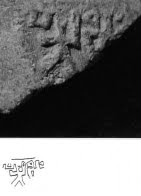
Fig 10.63 Stamp seal impression on plain red ware sherd of Tepe Yahya with Harappan inscription. (See other parallel glyphs – Fig. 10.62, 10.64, 10.66 discussed in this note) firmly establishing the site as the mid-point contact area in Persian Gulf sites (e.g. Tell Abraq). Objects with Indus script hieroglyphs had also been discovered in Mesopotamian civilization area (Elamite site of Susa and other sites).
Glyptic art tradition of Mesopotamia and Elam has been well-documents and the meanings/significance of glyphs explained in the writings of savants like Edith Porada, Henri Frankfort, Beatrice Teissier and Amiet. This note suggests that the glyptic art tradition evidenced on many tablets and cylinder seals of the Mesopotamian civilization area has to be re-evaluated as complementary to the writing systems which developed both in Mesopotamia (cuneiform, proto-elamite and elamite writing systems) and in Indus script (hieroglyphs). "Susa... profound affinity between the Elamite people who migrated to Anshan and Susa and the Dilmunite people... Elam proper corresponded to the plateau of Fars with its capital at Anshan. We think, however that it probably extended further north into the Bakhtiari Mountains... likely that the chlorite and serpentine vases reached Susa by sea... From the victory proclamations of the kings of Akkad we also learn that the city of Anshan had been re-established, as the capital of a revitalised political ally: Elam itself... the import by Ur and Eshnunna of inscribed objects typical of the Harappan culture provides the first reliable chronological evidence. [C.J. Gadd, Seals of ancient Indian style found at Ur, Proceedings of the British Academy, XVIII, 1932; Henry Frankfort, Tell Asmar, Khafaje and Khorsabad, OIC, 16, 1933, p. 50, fig. 22). It is certainly possible that writing developed in India before this time, but we have no real proof. Now Susa had received evidence of this same civilisation, admittedly not all dating from the Akkadian period, but apparently spanning all the closing years of the third millennium (L. Delaporte, Musee du Louvre. Catalogues des Cylindres Orientaux..., vol. I, 1920, pl. 25(15), S.29. P. Amiet, Glyptique susienne, MDAI, 43, 1972, vol. II, pl. 153, no. 1643)...The finds of object with Indus script had served the purpose of validating the chronology and dating of Indus Civilization (Meluhha).
Now, there is sufficient justification to go beyond this chronological affirmation to understanding the exchanges of glyptic traditions between two contemporaneous contact areas – Mesopotamia and Indus. A good starting point is the discovery of a storage pot in Susa (Elam) with an Indus script hieroglyph: fish.
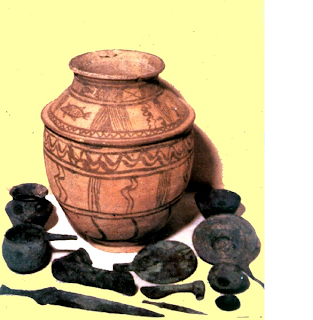
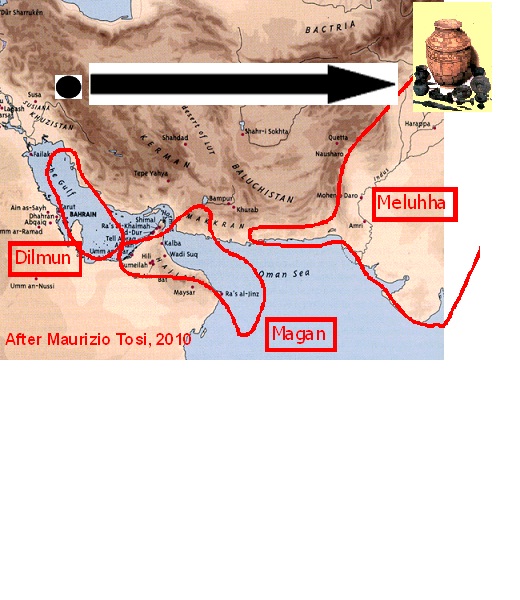
Susa pot showing the interaction areas of Meluhha, Magan, Dilmun and Mesopotamia (After Maurizio Tosi, 2010). This storage jar has a FISH glyph inscribed on the pot. This pot contained metal artefacts. See the two slides of Maurizio Tosi (2010). The slides were presented by Prof. Maurizio Tosi (2010: The middle Asian intercultural space and the Indus civilization: a comparative perspective for a definition of diversity) in the international conference held in Delhi between 25 to 27 November 2010)
http://www.vifindia.org/sites/default/files/Abstract_22_11_10.pdf “There is a solid archaeological evidence that trade and exchanges took place among all this regions and the Indus plains during the whole of the formative period.” The 'fish' glyphic is a glyph of the civilization denoting ayo, ayas 'metal' of the Indian sprachbund or Indian linguistic area. Fish + crocodile is read as: ayakaara 'metal smith' (Pali).
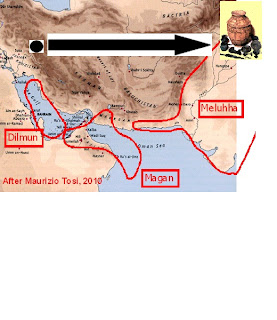
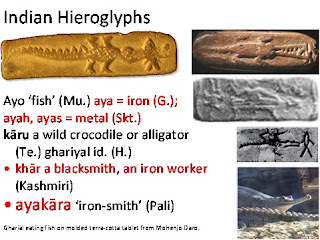
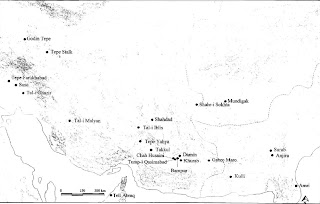 Fig A.1 Map of the Indo-Iranian borders illustrating the principal sites (e.g. Amri, Tepe Yahya, Tell Abraq, Susa).
…B. Buchanan has published a tablet dating from the reign of Gungunum of Larsa, in the twentieth century BC, which carries the impression of such a stamp seal. (B.Buchanan, Studies in honor of Benno Landsberger, Chicago, 1965, p. 204, s.). The date so revealed has been wholly confirmed by the impression of a stamp seal from the same group, fig. 85, found on a Susa tablet of the same period. (P. Amiet, Antiquites du Desert de Lut, RA, 68, 1974, p. 109, fig. 16. Maurice Lambert, RA, 70, 1976, p. 71-72). It is in fact, a receipt of the kind in use at the beginning of the Isin-Larsa period, and mentions a certain Milhi-El, son of Tem-Enzag, who, from the name of his god, must be a Dilmunite. In these circumstances we may wonder if this document had not been drawn up at Dilmun and sent to Susa, after sealing with a local stamp seal. This seal is decorated with six tightly-packed, crouching animals, characterised by their vague shapes, with legs tucked under their bodies, huge heads and necks sometimes striped obliquely. The impression of another seal of similar type, fig. 86, depicts in the centre a throned figure who seems to dominate the animals, continuing a tradition of which examples are known at the end of the Ubaid period in Assyria... Fig. 87 to 89 are Dilmun-type seals found at Susa. The boss is semi-spherical and decorated with a band across the centre and four incised circles. [Pierre Amiet, Susa and the Dilmun Culture, pp. 262-268].
Read on...
Glyptic art and glyptic writing in contact areas of Indus script hieroglyphs

Fig 10.63 Stamp seal impression on plain red ware sherd of Tepe Yahya with Harappan inscription. (See other parallel glyphs – Fig. 10.62, 10.64, 10.66 discussed in this note) firmly establishing the site as the mid-point contact area in Persian Gulf sites (e.g. Tell Abraq). Objects with Indus script hieroglyphs had also been discovered in Mesopotamian civilization area (Elamite site of Susa and other sites).
Glyptic art tradition of Mesopotamia and Elam has been well-documents and the meanings/significance of glyphs explained in the writings of savants like Edith Porada, Henri Frankfort, Beatrice Teissier and Amiet. This note suggests that the glyptic art tradition evidenced on many tablets and cylinder seals of the Mesopotamian civilization area has to be re-evaluated as complementary to the writing systems which developed both in Mesopotamia (cuneiform, proto-elamite and elamite writing systems) and in Indus script (hieroglyphs). "Susa... profound affinity between the Elamite people who migrated to Anshan and Susa and the Dilmunite people... Elam proper corresponded to the plateau of Fars with its capital at Anshan. We think, however that it probably extended further north into the Bakhtiari Mountains... likely that the chlorite and serpentine vases reached Susa by sea... From the victory proclamations of the kings of Akkad we also learn that the city of Anshan had been re-established, as the capital of a revitalised political ally: Elam itself... the import by Ur and Eshnunna of inscribed objects typical of the Harappan culture provides the first reliable chronological evidence. [C.J. Gadd, Seals of ancient Indian style found at Ur, Proceedings of the British Academy, XVIII, 1932; Henry Frankfort, Tell Asmar, Khafaje and Khorsabad, OIC, 16, 1933, p. 50, fig. 22). It is certainly possible that writing developed in India before this time, but we have no real proof. Now Susa had received evidence of this same civilisation, admittedly not all dating from the Akkadian period, but apparently spanning all the closing years of the third millennium (L. Delaporte, Musee du Louvre. Catalogues des Cylindres Orientaux..., vol. I, 1920, pl. 25(15), S.29. P. Amiet, Glyptique susienne, MDAI, 43, 1972, vol. II, pl. 153, no. 1643)...The finds of object with Indus script had served the purpose of validating the chronology and dating of Indus Civilization (Meluhha).
Now, there is sufficient justification to go beyond this chronological affirmation to understanding the exchanges of glyptic traditions between two contemporaneous contact areas – Mesopotamia and Indus. A good starting point is the discovery of a storage pot in Susa (Elam) with an Indus script hieroglyph: fish.
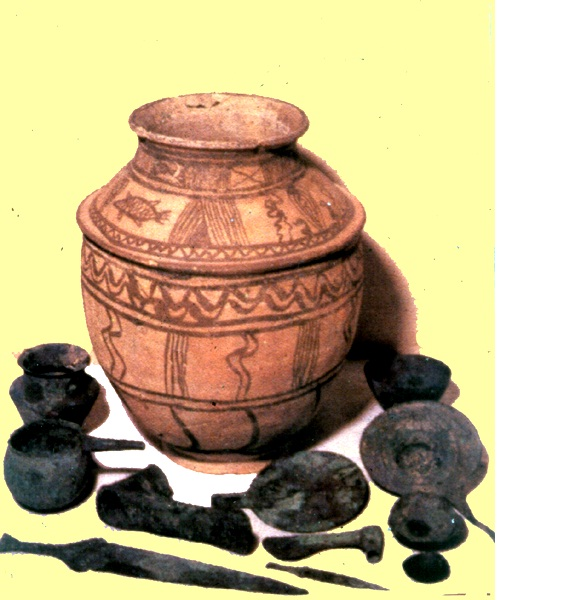
Susa pot showing the interaction areas of Meluhha, Magan, Dilmun and Mesopotamia (After Maurizio Tosi, 2010). This storage jar has a FISH glyph inscribed on the pot. This pot contained metal artefacts. See the two slides of Maurizio Tosi (2010). The slides were presented by Prof. Maurizio Tosi (2010: The middle Asian intercultural space and the Indus civilization: a comparative perspective for a definition of diversity) in the international conference held in Delhi between 25 to 27 November 2010)
http://www.vifindia.org/sites/default/files/Abstract_22_11_10.pdf “There is a solid archaeological evidence that trade and exchanges took place among all this regions and the Indus plains during the whole of the formative period.” The 'fish' glyphic is a glyph of the civilization denoting ayo, ayas 'metal' of the Indian sprachbund or Indian linguistic area. Fish + crocodile is read as: ayakaara 'metal smith' (Pali).


…B. Buchanan has published a tablet dating from the reign of Gungunum of Larsa, in the twentieth century BC, which carries the impression of such a stamp seal. (B.Buchanan, Studies in honor of Benno Landsberger, Chicago, 1965, p. 204, s.). The date so revealed has been wholly confirmed by the impression of a stamp seal from the same group, fig. 85, found on a Susa tablet of the same period. (P. Amiet, Antiquites du Desert de Lut, RA, 68, 1974, p. 109, fig. 16. Maurice Lambert, RA, 70, 1976, p. 71-72). It is in fact, a receipt of the kind in use at the beginning of the Isin-Larsa period, and mentions a certain Milhi-El, son of Tem-Enzag, who, from the name of his god, must be a Dilmunite. In these circumstances we may wonder if this document had not been drawn up at Dilmun and sent to Susa, after sealing with a local stamp seal. This seal is decorated with six tightly-packed, crouching animals, characterised by their vague shapes, with legs tucked under their bodies, huge heads and necks sometimes striped obliquely. The impression of another seal of similar type, fig. 86, depicts in the centre a throned figure who seems to dominate the animals, continuing a tradition of which examples are known at the end of the Ubaid period in Assyria... Fig. 87 to 89 are Dilmun-type seals found at Susa. The boss is semi-spherical and decorated with a band across the centre and four incised circles. [Pierre Amiet, Susa and the Dilmun Culture, pp. 262-268].
Read on...
Glyptic art and glyptic writing in contact areas of Indus script hieroglyphs
Lamberg-Karlovsky, C. C., 1979, Excavations at Tepe Yahya, Iran 1967-1969: progress report 1, Bulletin (American School of Prehistoric Research) ; no. 27, Cambridge, Mass.: Peabody Museam, (Jointly with The Asia Institute of Pahlavi University).
Toshiki Osada and Akinori Uesugi, 2011, Occasional Paper No. 10, Linguistics, archaeology and the human past, Indus Project, Research Institute for Humanity and Nature, Kyoto, Japan
Kalyanaraman
https://sites.google.com/site/indianoceancommunity1/http://bharatkalyan97.blogspot.com
http://tinyurl.com/3w6ojj6 (Indus Script Cipher)
http://tinyurl.com/4xguuoh (Rastram: Flipkart in India)
Reply all
Reply to author
Forward
0 new messages