MINDWINGS & LEBLON recomenda:

16 views
Skip to first unread message

Joaquim Machado

unread,
Sep 3, 2013, 12:15:52 PM9/3/13
to Joaquim Machado, Braulio Dias, adrit...@yahoo.com.br, Maria Cecilia Vieira, davi.bonavides@itamaraty.gov.br bonavides, Maximiliano da Cunha Henriques Arienzo, Marcio de M. Santos, Paulo Brandao, Eliana Maria Gouveia Fontes, Lidio Coradin, Zeze Sampaio, Simone Ferreira, Decio Zylbersztajn, Sergio Salles Filho, Maria Beatriz Bonacelli, beatriz bulhoes, Beatriz Florence, btc5734_2011-1@googlegroups.com 2011-1, btc...@googlegroups.com, btc5734_2012@googlegroups.com 2012, economia_biotec@googlegroups.com biotec, BTC5700 2012, btc573...@googlegroups.com, acgs...@usp.br, Monica Adriana Salles, Tejon Megido_fw, Coriolano, guedes Antonio Carlos, Mariza T. Barbosa, SILVIA KANADANI CAMPOS, ELIANA VALERIA C FIGUEIREDO (eliana.figueiredo@embrapa.br), DANIELLE ALENCAR PARENTE TORRES, Pedro Abel Vieira (Pedro.Vieira@embrapa.br), eduardo.couto@cgee.org.br Silva, Paulo Manoel L.C. Protasio, José Hartur Setubal Lima, kalcanfor@cgee.org.br Alcanfor, noos...@terra.com.br, Diana de Mello Jungmann, Maria Claudia Nunes Pinheiro, Elisa Romano Dezolt


Joaquim A.  Machado
MINDWINGS & LEBLON
Science, Politics and Art
iPhone +55-19-8830-3600
Campinas - SP  Brazil


--
Joaquim A. Machado
MINDWINGS&LEBLON: Arquitetura da Biodiversidade
Estudos, Projetos e Negociações
Campinas - SP - Brasil
T - 55 - 19 - 8830 - 3600

Joaquim Machado

unread,
Sep 3, 2013, 3:51:58 PM9/3/13
to Joaquim Machado, Braulio Dias, adrit...@yahoo.com.br, Maria Cecilia Vieira, davi.bonavides@itamaraty.gov.br bonavides, Maximiliano da Cunha Henriques Arienzo, Marcio de M. Santos, Paulo Brandao, Eliana Maria Gouveia Fontes, Lidio Coradin, Zeze Sampaio, Simone Ferreira, Decio Zylbersztajn, Sergio Salles Filho, Maria Beatriz Bonacelli, beatriz bulhoes, Beatriz Florence, btc5734_2011-1@googlegroups.com 2011-1, btc...@googlegroups.com, btc5734_2012@googlegroups.com 2012, economia_biotec@googlegroups.com biotec, BTC5700 2012, btc573...@googlegroups.com, acgs...@usp.br, Monica Adriana Salles, Tejon Megido_fw, Coriolano, guedes Antonio Carlos, Mariza T. Barbosa, SILVIA KANADANI CAMPOS, ELIANA VALERIA C FIGUEIREDO (eliana.figueiredo@embrapa.br), DANIELLE ALENCAR PARENTE TORRES, Pedro Abel Vieira (Pedro.Vieira@embrapa.br), eduardo.couto@cgee.org.br Silva, Paulo Manoel L.C. Protasio, José Hartur Setubal Lima, kalcanfor@cgee.org.br Alcanfor, noos...@terra.com.br, Diana de Mello Jungmann, Maria Claudia Nunes Pinheiro, Elisa Romano Dezolt
FIFTY YEARS AROUND THE THIRD WORLD: adventures and reflections of an overseas american
Haldore Hanson
Fraser Publishing Company, USA. 1986


OF PLANTS AND PEOPLE
Charles B. Heiser, Jr. 
University of Oklahoma Press, USA. 1985

Joaquim Machado

unread,
Sep 3, 2013, 4:40:22 PM9/3/13
to Joaquim Machado, Braulio Dias, adrit...@yahoo.com.br, Maria Cecilia Vieira, davi.bonavides@itamaraty.gov.br bonavides, Maximiliano da Cunha Henriques Arienzo, Marcio de M. Santos, Paulo Brandao, Eliana Maria Gouveia Fontes, Lidio Coradin, Zeze Sampaio, Simone Ferreira, Decio Zylbersztajn, Sergio Salles Filho, Maria Beatriz Bonacelli, beatriz bulhoes, Beatriz Florence, btc5734_2011-1@googlegroups.com 2011-1, btc...@googlegroups.com, btc5734_2012@googlegroups.com 2012, economia_biotec@googlegroups.com biotec, BTC5700 2012, btc573...@googlegroups.com, acgs...@usp.br, Monica Adriana Salles, Tejon Megido_fw, Coriolano, guedes Antonio Carlos, Mariza T. Barbosa, SILVIA KANADANI CAMPOS, ELIANA VALERIA C FIGUEIREDO (eliana.figueiredo@embrapa.br), DANIELLE ALENCAR PARENTE TORRES, Pedro Abel Vieira (Pedro.Vieira@embrapa.br), eduardo.couto@cgee.org.br Silva, Paulo Manoel L.C. Protasio, José Hartur Setubal Lima, kalcanfor@cgee.org.br Alcanfor, noos...@terra.com.br, Diana de Mello Jungmann, Maria Claudia Nunes Pinheiro, Elisa Romano Dezolt
J. Craig Venter Institute


Section Banner


Press Release 03-Sep-2013 

Venter Institute-Led Team Uncovers Unique Microbial Diversity in The Cedars, Rare, High pH, Ultra reducing, Low Salinity Springs in Northern California

Microbes found in these low life sustaining environments could elucidate origins of life on Earth

LA JOLLA, CA—September 3, 2013—Scientists from the J. Craig Venter Institute (JCVI), a not-for-profit genomic research organization, along with collaborators from the University of Southern California (USC) and Delft University in the Netherlands, have published results from a three year study outlining the microbial diversity in The Cedars, a high pH, ultra reducing, low salinity systems of springs located in Northern California. The research, led by first author and post doctoral fellow at JCVI, Shino Suzuki Ishii, Ph.D. has been published in the online, early edition of the journal, PNAS.

This unique spring system is an active terrestrial serpentinization site. Serpentinization is a process whereby water reacts with certain types of minerals in the ground to produce other kinds of minerals, as well as hydrogen, methane and highly alkaline fluids. These sites are common in the deep ocean where tectonic plates meet, but are very rare elsewhere.

For three years the JCVI, USC and Delft University team took multiple samples in three springs at The Cedars and isolated the microbes using sequencing technologies as opposed to culturing them. Each spring was fed by unique groundwater, one by deep groundwater only and the other two by a mixture of deep and shallow groundwater. The team found that the microbial communities remained constant in each spring but that each one had unique microbes which were determined by the type of groundwater by which they were fed.

The microbes in the deep groundwater fed spring were distinct from any other microbial communities found in other terrestrial serpentinizing sites. The most abundant of these microbes are members of the Chloroflexi, Clostridia, andcandidate division OD1, followed by some Euryarchaeota. The microbes found in the mixture of shallow and deep groundwater fed sites appear to be similar to other microbial communities isolated from other terrestrial sites. The most abundant of these microbes were Betaproteobacteria
The team concludes that because of the pristine yet harsh nature of The Cedars environment, the microbes found there could be crucial to understanding the origins of life on Earth and in understanding the key survival mechanism used by these hearty microbes.

Kenneth Nealson, Ph.D., senior author, JCVI Distinguished Professor, Department of Microbial and Environmental Genomics; and Wrigley Chair in Environmental Studies and Professor of Earth Sciences and Biological Sciences at USC, stated, “This combination of water chemistries in The Cedars springs is very challenging for life. While there is plenty to “eat” (i.e., electron donors) in the form of hydrogen and methane produced by serpentinization there, there is nothing obvious to “breathe” (i.e., electron acceptors). There are also low levels of sodium to be used for establishing a membrane potential. However, the challenge of sustaining life has been met, as evidenced in this study, by the stable microbial populations seen in each spring. We believe these communities have the potential to yield important insights into survival mechanisms in these challenging, early-earth analog environments.”

About the J. Craig Venter Institute (JCVI)

The JCVI is a not-for-profit research institute in Rockville, MD and San Diego, CA dedicated to the advancement of the science of genomics; the understanding of its implications for society; and communication of those results to the scientific community, the public, and policymakers. Founded by J. Craig Venter, Ph.D., the JCVI is home to approximately 250 scientists and staff with expertise in human and evolutionary biology, genetics, bioinformatics/informatics, information technology, high-throughput DNA sequencing, genomic and environmental policy research, and public education in science and science policy. The legacy organizations of the JCVI are: The Institute for Genomic Research (TIGR), The Center for the Advancement of Genomics (TCAG), the Institute for Biological Energy Alternatives (IBEA), the Joint Technology Center (JTC), and the J. Craig Venter Science Foundation. The JCVI is a 501 (c)(3) organization. For additional information, please visit http://www.JCVI.org.

#     #     #

Media Contact

Heather Kowalski
301-943-8879
hkowalski(AT)jcvi.org

- See more at: http://www.jcvi.org/cms/press/press-releases/full-text/article/venter-institute-led-team-uncovers-unique-microbial-diversity-in-the-cedars-rare-high-ph-ultra-re/#sthash.45lnyIV1.dpuf

Joaquim Machado

unread,
Sep 3, 2013, 4:46:13 PM9/3/13
to Joaquim Machado, Braulio Dias, adrit...@yahoo.com.br, Maria Cecilia Vieira, davi.bonavides@itamaraty.gov.br bonavides, Maximiliano da Cunha Henriques Arienzo, Marcio de M. Santos, Paulo Brandao, Eliana Maria Gouveia Fontes, Lidio Coradin, Zeze Sampaio, Simone Ferreira, Decio Zylbersztajn, Sergio Salles Filho, Maria Beatriz Bonacelli, beatriz bulhoes, Beatriz Florence, btc5734_2011-1@googlegroups.com 2011-1, btc...@googlegroups.com, btc5734_2012@googlegroups.com 2012, economia_biotec@googlegroups.com biotec, BTC5700 2012, btc573...@googlegroups.com, acgs...@usp.br, Monica Adriana Salles, Tejon Megido_fw, Coriolano, guedes Antonio Carlos, Mariza T. Barbosa, SILVIA KANADANI CAMPOS, ELIANA VALERIA C FIGUEIREDO (eliana.figueiredo@embrapa.br), DANIELLE ALENCAR PARENTE TORRES, Pedro Abel Vieira (Pedro.Vieira@embrapa.br), eduardo.couto@cgee.org.br Silva, Paulo Manoel L.C. Protasio, José Hartur Setubal Lima, kalcanfor@cgee.org.br Alcanfor, noos...@terra.com.br, Diana de Mello Jungmann, Maria Claudia Nunes Pinheiro, Elisa Romano Dezolt
SkySweeper 3D Printed Powerline inspection robot

Broken Down Powerlines? 3D Printed Robots to the Rescue

Juho Vesanto BY JUHO VESANTO ON  · 3DP APPLICATIONSINDUSTRY NEWSMAKERSVIDEOS ADD COMMENT

Even though some companies, with consumer electronics manufacturers at the most public forefront, have eagerly showcased TV’s and other appliances working on induction or other truly cordless solutions, the majority of the world is still pretty much stuck with powerlines and cords making our surroundings inside and outside our houses less aesthetically pleasing. Even though Tesla’s dream of electricity being distributed in other ways lives on, the cables are here to stay, probably for a long while yet. They also break down or can be brought down by disasters of different kinds. And because this world wouldn’t function at all well without electricity, the broken down lines have to be fixed as soon as possible.

SkySweeper 3D Printed Powerline inspection robot

Unfortunately, checking utility lines for damage is not as easy as it might sound – especially in vast open areas where the lines are not necessarily on the ground, but are out of order in a more subtle way. Besides using engineers’ trained eyes to hunt down for break points, unmanned solutions are also used for the process, such as different kinds of inspection robots and unmanned helicopters with infrared tech. Sound expensive? That’s because it is, but if it were up to students from Jacobs School of Engineering at UC San Diego, another more simple and inexpensive solution could be applied – enabled by 3D printing, of course.

The project is called the SkySweeper and it has been designed by grad student Nick Morozovsky from the university’s mechanical engineering department, in the lab of Professor Thomas Bewley. The V-shaped robot, which could potentially be manufactured for less than a $1,000, is built out of simple off the shelf electronic parts with the plastics having come off of an FDM 3D printer. Inexpensiveness, functionality and efficiency have clearly been priorities for the designer himself during the creation process: “Current line inspection robots are large, complex and expensive. Utility companies may also use manned or unmanned helicopters equipped with infrared imaging to inspect lines. This is much simpler,” Morozovsky stated.

Although a bit crude – or to put it another way, suitable as an early prototype – the video below demonstrates nicely how the SkySweeper would work in practice, accompanied by its inventor explaining the functionality of the robot.

Even though passing the structural support poles for powerlines is an obvious phase of the inspection process where an unmanned solution could prove particularly useful, the powering issue with the SkySweeper  is quite ingenious, as Morozovsky explains on the video – when moving along an electrical line, the robot could be equipped with components – induction coils -  essentially a self-powering system that generates electricity from the electric field itself to keep the SkySweeper going.

This is not the last you’ll likely hear from the SkySweeper or from Morozovsky – after competing in the Road to Maker Faire challenge (and placing as a runner-up), the inspection robot and his human master are soon travelling to Tokyo to showcase the project at the International Conference on Intelligent Robots and Systems, or IROS 2013, from November 3rd to 8th, and will present a paper on the subject as well.

Source: UCSD Jacobs School of Engineering

Recommended articles:

Juho Vesanto
ABOUT THE AUTHOR

Juho Vesanto

Juho is a tech enthusiast with a solid background in consumer understanding and research. Strategic consulting on technology, innovation and branding processes have been a major part of Juho’s working history, but the revolution that is 3D printing has drawn him away from board rooms to spread the joyous message of a new era of design and prosumer to the masses. Juho holds a BBA in marketing and is studying user-centered design for an MBA.


Joaquim Machado

unread,
Sep 3, 2013, 5:30:38 PM9/3/13
to Joaquim Machado, Braulio Dias, adrit...@yahoo.com.br, Maria Cecilia Vieira, davi.bonavides@itamaraty.gov.br bonavides, Maximiliano da Cunha Henriques Arienzo, Marcio de M. Santos, Paulo Brandao, Eliana Maria Gouveia Fontes, Lidio Coradin, Zeze Sampaio, Simone Ferreira, Decio Zylbersztajn, Sergio Salles Filho, Maria Beatriz Bonacelli, beatriz bulhoes, Beatriz Florence, btc5734_2011-1@googlegroups.com 2011-1, btc...@googlegroups.com, btc5734_2012@googlegroups.com 2012, economia_biotec@googlegroups.com biotec, BTC5700 2012, btc573...@googlegroups.com, acgs...@usp.br, Monica Adriana Salles, Tejon Megido_fw, Coriolano, guedes Antonio Carlos, Mariza T. Barbosa, SILVIA KANADANI CAMPOS, ELIANA VALERIA C FIGUEIREDO (eliana.figueiredo@embrapa.br), DANIELLE ALENCAR PARENTE TORRES, Pedro Abel Vieira (Pedro.Vieira@embrapa.br), eduardo.couto@cgee.org.br Silva, Paulo Manoel L.C. Protasio, José Hartur Setubal Lima, kalcanfor@cgee.org.br Alcanfor, noos...@terra.com.br, Diana de Mello Jungmann, Maria Claudia Nunes Pinheiro, Elisa Romano Dezolt

Scientific American

We've Been Looking at Ant Intelligence the Wrong Way

Unlike humans, ants don't build a unified map of the world. Instead, specialized systems, including the ability to learn from recent experience, create complex navigational behavior

By Antoine Wystrach and The Conversation  | Friday, August 30, 2013 | 1

Ant on flower in Seagrove, North Carolina

A lot cleverer than he looks.Image: Flickr/Samantha Henneke

ADVERTISEMENT

Editor's note: The following essay is reprinted with permission from The Conversation, an online publication covering the latest research.

By Antoine Wystrach, University of Sussex

How intelligent are animals? Despite centuries of effort by philosophers, psychologists and biologists, the question remains unanswered. We are inclined to tackle this question using a top-down approach. It seems intuitive to start with our own assumptions about human intelligence, and design experiments that ask whether animals possess similar anthropomorphic abilities.

Do animals have a language, or a personality? Do they feel empathy or achieve abstract reasoning? This approach does suit the study of animals closely related to us, like apes. But is it relevant when studying animals such as insects?

Insects certainly display complex and apparently intelligent behavior. They navigate over long distances, find food, avoid predators, communicate, display courtship, care for their young, and so on. The complexity of their behavioral repertoire is comparable to any mammal.

However, they have a tiny brain, and probably because of assumptions about the limitations of tiny brains, researchers generally avoid seeking human abilities in insects. In his 1969 book, The Sciences of the Artificial, Herbert Simon contemplates an ant wandering on the beach:

Viewed as a geometric figure, the ant’s path is irregular, complex, and hard to describe. But its complexity is really a complexity in the surface of the beach, not the complexity in the ant.

Simon explains that the complexity observed in the behavior is not necessarily in the ant, but in the interaction between the ant and the surrounding complex environment. This idea has allowed scientists to avoid any idea of an anthropomorphic intelligence, by looking instead for the simplest solutions to explain complex behavior.

Assume an animal is the simplest it can be, whilst looking for proof of a higher level of intelligence. With such an approach, research in insect intelligence is working bottom-up, with simple (and boring) initial explanations being steadily replaced by increasingly complex (and exciting) explanations.

Decades of bottom-up research have passed since Simon looked at his ant on the beach, and Simon himself would be surprised at how complex, and intelligent, insects are. The change of perspective that allowed him to profess the ant’s simplicity has, in fact, revealed an alien complexity, one not driven by anthropomorphic considerations.

We now know that the path produced by a navigating ant is based on sophisticated mechanisms.

Ants use a variety of cues to navigate, such as sun position, polarized light patterns, visual panoramas, gradient of odors, wind direction, slope, ground texture, step-counting … and more. Indeed, the list of cues ants can utilise for navigation is probably greater than for humans.

Counter-intuitively, years of bottom-up research has revealed that ants do not integrate all this information into a unified representation of the world, a so-called cognitive map. Instead they possess different and distinct modules dedicated to different navigational tasks. These combine to allow navigation.

One module keeps track of distance and direction travelled, and continually updates an estimate of the best “bee-line” home. A second module, dedicated to the learning of visual scenery, allows ants to recognise and navigate rapidly along important routes as defined by familiar visual cues. Finally, ants possess an emergency plan for when both of these systems fail to indicate what to do: in other words, when the ant is lost. In this case, they display a systematic search pattern.

In our recent work, published in Proceedings of the Royal Society, we have discovered a fourth strategy: backtracking. We showed that ants keep track of the direction they have just been travelling, allowing them to backtrack if they unexpectedly move from familiar to unfamiliar surroundings.

From a human perspective, this seems sensible, and is probably what we would do if unexpectedly encountered an unfamiliar street while walking through town. What is most interesting, with regard to the cognitive sophistication or intelligence of the ant, is that ants display this backtracking behavior only if they had seen their nest’s surroundings immediately prior to getting lost. This ensures that backtracking happens only when the ant is likely to be beyond the nest, rather than short of it.

Thus we have evidence that ants can also take into account what they have recently experienced in order to modulate their behavior. What’s more, we have shown that the ant’s navigational modules are not purely isolated. In the case of backtracking for instance, the experience of familiar visual scenery modulates the use of sky compass information.

Evolution has equipped ants with a distributed system of specialised modules interacting together. These results demonstrate that the navigational intelligence of ants is not in an ability to build a unified representation of the world, but in the way different strategies cleverly interact to produce robust navigation.

We need to keep in mind that this is only our current level of understanding. Even insect brains are far too complex to be fully understood in the near future. Perhaps we will have misjudged the intelligence of ants just as much as we think Simon did. However, we know that continued bottom-up research is the principled way to pull back the veil on insect intelligence, without the spectre of anthropomorphism.

Antoine Wystrach does not work for, consult to, own shares in or receive funding from any company or organization that would benefit from this article, and has no relevant affiliations.

This article was originally published at The Conversation. Read the original article.

The Conversation

Joaquim Machado

unread,
Sep 3, 2013, 6:05:44 PM9/3/13
to Joaquim Machado, Braulio Dias, adrit...@yahoo.com.br, Maria Cecilia Vieira, davi.bonavides@itamaraty.gov.br bonavides, Maximiliano da Cunha Henriques Arienzo, Marcio de M. Santos, Paulo Brandao, Eliana Maria Gouveia Fontes, Lidio Coradin, Zeze Sampaio, Simone Ferreira, Decio Zylbersztajn, Sergio Salles Filho, Maria Beatriz Bonacelli, beatriz bulhoes, Beatriz Florence, btc5734_2011-1@googlegroups.com 2011-1, btc...@googlegroups.com, btc5734_2012@googlegroups.com 2012, economia_biotec@googlegroups.com biotec, BTC5700 2012, btc573...@googlegroups.com, acgs...@usp.br, Monica Adriana Salles, Tejon Megido_fw, Coriolano, guedes Antonio Carlos, Mariza T. Barbosa, SILVIA KANADANI CAMPOS, ELIANA VALERIA C FIGUEIREDO (eliana.figueiredo@embrapa.br), DANIELLE ALENCAR PARENTE TORRES, Pedro Abel Vieira (Pedro.Vieira@embrapa.br), eduardo.couto@cgee.org.br Silva, Paulo Manoel L.C. Protasio, José Hartur Setubal Lima, kalcanfor@cgee.org.br Alcanfor, noos...@terra.com.br, Diana de Mello Jungmann, Maria Claudia Nunes Pinheiro, Elisa Romano Dezolt

Joaquim Machado

unread,
Sep 3, 2013, 6:51:22 PM9/3/13
to Joaquim Machado, Braulio Dias, adrit...@yahoo.com.br, Maria Cecilia Vieira, davi.bonavides@itamaraty.gov.br bonavides, Maximiliano da Cunha Henriques Arienzo, Marcio de M. Santos, Paulo Brandao, Eliana Maria Gouveia Fontes, Lidio Coradin, Zeze Sampaio, Simone Ferreira, Decio Zylbersztajn, Sergio Salles Filho, Maria Beatriz Bonacelli, beatriz bulhoes, Beatriz Florence, btc5734_2011-1@googlegroups.com 2011-1, btc...@googlegroups.com, btc5734_2012@googlegroups.com 2012, economia_biotec@googlegroups.com biotec, BTC5700 2012, btc573...@googlegroups.com, acgs...@usp.br, Monica Adriana Salles, Tejon Megido_fw, Coriolano, guedes Antonio Carlos, Mariza T. Barbosa, SILVIA KANADANI CAMPOS, ELIANA VALERIA C FIGUEIREDO (eliana.figueiredo@embrapa.br), DANIELLE ALENCAR PARENTE TORRES, Pedro Abel Vieira (Pedro.Vieira@embrapa.br), eduardo.couto@cgee.org.br Silva, Paulo Manoel L.C. Protasio, José Hartur Setubal Lima, kalcanfor@cgee.org.br Alcanfor, noos...@terra.com.br, Diana de Mello Jungmann, Maria Claudia Nunes Pinheiro, Elisa Romano Dezolt

Backtracking behaviour in lost ants: an additional strategy in their navigational toolkit

  1. Antoine Wystrach1,2,
  2. Sebastian Schwarz1,
  3. Alice Baniel1 and
  4. Ken Cheng1

+Author Affiliations

  1. 1Department of Biological Sciences, Macquarie University, Sydney, New South Wales 2109, Australia
  2. 2School of Life Sciences, University of Sussex, Brighton BN1 9RH, UK
  1. e-mail: a.wys...@sussex.ac.uk
  1.  These authors contributed equally to this study.

Abstract

Ants use multiple sources of information to navigate, but do not integrate all this information into a unified representation of the world. Rather, the available information appears to serve three distinct main navigational systems: path integration, systematic search and the use of learnt information—mainly via vision. Here, we report on an additional behaviour that suggests a supplemental system in the ant's navigational toolkit: ‘backtracking’. Homing ants, having almost reached their nest but, suddenly displaced to unfamiliar areas, did not show the characteristic undirected headings of systematic searches. Instead, these ants backtracked in the compass direction opposite to the path that they had just travelled. The ecological function of this behaviour is clear as we show it increases the chances of returning to familiar terrain. Importantly, the mechanistic implications of this behaviour stress an extra level of cognitive complexity in ant navigation. Our results imply: (i) the presence of a type of ‘memory of the current trip’ allowing lost ants to take into account the familiar view recently experienced, and (ii) direct sharing of information across different navigational systems. We propose a revised architecture of the ant's navigational toolkit illustrating how the different systems may interact to produce adaptive behaviours.

Joaquim Machado

unread,
Sep 3, 2013, 10:55:23 PM9/3/13
to Joaquim Machado, Braulio Dias, adrit...@yahoo.com.br, Maria Cecilia Vieira, davi.bonavides@itamaraty.gov.br bonavides, Maximiliano da Cunha Henriques Arienzo, Marcio de M. Santos, Paulo Brandao, Eliana Maria Gouveia Fontes, Lidio Coradin, Zeze Sampaio, Simone Ferreira, Decio Zylbersztajn, Sergio Salles Filho, Maria Beatriz Bonacelli, beatriz bulhoes, Beatriz Florence, btc5734_2011-1@googlegroups.com 2011-1, btc...@googlegroups.com, btc5734_2012@googlegroups.com 2012, economia_biotec@googlegroups.com biotec, BTC5700 2012, btc573...@googlegroups.com, acgs...@usp.br, Monica Adriana Salles, Tejon Megido_fw, Coriolano, guedes Antonio Carlos, Mariza T. Barbosa, SILVIA KANADANI CAMPOS, ELIANA VALERIA C FIGUEIREDO (eliana.figueiredo@embrapa.br), DANIELLE ALENCAR PARENTE TORRES, Pedro Abel Vieira (Pedro.Vieira@embrapa.br), eduardo.couto@cgee.org.br Silva, Paulo Manoel L.C. Protasio, José Hartur Setubal Lima, kalcanfor@cgee.org.br Alcanfor, noos...@terra.com.br, Diana de Mello Jungmann, Maria Claudia Nunes Pinheiro, Elisa Romano Dezolt

Envoyer sur votre Kindle ou un autre appareil

Ce titre sera envoyé directement sur votre Kindle le 5 septembre 2013.


Lisez des livres sur votre ordinateur ou un autre appareil mobile grâce à nos applications de lecture Kindle GRATUITES.
Puissances d'hier et de demain
 
Agrandissez cette image
 

Puissances d'hier et de demain [Format Kindle]

Bertrand Badie (Auteur, Sous la direction de)Dominique VIDAL (Sous la direction de) 

Prix éditeur - format imprimé :EUR 18,00
Prix Kindle :EUR 12,99 TTC & envoi gratuit via réseau sans fil parAmazon Whispernet
Économisez :EUR 5,01 (28%)
Le prix a été fixé par l'éditeur.

Formats

Prix AmazonNeuf à partir deOccasion à partir de
Format KindleEUR 12,99 ----
ReliéEUR 17,10 EUR 17,10--
Gratuit : téléchargez l'application Amazon pour iPhone, iPad, Android ou Windows Phone ou découvrez la nouvelle application Amazon pour Tablette Android !


Descriptions du produit

Présentation de l'éditeur

La livraison 2014 de L'état du monde se penche sur la dynamique des puissances mondiales. Contrairement à bien des prévisions, la victoire de l'Occident dans la guerre froide n'a pas débouché sur une longue période de domination américaine. Si les États-Unis restent à bien des égards le pivot des équilibres géopolitiques mondiaux, la puissance américaine est confrontée des concurrences nouvelles. Un constat qui s'applique également aux autres puissances occidentales, en particulier européennes, profondément secouées par la crise économique.
Cette évolution structurelle s'accompagne de la montée en puissance de nouveaux mouvements sociaux, revendicatifs ou révolutionnaires, qui bouleversent directement ou indirectement les fondements de l'ordre international hérité de l'après-guerre froide.
Grâce aux dizaines de spécialistes qui y participent, cette édition 2014 évalue donc cette remise en cause de l'hégémonie occidentale, par des puissances émergentes et par les " sociétés civiles ". La Chine, l'Inde, le Brésil, et dans une moindre mesure l'Afrique du Sud et la Russie, se dotent à leur tour des atouts de la puissance politiques, économiques mais aussi culturelles et technologiques. Quant aux mouvements révolutionnaires ou contestataires, dans le monde arabe et ailleurs, ils auront certainement des conséquences sur le modelage en cours de la nouvelle architecture mondiale.
Outre cette réflexion globale sur les dynamiques de la puissance, L'état du monde 2014 fait le point sur les grandes tendances observables dans les relations internationales, de la recomposition des mafias à l'essor de nouveaux mouvements religieux en passant par le rôle stratégique croissant du pétrole non conventionnel, et sur les situations conflictuelles à travers le monde, de l'Iran à la Colombie en passant par le Mali, la Syrie ou la Corne de l'Afrique.


Joaquim Machado

unread,
Sep 4, 2013, 8:16:48 AM9/4/13
to Joaquim Machado, Braulio Dias, adrit...@yahoo.com.br, Maria Cecilia Vieira, davi.bonavides@itamaraty.gov.br bonavides, Maximiliano da Cunha Henriques Arienzo, Marcio de M. Santos, Paulo Brandao, Eliana Maria Gouveia Fontes, Lidio Coradin, Zeze Sampaio, Simone Ferreira, Decio Zylbersztajn, Sergio Salles Filho, Maria Beatriz Bonacelli, beatriz bulhoes, Beatriz Florence, btc5734_2011-1@googlegroups.com 2011-1, btc...@googlegroups.com, btc5734_2012@googlegroups.com 2012, economia_biotec@googlegroups.com biotec, BTC5700 2012, btc573...@googlegroups.com, acgs...@usp.br, Monica Adriana Salles, Tejon Megido_fw, Coriolano, guedes Antonio Carlos, Mariza T. Barbosa, SILVIA KANADANI CAMPOS, ELIANA VALERIA C FIGUEIREDO (eliana.figueiredo@embrapa.br), DANIELLE ALENCAR PARENTE TORRES, Pedro Abel Vieira (Pedro.Vieira@embrapa.br), eduardo.couto@cgee.org.br Silva, Paulo Manoel L.C. Protasio, José Hartur Setubal Lima, kalcanfor@cgee.org.br Alcanfor, noos...@terra.com.br, Diana de Mello Jungmann, Maria Claudia Nunes Pinheiro, Elisa Romano Dezolt

NATURE NANOTECHNOLOGY | NEWS AND VIEWS


Patchy nanoparticles: Curvature makes a difference
Nature Nanotechnology
 
8,
 
620–621
 
 
doi:10.1038/nnano.2013.173
Published online
 

The local curvature of dumbbell-shaped nanoparticles can be used to control the ionization state of a molecular layer adsorbed on their surfaces and the self-assembly patterns of the particles.

Joaquim Machado

unread,
Sep 4, 2013, 8:21:01 AM9/4/13
to Joaquim Machado, Braulio Dias, adrit...@yahoo.com.br, Maria Cecilia Vieira, davi.bonavides@itamaraty.gov.br bonavides, Maximiliano da Cunha Henriques Arienzo, Marcio de M. Santos, Paulo Brandao, Eliana Maria Gouveia Fontes, Lidio Coradin, Zeze Sampaio, Simone Ferreira, Decio Zylbersztajn, Sergio Salles Filho, Maria Beatriz Bonacelli, beatriz bulhoes, Beatriz Florence, btc5734_2011-1@googlegroups.com 2011-1, btc...@googlegroups.com, btc5734_2012@googlegroups.com 2012, economia_biotec@googlegroups.com biotec, BTC5700 2012, btc573...@googlegroups.com, acgs...@usp.br, Monica Adriana Salles, Tejon Megido_fw, Coriolano, guedes Antonio Carlos, Mariza T. Barbosa, SILVIA KANADANI CAMPOS, ELIANA VALERIA C FIGUEIREDO (eliana.figueiredo@embrapa.br), DANIELLE ALENCAR PARENTE TORRES, Pedro Abel Vieira (Pedro.Vieira@embrapa.br), eduardo.couto@cgee.org.br Silva, Paulo Manoel L.C. Protasio, José Hartur Setubal Lima, kalcanfor@cgee.org.br Alcanfor, noos...@terra.com.br, Diana de Mello Jungmann, Maria Claudia Nunes Pinheiro, Elisa Romano Dezolt

Applause is Contagious Like a Disease

By Bill Andrews | June 20, 2013 8:30 am

audience applause

Imagine this nightmare scenario: You’re in a crowd when you begin to notice signs of contagion. First one or two people display signs of infection, and then the number grows until nearly everyone is consumed. Luckily, a few seconds later, a wide recovery begins, just about as intense as the infection, until finally it’s as if nothing happened.

It’s a scene from either the most boring zombie movie ever, or a recent study on the dynamics of audience applause.


Researchers conducting the study watched videos of students’ applause behavior after academic presentations, and found the applause spread linearly, like a disease. New people begin clapping at a rate proportional to how many are already clapping, and they cease in a socially contagious way as well. The amount of time an individual feels like clapping is a factor, but not nearly as much as peer pressure.

Interestingly, the results imply that lengthy applause sessions have less to do with the performance and more to do with the individuals in the audience (something to remind yourself if you’re ever disappointed by too-short applause: it’s not you, it’s them). The results were published this week in Journal of the Royal Society Interface.

This isn’t just useful information to anxious performers and obsessive clap-counters: the study of how behavior spreads through groups is useful for understanding divorce rates, fashions, fads, and, yes, even biological epidemics (hence the language of contagion, infection and recovery, which the authors used in their analysis). Unlike typical diseases, though, “recovery” (i.e., the cessation of applause) spreads linearly as well, with stopped individuals influencing others in the group to stop. Also unusually, this study found that spatial proximity didn’t matter as much, probably since visual cues are less important with such a loud “infection.”

If nothing else, the paper does justice to that awkward feeling we’ve all experienced in small-group applause situations. As the authors write, “The social problem an audience must solve after an academic presentation is not how and when to start a round of applause, but it is rather how to coordinate its end.”

Image courtesy Christian Bertrand / Shutterstock

Joaquim Machado

unread,
Sep 4, 2013, 8:27:23 AM9/4/13
to Joaquim Machado, Braulio Dias, adrit...@yahoo.com.br, Maria Cecilia Vieira, davi.bonavides@itamaraty.gov.br bonavides, Maximiliano da Cunha Henriques Arienzo, Marcio de M. Santos, Paulo Brandao, Eliana Maria Gouveia Fontes, Lidio Coradin, Zeze Sampaio, Simone Ferreira, Decio Zylbersztajn, Sergio Salles Filho, Maria Beatriz Bonacelli, beatriz bulhoes, Beatriz Florence, btc5734_2011-1@googlegroups.com 2011-1, btc...@googlegroups.com, btc5734_2012@googlegroups.com 2012, economia_biotec@googlegroups.com biotec, BTC5700 2012, btc573...@googlegroups.com, acgs...@usp.br, Monica Adriana Salles, Tejon Megido_fw, Coriolano, guedes Antonio Carlos, Mariza T. Barbosa, SILVIA KANADANI CAMPOS, ELIANA VALERIA C FIGUEIREDO (eliana.figueiredo@embrapa.br), DANIELLE ALENCAR PARENTE TORRES, Pedro Abel Vieira (Pedro.Vieira@embrapa.br), eduardo.couto@cgee.org.br Silva, Paulo Manoel L.C. Protasio, José Hartur Setubal Lima, kalcanfor@cgee.org.br Alcanfor, noos...@terra.com.br, Diana de Mello Jungmann, Maria Claudia Nunes Pinheiro, Elisa Romano Dezolt
By Deanna Conners in 
BLOGS | EARTH on Jun 24, 2013

Cicada wings inspire new ideas for antibacterial products

cicada-lee-ruk-300
Here’s another reason to love cicadas: A new study has found that tiny structures on cicada wings can kill bacteria through physical and not chemical means.

It’s been a noisy summer along parts of the eastern US where 17-year periodical cicadas have emerged in large numbers to breed.  Most of them should be gone by early to mid July. If you don’t already, here’s another reason to love cicadas. A 2013 study published inBiophysical Journal has found that cicada wings are covered with intricate nanopillar-shaped structures that are capable of killing bacteria through physical and not chemical means. This nanotechnology research is starting to inspire new ideas for environmentally-friendly antibacterial products.

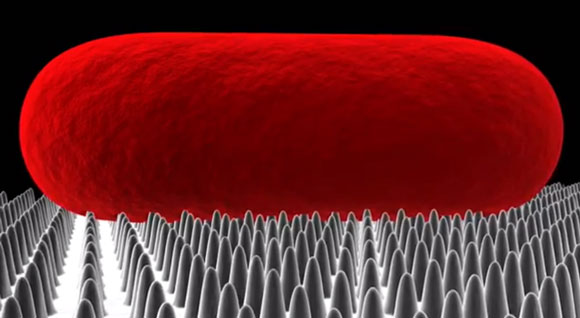
Scientists have discovered that the wing surface of the Clanger cicada (Psaltoda claripennis) isn’t flat. Instead, it is covered with thousands of pillars that are about 200 nanometers tall (a nanometer is a billion times smaller than a meter). When certain types of disease causing bacteria land on a cicada’s wing, they are killed by the nanopillars.

An international team of scientists just completed a study of Clanger cicada wings and found that they killed bacteria through physical and not chemical means. According to their model, when a bacteria lands on the nanopillars—the pillars are much smaller than bacterial cells—the bacterial membrane stretches into the spaces in between the pillars then, ruptures.

cicada-wing-nanopillar-580
A bacteria cell on the surface of a cicada wing. Image appears courtesy of Swinburne University of Technology.

To see the bacteria-killing cicada wing in action, check out this animation here.

While gram-positive bacteria with rigid membranes appear to be resistant to the lethal effects of the cicada wing, gram-negative bacteria that have more elastic membranes are susceptible data suggests. When the scientists microwaved gram-positive bacteria to make their membranes more elastic, these bacteria also became susceptible to the lethal effects of the cicada wing. Types of bacteria known to be susceptible in their natural state (i.e., non-microwaved state) include Escherichia coli, which can cause food poisoning, andPseudomonas aeruginosa, which can cause ear infections.

According to scientists interviewed by Nature News, materials designed to kill bacteria without environmentally harmful chemicals could be useful to use on such things as railings in public settings where diseases tend to spread. Because many of the bacteria involved in food poisoning incidents (e.g., E. coliSalmonellaCampylobacter) are gram-negative bacteria that have less rigid membranes, cicada wing inspired cutting-boards and countertops would make good sense to me.

Sergey Pogodin, first author of the study, was a doctoral student and researcher affiliated with Rovira I Virgili University in Spain at the time this research was conducted. Lead author, Elena Ivanova, is a scientist affiliated with Swinburne University in Australia.

Co-author Gregory Watson, a scientist affiliated with James Cook University in Australia, commented on the findings in a press release. He said:

Resistance to antibiotics is a world-wide challenge as a result of the serious implications for public health. Natural biological surfaces such as insect wings [give] us an exciting opportunity for templates that we can use in the development of a wide range of novel antibacterial materials for industrial and especially biomedical applications.

Both Gregory Watson and Jolanta Watson, another co-author of the new study, became interested in studying the antibacterial properties of cicada wings several years ago while hiking. They noticed that the wings of dead cicadas on the ground did not decompose to the same extent as other parts of the insects. This observation has led to several studies regarding the remarkable properties of not only cicada wings, but the wings of other insects as well.

cicada-lee-ruk-580
A cicada. Image Credit: Lee Ruk via Flickr.

The new study was funded in part by the Advanced Manufacturing Cooperative Research Center. Other co-authors of the study included Jafar Hasan, Vladimir Baulin, Hayden Webb, Vi Khanh Truong, Hong Phong Nguyen, Veselin Boshkovikj, Christopher Fluke, and Russell Crawford.


Bottom line: A 2013 study published in Biophysical Journal has found that cicada wings are covered with intricate nanopillar-shaped structures that are capable of killing bacteria through physical and not chemical means. This nanotechnology research is starting to inspire new ideas for environmentally-friendly antibacterial products.

This article was updated on June 24, 2013 to include other co-authors of the study.


Joaquim Machado

unread,
Sep 4, 2013, 8:37:05 AM9/4/13
to Joaquim Machado, Braulio Dias, adrit...@yahoo.com.br, Maria Cecilia Vieira, davi.bonavides@itamaraty.gov.br bonavides, Maximiliano da Cunha Henriques Arienzo, Marcio de M. Santos, Paulo Brandao, Eliana Maria Gouveia Fontes, Lidio Coradin, Zeze Sampaio, Simone Ferreira, Decio Zylbersztajn, Sergio Salles Filho, Maria Beatriz Bonacelli, beatriz bulhoes, Beatriz Florence, btc5734_2011-1@googlegroups.com 2011-1, btc...@googlegroups.com, btc5734_2012@googlegroups.com 2012, economia_biotec@googlegroups.com biotec, BTC5700 2012, btc573...@googlegroups.com, acgs...@usp.br, Monica Adriana Salles, Tejon Megido_fw, Coriolano, guedes Antonio Carlos, Mariza T. Barbosa, SILVIA KANADANI CAMPOS, ELIANA VALERIA C FIGUEIREDO (eliana.figueiredo@embrapa.br), DANIELLE ALENCAR PARENTE TORRES, Pedro Abel Vieira (Pedro.Vieira@embrapa.br), eduardo.couto@cgee.org.br Silva, Paulo Manoel L.C. Protasio, José Hartur Setubal Lima, kalcanfor@cgee.org.br Alcanfor, noos...@terra.com.br, Diana de Mello Jungmann, Maria Claudia Nunes Pinheiro, Elisa Romano Dezolt

Focus: How to Learn a Language Quickly

Published June 21, 2013  |  Physics 670 (2013)  |  DOI: 10.1103/Physics.6.70

Simulations show that you can learn the meaning of words rapidly if you assume that every object has only one word associated with it.

Stochastic Dynamics of Lexicon Learning in an Uncertain and Nonuniform World

Rainer Reisenauer, Kenny Smith, and Richard A. Blythe

Published June 21, 2013
+Enlarge imageFigure 1

Name game. One very effective strategy for learning the meanings of words, such as “cup,” is to assume that there is only one word for each object, according to simulations of word learning.

Children learn the meanings of about ten words per day, but it isn’t clear which techniques they use to achieve this fast rate. A research team simulated word learning and showed that a specific strategy, where the learner assumes there are no exact synonyms, is so effective that it can reduce the total learning time to the shortest time possible, which is just as soon as every word has been heard at least once. The results may give insight into the development of language in human ancestors.

A typical child learns approximately 60,000 words by the time she is 18. Children use many strategies to identify word meanings, including techniques to deal with ambiguous situations. For example, a child hears the word “cup” and at the same time sees a cup, a ball, and a book. She might remember this experience the next time she hears “cup” in conjunction with a cup and a different set of objects (the “confounders”). If the cup was the only object present in both situations, the child learns that “cup” means cup.

If the child further assumes that there is only one name for each object (meanings are mutually exclusive), then she can learn words faster. For example, if she hears “cup” and already knows the meanings of “ball” and “book,” the two other objects present, then she learns immediately that “cup” refers to the only non-assigned object. “It’s a boot-strapping technique, where you use information from previous learning [of words] to eliminate certain meanings,” explains Richard Blythe of the University of Edinburgh in the UK. Small-scale lab tests have shown that children and adults use mutual exclusivity to determine word meaning [1]. But researchers don’t know how effective this strategy is compared with others when dealing with hundreds or thousands of words.

To address this question, Blythe and his colleagues used a physics analogy that others have exploited in the past: word learning resembles some problems in nonequilibrium statistical physics, where a large number of entities (such as molecules) interact, and the probability distributions for certain states evolve over time. In language learning, a word like “cup” will start off with many confounders, and so the probability of “cup” meaning cup will be low. But over time this probability—and that of other word-meaning pairs—will grow to one, analogous to the system approaching equilibrium.

The researchers at first assumed a language, or “lexicon,” with 50 or 100 words, which appear with a range of different frequencies. In their computer simulations, the “learner” is repeatedly presented with a single word and a set of “objects,” one of which is the target meaning and the rest of which are confounders. The learner gradually learns the words by comparing many of these events. The team mathematically derived the total learning time for the entire lexicon, and it was strongly dependent on the number of confounders presented in each event.

Blythe and his colleagues compared two cases. The first assumed simple elimination without mutual exclusivity, in which the learner still considers already-named objects as potentially correct meanings for a new word. Learning 60,000 words with this strategy would take more than a lifetime, they found, unless the number of confounders was less than a few. When the team included mutual exclusivity in the model, they found that the learning time dropped dramatically. For a modest number of confounders (around ten), the entire lexicon was learned in the minimum time it takes to hear every word at least once. Words were learned nearly as quickly as they were encountered, suggesting that the mutual exclusivity assumption is extremely effective. The authors speculate that acquiring this word learning strategy may have been an important step for early humans as they developed their language ability.

Linda Smith, a cognitive scientist from Indiana University in Bloomington, says that mutual exclusivity is a common theme in brain studies. “Competition is how the brain works—in all domains, at all levels,” she says. If the brain forms an association between a word and an object, this will inhibit other words from forming a similar association with the same object. She expects some psychologists will take issue with the idea that learners retain a set of confounders for each word from one utterance to the next [2], but she says that similar kinds of ambiguity are included in theories of the brain’s memory retrieval.

–Michael Schirber

Michael Schirber is a freelance science writer in Lyon, France.


References

  1. E. M. Markman and G. F. Wachtel, “Children’s Use of Mutual Exclusivity to Constrain the Meanings of Words,” Cognitive Psychol. 20, 121 (1988).
  2. T. N. Medina, J. Snedeker, J. C. Trueswell, and L. R. Gleitman, “How Words Can and Cannot Be Learned by Observation,” Proc. Natl. Acad. Sci. U.S.A. 108, 9014 (2011).

More Information

Learning meaning: Why language learning seems hard (book chapter by Michael Gasser of Indiana University)


Joaquim Machado

unread,
Sep 4, 2013, 3:51:09 PM9/4/13
to Joaquim Machado, Braulio Dias, adrit...@yahoo.com.br, Maria Cecilia Vieira, davi.bonavides@itamaraty.gov.br bonavides, Maximiliano da Cunha Henriques Arienzo, Marcio de M. Santos, Paulo Brandao, Eliana Maria Gouveia Fontes, Lidio Coradin, Zeze Sampaio, Simone Ferreira, Decio Zylbersztajn, Sergio Salles Filho, Maria Beatriz Bonacelli, beatriz bulhoes, Beatriz Florence, btc5734_2011-1@googlegroups.com 2011-1, btc...@googlegroups.com, btc5734_2012@googlegroups.com 2012, economia_biotec@googlegroups.com biotec, BTC5700 2012, btc573...@googlegroups.com, acgs...@usp.br, Monica Adriana Salles, Tejon Megido_fw, Coriolano, guedes Antonio Carlos, Mariza T. Barbosa, SILVIA KANADANI CAMPOS, ELIANA VALERIA C FIGUEIREDO (eliana.figueiredo@embrapa.br), DANIELLE ALENCAR PARENTE TORRES, Pedro Abel Vieira (Pedro.Vieira@embrapa.br), eduardo.couto@cgee.org.br Silva, Paulo Manoel L.C. Protasio, José Hartur Setubal Lima, kalcanfor@cgee.org.br Alcanfor, noos...@terra.com.br, Diana de Mello Jungmann, Maria Claudia Nunes Pinheiro, Elisa Romano Dezolt
Genome Editing Tools - Article.pdf

Rafael Silveira Xavier

unread,
Sep 4, 2013, 4:12:06 PM9/4/13
to btc5734...@googlegroups.com
Segue o texto do artigo.


Abraço,


2013/9/3 Joaquim Machado <mindwing...@gmail.com>

--
Você está recebendo esta mensagem porque se inscreveu no grupo "Organização e Fluxo da Informação Genética em Sistemas Complexos" dos Grupos do Google.
Para cancelar a inscrição neste grupo e parar de receber seus e-mails, envie um e-mail para btc5734_2011-...@googlegroups.com.
Para obter mais opções, acesse https://groups.google.com/groups/opt_out.


--
Rafael Silveira Xavier
LCoN - Laboratório de Computação Natural
Faculdade de Computação e Informática & Pós-Graduação em Engenharia
Elétrica
Universidade Presbiteriana Mackenzie - SP
Proc. R. Soc. B-2013-Wystrach-.pdf

Joaquim Machado

unread,
Sep 5, 2013, 9:31:57 AM9/5/13
to Joaquim Machado, Braulio Dias, adrit...@yahoo.com.br, Maria Cecilia Vieira, davi.bonavides@itamaraty.gov.br bonavides, Maximiliano da Cunha Henriques Arienzo, Marcio de M. Santos, Paulo Brandao, Eliana Maria Gouveia Fontes, Lidio Coradin, Zeze Sampaio, Simone Ferreira, Decio Zylbersztajn, Sergio Salles Filho, Maria Beatriz Bonacelli, beatriz bulhoes, Beatriz Florence, btc5734_2011-1@googlegroups.com 2011-1, btc...@googlegroups.com, btc5734_2012@googlegroups.com 2012, economia_biotec@googlegroups.com biotec, BTC5700 2012, btc573...@googlegroups.com, acgs...@usp.br, Monica Adriana Salles, Tejon Megido_fw, Coriolano, guedes Antonio Carlos, Mariza T. Barbosa, SILVIA KANADANI CAMPOS, ELIANA VALERIA C FIGUEIREDO (eliana.figueiredo@embrapa.br), DANIELLE ALENCAR PARENTE TORRES, Pedro Abel Vieira (Pedro.Vieira@embrapa.br), eduardo.couto@cgee.org.br Silva, Paulo Manoel L.C. Protasio, José Hartur Setubal Lima, Flávia de Lacerda Parames, Ivone Alves de Oliveira Lopes, kalcanfor@cgee.org.br Alcanfor, noos...@terra.com.br, Diana de Mello Jungmann, Maria Claudia Nunes Pinheiro, Elisa Romano Dezolt
japan 3D Printing

Could Metal Give Japan a 3D Printing Boost?

Michael Molitch-Hou BY MICHAEL MOLITCH-HOU ON  · ASIA,INDUSTRY INSIGHTSINDUSTRY NEWS

Have you been keeping up with 3D printing in Japan? Maybe not. According to Reno Tibke at Akihabara News, Japan’s additive manufacturing (AM) sector is rather small compared with other countries, 0.3% of the global share to be more specific.  But, Tibke points out, that may soon change.

3D Printer Manufacturing Countries
Japan’s market share in 3D printing, as depicted by Akihabara.

Though Japan has had its own AM stories in headlines, including 3D printed fetuses and, possibly the first, 3D printing photobooths, its 3D printing power lags behind other countries.  The US is the furthest ahead in terms of investing in 3D printing and other countries, including the UK and China have also invested significantly.  At the same time, however, no one has quite figured out how to bring down the price on 3D printed metal technologies.  At the moment, additive manufacturing with metal is isolated to a small range of processes, most notably selective laser-melting, which is extremely expensive and still has issues with reliability and consistency of results.  Tibke proposes, with humor and irreverence, that

Metal 3D PrintedTo get back in the game, or rather to just get into the game, Japan wants to go metal – that’s the springboard – and if successful, it could alter the whole landscape. Because the thing is, as previously mentioned, most 3D metal printing is happening in Europe, so while the U.S.’s 70-75% market share is daunting, the metal-printing sector is a bit more accessible.

There’s an article at The Engineer that cites an official declaration by the Japanese government to pursue 3D printing, but their source link seems to have gone defunct; however, with 3D printing on the cover of Japan’s Ministry of Energy, Technology, and Industry magazine, Tibke indicates that it’s clear that the government is beginning to focus energy and money on the technology.  And, if Japan is able to produce its own metal printers instead of relying on those manufactured in other countries, the author proposes that Japan could leap (frog) ahead of the rest of the world.

I’d hasten to add that there are other 3D printing technologies that could also enhance Japan’s role, if they could beat other countries to the punch. Surely, 3D-printed electronics, another holy grail of 3D printing, would be the envy of any country. And, as Japan is one of the leading robot manufacturers, 3D-printed electronics and 3D-printed metal would make for a nice combination, leading such dreamed-of technology as fully self-replicating 3D printers.

Source: Akihabara News


Joaquim Machado

unread,
Sep 5, 2013, 10:26:31 AM9/5/13
to Joaquim Machado, Braulio Dias, adrit...@yahoo.com.br, Maria Cecilia Vieira, davi.bonavides@itamaraty.gov.br bonavides, Maximiliano da Cunha Henriques Arienzo, Marcio de M. Santos, Paulo Brandao, Eliana Maria Gouveia Fontes, Lidio Coradin, Zeze Sampaio, Simone Ferreira, Decio Zylbersztajn, Sergio Salles Filho, Maria Beatriz Bonacelli, beatriz bulhoes, Beatriz Florence, btc5734_2011-1@googlegroups.com 2011-1, btc...@googlegroups.com, btc5734_2012@googlegroups.com 2012, economia_biotec@googlegroups.com biotec, BTC5700 2012, btc573...@googlegroups.com, acgs...@usp.br, Monica Adriana Salles, Tejon Megido_fw, Coriolano, guedes Antonio Carlos, Mariza T. Barbosa, SILVIA KANADANI CAMPOS, ELIANA VALERIA C FIGUEIREDO (eliana.figueiredo@embrapa.br), DANIELLE ALENCAR PARENTE TORRES, Pedro Abel Vieira (Pedro.Vieira@embrapa.br), eduardo.couto@cgee.org.br Silva, Paulo Manoel L.C. Protasio, José Hartur Setubal Lima, Flávia de Lacerda Parames, Ivone Alves de Oliveira Lopes, kalcanfor@cgee.org.br Alcanfor, noos...@terra.com.br, Diana de Mello Jungmann, Maria Claudia Nunes Pinheiro, Elisa Romano Dezolt
  About the SA Blog Network


5
inShare


Guest Blog
Commentary invited by editors of Scientific American
Guest Blog HomeAboutContact

Time to Stop Fighting GMO Labeling?

By Tabitha M. Powledge | September 2, 2013 |  Comments39


Why do people react so strongly against the idea of genetic modification? Especially genetic modification that crosses species barriers? In a recentNew Yorker, Maria Konnikova returned to an explanation for these gut reactions that has been around at least since the early efforts at genetic engineering in the 1970s: The idea that fear and distrust of GMOs is based on ancient intuitive (but sometimes illogical) distinctions between the natural (good) and the unnatural (bad.)

There is much to be said about how cultures have drawn lines between the natural and unnatural, but that’s a topic for another time. Right now I want to focus on a present-day manifestation of that impulse: the controversies over whether foods with GM ingredients should be labeled to make that clear.

As Konnikova points out, there are data showing that how a food is labeled–organic, for instance–influences people’s readiness to eat it. The halo effect. Or, in the case of food based on GMOs, the reverse halo effect. Which is why there has been so much resistance to labeling.

Familiarity will breed acceptance of GM foods

But Konnikova also points out that familiarity breeds the opposite of contempt. She takes the Enlightenment view that time is on the side of what she calls “increased rationality.”

I’m not convinced that an onward march of rationality is inevitable, desirable as that would be. But I do agree that familiarity will be a powerful dampener of Unreasoning Fear of GMOs. A key there is demography. Children growing up in a world full of GMOs will no longer find them unnatural.

Of course, producers of GM foods don’t want to wait a generation or more for sales to pick up. Understandably. But what if that process could be hastened?  What if the whole familiarity thing could be nudged along a bit?

So I’ve been thinking about ways of making consumers understand and grow more comfortable with the fact that they are already eating lots of GM foods with no ill effects. I’m wondering if it’s counterproductive to keep battling labeling.

I understand perfectly well why food producers have a horror of the GM label. They’re thinking in the short term. The dreaded GM tag will surely mean dips in sales. I suspect that most of those dips will be temporary as it becomes increasingly obvious that mass-produced GM foods are harmless. But it’s easy to see why food producers don’t want to take the risk.

Still, it really makes sense to focus instead on longer-term gains that will follow from familiarity. These are inevitable. They will just take a while to sink in. So maybe food producers should learn to live with labels for the sake of hurrying future consumer acceptance along. Labeling is a way to get rid of the reverse halo effect. I think labeling might even, at least in some cases, confer a halo effect.

A voluntary experiment with labeling a GM food

So what about this: Experiment voluntarily. It might at least be worthwhile to find out how big a risk labeling really is. Take a deep breath. Label a well-loved GM food. Give people time to get used to it, and see what happens.

In my heart of hearts I don’t really expect to persuade the anti-label folks. And yes, I suppose it’s a somewhat facetious suggestion. But not entirely facetious. Not at all.  Why not experiment?

Here’s my plan for selective GMO labeling

Here’s my plan: Start this experiment with an immensely popular snack food whose central ingredient is a GMO. The experimental subject should be a beloved snack that has few other ingredients to complicate the picture. In short, why not start with corn chips?

And don’t be shy. Make a virtue of necessity. We’re turning a lemon into lemonade here. Slap a great big proud label on the chips. Make the label convey something like this message, maybe in red letters: GM [BRAND NAME HERE] CORN CHIPS—MADE WITH DELICIOUS NUTRITIOUS GENETICALLY MODIFIED CORN!!!

Yes, you will say, this is a gift marketing opportunity to any brand of chips not made with GM corn. But this assumes that hopeful boutique chip makers can find non-GM corn to turn into chips, which won’t be easy. And if they can find it, then they must induce consumers to pay more for their chips. Maybe a lot more, because when you can find it, non-GM corn is costly.

People might be put off by the GM label on regular chips initially, but I bet that phase wouldn’t last long. Millions of corn chip devotees are not going to deprive themselves, and they’re not going to want to pay a lot more either. Before long, I foresee, they will sink happily back into their couches with their family-size bags of crunchy, salty, tasty, less expensive GM-labeled corn chips. Yum.

Proudly labeled GM corn chips could even pave the way for other GM foods. Once the GM label is forthright and ubiquitous on an omnipresent product like corn chips, when the GM label is shouting loudly from that vast aisle of chips at the supermarket, other GM foods will gradually win acceptance too.

GM-labeled corn chips could be the opening shot in a campaign to help consumers along toward Konnikova’s optimistic model of increased rationality about GM foods.

Hey, it’s worth a try.

Image: Corn chips by Glane23

This post appeared in a somewhat different form at the Genetic Literacy Project.

Tabitha M. PowledgeAbout the Author: Tabitha M. Powledge is a long-time science and medical journalist whose work has appeared all over the place, including Scientific American. She began writing On Science Blogs for the National Association of Science Writers in 2009. On Science Blogs moved recently to the PLOS Blog Network. Follow on Twitter @tamfecit.

Joaquim Machado

unread,
Sep 5, 2013, 10:45:57 AM9/5/13
to Joaquim Machado, Andréa Derani, Braulio Dias, adrit...@yahoo.com.br, Maria Cecilia Vieira, davi.bonavides@itamaraty.gov.br bonavides, Maximiliano da Cunha Henriques Arienzo, Marcio de M. Santos, Paulo Brandao, Eliana Maria Gouveia Fontes, Lidio Coradin, Zeze Sampaio, Simone Ferreira, Decio Zylbersztajn, Sergio Salles Filho, Maria Beatriz Bonacelli, beatriz bulhoes, Beatriz Florence, btc5734_2011-1@googlegroups.com 2011-1, btc...@googlegroups.com, btc5734_2012@googlegroups.com 2012, economia_biotec@googlegroups.com biotec, BTC5700 2012, btc573...@googlegroups.com, acgs...@usp.br, Monica Adriana Salles, Tejon Megido_fw, Coriolano, guedes Antonio Carlos, Mariza T. Barbosa, SILVIA KANADANI CAMPOS, ELIANA VALERIA C FIGUEIREDO (eliana.figueiredo@embrapa.br), DANIELLE ALENCAR PARENTE TORRES, Pedro Abel Vieira (Pedro.Vieira@embrapa.br), eduardo.couto@cgee.org.br Silva, Paulo Manoel L.C. Protasio, José Hartur Setubal Lima, Flávia de Lacerda Parames, Ivone Alves de Oliveira Lopes, kalcanfor@cgee.org.br Alcanfor, noos...@terra.com.br, Diana de Mello Jungmann, Maria Claudia Nunes Pinheiro, Elisa Romano Dezolt
MUITO LEGAL  a revista Bamboo de setembro 2013 !!

Joaquim Machado

unread,
Sep 5, 2013, 12:36:57 PM9/5/13
to Joaquim Machado, Andréa Derani, Braulio Dias, adrit...@yahoo.com.br, Maria Cecilia Vieira, davi.bonavides@itamaraty.gov.br bonavides, Maximiliano da Cunha Henriques Arienzo, Marcio de M. Santos, Paulo Brandao, Eliana Maria Gouveia Fontes, Lidio Coradin, Zeze Sampaio, Simone Ferreira, Decio Zylbersztajn, Sergio Salles Filho, Maria Beatriz Bonacelli, beatriz bulhoes, Beatriz Florence, btc5734_2011-1@googlegroups.com 2011-1, btc...@googlegroups.com, btc5734_2012@googlegroups.com 2012, economia_biotec@googlegroups.com biotec, BTC5700 2012, btc573...@googlegroups.com, acgs...@usp.br, Monica Adriana Salles, Tejon Megido_fw, Coriolano, guedes Antonio Carlos, Mariza T. Barbosa, SILVIA KANADANI CAMPOS, ELIANA VALERIA C FIGUEIREDO (eliana.figueiredo@embrapa.br), DANIELLE ALENCAR PARENTE TORRES, Pedro Abel Vieira (Pedro.Vieira@embrapa.br), eduardo.couto@cgee.org.br Silva, Paulo Manoel L.C. Protasio, José Hartur Setubal Lima, Flávia de Lacerda Parames, Ivone Alves de Oliveira Lopes, kalcanfor@cgee.org.br Alcanfor, noos...@terra.com.br, Diana de Mello Jungmann, Maria Claudia Nunes Pinheiro, Elisa Romano Dezolt

Joaquim Machado

unread,
Sep 5, 2013, 2:32:38 PM9/5/13
to Joaquim Machado, Andréa Derani, Braulio Dias, adrit...@yahoo.com.br, Maria Cecilia Vieira, davi.bonavides@itamaraty.gov.br bonavides, Maximiliano da Cunha Henriques Arienzo, Marcio de M. Santos, Paulo Brandao, Eliana Maria Gouveia Fontes, Lidio Coradin, Zeze Sampaio, Simone Ferreira, Decio Zylbersztajn, Sergio Salles Filho, Maria Beatriz Bonacelli, beatriz bulhoes, Beatriz Florence, btc5734_2011-1@googlegroups.com 2011-1, btc...@googlegroups.com, btc5734_2012@googlegroups.com 2012, economia_biotec@googlegroups.com biotec, BTC5700 2012, btc573...@googlegroups.com, acgs...@usp.br, Monica Adriana Salles, Tejon Megido_fw, Coriolano, guedes Antonio Carlos, Mariza T. Barbosa, SILVIA KANADANI CAMPOS, ELIANA VALERIA C FIGUEIREDO (eliana.figueiredo@embrapa.br), DANIELLE ALENCAR PARENTE TORRES, Pedro Abel Vieira (Pedro.Vieira@embrapa.br), eduardo.couto@cgee.org.br Silva, Paulo Manoel L.C. Protasio, José Hartur Setubal Lima, Flávia de Lacerda Parames, Ivone Alves de Oliveira Lopes, kalcanfor@cgee.org.br Alcanfor, noos...@terra.com.br, Diana de Mello Jungmann, Maria Claudia Nunes Pinheiro, Elisa Romano Dezolt
http://www.nature.com/news/genetically-modified-crops-pass-benefits-to-weeds-1.13517

http://onlinelibrary.wiley.com/doi/10.1111/nph.12428/abstract

Na edição deste mês da revista científica New Phytologist foi publicado um artigo apresentando novas evidências de riscos das plantações transgênicas – desta vez para o meio ambiente. Na edição online da revista Nature foi publicada em 16 de agosto uma matéria relatando os principais resultados do estudo.

Um grupo de pesquisadores da China observou que uma variedade invasora de arroz, considerada “planta daninha” nas lavouras, adquiriu vantagens adaptativas no meio ambiente quando cruzada com a variedade transgênica tolerante à aplicação do herbicida glifosato – e mais: essa vantagem foi verificada mesmo na ausência do herbicida.

A modificação genética para conferir tolerância à aplicação de herbicidas é o tipo mais comum de transgenia na agricultura. A soja da Monsanto tolerante à aplicação do herbicida glifosato foi o primeiro cultivo transgênico a ser difundido em larga escala, e até hoje toda a soja e boa parte do milho, do algodão e da canola transgênicos plantados no mundo possuem (pelo menos) essa característica.

Nas lavouras tolerantes ao glifosato os agricultores pulverizam o produto sobre a plantação. O veneno mata todos os tipos de mato presentes no campo (até que estes se tornem resistentes), menos as plantas transgênicas.

Poucos estudos foram realizados no sentido de avaliar se, quando escapam para o meio ambiente, essas plantas transgênicas são mais competitivas para sobreviver e se reproduzir, bem como se isso também poderia ocorrer com variedades invasoras das plantas cultivadas ou espécies próximas que tenham adquirido a tolerância a herbicidas através da contaminação via polinização. Todas as liberações de transgênicos dos até hoje no Brasil se apoiaram na crença de que isso não aconteceria.

O recente estudo chinês coordenado por Lu Baorong, ecologista da Fudan University, em Shangai, investigou esta questão. Lu e seus colegas modificaram geneticamente o arroz comum para torná-lo resistente ao glifosato e depois cruzaram esse arroz modificado com uma variedade invasora de arroz. Os pesquisadores então deixaram essas plantas cruzarem entre si, criando uma segunda geração de híbridos que eram idênticos um ao outro, exceto pelo número de cópias do gene que codifica a produção da enzima EPSP-sintase – a enzima que é inibida com a aplicação do glifosato e que, nas plantas transgênicas tolerantes ao herbicida, é produzida em grande quantidade, o que as permite suportar os efeitos do veneno. Lembre-se que o número final de cópias dos transgene na planta modificada não é atributo controlável pela técnica. Como previsto, as plantas com mais cópias do gene expressaram níveis mais altos da enzima. Mas os pesquisadores descobriram também que esses híbridos transgênicos tinham taxas mais altas de fotossíntese, produziram mais brotos e flores e produziram 48-125% mais sementes por planta do que os híbridos não transgênicos – na ausência do glifosato.

Segundo Lu, tornar o arroz selvagem mais competitivo poderia exacerbar os problemas que ele causa aos produtores ao redor do mundo.

Brian Ford-Lloyd, geneticista de plantas da Universidade de Birmingham, no Reino Unido, explica que “se o gene que codifica a enzima EPSP-sintase contaminar as variedades selvagens de arroz, sua diversidade genética, cuja conservação é realmente importante, pode ser ameaçada pois o genótipo com o transgene poderá vencer a competição com as variedades normais.” O geneticista avalia que “este é um dos mais claros exemplos de efeitos danosos extremamente plausíveis das lavouras transgênicas no ambiente”.

O estudo também desafia a percepção pública de que lavouras modificadas geneticamente para apresentar cópias extras de seus próprios genes seriam mais seguras do que aquelas que contêm genes de microrganismos. “Nosso estudo mostra que este não é necessariamente o caso”, afirma Lu.

Talvez mais surpreendente do que os resultados do novo estudo seja o fato de pesquisas como essa não terem sido exigidas e realizadas antes da liberação dessas plantas em larga escala no meio ambiente. Lá se vão vinte anos desde que plantas transgênicas começaram a ser cultivadas comercialmente e somente agora começam a fazer volume os estudos independentes para avaliar os efeitos dessas plantas sobre o meio ambiente e a saúde. E o que é pior: até agora, com exceção do caso da Europa, as novas evidências científicas que têm sido publicadas comprovando a existência de riscos não têm sido suficientes nem para reverter liberações já concedidas, nem para frear novas liberações. Fato que reforça que as decisões são tomadas não com base em ciência, não ao menos numa ciência desinteressada.


Joaquim Machado

unread,
Sep 5, 2013, 2:54:25 PM9/5/13
to Joaquim Machado, Andréa Derani, Braulio Dias, adrit...@yahoo.com.br, Maria Cecilia Vieira, davi.bonavides@itamaraty.gov.br bonavides, Maximiliano da Cunha Henriques Arienzo, Marcio de M. Santos, Paulo Brandao, Eliana Maria Gouveia Fontes, Lidio Coradin, Zeze Sampaio, Simone Ferreira, Decio Zylbersztajn, Sergio Salles Filho, Maria Beatriz Bonacelli, beatriz bulhoes, Beatriz Florence, btc5734_2011-1@googlegroups.com 2011-1, btc...@googlegroups.com, btc5734_2012@googlegroups.com 2012, economia_biotec@googlegroups.com biotec, BTC5700 2012, btc573...@googlegroups.com, acgs...@usp.br, Monica Adriana Salles, Tejon Megido_fw, Coriolano, guedes Antonio Carlos, Mariza T. Barbosa, SILVIA KANADANI CAMPOS, ELIANA VALERIA C FIGUEIREDO (eliana.figueiredo@embrapa.br), DANIELLE ALENCAR PARENTE TORRES, Pedro Abel Vieira (Pedro.Vieira@embrapa.br), eduardo.couto@cgee.org.br Silva, Paulo Manoel L.C. Protasio, José Hartur Setubal Lima, Flávia de Lacerda Parames, Ivone Alves de Oliveira Lopes, kalcanfor@cgee.org.br Alcanfor, noos...@terra.com.br, Diana de Mello Jungmann, Maria Claudia Nunes Pinheiro, Elisa Romano Dezolt
nph12428.pdf

Joaquim Machado

unread,
Sep 5, 2013, 4:23:29 PM9/5/13
to Joaquim Machado, Braulio Dias, adrit...@yahoo.com.br, Maria Cecilia Vieira, davi.bonavides@itamaraty.gov.br bonavides, Maximiliano da Cunha Henriques Arienzo, Marcio de M. Santos, Paulo Brandao, Eliana Maria Gouveia Fontes, Lidio Coradin, Zeze Sampaio, Simone Ferreira, Decio Zylbersztajn, Sergio Salles Filho, Maria Beatriz Bonacelli, beatriz bulhoes, Beatriz Florence, btc5734_2011-1@googlegroups.com 2011-1, btc...@googlegroups.com, btc5734_2012@googlegroups.com 2012, economia_biotec@googlegroups.com biotec, BTC5700 2012, btc573...@googlegroups.com, acgs...@usp.br, Monica Adriana Salles, Tejon Megido_fw, Coriolano, guedes Antonio Carlos, Mariza T. Barbosa, SILVIA KANADANI CAMPOS, ELIANA VALERIA C FIGUEIREDO (eliana.figueiredo@embrapa.br), DANIELLE ALENCAR PARENTE TORRES, Pedro Abel Vieira (Pedro.Vieira@embrapa.br), eduardo.couto@cgee.org.br Silva, Paulo Manoel L.C. Protasio, José Hartur Setubal Lima, Flávia de Lacerda Parames, Ivone Alves de Oliveira Lopes, kalcanfor@cgee.org.br Alcanfor, noos...@terra.com.br, Diana de Mello Jungmann, Maria Claudia Nunes Pinheiro, Elisa Romano Dezolt
Cover Image: September 2013 Scientific American MagazineSee Inside

Is NASA Too Worried about Contaminating Mars?

It's time to relax constraints on Mars exploration, researchers argue


Mars blowing nose

Image: Thomas Fuchs

Does Mars need protection from our microbes? Conventional wisdom says yes, as does space law—the United Nations Outer Space Treaty prohibits the contamination of potentially fertile worlds with earthly bacteria. Yet some researchers disagree: Mars will be just fine on its own, they say, and the stringent safeguards now in place discourage scientists from exploring the Red Planet. On missions dedicated to searching for life, costs “could easily double because of planetary protection procedures,” says Cornell University astrobiologist Alberto G. Fairén.

Protecting Mars is not worth the effort and expense, Fairén and Dirk Schulze-Makuch of Washington State University argue in a recent issue of Nature Geoscience. After all, some Earth bacteria are probably already there, having hitched a ride on debris from ancient meteor impacts or more recently on NASA's Viking landers. Besides, any life-form already on Mars would easily fight off the poorly adapted invasive microbes.

The odds of NASA changing course are low. “If you want to study life elsewhere, you have to make sure not to bring Earth materials along” or else risk mistaking stowaways for alien life, says Catharine Conley, NASA's planetary protection officer.

John Rummel, Conley's predecessor at NASA, says simulations and experiments suggest Earth bacteria actually could survive on Mars. Adds Rummel: “We don't know everything that Earth organisms can do.”


Joaquim Machado

unread,
Sep 6, 2013, 2:43:11 PM9/6/13
to Joaquim Machado, Braulio Dias, adrit...@yahoo.com.br, Maria Cecilia Vieira, davi.bonavides@itamaraty.gov.br bonavides, Maximiliano da Cunha Henriques Arienzo, Marcio de M. Santos, Paulo Brandao, Eliana Maria Gouveia Fontes, Lidio Coradin, Zeze Sampaio, Simone Ferreira, Decio Zylbersztajn, Sergio Salles Filho, Maria Beatriz Bonacelli, beatriz bulhoes, Beatriz Florence, btc5734_2011-1@googlegroups.com 2011-1, btc...@googlegroups.com, btc5734_2012@googlegroups.com 2012, economia_biotec@googlegroups.com biotec, BTC5700 2012, btc573...@googlegroups.com, acgs...@usp.br, Monica Adriana Salles, Tejon Megido_fw, Coriolano, guedes Antonio Carlos, Mariza T. Barbosa, SILVIA KANADANI CAMPOS, ELIANA VALERIA C FIGUEIREDO (eliana.figueiredo@embrapa.br), DANIELLE ALENCAR PARENTE TORRES, Pedro Abel Vieira (Pedro.Vieira@embrapa.br), eduardo.couto@cgee.org.br Silva, Paulo Manoel L.C. Protasio, José Hartur Setubal Lima, Flávia de Lacerda Parames, Ivone Alves de Oliveira Lopes, kalcanfor@cgee.org.br Alcanfor, noos...@terra.com.br, Diana de Mello Jungmann, Maria Claudia Nunes Pinheiro, Elisa Romano Dezolt
A WIRED (UK edition) de outubro 2013,  especial sobre Inovação, substitui com vantagens 132,69 % dos livros sobre o tema encontrados em livrarias, rodoviárias e aeroportos.

Joaquim Machado

unread,
Sep 6, 2013, 4:42:32 PM9/6/13
to Joaquim Machado, Braulio Dias, adrit...@yahoo.com.br, Maria Cecilia Vieira, davi.bonavides@itamaraty.gov.br bonavides, Maximiliano da Cunha Henriques Arienzo, Marcio de M. Santos, Paulo Brandao, Eliana Maria Gouveia Fontes, Lidio Coradin, Zeze Sampaio, Simone Ferreira, Decio Zylbersztajn, Sergio Salles Filho, Maria Beatriz Bonacelli, Beatriz Florence, btc5734_2011-1@googlegroups.com 2011-1, btc...@googlegroups.com, btc5734_2012@googlegroups.com 2012, economia_biotec@googlegroups.com biotec, BTC5700 2012, btc573...@googlegroups.com, acgs...@usp.br, Monica Adriana Salles, Tejon Megido_fw, Coriolano, guedes Antonio Carlos, Mariza T. Barbosa, SILVIA KANADANI CAMPOS, ELIANA VALERIA C FIGUEIREDO (eliana.figueiredo@embrapa.br), DANIELLE ALENCAR PARENTE TORRES, Pedro Abel Vieira (Pedro.Vieira@embrapa.br), eduardo.couto@cgee.org.br Silva, Paulo Manoel L.C. Protasio, José Hartur Setubal Lima, Flávia de Lacerda Parames, Ivone Alves de Oliveira Lopes, kalcanfor@cgee.org.br Alcanfor, noos...@terra.com.br, Diana de Mello Jungmann, Maria Claudia Nunes Pinheiro, Elisa Romano Dezolt
BIOLOGY IS THE NEW SOFTWARE


Joaquim Machado

unread,
Sep 6, 2013, 4:56:24 PM9/6/13
to Joaquim Machado, Braulio Dias, adrit...@yahoo.com.br, Maria Cecilia Vieira, davi.bonavides@itamaraty.gov.br bonavides, Maximiliano da Cunha Henriques Arienzo, Marcio de M. Santos, Paulo Brandao, Eliana Maria Gouveia Fontes, Lidio Coradin, Zeze Sampaio, Simone Ferreira, Decio Zylbersztajn, Sergio Salles Filho, Maria Beatriz Bonacelli, Beatriz Florence, btc5734_2011-1@googlegroups.com 2011-1, btc...@googlegroups.com, btc5734_2012@googlegroups.com 2012, economia_biotec@googlegroups.com biotec, BTC5700 2012, btc573...@googlegroups.com, acgs...@usp.br, Monica Adriana Salles, Tejon Megido_fw, Coriolano, guedes Antonio Carlos, Mariza T. Barbosa, SILVIA KANADANI CAMPOS, ELIANA VALERIA C FIGUEIREDO (eliana.figueiredo@embrapa.br), DANIELLE ALENCAR PARENTE TORRES, Pedro Abel Vieira (Pedro.Vieira@embrapa.br), eduardo.couto@cgee.org.br Silva, Paulo Manoel L.C. Protasio, José Hartur Setubal Lima, Flávia de Lacerda Parames, Ivone Alves de Oliveira Lopes, kalcanfor@cgee.org.br Alcanfor, noos...@terra.com.br, Diana de Mello Jungmann, Maria Claudia Nunes Pinheiro, Elisa Romano Dezolt

Joaquim Machado

unread,
Sep 7, 2013, 2:07:43 PM9/7/13
to Joaquim Machado, Braulio Dias, adrit...@yahoo.com.br, Maria Cecilia Vieira, davi.bonavides@itamaraty.gov.br bonavides, Maximiliano da Cunha Henriques Arienzo, Marcio de M. Santos, Paulo Brandao, beatriz bulhoes, Eliana Maria Gouveia Fontes, Lidio Coradin, Zeze Sampaio, Simone Ferreira, Decio Zylbersztajn, Sergio Salles Filho, Maria Beatriz Bonacelli, Beatriz Florence, btc5734_2011-1@googlegroups.com 2011-1, btc...@googlegroups.com, btc5734_2012@googlegroups.com 2012, economia_biotec@googlegroups.com biotec, BTC5700 2012, btc573...@googlegroups.com, acgs...@usp.br, Monica Adriana Salles, Tejon Megido_fw, Coriolano, guedes Antonio Carlos, Mariza T. Barbosa, SILVIA KANADANI CAMPOS, ELIANA VALERIA C FIGUEIREDO (eliana.figueiredo@embrapa.br), DANIELLE ALENCAR PARENTE TORRES, Pedro Abel Vieira (Pedro.Vieira@embrapa.br), eduardo.couto@cgee.org.br Silva, Paulo Manoel L.C. Protasio, José Hartur Setubal Lima, Flávia de Lacerda Parames, Ivone Alves de Oliveira Lopes, kalcanfor@cgee.org.br Alcanfor, noos...@terra.com.br, Diana de Mello Jungmann, Maria Claudia Nunes Pinheiro
Fernando Reinach
Início do conteúdo

Novo órgão envolvido no controle da obesidade

07 de setembro de 2013 | 2h 08
Fernando Reinach - O Estado de S.Paulo

Não entre em pânico. O novo órgão não é uma agência federal encarregada de monitorar seu peso ou controlar sua dieta. O novo órgão é sua microbiota. Um novo estudo demonstrou que o transplante de microbiota não só é possível, mas pode ajudar a controlar a obesidade.


Provavelmente você não sabia que tem um órgão chamado microbiota, mas isso não é motivo de vergonha. Faz pouco tempo que os cientistas passaram a acreditar que a coleção de microrganismos que habitam nosso intestino (a flora intestinal) pode ser considerada uma espécie de órgão, necessário para o bom funcionamento de nosso corpo.

Bilhões de microrganismos vivem no nosso intestino. São milhares de espécies distintas. A população de microrganismos que habitam nosso intestino é maior que o número de células que compõem nosso corpo. Durante muito tempo se acreditou que a flora intestinal era uma mera consequência da ingestão de alimentos contendo outros seres vivos. Acreditávamos que eles viviam em nosso intestino aproveitando os restos de alimentos, vez por outra provocando uma diarreia. Em meados do século 20, muitos consideravam a flora intestinal perniciosa e se submetiam a lavagens intestinais periódicas, para eliminar parte desses microrganismos, se mantendo "limpos" por dentro.

Nas últimas décadas, o verdadeiro papel desses microrganismos começou a ser compreendido. Foi descoberto que muitos deles degradam parte dos alimentos que ingerimos e produzem moléculas importantes que são absorvidas por nosso intestino, inclusive algumas vitaminas que nós próprios não somos capazes de produzir. Também se descobriu que a manutenção desses bichinhos é importante para nosso processo digestivo e que, quando nossa flora intestinal é alterada pela ingestão de antibióticos, é necessário repor a coleção. Surgiram produtos alimentares, como iogurtes, que contêm microrganismos que ajudam na reposição da flora intestinal, entre eles os famosos "lactobacilos vivos".

Com o desenvolvimento do sequenciamento de DNA, essa população de microrganismos pode ser estudada em detalhe. Hoje sabemos que a composição da microbiota varia entre populações, é parcialmente estável, pode ser influenciada pela dieta, e é diferente em pessoas magras e obesas.

Foi essa observação que levou os cientistas a suspeitar que talvez a composição da microbiota possa ser um dos fatores que determinam se uma pessoa é magra ou obesa. Mas como testar essa hipótese? O mais simples seria eliminar a flora intestinal de uma pessoa magra e recolonizar seu intestino com a microbiota de uma pessoa obesa. Usei recolonizar como um eufemismo para evitar dizer que o receptor teria de receber (eufemismo para ingerir) conteúdo intestinal (eufemismo para fezes) do doador. Um experimento no mínimo desagradável. A solução foi usar camundongos.

Foram identificados pares de pessoas gêmeas em que um membro do par era obeso e o outro, magro. Essas pessoas doaram amostras de suas fezes. Os microrganismos presentes nas fezes foram transferidos para camundongos geneticamente idênticos, criados em condições estéreis, e que, portanto, não possuíam microrganismos em seus intestinos. Após receberem os microrganismos, os dois grupos de camundongos foram mantidos com a mesma dieta. Para surpresa dos cientistas, os camundongos que receberam microrganismos de pessoas obesas se tornaram obesos e os que receberam amostras de pessoas magras permaneceram magros. Esse experimento simples demonstra que a microbiota de pessoas obesas é capaz de alterar de tal forma o metabolismo dos camundongos que eles se tornam obesos mesmo consumindo a mesma dieta.

Esse novo modelo experimental vai permitir um estudo detalhado do papel da microbiota na obesidade humana. Usando esse modelo, os cientistas já descobriram que, se colocarem camundongos gordos na mesma gaiola dos magros, os gordos emagrecem, pois, como eles comem as fezes um dos outros (são coprófagos), a microbiota dos magros é transmitida para os gordos, fazendo com que eles emagreçam. Já o caminho inverso não foi observado, a microbiota dos gordos não passa para os magros. Analisando quais microrganismos estavam presentes nas duas microbiotas, os cientistas identificaram 39 espécies que poderiam ser responsáveis pela obesidade. Mas, quando somente esse grupo foi inoculado, não foi possível tornar os camundongos obesos. Também foi descoberto que a dieta dos camundongos afeta o resultado dos experimentos. Uma dieta mais rica em fibra é necessária para que os camundongos obesos sejam colonizados pela microbiota dos camundongos magros.

A demonstração de que é possível transplantar microbiotas e que elas carregam parte determinante da obesidade humana abre um enorme campo de investigação. Nos próximos anos provavelmente serão isolados os microrganismos responsáveis pela obesidade e, talvez, no futuro tenhamos métodos capazes de regular nossa microbiota, reduzindo a incidência da obesidade.

Já imagino a receita: "Para Fernando Reinach, ingerir duas colheres de microrganismos emagrecedores ao dia, durante 10 dias". Prometo que vou tentar engolir o remédio me esforçando para esquecer a origem.   * MAIS INFORMAÇÕES: GUT MICROBIOTA FROM TWINS DISCORDANT FOR OBESITY MODULATES METABOLISM IN MICE. SCIENCE VOL 341 PAG. 1241214 2013


Joaquim Machado

unread,
Sep 8, 2013, 12:34:31 PM9/8/13
to Joaquim Machado, Braulio Dias, adrit...@yahoo.com.br, Maria Cecilia Vieira, davi.bonavides@itamaraty.gov.br bonavides, Maximiliano da Cunha Henriques Arienzo, Marcio de M. Santos, Paulo Brandao, beatriz bulhoes, Eliana Maria Gouveia Fontes, Lidio Coradin, Zeze Sampaio, Simone Ferreira, Decio Zylbersztajn, Sergio Salles Filho, Maria Beatriz Bonacelli, Beatriz Florence, btc5734_2011-1@googlegroups.com 2011-1, btc...@googlegroups.com, btc5734_2012@googlegroups.com 2012, economia_biotec@googlegroups.com biotec, BTC5700 2012, btc573...@googlegroups.com, acgs...@usp.br, Monica Adriana Salles, Tejon Megido_fw, Coriolano, guedes Antonio Carlos, Mariza T. Barbosa, SILVIA KANADANI CAMPOS, ELIANA VALERIA C FIGUEIREDO (eliana.figueiredo@embrapa.br), DANIELLE ALENCAR PARENTE TORRES, Pedro Abel Vieira (Pedro.Vieira@embrapa.br), eduardo.couto@cgee.org.br Silva, Paulo Manoel L.C. Protasio, José Hartur Setubal Lima, Flávia de Lacerda Parames, Ivone Alves de Oliveira Lopes, kalcanfor@cgee.org.br Alcanfor, noos...@terra.com.br, Diana de Mello Jungmann, Maria Claudia Nunes Pinheiro
3D Printing Breast Implants

3D Tissue Printing for Breast Implants

3D Printing Industry BY 3D PRINTING INDUSTRY ON  · MEDICAL & DENTALRESEARCHVIDEOS ADD COMMENT

At The University of Texas at El Paso a group of researchers led by director of biomedical engineering, Thomas Boland, Ph.D., are in the process of developing 3D Printed breast implants for cancer patients who have undergone lumpectomies. For the printing they use a modified HP Deskjet Printer which allows control of the X, Y and Z axis. Check the video for more details:


Joaquim Machado

unread,
Sep 8, 2013, 9:14:37 PM9/8/13
to Joaquim Machado, Braulio Dias, adrit...@yahoo.com.br, Maria Cecilia Vieira, davi.bonavides@itamaraty.gov.br bonavides, Maximiliano da Cunha Henriques Arienzo, Marcio de M. Santos, Paulo Brandao, beatriz bulhoes, Eliana Maria Gouveia Fontes, Lidio Coradin, Zeze Sampaio, Simone Ferreira, Decio Zylbersztajn, Sergio Salles Filho, Maria Beatriz Bonacelli, Beatriz Florence, btc5734_2011-1@googlegroups.com 2011-1, btc...@googlegroups.com, btc5734_2012@googlegroups.com 2012, economia_biotec@googlegroups.com biotec, BTC5700 2012, btc573...@googlegroups.com, acgs...@usp.br, Monica Adriana Salles, Tejon Megido_fw, Coriolano, guedes Antonio Carlos, Mariza T. Barbosa, SILVIA KANADANI CAMPOS, ELIANA VALERIA C FIGUEIREDO (eliana.figueiredo@embrapa.br), DANIELLE ALENCAR PARENTE TORRES, Pedro Abel Vieira (Pedro.Vieira@embrapa.br), eduardo.couto@cgee.org.br Silva, Paulo Manoel L.C. Protasio, José Hartur Setubal Lima, Flávia de Lacerda Parames, Ivone Alves de Oliveira Lopes, kalcanfor@cgee.org.br Alcanfor, noos...@terra.com.br, Diana de Mello Jungmann, Maria Claudia Nunes Pinheiro

Joaquim Machado

unread,
Sep 9, 2013, 6:09:46 AM9/9/13
to Joaquim Machado, Braulio Dias, adrit...@yahoo.com.br, Maria Cecilia Vieira, davi.bonavides@itamaraty.gov.br bonavides, Maximiliano da Cunha Henriques Arienzo, Marcio de M. Santos, Paulo Brandao, Eliana Maria Gouveia Fontes, Lidio Coradin, Zeze Sampaio, Simone Ferreira, Decio Zylbersztajn, Sergio Salles Filho, Maria Beatriz Bonacelli, beatriz bulhoes, Beatriz Florence, btc5734_2011-1@googlegroups.com 2011-1, btc...@googlegroups.com, btc5734_2012@googlegroups.com 2012, economia_biotec@googlegroups.com biotec, BTC5700 2012, btc573...@googlegroups.com, acgs...@usp.br, Monica Adriana Salles, Tejon Megido_fw, Coriolano, guedes Antonio Carlos, Mariza T. Barbosa, SILVIA KANADANI CAMPOS, ELIANA VALERIA C FIGUEIREDO (eliana.figueiredo@embrapa.br), DANIELLE ALENCAR PARENTE TORRES, Pedro Abel Vieira (Pedro.Vieira@embrapa.br), eduardo.couto@cgee.org.br Silva, Paulo Manoel L.C. Protasio, José Hartur Setubal Lima, Flávia de Lacerda Parames, Ivone Alves de Oliveira Lopes, kalcanfor@cgee.org.br Alcanfor, noos...@terra.com.br, Diana de Mello Jungmann, Maria Claudia Nunes Pinheiro, Elisa Romano Dezolt
McGruff Cyber Crime

Desktop 3D Printing Pharmacies: Democratizing Medical Care and What Happens When Drugs are Legal

When I was in high school, sitting around the dinner table with my friend and his parents, his dad mentioned that he was an anarchist. I don’t remember how it came up, but, because they’re both doctors with strong belief systems, it was likely in a conversation about inequality in the world.   asked him what that meant, what sorts of things an anarchist believed.  He said that, well, for one, he believed that all drugs should be decriminalized. To me, as a high schooler with a frontal lobe still not fully grown, that seemed to go against everything I knew, believed, and everything that was taught to me by the D.A.R.E. program[1]. Since that night, I’ve thought about that comment, trying to decipher it. What would a world where drugs aren’t illegal actually look like?

Dr. Lee CroninNow that 3D printing, as the manufacturing solution for the web 2.0 era, has shifted the way that we look at almost every industry, that question has become even more relevant. Reason.com recently posted an article looking at the possibilities raised by 3D printers that can manufacture chemical compounds, which would result in the desktop production of medicines and psychoactive substances. The post cites the work of Dr. Lee Cronin, who proposes the use of 3D printers to produce “reactionware” that, capsules carrying “chemical ink” (or chemical catalysts), when printed, cause a chemical reaction to occur, potentially synthesizing your medicine of choice. In the future, users could download the chemical formula for a particular drug and, if they had the chemical inks necessary to manufacture it, could print the drug out in their own homes. As Cronin puts it to Vice: “Imagine the following: 1) you go to an online drug store; 2) you decide what you need (with a prescription); 3) you buy both the blueprint and the ink; 4) the “ink” comes pre-sealed in a safe cartridge; 5) you print the drug with the special ink and the software; 6) you take the drug.

Such an advancement in 3D printing technology has the potential to revolutionize the medical industry. Not only would printable medicine allow for customizable medical treatment, such that patients could print out doses and compounds specifically tailored for their genome, but, by making chemical formulas available for download by any hospital across the globe, much needed medicine could be brought to remote areas of the world.  The exorbitant prices of HIV medication could be significantly reduced to battle the massive AIDS epidemic coursing through Africa (such a huge problem that it has its own extensive Wiki page). At the same time, the ability to 3D print chemical compounds anywhere and everywhere would, clearly, have a significant effect on the ability to control controlled substances, medical or otherwise.

As the post’s author, J.D. Tuccille points out, Cody Wilson’s Defense Distributed has already shown us that gun regulation may become impossible with the advancement of additive manufacturing. The proposed ability of users to 3D print guns in their own homes, regardless of licensing, makes gun ownership difficult to restrict. His question then is, what will happen to the regulation of chemical compounds?


Joaquim Machado

unread,
Sep 9, 2013, 6:26:10 AM9/9/13
to Joaquim Machado, Braulio Dias, adrit...@yahoo.com.br, Maria Cecilia Vieira, davi.bonavides@itamaraty.gov.br bonavides, Maximiliano da Cunha Henriques Arienzo, Marcio de M. Santos, Paulo Brandao, Eliana Maria Gouveia Fontes, Lidio Coradin, Zeze Sampaio, Simone Ferreira, Decio Zylbersztajn, Sergio Salles Filho, Maria Beatriz Bonacelli, beatriz bulhoes, Beatriz Florence, btc5734_2011-1@googlegroups.com 2011-1, btc...@googlegroups.com, btc5734_2012@googlegroups.com 2012, economia_biotec@googlegroups.com biotec, BTC5700 2012, btc573...@googlegroups.com, acgs...@usp.br, Monica Adriana Salles, Tejon Megido_fw, Coriolano, guedes Antonio Carlos, Mariza T. Barbosa, SILVIA KANADANI CAMPOS, ELIANA VALERIA C FIGUEIREDO (eliana.figueiredo@embrapa.br), DANIELLE ALENCAR PARENTE TORRES, Pedro Abel Vieira (Pedro.Vieira@embrapa.br), eduardo.couto@cgee.org.br Silva, Paulo Manoel L.C. Protasio, José Hartur Setubal Lima, Flávia de Lacerda Parames, Ivone Alves de Oliveira Lopes, kalcanfor@cgee.org.br Alcanfor, noos...@terra.com.br, Diana de Mello Jungmann, Maria Claudia Nunes Pinheiro, Elisa Romano Dezolt

Joaquim Machado

unread,
Sep 9, 2013, 2:14:39 PM9/9/13
to Joaquim Machado, Andréa Derani, Braulio Dias, adrit...@yahoo.com.br, Maria Cecilia Vieira, davi.bonavides@itamaraty.gov.br bonavides, Maximiliano da Cunha Henriques Arienzo, Marcio de M. Santos, Paulo Brandao, Eliana Maria Gouveia Fontes, Lidio Coradin, Zeze Sampaio, Simone Ferreira, Decio Zylbersztajn, Sergio Salles Filho, Maria Beatriz Bonacelli, beatriz bulhoes, Beatriz Florence, btc5734_2011-1@googlegroups.com 2011-1, btc...@googlegroups.com, btc5734_2012@googlegroups.com 2012, economia_biotec@googlegroups.com biotec, BTC5700 2012, btc573...@googlegroups.com, acgs...@usp.br, Monica Adriana Salles, Tejon Megido_fw, Coriolano, guedes Antonio Carlos, Mariza T. Barbosa, SILVIA KANADANI CAMPOS, ELIANA VALERIA C FIGUEIREDO (eliana.figueiredo@embrapa.br), DANIELLE ALENCAR PARENTE TORRES, Pedro Abel Vieira (Pedro.Vieira@embrapa.br), eduardo.couto@cgee.org.br Silva, Paulo Manoel L.C. Protasio, José Hartur Setubal Lima, Flávia de Lacerda Parames, Ivone Alves de Oliveira Lopes, kalcanfor@cgee.org.br Alcanfor, noos...@terra.com.br, Diana de Mello Jungmann, Maria Claudia Nunes Pinheiro, Elisa Romano Dezolt

Joaquim Machado

unread,
Sep 9, 2013, 4:03:41 PM9/9/13
to Joaquim Machado, Andréa Derani, Braulio Dias, adrit...@yahoo.com.br, Maria Cecilia Vieira, davi.bonavides@itamaraty.gov.br bonavides, Maximiliano da Cunha Henriques Arienzo, Marcio de M. Santos, Paulo Brandao, Eliana Maria Gouveia Fontes, Lidio Coradin, Zeze Sampaio, Simone Ferreira, Decio Zylbersztajn, Sergio Salles Filho, Maria Beatriz Bonacelli, beatriz bulhoes, Beatriz Florence, btc5734_2011-1@googlegroups.com 2011-1, btc...@googlegroups.com, btc5734_2012@googlegroups.com 2012, economia_biotec@googlegroups.com biotec, BTC5700 2012, btc573...@googlegroups.com, acgs...@usp.br, Monica Adriana Salles, Tejon Megido_fw, Coriolano, guedes Antonio Carlos, Mariza T. Barbosa, SILVIA KANADANI CAMPOS, ELIANA VALERIA C FIGUEIREDO (eliana.figueiredo@embrapa.br), DANIELLE ALENCAR PARENTE TORRES, Pedro Abel Vieira (Pedro.Vieira@embrapa.br), eduardo.couto@cgee.org.br Silva, Paulo Manoel L.C. Protasio, José Hartur Setubal Lima, Flávia de Lacerda Parames, Ivone Alves de Oliveira Lopes, kalcanfor@cgee.org.br Alcanfor, noos...@terra.com.br, Diana de Mello Jungmann, Maria Claudia Nunes Pinheiro, Elisa Romano Dezolt

Joaquim Machado

unread,
Sep 9, 2013, 4:18:36 PM9/9/13
to Joaquim Machado, Andréa Derani, Braulio Dias, adrit...@yahoo.com.br, Maria Cecilia Vieira, davi.bonavides@itamaraty.gov.br bonavides, Maximiliano da Cunha Henriques Arienzo, Marcio de M. Santos, Paulo Brandao, Eliana Maria Gouveia Fontes, Lidio Coradin, Zeze Sampaio, Simone Ferreira, Decio Zylbersztajn, Sergio Salles Filho, Maria Beatriz Bonacelli, beatriz bulhoes, Beatriz Florence, btc5734_2011-1@googlegroups.com 2011-1, btc...@googlegroups.com, btc5734_2012@googlegroups.com 2012, economia_biotec@googlegroups.com biotec, BTC5700 2012, btc573...@googlegroups.com, acgs...@usp.br, Monica Adriana Salles, Tejon Megido_fw, Coriolano, guedes Antonio Carlos, Mariza T. Barbosa, SILVIA KANADANI CAMPOS, ELIANA VALERIA C FIGUEIREDO (eliana.figueiredo@embrapa.br), DANIELLE ALENCAR PARENTE TORRES, Pedro Abel Vieira (Pedro.Vieira@embrapa.br), eduardo.couto@cgee.org.br Silva, Paulo Manoel L.C. Protasio, José Hartur Setubal Lima, Flávia de Lacerda Parames, Ivone Alves de Oliveira Lopes, kalcanfor@cgee.org.br Alcanfor, noos...@terra.com.br, Diana de Mello Jungmann, Maria Claudia Nunes Pinheiro, Elisa Romano Dezolt

Vultures Face Extinction and Indifference

The much reviled but extremely valuable vulture needs a public relations makeover

hooded vulture, Necrosyrtes monachus [opener]

Image: SHEM COMPION Getty Images

Vultures have an image problem. Charles Darwin did them no favors when he saw a turkey vulture from the deck of the Beaglein 1835 and called it a “disgusting bird” whose bald head was “formed to wallow in putridity.” Despite their vital cleanup role, vultures are not nearly as cute as polar bears, nor do they inspire the same interest when extinction looms—as it does for more than half of the world's 23 vulture species.

In Asia, livestock carcasses laced with the painkiller diclofenac wiped out 95 percent of three vulture species in just 15 years before nations began banning the drug in 2006. African vultures are vanishing just as rapidly. A study in 2012 reported up to 33 percent annual mortality rates for some species in East Africa. The crisis spurred the first Pan-African Vulture Summit last year, but political action has failed to materialize.

“A Kenya Wildlife Service scientist recently told us, ‘We are so busy trying to save elephants and rhinos, when it comes to vultures we are just tired,’” says Darcy Ogada of the nonprofit Peregrine Fund. Ogada and her colleagues have documented staggering die-offs: in rural West Africa, for instance, populations of almost all vulture species have fallen by 95 percent in 30 years.

Saving African vultures will require more than a simple drug ban. In East Africa, vultures are both targets (slaughtered by ivory hunters to conceal poaching sites) and collateral damage (poisoned by pastoralists out to kill livestock predators, such as hyenas and lions). In West Africa, vulture parts are sold as meat or as clairvoyance drugs in the indigenous medicine trade. Wind farms and electrical lines pose growing additional threats.

As the vulture die-off continues, raptor specialists assess the consequences. In India it seems to have sparked population booms for rats and feral dogs, which carry leptospirosis and rabies. Ecological economists estimate the health-associated costs from India's dearth of vultures at $34 billion over 14 years. African vultures consume carcasses of livestock and migrating wildebeests, breaking down pathogens such as anthrax in the process. “If they were gone, we'd be left with a huge disease-transmission time bomb,” says Munir Virani of the Peregrine Fund.

For her part, Ogada is now developing ways to track the spread of carrion-borne disease. By quantifying the public health cost of the vulture die-off, she hopes to spur governments to do something about it.


This article was originally published with the title “Disgusting Bird” Is Dying Off.


Joaquim Machado

unread,
Sep 9, 2013, 5:22:36 PM9/9/13
to Joaquim Machado, Braulio Dias, adrit...@yahoo.com.br, Maria Cecilia Vieira, davi.bonavides@itamaraty.gov.br bonavides, Maximiliano da Cunha Henriques Arienzo, Marcio de M. Santos, Paulo Brandao, Eliana Maria Gouveia Fontes, Lidio Coradin, Zeze Sampaio, Simone Ferreira, Decio Zylbersztajn, Sergio Salles Filho, Maria Beatriz Bonacelli, beatriz bulhoes, Beatriz Florence, btc5734_2011-1@googlegroups.com 2011-1, btc...@googlegroups.com, btc5734_2012@googlegroups.com 2012, economia_biotec@googlegroups.com biotec, BTC5700 2012, btc573...@googlegroups.com, acgs...@usp.br, Monica Adriana Salles, Tejon Megido_fw, Coriolano, guedes Antonio Carlos, Mariza T. Barbosa, SILVIA KANADANI CAMPOS, ELIANA VALERIA C FIGUEIREDO (eliana.figueiredo@embrapa.br), DANIELLE ALENCAR PARENTE TORRES, Pedro Abel Vieira (Pedro.Vieira@embrapa.br), eduardo.couto@cgee.org.br Silva, Paulo Manoel L.C. Protasio, José Hartur Setubal Lima, Flávia de Lacerda Parames, Ivone Alves de Oliveira Lopes, kalcanfor@cgee.org.br Alcanfor, noos...@terra.com.br, Diana de Mello Jungmann, Maria Claudia Nunes Pinheiro, Elisa Romano Dezolt

Joaquim Machado

unread,
Sep 10, 2013, 2:30:05 PM9/10/13
to Joaquim Machado, Braulio Dias, adrit...@yahoo.com.br, Maria Cecilia Vieira, davi.bonavides@itamaraty.gov.br bonavides, Maximiliano da Cunha Henriques Arienzo, Marcio de M. Santos, Paulo Brandao, Eliana Maria Gouveia Fontes, Lidio Coradin, Zeze Sampaio, Simone Ferreira, Decio Zylbersztajn, Sergio Salles Filho, Maria Beatriz Bonacelli, beatriz bulhoes, Beatriz Florence, btc5734_2011-1@googlegroups.com 2011-1, btc...@googlegroups.com, btc5734_2012@googlegroups.com 2012, economia_biotec@googlegroups.com biotec, BTC5700 2012, btc573...@googlegroups.com, acgs...@usp.br, Monica Adriana Salles, Tejon Megido_fw, Coriolano, guedes Antonio Carlos, Mariza T. Barbosa, SILVIA KANADANI CAMPOS, ELIANA VALERIA C FIGUEIREDO (eliana.figueiredo@embrapa.br), DANIELLE ALENCAR PARENTE TORRES, Pedro Abel Vieira (Pedro.Vieira@embrapa.br), eduardo.couto@cgee.org.br Silva, Paulo Manoel L.C. Protasio, José Hartur Setubal Lima, Flávia de Lacerda Parames, Ivone Alves de Oliveira Lopes, kalcanfor@cgee.org.br Alcanfor, noos...@terra.com.br, Diana de Mello Jungmann, Maria Claudia Nunes Pinheiro, Elisa Romano Dezolt
sciencechalkboardw220

New £10m synthetic biology centre at Imperial College London announced

The EPSRC has announced plans for a new £10 million Innovation and Knowledge Centre (IKC) to be based at Imperial College London. SynbiCITE will focus on translating academic advances in synthetic biology into application, providing a bridge between academia and industry.

Synthetic biology is an emerging field with the potential to provide a range of benefits to society in sectors such as human health; agriculture and food production; environmental protection and remediation; bioenergy and chemical production. Establishing the IKC was one of the recommendations of the UK Roadmap for Synthetic Biology, published in July 2012.

SynbiCITE will be led by Professor Richard Kitney and Professor Paul Freemont and is funded by the Engineering and Physical Sciences Research Council (EPSRC), Biotechnology and Biological Sciences Research (BBSRC) and Technology Strategy Board. It will receive initial grant funding of £5 million, with a further £5 million to be awarded over the next two years. Academics from a further 17 universities and academic institutions across the UK will join 13 industrial partners, including the research arms of Microsoft, Shell and GlaxoSmithKline, to advance the research agenda and create impact by enhancing wealth generation of the businesses involved.

David Willetts, Minister for Universities and Science who included synthetic biology in his ‘Eight Great Technologies’, said “Synthetic biology has huge potential for our economy and society in so many areas, from life sciences to agriculture. But to realise this potential we need to ensure researchers and business work together. This new Innovation and Knowledge Centre will help advance scientific knowledge and turn cutting edge research into commercial success.”

Professor Richard Kitney, co-academic of SynbiCITE from the Department of Bioengineering at Imperial, says: “Synthetic Biology could be the next ‘industrial revolution’ for the UK, where tiny devices manufactured from cells are used by us to improve many facets of our lives. From producing new, more sustainable fuels to developing devices that can monitor or improve our health, the applications in this field are limitless.”

Professor David Delpy, EPSRC’s Chief Executive, said “Synthetic Biology is an EPSRC priority area. This new Innovation and Knowledge Centre, the seventh we have co-funded, will link universities to industries and accelerate the transition of discoveries from the laboratory to the factory.”

Joaquim Machado

unread,
Sep 11, 2013, 4:48:57 PM9/11/13
to Joaquim Machado, Andréa Derani, Braulio Dias, adrit...@yahoo.com.br, Maria Cecilia Vieira, davi.bonavides@itamaraty.gov.br bonavides, Maximiliano da Cunha Henriques Arienzo, Marcio de M. Santos, Paulo Brandao, Eliana Maria Gouveia Fontes, Lidio Coradin, Zeze Sampaio, Simone Ferreira, Decio Zylbersztajn, Sergio Salles Filho, Maria Beatriz Bonacelli, beatriz bulhoes, Beatriz Florence, btc5734_2011-1@googlegroups.com 2011-1, btc...@googlegroups.com, btc5734_2012@googlegroups.com 2012, economia_biotec@googlegroups.com biotec, BTC5700 2012, btc573...@googlegroups.com, acgs...@usp.br, Monica Adriana Salles, Tejon Megido_fw, Coriolano, guedes Antonio Carlos, Mariza T. Barbosa, SILVIA KANADANI CAMPOS, ELIANA VALERIA C FIGUEIREDO (eliana.figueiredo@embrapa.br), DANIELLE ALENCAR PARENTE TORRES, Pedro Abel Vieira (Pedro.Vieira@embrapa.br), eduardo.couto@cgee.org.br Silva, Paulo Manoel L.C. Protasio, José Hartur Setubal Lima, Flávia de Lacerda Parames, Ivone Alves de Oliveira Lopes, kalcanfor@cgee.org.br Alcanfor, noos...@terra.com.br, Diana de Mello Jungmann, Maria Claudia Nunes Pinheiro, Elisa Romano Dezolt
Está na Livraria Cultura do Conjunto Nacional em Sampa, disponível para os geeks do planeta,  o louquíssimo livro:

READY PLAYER ONE
Ernest Cline
Broadway Books, NY. 2011

Uma impactante projeção do mundo "gamificado"  em 2044.

Joaquim Machado

unread,
Sep 13, 2013, 6:38:00 AM9/13/13
to Joaquim Machado, Braulio Dias, adrit...@yahoo.com.br, Maria Cecilia Vieira, davi.bonavides@itamaraty.gov.br bonavides, Maximiliano da Cunha Henriques Arienzo, Marcio de M. Santos, Paulo Brandao, Eliana Maria Gouveia Fontes, Lidio Coradin, Zeze Sampaio, Simone Ferreira, Decio Zylbersztajn, Sergio Salles Filho, Maria Beatriz Bonacelli, beatriz bulhoes, Beatriz Florence, btc5734_2011-1@googlegroups.com 2011-1, btc...@googlegroups.com, btc5734_2012@googlegroups.com 2012, economia_biotec@googlegroups.com biotec, BTC5700 2012, btc573...@googlegroups.com, acgs...@usp.br, Monica Adriana Salles, Tejon Megido_fw, Coriolano, guedes Antonio Carlos, Mariza T. Barbosa, SILVIA KANADANI CAMPOS, ELIANA VALERIA C FIGUEIREDO (eliana.figueiredo@embrapa.br), DANIELLE ALENCAR PARENTE TORRES, Pedro Abel Vieira (Pedro.Vieira@embrapa.br), eduardo.couto@cgee.org.br Silva, Paulo Manoel L.C. Protasio, José Hartur Setubal Lima, Flávia de Lacerda Parames, Ivone Alves de Oliveira Lopes, kalcanfor@cgee.org.br Alcanfor, noos...@terra.com.br, Diana de Mello Jungmann, Maria Claudia Nunes Pinheiro, Elisa Romano Dezolt
Feature Image new_wood_temps1

3D Printing: Progression with Wood Filament Material

Back at the end of September, 3DPI reported on a new wood composite filament material for 3D printing. Laywoo-3D has generated a great deal of interest since, but a more recent, compelling development with this material has come from Jeremie Francois who has posted on the betterprinter blog after testing the material on his Ultimaker 3D printer.

Jeremie reports that with a home-made Skeinforge plugin he has found a way to automatically adjust the temperature range for different layers of the build on the 3D printer, which affects the colour of the wood filament and creates a more realistic wood effect in the final part.

New 3d printed wood
Here you can see the difference between a part printed at a constant temperature (top right) and a part printed utilising the plugin (front left & centre).

Currently this development can only be applied in the Z axis, according to Jeremie, which implies he wants to go further and address the other axes. And with an open source ethos, he is also willing for interested parties to beta test the plugin on their own 3D printers.

This is still a work in progress, but fascinating nonetheless, as you can see from the images and Jeremie’s full report on temperature control and testing according to the material vendor’s recommendations — it is not without issues.

Source: Jeremie Francois

Joaquim Machado

unread,
Sep 16, 2013, 6:38:55 AM9/16/13
to Joaquim Machado, Andréa Derani, Braulio Dias, adrit...@yahoo.com.br, Maria Cecilia Vieira, davi.bonavides@itamaraty.gov.br bonavides, Maximiliano da Cunha Henriques Arienzo, Marcio de M. Santos, Paulo Brandao, Eliana Maria Gouveia Fontes, Lidio Coradin, Zeze Sampaio, Simone Ferreira, Decio Zylbersztajn, Sergio Salles Filho, Maria Beatriz Bonacelli, beatriz bulhoes, Beatriz Florence, btc5734_2011-1@googlegroups.com 2011-1, btc...@googlegroups.com, btc5734_2012@googlegroups.com 2012, economia_biotec@googlegroups.com biotec, BTC5700 2012, btc573...@googlegroups.com, acgs...@usp.br, Monica Adriana Salles, Tejon Megido_fw, Coriolano, guedes Antonio Carlos, Mariza T. Barbosa, SILVIA KANADANI CAMPOS, ELIANA VALERIA C FIGUEIREDO (eliana.figueiredo@embrapa.br), DANIELLE ALENCAR PARENTE TORRES, Pedro Abel Vieira (Pedro.Vieira@embrapa.br), eduardo.couto@cgee.org.br Silva, Paulo Manoel L.C. Protasio, José Hartur Setubal Lima, Flávia de Lacerda Parames, Ivone Alves de Oliveira Lopes, kalcanfor@cgee.org.br Alcanfor, noos...@terra.com.br, Diana de Mello Jungmann, Maria Claudia Nunes Pinheiro, Elisa Romano Dezolt
3sweep Image 2D to 3D Conversion

3-Sweep Sweeps the Net with Smart 2D to 3D Conversion

Michael Molitch-Hou BY MICHAEL MOLITCH-HOU ON  · 3D SOFTWAREINDUSTRY NEWSVIDEOS ADD COMMENT

Blowing up across the 3D printing Internet last week was the following video, which demonstrated a software with the ability to convert 2D photographs into complete 3D models, possibly opening up a whole new method for creating 3D-printable objects:

Developed by researchers at Tel Aviv University, Tao Chen, Zhe Zhu, Ariel Shamir, Shi-Min Hu, and Daniel Cohen-Or, the software, called 3-Sweep, is meant to make 3D modeling accessible to anyone, regardless of skill level.  By relying on the intuitive capacities of human perception in tandem with the algorithms of a computer program, users can identify objects and their relative depths, while the software detects edges and generates a texture map.

3sweep Image
Shhh. I took this .gif from Wired. Don’t tell anyone!

The software performs its operations in three steps. The first two are used to outline the contours of an object, while the last step is meant to determine its depth. The background is then separated from the object and filled in. A writer at Wired rightly drew analogies to the magic lasso and content-aware fill tools in Photoshop, saying that, “the software [snaps] intelligently to the object along the way, like a more sophisticated version of Photoshop’s magic lasso. The background of the image is filled in with something like Photoshop’s content-aware fill, allowing the object to be turned and repositioned anywhere in its environment.”  The software will make its debut at SIGGRAPH Asia in November of this year, at which point, the accompanying paper and, if we’re lucky, the source code will be released to the public.

Until then, you can try futzing around with an online app from 3defy.  Certainly, it lacks the power of the 3-sweep app, but it’s fun nonetheless.  With 3defy, you can add a depth map to your photograph and create a sort of pop-up effect, rendering your favorite family photos into a topography of pores and blemishes.  The software is relatively easy to use, though possibly not as simple as 3-sweep, with a “color matcher” that 3defy warns me “is for advanced users only”.  As you can tell, I’m clearly an advanced user, as I’ve expertly created a 3D model of a photo of Danielle and I at our cat lady-themed party:


I can then export a printable file of my beautiful portrait or this stranger’s terrifying baby for $4.99:


Of course, 3defy doesn’t compare to the potential of 3-sweep and other services that offer similar 2D to 3D conversion.  We’ll just have to wait with baited breath until 3-sweep is released to the public.  If 3-sweep can become even more refined, maybe it can capture our less symmetrical human shapes and turn them into fully-interactive 3D models!

Hat tip to Nancy at Mixee Labs.


Joaquim Machado

unread,
Sep 16, 2013, 3:23:17 PM9/16/13
to Joaquim Machado, Braulio Dias, adrit...@yahoo.com.br, Maria Cecilia Vieira, davi.bonavides@itamaraty.gov.br bonavides, Maximiliano da Cunha Henriques Arienzo, Marcio de M. Santos, Paulo Brandao, Eliana Maria Gouveia Fontes, Lidio Coradin, Zeze Sampaio, Simone Ferreira, Decio Zylbersztajn, Sergio Salles Filho, Maria Beatriz Bonacelli, beatriz bulhoes, Beatriz Florence, btc5734_2011-1@googlegroups.com 2011-1, btc...@googlegroups.com, btc5734_2012@googlegroups.com 2012, economia_biotec@googlegroups.com biotec, BTC5700 2012, btc573...@googlegroups.com, acgs...@usp.br, Monica Adriana Salles, Tejon Megido_fw, Coriolano, guedes Antonio Carlos, Mariza T. Barbosa, SILVIA KANADANI CAMPOS, ELIANA VALERIA C FIGUEIREDO (eliana.figueiredo@embrapa.br), DANIELLE ALENCAR PARENTE TORRES, Pedro Abel Vieira (Pedro.Vieira@embrapa.br), eduardo.couto@cgee.org.br Silva, Paulo Manoel L.C. Protasio, José Hartur Setubal Lima, Flávia de Lacerda Parames, Ivone Alves de Oliveira Lopes, kalcanfor@cgee.org.br Alcanfor, noos...@terra.com.br, Diana de Mello Jungmann, Maria Claudia Nunes Pinheiro, Elisa Romano Dezolt

Working Gears Evolved in Plant-Hopping Insect [Video]

The discovery marks the first time gears have been observed in an animal—which in this case helps the juvenile form of the insect Issus coleoptratus jump in a stable way


Scanning electron micrograph image of the intermeshing gears.Image: Malcolm Burrows


Joaquim Machado

unread,
Sep 17, 2013, 7:01:06 AM9/17/13
to Joaquim Machado, Braulio Dias, adrit...@yahoo.com.br, Maria Cecilia Vieira, davi.bonavides@itamaraty.gov.br bonavides, Maximiliano da Cunha Henriques Arienzo, Marcio de M. Santos, Paulo Brandao, Eliana Maria Gouveia Fontes, Lidio Coradin, Zeze Sampaio, Simone Ferreira, Decio Zylbersztajn, Sergio Salles Filho, Maria Beatriz Bonacelli, beatriz bulhoes, Beatriz Florence, btc5734_2011-1@googlegroups.com 2011-1, btc...@googlegroups.com, btc5734_2012@googlegroups.com 2012, economia_biotec@googlegroups.com biotec, BTC5700 2012, btc573...@googlegroups.com, acgs...@usp.br, Monica Adriana Salles, Tejon Megido_fw, Coriolano, guedes Antonio Carlos, Mariza T. Barbosa, SILVIA KANADANI CAMPOS, ELIANA VALERIA C FIGUEIREDO (eliana.figueiredo@embrapa.br), DANIELLE ALENCAR PARENTE TORRES, Pedro Abel Vieira (Pedro.Vieira@embrapa.br), eduardo.couto@cgee.org.br Silva, Paulo Manoel L.C. Protasio, José Hartur Setubal Lima, Flávia de Lacerda Parames, Ivone Alves de Oliveira Lopes, kalcanfor@cgee.org.br Alcanfor, noos...@terra.com.br, Diana de Mello Jungmann, Maria Claudia Nunes Pinheiro, Elisa Romano Dezolt
Nasa Space

3D Printing & Space (Part 1): An Interstellar Voyager

Shane Taylor BY SHANE TAYLOR ON  · 3DP APPLICATIONSAEROSPACEINDUSTRY INSIGHTSRESEARCH 1COMMENT

Voyager 1 has left the solar system. An amazing feat considering it set off from Earth shortly after Elvis left the building for the final time. The technology of species Homo Sapien can now be considered of interstellar capacity. So, inevitably… here we go… Space: the final frontier. These are the voyages of starship 3DPI. It’s continuing mission to increase the potentiality of human travel beyond our solar system unto actuality within the next 100 years. Or is that the mission of One Hundred Year Star Ship? If you haven’t come across this project yet, it’s the only projectI would be so bold as to suggest going where you have not gone before: DARPA & co’s collective effort to achieve this very remit. 3D printing will be a significant part of the technologies that catalyze that progress.

By the end of this series (projected at five articles), we will be looking at mankind’s most forward looking technologies, such as The Quantum Vacuum Plasma thruster (‘Q-thruster’) which utilizes quantum vacuum fluctuations as its propellant, and magnetohydrodynamics (MHD) to predict the propellant’s behaviour. On the way there, we will examine the profit making potential of asteroid capture, look at space 3D printing projects such as Made In Space, Deep Space Industries and NASA’s Asteroid Capture project – the head of which team, I am graced to say, chats with myself online, I enjoy dropping a very busy man a line on the latest relevant developments of 3DP to their projects.

If you are a maker or small 3D printing business owner pondering the potentials of replicating the famed NASA purchase of MakerBot 3D printers, the world’s most advanced technological advancement agency’s Small Business Innovation Research (S.B.I.R.) and Small Business Technology Transfer (S.T.T.R.) programs are worth looking in to.


spacecraft Voyager Nasa
Voyager 1: Boldly Going Where No Man-Made Object Has Gone Before [Image Credit: NASA]
Not that, in this authors opinion, MakerBot is anything approaching the best manufacturers of prosumer 3D printers. Rather IMHO, currently Zmorph co.’s Zmorph, AIO Robotics‘ Zeus, ZeePro’s Zim, RichRap’s open-source Rostock Delta,  and Type A-Machines’ Series 1 are currently the best options… but, we will doubtless see what the patent-laden sector monolith, Stratasys’, brings forth following its acquisition of MakerBot, in competition with corporate rival 3D System’s triple colour Cube X.

Analysis bares witness to the strategic element of the ‘Made In America’ opensource-hardware-to-patented-hardware and market potential regarding DARPA’s Manufacturing Experimentation and Outreach (MENTOR) program, the financing of 3D printing for schools in the US: Catalysation in education > applicability in Science Technology Engineering and Manufacturing (S.T.E.M.) based work-force catalysation of technological progress > inter-relational aspects regarding U.S. geo-strategy.

USA2013-23STEM
USA IN 2013-2023 [Image Credit: Forbes]

Voyager

Voyager 1, NASA’s first interplanetary, and now interstellar, probe has achieved this feat with technology including an 8-track tape recorder and computers operating with just 1/240,000 the memory of a ‘low spec’ iPhone. The probe departed Earth the year audiences first watched a certain movie’s opening sequence that included a star-ship so large it took 13 seconds to enter the frame in full.

It’s worth noting that the probe has been classified as having left the solar system before – Voyager 1 has been detecting the interstellar magnetic field since July 27, 2012 – but today represents the first bold step with certitude of liberation from our solar system, a mere 18,800,000,000 km (11.7 billion miles or 125 Astronomical Units) from the now distant star that we call ‘The Sun.’

Karl Maxly, of Engineering.com, whose articles I tend to respect, posits an interesting angle at the time of writing regarding 3D printing, von Neumann probes and the One Hundred Year Star Ship project today. It is logical: although I would speculate that this approach merely represents a number of the stronger paths regarding interstellar space travel.

One base applicability of the concept is to send self-replicating 3D printing nano-probes to other world’s to construct star-ships that contain resources mined from that world by other constructs of the probes, for the star-ship to then ship back to the home-world.

Actual projects using nano-sats are in place, such as project Tin Tin: an interstellar nano-sat mission to Alpha Centauri.

To quote:

‘Project Tin Tin is an effort to lay the foundations for cost-effective technology and engineering validation Cube-at missions, leading up to the first interstellar precursor mission to Alpha Centauri. The objective of Project Tin Tin is to motivate interstellar exploration by pushing the envelope of what is currently possible for deep space exploration.

The Project Tin Tin research team aims to design, model and pursue the launch of a set of nano-sat-sized spacecraft, or “Tins”, with technical and scientifically relevant objectives starting as early as 2015.

The mission objectives include:

1) Assessing current capabilities for near future interstellar precursor nano-sat missions;

2) The incremental space validation of enabling technologies in propulsion, power, communications, structures, fabrication, telemetry and sensors; and 

3) To launch the first interstellar spacecraft on route to Alpha Centauri, by the end of the decade.’

The reader may well, most understandably, find that upon the realization mankind is on the brink of genuinely considering terminology such as ‘homeworld’ as a pragmatic, technological and indeed industrial, reference takes a while to rationally and emotionally accept.

In the next part of this series I will be looking at specific applications of 3D printing of nanosats, the International Space Station, forthcoming also is an analysis of aerospace – and how 3D Systems (DDD) and Stratasys (SSYS)  are contributing, as well as examining how capturing an asteroid could be a catalyst for global economic and ecological maintenance. For example, asteroid 1997 RT, which has an estimated net worth of USD$6,210,000,000,000.


Joaquim Machado

unread,
Sep 18, 2013, 5:50:12 PM9/18/13
to Joaquim Machado, Braulio Dias, adrit...@yahoo.com.br, Maria Cecilia Vieira, davi.bonavides@itamaraty.gov.br bonavides, Maximiliano da Cunha Henriques Arienzo, Marcio de M. Santos, Paulo Brandao, Eliana Maria Gouveia Fontes, Lidio Coradin, Zeze Sampaio, Simone Ferreira, Decio Zylbersztajn, Sergio Salles Filho, Maria Beatriz Bonacelli, beatriz bulhoes, Beatriz Florence, btc5734_2011-1@googlegroups.com 2011-1, btc...@googlegroups.com, btc5734_2012@googlegroups.com 2012, economia_biotec@googlegroups.com biotec, BTC5700 2012, btc573...@googlegroups.com, acgs...@usp.br, Monica Adriana Salles, Tejon Megido_fw, Coriolano, guedes Antonio Carlos, Mariza T. Barbosa, SILVIA KANADANI CAMPOS, ELIANA VALERIA C FIGUEIREDO (eliana.figueiredo@embrapa.br), DANIELLE ALENCAR PARENTE TORRES, Pedro Abel Vieira (Pedro.Vieira@embrapa.br), eduardo.couto@cgee.org.br Silva, Paulo Manoel L.C. Protasio, José Hartur Setubal Lima, Flávia de Lacerda Parames, Ivone Alves de Oliveira Lopes, kalcanfor@cgee.org.br Alcanfor, noos...@terra.com.br, Diana de Mello Jungmann, Maria Claudia Nunes Pinheiro, Elisa Romano Dezolt

MIT team receives $10.4 million biomanufacturing grant from DARPA

With the grant, MIT’s Biomanufacturing Research Program aims to develop new technologies that can rapidly manufacture biologic drugs on the battlefield.
Center for Biomedical Innovation
Investigators from MIT’s Biomanufacturing Research Program (BioMAN) have received a $10.4 million grant from the Defense Advanced Research Projects Agency (DARPA) to develop new technologies for DARPA’s Biologically-derived Medicines On Demand (BioMOD) program. 

Through BioMOD, DARPA seeks to develop devices and techniques to produce biologics in response to specific battlefield threats and medical needs. To that end, BioMAN plans to develop innovative methodologies for engineering robust, flexible microbial strains capable of synthesizing multiple protein-based therapeutics — as well as portable device platforms — for the rapid manufacturing of multiple biologics with high purity, efficacy and potency.

“This DARPA program aims to manufacture biologic drugs on demand in a forward-operations setting, where resources are often limited. Making drugs available within 24 hours could save lives,” says J. Christopher Love, the Latham Family Career Development Associate Professor of Chemical Engineering at MIT and lead investigator on the program. 

“This timing is unheard of, as such drugs now take six to 12 months to manufacture,” he adds. “To make and release such medications on fast timescales will require orders-of-magnitude improvements on today’s manufacturing practices. The goal for BioMAN is to transform biologic drug manufacturing from a time-consuming, stepwise process to a tightly integrated one for small-scale production.” 

Love suggests that the implications are tremendous: “Imagine how having rapid access to drugs in remote settings could change lives, or how such new capabilities might promote better global access to these costly drugs through distributed production.” 

BioMAN is part of MIT’s Center for Biomedical Innovation (CBI), whose mission is to improve global health through the development and implementation of biomedical innovations. BioMAN focuses on developing new knowledge, science, technologies and strategies that advance the manufacture and global delivery of high-quality biopharmaceuticals. 

“In BioMAN, we have created a unique ecosystem where MIT and other affiliated faculty work closely with the biomanufacturing industry, as well as government and regulatory communities, to examine key issues in biomanufacturing and see new manufacturing innovations implemented,” says Stacy Springs, BioMAN’s executive director.

Additional academic collaborators on the BioMOD program include MIT professors Richard Braatz, Jongyoon “Jay” Han, Tim Lu, Rajeev Ram, Anthony Sinskey and Michael Strano; Northeastern University professor William Hancock; and professors Steve Cramer and Pankaj Karande of Rensselaer Polytechnic Institute. GK Raju of LightPharma and CBI’s James C. Leung are both consultants on the project. Industrial collaborators include Pall Corporation and PerkinElmer. Latham BioPharm Group and the CBI will provide system integration.

“Within a two-year timeframe, we aim to have a prototype system composed of all of the individual components to make at least two different drugs at doses and qualities comparable to those that are currently on the market. We have an all-star team to meet our objectives,” says Sinskey, a professor of microbiology and faculty director of the CBI.

The two-year contract includes options that, if exercised, would bring its potential value to $21.8 million.

Joaquim Machado

unread,
Sep 18, 2013, 6:05:39 PM9/18/13
to Joaquim Machado, Braulio Dias, adrit...@yahoo.com.br, Maria Cecilia Vieira, davi.bonavides@itamaraty.gov.br bonavides, Maximiliano da Cunha Henriques Arienzo, Marcio de M. Santos, Paulo Brandao, Eliana Maria Gouveia Fontes, Lidio Coradin, Zeze Sampaio, Simone Ferreira, Decio Zylbersztajn, Sergio Salles Filho, Maria Beatriz Bonacelli, beatriz bulhoes, Beatriz Florence, btc5734_2011-1@googlegroups.com 2011-1, btc...@googlegroups.com, btc5734_2012@googlegroups.com 2012, economia_biotec@googlegroups.com biotec, BTC5700 2012, btc573...@googlegroups.com, acgs...@usp.br, Monica Adriana Salles, Tejon Megido_fw, Coriolano, guedes Antonio Carlos, Mariza T. Barbosa, SILVIA KANADANI CAMPOS, ELIANA VALERIA C FIGUEIREDO (eliana.figueiredo@embrapa.br), DANIELLE ALENCAR PARENTE TORRES, Pedro Abel Vieira (Pedro.Vieira@embrapa.br), eduardo.couto@cgee.org.br Silva, Paulo Manoel L.C. Protasio, José Hartur Setubal Lima, Flávia de Lacerda Parames, Ivone Alves de Oliveira Lopes, kalcanfor@cgee.org.br Alcanfor, noos...@terra.com.br, Diana de Mello Jungmann, Maria Claudia Nunes Pinheiro, Elisa Romano Dezolt
Greenwall_report.pdf

Joaquim Machado

unread,
Sep 21, 2013, 8:48:19 AM9/21/13
to Joaquim Machado, Andréa Derani, Braulio Dias, adrit...@yahoo.com.br, Maria Cecilia Vieira, davi.bonavides@itamaraty.gov.br bonavides, Maximiliano da Cunha Henriques Arienzo, Marcio de M. Santos, Paulo Brandao, Eliana Maria Gouveia Fontes, Lidio Coradin, Zeze Sampaio, Simone Ferreira, Decio Zylbersztajn, Sergio Salles Filho, Maria Beatriz Bonacelli, beatriz bulhoes, Beatriz Florence, btc5734_2011-1@googlegroups.com 2011-1, btc...@googlegroups.com, btc5734_2012@googlegroups.com 2012, economia_biotec@googlegroups.com biotec, BTC5700 2012, btc573...@googlegroups.com, acgs...@usp.br, Monica Adriana Salles, Tejon Megido_fw, Coriolano, guedes Antonio Carlos, Mariza T. Barbosa, SILVIA KANADANI CAMPOS, ELIANA VALERIA C FIGUEIREDO (eliana.figueiredo@embrapa.br), DANIELLE ALENCAR PARENTE TORRES, Pedro Abel Vieira (Pedro.Vieira@embrapa.br), eduardo.couto@cgee.org.br Silva, Paulo Manoel L.C. Protasio, José Hartur Setubal Lima, Flávia de Lacerda Parames, Ivone Alves de Oliveira Lopes, kalcanfor@cgee.org.br Alcanfor, noos...@terra.com.br, Diana de Mello Jungmann, Maria Claudia Nunes Pinheiro, Elisa Romano Dezolt
20/09/2013

Gamificação nas empresas estimula profissionais, garante professor da Universidade de Stanford

De acordo com o pesquisador Byron Reeves, é possível extrair ingredientes do mundo dos games para engajar pessoas e melhorar resultados

Byron Reeves
"O feedback que as pessoas têm jogando é muito difícil de se ter no trabalho"
Para o professor do departamento de Comunicação da Universidade de Stanford, na Califórnia (EUA), Byron Reeves, videogame definitivamente não é coisa de criança ou adolescente. Ele é um dos maiores estudiosos da gamificação nas empresas, ou seja, a adoção de práticas dos games no dia a dia das instituições. Com esses processos, o objetivo é engajar o funcionário e, com isso, ampliar a produtividade. Por isso, segundo ele, empresas de todo o mundo devem ficar atentas à importância dos jogos eletrônicos para ampliar mercados. 

O pesquisador participou de um evento promovido pela Confederação Nacional da Indústria (CNI), pelo Serviço Social da Indústria (SESI), pelo Serviço Nacional de Aprendizagem Industrial (SENAI) e pelo Instituto Euvaldo Lodi (IEL), em Brasília. Especialista no estudo da influência dos jogos sobre o comportamento dos profissionais é, também, cofundador do H-Star Institute, centro de pesquisa avançada que estuda a relação das pessoas com a tecnologia. 

O Portal da Indústria entrevistou o professor, autor de mais de cem artigos científicos sobre mídia e psicologia. Confira:

Portal da Indústria – Como os games podem ser usados para influenciar os profissionais no ambiente de trabalho?


Byron Reeves - As pesquisas que temos feito nos últimos vinte anos tentam mostrar o que há na mídia que a faz tão popular, tão engajadora, que faz as pessoas quererem gastar tanto tempo e dinheiro com ela.  Nos laboratórios temos estudos para descobrir quais são esses ingredientes. E agora, estamos tentando aplicá-los para propósitos sérios, não apenas para diversão, mas para engajar as pessoas em áreas em que o engajamento é difícil como, por exemplo, estimular a proatividade.

Portal da Indústria - Como conduzir os aspectos dos games para a realidade das empresas?

Reeves - As pessoas estão começando a fazer isso agora. Há muitos exemplos, muitas formas de aplicação. Estamos trabalhando com companhias que identificam problemas de engajamento no dia a dia, nas tarefas realizadas. Em nossas pesquisas, os entrevistados reclamam das atividades muito repetitivas, que tornam o trabalho chato, e também que falta feedback. Outro ponto é que eles desconhecem a contribuição deles para os objetivos maiores da organização. A partir dessas questões, aplicamos os ingredientes de sucesso dos games para tentar solucionar cada um dos problemas. Dependendo da aplicação, pode afetar a realidade de trabalhode forma ampla ou apenas em alguns pontos específicos, buscando o engajamento total.

Portal da Indústria - O que significa o engajamento total?

Reeves - Você pode dividir a vida em duas: a primeira é o pensamento racional e, a partir dessa lógica, as formas de interagir com outras pessoas e com meio ambiente. A outra se trata da parte da vida que são abrange emoções, conexões sociais, engajamento, paixão, irracionalidade. Engajamento total é uma combinação desses dois mundos diferentes. É o racional com etapas reflexivas do trabalho, como olhar para planilhas, avaliação de números, estratégia e táticas, aliadas às partes mais emocionais do trabalho, como a paixão , inovação, excitação, criatividade, o interesse de estar com outras pessoas, colaboração. O engajamento total envolve os dois universos.

Portal da Indústria – É possível aproveitar esse aprendizado para estimular os colaboradores a serem mais inovadores e a trabalhar melhor?

Reeves - O que estamos tentando fazer é imitar o que os games proporcionam. Eles fazem as pessoas se envolverem, elas os amam, gastam muito dinheiro com eles e, o interessante, é que são pessoas de todas as idades. Elas jogam por motivos diferentes e o fazem por muitas horas, vários dias, todas as semanas. O que queremos é “roubar” esses ingredientes e  aplicá-los no trabalho. Nos jogos, as pessoas percebem que estão trabalhando em equipe e podem ver o papel que exercem na história. Essas são algumas das coisas que os games fazem muito bem. O feedback que as pessoas têm jogando é muito difícil de se ter no trabalho. Nos games você tem isso a cada momento, pois eles te mostram se você está indo para a direção certa ou errada a partir da decisão tomada.

Portal da Indústria – Como implementar o método da gamificação na indústria?

Reeves – Há várias companhias diferentes ao redor do mundo tentando fazer isso. A melhor forma é começar com pequenos passos e entender a psicologia do que está acontecendo. No Vale do Silício, onde eu vivo, há várias empresas agora mesmo tentando responder a essa pergunta. Elas estão pesquisando como podemos construir uma plataforma de tecnologia e que tipo de serviços podemos ter para ajudar as pessoas a tornarem o trabalho mais divertido. A ideia, aqui, é desenvolver o engajamento emocional. Se divertir não é o oposto a trabalhar, é um complemento. As pessoas trabalham melhor quando se divertem, quando estão engajadas.

Portal da Indústria - Você pode citar exemplos de empresas que estão usando a gamificação?

Reeves - Algumas empresas estão experimentando de forma diferente esse processo para transformar a maneira de se trabalhar. Há mercearias, grandes redes de varejo, empresas de consultoria, equipes de descobertas científica, entre outras iniciativas. Em muitos casos os estímulos são para pequenas coisas do dia a dia. A ideia é desenvolver jogos capazes de estimular o comprometimento e provocar mudanças no comportamento das pessoas. E sim, é possível alterar as atitudes, ampliar o compromisso delas quando estão inseridas num jogo.

Um bom exemplo disso é o caso de uma empresa em que criamos um jogo para ajudar as pessoas a economizar energia. Colocamos um medidor na casa delas e todo o consumo podia ser monitorado na tela do computador, mostrando o que consumia mais, em quais horários, etc. Ao acompanhar essas ações e receber estímulos para diminuir os gastos, as pessoas começaram a mudar o comportamento em diferentes situações. Com isso, algumas delas conseguiram gerar economia de 2, 5 e até 10% no consumo.

Portal da Indústria - Como os jogos podem tornar as grandes empresas mais fortes?

Reeves - A mídia mudou. Ela não tem mais apenas uma direção: eu escrevo algo, faço um vídeo, faço uma propaganda e as pessoas respondem a isso. Esse não é o futuro. O futuro é a interação, onde a audiência individualmente tem muito mais discernimento e escolhas,  ela tem voz sobre as preferências do que ela quer fazer. Uma das coisas que os games fazem é encorajar a conversação, a participação. Os jogos podem fazer justamente isso, colocar as pessoas para participarem do desenvolvimento das marcas, tornando-as mais importantes. A empresa ganha muito com isso.

Portal da Indústria - O senhor acredita que a gamificação torna possível a descoberta de novos líderes?

Reeves - Sim. Jogos internos nas empresas são uma das coisas que nós provavelmente estudamos mais. Quando as pessoas participam de games que demandam interação, diferentes tipos de líderes surgem. Esses líderes são baseados em expertise nos games. Se eu tenho mais pontos que você, eu sei mais, então posso ser um líder melhor. Mas também posso ser tímido, estar em uma cadeira de rodas, ser alguém que ninguém pensa em ser um líder, mas tenho mais chances de conseguir um cargo de liderança porque nos games tudo é transparente.

Nos games fica tudo lá para quem quiser ver. Sabemos quem sabe mais e como estamos em relação ao outro. Às vezes isso é um problema, mas é uma forma interessante de descobrir líderes. Nos games, a percepção de líderes é muito mais rápida que na vida real.


Reply all
Reply to author
Forward
0 new messages