
3- variable k-map

Vipin Hole
3-Variable K-Map – Karnaugh Map In Digital Electronics Tutorial Part 4
A 3-variable K-Map will have 23 = 8 cells. As told in last post, number of variables are decided by the biggest decimal number in a given function. A function F which has maximum decimal value of 7, can be defined and simplified by a 3-variable Karnaugh Map.
Boolean Table For 3 Variables
 3-Variable K-Map
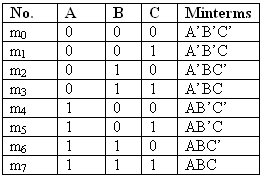
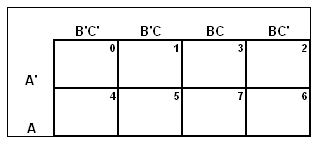 Carefully note how cells are numbered in above diagram. First cells is denoted by 0, second by 1 and then third by 3 and not by 2. This is because, A’BC (ANDing of first row A’ and third column BC) corresponds to decimal number 3 in the boolean table. Similarly, second row, third column ABC is denoted by 7 and not by 6.
Now, let’s understand how to simplify 3-variables K-Map by taking couple of examples.
Example of 3-Variable K-Map
Given function, F = Σ (1, 2, 3, 4, 5, 6)
Since the biggest number in this function is 6, it can be defined by 3 variables.
Let’s draw K-Map for this function by writing 1 in cells that are present in function and 0 in rest of the cells. You don’t necessarily need to write 0s but it is okay to have them.
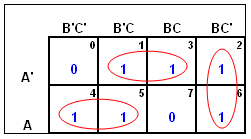 We need to apply rules for simplifying K-Map that we read in last tutorial. So, first we need to look for an octet i.e. 8 adjacent 1′s. There is none, so we should now look for a quad i.e. 4 adjacent 1′s. Again, there is none, so we will look for pairs. There are 3 pairs circled in red.
(1,3) – A’C (Since B is the changing variable between these two cells, it is eliminated)
(2,6) – BC’ (Since A is the changing variable, it is eliminated)
(4, 5) – AB’ (Since C is the changing variable, it is eliminated)
Thus, F = A’C + BC’ + AB’