
4-variable k-map

Vipin Hole
4-Variable K-Map – Karnaugh Map In Digital Electronics Tutorial Part 5
A 4-variable K-Map will have 24 = 16 cells. A function F which has maximum decimal value of 15, can be defined and simplified by a4-variable Karnaugh Map.
Boolean Table for 4 Variables
 4-variable K-Map
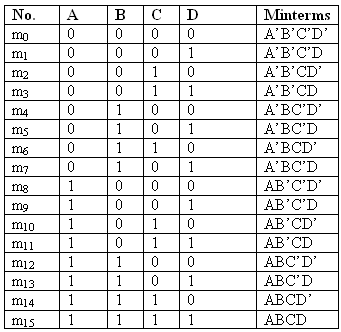
 Again, as we did with 3-variable K-Map, carefully note the numbering of each cell.
Now, let’s understand how to simplify 4-variables K-Map by taking couple of examples.
Example 1 of 4-Variable K-Map
Given function, F = Σ (0, 4, 6, 8, 10, 15)
Since, the biggest number is 15, we need to have 4 variables to define this function.
Let’s draw K-Map for this function by writing 1 in cells that are present in function and 0 in rest of the cells.
 Applying rules of simplifying K-Map, there are no Octets and Quads. There are 3 pairs, circled in red.
(0, 4) – A’C'D’ (Since B is the changing variable between these two cells, it is eliminated)
(4, 6) – A’BD’ (Since C is the changing variable, it is eliminated)
(8, 10) – AB’D’ (Since C is the changing variable, it is eliminated)
There is 1 in cell 15, which can not be looped with any adjacent cell, hence it can not be simplified further and left as it is.
15 = ABCD
Thus, F = A’C'D’ + A’BD’ + AB’D’ + ABCD
Example 2 of 4-Variable K-Map
Given function, F = Σ (0, 1, 3, 5, 6, 9, 11, 12, 13, 15)
Since, the biggest number is 15, we need to have 4 variables to define this function.
Let’s draw K-Map for this function by writing 1 in cells that are present in function and 0 in rest of the cells.
 Applying rules of K-Map, there is no octet. There are 2 quads and there are 3 pairs.
(1, 5, 13, 9) – C’D (Since A and B are changing variables, they are eliminated)
(9, 11, 13, 15) – AD (Since B and C are changing variables, they are eliminated)
(0, 1) – A’B'C’ (Since D is the changing variable, it is eliminated)
(1, 3) – A’B'D (Since C is the changing variable, it is eliminated)
(12, 13) – ABC’ (Since D is the changing variable, it is eliminated)
There is 1 in cell 6, which can not be looped with any adjacent cell, hence it can not be simplified further and left as it is.
6 = A’BCD’
Thus, F = C’D + AD + A’B'C’ + A’B'D + ABC’ + A’BCD’
Example 3 of 4-Variable K-Map
Given function, F = Σ (0, 2, 3, 4, 5, 7, 8, 9, 13, 15)
Since, the biggest number is 15, we need to have 4 variables to define this function.
Let’s draw K-Map for this function by writing 1 in cells that are present in function and 0 in rest of the cells.
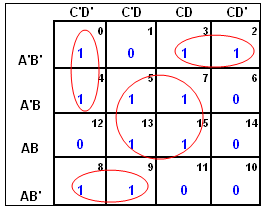 Applying rules of simplifying K-Map, there is no octet. There are 1 quad and 3 pairs.
(5, 7, 13, 15) – BD (Since A and C are changing variables, they are eliminated)
(0, 4) – A’C'D’ (Since B is the changing variable, it is eliminated)
(2, 3) – A’B'C (Since D is the changing variable, it is eliminated)
(8, 9) – AB’C’ (Since D is the changing variable, it is eliminated)
Thus, F = BD + A’C'D’ + A’B'C + AB’C’
Example 4 of 4-Variable K-Map
Given function, F = Σ (0, 3, 4, 6, 7, 9, 12, 14, 15)
Since, the biggest number is 15, we need to have 4 variables to define this function.
Let’s draw K-Map for this function by writing 1 in cells that are present in function and 0 in rest of the cells.
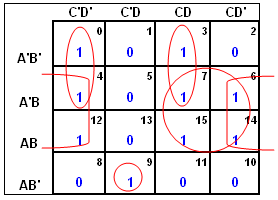 Applying rules of simplifying K-Map, there is no octet. There are two quads and two pairs.
(4, 6, 12, 14) – BD’ (Since A and C are changing variables, they are eliminated)
(6, 7, 14, 15) – BC (Since A and D are changing variables, they are eliminated)
(0, 4) – A’C'D’ (Since B is the changing variable, it is eliminated)
(3, 7) – A’CD (Since B is the changing variable, it is eliminated)
There is 1 in cell 9, which can not be looped with any adjacent cell, hence it can not be simplified further and left as it is.
9 – AB’C'D
Thus, F = BD’ + BC + A’C'D’ + A’CD + AB’C'D