
DoprSite Update On the Zionist War on Palestine

S. E. Anderson
Nearly 100 bodies recovered under Al-Shifa hospital in Gaza
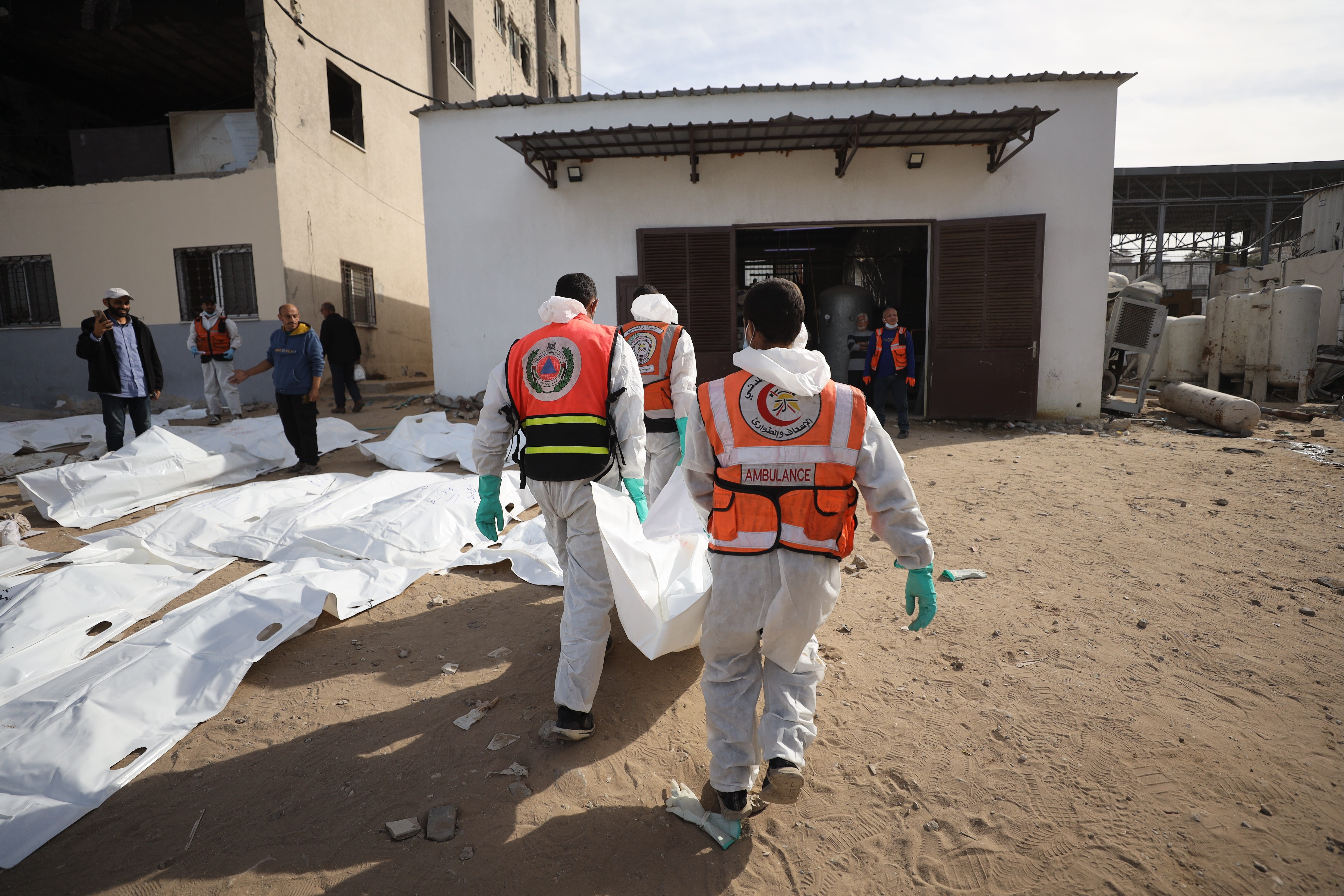
Civil Defense teams recover 98 additional bodies of people trapped under the rubble of Al-Shifa hospital. A new report estimates the Gaza genocide has produced over 60 million tons of rubble in Gaza. Tony Blair appears to be out as the prospective head of trump’s “Board of Peace.” The Israeli government to allocate an additional $843 million to West Bank settlements. Israeli warplanes strike southern Lebanon. Israeli National Security Minister Itamar Ben-Gvir and other party members wear a noose on their lapels to signal support for legislation that would allow for lynching Palestinian prisoners....
The Genocide in Gaza
-
Casualty counts in the last 24 hours: Over the past 24 hours, the body of one Palestinian arrived at hospital, while six Palestinians have been injured, according to the Gaza Ministry of Health. The total recorded death toll since October 7, 2023 is now 70,366 killed, with 171,064 injured.
-
Total casualty counts since ceasefire: Since October 11, the first full day of the ceasefire, Israel has killed at least 377 Palestinians in Gaza and wounded 987, while 626 bodies have been recovered from under the rubble, according to the Ministry of Health.
-
Israeli strikes kill a man in Deir al-Balah: A Palestinian man was killed and several others were injured Monday evening when Israeli aircraft struck the Al-Jarou family home in Deir al-Balah. Israeli forces simultaneously carried out artillery shelling, demolitions, and heavy helicopter fire across eastern Gaza, Rafah, and Khan Younis, the Palestine Information Center reported. Local sources said multiple homes were damaged and residential blocks demolished northwest of Rafah.
-
Tony Blair no longer expected to head trump’s “Board of Peace”: Bulgarian diplomat Nickolay Mladenov is poised to head a new executive committee under President donald trump’s proposed “Board of Peace” plan, sources told the Financial Times on Monday. Tony Blair is no longer expected to join the leadership board after objections from Arab and Muslim states, though allies say he may still serve on the committee with former Senior Advisor to the U.S. President Jared Kushner and trump’s Special Envoy Steve Witkoff. The board is expected to combine a governing council of world leaders with a technocratic Palestinian-led administration.
-
Civil Defense teams recover bodies under the rubble of Al-Shifa Hospital: Civil Defense teams in Gaza said that they recovered the bodies of 98 Palestinians from Al-Shifa Hospital on Monday, including 55 unidentified victims who had been buried on the hospital grounds during the height of the Israeli occupation’s genocide. The remains have been transferred to forensic authorities and relevant parties for formal burial, local officials reported. Dozens more bodies are still estimated to be inside the complex.
-
The Gaza genocide has created over 60 million tons of rubble: Gaza’s Environmental Quality Authority told an emergency government meeting this week that Israel’s assault has produced more than 60 million tons of rubble—including 4 million tons of hazardous waste, 50,000 tons of asbestos, and roughly 100,000 tons of explosives and unexploded ordnance—producing long-term environmental and public health risks, Al Araby reported. Israel’s destruction of 80 percent of Gaza’s water and sanitation infrastructure, the collapse of formal landfill and medical waste systems, and mass displacement of people have spread contamination across the enclave, officials added, leaving at least 700,000 tons of uncollected waste and causing widespread chemical leakage into Gaza’s soil and groundwater.
-
More heavy rains expected this week: Winter storm Byron is expected to hit Gaza on Wednesday after battering Greece and Cyprus with heavy rains, lightning, and strong winds. Gaza’s Government Media Office issued a statement saying the storm “carries real dangers, including the flooding of tents, the inundation of displaced encampments by rainwater, and the renewal of the tragedy endured by more than 1.5 million displaced people who have been living in dilapidated tents for over a year without any real solutions or alternatives.” The media office added: “We hold the Israeli occupation fully responsible for exposing displaced persons to the dangers of the climate, given its closure of crossings and its prevention of the entry of relief and shelter materials, including the prevention of the entry of 300,000 tents and mobile homes, in addition to the absence of alternative shelters.”
West Bank and Israel
-
$843M allocated to West Bank settlements: Israel’s far-right finance minister Bezalel Smotrich has allocated 2.7 billion shekels ($843 million) over five years to dramatically expand settlements across the occupied West Bank. This allocation will fund 17 new settlements, legalize existing outposts, deploy “absorption cluster” mobile homes that seek to become the nuclei of new settlements, relocate three army bases into Palestinian areas, and result in the building of new roads and structures within the region, Anadolu and the Palestine Information Center reported. Israeli media have described the package as “de facto annexation.”
-
Ben-Gvir and an associate wear noose-pins to signal support for executions: Israeli National Security Minister Itamar Ben-Gvir, Heritage Minister Amichai Eliyahu, and other members of the Otzma Yehudit (Jewish Power) party wore gold noose pins—a symbol widely associated with racial terror and lynching—during a meeting of the National Security Committee to discuss a bill to that would allow Israel to execute Palestinian detainees. During the hearing, Ben Gvir said that the noose is just “one of the options through which we will implement the death penalty law for terrorists...there is the option of the gallows, the electric chair, and also the option of euthanasia.” It is worth noting in this context that Israeli military courts convict more than 99% of Palestinian defendants.
-
Hamas condemns Israeli expansion in Marda: Hamas warned Monday that Israel’s bulldozing of 61 dunams of land in the village of Marda, north of Salfit, is a “dangerous escalation in settlement expansion.” Hamas official Abdul Rahman Shadid said the land is a vital source of livelihood for hundreds of families, and he warned of the environmental and economic destruction wrought by settlements, while urging Palestinians and the international community to intervene to stop Israel’s plans of annexation.
-
Israel holding 32 Gazans with expired sentences: Israel is still holding 32 detainees from Gaza whose sentences have fully expired—in some cases, for months or years—without judicial oversight or access to family visits or medical information, the Asra Media Office (AMO) said Monday, calling the practice a war crime under the Fourth Geneva Convention. AMO warned that Israel continues to withhold the bodies of prisoners who died under torture, including Dr. Adnan al-Bursh, as Gaza’s Health Ministry reports that more than 300 bodies returned since the truce show signs of severe abuse and mutilation, with autopsies indicating organ removal and what officials describe as “systematic” violations that require urgent international investigation.
-
Netanyahu to meet trump in Mar-a-Lago: Israeli Prime Minister Benjamin Netanyahu will meet President donald trump in the United States on December 29, according to Agence France Press. It will be Netanyahu’s fifth visit to meet trump in the U.S. this year. Israel’s Channel 12 reported that Netanyahu would visit trump’s Mar-a-Lago estate in Florida and that the two leaders were expected to meet twice during Netanyahu’s eight-day visit to the U.S.
How Israel Organizes and Arms Settler Militias to Terrorize Palestinians in the West Bank
What often appears as sporadic settler violence is in fact an organized system with an official structure fully operating as intended.
Story by David Schutz
IBSIQ, WEST BANK—On July 20, around ten masked men raided the Palestinian hamlet of Ibsiq in the northern Jordan Valley in the occupied West Bank. They arrived in a two car convoy, dressed in Israeli military-issue fatigues, and carried assault rifles fitted with green laser pointers.
While their vehicles blocked the road, they stormed into a cluster of homes. At gunpoint, they forced a Palestinian family to their knees and warned them they had 48 hours to evacuate Area C and go to Area B—referring to technical designations of control in the West Bank under the Oslo Accords. Area C is under full Israeli control and Area B is technically under Palestinian civil administration but shares security control with Israel. The masked men said they would “return and burn the community down,” if the family did not evacuate to Area B.
I had been staying with an elderly Palestinian couple for five days in Ibsiq to document settler violence amid rising threats against the community. As the men approached, I asked one of them who he was. They looked like soldiers, but the vehicles in which they arrived had yellow civilian license plates. These masked assailants were members of the hagmar— settler reservist militias formally attached to the Israeli army and tasked with “security” in West Bank settlements.
The men dragged me behind a fence where four of them beat me until I required hospitalization. They stole the phone of an International Solidarity Mission activist who tried to record the attack.
My host, Abu Safi, who was 84, had little choice but to leave his home after that raid by the hagmar. The family packed up their belongings accumulated over decades in the house and moved to a nearby location in Area B. Abu Safi died of a heart attack soon afterwards.
The raid on Ibsiq, whose Palestinian residents have since all fled the depopulated hamlet, offers a glimpse into an essential part of how Israel rules the West Bank.
In parallel with Israel’s genocidal assault on Gaza that began in October 2023, Israeli violence from settlers and soldiers in the West Bank escalated to record levels. About 3,000 settler-related attacks causing Palestinian casualties or property damage were recorded between October 2023 and mid-2025, with more than 1,000 of them in the first 8 months of 2025, and 264 incidents in October 2025 alone—the highest monthly total since the UN began monitoring in 2006.
Over the past two years, settlers have increasingly been “going into houses, holding people at gunpoint, and giving them 24 hours to leave, and many have…It happened in Khirbet al-Maktal, Umm Salam, Razeem, and elsewhere,” said a field researcher with Israeli human rights group B’Tselem. He spoke to Drop Site on condition of anonymity out of security concerns. “We file complaints, but many times the authorities tell us the perpetrators were acting outside their capacity as soldiers, so we’re referred to the police,” he added. “Then the police say it’s a military matter. We end up in a situation where no one investigates.”
An Integrated Web of Civilians and Soldiers
Settler violence against Palestinians often appears sporadic, but it is an official government system with an organized structure operating as intended.
Since 1967, Israel has ruled occupied Palestinian territories through dual structures—military occupation and civilian settlements—each reinforcing the other while mutually devolving responsibility.
At the heart of this arrangement lies a legal device: regional settlement councils, chartered under the 1964 Municipalities Ordinance as standard Israeli municipalities, yet which operate in occupied Palestinian territory. Israeli jurisdiction rests on military orders and the West Bank Emergency Regulations, which extend most aspects of Israeli law in personam to settlers but not to the land itself. Territorial authority is supplied by the Israeli military, making the army the de facto sovereign.
Within this framework, the state delegates enforcement to settlers. Each settlement appoints a ravshatz, or a civilian security coordinator, paid by the Defense Ministry and authorized by the military to command a plain clothes rapid-response squad, or kitat konenut, of 20 to 40 volunteers within the settlement boundary. Weapons are issued from the Defense Ministry’s Department for Settlement Security; additional arms also flow from the National Security Ministry.
Inside Israel proper, these squads fall under police authority. Beyond it, across the military’s sector that covers rural border areas and all West Bank settlements, the ravshatz usually operates through a local security officer, or kabat, who is appointed by the settlement council to coordinate with the army.
Parallel to the ravshatz are the Hagmar Territorial Defense brigades: a reserve network integrating each settlement into a military grid broken out into districts, blocs, and areas. At the two top levels—district and bloc—the hagmar report to the regional hagmar command of the IDF. At the lowest level, the area hagmar corresponds to a single settlement. Each settlement coordinates with its area hagmar through its appointed kabat.
The hagmar are issued uniforms by the IDF, while the kitot konenut are not. The distinction between the kitot konenut and the area hagmar is merely a technical one, with the same settlers often serving in both units.
In short, the settlement appoints a security coordinator who essentially commands his own volunteer militia that is armed and funded by the state. Those same settler volunteers also often serve in uniformed army reservist militias under the control of the military that coordinates with their settlement. The volunteer militias, the reservist militias, and the military itself all work together to attack and terrorize Palestinians in the West Bank.
Although wartime command is meant to shift from local coordinators to the army, the West Bank has never officially been declared a war zone. It remains under what the military calls “ongoing routine security,” a permanent state of civilian control by armed settlers under military cover.
“On paper, the weapons are checked in and out by the ravshatz, but in reality, they almost never come back,” said an Israeli solidarity activist who monitors settler violence in the South Hebron Hills, and who spoke to Drop Site on condition of anonymity, citing security concerns. “In some councils, the armory rules are strict; in others, people just keep the guns at home. It depends on the local kabat and how much the army wants to look the other way.”
While the ravshatz and the settlement’s kitat konenut are technically limited to operating within their settlement, military auxiliaries like hagmar, operating in theory at broader territorial echelons, are not.
“The result is that we have settlers operating as the military without regulation,” Roni Peli, of Israeli human rights organization Yesh Din, told Drop Site.
Forced Evictions
This system was on full display in mid-October on the outskirts of Al-Mufaqara, a hamlet in Masafer Yatta. Armed settlers broke into a Palestinian family’s cave-home, forcibly expelled them, and moved in—threatening to shoot anyone who approached. I arrived a few hours later to find the family and several Israeli solidarity activists outside waiting for the police.
“When the Palestinians tried to stop them, a group of armed men arrived, some in uniform, some not, including Binyamin Zarbiv, the ravshatz from Ma’on,” an Israeli activist who witnessed the incident told Drop Site, pointing to the settlement some 200 meters away. They also spoke on the condition of anonymity, citing security concerns. “They aimed their rifles at the Palestinians and at us, while the settlers carried their belongings inside.”
As we waited, an armed man in a ragtag uniform, identified by the activist as one of those who had arrived earlier, demanded my ID. He claimed to be representing Hagmar Har Hevron, though no such Israeli military unit officially exists, and identified himself as a member of three bodies: Ma’on’s rapid-response squad, the area hagmar unit, and a so-called farm patrol. He refused to say which group had sent him.
“The settler who broke in called the ravshatz on his phone,” the activist said. “That’s how it usually happens. The ravshatz makes a few calls, and within minutes they start showing up—half in uniform, half not—all with state-issued rifles.”
The man told me that he would be collecting a full day’s pay for his work, and acknowledged that he could do so whenever he wanted. He claimed his rifle came “from the army,” adding that he had received it “from the base,” but when pressed, he clarified that the “base” was the settlement itself, where no army base exists.
When the Israeli Civil Administration and police finally arrived, accompanied by army soldiers, they declined to review documents proving Palestinian ownership and left the militia in control of the site.
A few kilometers away in Susya, footage from August 24 shows a group of armed men invading the small community, some in fatigues, others in civilian clothes. One of them assaulted a Palestinian resident who was later hospitalized with a severe concussion.
The head of the Susya village council, Jihad Nawaja, said he recognized the attackers immediately. “I’ve known this man for 15 years,” Nawaja told Drop Site, pointing to an armed settler wearing civilian clothing. “The one who beat the Palestinian was his son. They came with armed men from Susya, in uniform, to tell us to evacuate. ‘Leave and move to Hebron,’ they said. There was no other reason for them to come that night.”
The B’Tselem researcher, who is also a resident of Susya, said armed groups of organized settlers frequently also detain Palestinians. They “kidnap people often … anyone who tries to resist eviction. They take him, warn him not to do it again, and release him later,” he said. “I once saw them during an attack near Susya. Settlers were escaping from the police, and one of these men helped drive them away.”
In a recurring pattern, settlers raid in broad daylight and, hours later, the same men reappear in uniform to enforce closures and secure the ground they seized.
“They also actively intercept the army’s radio frequency, to listen in on coordinations with the Palestinians. Once we had coordination for plowing, from four to eight o’clock… they found out and made sure it stopped,” the B’Tselem researcher added.
Rights groups report that complaints about organized violence by armed settlers routinely bounce between various jurisdictions of Israeli authorities. Police classify suspects as “military auxiliaries” and pass the files to the army; the army returns them as “civilian” cases; civilian authorities cite military jurisdiction, and the investigations close for “lack of evidence.”
A Private Army
Before October 7, 2023, Israel maintained about 450 rapid response squads, according to a 2024 report by the Knesset Research and Information Center (KRIC)—the non-partisan research arm of the Israeli parliament. Roughly 390 of the kitot konenut operated under army supervision in West Bank settlements, while the border police (a police paramilitary unit that operates on both sides of the green line) oversaw 50 and the police oversaw fewer than ten.
The report found that the division of control between government bodies over these units rests on a 1974 government decision that was never published and is missing from the state archives. Military Order 432 of 1971, which regulates kitot konenut in the West Bank, and related directives on open fire and emergency mobilization also remain classified.
In the report, researchers described sweeping non-cooperation from the Israel police, Defense Ministry, and IDF—none of which provided data on the squads’ authority, arming, or oversight. The KRIC noted that its report relied on partial replies and public sources, as “no response was received from the bodies involved.”
Following October 7, National Security Minister Itamar Ben-Gvir announced more than 700 new kitot konenut, expanding the police-run network, while the army’s share remained largely unchanged. The new units were incorporated under the border police, the only way Ben-Gvir could get a mandate to operate outside the green line. By early 2024, the government listed 906 active units, with a target of 1,086 by year’s end. By late October 2025, 1,052 kitot konenut units were active.
In October 2023, Ben-Gvir’s ministry also began distributing around 10,000 newly purchased assault rifles to kitot konenut and loosened gun-ownership eligibility, while the Defense Ministry supplied training, ammunition, and armory infrastructure. By November 2025, Ben-Gvir’s office said roughly 230,000 gun licenses had been issued over the past two years. Meanwhile, the National Missions Ministry funded vehicles, drones, and surveillance systems; regional councils added weapons and vehicles through private and foreign donors, including U.S.-Jewish federations that gifted sniper rifles to kitot konenut under campaigns like “Friends of Samaria.”
The KRIC noted that much of this equipment was distributed through ravshatz-operated armories, bypassing Israeli military depots. Earlier in 2023, the government created the Mishmar Leumi (National Guard), a Border Police reserve under Ben-Gvir, meant to absorb local militias and volunteer frameworks. Activated after October 7, it became a vehicle for mobilizing and reinforcing kitot konenut, with recruitment tracks allowing civilians to join armed policing roles outside the traditional Magav or IDF pathways. Formally under the police commissioner, its control can shift to the minister of national security in emergencies.Leading critics call it Ben-Gvir’s “private army.”
Simultaneously, the army expanded hagmar battalions, adding about 5,500 reservists for a total of roughly 8,000, divided between regional companies and settlement-level auxiliaries known as bnei hayishuv (“sons of the town”).
Finance Minister Bezalel Smotrich’s new Settlements Administration inside the Defense Ministry absorbed powers from the Civil Administration, giving his office direct control over civilian-security budgets: armories, budget lines, weapons requests, and patrol mandates. Under this structure, new siyur havot (“farm patrols”) emerged to police land outside settlement boundaries, funded from the same Defense Ministry budgets as the kitot konenut.
By May 2024, when the army began reducing hagmar deployments, a parallel militia network aligned to Ben-Gvir’s National Guard and Smotrich’s policy priorities was already firmly entrenched. The military is now considering further troop reductions in the West Bank, transferring security responsibilities to “local elements,” according to the Jerusalem Post.
On their websites, West Bank regional councils describe their roles in deliberately opaque terms: the South Hebron Hills Council boasts of “creating and maintaining local security elements”; the Jordan Valley Council pledges to “define security components in conjunction with security forces”; and the Binyamin Council vows to “improve and maintain local security components.”
“They don’t distinguish even between the hagmar and the rapid-response squads, everyone’s in uniform now,” a resident from the South Hebron Hills told Drop Site on condition of anonymity. “I know many of them by name. Some even have criminal records. Now they’ve been given uniforms. ///
s. e. anderson
author of The Black Holocaust for Beginners
www.blackeducator.org
"If WORK was good for you, the rich would leave none for the poor." (Haiti)
--------------------------------------------