
Which Paramapara or Disciplic Succession is followed in ISKCON?

Bhagavat-Sangi-Sangasya
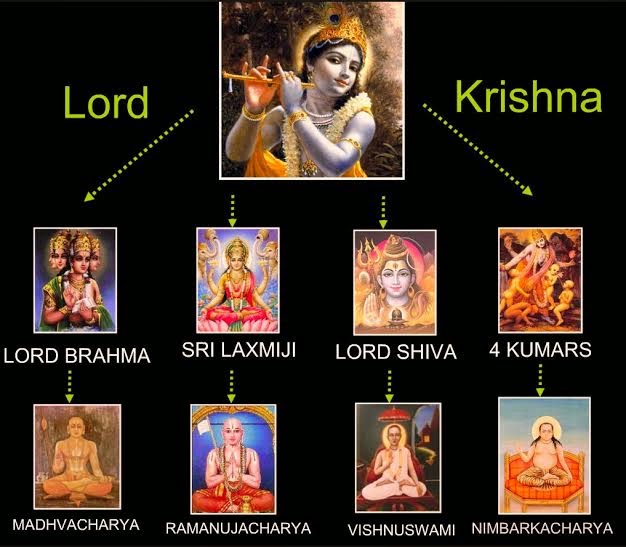
Spiritual knowledge is passed on from master to disciple in a Disciplic succession. The original spiritual master is Krishna. In the beginning of creation, He imparted spiritual knowledge to four bona fide authorities and they are the progenitors of the four bona fide Vaisnava Sampradaya. These are - the Brahma Sampradaya, beginning from Brahma, Sri Sampradaya coming down from Goddess Laksmi, the Kumara Sampradaya coming from the four Kumaras and Rudra Sampradaya coming from Lord Siva.
 Gauḍīya indicates the part of India between the southern side of the Himalayan Mountains and the northern part of the Vindhyā Hills, which is called Āryāvarta, or the Land of the Āryans. This portion of India is divided into five parts or provinces (Pañca-gauḍadeśa): Sārasvata (Kashmir and Punjab), Kānyakubja (Uttar Pradesh, including the modern city of Lucknow), Madhya-gauḍa (Madhya Pradesh), Maithila (Bihar and part of Bengal) and Utkala (part of Bengal and the whole of Orissa). Bengal is sometimes called Gauḍadeśa, partly because it forms a portion of Maithila and partly because the capital of the Hindu king Rāja Lakṣmaṇa Sena was known as Gauḍa. This old capital later came to be known as Gauḍapura and gradually Māyāpur.
The devotees of Orissa are called Uḍiyās, the devotees of Bengal are called Gauḍīyas, and the devotees of southern India are known as Drāviḍa devotees. As there are five provinces in Āryāvarta, so Dākṣiṇātya, southern India, is also divided into five provinces, which are called Pañca-draviḍa. The four Vaiṣṇava ācāryas who are the great authorities of the four Vaiṣṇava Disciplic successions, as well as Śrīpāda Śańkarācārya of the Māyāvāda School, appeared in the Pañca-draviḍa provinces. Among the four Vaiṣṇava ācāryas, who are all accepted by the Gauḍīya Vaiṣṇava, Śrī Rāmānuja Ācārya appeared in the southern part of Andhra Pradesh at Mahābhūtapurī, Śrī Madhva Ācārya appeared at Pājakam (near Vimānagiri) in the district of Mangalore, Śrī Vishnu Svāmī appeared at Pāṇḍya, and Śrī Nimbārka appeared at Muńgera-patana, in the extreme south.
Sri Caitanya Mahāprabhu accepted the chain of Disciplic succession from Madhva Ācārya, but the Vaiṣṇava in His line do not accept the Tattva-vādīs, who also claim to belong to the Mādhva-sampradāya. To distinguish themselves clearly from the Tattva-vādīs branch of Madhva's descendants, the Vaiṣṇavas of Bengal prefer to call themselves Gauḍīya Vaiṣṇavas. Śrī Madhva Ācārya is also known as Śrī Gauḍa-pūrṇānanda, and therefore the name Mādhva-Gauḍīya-sampradāya is quite suitable for the Disciplic succession of the Gauḍīya Vaiṣṇavas. Founder Acharya of the International Society for Krishna Consciousness, Oḿ Viṣṇupāda Śrīmad A. C. Bhaktivedanta Swami Prabhupad, accepted initiation in the Brahma- Mādhva – Gauḍīya Vaishnava sampradāya. Thus, all initiated devotees of ISKCON also belong to this sampradaya.
Vaisnava Sampradaya | Beginning with | Authorities of the Sampradaya |
Brahma Sampradaya | Lord Brahma | Madhvacharya |
Sri Sampradaya | Goddess Laksmi | Ramanujacharya |
Kumara Sampradaya | Sanata Kumaras | Nimbarkacharya |
Rudra Sampradaya | Lord Shiva | Vishnu Swami |