
干细胞治疗带来新希望(Redstar报道)
0 views
Skip to first unread message

wade.wang
Nov 14, 2008, 7:17:03 AM11/14/08
to beikecell
2007年5月,苏格兰人巴尼开始了他人生中第一次中国之旅。他三十岁左右,正值人生黄金阶段,然而对于他来说,这是他一生最大的冒险。巴尼高大强壮,当他告诉你他曾经是一名出色的橄榄球手时,相信你并不会感到惊奇。
苏格兰多山的地形使徒步旅行充满挑战,多雨的天气使道路变得泥泞不堪。撞车,跌跤,滑倒,摔落都不足为奇。但是这对于巴尼来说却是极不平常的,他知道自己为什么总是摔倒即使他的同事老是取笑他笨,连路都走不好。
巴尼和他的家庭成员一样,饱受共济失调的折磨,就像他的妈妈姐姐一样,病情会越来越重,渐渐地让他失去力气,直到死去。在临床上,它还是不可治愈的。
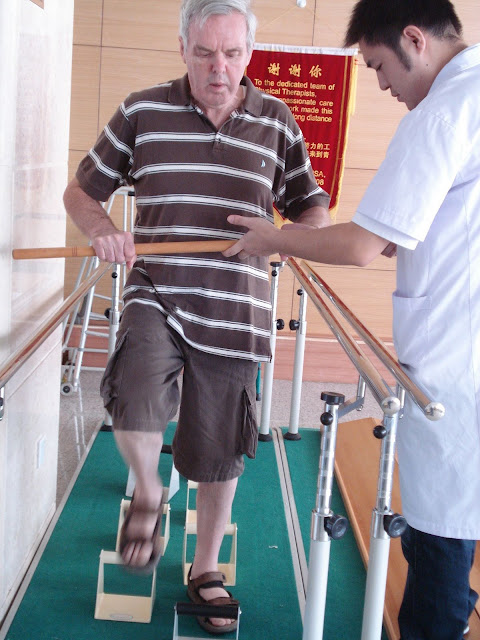
巴尼来到中国,他尽最大努力去说话,每一个动作都要用尽全身力气,走路更需要全神贯注。在第一次治疗之后,他的说话能力有了显著的提高,走路也比以前容易多了。现在,通过在青岛接连的三次治疗后,巴尼看上去比以前更年轻,健康。打眼看上去,你肯定不会相信他有过病。
巴尼说,“对我来说,最糟糕的事情莫过于紧张和抽搐。但是,现在它们都消失了,在我来中国之前,我从来不敢想象我能骑自行车,现在呢,我骑上就走。干细胞给我的身体注入了活力。”
青岛城阳人民医院的温蒂说,“干细胞对共济失调和视神经萎缩的治疗效果最好,共济失调的病人,一到两次治疗之后,就会明显感到平衡能力提高,有些病人会发现说话也比以前清楚很多。对于视神经萎缩的病人,经过治疗之后,他们能感觉到光了。之前有一个美国的小男孩,起初他的眼睛对光没有一点反应,治疗后,医生用光刺激他,他的眼睛开始眨了。”
重见光明?事实证明。去年,美国的萝莉来到中国接受治疗。“妈妈,你真美!”她已经六岁了,这却是她第一次看见妈妈。她的重见光明引起了广大新闻媒体的关注,你可以在stemcellchina.com通过视频观看她的进步。
这只是冰山一角。“现在,我们估计60%的病人有了显著的提高,90%有所改善。”温蒂说。也许最有力的证明要数美国的大卫,2002年他从船上跌入水中伤到后背,从那以后,他的腿几乎动弹不得,视力模糊,仅限于一些模糊地轮廓,听力也下降了,听到的都是些类似噪音的东西。2006年9月,在第一轮治疗之后,他能够近距离的阅读,看电视了。他能握起他的手,这样他就能自己推轮椅并能够坐起来。在今年进一步治疗之后,他现在能够跪在地上,看见颜色,控制自己的手指喂自己吃饭了。
中国在经济和科技的进步下,并没有遭遇类似西方国家政策的限制和规定。没有干细胞治疗,萝莉就会在黑暗的世界里生活一辈子,大卫也不会从轮椅上站起来,巴尼说不定已经面临死亡。这个领域不断的发展让共济失调的病人看到了希望。
“因为我的大脑在退化,这意味着我只能回忆过去。”巴尼说,“我很喜欢来中国,在这之前,我没想过跟中国姑娘谈恋爱,一心只想治病,遇到温蒂后,我们一见钟情。一个月之后,我又回来了。。。”
“春节的时候我带他去日照见了我的父母,我们打算明年五月份结婚呢。”温蒂高兴地笑着,像个小孩一样。
May 2007 and Scotsman Brian McNeil is making his first trip to
China. In his mid thirties, this is the adventure of a lifetime for him. Brian
is tall, around 6'2", and solidly built - it comes as no surprise when you learn
that in his youth, he was an accomplished footballer, though tearing a groin
muscle ended any career aspirations. Until recently he worked in the forestry
industry, spending long days in demanding conditions in the British outdoors.
The hilly terrain of Scotland makes for challenging hiking and
the weather makes the footing loose. Accidents, trips, slips, falls are not
uncommon. But they were becoming increasingly uncommon for Brian, and
increasingly immobilising. He knew why he was falling, even if his colleagues
jested him for his clumsiness.
Brian, like many of his family members, suffers from ataxia, a
hereditary and degenerative neurological disorder leading to dysfunction of the
nervous system and muscle coordination. It, as with his mother and sister, would
get worse, gradually paralysing him and eventually leading to death. It remains
clinically incurable.
-------------------------------------------------------------------------------------
Hope where there wasn't any
Beike Biotechnology are based in Shenzhen, and have been
extracting and cultivating stem cells - precursor cells that can be encouraged
to form specific tissues - from the umbilical cords of healthy newborns since
1999. One transfusion generates around 300,000 cells, a tiny amount, which is
multiplied, and then conditioned to form the basis of whatever is required -
spinal cord cells, nerve cells, muscle tissue and so on. Since 2001, they have
been administering the cells to patients in experimental medical procedures by
two methods; targeted IV and spinal injections.
By the time Brian arrived in Hangzhou, he was struggling to
speak. Every movement was thoroughly laboured and walking required an intense
amount of focus. After his first course of treatment, his speech had noticeably
improved and movement was easier. Now, after three subsequent trips to Hangzhou
and Qingdao, Brian looks visibly younger, fitter and more healthy. To look at
him, you wouldn't know he was ill.
"The worst thing for me was the nervousness and the shaking. But
that's gone. Before I came, I never had the confidence to get on my bike. Now I
just get on and go. It seems to give a boost to your whole body."
The treatment is administered in conjunction with extensive
physiotherapy. It is thought that by targeting the therapy to areas where
improvement is required, the stem cells will regenerate the missing or damaged
tissue. Brian's early therapy included walking exercises and speech therapy.
However, the treatment is so experimental that limited quantitative analysis can
be done.
"The most change is in ataxia and optic nerve hypoplasia," says
Wendy W., Managing Nurse in Qingdao's Chengyang People's Hospital, "With ataxia,
after one or two treatments, the patients notice their balance is better; some
of them find that their speech is clearer. For ONH, they see light. When I was
in Hangzhou, there was a little baby from America. At first, there was no
reaction to light, then [Xiaoshan Hospital's] Dr. Shi shined a light in front of
his eyes, and he started blinking."
Let there be...
Restoring sight? This is not an isolated case. Last year
American toddler, Rylea Barlett came to China, and her plight was given a lot of
media attention in the US, gracing local and cable news networks and being
sensationalised in the National Enquirer under the byline, "Mommy, you are
beautiful!" Bear in mind, at 6 years old, this was the first time she had seen
her mother. You can see the videos of her progression at stemcellschina.com, or
read her blog at nomoredarkness.com.
But this is Just The Tip of the iceberg. To date, Beike (which
is just one of the Chinese companies researching stem cells) have treated
diseases and ailments as varied and extreme as amyotrophic lateral sclerosis
(Lou Gehrig's Disease), autism, brain injuries, cerebral palsy, epilepsy,
diabetes, Huntington's Disease, Parkinson's Disease, spinal cord injuries and
strokes with varying degrees of success - but for the most part, success.
Since it remains difficult to classify, the best way to gauge
the level of improvements is through the experiences of the patients and nurses.
"Right now, we estimate 60% of our patients exhibit notable improvements, that
is, their expectations are met. 90% of our patients show some improvement. We
don't do miracles," says Wendy, "Right now we have sixteen patients, who suffer
from ONH, cerebral palsy and spinal cord injury."
They don't do miracles, but one male patient from New Zealand
did get sensation back in his lower half, which put a smile back on his
girlfriend's face.
Perhaps the most extreme example of the power of this medical
tool are the improvements of American, David Aldrich. In mid 2002, he fell off a
boat in shallow water, damaging his back during the fall. After spending several
minutes immersed in water he was found and dragged to safety. He could barely
move his limbs, bend or stand. His vision was restricted to vague shapes and his
hearing overwhelmed by background noise. His blood pressure reduced to the
extent that he needed a pacemaker to prevent him from passing out.
After his first round of treatment, in September 2006, he could
read at close distance and watch television. He could grip with his hands, which
allowed him to drive his wheelchair and he could sit up. After further treatment
this year, he is now able to kneel, see colours and is working to control his
fingers such that he can feed himself and better control his laptop.
------------------------------------------------------------------------------------
Why China?
Necessarily strict regulations on medical testing render human
experiments with stem cells next to impossible in the US and Europe. The lack of
an empirical way of tracking what improvements (or degeneration) a patient
endures as a result of the treatment means that the FDA and other institutions
are reluctant to pursue it. Brian's torn groin no longer gives him any pain. He
puts that down to the stem cells. Amazing, but an unpredicted improvement, and
one that implies that someone made erroneous assumptions about his treatment.
Generally though, the negative side effects reported are quite benign; nausea,
headaches, general feverish symptoms, which are usually reported immediately
after the treatment is administered.
Added to this is the religious right that see genetic and stem
cell research as tantamount to playing God, and the pro-life brigade that
condemn the use of embryonic stem cells because the foetus must be killed
(though Beike to date have not used cells from unborn babies). Interestingly,
Iran, who are also engaged in stem cell research and generally considered to be
even more far-right than the US, surmount this assumption because according to
Islamic law, the foetus is 'ensouled' 120 days after conception, meaning the
embryo can be subjected to the researcher's syringe prior to this event.
China does not suffer from these ideological inhibitors, or
strict regulations that fly in the face of economic and technological
progression.
On the human side, the decision ultimately comes down to what
the patient stands to lose. Rylea would have grown up blind. David would never
have moved again. Brian would have died. And continuing developments in the
field are looking better and better for ataxia sufferers - Japanese researchers
have discovered that a combination of gene therapy and stem cells can cure the
disease in mice.
"Because my brain is degenerative, it means I'll have to keep
coming back." he said, though not with apprehension. He clearly likes coming to
China, "It's been quite amazing, when I came over here for treatment, I wasn't
interested in any women, I just wanted to get better. I met Wendy and it went
'click'. I came back a month later...."
"I took him to see my family in Rizhao for Spring Festival."
says Wendy, gingerly, knowing it's a dangerous move for potential suitors. She's
giggling like a little girl. "We're getting married next May."
2008-11-14
wade.wang
Reply all
Reply to author
Forward
0 new messages