
Esper Control at Pro Tour Battle for Zendikar - 13th, Patrick Chapin
Skip to first unread message

raymundo calimbas
Oct 20, 2015, 7:01:38 PM10/20/15
to Beast

Abzan may have defeated Jeskai in the finals of the Pro Tour… again… but the format is in a very different place now that Battle for Zendikar has replaced Theros block. There's no question the set's primary contribution comes from the lands. The following is a list of the Battle for Zendikar cards that appeared in the most 6-4 or better decks at the Pro Tour (at least one copy).
10. Ob Nixilis Reignited & Exert Influence (tie)
7. Canopy Vista
6. Cinder Glade
4. Gideon, Ally of Zendikar & Dispel (tie)
Prairie Stream was played by over half of the winning records, while Ob Nixilis Reignited appeared in 18%. Cards not appearing on the above list showed up in less than 13% of decks.
Other BFZ cards appearing in winning decks:


With 19.3% of the set showing up in winning lists, the set is below average in terms of depth, but not outlandishly so. Unfortunately, so much of the power is tied up in the lands, it makes casting Khans of Tarkir cards easy, which pushes out possible new Battle for Zendikar cards.
There were two Open Series events in the weeks leading up to PT Battle for Zendikar, and there's no denying the impact those results had. The top 3 decks of the first two weeks were Jeskai Black, Atarka Red, and G/W Megamorph, so it's no surprise to discover these three archetypes were the most played at the Pro Tour, and all three performed reasonably.
Meanwhile, Esper Dragons and Abzan were both quite popular week 1, but mostly fell off week 2, when players learned more about their weaknesses in the new format. When the Pro Tour rolled around, both archetypes performed poorly (despite Abzan taking home the trophy).
Early in testing, we concluded that Crackling Doom was going to be omnipresent in the format, which made Dragonlord Ojutai seem unappealing as a primary victory condition. It's such a good addition to Jeskai and costs so little, since Polluted Delta is functionally a quad-land, and both Flooded Strand and Bloodstained Mire are functionally tri-lands that can usually enter the battlefield untapped.
Another important observation was the lack of options for cheap removal. There is exactly one card in the format that can remove either Jace, Vryn's Prodigy or Hangarback Walker for two or less mana without losing value.

This was an important realization that led to a number of insights about the format and what cards people would end up playing. Most importantly, Jace, Vryn's Prodigy seemed like the defining card of the format. It's generally a good draw at all points in the game, even when you already have a Jace going. It demands an answer almost immediately, which is extremely uncommon for a two-drop.
Even when they kill it, you aren't really that much worse off since you only spent two mana on it. Besides, if you spend your second turn playing a Jace and then your opponent spends their turn dealing with it, the control deck is ahead on the exchange, since it means they are one turn closer to being able to play their more expensive spells. Even if their Wild Slash wasn't going to do much for a while, if they tapped out on two to play a Hangarback Walker and now have a Mantis Rider and a Wild Slash in their hand, Jace could still be an excellent play.
Jace is just an unreal card in the format anyway. The printing of Battle lands makes it easier to play a ton of delve cards. Dig Through Time and Treasure Cruise are among the best cards to flashback with Jace since you can get a very powerful effect for very little mana by the time you can flip Jace. His looting ability actually makes delve cards even cheaper. Exiling cards to pay for delve can actually allow you to keep looting with one Jace while using another as a planeswalker.
While I did try some exotic brews, it pretty quickly seemed like the mana lent itself best to "good stuff" decks, so most of my time was spent tuning various Esper, Esper with red, and Esper with green decks.
Why Esper?
Blue - Jace and Dig Through Time
White - Gideon, Secure the Wastes, lifegain, better removal than black
Black - Shambling Vent was the primary draw, but Duress, Ob Nixilis, and more creature kill options were appreciated
Red offered Wild Slash, Fiery Impulse, Crackling Doom, Kolaghan's Command, Radiant Flames, Mantis Rider, and Butcher of the Horde, but we ended up finding a mix of removal that didn't require the fourth color. Besides, the lack of a red creature-land meant that the only way we could play red and get any would be to play Temur (which I tried); but that misses out on both of the good removal colors (and most of the good red cards).
Green offered Lumbering Falls, Nissa, Vastwood Seer, Den Protector, Anafenza, the Foremost, Siege Rhino, and Abzan Charm. The problem with this list, of course, is that half of those cards require both black and white (much like the red cards). I'm very interested in Abzan Blue (which I found to be better than straight up Abzan, and favored against Esper), but I didn't like it for this past weekend, as it was too soft to Atarka Red and many shades of Jeskai Black.
Here's the list Paul Rietzl, Matt Sperling, and I shuffled up this weekend:

Creatures (4)
Planeswalkers (4)
Lands (27)
Spells (25)

The only variation among our lists was the Utter End in the sideboard. Paul and Matt played a Despiseinstead, and it was solid for them, though it sounds like they wouldn't mind the Utter End. Our combined record with the deck was 17-8-5, which included Paul defeating me in the mirror.
The draws were extremely unfortunate (primarily Esper mirrors), particularly since Paul, Matt, and I don't get a ton of unintentional draws in the first place. Fetchlands take a long time to resolve, but that's one of the costs to playing a strategy like this. Moving forward, I think more consideration needs to be given to completing matches in time, even if there is some loss of objective quality because of playing more victory conditions both in the maindeck and sideboard.
One of the first places to look is a third Secure the Wastes.

Secure the Wastes was one of the big standouts from our testing. At one point I was looking for more possible spells to help keep Jace at a high power level, despite cutting white removal spells for Silkwraps. I tried one, and it was awesome every time. I eventually tried a second, and then a third, and even a fourth. The relative weakness against G/W Megamorph, Abzan, and other Den Protector decks was the only thing holding me back on the card, but I think I want to try three moving forward.
Everyone that tried the card found it to overperform, and we all started wondering if we had missed something in the previous format. However, the previous format featured Elspeth, Sun's Champion, which kind of just stepped on Secure the Wastes. Elspeth was a crazy powerful token maker, victory condition, and general way to gain an advantage in the game. The format warped so much around Elspeth, tokens were not as naturally strong as they would be. Plus, the format featured cards like Bile Blight as regular fixtures.
Nowadays, Secure the Wastes is a defensive card that can be used offensively when we need to close. Early, it's common to Secure the Wastes for two or three to provide a little defense. You can often trade with a Nissa, Vastwood Seer or Soulfire Grand Master; but it's super nice to be able to produce enough blockers to stop a Hordeling Outburst with a single card (particularly when Duress helps reduce the risk of Atarka's Command blowing you out). It's also one of the best answers in the format to Lumbering Falls, and responding to your opponent's Crackling Doom with a Secure the Wastes for two when they try to kill your Jace…? Well, that's the kind of play that wipes smiles off of faces.
Later in the game, you can Secure the Wastes for a large amount, generating virtual card advantage or helping keep opposing planeswalkers from ultimating against you. It's also a nice road to victory that is harder to defend or play around than most, particularly when Crackling Doom makes hexproof so much less valuable. Secure the Wastes is also an interesting Jace target, since early, you can use it to chump or trade with something small. Then, when you've developed your mana a lot more, you can sink all of your mana into flashing it back for a much larger board presence.
One of my favorite plays with Secure the Wastes is to hold up four mana on turn 4, facing a creature or two. Sometimes people will respect Ojutai's Command, or think you are trying to bait them into a more effective Languish (and maybe you are, maybe you aren't). If they do nothing, you can end step Secure the Wastes for three, then untap and drop Ob Nixilis, Reignited with plenty of blockers to help protect him.
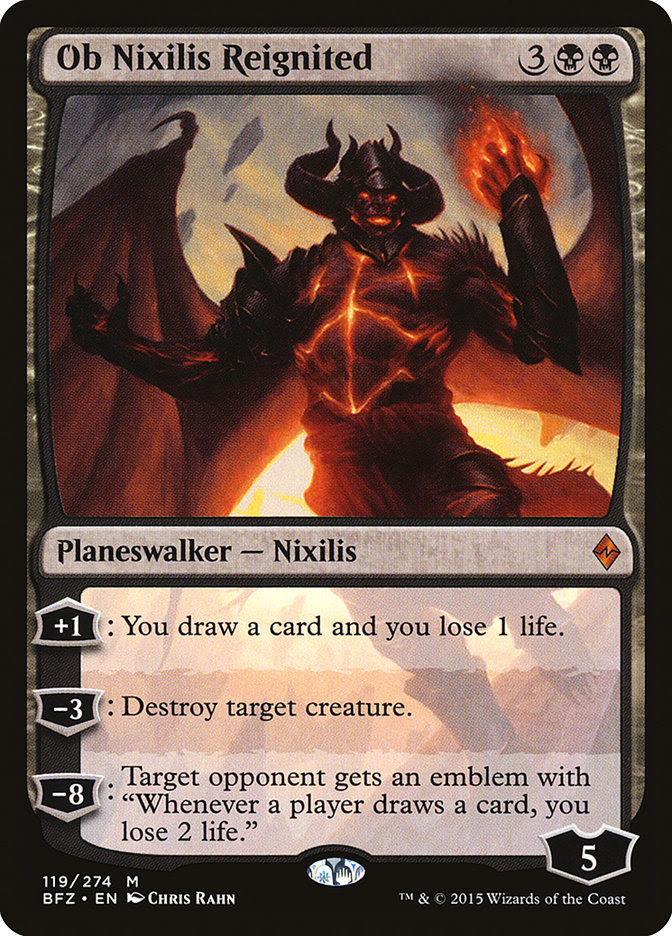
Ob Nixilis isn't as crazy good of a rate or as versatile as Gideon, Ally of Zendikar, but it's still a great card. The key is to think of it as an Underworld Connections that costs one more the first turn, but then is free every turn after. Additionally, whenever you want, you can buy a Murder that you don't even have to spend mana to cast. A common play is to use Ob Nixilis to kill your opponent's Hangarback Walker, then use Jace to flashback Languish and kill several creatures, including all the Thopter tokens. It's a nice way to solve a bunch of hard problems at the same time.
There are two primary times to play Ob Nixilis:
1) When your opponent has a single creature, so you can kill it and have an Underworld Connections on the table free and clear.
2) When you already have the board stable, or at least a high life total against an opponent with five or less power on the table, so that you can drop the Ob Nixilis and draw a card. Your opponent is often going to have to start attacking him, and then it's like you've gained six life, plus another each turn (completely off-setting the life loss from the card draw, and then some).
Ob Nixilis is also an important way to close out games in a hurry. If you can keep Ob Nixilis on the battiefield for three turns without needing to Murder anything, you ultimate him and end the game very quickly and reliably. Not every board is stable enough to use his ultimate, but I've never seen anyone beat it when actually used.
It's a much more reliable kill than Jace's ultimate, for instance. Jace, I usually wait until he can live through it, unless I already have another Jace waiting. Often, I just keep ticking up anyway. Ob Nixilis reaching ultimate, however, is usually grounds for stopping what I was doing and doing that. It's important to remember that another Ob Nixilis continuing to draw cards speeds up the kill, as does Jace looting or flashing back Ojutai's Commands.
It is true that Ob Nixilis at two loyalty gets attacked by a lot of Mantis Riders, but that's okay. In spots like that, it's kind of like you Drain Lifed the first Mantis Rider, and while it might not be the most mana efficient play in the world, it's a totally reasonable part of the card's range. It is nice to be able to drop Ob Nixilis against Jeskai and plus him, however. There is so much one-for-one trading, it's nice to actually get ahead.

Gideon is the stronger of the two cards; however, it is less of a natural fit for this Esper deck's strategy. The best use of Gideon is typically in an aggressive deck that can put down some pressure early, and then stick a Gideon when the opponent is reacting to it. Additionally, he's particularly valuable in decks that can go wide, whether by Hangarback Walker tokens, Secure the Wastes tokens, or any other way to get an unusually large number of creatures on the battlefield at the same time so that his emblem can provide a bigger advantage.
You generally don't want to tap out to play Gideon against Jeskai, unless it's a truly empty board. Even if they were on the draw and all they have is a Hangarback Walker (now ticked up to 2/2), you are still asking to get hit with a Crackling Doom. Now you have no blocker and Gideon takes two, then when the Walker attacks, you have nothing to show for your turn and one of your best cards.
It's generally better to try to trade cards as much as possible against Jeskai. They actually topdeck pretty poorly, so if you can make it a battle of attrition, you'll be in much better shape than trying to fight through them having a hand full of spells (where they generally have as cheap or cheaper options than you).
The normal play pattern of Gideon is:
1) Make a 2/2.
2) If you are winning on board, make him a 5/5 and attack. Otherwise, make a 2/2.
3) If your opponent is unlikely to kill Gideon, make him a 5/5 and keep attacking. If they are good at defending themselves or feature a fair bit of removal, look to possibly emblem. Making the emblem has backfired less often than I would have thought, whereas there have been plenty of games where in retrospect I should have made one.
Of course, the most common reason to make the Emblem is to end the game on the spot. For instance, Secure the wastes for seven, untap and Gideon Emblem is fourteen out of nowhere, often ending the game in one fell swoop.
However, Gideon's emblem can also be an invaluable tool for helping climb out of reach of potential counterplay by way of increasing the life gained by Shambling Vent. If you're at two life and go up to five instead of four, that can be a big deal against an opponent with Jeskai Charm in their deck.
It sounds like a minor point, but tactically, it ends up relevant more often than one would expect. Of course, it's also just nice to be able to attack with Shambling Vent against an opponent with their own Shambling Vent. A +1/+1 counter goes a long way there, particularly if you need to Ob Nixilis for extra cards to find an answer to something critical, like a Ruinous Path for their Nissa, Sage Animist about to go ultimate.

Ruinous Path is definitely no Hero's Downfall. The sorcery speed is particularly rough when the format is so full of Mantis Riders, Butchers of the Horde, and Shambling Vents. I actually like Utter End better, but with Gideon, Ojutai's Command, and Languish, we are already long on fours; while there are no other threes in the deck.
Ruinous Path is another fun one with Jace, since you can play Jace on two, then Ruinous Path on three, and then just hang out, just doing Jace things. Eventually, you may have multiple problems to solve. Sometimes you can Ruinous Path the Gideon and attack Nissa or Ob Nixilis with a 4/4 land. Sometimes you just remove the Knight Ally token their Gideon just made, and attack Gideon for exactly enough. Nissa is another planeswalker that is conveniently the perfect size to kill one-shot'ed by your land, while you Ruinous Path the blocker that was protecting her.

Ruinous Path on Shambling Vent is an interesting play. Most of the time it's better to just spread out your investment. Turn an extra Battle land or basic into a threat, and your opponent will need an extra removal spell. If you animate your Shambling Vent, they can kill it on their turn, including with sweepers. That said, there is a big reward for when you pull it off, since you can now pay 1WB to turn the Shambling Vent into a 6/7 lifelink, which is super hard to race and can lead to super crazy comebacks.
One important distinction between Ruinous Path and Utter End is Ruinous Path's ability to hit Shambling Vent. No, you can't awaken your opponent's lands, and that it is a sorcery makes it feel a bit weird since creature-lands are typically only vulnerable to instants. However, Utter End calls out non-land specifically, while Ruinous Path can kill creatures or planeswalkers, regardless of land-status.
You can attack their planeswalker with your Shambling Vent, prompting them to power up their Shambling Vent. They block and you both gain two life, but their Vent is a creature until end of turn. Ruinous Path it (or Silkwrap it, which also works, since Shambling Vent's converted mana cost is zero, which is definitely three or less).
Deciding when to attack or not with a Shambling Vent is a very rich and nuanced subject. In general, however:
— Killing planeswalkers is good. If you have a chance to do that with your Shambling Vent, you usually want to (which comes up a lot against Jace, who naturally ends up on two). Of course, be careful, because that's exactly what your opponent will expect you to do, so they could be setting a trap to try to get you with Fiery Impulse. A one-mana Stone Rain can be a blowout. Of course, you might just be trying to clear a path for Jace, anyway...
— Gaining life (or dealing damage) is better than doing nothing.
— It's more efficient to "threaten to block" with Shambling Vent, and then just cast instants than to actually attack.
— Shambling Vent gets double-blocked a lot, so it works well with instant speed removal.
— Sometimes, opponents will attack with four creatures, knowing the Vent will eat one. Instant speed removal is also big here since it radically changes how much the opponent gets for their sacrifice.
— Shambling Vent on defense can still tap for mana, letting you cast spells like Murderous Cut for big tempo boosts.
— Sometimes it is right to suicide your Shambling Vent into your opponent's Mantis Rider if all you need to do is live through the next turn to be in a good position and you have tons of mana to spare. You're also going to have to suicide into some 4/4 Hangarbacks at times just to draw cards with Ob Nixilis when you are at one. Just make sure you have a plan if they Fiery Impulse their Hangarback after damage to surprise you with a bunch of fliers in the air!
— If your opponent attacks you with Gideon and you need to block with a Shambling Vent, you might as well block with the second Shambling Vent if you have that kind of mana. They are usually only going to be able to kill one, and you'll gain twice as much life.
— You can activate Shambling Vent in response to a Crackling Doom to save Jace.
— Languish is great at clearing a path for Shambling Vent (or Gideon) to reliably put some damage on a planeswalker getting disturbingly big.
— If one player has a bunch of Shambling Vents while the other has just one, it is to the advantage of the player with many to seize an opportunity to get into a combat in which both players lose a Vent. The player with the extra Vents usually couldn't activate them all in one turn anyway, and now the player that only had one has one less option (and it was an important one).


The one-mana removal spells are great in Jace wars! A turn 1 Duress greatly increases the chances that your Jace is living, and a turn 1 Despise can be another answer to Jace, even on the draw. Just getting an extra card in your graveyard fast is also key, increasing the chances that you can flip him before they can kill him. After all, if you play two fetchlands by turn 3, you still need to cast two spells to flip Jace the first turn he's active. Casting a Ruinous Path or Ultimate Price on turn 3 is a start, but you still need one more if you want to dodge Crackling Doom.
As a side note, it's totally reasonable to Secure the Wastes for two in response to your opponent's Ruinous Path on your Jace when you have three cards in your graveyard (assuming Jace is active). You aren't getting a ton of value from the Secure, but you now have four cards in your yard so that tapping Jace means he'll flip and dodge the removal spell.
Another advantage to pairing the discard spells with Jace is that later in the game, if your opponent is drawing off the top, or just doesn't have the appropriate type of card in their hand, you can usually eventually loot away the Duress or Despise.
Well, to begin with, I love Duress in this format. Everyone has great stuff to hit, and people accrue it over time. I do sideboard out the Duresses against G/W Megamorph and Abzan, but it's not like they don't have stuff to hit (that's just the wrong way to fight them, most of the time).
The one Despise was just part of a balancing act. I wanted to have an answer to a turn 2 Jace a certain percentage of the time, a certain number of answers to Gideon, a certain number of answers to haste creatures, and one Despise made the math work. It's totally fine to cut it when it doesn't seem good (like against Jeskai, where it's fine, but not as good as our sideboard cards), and remember that it can be surprisingly good in matchups you might not expect (like against an Esper Dragons opponent that has to show you when they have a Dragon in their hand).

I liked Transgress the Mind in Abzan for a little while, but there's a lot of competition at the two-spot in Esper. Besides, the card is basically unplayable against Atarka Red, whereas both Duress and Despiseare solid gold in that matchup.


None of the countermagic is particularly good, but it is useful in small numbers. Clash of Wills helps give us more two and three-cost interaction in the early turns, often countering Mantis Rider or Gideon and helping recoup lost tempo from being on the draw. It's a versatile catchall, but it's also just a weak card (the weakest in the deck), and I usually sideboard it out against basically every non-blue deck.
Similarly, I usually sideboard Utter End in against the majority of decks. So, why not just cut out the middleman and maindeck the Utter End? To begin with, Utter End hits a lot of sideboard cards, so that is part of the value. However, the main thing is that Clash of Wills is a two-cost piece of interaction that is playable against everyone. It's great to be able to play Surge of Righteousness against a red deck, or Jeskai, or Abzan, but the card is a total blank against G/W Megamproh, and real bad against control. It's great to be able to play more Duress/Dispel types, but that gets risky against opponents that are mostly creature-based.
Negate is great in the format for most of the same reasons as Duress. Being able to hit planeswalkers, removal spells, or Dig Through Time is a big deal. Having a couple of Negates in the deck makes us much better equipped to actually holding onto control of the game once we are ahead.
Dispel is also a totally maindeckable card (particularly in tempo-based aggressive strategies), but given our Duress access and cheap removal, I preferred the versatility of Negate in the maindeck. The first time you are holding Dispel with a control deck and your opponent casts Treasure Cruise, you really start to question things. When they follow it up with a Gideon, you immediately replace the Dispel with a Negate for the next game.
So, why Dispel at all?
It's just so good at protecting Jace on turn 3, as well as winning counter-wars. You are going to be much harder to play against if your opponent has to give you credit every time you have any mana open at all.
Ojutai's Command is not primarily used as a counterspell in this deck. I would say all four modes are very common, even if drawing a card is probably the most common. There is often something you want, be it an answer to their creature, an extra four life, or just getting your Jace back; and then drawing a card is always good. The four life is particularly important for fueling Ob Nixilis and for getting out of burn range.
Flashing back Ojutai's Command with Jace usually involves gaining four life and drawing a card; however, you can also use a Jace at three loyalty to let you play the Ojutai's Command in your graveyard. The Jace dies, returning to his original form, and can now be targeted by Ojutai's Command. This not only draws an extra card (or gains four extra life), it resets your Jace to a Looter (which is sometimes important) and potentially speeds up Jace's loyalty increase (since you will functionally have a Jace on five next turn, instead of four, like he would have gone to).
An important point to remember about Jace is that you can use delve cards to shrink your graveyard, so that another Jace on the battlefield can get in a little looting. There are also going to be times where you want to flashback multiple spells in a turn. If you have pre- and post-spark Jace, you can flashback your Duress, then flip your new Jace, and then flashback Dig Through Time all in one turn, and without anything good in your hand.

I tried Scatter to the Winds, but it was literally always just Cancel, and I didn't find the format to be particularly good for Cancel. It's fine to play a glorified Cancel; it's just not particularly compelling, and my build is intentionally lighter on the countermagic anyway.
Besides, double blue on turn 3 is not trivial. If you play a Shambling Vent on turn 1 (as you do), you usually need to find a basic on turn 2 for your Jace or Silkwrap. This means you would need another basic on turn 3 for it to be untapped and that both basics would need to be Island. That puts us real far away from being able to ever activate that Shambling Vent, not to mention leaving us choosing between access to Gideon or access to Languish next turn (instead of both).

This card is grrrrreat in the format. It's great against red aggro, great against G/W Megamorph, great against most builds of Jeskai (and a big part of why I thought The Pantheon's use of Tasigur was so brilliant), and great against Abzan Aggro. It can even be good against Esper Dragons!


You gotta have some instant speed removal. It's important against Atarka Red, but it's also important as part of the control plan. Ultimate Price is particularly underrated, with a lot of people afraid of how many gold creatures and Hangarbacks there are.
Ultimate Price kills:
— Dash creatures
— Den Protector (once it unmorphs)
Even if the card gets sideboarded out sometimes, it's often awesome and can usually be made to at least do something.

Blighted Fen is just another nice way to get a little extra value out of your lands. It's at its best against Dragonlord Ojutai, of course, but even just threatening to kill an opposing Shambling Vent can be big, such as if your opponent contemplates any smart ideas about getting hostile towards your Ob Nixilis.


The victory conditions in the sideboard are not just a concession to the round time. They are also an important way to take advantage of how much better opponents are typically able to make their decks once they sideboard out dead cards and sideboard in specifically anti-spell cards. The wide variety makes it harder to sideboard against you.
Dragonlord Ojutai is primarily for anyone without Crackling Doom in their deck.
Dragonlord Silumgar is primarily for anyone with planeswalkers in their deck (he is particularly fond of stealing Gideon, and then wearing Gideon's emblem around his neck…).
Tasigur is great against red, but it is also just a mana efficient threat against blue decks that can potentially draw some cards.
Ugin gives us a way to go over the top of people, particularly those that rely on enchantments.
Another option to consider is Silumgar, the Drifting Death, particularly if token-based strategies pick up, whether Jeskai like Martin Muller, or Bant like Sam Black.
Overall, I was a big fan of this style of Esper Control, though it does need a little bit more ability to close quickly. I ended up just one point short of top 8, with a record of 11-3-2 (and great tiebreakers), and while I could have potentially played even faster, I was already playing significantly faster than most players at a Grand Prix or Open Series would.
My advice would be to try to find room for another victory condition or two in the maindeck (maybe a Secure the Wastes and then either another Gideon, or perhaps another dimension, like Tasigur or one of the Silumgars). Then, find room for even more kill conditions in the sideboard. I know I'd like to have at least two Dragonlord Silumgars if we can find the space.
It sounds funny, but there's nothing wrong with sideboarding in all the victory conditions, even the ones that aren't at their best in this matchup if you are running out of time and need to win in a hurry. The main thing, though, is practicing with the deck enough to be able to fetch quickly and confidently, as well as being able to play at a steady clip starting in the early turns.
This type of game isn't for everyone, but it's the best major deck in the format against Jeskai and generally well-positioned against most of the top decks. Esper Control (specifically without maindeck Dragons) was actually the best performing major archetype at PT Battle for Zendikar, which may have been partially surprise factor (though still behind some rogue decks, like Sam Black's Bant Tokens deck that won 75% of its matches on the weekend). Still, the deck is likely to continue to be well-positioned next week, and is quite durable, much like an Abzan deck.
Of course, that's how Paul got on board with the deck in the first place. Once he realized it's just an Orzhov Control deck, splashing blue for Jace and Dig, his whole perspective on the deck changed...
About Patrick Chapin
 Patrick Chapin, "The Innovator," is a member of the Hall of Fame class of 2012. The Pro Tour Journey into Nyx Champion and five-time Pro Tour Top 8 competitor is a renowned deckbuilder and author of both Next Level Magic and Next Level Deckbuilding.

Reply all
Reply to author
Forward
0 new messages