
BOEING 797 .
37 views
Skip to first unread message

Nada Fadhel
Jan 16, 2013, 4:39:25 AM1/16/13
to
---
BOEING 797 ........WOW
Better get a window seat...... BOEING 797 It can comfortably fly 10,000 Miles at Mach 0.88 or 654 mph with 1000 passengers on board ! They have kept this secret long enough. This shot was taken last month by an amateur photographer.
Better get a window seat...... BOEING 797 It can comfortably fly 10,000 Miles at Mach 0.88 or 654 mph with 1000 passengers on board ! They have kept this secret long enough. This shot was taken last month by an amateur photographer.

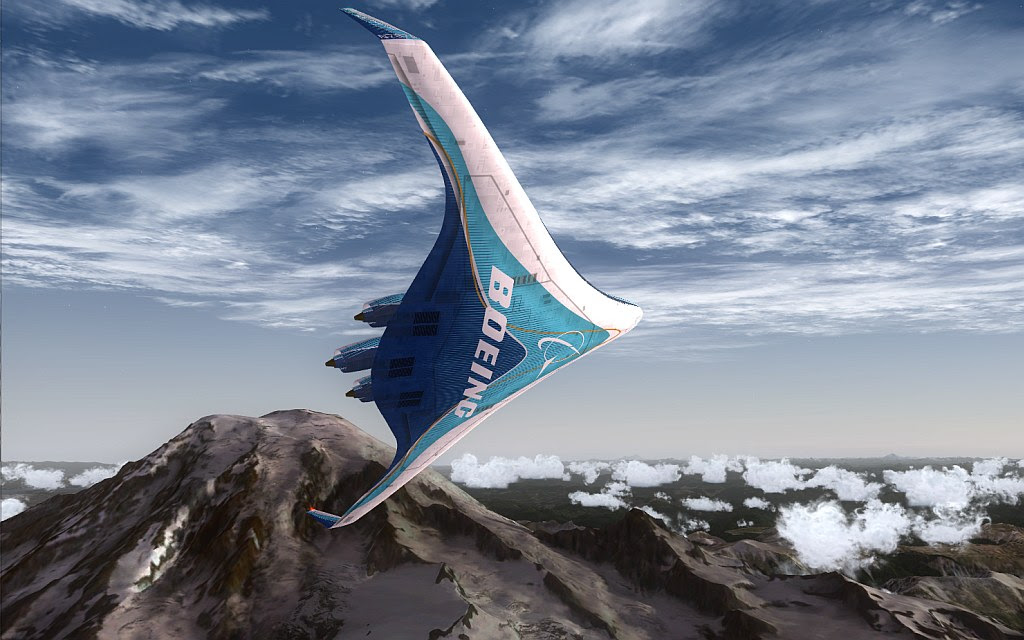
 Boeing has been preparing a 1000 passenger jet that could reshape the
Air travel industry for the next 100 years. The radical Blended Wing
design has been developed by Boeing in cooperation with the NASA Langley
Research Center. The mammoth plane will have a wing span of 265 feet
compared to the 747’s 211 feet, and is designed to fit within the newly
created terminals used for the 555 seat Airbus A380, which is 262 feet wide. The new 797 is in direct response to the Airbus A380 which has racked up159 orders, but has
not yet flown any passengers.
Boeing has been preparing a 1000 passenger jet that could reshape the
Air travel industry for the next 100 years. The radical Blended Wing
design has been developed by Boeing in cooperation with the NASA Langley
Research Center. The mammoth plane will have a wing span of 265 feet
compared to the 747’s 211 feet, and is designed to fit within the newly
created terminals used for the 555 seat Airbus A380, which is 262 feet wide. The new 797 is in direct response to the Airbus A380 which has racked up159 orders, but has
not yet flown any passengers.
 The new 797 is Boeing's direct response to the Airbus A380, which has
racked up orders for 159 already. Boeing decided to kill its 747X
Stretched Super Jumbo in 2003 after little interest was shown for it by
Airline Companies, but continued to develop its "Ultimate Airbus
Crusher", the 797 at its Phantom Works Research Facility in Long Beach,
California. The Airbus A380 had been in the works since 1999 and has
accumulated $13 Billion in development costs, which gives Boeing a huge
advantage. More so because Airbus is thus committed to the older style
tubular
structure for their aircraft for decades to come.
The new 797 is Boeing's direct response to the Airbus A380, which has
racked up orders for 159 already. Boeing decided to kill its 747X
Stretched Super Jumbo in 2003 after little interest was shown for it by
Airline Companies, but continued to develop its "Ultimate Airbus
Crusher", the 797 at its Phantom Works Research Facility in Long Beach,
California. The Airbus A380 had been in the works since 1999 and has
accumulated $13 Billion in development costs, which gives Boeing a huge
advantage. More so because Airbus is thus committed to the older style
tubular
structure for their aircraft for decades to come. There are several big advantages in the "Blended Wing & Fuselage"
design, the most important being the ‘Lift to Drag’ ratio which is
expected to increase by an amazing 50%, resulting in an overall weight
reduction of the aircraft by 25%, making it an estimated 33% more fuel
efficient than the A380, and thus making the Airbus's $13 Billion Dollar
investment look pretty shaky. "High Airframe Rigidity" is another key
factor in the "Blended Wing & Fuselage" technology. It reduces
turbulence and creates less stress on the airframe which adds to fuel
efficiency, giving the 797 a tremendous 10,000 Mile range with 1,000
passengers on board cruising comfortably at Mach 0.88 or 654 MPH, which
gives it another advantage over the tube-and-wing designed A380's 570
MPH.
There are several big advantages in the "Blended Wing & Fuselage"
design, the most important being the ‘Lift to Drag’ ratio which is
expected to increase by an amazing 50%, resulting in an overall weight
reduction of the aircraft by 25%, making it an estimated 33% more fuel
efficient than the A380, and thus making the Airbus's $13 Billion Dollar
investment look pretty shaky. "High Airframe Rigidity" is another key
factor in the "Blended Wing & Fuselage" technology. It reduces
turbulence and creates less stress on the airframe which adds to fuel
efficiency, giving the 797 a tremendous 10,000 Mile range with 1,000
passengers on board cruising comfortably at Mach 0.88 or 654 MPH, which
gives it another advantage over the tube-and-wing designed A380's 570
MPH. 

The exact date ! for introduction of the 797 is as yet unclear, but the battle lines are clearly drawn in the high-stakes war for future civilian aircraft supremacy.

Reply all
Reply to author
Forward
0 new messages