
Monstrous Aviation - Huge Helicopters
185 views
Skip to first unread message

Chathuraka
Mar 21, 2009, 9:45:37 AM3/21/09
to Area51
"Let's see how insanely huge we can make them!"

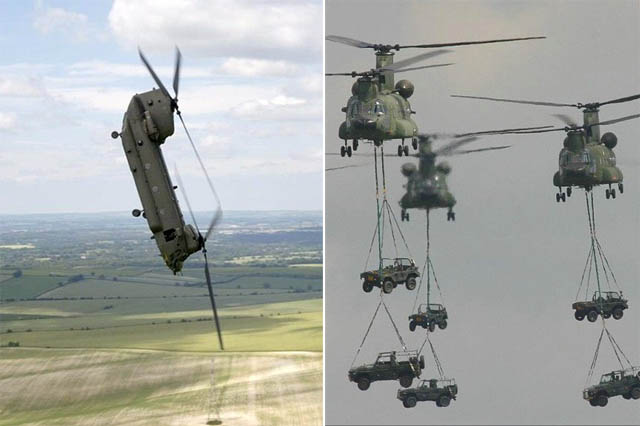
images credit: Ruslan Sharyga, Chris Clarke and Sven De Bevere Airliners.net
Airplanes you can understand: they're basically just big birds, with recognizable wings, tail and body. But helicopters... are somewhat strange beasts. It's a wonder why anyone took Mr. Sikorsky (and his predecessors) seriously, and an even bigger wonder how they got anyone remotely sane enough to sit inside one of those early prototypes and hit the START button.
Beyond the fact that helicopters came out of left field (the far, far left field) the craziness continues when you begin to think about how easy it is for something to seriously -- and traumatically -- go wrong with one. An airplane, after all, can glide if its engines fail. An airship (dirigible, zeppelin, etc) can usually descend if it loses too much lift. But a whirlybird without power has one - and only one (barring autorotation) -- option: crash.

An NH90 helicopter crashes in the Bracciano Lake, Italy. More info; photo by David Cenciotti

Columbia Helicopters in Alaska attempting to tow a barge... with a 600 foot cable and up to 25 degrees nose low attitude; photo by Ted Veal
But, thankfully, Mr. Sikorsky didn't give up and today we are lucky to have the results of his work: incredibly flexible, wonderfully useful, spectacularly nimble aircraft. Although many breeds of helicopter have become quite safe, there is still a lingering kind of madness regarding these "whirlybirds": the drive to see how insanely huge we can make them.

Moscow, 2007 - image via)
Unlike airplanes, the size-wars with helicopters began after World War II. While, like a lot of aircraft technology, helicopters were jump-started into being useful and moderately reliable machines, the early 40s aircraft were lucky enough to get into the air -- let alone get into the air without killing the pilot.
But this clumsy infancy didn't last very long. The 1950s saw an explosion of radical -- and in some cases terrifying -- helicopter designs in both the United States as well as the Soviet Union. One of the grander designs is one that is pretty familiar as it's been used by both the US military as well as civilian companies in need of some heavy lifting. Looking something like a twin-rotored banana, the earliest Boeing Chinook popped up in the late 50s but because of its heavy lifting skills, stayed around for a very long time.
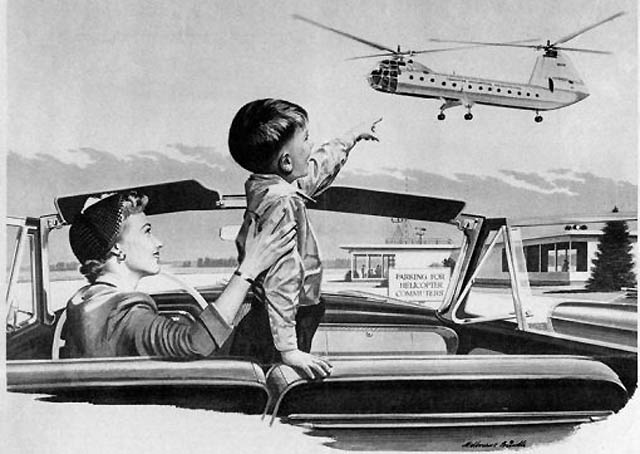
"Helicopters are coming!" in Look Magazine, May 18, 1954, via
Modern, updated versions are still used all over the world. The Chinook, in fact, is kind of the poster-child for big helicopters. Got something heavy that needs to go from impossible point A to impossible point B? More than likely the machine connecting the dots is a Chinook. While numbers are rarely impressive, the size of the numbers the modern Chinook can lift are still ones to give pause: 28,000 pounds of cargo, which is about 14 tons...
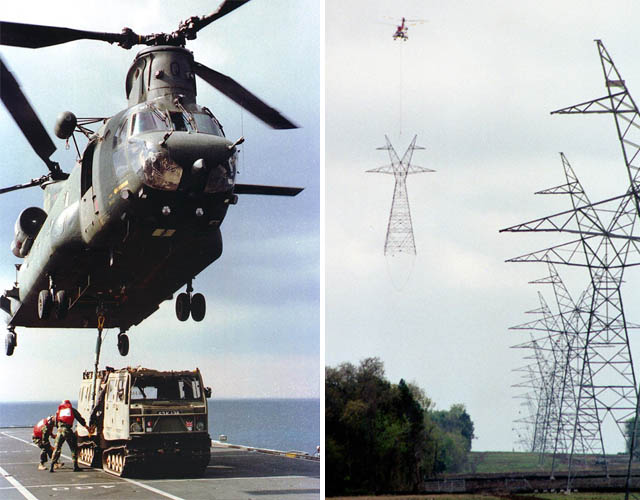
(images via 1, 2)
The whole range of Soviet "monster" helicopters
Another Goliath is the MI-6, made by the Soviet Mikhail Mil design bureau. Again created in the 50s, the MI-6 was a true monster. While not as oddly stylish as the Chinook, this powerhouse could lift 26,000 pounds of cargo (12 tons), being an incredibly versatile heavy hauler. Almost all of these types of machines were very popular with the Soviets, spawning a whole range of monster helicopters, some of whose descendants are still in use today.
This page has a few beautiful photos of incredibly detailed Mi-6 scale model, built by Bernhard Pethe:
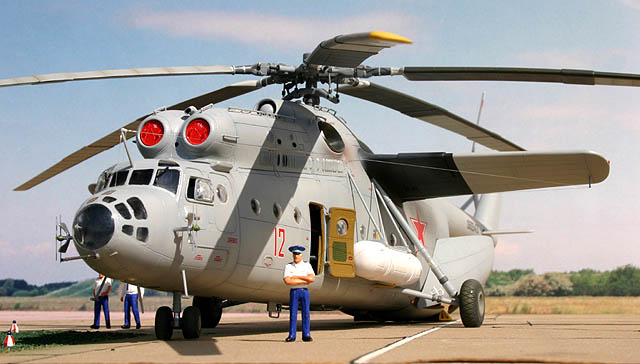
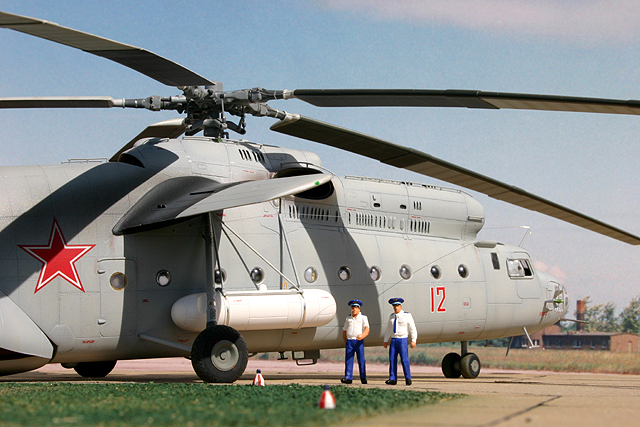

(images credit: Bernhard Pethe, Scale Rotors)
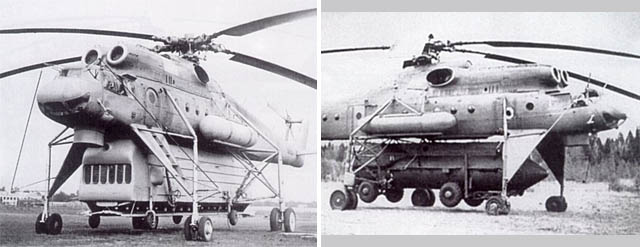
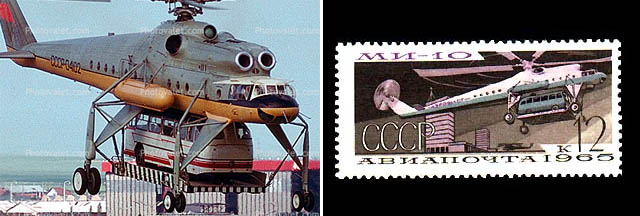
While the Chinook certainly appears odd, and the MI-6 is damned huge, other big helicopters begin to look like the designers were not trying for size as much as just plain weirdness. Take a gander at the imaginatively-named Soviet MI-10. Although its guts were from the old, reliable MI-6, this misshapen cousin sported four monster legs, giving it the impression of a bug-phobics nightmare dragonfly. Whenever I look at the MI-10 I always wonder if the pilot ever forgot what he was flying and stepped out -- falling dozens of feet to the tarmac:
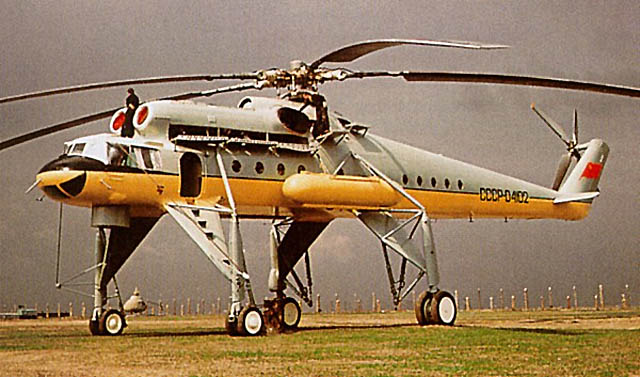
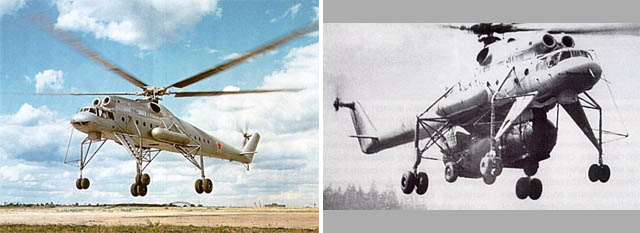
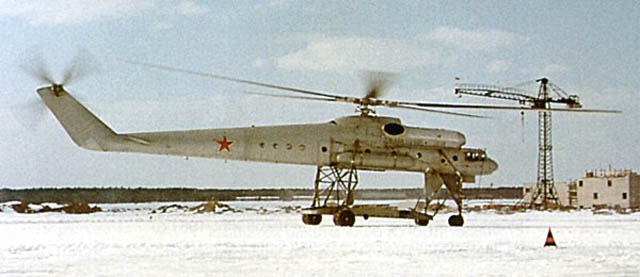
(images via)
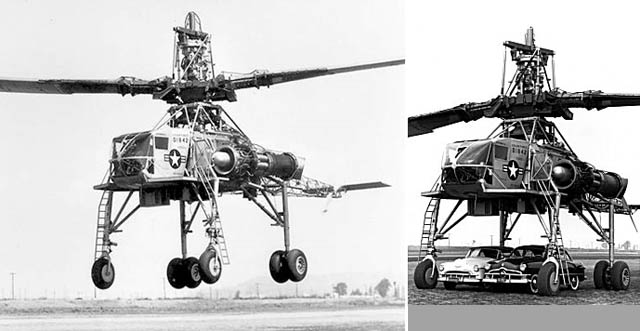
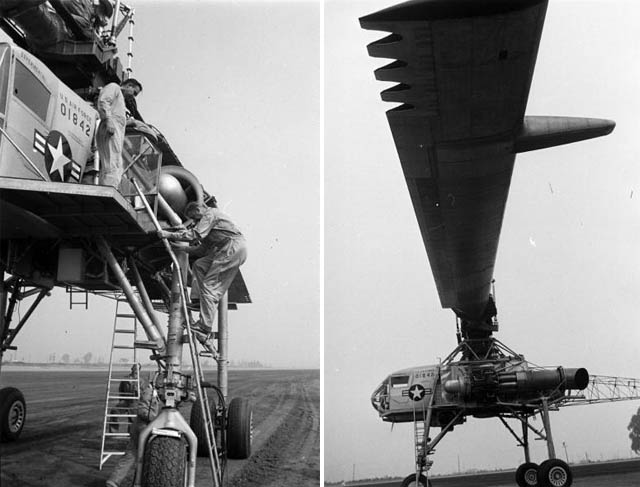
Not that the US hadn't had its own share of big, and damned ugly, helicopters. Perhaps because it was created by Hughes, the same Hughes of crazy-in-Las-Vegas and the Spruce Goose, the XH-17 Sky Crane was terrifyingly huge: the rotors alone were 135 feet across (the largest in the world). Imagine the jaw-dropping effect watching those insane rotors starting to swing... and the whole Sky Crane taking off like a half-transformed insectoid alien ship:
(images via 1, 2)
CH-54 Tarhe recovering a damaged F-4 Phantom II:

(image via)
Sikorsky S-64 Skycrane, again featured as a beautifully-detailed model, see here:
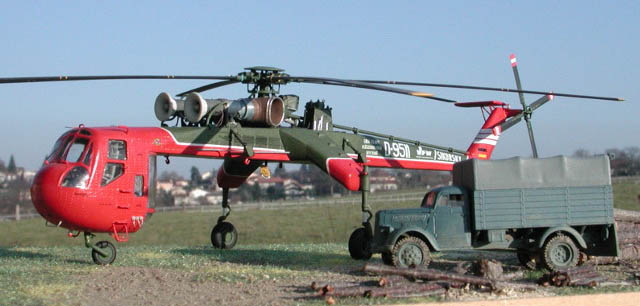
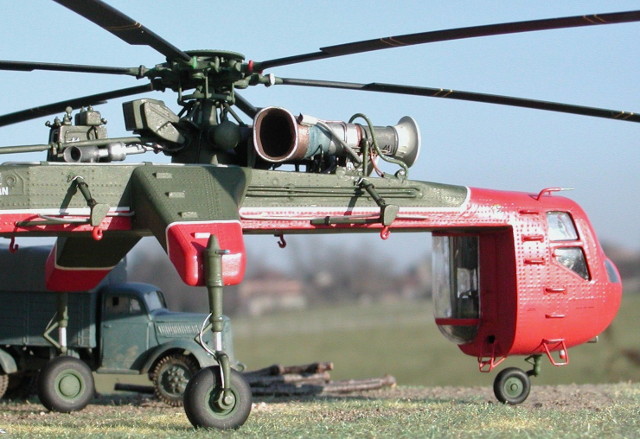
(image credit: Didier Peillon, Scale Rotors)
The Fairey Rotodyne, 1959, advertised as the "first vertical take-off airliner in the world" (project scrapped in 1962) and the first helicopter airline in the world: New York Airways, 1953

(images via)
"On July 8, 1953, a company called New York Airways began the first regularly scheduled helicopter passenger service in the world. Operating in a fashion similar to a bus line, the helicopters flew to sites such as La Guardia Airport, New York International Airport, Neward Airport, West 30th Street in Manhattan, White Plains, and Stamford periodically throughout the day."
The biggest helicopter to date, and one of the very strangest.
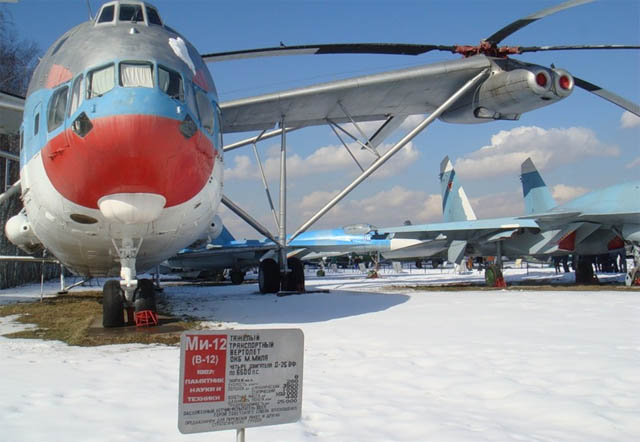
Aside from the bug-geared machines like the Sky Crane and the MI-10, most big helicopters usually look like smaller ones simply writ large. Rotors? Check. Tail rotor for stability? Sure. Fuselage? Absolutely. But the -- yet again -- poetically named Mil V-12 looks nothing like anything before or since:

Click to enlarge to see detailed view (from Russian TM magazine):
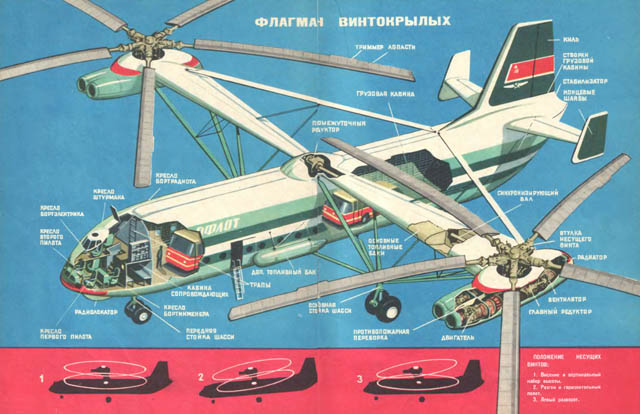
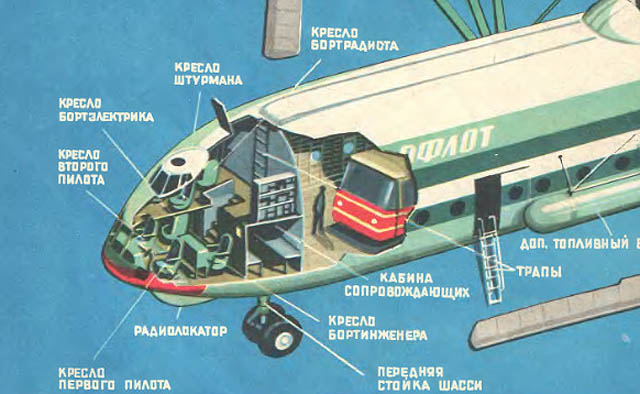
Sure it has rotors -- it wouldn't be a helicopter without them -- but with the V-12 they are placed on the side of its massive fuselage. Weird, right? But this is BIG weirdness as the V-12 is commonly considered to be the largest helicopter in the world. How big? Think of it this way: see that 747 over there -- that monstrous fixed wing machine? Well, the V-12 is as wide as one of those 747s. But unlike a 747, the V-12 can take off straight up, and haul close to 55,000 pounds at the same time -- or 88,000 if it takes off a bit less like a helicopter and more like a plane.
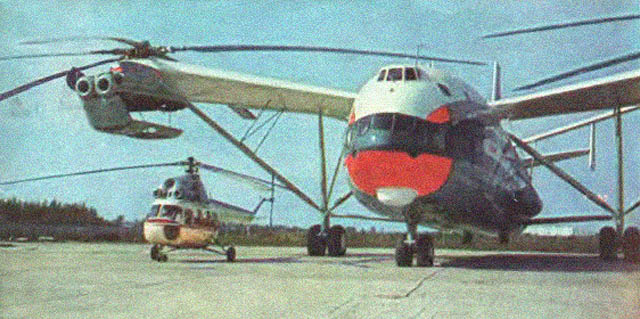
"On August, 6th 1969, Mi-12 has lifted cargo in 44205 kg on height of 2255 m, having established a world record of load-carrying capacity for helicopters which is not beaten till now."

(image via TM magazine, Russia)
Mi-26: The biggest operational helicopter in the world
Don't get close, or even approach it when the rotors are spinning: "this chopper's wash will pick up and fling rocks, up to 12 inches in diameter, around like leaves!". With a crew of six, this "Halo" (NATO reporting name) mega helicopter can carry 70 passengers, or a flying laboratory, or a whole dump truck, with space to spare...
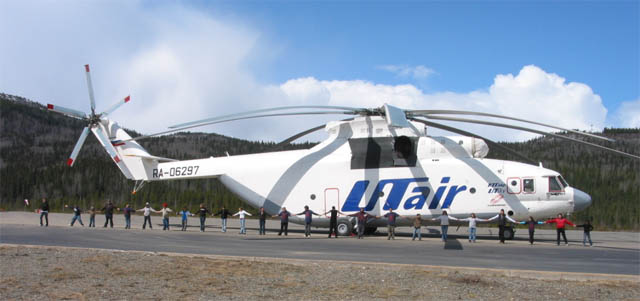
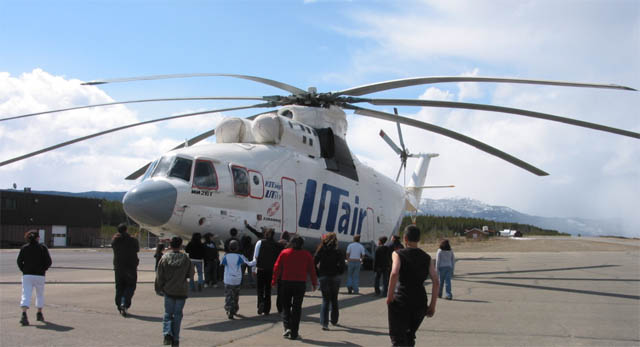
(images credit: Marty North)
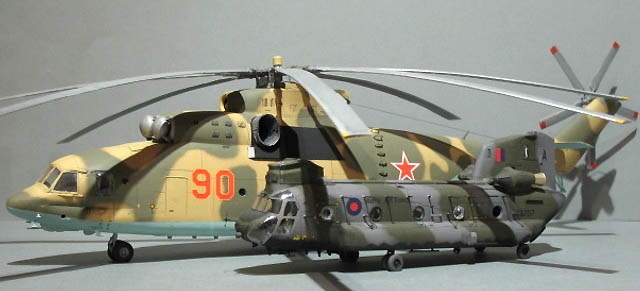
When compared with a typical Chinook, Mi-26 does indeed look big:
(image credit: Henry Ludlam, Scale Rotors)
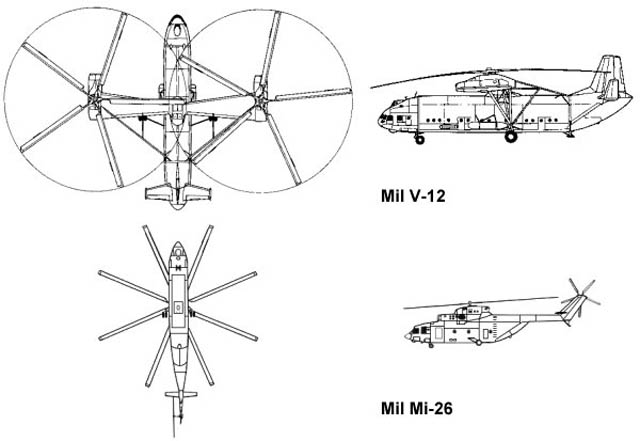
See a detailed chart of this craft on this page. Still, Mi-12 is significantly bigger than Mi-26 (however, Mi-12 is not in operation, which is really a shame, if you ask me):
(image via)
Mi-26 carrying Mi-10 in a sling:

(image credit: AviaStar)
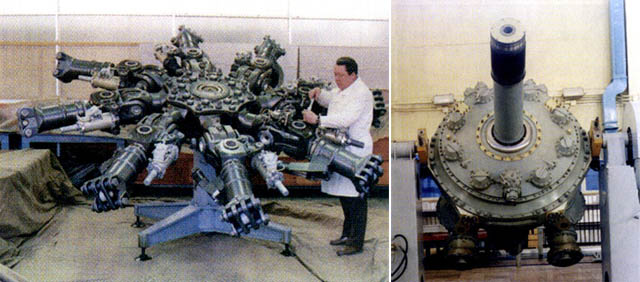
Mi-26 main rotor head and main gearbox:
(image credit: AviaStar)
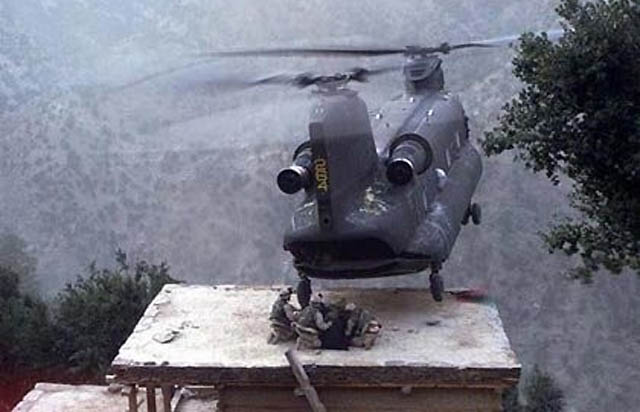
Mi-26 lifts the MH-47e Chinook in Afghanistan (left image), while Chinook stars in an incredible rescue operation, confirmed as true by Snopes (details here) -
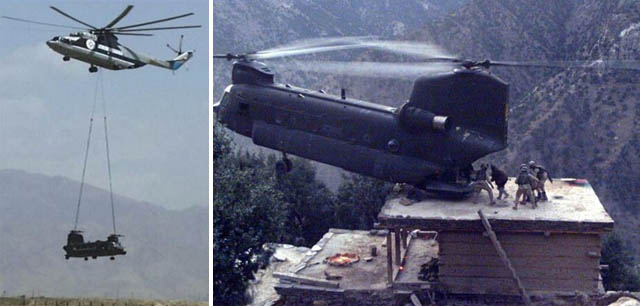
"November 2003, a U.S.-led coalition launched Operation Mountain Resolve in the Nuristan and Kunar provinces of Afghanistan. The above-displayed photograph of the precarious-looking rooftop landing by a CH-47 Chinook helicopter was taken during that operation by U.S. Army Sgt. Greg Heath. The Chinook helicopter is touching down to receive Afghan Persons Under Control (APUC) captured by members of the U.S. 10th Mountain Division"
(images via)
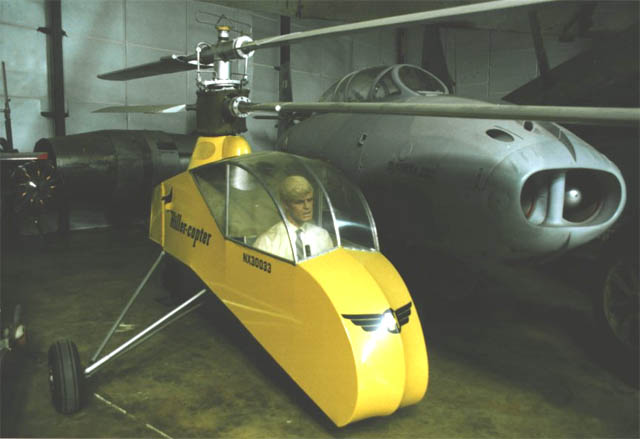
We've also received a tip that the "Largest helicopter that has been seriously proposed" was, perhaps, The Hiller-Copter, which is featured in Hiller Museum in San Carlos, California. The museum has documents and a film from a (semi) serious proposal from Hiller to recover Saturn V booster stages in midair, using an enormous helicopter. The exact helicopter specs we can't locate, but it was something like a 200 foot rotor turning at 10 RPM, with full-sized turbojet engines at the rotor tips. Here is a history of the Hiller Aircraft concepts, and more info
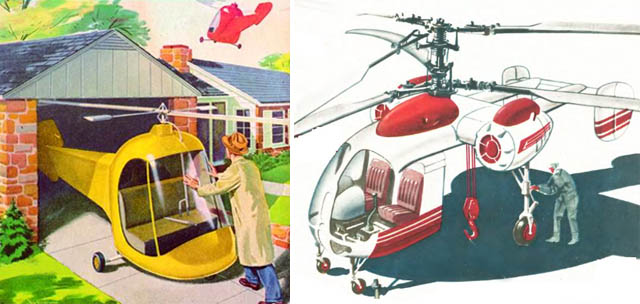
"Here's your helicopter coupe!"
As for the smallest helicopters, nothing beats this concept from Popular Mechanics Magazine, Feb. 1951:
(images via Futuristic Transportation and Tekhnika Molodezhi, Russia)
Compare it with the diminutive and very practical Soviet Ka-26 from the early 1970s (you could attach various functional blocks behind the pilot's cabin) - see image above, on the right. And then, there was a Hiller XH-44 Copter, which Stanley Hiller, being 19 years old, designed, built and succesfully flew - in 1944! - making it "the first helicopter with coaxial rotors to fly successfully in the United States."
(image via, more info)
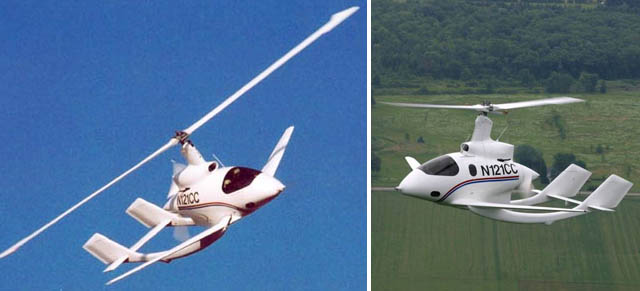
Carter Copter: looking into the future
Carter Copter is the proverbial small company "that could". It's been around for long time, and delivers results: their signature mini-copter has flown faultlessly since 2002 (more info here)
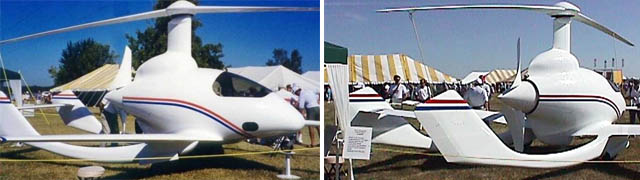
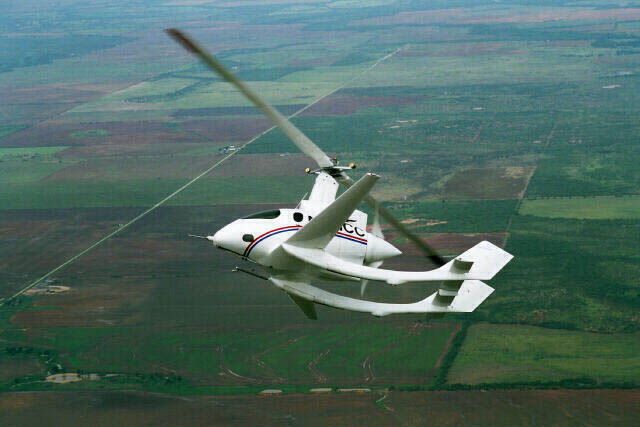
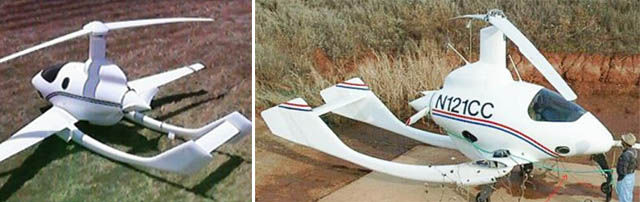
(images via 1, 2, 3)
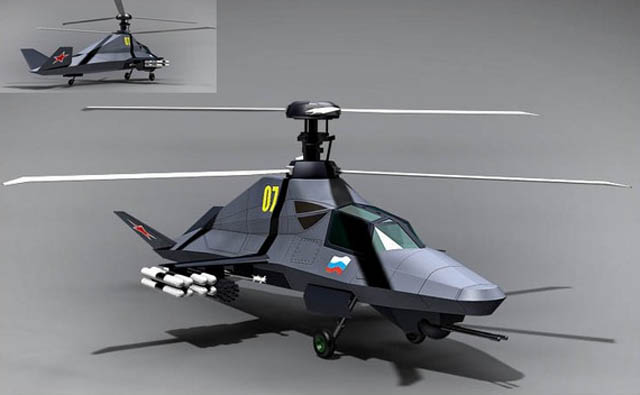
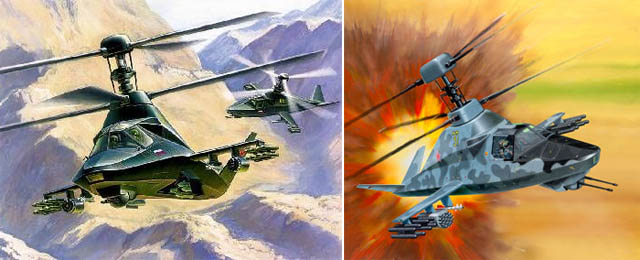
On the Russian side, things were really looking into the future with Ka 58 Stealth Helicopter - "Black Ghost" (it looks too good to be true, almost good enough for a cool videogame - and, yes, it remained a concept... but pushed design envelopes for other models). "Ghosts" hardly die completely, so perhaps this stealthy creature is being resurrected. Your guess is as good as mine.
Next time you see some draconic monstrosity fly overhead, don't jump to conclusion that this is an apocalyptic Angel of Doom, or worse, casting a crooked shadow on the cowering world below. It could be just one of these giant helicopters, on a mission from... well, judging from thrilling picture below, some of the missions could be pretty intense, indeed:
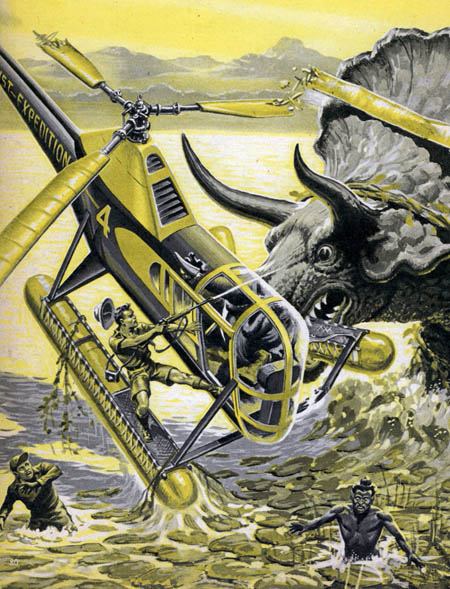
(image credit: Modern Mechanix)
images credit: Ruslan Sharyga, Chris Clarke and Sven De Bevere Airliners.net
Airplanes you can understand: they're basically just big birds, with recognizable wings, tail and body. But helicopters... are somewhat strange beasts. It's a wonder why anyone took Mr. Sikorsky (and his predecessors) seriously, and an even bigger wonder how they got anyone remotely sane enough to sit inside one of those early prototypes and hit the START button.
Beyond the fact that helicopters came out of left field (the far, far left field) the craziness continues when you begin to think about how easy it is for something to seriously -- and traumatically -- go wrong with one. An airplane, after all, can glide if its engines fail. An airship (dirigible, zeppelin, etc) can usually descend if it loses too much lift. But a whirlybird without power has one - and only one (barring autorotation) -- option: crash.
An NH90 helicopter crashes in the Bracciano Lake, Italy. More info; photo by David Cenciotti
Columbia Helicopters in Alaska attempting to tow a barge... with a 600 foot cable and up to 25 degrees nose low attitude; photo by Ted Veal
But, thankfully, Mr. Sikorsky didn't give up and today we are lucky to have the results of his work: incredibly flexible, wonderfully useful, spectacularly nimble aircraft. Although many breeds of helicopter have become quite safe, there is still a lingering kind of madness regarding these "whirlybirds": the drive to see how insanely huge we can make them.
Moscow, 2007 - image via)
Unlike airplanes, the size-wars with helicopters began after World War II. While, like a lot of aircraft technology, helicopters were jump-started into being useful and moderately reliable machines, the early 40s aircraft were lucky enough to get into the air -- let alone get into the air without killing the pilot.
But this clumsy infancy didn't last very long. The 1950s saw an explosion of radical -- and in some cases terrifying -- helicopter designs in both the United States as well as the Soviet Union. One of the grander designs is one that is pretty familiar as it's been used by both the US military as well as civilian companies in need of some heavy lifting. Looking something like a twin-rotored banana, the earliest Boeing Chinook popped up in the late 50s but because of its heavy lifting skills, stayed around for a very long time.
"Helicopters are coming!" in Look Magazine, May 18, 1954, via
Modern, updated versions are still used all over the world. The Chinook, in fact, is kind of the poster-child for big helicopters. Got something heavy that needs to go from impossible point A to impossible point B? More than likely the machine connecting the dots is a Chinook. While numbers are rarely impressive, the size of the numbers the modern Chinook can lift are still ones to give pause: 28,000 pounds of cargo, which is about 14 tons...
(images via 1, 2)
The whole range of Soviet "monster" helicopters
Another Goliath is the MI-6, made by the Soviet Mikhail Mil design bureau. Again created in the 50s, the MI-6 was a true monster. While not as oddly stylish as the Chinook, this powerhouse could lift 26,000 pounds of cargo (12 tons), being an incredibly versatile heavy hauler. Almost all of these types of machines were very popular with the Soviets, spawning a whole range of monster helicopters, some of whose descendants are still in use today.
This page has a few beautiful photos of incredibly detailed Mi-6 scale model, built by Bernhard Pethe:
(images credit: Bernhard Pethe, Scale Rotors)
While the Chinook certainly appears odd, and the MI-6 is damned huge, other big helicopters begin to look like the designers were not trying for size as much as just plain weirdness. Take a gander at the imaginatively-named Soviet MI-10. Although its guts were from the old, reliable MI-6, this misshapen cousin sported four monster legs, giving it the impression of a bug-phobics nightmare dragonfly. Whenever I look at the MI-10 I always wonder if the pilot ever forgot what he was flying and stepped out -- falling dozens of feet to the tarmac:
(images via)
Not that the US hadn't had its own share of big, and damned ugly, helicopters. Perhaps because it was created by Hughes, the same Hughes of crazy-in-Las-Vegas and the Spruce Goose, the XH-17 Sky Crane was terrifyingly huge: the rotors alone were 135 feet across (the largest in the world). Imagine the jaw-dropping effect watching those insane rotors starting to swing... and the whole Sky Crane taking off like a half-transformed insectoid alien ship:
(images via 1, 2)
CH-54 Tarhe recovering a damaged F-4 Phantom II:
(image via)
Sikorsky S-64 Skycrane, again featured as a beautifully-detailed model, see here:
(image credit: Didier Peillon, Scale Rotors)
The Fairey Rotodyne, 1959, advertised as the "first vertical take-off airliner in the world" (project scrapped in 1962) and the first helicopter airline in the world: New York Airways, 1953
(images via)
"On July 8, 1953, a company called New York Airways began the first regularly scheduled helicopter passenger service in the world. Operating in a fashion similar to a bus line, the helicopters flew to sites such as La Guardia Airport, New York International Airport, Neward Airport, West 30th Street in Manhattan, White Plains, and Stamford periodically throughout the day."
The biggest helicopter to date, and one of the very strangest.
Aside from the bug-geared machines like the Sky Crane and the MI-10, most big helicopters usually look like smaller ones simply writ large. Rotors? Check. Tail rotor for stability? Sure. Fuselage? Absolutely. But the -- yet again -- poetically named Mil V-12 looks nothing like anything before or since:
Click to enlarge to see detailed view (from Russian TM magazine):

Sure it has rotors -- it wouldn't be a helicopter without them -- but with the V-12 they are placed on the side of its massive fuselage. Weird, right? But this is BIG weirdness as the V-12 is commonly considered to be the largest helicopter in the world. How big? Think of it this way: see that 747 over there -- that monstrous fixed wing machine? Well, the V-12 is as wide as one of those 747s. But unlike a 747, the V-12 can take off straight up, and haul close to 55,000 pounds at the same time -- or 88,000 if it takes off a bit less like a helicopter and more like a plane.
"On August, 6th 1969, Mi-12 has lifted cargo in 44205 kg on height of 2255 m, having established a world record of load-carrying capacity for helicopters which is not beaten till now."
(image via TM magazine, Russia)
Mi-26: The biggest operational helicopter in the world
Don't get close, or even approach it when the rotors are spinning: "this chopper's wash will pick up and fling rocks, up to 12 inches in diameter, around like leaves!". With a crew of six, this "Halo" (NATO reporting name) mega helicopter can carry 70 passengers, or a flying laboratory, or a whole dump truck, with space to spare...
(images credit: Marty North)
When compared with a typical Chinook, Mi-26 does indeed look big:
(image credit: Henry Ludlam, Scale Rotors)
See a detailed chart of this craft on this page. Still, Mi-12 is significantly bigger than Mi-26 (however, Mi-12 is not in operation, which is really a shame, if you ask me):
(image via)
Mi-26 carrying Mi-10 in a sling:
(image credit: AviaStar)
Mi-26 main rotor head and main gearbox:
(image credit: AviaStar)
Mi-26 lifts the MH-47e Chinook in Afghanistan (left image), while Chinook stars in an incredible rescue operation, confirmed as true by Snopes (details here) -
"November 2003, a U.S.-led coalition launched Operation Mountain Resolve in the Nuristan and Kunar provinces of Afghanistan. The above-displayed photograph of the precarious-looking rooftop landing by a CH-47 Chinook helicopter was taken during that operation by U.S. Army Sgt. Greg Heath. The Chinook helicopter is touching down to receive Afghan Persons Under Control (APUC) captured by members of the U.S. 10th Mountain Division"
(images via)
We've also received a tip that the "Largest helicopter that has been seriously proposed" was, perhaps, The Hiller-Copter, which is featured in Hiller Museum in San Carlos, California. The museum has documents and a film from a (semi) serious proposal from Hiller to recover Saturn V booster stages in midair, using an enormous helicopter. The exact helicopter specs we can't locate, but it was something like a 200 foot rotor turning at 10 RPM, with full-sized turbojet engines at the rotor tips. Here is a history of the Hiller Aircraft concepts, and more info
"Here's your helicopter coupe!"
As for the smallest helicopters, nothing beats this concept from Popular Mechanics Magazine, Feb. 1951:
(images via Futuristic Transportation and Tekhnika Molodezhi, Russia)
Compare it with the diminutive and very practical Soviet Ka-26 from the early 1970s (you could attach various functional blocks behind the pilot's cabin) - see image above, on the right. And then, there was a Hiller XH-44 Copter, which Stanley Hiller, being 19 years old, designed, built and succesfully flew - in 1944! - making it "the first helicopter with coaxial rotors to fly successfully in the United States."
(image via, more info)
Carter Copter: looking into the future
Carter Copter is the proverbial small company "that could". It's been around for long time, and delivers results: their signature mini-copter has flown faultlessly since 2002 (more info here)
(images via 1, 2, 3)
On the Russian side, things were really looking into the future with Ka 58 Stealth Helicopter - "Black Ghost" (it looks too good to be true, almost good enough for a cool videogame - and, yes, it remained a concept... but pushed design envelopes for other models). "Ghosts" hardly die completely, so perhaps this stealthy creature is being resurrected. Your guess is as good as mine.
Next time you see some draconic monstrosity fly overhead, don't jump to conclusion that this is an apocalyptic Angel of Doom, or worse, casting a crooked shadow on the cowering world below. It could be just one of these giant helicopters, on a mission from... well, judging from thrilling picture below, some of the missions could be pretty intense, indeed:

(image credit: Modern Mechanix)
source : digg /darkroastedblend.
--
Rgd, :)
Chathuraka
~~~
"Do not follow where the path may lead... Go instead where there is no path and leave a trail"
Robert Frost
~~~
--
Rgd, :)
Chathuraka
~~~
"Do not follow where the path may lead... Go instead where there is no path and leave a trail"
Robert Frost
~~~
Reply all
Reply to author
Forward
0 new messages