Common Mistakes in Communication

180 views
Skip to first unread message

Σαῦλος

unread,
Feb 27, 2015, 4:25:19 AM2/27/15
to ancient-greek-...@googlegroups.com
ASKING QUESTIONS
Right:           Wrong: 
τί ἐστίν τοῦτο;          τοῦτο ἐστίν τί;     Nominative
τὶ ἔδωκας αὐτῷ;          ἔδωκάς αὐτῷ τί;     Accusative
τί ποιεῖ;          ποιεῖ τί;     Accusative
τίνος βιβλίον ἐστίν τοῦτο;          τοῦτο τὸ βιβλίον τίνος ἐστίν;     Genitive
τίνι ἔδωκας τὸ βιβλίον;          ἔδωκας τὸ βιβλίον τίνι;            Dative
ποῦ ἔρχεται ὁ ἀνήρ;          ἔρχεται ὁ ἀνήρ ποῦ;                     .
ἐπὶ τίνος τίθωσι τὸ ποτήριον;          τίθωσι τὸ ποτήριονἐπὶ τίνος;                      .
πρὸς τίνα εἶπεν ὅτι περιπατεῖ;           εἶπεν ὅτι περιπατεῖ πρὸς τίνα;                      .

COMMUNICATION VERBS
Right:           Wrong: 
λέγει αὐτῷ ὅτι...           λέγει αὐτόν ὅτι....
ἐρωτᾷ αὐτόν ἐρώτημα.          ἐρωτᾷ αὐτῷ ἐρώτημα.
ἀκούει αὐτοῦ.          ἀκούει αὐτόν.
ἀκούει τὴν φωνήν.          ἀκούει τῆς φωνῆς.

NOMINATIVE 3rd PERSON PERSONAL PRONOUN
The use of αὐτός-αὐτοί, αὐτή-αὐταί, αὐτό, αὐτά is reserved for emphasis ("himself" or "the same one") and cannot be used as an unmarked third person personal pronoun.  The Nominative demonstratives take their place, and thus usually lose their deitic quality.     
Right:           Wrong: 
οὗτος τρέχει.          αὐτὸς τρέχει.
αὕτή τρέχει.          αὐτὴ τρέχει.
τοῦτο τρέχει.          αὐτὸ τρέχει.
τίνες εἰσίν οὗτοι;          τίνες εἰσίν αὐτοί;
τίνες εἰσίν αὗται;          τίνες εἰσίν αὐταί;
τίνα ἐστίν ταῦτα;          τίνα ἐστίν αὐτά;

ON THE TABLE
Motion to = ἐπί + Accusative.  Resting on = ἐπί + Genitive
Right:           Wrong: 
θές τὸ ποτήριον ἐπὶ τὴν τράπεζαν!          θές τὸ ποτήριον ἐπὶ τῆς τραπέζης!
τὸ ποτήριον ἐπὶ τῆς τραπέζης ἐστίν.          τὸ ποτήριον ἐπὶ τὴν τράπεζαν ἐστίν.

NEUTER PLURAL + SINGULAR VERB
Neuter plurals always take a singular verb. 
Right:           Wrong: 
τίνα ἐστίν ταῦτα;          τίνα εἰσίν ταῦτα;
τὰ ποτήρια ἐστίν.          τὰ ποτήρια εἰσιν.
τὰ τέκνα τρέχει.             τὰ τέκνα τρέχουσι.


What brought this to mind was that I've been watching some of our classroom videos from 2 years ago and cringing at all the mistakes I used to make.  I thought I'd just post some tips here in case we have members who  are starting out with communicative teaching.  What would you add?

Mark Lightman

unread,
Mar 1, 2015, 6:45:06 AM3/1/15
to ancient-greek-...@googlegroups.com
I think this is a good idea, Paul, to share some of the mistakes one had made. This is how one learns, in general.

Two mistakes I remember making were:   

right: τοῦτον τὸν λόγον.   wrong:  τοῦτον λόγον.

right: λόγοι τε καὶ  ἔργα   wrong:   λόγοι καί τε ἔργα.

( I later found out that both of these constructions were in fact attested, but are so rare as to be virtual mistakes, and should at any rate certainly not be taught.)

I'll share any more as they come to me.

Μᾶρκος

Michael Halcomb

unread,
Mar 1, 2015, 4:10:14 PM3/1/15
to ancient-greek-...@googlegroups.com
I agree. I think this is a good idea. 

It is often quite easy just to get these seemingly simple things wrong. It is really just a learning process and takes time.....even when/while one is teaching others. I think one of the most important things to keep in mind with it all is that we need to be a) forgiving of one another; and b) forgiving of ourselves. 

As a native English speaker, that is, as one who's been speaking English for 30+ years, I find that pretty much daily I still make mistakes in English. To expect from myself a constant no-mistake mentality is just not feasible and even more, that's just not how speaking a language works anyway. That's why, as a teacher, I'm keen to create an atmosphere of allowance for mistakes, an atmosphere that is safe w/regard to this matter, and to also be forgiving of myself all the while striving to get better. Of course, I'm not saying that inaccuracy is virtuous; rather, I'm saying that a safe atmosphere is virtuous, especially when combined w/the desire to continue getting better. 

I can relate to the "I want to cringe when I watch my old videos" sentiment - I totally get that. And of course, at the same time, I have to keep in mind that that was simply one moment or point in time in the journey. Then I'm encouraged to see the growth up til now. I imagine that I'll continue making mistakes but as long as understandable communication is taking place, I'll keep working hard at it. 

Here's an example of something I used in a session for "which is correct?  ποτερος ορθος that should've followed a different form, likely ποτερον ορθως. Perhaps there's an even better way to say it still. I also often find myself using νυν at the ends of remarks (I think that's English interference), even though it is not used that way so much in Koine. Also, I've recognized that sometimes, if I'm using an ουκ...αλλα construction I'll use εστιν in both halves, which is not typical. 

One last note, while it is certainly incredibly common for the neut/pl to take a sg verb, it is not accurate that this is "always" the case. τα τεκνα, (often followed by gen pronouns) for example, can be seen taking pl verbs not infrequently. Anyways, I appreciate this post. Thanks for sharing some more of your learning experiences, especially by way of mistakes, at this point in your journey, Paul and Mark. Keep up the good work!


--
--------------------------------
REPLY
.... a) reply to this email, or
.... b) visit website, search for the message, hit reply button.
--------------------------------
POST
When creating a post, add a tag.
--------------------------------
GROUP WEBSITE:
https://groups.google.com/forum/?hl=en&fromgroups#!forum/ancient-greek-best-practices
--------------------------------
UNSUBSCRIBE
Send an email to ancient-greek-best-p...@googlegroups.com
--------------------------------
---
You received this message because you are subscribed to the Google Groups "Ancient Greek Best Practices" group.
To unsubscribe from this group and stop receiving emails from it, send an email to ancient-greek-best-p...@googlegroups.com.
For more options, visit https://groups.google.com/d/optout.


--
Grace and Peace,
T. Michael W. Halcomb, Ph.D.

Σαῦλος

unread,
Mar 2, 2015, 9:35:44 AM3/2/15
to ancient-greek-...@googlegroups.com
We have a very strict limit on the number of mistakes a person can make. No one may go over 35,000 mistakes in any one class period.  

Michael Halcomb

unread,
Mar 2, 2015, 10:02:26 AM3/2/15
to ancient-greek-...@googlegroups.com

Lol!

On Mar 2, 2015 9:35 AM, "Σαῦλος" <pn...@seelsorger.org> wrote:
We have a very strict limit on the number of mistakes a person can make. No one may go over 35,000 mistakes in any one class period.  

--

Κεῖθ

unread,
Mar 3, 2015, 7:12:29 PM3/3/15
to ancient-greek-...@googlegroups.com
This is super helpful. I've been making a few of these mistakes. In particular "επι την" vs "επι της" and αυτος vs ουτος.

Jason Weaver

unread,
Mar 5, 2015, 9:27:20 AM3/5/15
to ancient-greek-...@googlegroups.com

Σαῦλε,

You got me with the use of αὐτός etc.  instead of οὗτος.  Do you have any more info/evidence for this?  I’m not objecting, and I could do a study myself but if you’ve already got some info put together I’d love to see it.

Εὐχαριστῶ,

Ἰάσων ὁ φαλακρός

--

Σαῦλος

unread,
Mar 5, 2015, 11:06:02 AM3/5/15
to ancient-greek-...@googlegroups.com, jason_...@ntm.org
Jason,

Yes, I studied and struggled over this one quite a bit.  When I had it all figured out, I still wondered if I should just use αὐτός αὐτή αὐτό  as 3rd person Nom. anyway.  I've decided not to because I figure when the time comes to actually learn and understand αυτος in the Nom as a marker of something emphatic, it will make much more sense.  

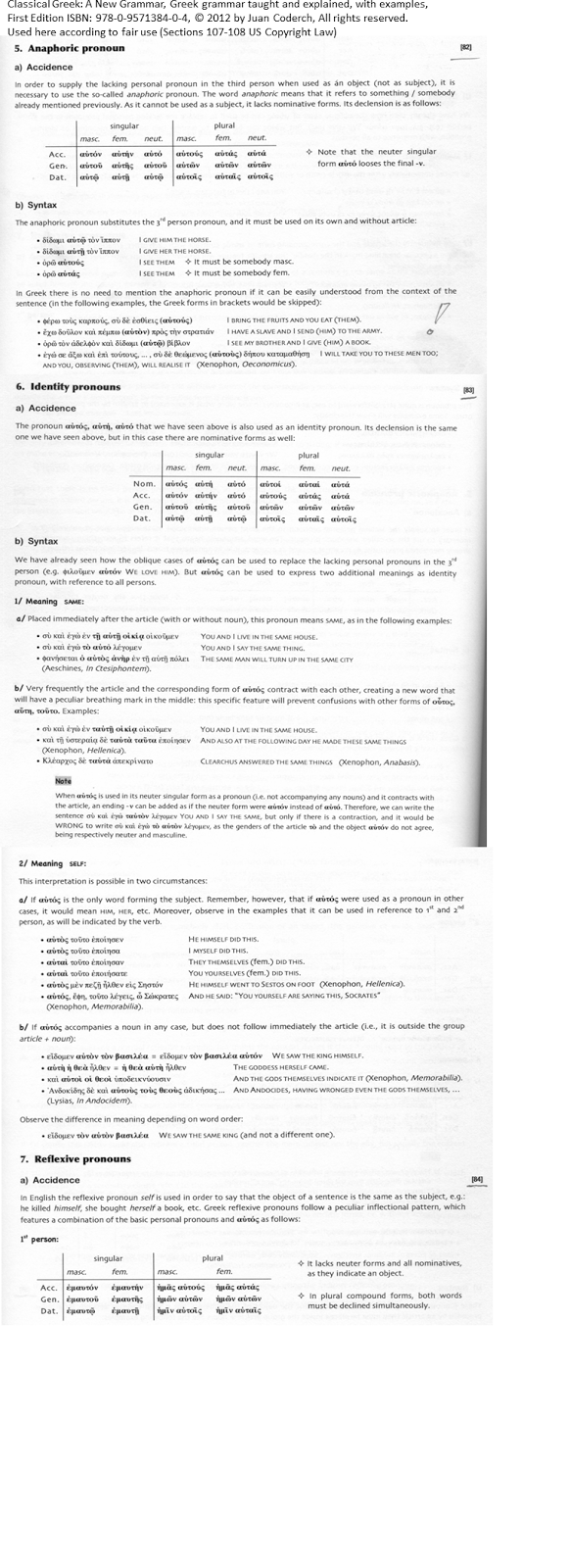
Smyth is the best, but not the only source on this.  Coderch has a different way of looking at it that is interesting.  He lists all oblique cases of αυτος as "anaphoric pronouns."  Then he lists all forms of αυτος as a separate "Identity Pronoun" which happens to share many of the same forms.

I've written up my own explanation of the use of αυτος.  I'll look at that again and post it another day for you all to look at.

Here are the germane sections from the venerable Smyth:


1204

αὐτός is used as an adjective and as a pronoun. It has three distinct uses: (1) as an intensive adjective pronoun it means self (ipse). (2) As an adjective pronoun, when preceded by the article, it means same (idem). (3) In oblique cases as the personal pronoun of the third person, himheritthem (eum, eam, id, eos, eas, ea).


1212

αὐτός when unemphatic and standing alone in the oblique cases means him, her, it, them. ἐκέλευον αὐτὴν ἀπιέναι they ordered her to depart L. 1.12.


1194

The nominative of the pronoun of the third person is replaced by ἐκεῖνος (of absent persons), ὅδε, οὗτος (of present persons), ὁ μέν . . . ὁ δέ (at the beginning of a sentence), and by αὐτός in contrasts. The oblique cases of the foregoing replace οὗ, etc., which in Attic prose are usually indirect reflexives ( cross1228, cross1229). οὗ and  in Attic prose occur chiefly in poetical passages of Plato; in Attic poetry they are personal pronouns. The pronoun of the third person is very rare in the orators.


Pasted from <http://perseus.uchicago.edu/cgi-bin/philologic/getobject.pl?c.9:6:46:4.NewPerseusMonographs>


Derek Greer

unread,
Mar 5, 2015, 11:50:15 AM3/5/15
to ancient-greek-...@googlegroups.com, jason_...@ntm.org
I think this is going to take me some practice to break the habit of using these as pronouns. Buth seems to use them as such in his level 1 materials (though perhaps he meant them as emphatic and I just misinterpreted) and I think this had been reinforced by most of the communicative circles I've been in.  Here's a few sentences from Buth's second lesson:
  1. ὁ ἀνὴρ κρατεῖ ᾠόν.

  2. αὐτὸς τὸ ᾠὸν ἐσθίει

Sent from my iPhone

Michael Halcomb

unread,
Mar 5, 2015, 12:36:09 PM3/5/15
to ancient-greek-...@googlegroups.com
I would actually nuance this idea a bit, that is, the idea of the use of ουτος and αυτος. I would contend that ουτος is also marked. As a demonstrative pronoun, it is often, if not always, "marked," and thus indicating some sort of prominence or emphasis. I would suggest that ουτος often indicates contrastive emphasis or prominence. That is, it is often used in instances where a contrast is implied. I think it is correct that αυτος, when used as suggested in the above discussion, is indicating a sort of emphatic reflexive/ meaning (he himself) conveyed essentially through redundancy. This, of course, is marked. Thus, both ουτος and αυτος are marked, often just in different ways. Having said this, I think we just have to be sensitive to how such words are used in a given context. I don't think that αυτος can never ever be used as a pronoun. To take the sentence from above, αυτος το ωον εσθιει, we could translate that a couple of different ways, one conveying "more" emphasis and one conveying "less" emphasis, perhaps:

more emphasis: He himself is eating the egg.
less emphasis: He, he is the one eating the egg.

as opposed to:

contrastive emphasis / singling-out (ουτος το ωον εσθιει): 
This one (as opposed to that one/them/anyone else), he is eating the egg. 
OR
This one (as opposed to that one/them/anyone else) is eating the egg.   

The least emphatic / most unmarked way, then, would seemingly be: (ο ανηρ) το ωον εσθιει. One might also get away with using an elided verb structure, probably with a genitive included, such as: "αυτος χριστου ()." where the verb is simply implied inside the brackets (e.g. (εστιν)).


Σαῦλος

unread,
Mar 6, 2015, 5:13:57 AM3/6/15
to ancient-greek-...@googlegroups.com

Jason,  I looked at what I had written up about αυτος and decided it was rubbish.  I re-wrote my understanding of it as a way of sorting out the whole thing in my mind once again.  I can’t count the number of times I have revisited and restudied this little word αυτός.  It’s elusive.   See what you all think of this explanation.   


I have no queasiness about hearing objections to my understanding.  I'd welcome a dispassionate debate about it.    I think I'll throw this into the teeth of B-Greek, too.  Should be entertaining.  


First of all, I guess we can say that almost any use of any pronoun, if it is in the Nominative, is “marking “ something (saying something extra, non-default).

εσθίεις τὸν ἄρτον =  unmarked.

εσθίεις συ τὸν ἄρτον =  emphasizes the subject.  


But how do we say “HE is eating” in the same way as we say “YOU are eating”?  In other words, what is the 3rd person Nominative personal pronoun equivalent of εγω, συ, ημεις, υμεις?   


According to my understanding, that would be οὗτος (& οὗτοι, αὗτη, αὗται, τοῦτο, ταῦτα).  Some grammars would also include ὁ δὲ  (& ἡ δέ, τὸ δέ, etc.) as 3rd Person Nominative stand-ins.


The way I see it, there's a identifiable reason for this.   The six Nominative forms of αὐτός (singular, plural, x 3 genders) are reserved for an particular “self” emphasizing function that is a different sort of emphasis than simply adding personal pronouns εγω, συ, ημεις, υμεις.  


If we would use αὐτός (or, αὐτή, αὐτό, αὐτοί, αὐταί, αὐτά) as a normal 3rd Person Nominative Personal Pronoun (as an equivalent of εγω, συ, ημεις, υμεις), we would be communicating a special marking that wouldn't be carried by the other personal pronouns.  For example, when αὐτός is used alone, it often has an implicit noun that it is marking as “self” emphasized. 


We love because αὐτὸς (supply ὁ θεός) first loved us.  1 John 4:19

It would also create confusion because we can add αυτος to the other personal pronouns if we want to add the “self” emphasis.


αὐτός ἐγώ...  I myself am a slave to God’s law (Rom 7:25).


If αὐτός (Nominative only) is a special “self” emphasizer, then adding it to εγω makes sense.  Otherwise, we would look at it and say, Huh???  αὐτός ἐγώ...   He I….  ???


This “Self” emphasizing effect of αὐτός (and other Nominative forms of it) is shown by a connecting αὐτός to a noun in what's called the Predicate position.  Or, it can be found alone with an implicit noun.   

αὐτός ὁ πατήρ τρέφει τὰ τέκναThe father himself feeds his children.

αὐτός τρέφει τὰ τέκνα.  He himself (supply “the father”) feeds his children.


The Attributive position is an entirely different story.


The attributive postion (article/noun sandwich) is very clear and identifiable.  When you see any form of αὐτός (ANY CASE) in the attributive / sandwich position, then it signifies a “same” identifying emphasis.  


  ὁ αὐτός πατήρ τρέφει τὰ τέκνα - The same father feeds his children.  We had maybe been talking about different fathers.  But now you want to emphasize that this same father we just mentioned is the one who feeds his children - ὁ αὐτός πατήρ!!!


Note, αὐτοῦ, αὐτῷ & αὐτόν (and variations for number and gender) can be also used as “same” indentifying emphasizers if in the Attributive/sandwich position. 


ἔδωκεν οὗτος τὸν κάλαμον τῷ αὐτῷ ἀνδρί.  

He gave the pen to the same man


But, if αὐτοῦ, αὐτῷ & αὐτόν (and variations for number and gender) are not connected in a sandwich construction, if they are ALONE then they are plain personal pronouns that carry NO EMPHASIS.   They are just like μου μοι με σου σοι σε ημων ημιν ημας υμων υμιν υμας.  Unlike the Nominative pronouns, these personal pronouns are needed.  The word βλέπομεν contains the pronoun “we.”  Adding ἡμεῖς βλέπομεν emphasizes the pronoun.   But adding βλέπομεν αὐτούς does not add any emphasis.  It simply supplies the information.  Whom did we see?  αὐτόυς.    Whose book did you take?  ἐλαβόν αὐτοῦ βιβλίον.   To whom did you give the pen?   ἔδωκεν αὐτῷ τὸν κάλὸμον. 


So, what do we conclude?


If you see a form of αυτός in the Nominative, it’s NORMALLY going to be an emphasizer.  If it’s predicate or alone, it will be a “self” emphasizer.  If it’s attributive in any case, it will be a “same” emphasizer.   If it’s all alone and lonely and not a Nominative, it’s just a plain old dull 3rd person personal pronoun.

Randy Gibbons

unread,
Mar 8, 2015, 7:22:53 PM3/8/15
to ancient-greek-...@googlegroups.com
Hi Paul and All.

Paul, line-by-line I agree with everything you say, and with Michael, but I can see you and αὐτός still have an uneasy relationship :-)

Here I think is a very simply and adequate exposition on αὐτός, on p. 38 of the North & Hillard Greek Prose Composition.

On "marking," you may want to browse the web on "deictic" and "anaphoric," for example here. Note that, as Michael also said, deictic expressions cannot be interpreted unless contextual parameters are taken into account. (L. Palmer, The Greek Language, pp. 285-287: Demonstrative pronouns form a deictic system "with three or four oppositions like (a) 'this (near you), (b) 'that (near you)', (c) 'that (near him)' and (d) 'yon'. In the Latin system hic/iste/ille, the last combines oppositions (c) and (d)." First and second personal pronouns are also in essence deictic, while the third-person pronoun (αὐτοῦ, αὐτῷ, αὐτόν, ...) is in effect anaphoric.)

Αὐτὸς τὸ ᾠὸν ἐσθίει. Deictic. αὐτός by itself in the nominative, meaning self, or paired with another noun or pronoun in the oblique cases, embodies a particular opposition, self opposed to <someone else that the context needs to define>. Bottom line: Αὐτὸς τὸ ᾠὸν ἐσθίει cannot be translated "He eats the egg." In the given context, it means "He himself, the one who cracked open the egg, eats it [as opposed to anyone other than he]."

Τὸ ᾠὸν ἐσθίει. Anaphoric: The subject "he" embodied in the inflection stands for a noun previously used in the context. But in context, also deictic. Sam cooks the egg, so he eats it.

Ὁ δὲ / Ὅδε / Οὖτὸς / Ἐκεῖνος τὸ ᾠὸν ἐσθίει. All deictic, expressing an opposition only the context can make clear.

At least that's food for thought.

Randy


--

Σαῦλος

unread,
Mar 9, 2015, 8:09:36 AM3/9/15
to ancient-greek-...@googlegroups.com

Randy,  Thanks much.  Really helpful thoughts.   

  1. North and Hillard on the point is brief, but very good.  
  2. You wrote, “deictic expressions cannot be interpreted unless contextual parameters are taken into account.”  Do you mean that when there is no contrastive position (a “here” to contrast to a “there”) then the word would not have a deitic meaning?   In that case, we would look for a anaphoric meaning?
  3. Your mention of deitic and anaphoric uses sent me off in instructive directions. 

  • A.T. Roberston, referring to Koine, says οὗτος is most often anaphoric (pg. 697).
  • A.T.R. also helped me to see that deitic and anaphoric are better thought of as uses, rather than types of pronouns. (see quotation below)*
  • Thompson’s Syntax of Attic Greek has very good explanations on the point.  Very interestingly, this is how he lists the pronouns:


Now, let’s put it to the test…

Template Sentence:  

John and I went to town.  I was in one store and John was in another store.  I saw John buying some bread.  Later, we ate some of John’s bread.  John is a good guy that way.

Adding Anaphoric Pronouns in English:

John and I went to town.  I was in one store and he was in another.  I saw him buying some bread.  Later, we ate some of his bread.  He’s a good guy that way.

HOW WOULD WE SAY THIS IN GREEK?


(I hope Lightman is listening…)

Paul


* VI. Demonstrative Pronouns (δεικτικαὶ ἀντωνυμίαι).            

(a) NATURE. Curiously enough the demonstrative pronoun,  like all pronouns, has given the grammarians a deal of trouble to  define. For a discussion of the various theories during the ages  see Riemann and Goelzer.1  Originally all pronouns were "deictic,"  "pointing." The "anaphoric" use came gradually.2  Indeed the  same pronoun often continued to be now deictic, now anaphoric,  as ὅς, for instance, originally demonstrative, but later usually  relative. Indeed the anaphoric use blends with the relative.  Monro3 marks out three uses of pronouns, not three kinds of pro- nouns. The "deictic" "marks an object by its position in respect to the speaker." Thus ἐγώ, σύ, ὅδε, οὗτος, ἐκεῖνος all fall under this head.  The "anaphoric" pronoun "is one that denotes an object  already mentioned or otherwise known." Thus the resumptive use of ὅδε, οὗτος, ἐκεῖνος, ὅς, ὅστις. The "relative" in the modern sense would be only ὅς, ὅστις, οἷος, ὅσος, etc.  As a matter of fact, for practical purposes the two Greek terms "deictic" and "ana- phoric" may be placed beside the Latin "demonstrative" and  "relative." (Roberson, AT, pg. 693). 

(e) DEMONSTRATIVE PRONOUNS (δεικτικαὶ ἀντωνυμίαι). But deictic must have a special limitation, for all pronouns were pos- sibly originally deictic (marking an object by its position). The  anaphoric (ἀναφορικαί) pronouns develop out of the deictic by  usage. They refer to or repeat.  (Robertson, 289).

᾿Ιωάννης καγώ ἤλθομεν εἰς πόλιν.   ἠμήν ἐν ἐμπορίῳ καὶ ὁ δὲ ἐν ἄλλῳ.  Εἴδον αὐτόν ἀγοράζοντα ἄρτονΕἴτα ἐσθίομεν ἄρτον αὐτοῦΟὗτος ἀγαθός.

Mark Lightman

unread,
Mar 9, 2015, 12:02:08 PM3/9/15
to ancient-greek-...@googlegroups.com
Hi, guys,

As a pedagogical matter, I agree with Paul that, while teaching Ancient Greek as a second language, one should use λαμβανει ουτος το βιβλιον instead of λαμβανει αυτος το βιβλιον.   

This discussion of  ουτος versus αυτος, not a word of which I really disagree with, is a good example of why map is not territory.
On Friday, February 27, 2015 at 2:25:19 AM UTC-7, Σαῦλος wrote:

Randy Gibbons

unread,
Mar 9, 2015, 3:04:10 PM3/9/15
to ancient-greek-...@googlegroups.com
Howdy Paul.

You asked,

You wrote, “deictic expressions cannot be interpreted unless contextual parameters are taken into account.”  Do you mean that when there is no contrastive position (a “here” to contrast to a “there”) then the word would not have a deictic meaning? In that case, we would look for a anaphoric meaning?

No, I didn't mean that. I was quoting, including the bold font, from that bit on the web about Deixis/Anaphora/Cataphora. I'm no linguist. What led me to search on deixis/anaphora was Leonard Palmer's statement about demonstrative pronouns forming a deictic system, and I had to refresh my memory on what that means. I thought the web quote was interesting as a linguist's way of saying what you and Michael were saying about "marking." (Palmer isn't saying, by the way, that deictics are pronouns, but that Greek demonstrative pronouns are examples of the deictic linguistic function.)

Thank you for your interesting quotes from Robertson, with whom I'm not familiar (all my training and textbooks are classical Greek, not Koine). Part of what he is saying seems consistent with that web guy says under "The difference" (between Deixis and Anaphora).

I like your Greek take on the "John and I" story of your own composition. John seems like a nice guy, and I'd like to meet him! The only thing I'd quibble with is the ὁ δὲ ἐν ἄλλῳ. In Homeric Greek, the articles ὁ, ἡ, ... function as demonstrative pronouns. There is a faint echo of that in Attic Greek, mostly in the common occurrence of ὁ μὲν / ὁ δὲ at the beginning of sentences. But I don't think your sentence would expect οὖτος or ἐκεῖνος (or ὅδε, but ὅδε would imply that John is physically present, which I don't sense is the case.) ... Unless you mean δὲ as a connector, in which case it's redundant with καὶ ?

Here's another (not better) take: Ἰωάννης κἀγὼ ἤλθομεν εἰς τὴν πόλιν. ἐγὼ μὲν ἠγοράζον ἐν ἐμπορίῳ, ἐκεῖνος δ’ ἐν ἑτέρῳ τινί. εἶδον αὐτὸν ἀγοράζοντα ἄρτον. εἶτα ἠσθίομεν τὸν ἄρτον αὐτοῦ· τοιοῦτός ἐστι ἐκεῖνος.

Let me close with a nice example of αὐτὸς οὗτος. This is from the opening of the first speech of Aeschines, Against Timarchus, which I am reading right now for a class:

τοῦ μὲν οὖν ὅλου ἀγῶνος φανήσεται οὔθ’ ἡ πόλις αἰτία οὖσα Τιμάρχῳ οὖθ’ οἱ νόμοι οὖθ’ ὑμεῖς οὖθ’ ἐγώ, ἀλλ’ αὐτὸς οὗτος ἑαυτῷ. Nick Fisher's translation (Clarendon Press): "It is not the city, it will be seen, that is responsible for this whole trial facing Timarchos; it is not the laws, nor you the jury, not I; it is that man there who has brought it on himself." Fisher doesn't translate the αὐτὸς, but it means "he himself," as opposed to you, me, the laws, etc. In this sentence, οὗτος conveys physical presence - this guy right here that I'm pointing at, no one else (in court speeches, οὗτος also usually means "my opponent") - and Fisher captures this with "that man there."

In fact the deictic quality of οὗτος is really emphasized when it is suffixed with ι, which usually means physically pointing at, and is also common in the Greek oratory, as in the opening sentence of this same speech: ... ὁρῶν δὲ τὴν τε πόλιν μεγάλα βλαπτομένην ὑπὸ Τιμάρχου τουτουί δημηγοροῦντος παρὰ τοὺς νόμους ...

R

--
You received this message because you are subscribed to the Google Groups "Ancient Greek Best Practices" group.
To unsubscribe from this group and stop receiving emails from it, send an email to ancient-greek-best-p...@googlegroups.com.

Σαῦλος

unread,
Mar 10, 2015, 2:27:22 AM3/10/15
to ancient-greek-...@googlegroups.com

Mark wrote:

“This discussion of  ουτος versus αυτος, not a word of which I really disagree with, is a good example of why map is not territory.

I’m not entirely sure what Mark means, but I thank him for epigram, “map is not territory.”  I had to look it up on the web to make sure I understood it.  The representation of the thing is not the thing.  Great maxim. 

Randy wrote:

“Here's another (not better) take: Ἰωάννης κἀγὼ ἤλθομεν εἰς τὴν πόλιν. ἐγὼ μὲν ἠγοράζον ἐν ἐμπορίῳ, ἐκεῖνος δ’ ἐν ἑτέρῳ τινί. εἶδον αὐτὸν ἀγοράζοντα ἄρτον. εἶτα ἠσθίομεν τὸν ἄρτον αὐτοῦ· τοιοῦτός ἐστι ἐκεῖνος.

I like your rendition.  And if I may borrow a phrase from the beauty parlour, your accents are beautiful!

I don’t have anything else to say on this autos-outos question, but I did mean to post an image showing Coderch’s take on it.  His presentation of it in Classical Greek: A New Grammar is unlike any other I’ve seen.  I’m a big fan of this intermediate Greek REFERENCE grammar.  I think it’s the only book of its kind written in the last hundred years.

I hope the image comes through… I tried to get three pages into one image.

PDN


Seumas Macdonald

unread,
Mar 10, 2015, 2:40:57 AM3/10/15
to ancient-greek-...@googlegroups.com
Not to draw anything to a close, but I just wanted to chip in and say I have found the discussion fascinating, have had good reason to reflect on αὐτός a lot more, and am thankful this has been a public discussion that all may learn from, thanks for having the conversation here!

Seumas

Michael Halcomb

unread,
Mar 10, 2015, 9:20:57 AM3/10/15
to ancient-greek-...@googlegroups.com
Although the discussion does seem to be drawing to a close, I would like to throw in just a couple more comments. I wanted to yesterday but didn't have time. First, I wanted to say what Randy beat me to the punch to, namely, the fact that in Classical Greek the article could function in place of the personal pronoun. Thus, instead of using the personal pronoun or demonstrative pronoun, the article was another choice (especially the case in μεν...δε constructions). See the screenshots of Smyth and Jannaris below. But Mounce and Wallace suggest that this was still at work in the Koine; Porter seems to suggest this too, again see the screenshot. 

One other thing that occurs to me, which has not come up in this discussion, is tone. By this I mean tone of voice. I was speaking with a native Modern Greek speaker just a couple of days ago and I noticed that consistently, he was using personal pronouns like εγω and αυτος, even though he was still using verbs. So, I just point blank asked him about his use of αυτος. More specifically, I asked him if he was meaning to use it emphatically. His response was that he was not but, were he to adjust his tone just a bit, he could make it so. While I know Modern Greek isn't always the best or first place to go for analogy to Ancient Greek, I am "inclined" to think that tone likely played a big part in whether or not the use of αυτος would have been understood by listeners as emphatic or serving some other purpose. While I am also inclined in translation to treat αυτος as emphatic/reflexive when used w/a verb, I have to remind myself of the fact that it's difficult to know exactly in every occurrence because it's difficult to get at the tone that was likely conveyed by a speaker/writer. 


smyth.JPG
jannaris.JPG
porter.JPG
Reply all
Reply to author
Forward
0 new messages