📂 Could adding friction to onboarding be a good thing?

Corey Haines | Swipe Files
Today's newsletter is by my friend Ramli John. Ramli is the author of Product-Led Onboarding, Director of Content at Appcues, and PLG Coach at the Product-Led Institute. And for the Swipe Files audience only, he's sharing some behind the scenes content of real projects with clients. An unconventional growth tip: add friction to boost your activation. You’ve probably heard it way TOO many times—remove all friction from onboarding to get more people to experience your product’s “Aha!” moment. But when taken to the extreme, you risk cutting too much and ultimately detracting from the experience. That’s because the primary goal of onboarding isn’t to get more people to experience your product’s value as quickly as possible. It’s to help them adopt new product habits. Habit-formation requires some friction. Think about the last time you tried forming a new habit, whether that was going to the gym more consistently, writing more often, or drinking less coffee. More likely than not, the first few days were tough—but necessary. Once you’ve gotten over the initial friction, it becomes easier to do the new habit. Similarly, helping people adjust to a new and better life with your product requires some friction. The key is identifying the difference between “good” and “bad” friction so you can weed out the bad ones and keep the good ones. I use a three-question framework I call the “DAD” test (yes, it’s a riff on Rob Fitzpatrick’s MOM test!) to help people identify good onboarding friction from the bad. Good friction #1: Direct users to the next step For example, Canva shows relevant design templates to users based on their responses to their sign-up questions.
Some might consider this step unnecessary. It’s one extra screen that new users see before creating a new design with Canva. But by suggesting relevant templates, this step helps speed up the design process and allows new users to experience the product’s value quicker. Good friction #2: Adds to and personalizes the experience Segmenting and personalizing the user onboarding experience is almost guaranteed to improve its performance. There are three main benefits of segmenting your onboarding:
It's why some of the best onboarding experiences I've reviewed ask users their primary reason for signing up and then they personalize the onboarding process based on their response. For example, Wave, an invoicing and payroll software company, asks: "Hey Ramli! What would you like to do in Wave? Choose a starting point" during the signup process. Users are presented with four options:
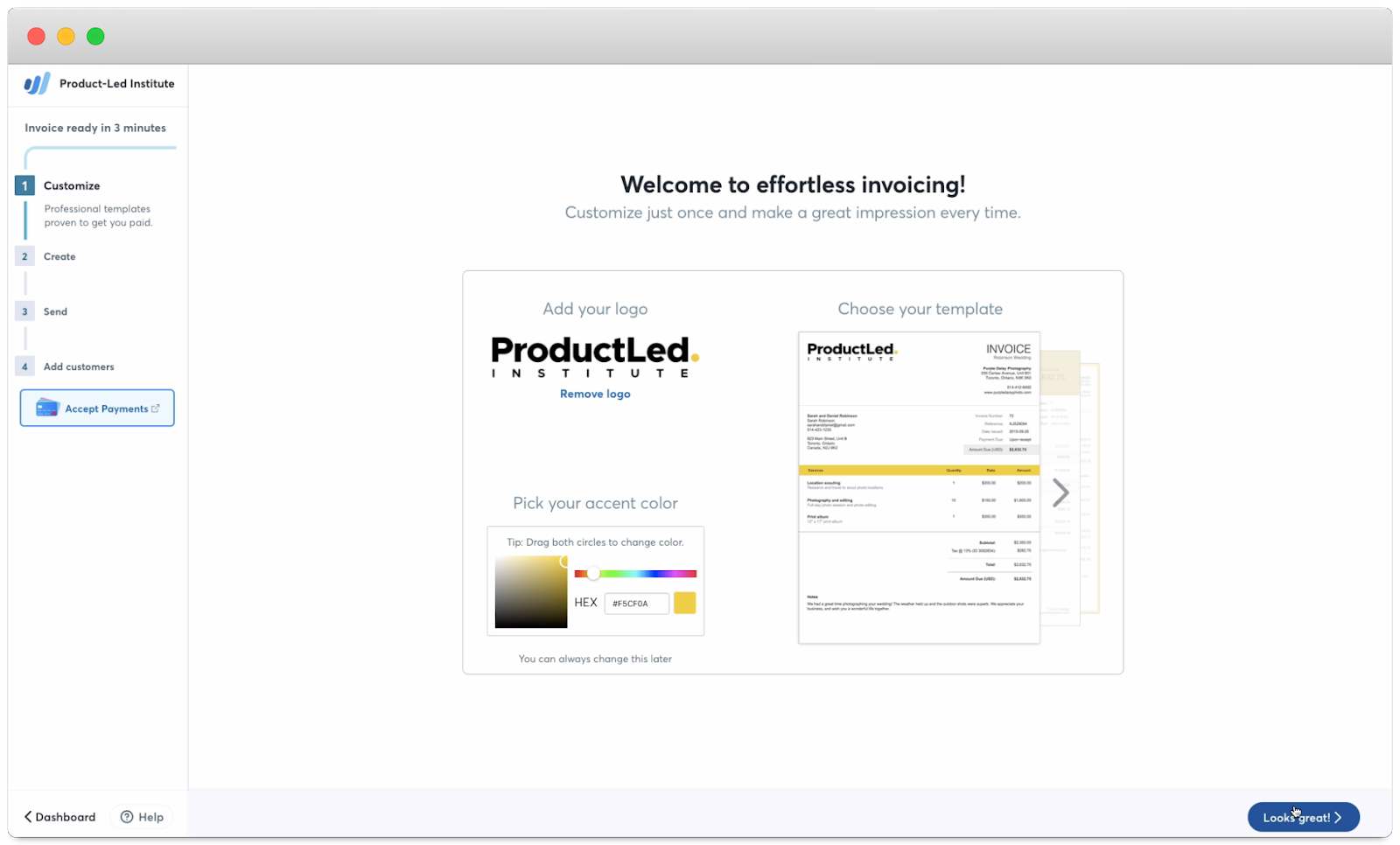
Based on your response, Wave customizes the rest of the onboarding experience, including emails, in-app messages, and product tours. Good friction #3: Delight users and get them excited about the product An example of this is what Wave does during the user onboarding process. It asks for the users’ company logo. From there, they automatically identify the brand colors and update the invoice template to match the branding.
Some may think that this step is unnecessary and should be removed. But, after doing customer interviews, the Wave team found that this step got users excited about Wave: "During customer interviews, the customers we talked to that saw what their invoice will look like with Wave said, “Wow! This is great! This looks professional. It’s beautiful.” That gives them a lot of confidence that the product is good. Wave is something that they can trust." — Vivek Balasubramanian, Director of Growth at Wave The three types of “good” friction To wrap it up, the three types of good friction in the onboarding are ones that:
So, next time you’re wondering if you should cut out a step in your user onboarding process, ask yourself, “Does this pass the DAD test?” —Ramli Thanks again to Ramli for sharing the case study. Make sure to go follow him on Twitter. What did you think? —Corey
|