Biggest bugs on earth ..

Siti Roha Mukhtar
Belostomatidae
Belostomatidae is a family of insects better known as "giant water
bugs" or "toe-biters." Most species in the Belostomatidae family
are relatively large (2 cm or more) with some of the largest, such as
Lethocerus, exceeding 12 cm, and nearly reaching the dimensions (length and
mass) of some of the larger beetles in the world.
All bugs in the Belostomatidae family are fierce predators which stalk, capture
and feed on aquatic crustaceans, fish and amphibians. They often lie motionless
at the bottom of a body of water, attached to various objects, where they wait
for prey to come near. They then strike, injecting a powerful digestive saliva
and suck out the liquefied remains. Yum!
Their bite is considered one of the most painful that can be inflicted by any
insect. The saliva liquefies muscle tissue. In rare instances, their bite can
do permanent damage to humans. So don't get drunk and pass out with your face
near one of these guys.

Occasionally when encountered by a larger predator, such as a human, they have
been known to "play dead" and emit a fluid from their anus to make
them look less appetizing. Giant water bugs are a popular food in Thailand.

Atlas Moth
(Attacus Atlas)

Atlas moths are...
- ...considered to be the largest moths in the world in terms of total wing surface area. Their wingspan is often up to a foot long.
- ...are said to be named after either the Titan of Greek mythology, or their map-like wing patterns.
- ...unsteady fliers and the female does not stray far from the location of her discarded chrysalis.
- ...found in the tropical and subtropical forests of Southeast Asia.
Giant Camel Spider
When American soldiers aren't worrying about insurgents and IEDs, they have to
keep an eye out for Giant Camel Spiders. Iraq's Giant Camel Spiders have even
been found hiding in sleeping bags. Fortunately, the giant desert camel spiders
native to Iraq aren't venomous. But they are FAST. Giant Camel Spiders have
been known to run around 10 MPH. Although most Camel Spiders are about the size
of a credit card, they have been know to grow larger than 10 inches, especially
in the deserts of the Middle East.

The above photo was taken in the desert area outside of Baghdad. The 2 camel
spiders were in a fight to the death. The spider on the bottom has his fangs
locked on the torso of the spider above.
The image below is of a U.S. solider stationed outside of Kuwait. He was bitten
by a Camel Spider in his sleep. The infected wound was so bad doctors couldn't
stitch it up. They had to leave it open to drain and heal from the inside out.
The bitten soldier now has a scar the size of a penny on his elbow.

Camel Spiders are common in the Middle East, but they can also be found in the
southwest U.S. and Mexico. The Mexican's call Camel Spiders matevenados, which
translates to"deer killers" in English.

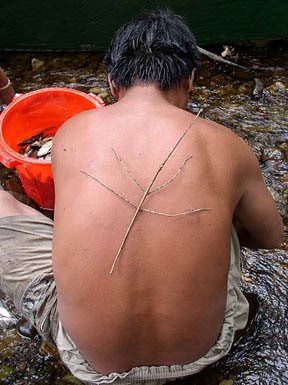
Many stick insects are easy to care for, and believe it or not make good
tropical pets.
Indian stick insects are all female and reproduce by themselves
(parthenogenesis) and seem content living without mates or kin. Occasionally
part-male part-female individuals are reared in captivity, but never true
males.
The stick insects molt and may eat their own shed skin. By the 6th molt, the
stick insect will lay eggs. Yum!
Queen Alexandra’s Birdwing
(Ornithoptera alexandrae)

Queen Alexandra's Birdwing (Ornithoptera alexandrae) is the largest butterfly
in the world. The species was named by Lord Walter Rothschild in 1907, in honor
of Queen Alexandra, wife of King Edward VII of the United Kingdom. Female
Birdwings can reach a wingspan of about 14 inches, a body length of 3-4 inches
and a body mass of up to 1/2 ounce. These are all enormous measurements for a
butterfly and actually much more common for small birds.
Goliath Beetle
The Goliath beetles are among the heaviest insects on Earth. They are found in
Africa. The heavily armored adults are so large that when flying, they produce
a sound akin to a toy helicopter in flight. They are scavengers and eat rotting
fruit, vegetables and animal feces off the jungle floor. Jungle poop. It's
what's for dinner.

Giant Weta
Weta are extremely large by insect standards. They can weigh more than 70g,
making them one of the heaviest documented insects in the known world. The
Giant Weta can't even jump because it's so heavy. Giant Weta and are classified
in the genus Deinacrida, which is Greek for terrible grasshopper. They are
found primarily on small islands off the coast of the main islands, and are
examples of island gigantism. Wetas like to hide under rocks or plant debris.

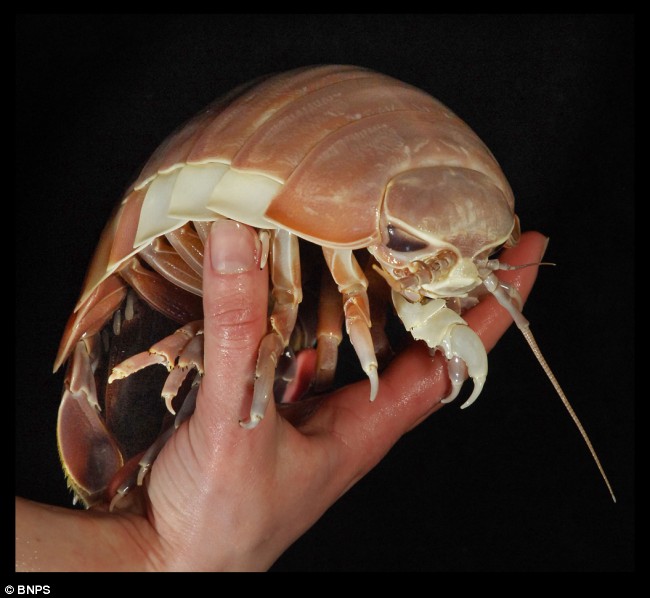
Giant Isopod

The Giant Isopod isn't
technically an insect. Believe it or not, it falls under the Crustacean class
along with crab, shrimp and lobster. That's right kids, it's aquatic. Like a
giant sea roach.
Although rarely found on food menus in most of the world, it's not uncommon in
some Eastern Asian countries to find seaside restaurants serving boiled Giant
Isopods.
Even though the Giant Isopod is a deep sea dwelling creature, it might look
strangely familiar to you. A close cousin of the Giant Isopod is the much
smaller terrestrial Woodlouse (3-30 mm). But you might know the Woodlouse by
one of its more common nicknames like pill bug or roly-poly. Woodlice are
usually found in damp, dark places, rotting logs and typically eat decaying
plant material.
Genetically, Woodlice and Giant Isopods have been unchanged for over 160
million years.