| | | | Links to recent scientific papers, web posts, upcoming events, job opportunities, podcasts, and event recordings, etc. on Carbon Dioxide Removal Technology.📃TABLE OF CONTENTSNote: Click on the headings listed in the table of contents above to easily navigate to the sections you're interested in. 💸COMMERCIAL NEWS Share 📝RESEARCH PAPERSHaig, J., Sanderman, J., Zwart, C., Smith, C., & Bird, M. I. (2024). Impact of fire return interval on pyrogenic carbon stocks in a tropical savanna, North Queensland, Australia. International Journal of Wildland Fire, 33(8).Synopsis: This study was conducted to test whether reintroducing Indigenous fire management practices could enhance pyrogenic carbon sequestration in northern Australian savanna soils. The findings revealed that soils subjected to ≥5 fires from 2000 to 2022 had an average increase of 0.25 MgC ha−1 in pyrogenic carbon stocks, while the increase in soil organic carbon was small and not statistically significant.
Fridahl, M., Möllersten, K., Lundberg, L., & Rickels, W. (2024). Potential and goal conflicts in reverse auction design for bioenergy with carbon capture and storage (BECCS). Environmental Sciences Europe, 36(1), 146.Synopsis: To guide the scale-up of BECCS in Sweden, this study explores policy design preferences among politicians, regulators, and BECCS operators. Through 35 expert interviews, it identifies key trade-offs, including the need to balance early implementation with operators' fear of costly bids, allocate contracts without inflating costs, design effective compliance mechanisms, and integrate auctions with the voluntary carbon market while maintaining environmental integrity.
Buck, H. J., Markusson, N., & Carton, W. (2024). Racial capitalism’s role in mitigation deterrence from carbon removal. Environmental Science & Policy, 160, 103865.Synopsis: To address the challenges of mitigation deterrence and environmental justice in carbon removal, this study explores how racial capitalism underpins these issues. It finds that current policy measures are insufficient and argues that understanding racial capitalism is crucial for developing policies that limit the risks of mitigation deterrence and racial injustice. The study suggests integrating these insights into policymaking to ensure equitable carbon removal practices.
Xiao, Y., Zhou, M., Liu, X., Zhang, X., Xiao, L., Liu, J., & Cruse, R. M. (2024). Pore connectivity and anisotropy affect carbon mineralization via extracellular enzymes in> 2 mm aggregates under conservation tillage of Mollisols. Soil and Tillage Research, 244, 106253.Synopsis: To investigate the role of soil aggregate pore characteristics in carbon sequestration within Mollisols, this study found that 15 years of no-tillage and reduced tillage increased total porosity and the proportion of larger pores, while conventional tillage created the most complex pore structures. Pore shape parameters, particularly connectivity and anisotropy, were key in enhancing soil carbon mineralization by influencing extracellular enzyme activity.
Wijaya, N., Morgan, D., Vikara, D., Grant, T., & Liu, G. (2024). Basin-scale study of CO2 storage in stacked sequence of geological formations. Scientific Reports, 14(1), 18661.Synopsis: This study was conducted to address concerns over caprock integrity and reservoir pressure buildup in closely located CO2 storage projects. The findings indicate that injecting CO2 into a stacked sequence of saline formations, rather than a single formation, reduces pressure buildup by up to 46%, minimizes the CO2 footprint, and helps maintain caprock integrity, making it a favorable strategy for commercial-scale carbon capture and storage.
Badger, N., Boylu, R., Ilojianya, V., Erguvan, M., & Amini, S. (2024). A cradle-to-gate life cycle assessment of green methanol production using direct air capture. Energy Advances.Synopsis: This study assesses the environmental impacts of renewable energy in synthetic methanol production. It finds that renewable energy configurations for DAC-to-methanol processes result in significantly lower greenhouse gas emissions compared to traditional methods. Hydroelectric and wind power in the western U.S. demonstrate the lowest global warming potential, with reductions of −2.53 and −2.39 kg CO2 eq. per kg methanol, respectively. These findings emphasize the importance of optimizing renewable energy sources and DAC technologies to achieve carbon neutrality.
Delacroix, S., Nystuen, T. J., Tobiesen, A. E. D., King, A. L., & Höglund, E. (2024). Ocean alkalinity enhancement impacts: regrowth of marine microalgae in alkaline mineral concentrations simulating the initial concentrations after ship-based dispersions. Biogeosciences, 21(16), 3677-3690.Synopsis: This study evaluates the biological impacts of adding alkaline minerals to oceans for increasing CO2 absorption and mitigating acidification. Findings show that magnesium hydroxide (Mg(OH)₂) has minimal toxicity to marine microalgae, with no detectable effects on growth, while calcium hydroxide (Ca(OH)₂) causes significant initial damage but similar regrowth rates as Mg(OH)₂ and controls. The results suggest Mg(OH)₂ is a safer option for marine carbon dioxide removal compared to Ca(OH)₂.
Hasemer, H. D., Borevitz, J., & Buss, W. Measuring Enhanced Weathering: inorganic carbon-based approaches may be required to complement cation-based approaches. Frontiers in Climate, 6, 1352825.Synopsis: To improve the accuracy of CO2 sequestration measurements through enhanced weathering, this research compares cation-based and inorganic carbon-based approaches. Results reveal that cation-based CDR estimates are often higher due to issues like incomplete cation extraction and CO2 outgassing, while inorganic carbon-based methods face challenges with CO2 loss. The study highlights the need to reconcile these methods for accurate CDR measurement and suggests validating both approaches.
Dale, A. W., Geilert, S., Diercks, I., Fuhr, M., Perner, M., Scholz, F., & Wallmann, K. (2024). Seafloor alkalinity enhancement as a carbon dioxide removal strategy in the Baltic Sea. Communications Earth & Environment, 5(1), 452.Synopsis: To evaluate the effectiveness of ocean alkalinity enhancement for CO2 sequestration, this study uses a reaction-transport model to assess calcite addition in the southwestern Baltic Sea. Findings indicate that most calcite is buried without dissolving under moderate addition rates, but higher dissolution rates occur in low salinity areas. The model predicts a potential net CO2 uptake of 3.2 megatonnes per year for the Baltic Sea with ongoing calcite addition, though field validation is needed for more accurate estimates.
Dale, A. W., Geilert, S., Diercks, I., Fuhr, M., Perner, M., Scholz, F., & Wallmann, K. (2024). Seafloor alkalinity enhancement as a carbon dioxide removal strategy in the Baltic Sea. Communications Earth & Environment, 5(1), 452.Synopsis: To investigate the environmental impacts of ocean alkalinity enhancement (OAE) on marine biology, this study introduces the Ocean Alkalinity Enhancement Pelagic Impact Intercomparison Project (OAEPIIP). The project standardizes OAE experiments with plankton communities worldwide, offering a detailed methodology for consistent data collection. Results will highlight common OAE responses across various environments, supporting scientific consensus and guiding decisions on OAE scaling.
Berger, M., Comte, A., Kwiatkowski, L., & Bopp, L. (2024). Unaccountable counting: the folly of incorporating open ocean carbon sinks in Nationally Determined Contributions. Comptes Rendus. Géoscience, 356(G1), 123-137.Synopsis: To explore the challenges of including open ocean carbon sinks in Nationally Determined Contributions (NDCs), this study uses a high-resolution ocean biogeochemical model and observations. Findings show that the French Exclusive Economic Zone (EEZ) acts as a significant anthropogenic carbon sink, accounting for 0.21 GtCO2·yr–1, nearly 50% of France’s emissions. However, this uptake results from natural ocean processes rather than human management, complicating integration into NDCs due to inconsistencies with global climate goals and challenges in accurately assessing and verifying carbon sinks.
Morris, J., Gurgel, A., Mignone, B. K., Kheshgi, H., & Paltsev, S. (2024). Mutual reinforcement of land-based carbon dioxide removal and international emissions trading in deep decarbonization scenarios. Nature Communications, 15(1), 7160.Synopsis: This study examines how carbon dioxide removal (CDR) technologies interact with international emissions trading using a global energy-economic model. Findings reveal that CDR and emissions trading mutually reinforce each other in deep decarbonization scenarios. CDR's geographic variability is leveraged through trading, and a net-zero emissions world requires CDR to make trading effective. Although overall spending and revenue remain stable, combining CDR with trading enhances efficiency and GDP.
Schiffer, Z. J., Lucas, É., Watkins, N. B., Ardo, S., Xiang, C., & Atwater, H. A. (2024). Acid and base generation via an electrochemical hydrogen-looping cell tailored for carbon removal applications. Device.Synopsis: This study introduces an ion-exchange membrane-free electrochemical cell designed to enhance direct ocean carbon capture. By generating acid and base through anodic hydrogen oxidation and cathodic hydrogen evolution, the system achieves current densities up to 500 mA/cm². Operating with simulated ocean water, it uses alternating electrode polarities to prevent fouling and eliminates the need for expensive and prone-to-failure ion-exchange membranes. This approach offers a more efficient and durable method for creating the pH swings essential for carbon capture.
Szeligowska, M., Benkort, D., Przyborska, A., Moskalik, M., Moreno, B., Trudnowska, E., & Błachowiak-Samołyk, K. (2024). Estimates of carbon sequestration potential in an expanding Arctic fjord (Hornsund, Svalbard) affected by dark plumes of glacial meltwater. Biogeosciences, 21(16), 3617-3639.Synopsis: This study investigates how increasing inorganic suspended particulate matter (iSPM) from glacial meltwater impacts carbon sequestration in polar fjords. Using satellite, meteorological, and model data, we find that with longer melt seasons and more ice-free coastal areas, iSPM has increased by 3.7 g/m³ per decade. This influx delays and reduces peaks in phytoplankton and zooplankton but does not significantly affect carbon burial, which decreased by about 16%. Despite these impacts, new marine habitats still contribute notably to carbon sequestration. Further research is needed to explore the broader effects of marine ice loss on carbon fluxes in polar fjords.
Xu, T., Yuan, Z., Vicca, S., Goll, D. S., Li, G., Lin, L., ... & Beerling, D. J. (2024). Enhanced silicate weathering accelerates forest carbon sequestration by stimulating the soil mineral carbon pump. Global Change Biology, 30(8), e17464.Synopsis: This study evaluates the impact of enhanced silicate rock weathering (ERW) on soil organic carbon (SOC) and inorganic carbon in tropical rubber plantations. Over two years, adding wollastonite powder increased SOC concentration significantly more than inorganic carbon (HCO3-), with SOC increases being four to eight times higher. ERW positively affected mineral-associated organic matter and macroaggregates by enhancing the release of essential nutrients and stimulating root and microbial activity. These results suggest that ERW with wollastonite can substantially boost SOC sequestration, potentially surpassing inorganic carbon removal. Thus, incorporating SOC responses is crucial in CDR assessments.
Wang, Q., Du, C., & Zhang, X. (2024). Direct air capture capacity configuration and cost allocation based on sharing mechanism. Applied Energy, 374, 124037.Synopsis: This study aims to address the high costs and early-stage maturity of direct air capture (DAC) technology by introducing a novel cost-sharing mechanism for DAC equipment in power systems. It develops a unified operational model integrating electricity and carbon considerations and an enhanced carbon emission flow theory tailored for DAC. The study presents a DAC capacity planning model and a cost allocation methodology using the Shapley value framework. Case studies demonstrate the effectiveness of this approach in optimizing DAC capacity and ensuring equitable cost distribution among stakeholders.
Liu, G., Sun, Z., Wang, Z., Yu, B., Yang, X., Zhang, B., ... & Wu, Z. Flexible strategies for carbon‐negative syngas and biochar poly‐generation via a novel chemical looping approach. AIChE Journal, e18533.Synopsis: This paper introduces the pyrolysis chemical looping reforming-two stage regeneration (PCLR-TR) process, aimed at advancing chemical looping gasification with carbon-negative syngas and biochar production. The process separates pyrolysis and reforming, enhancing the flexibility of the H2/CO ratio and improving reaction rate synchronization through two-stage regeneration. Results show that process adjustments allow a H2/CO ratio between 1.02 and 3.83, and CO2 feed reduces exothermic intensity by 58%. The optimized system achieves up to 1.85 kg CO2 negative emission per kg of syngas, providing an adaptable and eco-friendly solution for energy and chemical sectors.
Zhang, T., Wang, L., Zhu, W., Guo, Y., Chen, Z., Li, J., ... & Yu, Q. (2024). Preparation of high strength carbon negative building material by CO2 curing biochar-EAF steel slag compacts. Construction and Building Materials, 441, 137456.Synopsis: To enhance CO2 reduction and waste utilization, this study investigates carbonating alkaline solid wastes using porous biochar. Incorporating biochar into dense electric arc furnace (EAF) steel slag compacts improves CO2 diffusion. Results reveal that at 6 hours of carbonation and 25 MPa pressure, the compressive strength reaches 64.49 MPa. Adding 5% biochar boosts strength by 24.6% and CO2 uptake by 1.3%. An empirical model for predicting carbonation depth based on pore structure was developed, supporting the creation of high-strength, carbon-negative building materials.
Uludere Aragon, N., Xie, Y., Bigelow, D., Lark, T. J., & Eagle, A. J. (2024). The realistic potential of soil carbon sequestration in US croplands for climate mitigation. Earth's Future, 12(6), e2023EF003866.Synopsis: To refine estimates of cropland carbon sequestration potential, this study identifies a more accurate land base for cover cropping in the U.S. By focusing on stable croplands in annual systems that don’t require irrigation, we find that only 32% of current U.S. cropland is suitable. This revised focus reduces potential sequestration to 19.4 Tg CO2e per year—about one-fifth of previous estimates. Moreover, achieving half of this potential may cost over 100 USD per Mg CO2e, highlighting the need for financial incentives to support cover cropping and ensure additional carbon sequestration.
Sendi, M., Bui, M., Mac Dowell, N., & Fennell, P. (2024). Geospatial techno-economic and environmental assessment of different energy options for solid sorbent direct air capture. Cell Reports Sustainability.Synopsis: To evaluate the effectiveness of Direct Air Capture (DAC) technology, this study assesses its coupling with various energy sources. Findings reveal that pairing DAC with thermal power plants like nuclear and natural gas combined cycle with carbon capture is most cost-effective, with levelized costs ranging from $246–$503 per ton of CO2. Renewable options such as concentrated solar power offer lower costs in regions with high solar irradiation, at $319 per ton, but are impractical in areas with low solar resources. Achieving costs below $200 per ton would necessitate significant technological advancements.
Uludere Aragon, N., Xie, Y., Bigelow, D., Lark, T. J., & Eagle, A. J. (2024). The realistic potential of soil carbon sequestration in US croplands for climate mitigation. Earth's Future, 12(6), e2023EF003866. 📰WEB POSTSA CO2 Capture "Heilmeier Catechism" for the Department of DefenseXCaptureCO2 DOD’s Alternate plan to achieve Net Zero CO2 emissions… 20 hours ago · mike landmeier 🗓️UPCOMING EVENTSDiscovery workshop focussing on terrestrial science (CDR) | 22 October 2024 | OnlineDiscovery workshop focussing on ocean science (CDR) | 25 October 2024 | OnlineIntegrative synthesis workshop focusing on identifying gaps in current governance & ethics | 18 November 2024 | Online
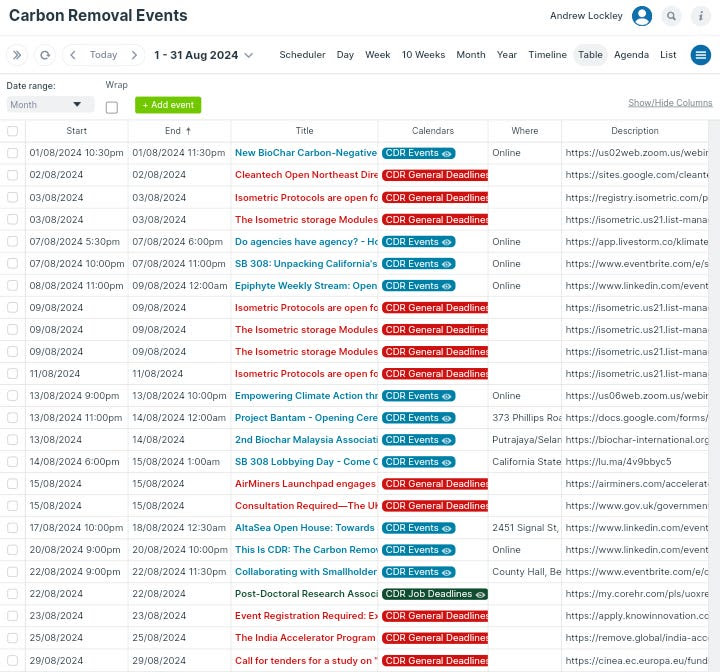
We have curated a “Carbon Removal Events Calendar.” Explore and stay informed about upcoming events, conferences, and webinars on Carbon Dioxide Removal technology. Sync specific events / all events to your default calendar to ensure you never miss out on important CDR updates. Carbon Removal Events Calendar GUIDELINES:Sync selected events to your default calendar in these simple steps:1) Click on the event you want to sync.2) Tap the menu icon (three vertical lines) at the top left.3) Choose 'Share.'4) Pick your default calendar.5) Save the event.Sync the entire Teamup Calendar to your default calendar with these simple steps:1) Tap the menu icon (three vertical lines) at the top right.2) Choose 'Preferences.'3) Click 'iCalendar Feeds.'4) Copy the URL shown for 'CDR Events / CDR General Guidelines / CDR Job Deadlines.'’5) Paste the URL into your default calendar settings.6) Click 'Subscribe' or 'Add Calendar.'
You can directly sync all Carbon Removal events to your default calendars by pressing the link below: Sync CDR Events to your Default Calendar 💼JOB OPPORTUNITIES"There is an urgent need to reduce greenhouse gas (GHG) emissions and remove GHGs from the atmosphere. Like rainforests, the ocean removes carbon dioxide from the atmosphere and stores it. Scientific studies are underway to quantify the potential of a wide range of marine carbon dioxide removal (mCDR) strategies to boost the carbon sequestration capacity of the ocean, via both natural and engineered approaches. Research to evaluate the efficacy and impacts of potential mCDR deployments is rapidly progressing from initial lab or modeling studies to limited deployments in the marine environment, where mCDR activities are met with both interest and concern by coastal community and existing ocean users as to the impacts of these activities on ecosystems, marine resources, and local livelihoods. Ensuring broad participation in decision-making, rooted in robust public engagement and considerations of environmental justice that acknowledge and respond to the needs of coastal communities and ocean stakeholders, will be critical for advancement of the field. The intern will contribute to this effort by engaging with an ongoing field trial to determine best practices for engaging a diverse set of stakeholders and the public. The intern will be engaged with the work of Woods Hole Oceanographic Institute (WHOI), and will participate in the joint EDF-WHOI collaborative project. The intern will report directly to the Social-ecological Systems Scientist on EDF’s Ocean Science team and work closely with WHOI’s Research Specialist, Marine Chemistry and Geochemistry."
"Pachama is developing three core technologies required to modernize the voluntary carbon market and create a future where high-integrity, transparent carbon credits can scale at the speed our planet demands."
"The project will conduct a cost-benefit analysis of emerging technologies for decarbonisation, including electrochemical technologies, by taking into consideration the social, economic and environmental aspects of these technologies by applying the triple bottom line approach.We seek a PhD candidate interested in understanding how the public perceives new technologies for transforming carbon dioxide (CO2) into useful products and chemicals. The student will collaborate with experts to:-conduct life-cycle and cost-benefit analyses of different CO2 transformation technologies;-develop frameworks to consider both the CO2 mitigation potential and/or benefit of products produced from CO2; and-develop methodology to integrate circular economy concepts for the fulfilment of sustainable development objectives.-In addition, based on surveys and experimental data, the student will also model public perception and technology preferences/choices along the supply chain."
"Carbon Capture is building a team and the capabilities to deliver end-to-end DAC projects from materials science to large-scale project development."
Deep Sky is developing technology-based carbon removal projects at scale in Canada."
"Charm Industrial is working to return the atmosphere to 280 ppm CO₂. We design, build and operate a fleet of mobile fast pyrolyzers that convert ag and forest biomass residues into bio-oil for use in carbon removal and direct-reduced-iron steelmaking."
"UNDO is on a mission to tackle the greatest challenge of our time: climate change. We have set-up a range of field trials designed to detect weathering signals, validate our geochemical model, provide robust evidence of enhanced rock weathering as a carbon removal tool, and show the agronomic co-benefits of enhanced weathering."
"BeZero Carbon is a global ratings agency for the Voluntary Carbon Market. We distribute our ratings via our SaaS Product, BeZero Carbon Markets, informing all market participants on how to price and manage risk. Our ratings and research tools support buyers, intermediaries, investors and carbon project developers."
"At Skytree, we’re turning ideas into action in the journey toward stable, reliable, and cleaner CO2. We create smart, scalable carbon dioxide solutions that recycle atmospheric CO2 and contribute to a healthier planet."
"Charm Industrial is working to return the atmosphere to 280 ppm CO₂. We design, build and operate a fleet of mobile fast pyrolyzers that convert ag and forest biomass residues into bio-oil for use in carbon removal and direct-reduced-iron steelmaking."
"Managing natural processes is one of the most practical and effective implementable approaches to removing CO2 from the atmosphere. It is imperative to measure carbon sequestered by natural means accurately, to understand process drivers and uncertainties and to accelerate nature-based carbon sequestration. Soil can store or sequester carbon through microbiological activity, providing a nature-based sink for CO2. However, poorly managed soils can release carbon as CO2 or methane (CH4) to the atmosphere - contributing to climate change and reducing soil health and fertility.This project will develop machine learning (ML) platforms to monitor, quantify and reveal the processes underlying soil carbon sequestration. This approach combines measurements of physical, chemical, and biological functional and evolutionary processes. Soil microbiome research focuses on determining which microbial taxa and functions facilitate carbon capture across a range of climatic conditions. There will be an analytical challenge to integrate datasets of different types, scales and modalities. These relate to the processing and integration of soil chemistry, soil structure (tomographic imaging data) and metagenomic profiling of soil microbiome across different environmental conditions and soil textures. The overall aim is to integrate disparate measurements of physical, chemical, and biological processes in soil to develop a generalizable predictive model of carbon sequestration."
"CarbonPlan is a nonprofit research organization working on improving the transparency and scientific integrity of climate solutions with open data and tools. Our team analyzes the design and implementation of climate programs across the public and private sector. Our work focuses on three program areas: carbon offsets, carbon removal, and climate risks. In all three areas, we create public resources on climate solutions based on the best available science and data."
"Climeworks empowers people and companies to fight global warming by offering carbon dioxide removal as a service via direct air capture (DAC) technology."
"Vaulted is an emerging leader in permanent carbon removal. A biomass carbon removal and storage (BiCRs) solution, Vaulted delivers permanent, high quality carbon removal at scale through the geologic sequestration of carbon-filled organic waste."
"Isometric is a carbon removal registry. We issue the world’s most scientifically rigorous carbon credits to help Fortune 100 companies tackle climate change and prevent greenwashing."
"We seek a postdoctoral scholar to study the release of alkalinity from carbonates for use in carbon capture technology. The postdoc will work in the Department of Earth Sciences at the University of Southern California and will be jointly supervised by professors Seth John (www.mtel.rocks) and Will Berelson (dornsife.usc.edu/berelson). The postdoc will lead investigation into the use of novel catalysts which can speed the dissolution of carbonate minerals. The dissolution of carbonates consumes CO2 and releases alkalinity, a process which can be utilized in various carbon capture applications including direct air capture, point-source carbon capture, and ocean alkalinity enhancement. The project will initially be focused on fundamental scientific research into reaction dynamics, including the mechanism of reaction catalysis, and the fundamental controls on dissolution kinetics and reaction rate. At later stages, the work may focus more on technical feasibility and engineering applications such as a trial conducted at or near Catalina’s Wrigley lab."
🎙️PODCASTSTurned to Stone - How to Permanently Store CO₂ | The Arctic Circle Podcast | Turned to Stone - How to Permanently Store CO₂ The Arctic Circle Podcast 21:08 |
"In this episode, we learn more about CarbFix, the Icelandic company that has pioneered a method to permanently store CO₂ by transforming it into stone deep underground. Our special guest, Edda Sif Pind Aradóttir, CEO of CarbFix, will introduce this groundbreaking technology and discuss its role as a crucial tool in the fight against the climate crisis. She will also take questions from the audience."
A new initiative just launched that could upend the approach to carbon removal standards | The Carbon Curve The Carbon Curve The Carbon CurveEpisode 40 is with Anu Khan, Founder and Executive Director at Carbon Removal Standards Initiative… 5 days ago · 2 likes · 1 comment · Na’im Merchant "Anu founded the Carbon Removal Standards Initiative or CRSI in early 2024 while an Entrepreneur in Residence at Carbon180. She previously led the Science & Innovation team at Carbon180 where her work focused on measurement, reporting, and verification (or MRV) as a crucial level for building a just, equitable, and highly accountable carbon removal (or CDR) sector. Prior to Carbon180, Anu worked in climate philanthropy at Founders Pledge. Her academic background is in electrochemistry and materials science. CRSI is a new nonprofit initiative that provides technical assistance and capacity building for carbon removal policy, focused specifically on carbon quantification. As a nonprofit, CRSI is able to provide financially unconflicted information to policymakers, regulators, and other NGOs working in CDR, decoupled from the sale of carbon credits or the growth of carbon markets. In this episode, Na’im and Anu discuss:-The Carbon Removal Standards Initiative (CRSI);-the importance of Measurement, Reporting, and Verification (MRV) in ensuring justice and accountability;-efforts to provide technically unconflicted information to policymakers and regulators;-bridging gaps in carbon quantification standards and build industry trust; and-the need for robust and scientifically sound standards tailored to various industries and jurisdictions."
🎥YOUTUBE VIDEOSHow are you celebrating "Carbon Removal Day"? | Tito- AirMiner “Imagine it's Carbon Removal Day, 100,000,000 people are talking about carbon removal as required, major media publications are promoting the need for carbon removal to policymakers, investors, and innovators.”
This silo stands against climate change | CBC Nova Scotia “A Halifax-based startup is adding powdered limestone from this silo to a nearby river — part of a strategy to help restore Nova Scotia's salmon rivers while simultaneously removing carbon dioxide from the atmosphere. The CBC's Moira Donovan is shown how it all works.”
IB Carbon Removal Portrait | Swiss Innovation Booster powered by Innosuisse “The Innovation Booster Carbon Removal presents itself.”
This Is CDR Ep.101: The Carbon Removal Standards Initiative with Anu Khan | OpenAir “In the fall of 2022, Carbon180 published its guide to high accountability MRV, CDR industry stakeholders met in San Francisco to discuss the state of standardization, and scientists convened in Rhode Island to consider the technical and social underpinnings of MRV in open systems like the ocean. Since then, interest in MRV has exploded, with events, panels and workshops all over the world. And Anu Khan (former Deputy Director of Science & Innovation at Carbon180) has been going around to those events asking: What are standards? Where do standards come from? And whose job is this anyway? 18 months of research on the carbon removal ecosystem, extensive industry interviews, and case studies from other emerging industries has led to the launch of the Carbon Removal Standards Initiative (CRSI). CRSI is a new nonprofit initiative focused on bringing rigor and accountability to the CDR sector through the uniquely powerful mechanism of regulatory standards. In today's episode of This Is CDR, Anu explains what CRSI does, why they focus on policy, and how they work with partners across the CDR ecosystem. Anu founded CRSI in early 2024 while an Entrepreneur in Residence at Carbon180. She previously led the Science & Innovation team at Carbon180. Prior to Carbon180, Anu worked in climate philanthropy at Founders Pledge. Her academic background is in electrochemistry and materials science.”
Evaluating Ocean Climate Solutions | Woods Hole Oceanographic Institution “Join us for a virtual public information session that explores the need for ocean-based climate solutions and the critical role of science in evaluating their effectiveness and safety. Additionally, learn about the LOC-NESS Project—a scientific initiative focused on evaluating ocean alkalinity enhancement as a potential climate solution, and the scope, methods, and potential environmental impacts of proposed field trials. The event will include an audience Q&A session and an opportunity to provide feedback.”
World’s largest carbon removal plant resides in Arkansas | THV11 How much do you know about Carbon Dioxide Removal (CDR)? | RESCUE Climate Horizon Europe Project “Carbon dioxide removal (CDR) refers to human-led techniques or strategies for removing carbon dioxide (CO₂) from the atmosphere and storing it for long periods of time. In this video, we address how CDR works and dive into four such methods investigated in the European research project, RESCUE”
Charm's First Verified Tons | Charm Industrial Weekly Carbon Removal Updates from 19 August - 25 August 2024 | Carbon Removal Updates Bulletin🚨DEADLINESAbstract Submission Deadline: 01 October 2024Full Manuscript Submission Deadline: 31 December 2024
Unlock exclusive insights on carbon removal! While all content on Carbon Removal Updates is free for everyone, I invite those who can to become paid subscribers. Your support empowers this important work and helps us spread the message far and wide. 20% Group Subscription Discount Share Carbon Removal Updates © 2024 Carbon Removal Updates
548 Market Street PMB 72296, San Francisco, CA 94104
Unsubscribe 
| |
  |
|