| | | | Links to recent scientific papers, web posts, upcoming events, job opportunities, podcasts, and event recordings, etc. on Carbon Dioxide Removal Technology.Unlock exclusive insights on carbon removal! While all content on Carbon Removal Updates is free for everyone, I invite those who can to become paid subscribers. Your support empowers this important work and helps us spread the message far and wide. 📝TABLE OF CONTENTSNote: Click on the headings listed in the table of contents above to easily navigate to the sections you're interested in. 💸COMMERCIAL NEWS 📃RESEARCH PAPERSBianchi, R., Abbate, S., Lockley, A. J., Abbà, A., Campo, F., Varliero, S., ... & Caserini, S. (2024). Evaluating rainbowing for ocean alkalinity enhancement. Environmental Research Communications.Synopsis: This study assesses Ocean Alkalinity Enhancement via rainbowing, where SL slurry is dispersed from ships. Simulations reveal that rainbowing requires high power to avoid environmental pH spikes, but even with significant dilution, it proves inefficient. Emissions nearly offset the carbon dioxide removal, achieving only 176 kg CO2 per ton of Ca(OH)2. Compared to ship-wake discharge, rainbowing is costlier and less effective, with costs at €388 per ton of CO2 removed versus €5.5.
Rosen, N., Welter, A., Schwankl, M., Plumeré, N., Staudt, J., & Burger, J. (2024). Assessment of the Potential of Electrochemical Steps in Direct Air Capture through Techno-Economic Analysis. Energy & Fuels.Synopsis: This study evaluates the long-term energy demand and levelized cost of capture (LCOC) for DAC technologies using liquid solvent absorption and solid adsorption. By comparing non-electrochemical and electrochemical DAC processes, it identifies the cell voltage needed for electrochemical steps to match or outperform non-electrochemical energy demands. Findings indicate that electrochemical processes could be competitive, but CapEx remains a significant factor, with uncertainties addressed through a range of initial data.
Narayan, K. B., Patel, P. L., Wise, M., Snyder, A., Calvin, K. V., & Graham, N. T. (2024). Seeing the forest for the trees: Implementing dynamic representation of forest management and forest carbon in a long-term global multisector model. Environmental Research Letters.Synopsis: This study implements a dynamic forest harvest model in GCAM, tracking forest age and adjusting rotation ages based on wood prices, age, and regional preferences. The model meets global wood demand with minimal old-growth loss, but economic pressures, especially in developing regions, drive deforestation more than wood harvesting. Carbon pricing leads to reduced rotation ages and a shift towards more carbon-efficient forest management, though forest cover may decrease due to competition with bio-energy crops.
Schwarz, E., Ghersheen, S., Belyazid, S., & Manzoni, S. (2024). When and why microbial-explicit soil organic carbon models can be unstable. Biogeosciences, 21(14), 3441-3461.Synopsis: This study examines when and why unstable equilibrium points (EPs) occur in microbial-explicit soil organic carbon models, leading to unrealistic predictions. Instability arises when dissolved organic carbon (DOC) resupply depends on its abundance via a positive feedback loop. The study identifies a conservative condition in model parameters to ensure stability. It suggests three strategies to avoid instability: ignoring DOC dynamics, using biomass-independent uptake rates, or correlating parameter values to maintain stability, emphasizing the importance of ecological principles in model accuracy.
Vivian, C., & Del Savio, L. (2024). The London Convention and Protocol: Adapting to Address the Ocean-Climate Crisis. The International Journal of Marine and Coastal Law, 1(aop), 1-9.Synopsis: This study addresses the need for clear regulations on ocean interventions like ocean fertilization and sub-sea carbon sequestration, which are gaining traction for mitigating climate change. These technologies, while aimed at accelerating CO2 uptake, may cause unintended environmental effects. The findings emphasize that international regulations must evolve with emerging technologies, grounded in scientific evidence, and aligned with public international law to protect the marine environment.
Sheehy, J., Kerr, S., Bell, M., & Porter, J. (2024). Adaptive stacked species distribution modelling: Novel approaches to large scale quantification of blue carbon to support marine management. Science of The Total Environment, 174993.Synopsis: This study introduces "Adaptively Stacked" Species Distribution Models (AS-SDMs) using Weighted Boosted Regression Trees (WBRTs) to predict blue carbon habitats in Orkney, including seagrass, maerl, and horse mussel abundance. The AS-SDMs integrate sediment thickness, carbon content, and sequestration potential, and a novel method characterizes substrates by mud, sand, and gravel inputs. Key findings estimate these habitats cover 657 km², store 16 Mt C, sequester 6000 t C annually, and have a potential value of £24.5 million, with six key project areas identified.
Titus, K., Dempsey, D., Peer, R., & Hanik, F. (2024). From carbon neutral to carbon negative: a theoretical bioenergy and CO2 removal retrofit at Ngāwhā geothermal power station. Journal of the Royal Society of New Zealand, 1-19.Synopsis: In countries like New Zealand, where renewable electricity generation exceeds 80%, traditional decarbonization methods are limited. This study highlights how carbon dioxide removal technologies, leveraging geothermal and biomass resources, can drive sectors to net-zero emissions. A theoretical bioenergy retrofit at the Ngāwhā geothermal plant, using forestry residues, could remove 15.9 ktCO2/year with only 6% of available feedstock. Under the 2024 ETS, CDR revenue could surpass that of new electricity generation.
Steinthorsdottir, K., Rahimi, M., Dipple, G. M., & Snæbjörnsdóttir, S. Ó. (2024). Evaluation and site selection for carbon storage via shallow CO2 injection into serpentinite in British Columbia, Canada. International Journal of Greenhouse Gas Control, 137, 104222.Synopsis: This study evaluates the potential for in-situ CO2 injection into serpentinite for carbon mineralization in British Columbia, Canada. Using multi-criteria index overlay analyses, 84 viable ultramafic formations were assessed for logistical feasibility, focusing on access to water, CO2 sources, and infrastructure. Three sites—Shulaps complex, Coquihalla serpentine belt, and Tulameen intrusion—were identified as prime candidates. Estimated CO2 storage capacities range from 141.2–18,682 MtCO2 at Shulaps to 2.8–373.6 MtCO2 at Tulameen. These sites will be further evaluated for pilot testing.
Li, Z., Planavsky, N. J., & Reinhard, C. (2024). Geospatial assessment of the cost and energy demand of feedstock grinding for enhanced rock weathering in the coterminous United States. Frontiers in Climate, 6, 1380651.Synopsis: This study assesses the regional variability in carbon footprints, costs, and energy demands associated with feedstock grinding for ERW. Findings show that CO2 emissions from grinding are relatively low (5–35 kgCO2/ton) compared to ERW's CDR potential. Grinding costs vary regionally, averaging $0.95–5.81/ton with grid power and $1.35–8.26/ton with solar PV. Overall, energy demand for grinding is modest, accounting for less than 2% of annual U.S. electricity supply. Costs and energy requirements are projected to decrease over time, indicating that large-scale ERW deployment should have minor impacts on lifecycle emissions, cost-effectiveness, and energy efficiency.
Liu, G., Sun, Z., Wang, Z., Yu, B., Yang, X., Zhang, B., ... & Wu, Z. Flexible strategies for carbon‐negative syngas and biochar poly‐generation via a novel chemical looping approach. AIChE Journal, e18533.Synopsis: The proposed pyrolysis chemical looping reforming-two stage regeneration (PCLR-TR) process addresses challenges in chemical looping gasification by separating pyrolysis and reforming, allowing flexible H2/CO ratio adjustments. The two-stage regeneration enhances reaction synchronization and reduces the exothermic intensity of the second stage by 58% with CO2 feed. Optimization shows the syngas can achieve a maximum CO2 negative emission of 1.85 kg/kg, making the PCLR-TR system a versatile and eco-friendly solution for energy and chemical industries.
Norby, R. J., Loader, N. J., Mayoral, C., Ullah, S., Curioni, G., Smith, A. R., ... & MacKenzie, A. R. (2024). Enhanced woody biomass production in a mature temperate forest under elevated CO2. Nature Climate Change, 1-6.Synopsis: This study investigates the impact of elevated CO2 on mature forests, focusing on a 180-year-old Quercus robur woodland in England. Using tree-ring analysis and canopy laser scanning, we found that the woodland increased woody biomass production and carbon exudation into the soil under free-air CO2 enrichment (FACE) over 7 years. These findings suggest that mature temperate forests can significantly contribute to climate change mitigation by enhancing carbon sequestration and influencing nutrient cycles.
Yang, P., Fankhauser, S., Smith, S. M., Sundvor, I., Hirmer, S., Johnstone, I., & Stemmler, J. (2024). Policy support for BECCS and DACCS in Europe: the view of market participants. Environmental Research Letters, 19(9), 094022.Synopsis: This paper explores the role of government intervention in fostering a Carbon Dioxide Removal industry, focusing on BECCS and DACCS. Surveys and interviews with 47 project developers and financiers in Europe reveal a preference for compliance markets linked to emissions trading systems to drive demand. Participants also emphasize the need for government support to mitigate early market risks, rigorous monitoring, and regulation to maintain environmental integrity. Policymakers face challenges in scaling CDR, balancing with emissions cuts, ensuring fairness, and speeding up deployment.
Zhang, J., Zhang, F., & Yang, L. (2024). Continuous straw returning enhances the carbon sequestration potential of soil aggregates by altering the quality and stability of organic carbon. Journal of Environmental Management, 358, 120903.Synopsis: This study examines how long-term straw return affects soil organic carbon sequestration and soil structure in oasis farmland in arid northwest China. Results show straw return increases SOC, particulate OC, and mineral-associated OC by up to 63.51%, 31.00%, and 226.00%, respectively. Over time, microaggregates convert to macroaggregates, with the highest soil stability observed after 10 years. Solid-state 13C NMR reveals O-alkyl C as the dominant component, with increases in aromatic C and hydrophobicity peaking at 10 years. The study confirms that long-term straw return enhances soil structure and stabilizes OC, improving carbon sequestration.
Reef, R., Daly, E., Anandappa, T., Vienna-Hallam, E. J., Robertson, H., Peck, M., & Guyot, A. (2024). Eddy Covariance Evaluation of Ecosystem Fluxes at a Temperate Saltmarsh in Victoria, Australia Shows Large CO 2 Uptake. EGUsphere, 2024, 1-27.Synopsis: Using eddy covariance at a temperate saltmarsh on French Island, Victoria, this study measured CO2 fluxes, gas gradients, and environmental factors. The marsh, dominated by Sarcocornia quinqueflora, showed seasonal flux variations, with net ecosystem productivity (NEP) averaging 10.54 g CO2 m-2 day-1 in the growing season and 1.64 g CO2 m-2/day in winter. Despite lower respiration rates in winter, the marsh remained a CO2 sink due to some evergreen species. Annual NEP was estimated at 753 (±112.7) g C m-2/yr, aligning with temperate saltmarshes in Europe and higher than the global saltmarsh average of 382 g C m-2/yr, but half of global mangroves.
Rinberg, A., & Aziz, M. J. (2024). Acid–base concentration swing for direct air capture of carbon dioxide. Energy Advances.Synopsis: This study presents the first experimental evidence of the acid–base concentration swing (ABCS) method for direct air capture of CO2. The ABCS process utilizes Le Chatelier's principle, where concentrating acid–base reactants acidifies the solution, causing CO2 to outgas. Re-dilution reverses this, allowing CO2 absorption. The system tested includes sodium cations, boric acid, and a polyol complex, though it faces rate and capacity limitations. Theoretical models show higher reaction orders (up to fourth-order) improve cycle capacity and reduce thermodynamic work to around 150 kJ per mole of CO2. The ABCS method benefits from compatibility with existing desalination technologies, offering potential for energy recovery and direct CO2 extraction.
Tran, D. A., Gerbig, C., Rödenbeck, C., & Zaehle, S. (2024). Interannual variations in Siberian carbon uptake and carbon release period. Atmospheric Chemistry and Physics, 24(14), 8413-8440.Synopsis: This study examines how warmer winters affect CO2 release and the annual terrestrial carbon sink using data from the Zotino Tall Tower Observatory (ZOTTO) in Siberia (2010–2021). Analysis of atmospheric CO2 records reveals increased carbon release during cold months and a rise in the length and intensity of carbon release periods (CRP), while carbon uptake periods also increased but less markedly. These trends indicate that despite greater growing-season CO2 uptake, higher winter respiration negates net annual CO2 absorption due to warming. Extreme events like the 2012 wildfire and 2020 heat wave influenced the data, but inversion-derived net ecosystem exchange fluxes did not show these trends, highlighting limitations in attributing regional ecosystem contributions to observed CO2 flux changes.
📰WEB POSTSThe Path to Responsible Mining (Climate Grift) Climate Drift Climate DriftWelcome to Climate Drift - the place where we dive into climate solutions and help you find your role in the race to net zero… 6 days ago · 4 likes · 1 comment · Samuel Weingast Relentless Pursuit of System Optimization and Engineering Excellence does not apply to Carbon Capture (XCaptureCO2)XCaptureCO2 Relentless System Optimization… 8 days ago · 1 like · 1 comment · mike landmeier 📖THESES📋REPORTS🗓️UPCOMING EVENTSDiscovery workshop focussing on terrestrial science (CDR) | 22 October 2024 | OnlineDiscovery workshop focussing on ocean science (CDR) | 25 October 2024 | OnlineIntegrative synthesis workshop focusing on identifying gaps in current governance & ethics | 18 November 2024 | Online
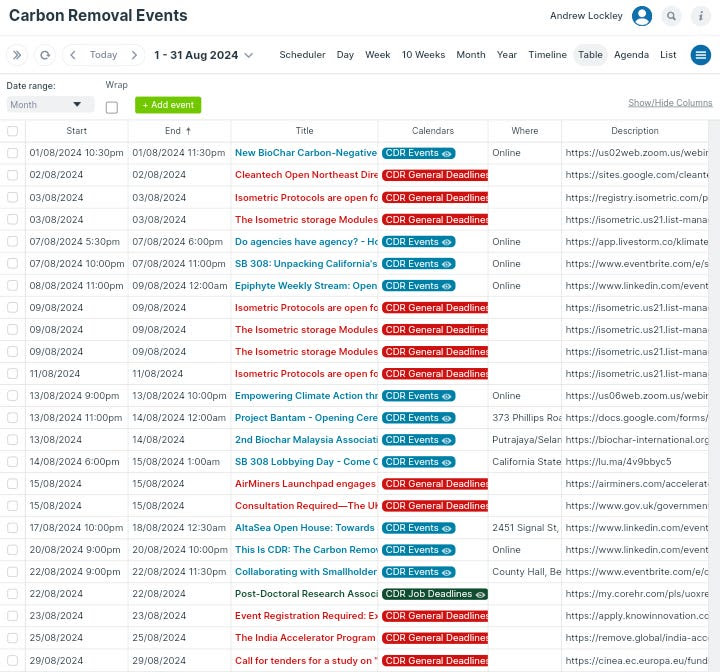
We have curated a “Carbon Removal Events Calendar.” Explore and stay informed about upcoming events, conferences, and webinars on Carbon Dioxide Removal technology. Sync specific events / all events to your default calendar to ensure you never miss out on important CDR updates. Carbon Removal Events Calendar GUIDELINES:Sync selected events to your default calendar in these simple steps:1) Click on the event you want to sync.2) Tap the menu icon (three vertical lines) at the top left.3) Choose 'Share.'4) Pick your default calendar.5) Save the event.Sync the entire Teamup Calendar to your default calendar with these simple steps:1) Tap the menu icon (three vertical lines) at the top right.2) Choose 'Preferences.'3) Click 'iCalendar Feeds.'4) Copy the URL shown for 'CDR Events / CDR General Guidelines / CDR Job Deadlines.'’5) Paste the URL into your default calendar settings.6) Click 'Subscribe' or 'Add Calendar.'
You can directly sync all Carbon Removal events to your default calendars by pressing the link below: Sync CDR Events to your Default Calendar 💼JOB OPPORTUNITIES"The project aims to investigate the value of different biomass-based pathways for CO2 removal from the atmosphere. The CO2 removal technologies that will be investigated include biochar, bioenergy with carbon capture and storage (BECCS) pathways, e.g., to produce electricity, heat, hydrogen and other fuels, as well as biomass carbon removal and storage (i.e., no energy product). The study will evaluate the process-level performance and the impact at a systems-level in the context of net zero transitions."
"Combining photosynthesis with practical engineering, Graphyte’s Carbon Casting technology provides an immediate pathway for billions of tons of low-cost, durable carbon removal."
"The Circular Carbon Network is an initiative of the Carbon XPRIZE that is focused on catalyzing more investment and commercial activity in the emerging Circular Carbon Economy to help accelerate its growth and realize its full economic and climate potential."
"Lithos Carbon remove atmospheric carbon for a fraction of the cost while increasing crop yields. Their process is highly efficient, increases soil health, and repurposes post-industrial waste. Then we sell the carbon credits to companies and split revenue with our regenerative growers."
"Charm Industrial is working to return the atmosphere to 280 ppm CO₂. We design, build and operate a fleet of mobile fast pyrolyzers that convert ag and forest biomass residues into bio-oil for use in carbon removal and direct-reduced-iron steelmaking."
"Isometric is a carbon removal registry. We issue the world’s most scientifically rigorous carbon credits to help Fortune 100 companies tackle climate change and prevent greenwashing."
"CarbonCure Technologies is on a mission to make concrete a climate solution, reducing embodied carbon emissions in the built environment and transforming concrete plants into a worldwide network of carbon removal factories."
"Bellona Europa is an international, independent, and non-profit organisation that meets environmental and climate challenges head on. We are solutions-oriented and have a comprehensive and cross-sectoral approach to assess the economics, climate impacts and technical feasibility of necessary climate actions. To do this, we work with civil society, academia, governments, institutions, and industries. We are based in Brussels."
"Vaulted is an emerging leader in permanent carbon removal. As a Biomass Carbon Removal and Storage (BiCRS) solution, Vaulted delivers permanent, high quality carbon removal at scale through the geologic sequestration of carbon-filled organic waste."
"Paebbl is a founder-led start up in the emerging field of climate technology and the new “carbon economy”. Our mission is to permanently sequester CO2 and repurpose it into products that the world needs. Inspired by natural CO2 mineralization, our technology accelerates this process by a factor of a million and is now ready for scale-up. We are privately financed by supportive, long-term oriented institutional and private investors, and our diverse team includes experts from technology, industrial engineering, digital innovation, waste management, finance, and academia."
"Research Project: The Arctic region has warmed at least twice as rapidly as the global warming trend. Arctic sea-ice has declined dramatically over the past few decades and an ostensibly ice-free summer Arctic in the near future seems like a real possibility. This would have significant global and regional implications and could trigger undesirable feedbacks (e.g. albedo feedback, ocean circulation disruptions). The goal of this project is to explore possible interventions that can hinder the decline trend or help regenerate sea-ice more effectively. The postdoctoral work will focus on high-resolution realistic modelling of the Arctic region, with a focus on ice-ocean interactions. The project will focus on I) enhancing scientific understandings of the physics of sea-ice and its interaction with the density stratified ocean beneath, II) use such knowledge to inform their representation in state-of-art models, and III) use the models to inform possible intervention design and quantify their potentials and hazards."
"Homeworld Collective is a non-profit dedicated to fostering the growth of climate biotech and strengthening its interconnections with other climate tech fields. Our ethos is action-oriented optimism about climate change: we believe that if we take action, we will get better outcomes. Our work centers on synthesizing actionable knowledge through community engagement, communicating that knowledge to lift all boats, and empowering practitioners to pursue solutions toward the collective goal of a thriving biosphere."
"BeZero Carbon is a global ratings agency for the Voluntary Carbon Market. We distribute our ratings via our SaaS Product, BeZero Carbon Markets, informing all market participants on how to price and manage risk. Our ratings and research tools support buyers, intermediaries, investors and carbon project developers."
"At SCW Systems, we believe in the power of innovation to combat climate change. Our Direct Air Capture technology, combined with groundbreaking energy efficiency, enables us to capture CO₂ directly from the air and store it permanently. This offers national and international companies a unique opportunity to offset their CO₂ emissions and achieve their sustainability goals."
"Aeroc is a German start-up specializing in the development and scaling of Enhanced Rock Weathering (ERW) for permanent CO2 sequestration. Our goal is to develop innovative climate protection solutions that are both ecologically and economically sustainable. In collaboration with renowned partners, we are working to establish ERW technology in agriculture and thus make a significant contribution to reducing greenhouse gases."
"Catona Climate is a climate finance company that delivers high-quality carbon solutions to businesses everywhere, helping transform climate pledges into measurable action through rigorously vetted high-impact nature-based carbon projects around the world."
Unlock exclusive insights on carbon removal! While all content on Carbon Removal Updates is free for everyone, I invite those who can to become paid subscribers. Your support empowers this important work and helps us spread the message far and wide. 🎙️PODCASTSShiladitya Ghosh (Mission Zero Technologies) | Climate Pioneers | S6: E1. Shiladitya Ghosh (Mission Zero Technologies) Climate Pioneers 59:55 |
"For the first episode of series 6, I spoke with Shiladitya Ghosh, co-founder and COO at Mission Zero Technologies (DAC), who are working to scale affordable direct air capture, and have gone from lab to commercial plant in under three years!Across this series we will be discussing the challenges around scaling deep tech solutions within climate. I’ll be speaking to Investors, Founders, Venture Builders and other key ecosystem players all focused on scaling and commercialising groundbreaking, deep tech innovations.We will explore how to prepare for the challenges that deep tech companies often face around fundraising, scaling, team building and commercialisation; and we’ll hear from stories of those who have successfully scaled to Series A and beyond."
"Julia Strong is the Executive Director of Symbiosis Coalition. Announced in early 2024, Symbiosis Coalition is an advanced market commitment from Google, Meta, Microsoft, and Salesforce to purchase up to 20 million tons of nature-based carbon removals. The forestry credit space has faced challenges over the last couple of years, prompting interest in how Julia and these large tech companies collaborated to stimulate activity in the sector. Conversations about forestry should be relatively straightforward, considering forests, along with oceans and soil, are natural carbon sinks. Preserving and restoring forests is crucial, yet the complexity surrounding forestry credits always brings new insights. We’re grateful to Julia for sharing more about the formation of Symbiosis Coalition, criteria for high-quality credits, barriers to bankability, and more."
Ben Rubin | The CDR Procurement Guide | Episode 4 - Ben Rubin The CDR Procurement Guide 25:47 |
"Some of the highlights from this episode:-Buyer resources through Carbon Business Council and The Carbon Herald partnership-Importance of science-based communication: 3 ‘R’s of climate: remove, reduce, resilience-The need for better education of critical stakeholders on risks and benefits of CDR-Unique buyer journeys and resources (CBC/BMWF paper on buyer experience)-Concept Of ‘Twin Targets’ For Net Zero Pledge: reduction and removal (joint letter and OpEd)-Critical Need For Demand-Side Support: public-led procurement (CDC paper this autumn)-Scaling to gigaton levels: increasing demand and supply-Communities for learning about CDR"
Benjamin Schulz | The CDR Procurement Guide | Episode 5 - Benjamin Schulz The CDR Procurement Guide 33:23 |
"Some of the highlights from this episode:-The importance of developing specific communication and education strategies for different audiences using simple, easily to understand concepts - thinking about carbon removal as necessary waste management, where you have to remove what you emit.-The necessity for novice buyers to be able to learn from pioneer buyers - industry and market peers need to help each other.-The importance of establishing a price for carbon to drive the right organisation behaviours and fund transition activity and compensation of residual/historic emissions. -Funding the first feature length CDR documentary through the Legion44 initiative to bring CDR to the wider public - launching at Venice Film Festival.-The importance of public long term multi-year CDR procurement commitments for both sides of the market.-The policy environment that is emerging is creating greater certainty for organisations with net zero claims about the action they will need to take.-Call To Action: Lobby for a price to be put on carbon by society and within organisations to fund carbon waste management."
🎥YOUTUBE VIDEOSCDR: A required Piece in a Net Zero Strategy - Dominic Lüdin (Chief Growth Officer, Carbonfuture) | Carbon Exposure Project "This new CXP episode is featured by Dominic Lüdin, Chief Growth Officer at Carbonfuture. Carbonfuture aims to accelerate climate action with the Trust Infrastructure for durable carbon removal. Rene and Dominic discuss the development and growth of CDR, how CDR should be combined with carbon reduction strategies and the durability of CDR projects."
Episode 3 - Rahul Shendure, Chief Executive Officer, CarbonBuilt | Decarbonization Disruptors Podcast "I had the privilege to interview Rahul Shendure, Chief Executive Officer of CarbonBuilt. CarbonBuilt's technology enables the production of ultra low-carbon concrete products, driving gigatonne-scale greenhouse gas reductions through the cost-effective mineralization of carbon dioxideRahul shared his career journey starting in the Chemical & Plastics manufacturing industry with the mission to focus on solutions for environmental pollution. Rahul talked about his introduction to early stage investing in cleantech and healthcare startups and how he evaluates companies for investment both by their solution and more importantly their people.We discussed in detail Rahul's role at CarbonBuilt and how they are tackling the massive problem of carbon reduction in the manufacturing of concreate. It was enlightening to hear how CarbonBuilt is revolutionizing the way concreate is produced, a process that that largely been unchanged in over 100 years. There is not silver bullet in decarbonization, but CarbonBuilt is a great example of advanced technology to reduce global carbon emissions implemented in a practical and cost effective way."
Biochar Expert Panel Healthy Planet Action Coalition Dec. 1, 2022 | Healthy Planet Action Coalition "Conversation with Bichar Expert Panel led by Brian von Herzen and including Albert Bates, Paul Anderson, Hugh McLaughlin and others."
How carbon removal can address the climate crisis | Carbon Removal Canada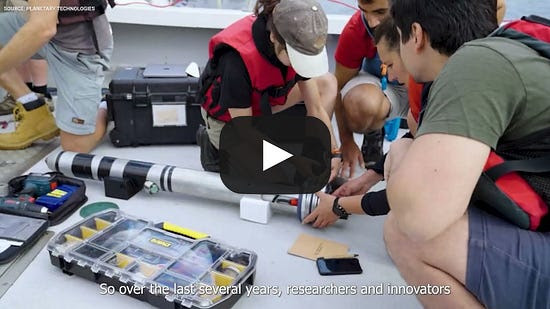 "In this video, our co-founder and executive director, Na'im Merchant, explains the importance of carbon removal and its role in addressing the climate crisis.Carbon Removal Canada is a nonpartisan think tank focused on scaling carbon removal solutions responsibly to help Canada meet its climate goals by 2050. Discover how we are helping Canada take action and remove carbon dioxide from the atmosphere (in addition to cutting emissions)."
Epiphyte Weekly Stream! Open Source DAC | OpenAir Turning the world’s largest waste stream into a CO2 sink | Anna Haas | TEDx Talks "To reach net zero by 2050, we need to drastically reduce our emissions as well as remove the residual, hard-to-abate emissions from the atmosphere via carbon removal. One method with widespread potential: capturing CO2 from the atmosphere and storing it in the world’s largest waste stream, demolition concrete, via a mineralization process. Anna Haas holds an M.Sc. in mineral resources engineering from RWTH Aachen University. She brings cross-industry experience from startups to corporates, having lived in 5 countries and now calling Switzerland home. Anna has worked in the Swiss machine building industry and a German VC-backed ConTech startup. Currently, she is a Sales Manager at Neustark, an ETH Zürich spin-off enabling carbon storage in mineral waste streams. Passionate about innovations for a better world, she’ll share insights on her work with carbon."
Thoughts on Epiphyte Tube Design - parts, heating, vacuum | OpenAir "Some early thoughts on how we might shift to the PFTE tube design, and incorporate heating and vacuum."
SB 308 Appropriations Hearing Livestream | OpenAir "OpenAir is livestreaming to Streamyard, Youtube and LinkedIn the Assembly Appropriations hearing, during which SB 308 (Becker) will be voted on. This is a critically important moment for the bill, as Appropriations is the final committee before the bill would be voted on in the Assembly, likely next week. If it makes it out of the Assembly, it's on to the Governor's desk."
Weekly Carbon Removal Updates from 12 August - 18 August 2024 | Carbon Removal Updates Bulletin🚨DEADLINESAbstract Submission Deadline: 01 October 2024Full Manuscript Submission Deadline: 31 December 2024
20% Group Subscription Discount Share Carbon Removal Updates © 2024 Carbon Removal Updates
548 Market Street PMB 72296, San Francisco, CA 94104
Unsubscribe 
| |
  |
|