| | | | Links to recent scientific papers, web posts, upcoming events, job opportunities, podcasts, and event recordings, etc. on Carbon Dioxide Removal TechnologySubscribe to stay informed on carbon dioxide removal tech and support our independent reporting through a paid subscription.Donate < $10 Get 20% off a group subscription TABLE OF CONTENTSNote: Click on the headings listed in the table of contents above to easily navigate to the sections you’re interested in.THIS WEEK’S TOP CDR HIGHLIHTSLSR Standard: Greenhouse Gas (GHG) Protocol released the Land Sector and Removals (LSR) Standard, establishing its first global standard for companies to account for greenhouse gas emissions and CO₂ removals from agricultural land use and emerging CO₂ removal technologies (e.g. direct air capture or fossil carbon capture with geologic storage). World Resources Institute will host an explainer webinar on 12 February 2026. C-QuIP Database Launched: Carbon Removal Standards Initiative launched the Carbon Removal Quantification, Integration, and Policy (C‑QuIP) Database, a tool linking carbon removal projects, policies, and measurement resources worldwide. It helps researchers, policymakers, and industry navigate CDR technologies, enabling strategic integration, policy support, and rigorous quantification for scaling carbon removal solutions. Puro.earth Launches Premium Service: Puro.earth, the leading registry for durable CDR credits, has introduced a premium service to help large-scale suppliers bring verified removals to market on a faster cadence, seeking to improve liquidity and predictability for engineered removal projects. Drax Biomass Tracker: Drax has launched a new Biomass Tracker, an interactive tool that maps its global woody biomass supply chain, showing sourcing regions, transport routes, fibre types and carbon data. The platform aims to boost transparency, traceability and accountability in biomass sourcing. Carbon Tracking Tool: Land & Carbon Lab, WRI, and partners launched the Land Emissions and Removals Navigator (LEARN) tool, enabling U.S. communities to track forest and tree carbon emissions and removals over time. By integrating these data into local GHG inventories, it supports more accurate, community-scale climate planning and decision-making. Call for Donations: A new campaign, New Jersey Rocks!, launched by OpenAir, aims to raise $5,000 by May 31 to purchase high-quality carbon removals through enhanced rock weathering from Princeton-based Eion Carbon, on behalf of communities across the state, supporting local climate action and durable carbon removal. Rules to Certify Biogenic Carbon Stored in Buildings: A confidential paper for the European Commission set out how long-lived wood and other bio-based materials in buildings could earn EU carbon removal certificates, detailing which building components would qualify, how to count stored carbon, and what rules should govern additionality, monitoring, and liability. Read on to unpack more updates: COMMERCIAL NEWS Share RESEARCH PAPERSAuthors: Hisham Hafez, Alastair T. M. Marsh, Matea Flegar, Liqing Peng & Karen L. ScrivenerSynopsis: This study compares low-carbon concrete with engineered bio-based materials and stabilized earth blocks for urban housing, assessing embodied carbon, resource limits, and scalability. Bio-based materials are constrained to <14% of global demand by sustainable harvest limits, while low-carbon concrete is not resource-limited and could save ~14.3 GtCO₂e by 2050. Despite imperfections, low-carbon concrete emerges as the most scalable low-carbon option for meeting global housing demand.
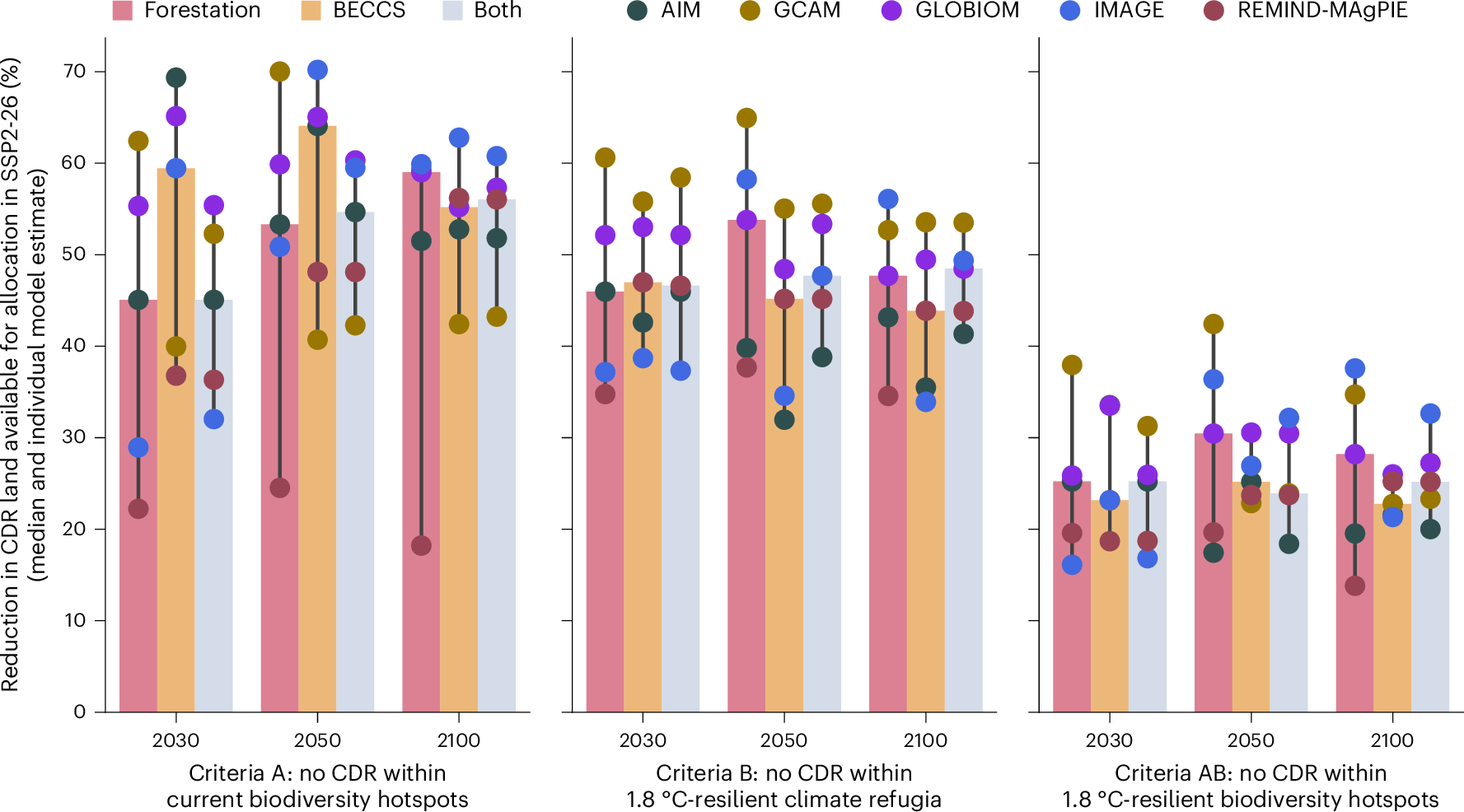
Authors: Ruben Prütz, Joeri Rogelj, Gaurav Ganti, Jeff Price, Rachel Warren, Nicole Forstenhäusler, et al.Synopsis: Analyzing five integrated assessment models, this study finds that 1.5 °C pathways could allocate up to 13% of global high-biodiversity areas to land-intensive CDR, with disproportionate impacts in low- and middle-income countries. Protecting biodiversity hotspots would make over half of planned forestation and BECCS land unavailable unless synergies are pursued, highlighting trade-offs between climate mitigation, conservation, and CDR benefits from avoided warming.
Authors: Behrouz Gholamahmadi, Claudia KammannSynopsis: This study shows that biochar enhances carbon permanence by reducing soil erosion and improving hydrology, not just as a co-benefit. Global meta-analysis and Mediterranean field data reveal 16–65% erosion reduction, increased water retention, and up to 85% SOC gains. Incorporating erosion-mediated carbon retention into MRV frameworks would improve the credibility of biochar-based CDR, supporting durable carbon removal, climate-resilient land management, and protection of existing soil carbon stocks.
Authors: Daniel P. Maxbauer, Ella Milliken, Jahmaine Renzo Yambing, Emma Watson, Rachel B. Gregg, Liza Swanson, Jaeeun Sohng, Noah W. Sokol, Noah J. PlanavskySynopsis: This three-year field trial in the U.S. Midwest shows that steel slag amendments on acidic soils enhance soil pH, alkalinity, and Ca saturation, providing clear evidence of carbon dioxide removal via enhanced weathering. In contrast, neutral soils and coarse basalt showed minimal effects. Results highlight both the CDR potential of steel slag on acidic cropland and the variability of outcomes depending on soil type and feedstock, emphasizing challenges for greenhouse gas accounting in enhanced weathering strategies.
Authors: Bo Shi, Alexander Ryota Keeley, Shunsuke ManagiSynopsis: This macroeconomic study evaluates how carbon pricing affects large-scale deployment of renewable energy (RE) and membrane-based direct air capture with utilization (DAC-U). Using a computable general equilibrium model, results show carbon taxes favor DAC-U over RE, supporting energy-intensive industries via upstream demand. However, a tradeoff remains between carbon abatement and economic growth, highlighting competitive dynamics and policy challenges in scaling these climate mitigation technologies.
Authors: James L GoodingSynopsis: This study presents a two-step model for wood biomass burial (WBB) decay, reconciling geologic wood preservation with thermodynamic and kinetic principles. Hydrolysis of lignin, cellulose, and hemicellulose releases monomers that decompose primarily to CO₂ unless mediated biologically. Model results indicate >97% carbon retention over 100 y and 50–90% over 1,000 y, aligning with empirical evidence, supporting WBB as a durable, nature-based carbon sequestration strategy relevant to climate mitigation.
Authors: Chonggang YangEllias Y. FengSynopsis: This study uses Earth system modeling to assess life-cycle impacts of four ocean alkalinity enhancement (OAE) approaches from 2030–2099. Mining, processing, transport, and deployment emissions can substantially offset carbon removal, rendering some OAE options ineffective. Coastal enhanced weathering performs best overall, with the North Atlantic showing highest storage potential, while all OAE pathways exhibit carbon leakage, underscoring the need to assess additionality, permanence, and leakage in OAE evaluations.
Authors: Lyla L. Taylor, Rachael H. James, Ilsa Kantola, and David J. BeerlingSynopsis: This study introduces a new 1-D reactive transport model to assess CDR from enhanced rock weathering in soils. Applied to a U.S. Corn Belt site, the model shows multi-decadal lags in CDR, strong sensitivity to nitrogen cycling, sorption, and mineral choice, and highlights trade-offs between bicarbonate export, calcite formation, and soil pH control, informing ERW verification and model development.
Authors: Yingzheng Yan, Qiuqin Zheng, Xiaohong Miao & Yuanzhu WeiSynopsis: Through a systematic review of 465 studies, this paper examines how forest carbon sinks can deliver both economic and livelihood benefits. It identifies key research themes, methodological gaps, and stakeholder conflicts, proposing a “measurement–market–policy” framework. The findings highlight the need for mixed-methods evaluation, equitable compensation, and coordinated market–government governance to achieve sustainable and inclusive forest carbon outcomes.
Authors: Yu Cheng, Shiying Yan, Lu Jin, Xu Wang, Ming Jia, Ping An, Binghui SunSynopsis: This study investigates CO₂ mineral sequestration in red mud (RM) enhanced with calcium sources (CaSO₄, CaCl₂). Experiments under varying CO₂ levels show faster pH stabilization, increased CaCO₃ formation, and lower equilibrium pH for supplemented RM, both in suspensions and solid-state. CO₂ sequestration reached 45–47 g/kg, with porous CaCO₃ coatings improving reaction stability and durability, offering a viable approach for long-term carbon capture in alkaline industrial wastes.
Authors: Eric C Davis, Brent Sohngen, David J LewisSynopsis: Using plot-level data from 2005–2022, this study quantifies passive and anthropogenic drivers of carbon accumulation in 14 temperate forest groups across the U.S. Passive factors (CO₂, temperature, precipitation) added 66 Tg C y⁻¹, while declining forest area reduced 31 Tg C y⁻¹ and tree planting added 23 Tg C y⁻¹. Changes in age composition contributed 89 Tg C y⁻¹, highlighting how distinguishing passive from active uptake can guide forests’ role in achieving national net-zero targets.
Authors: Sri MulyaniSynopsis: This systematic review evaluates seaweed cultivation as a marine carbon dioxide removal (mCDR) strategy and circular blue bioeconomy pathway. Evidence shows high biomass does not guarantee verified CO₂ removal; credible outcomes depend on carbon fate, residence time, and leakage. Ecosystem impacts vary, and MRV pipelines remain underdeveloped. Circular valorisation offers more immediate benefits than carbon offsets, positioning mCDR as a conditional co-benefit within sustainable ocean-based systems.
Authors: Pu Hong, Meiyu Guo, Sai Liang, Wenrui Shi, Yumeng Li & Xi LuSynopsis: This study assesses carbon sequestration potential in China’s shale gas value chain for achieving Geological Negative Emissions. Synergistic CO₂-based technologies could transform the sector into a 66 Gt CO₂e sink while boosting production by 4,518 bcm. Economic feasibility varies spatially: marine shale is profitable, whereas continental reservoirs need carbon credits or optimized production. Strengthened regional subsidies and carbon pricing could unlock this potential, supporting national carbon neutrality and broader SDGs.
Authors: Nur Hussain, Md Adnan Rahman, Md Rezaul Karim, Parvez Rana, Md Nazrul Islam and Anselme MuzirafutiSynopsis: This study quantifies fine-scale carbon dynamics in the Sundarbans mangroves (2019–2023) using high-resolution remote sensing, PROSAIL-derived LAI, and light-use efficiency modeling. Annual carbon uptake ranged 1881–2862 g C m⁻² yr⁻¹, totaling ~43–65 Mt CO₂ eq, with declines in 2022–2023 linked to climatic stress. LAI, GPP, NDVI, and SIF showed strong seasonal and interannual variability and tight coupling, highlighting the reliability of this approach for monitoring mangrove carbon sequestration and informing conservation and climate mitigation strategies.
Authors: Salma Noor, Xun Jiang, Xinyue Wang, Jiani Yang, Sally Newman, King-Fai Li, Liming Li, Le Yu, Xiyu Li, Yuk L YungSynopsis: This study shows that large-scale ecological restoration in the Taklamakan Desert is transforming it into a carbon sink. Wet-season precipitation boosts vegetation and CO₂ uptake, while long-term trends indicate rising vegetation cover, photosynthetic activity, and net CO₂ drawdown, especially along desert margins. Linked to China’s Three-North Shelterbelt Program, these results highlight the potential of dryland restoration as a nature-based solution for climate mitigation and desertification control.
Authors: Bamdad Ayati, Armor Gutierrez, Alan ChandlerSynopsis: This study quantifies climate benefits of diverting agricultural residues into long-lived building products using global mass-flow analysis and dynamic life cycle assessment. Full diversion from combustion yields sustained cooling (≈−0.6 W m⁻²; −0.35 °C at 100 years), but demand-constrained deployment delivers much smaller effects. Outcomes are most sensitive to material lifetimes, highlighting the need to expand bio-based construction uses to realize meaningful climate benefits.
Share of allocated land not available for CDR deployment under strictly enforced biodiversity conservation (Source)WEB POSTSShare Carbon Removal Updates THESESAuthors: Aida AmidiSynopsis: This thesis addresses monitoring challenges for enhanced rock weathering (ERW) as a carbon dioxide removal strategy. Traditional sparse, low-frequency sampling limits mechanistic insight, so the work develops high-resolution, automated computational frameworks that integrate micro-scale particle data with field-scale hydrological forcing, enabling robust, scalable MRV and positioning ERW monitoring at the intersection of environmental data science and systems engineering.
Authors: Salih, RimaSynopsis: This thesis examines riparian buffer systems (RBS) in southern Ontario as nature-based solutions for climate mitigation. Deciduous trees sequester carbon quickly but short-term, while conifers store it longer. Adoption is influenced by landowner decisions and government initiatives. RBS deliver multiple co-benefits, including carbon storage, water quality improvement, and biodiversity enhancement, highlighting their role in sustainable agricultural landscapes.
REPORTSShare Carbon Removal Updates UPCOMING EVENTSFebruary 2026DeCarbon | 24-26 February 2026 | CopenhagenMarch 2026We have curated a “Carbon Removal Events Calendar.” Explore and stay informed about upcoming events, conferences, and webinars on Carbon Dioxide Removal technology. Sync specific events / all events to your default calendar to ensure you never miss out on important CDR updates. Carbon Removal Events Calendar Add our Carbon Removal Events Calendar to your default calendar in 2 ways:Sync specific event: Click the event → menu (≡) → Share → choose your calendar → Save.Or sync all events: Menu (≡) → Preferences → iCalendar Feeds → Copy URL → Add to your calendar settings → Subscribe.JOB OPPORTUNITIES“Deep Sky is at the forefront of environmental innovation, specializing in Carbon Dioxide Removal (CDR) and Carbon Capture and Storage (CCS) technologies.”
“The Carbon Dioxide Removal team coordinates overall science-based, measurable, and scalable sustainability investments and outcomes across the company – engaging with business groups on the environmental impacts of business operations and positive environmental outcomes resulting from technology and policy development.”
“Vaulted is a waste management company that removes carbon. We take organic waste that can pollute our environment above ground and safely inject it ultra deep underground—permanently removing carbon from the atmosphere while protecting local land, air, and water.”
“Cascade is a philanthropy-backed nonprofit helping mobilize a comprehensive response to the climate crisis by accelerating high-potential solutions that remain on the margins of mainstream climate action.”
“Charm Industrial’s mission is to return the atmosphere to 280 ppm CO₂. We convert excess inedible biomass into carbon-rich bio-oil and inject it into underground storage for permanent carbon removal. At scale, we can use bio-oil to make fossil-free iron.”
“Reforest’Action is a certified B-corp company whose mission is to regenerate terrestrial ecosystems on a large scale to address environmental challenges.”
“Timber Finance is a young climate tech company at the forefront of the intersection between real estate, timber construction and carbon removal markets.”
“At Arca, we pull carbon dioxide from the air and store it permanently as rock.”
“Carbon Gap advocate for the scale-up of carbon removal to ensure that Europe meets its climate goals.”
“Carbon Removal Canada is an independent non-profit accelerating the responsible scale-up of carbon removal technologies by advocating for impactful, research-backed policies, shaping Canada’s carbon removal market, and connecting the right people to the right information.”
“UNDO is tackling the greatest challenge of our time: climate change.”
“Climate Vault Solutions is the integrity and execution layer for high-impact climate action.”
“The German Association for Negative Emissions (DVNE) is the largest national association for active CO2 removal in the EU.”
“NetZero’s mission is to bring biochar at scale in the tropics – for climate and people, now.”
“Removall supports companies and organizations in their climate ambition by developing and structuring shared or tailor-made carbon funds, or by implementing rigorous and ambitious carbon offsetting approaches.”
Looking for your dream job in CDR? There are 631 jobs available *right now*: check them all out at: CDRjobs Board
PODCASTSGraphyte’s Strategy Is a Masterpiece of Simplicity—w/ Barclay Rogers & Hannah Murnen | Reversing Climate Change | 384: Graphyte's Strategy Is a Masterpiece of Simplicity—w/ Barclay Rogers & Hannah Murnen Reversing Climate Change 57:37 |
“So many people think they need to dream up wild new tech to be successful at carbon removal. But one of CDR’s most ascendent companies is relentlessly simple. They’re so linear that I scrambled to make sure I wasn’t missing something... In fact, if you’ve ever received coaching from me about simplicity, this is where I’m sending you from now on.I recently completed Noah Deich and Dr. Jen Wilcox’s UPenn continuing education course, CDR Executive Education Program/Purchasing Carbon Removal Credits. It was wonderful and I highly recommend it.It did require a few homework assignments and a group project based upon a project developer. I chose Graphyte and their work putting waste biomass into bricks, wrapping them in polymer, and burying them underground. This is part of the class of projects called BiCRS (pronounced “bikers”), or Biomass Carbon Removal and Storage.Today’s show has Dr. Hannah Murnen, Graphyte’s CTO, and Barclay Rogers, Graphyte’s Co-Founder and CEO, on to correct my homework from the course. I’ve never had a show quite like this.My sincere respect to each of them for digging into this with me and sharing their numbers. Not everyone in CDR is willing or able to do that, and I’m so happy we got to do that together.”
Technology-Based Carbon Dioxide Removal & Carbon Markets | Carbon Markets Now | Technology-Based Carbon Dioxide Removal & Carbon Markets | Carbon Markets Now (Episode 05) Carbon Markets Now 50:01 |
“Can engineered carbon removal scale fast enough to matter for climate targets, and can carbon markets help unlock that potential?In Episode 05 of Carbon Markets Now, we dive into technology-based carbon dioxide removal (CDR) and how voluntary and compliance carbon markets, including Article 6 of the Paris Agreement, could accelerate investment, integrity, and deployment.”
“In this episode of Activating Sustainability, host Chris Peterson is joined by Roberto Strumpf (Rabobank), Pablo Francisco Borrelli (Ruuts), and John Leppers (Anthesis Netherlands) to explore ReTerra, a pioneering regenerative agriculture and soil carbon initiative in Brazil. Together, they unpack how financial institutions, technical experts, and farmers are collaborating to restore degraded land, strengthen food security, and unlock long-term climate and resilience benefits through regenerative land management and carbon finance.”
What It Takes to Finance Nature: Greg Adams of Chestnut Carbon | The Earthshot Podcast | What It Takes to Finance Nature: Greg Adams of Chestnut Carbon The Earthshot Podcast 50:02 |
“What does it actually take to finance nature at scale — not in theory, but in practice?In this episode, Troy Carter speaks with Greg Adams, about what it took to turn large-scale reforestation in the U.S. into something banks, buyers, and long-term capital could support.Greg walks through Chestnut’s journey from early land acquisition to signing long-term offtake agreements with Microsoft, and ultimately closing one of the most significant project finance deals the nature-based carbon market has seen to date. The conversation goes deep into why contract structure matters, why land ownership changes the risk profile, and how lessons from energy and infrastructure finance can be applied to forests.”
Carbon Markets and CDR: What matters and what’s next? - with Alexia Kelly | The CDR Policy Scoop | Carbon Markets and CDR: What matters and what’s next? - with Alexia Kelly The CDR Policy Scoop 29:39 |
“In this episode of The CDR Policy Scoop, Sebastian Manhart and Eve Tamme sit down for a second time with Alexia Kelly, Managing Director of the Carbon Policy and Markets Initiative at the High Tide Foundation, to unpack today’s messy carbon market governance landscape and what it really means for carbon removal.Over the past few years, carbon markets have been flooded with new initiatives, standards, and coalitions, most of them aimed at the supply side. The result: overlapping frameworks, lots of noise, and real confusion for buyers and CDR actors trying to understand what actually matters, while demand stubbornly lags behind.This episode explores which pieces of the governance architecture are genuinely useful (think ICVCM, VCMI, SBTi and more), where they are falling short, and how this affects the future of carbon removals. We also ask what it would take to move from proliferation to coherence, and why the next few years could be make‑or‑break for building carbon markets that are both high‑integrity and fit to finance CDR at scale.”
“The carbon removal market is transitioning from early adopters to mainstream customers through traditional corporate procurement processes, signalling early market maturation and genuine demand for durable carbon credits.A critical supply shortage exists for 2025 vintage credits, with insufficient durable carbon removal supply to meet emerging corporate demand, particularly in direct air capture and biochar pathways.Buyers are quietly building long-term decarbonization strategies and forward-purchasing carbon removal credits to meet net-zero commitments.”
YOUTUBE VIDEOSThe State of the Climate 2026 | Ep242: Zeke Hausfather | Cleaning Up Podcast “How do we model the climate system? How warm will 2026 be? And can geoengineering be anything more than a bandaid?This week on Cleaning Up, Bryony Worthington sits down with leading climate scientist Dr. Zeke Hausfather on the day the 2025 global temperature data is released. Despite a La Niña year, the planet has just experienced one of its hottest years on record — pushing us ever closer to the 1.5°C threshold.Zeke explains why recent warming has accelerated, how declining air pollution may be unmasking hidden heating, and what disappearing cloud cover could mean for climate sensitivity.The conversation ranges from the surprising accuracy of early climate models, the risks of rising nationalism, and what the U.S. withdrawal from international science means for the world.They also tackle controversial questions: Are worst-case climate scenarios still plausible? Is geoengineering a dangerous distraction — or an emergency brake? And can carbon removals ever work economically at scale.”
TCS Presents: New Jersey Rocks! | Tri-County Sustainability ”The New Jersey Rocks! campaign is both a chance to accelerate high-impact CDR solutions and to back local CDR innovators. Join us to hear about the NJ firm looking to remove 10 million tons of CO2 every year via enhanced rock weathering.”
Scrubbing the Skies: OSCAR’s Creation, Purpose, and Challenges in Carbon Removal | Institute for Responsible Carbon Removal “In this webinar Peter Mayer (Partner at Stairs Dillenbeck Finley Mayer PLLC) and Jason Grillo (Earthlight Enterprises) will outline OSCAR: the Open Standard Carbon Removal purchase agreement. Discussion topics include how to use OSCAR and where OSCAR fits within the wider effort to develop the market for durable carbon removal.”
Is “working in sustainability” actually a career plan? With Ted Christie-Miller, founder of Residual | Reinventing Capitalism “In this episode, we meet Ted, founder of Residual, the company helping businesses move from sustainability pledges to concrete, accountable action by developing high-quality carbon projects.After starting his career in UK climate policy and becoming one of the early specialists in carbon removal, Ted saw the same problem repeat itself: projects with the right ingredients, but no recipe to become trusted, financeable assets.”
What Do You Solve? with Zen Carbon CEO Andy Onyango | Climate Hive “Can cement fight climate change? Andy Onyango says yes — and he’s proving it.In this episode of Climate Hive: What Do You Solve?, we sit down with Andy Onyango, founder of Zen Carbon, to talk about the groundbreaking innovation behind their sustainable cement alternative — one that captures CO₂ rapidly, reduces material use, and outperforms traditional options on durability and cost.”
What if phasing out oil & gas takes far longer than we hope? | Sebastian Manhart “We take the big questions head-on:-Does every ton of CO₂ matter, regardless of where it comes from?-Is decarbonising oil & gas pragmatic climate action - or a moral hazard?-What does “high-integrity” decarbonisation of oil & gas actually look like?-What role, if any, should carbon dioxide removal (CDR) play in the sector’s transition?”
Scrubbing the Skies: CIEIF - A Grant Fund Dedicated to Climate Intervention Impact | Institute for Responsible Carbon Removal “This webinar discusses the Climate Intervention Environmental Impact Fund which gives grants for predictive environmental impact assessmentsJoin the Institute for Responsible Carbon Removal for the next event in its webinar series, “Scrubbing the Skies: The Role of Carbon Dioxide Removal in Combating Climate Change.” The series focuses on scientific, technological, legal, political, and justice-focused issues associated with carbon dioxide removal, and is hosted by the Institute’s Co-Director Wil Burns.”
What can engineering do for the climate? Centre for Climate Repair, Cambridge | Centre for Climate Repair “Glacier protection, carbon capture, and working in the real world. With Prof Jerome Neufeld, Rishul Karia, and Dr Zeynep Clulow.”
From Genomics to Carbon Removal: Adina Mangubat on Mission-Driven Entrepreneurship | Her Entrepreneurial Rise Podcast “In this episode of Her Entrepreneurial Rise, Kelen sits down with Adina Mangubat—a systems-minded entrepreneur, innovation strategist, and trailblazer in both health equity and climate action.Together, we explore how Adina’s journey as the Founder and CEO of Spiral Genetics and Accelerator Director at AirMiners reflects a singular commitment: building solutions that serve people and the planet. From genomics to carbon removal, she shares insights on navigating systemic challenges, leading as both founder and mentor, and why entrepreneurship is one of the most powerful tools for advancing equity and justice at scale.”
The Promise, and Potential Peril, of Marine Carbon Dioxide Removal | Ocean Nexus “The IPCC and other scientific bodies have concluded that meeting the temperature targets in the Paris Agreement will require both maximum efforts to decarbonize the world’s economy and as much as 10 billion tons of carbon dioxide removal annually by 2050, and perhaps up to 20 billion tons per year in 2100. Given the ocean’s yeoman work in removing carbon dioxide from the atmosphere, it’s not surprising that many startup companies and academic and government researchers are pursuing technological approaches in the oceans to enhance carbon removal. However, many of these options may also pose risks to ocean ecosystems and stakeholder livelihoods. This presentation will discuss the potential benefits and risks of the key marine carbon dioxide removal options, and will also briefly discuss governance considerations.”
“Deliveries have stalled” | Tito - AirMiners Weekly Carbon Removal Updates from 26 January - 01 February 2026 | Carbon Removal Updates BulletinDEADLINESFollow us on:Twitter | Bluesky | LinkedIn | YouTube | Substack | Podcast 1 | Podcast 2
Support us here:Support This Newsletter Share Carbon Removal Updates © 2026 Carbon Removal Updates
548 Market Street PMB 72296, San Francisco, CA 94104
Unsubscribe 
| |
  |
|