
Taking COSATU Today Forward Special Bulletin, 9 June 2026 #CosatuNationalActionAgainstCostofLiving

Norman Mampane
|
COSATU TODAY COSATU Call Center Contacts: 010 002 2590 #COSATU set to launch the Cost of Living Campaign this month, on the 19th June… #NationaActionAgainstCostOfLiving #ILC2026 #ClassWar #Cosatu40 #SACTU70 #ClassStruggle “Build Working Class Unity for Economic Liberation towards Socialism” #Back2Basics #JoinCOSATUNow #ClassConsciousness |
Taking COSATU Today Forward Special Bulletin
‘Whoever sides with the revolutionary people in deed as well as in word is a revolutionary in the full sense’-Maoo

Our side of the story
9 June 2026
“Build Working Class Unity for Economic Liberation towards Socialism”
Organize at every workplace and demand respect for labour rights Now!
Defend Jobs Now!
Join COSATU NOW!
Contents
- Workers Parliament: Back to Basics!
- NEHAWU to convene its 13th National Congress
- South Africa
- COSATU demands a full investigation into the tragic death of a worker at Cartrack
- Statistics South Africa reports 0.5% GDP growth
- Presidency announces progress in establishing Eskom's Independent Transmission System Operator
- SACP Limpopo 9th Provincial Congress, 12–14 June 2026
- International-Workers’ Solidarity!
- IndustriALL calls for sanctions and responsible exit at ILO Myanmar session
Workers’ Parliament-Back2Basics #ClassWar
NEHAWU to convene its 13th National Congress
Lwazi Nkolonzi, NEHAWU National Spokesperson, June 08, 2026
The National Education, Health and Allied Workers’ Union [NEHAWU] will hold its 13th National Congress at the Birchwood Hotel & Conference Centre in Boksburg from the 26th to 29th of June 2026.
The congress is convened under the theme “Advance Workplace Organisation to Defend Collective Bargaining, Heighten Class Consciousness and Advance Internationalism".
The congress will serve as a critical platform to deliberate and develop concrete responses to key international, national political and socio-economic matters as well as organisational matters affecting our members and the working class in general.
The congress will receive addresses from the African National Congress [ANC], South African Communist Party [SACP], Congress of South African Trade Unions [COSATU], World Federation of Trade Unions [WFTU] and Trade Union International Public Service & Allied [TUI – PS&A].
The congress will be attended by more than 750 delegates drawn from all structures of the union and other fraternal organizations from South Africa and Internationally.
Members of the media are hereby invited to apply for accreditation to cover the 13th National Congress.
The following information should be included in the application: Full name, Media House, and contact details.
The deadline for accreditation applications is Friday 19th June 2026.
The application for accreditation should be sent to the following email: lwa...@nehawu.org.za
Issued by NEHAWU Secretariat
For further information, please contact: Lwazi Nkolonzi (National Spokesperson) at 081 558 2335 or email: lwa...@nehawu.org.za
Visit NEHAWU website: www.nehawu.org.za
South Africa #ClassSolidarity
COSATU demands a full investigation into the tragic death of a worker at Cartrack
Zanele Sabela, COSATU Spokesperson, 09 June 2026
The Congress of South African Trade Unions (COSATU) has learned with profound shock, anger and sadness of the reported death of Ms Gcina Dhladhla, an employee at Cartrack's Head Office in Rosebank, Johannesburg.
Ms Dhladhla had reportedly informed management that she was experiencing serious health challenges and had been absent from work due to illness. Disturbing allegations further suggest that rather than receiving the necessary support and accommodation, she was subjected to disciplinary action and warned about her attendance record.
It is alleged that last week, fearing possible disciplinary consequences and the loss of her employment, she reported for duty despite her deteriorating health condition. Reports indicate that she was later discovered unconscious in a workplace bathroom and that emergency medical intervention may not have been implemented with the urgency and preparedness required under occupational health and safety standards.
While the full facts remain the subject of investigation, these allegations raise serious concerns regarding workplace health and safety, the treatment of sick employees, and the duty of care owed by employers to workers.
COSATU Condemns Any Form of Intimidation Against Sick Workers
Workers are not machines.
They are human beings whose labour creates wealth and sustains companies. No worker should ever be placed in a position where they must choose between protecting their health and protecting their income.
The rights to dignity, fair labour practices, safe working conditions and access to sick leave are protected by the Constitution, labour legislation and occupational health and safety regulations. Any workplace culture that intimidates workers for falling ill undermines these fundamental rights and erodes the values of decent work for which generations of workers have struggled and sacrificed.
COSATU Calls for Urgent Accountability
COSATU therefore demands:
An Immediate Independent Investigation
The Department of Employment and Labour must urgently investigate the circumstances surrounding this tragedy, including the company's sick leave policies, disciplinary practices, workplace health and safety procedures, and emergency response mechanisms.
A Comprehensive Occupational Health and Safety Inspection
Authorities must establish whether the employer complied fully with all statutory obligations relating to workplace safety, first aid readiness, emergency medical response and employee welfare.
Accountability Where Negligence Is Established
Should any investigation find evidence of negligence, coercion, misconduct or breaches of labour and safety legislation, appropriate legal, civil and criminal consequences must follow without fear or favour.
Justice and Support for the Family
The family of Ms Dhladhla deserves truth, dignity and justice.
Every effort must be made to support them during this painful period and to ensure that they receive all benefits and protections due to them under the law.
Industry-Wide Review of Workplace Practices
This tragedy must serve as a wake-up call to all employers.
Workplace policies must prioritise human life, dignity and wellbeing above productivity targets and disciplinary quotas. Sick leave is a hard-won worker right, not a management concession.
Workers Are Human Beings, Not Disposable Instruments of Production
The death of a worker under circumstances where concerns were allegedly raised about her health is deeply disturbing and demands the attention of the entire labour movement.
As trade unions, we have fought for generations against workplaces that treat workers as expendable commodities. Every worker has the right to return home safely and with dignity at the end of each working day.
No family should receive a call informing them that a loved one has died while trying to protect their livelihood.
COSATU will engage with the affected family, workers at the company, relevant authorities and our affiliates to ensure that all facts are uncovered and that justice is pursued wherever wrongdoing is found.
The labour movement will not remain silent when workers' lives are placed at risk. The struggle for safe workplaces, humane working conditions and the dignity of labour remains as urgent today as ever.
An injury to one is an injury to all.
Issued by COSATU
_____________________
Statistics South Africa reports 0.5% GDP growth
09 Jun 2026
The South African economy maintained its positive momentum in the first quarter of 2026 (January–March). Real gross domestic product (GDP) increased by 0,5%,1 marking a sixth consecutive quarter of growth. Finance, agriculture, trade and transport did the heavy lifting on the production (supply) side of the economy. The expenditure (demand) side was supported by a decline in imports and a rise in household consumption, government consumption and exports.
Nine industries were stronger
The finance industry was the main positive contributor on the production side of the economy, expanding by 0,9% and adding 0,2 of a percentage point to GDP growth. Agriculture, trade, and transport & communication also made notable contributions.
Agriculture grew for a sixth consecutive quarter, expanding by 3,9%. Field crops and horticulture products (particularly fruit) underpinned the industry’s stronger performance.
The trade industry also extended its gains for a sixth straight quarter, supported by stronger wholesale trade, motor trade, food & beverages and accommodation. Retail trade was the exception, recording zero growth.
Positive results from land transport, air transport and transport support services pushed the transport & communication industry higher by 0,7%. Economic activity in communications, however, was down in the quarter.
Mining was stronger on the back of higher production levels for platinum group metals, gold, chromium ore and diamonds.
Manufacturing misfired in the first quarter, weakening by 0,8%. This is the industry’s second consecutive decline, dragged lower mainly by the petroleum & chemicals; iron & steel; and wood, paper & publishing divisions. Glass & non-metallic mineral products, motor vehicles & transport equipment, electrical machinery and textiles & clothing were stronger, but not enough to lift the industry into positive territory.
Expenditure on GDP was also positive
The expenditure side of the economy was lifted by weaker imports, together with a rise in household consumption, government consumption and exports.
Household consumption expanded by a marginal 0,1%, the lowest growth rate in eight quarters. Household utilities (such as water and electricity) and transport were the largest positive contributors.
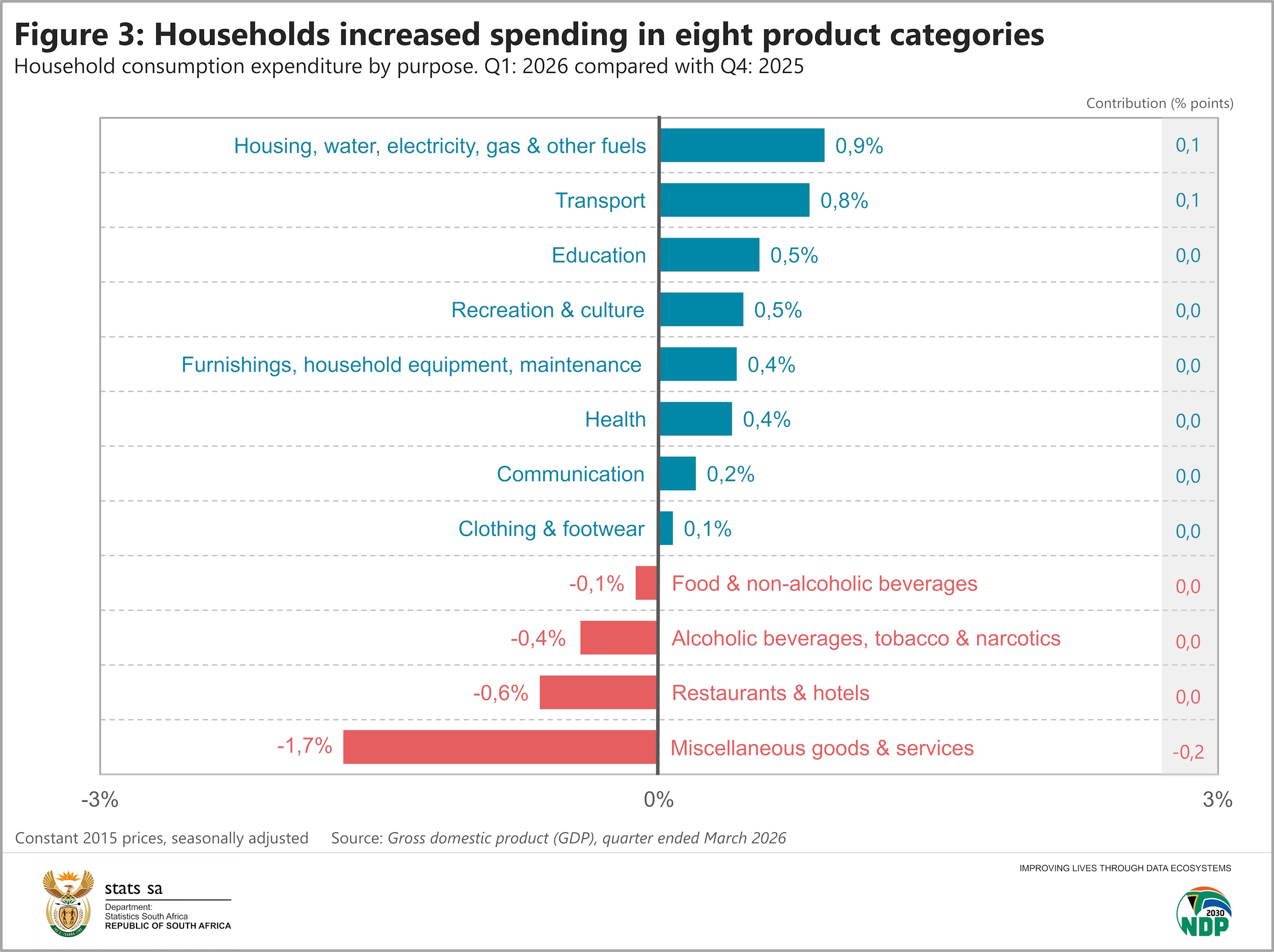
Consumers spent less on food & non-alcoholic beverages and alcoholic beverages, tobacco & narcotics. This was consistent with the zero per cent growth rate in retail trade on the production side of the economy. Spending on restaurants & hotels was also down. The miscellaneous goods & services category was the most significant negative contributor, reflecting a decline in insurance expenditure.
Following two consecutive increases, capital formation pulled back in the first quarter, declining by 1,1%. This was mainly due to a decrease in investments in machinery & other equipment and residential buildings.
The slowdown in imports was largely influenced by weaker trade in precious metals, mineral products, machinery & electrical equipment, textiles & textile articles, and animal & vegetable fats and oils. Exports rose by 0,5%, driven by rise in the trade of mineral products, vegetable products (reflecting the rise in the production of fruit in the agricultural industry), and prepared foodstuffs, beverages & tobacco.
The manufacturing, trade and mining industries dipped into their stockpiles to meet demand, resulting in an annualised R22,4 billion drawdown in inventories. Manufacturing’s drawdown was the largest (-R14,5 billion).
The impact of the conflict in the Middle East?
The conflict in the Middle East began towards the end of February, more than half-way through the first quarter. The impact of the conflict was felt in the sharp fuel price increases in April, which may reflect in the second quarter GDP estimates. These will be released on 08 September 2026.
For more information, download the GDP release, media presentation and Excel files here.
The quarter-on-quarter rates are seasonally adjusted and in real (volume) terms (constant 2015 prices).
Similar articles are available on the Stats SA website and can be accessed here.
For a monthly overview of economic indicators and infographics, catch the latest edition of the Stats Biz newsletter here.
Issued by Statistics South Africa
_____________________
Presidency announces progress in establishing Eskom's Independent Transmission System Operator
08 Jun 2026
Eskom Restructuring Task Team makes progress towards the establishment of an independent Transmission System Operator
During the 2026 State of the Nation Address, President Cyril Ramaphosa announced the establishment of a dedicated task team to oversee the restructuring of Eskom to establish a fully independent, state-owned Transmission System Operator (TSO) that will own and control transmission assets and be responsible for operating the electricity market. This is a crucial step towards enabling competition, and reflects government’s determination to reform South Africa’s electricity sector to achieve long-term energy security and lower electricity costs for all South Africans.
The Eskom Restructuring Task Team (ERTT) has since been established, and includes representatives of the Presidency, National Treasury, the Department of Electricity and Energy, Eskom, and the National Transmission Company South Africa (NTCSA). The task team is chaired by the Director-General of National Treasury, and has made significant progress in preparing for the establishment of the TSO. While the task team was expected to present a high-level report by the end of May 2026, the President has extended this deadline to the end of June 2026, in order to ensure that the proposed approach can be fully detailed and considered through the relevant governance structures.
The President said: “I am encouraged by the speed and diligence with which the task team has taken forward this important task. The establishment of a fully independent transmission company is a critical reform which will support the introduction of a competitive electricity market and ensure a reliable, affordable and sustainable electricity supply to power the economy.”
BACKGROUND NOTE
More than 90 countries have reformed their electricity sectors to establish competitive wholesale electricity markets. Most have unbundled transmission and system operation from the incumbent generator as a crucial part of the reform to ensure that the transmission system operator has no real or perceived conflict of interest and is free from influence or control by any market participant, guaranteeing that all participants are treated impartially in the way that it operates and makes decisions.
The Electricity Regulation Act (ERA) provides for the establishment of the TSO by no later than 31 December 2029. In the interim, the functions of the TSO are carried out by the NTCSA, a subsidiary of Eskom that was established in July 2024.
In line with the commitment made by the President, the Eskom Restructuring Task Team was established at the beginning of March 2026, comprising senior representatives from the Presidency, National Treasury, Department of Energy and Electricity, Eskom and the National Transmission Company South Africa (NTCSA). It is tasked with:
Developing a detailed proposal and implementation plan for establishing an independent, state-owned TSO separate from Eskom that will assume ownership and control of transmission assets, operate the electricity market, enable transmission investment at scale, and provide non-discriminatory access to the grid.
Giving consideration to the optimal institutional model for the TSO, drawing on international best practice and ensuring full alignment with the ERA.
Addressing the measures required to ensure adequate independence of the NTCSA during the period before the TSO is established, and considering the appropriate location of responsibility for the allocation of grid capacity to ensure independent and non-discriminatory treatment of grid users, both during the transitional period and once the TSO is established.
The ERTT is tasked with overseeing the restructuring of Eskom in a manner that fulfils the following core principles, among others, as set out in its Terms of Reference:
Maintain energy security;
Ensure full independence of the TSO from all market participants;
Ensure that ownership of the transmission network and any other assets associated with the statutory functions assigned to the TSO in terms of the ERA is separated from Eskom;
Ensure that Eskom is not worse off than its current financial position following the restructuring, and that the TSO is financially sustainable;
Ensure that the TSO is able to raise the funding required for investment in infrastructure in line with the Transmission Development Plan;
Avoid any qualified audit opinion for Eskom, the NTCSA or the TSO and ensure that that lender requirements are addressed to avoid any default;
Minimise any impact on South Africa’s fiscal position;
Prevent any undue financial burden on electricity users; and
Promote the objectives of electricity market reform, including the successful introduction of independent transmission projects (ITPs).
The
work of the ERTT will be undertaken in two phases. The first phase, which is now expected to be completed at the end of June 2026, will focus on the development of a high-level proposal for establishing the TSO. The second phase, which will be completed within
a further three months, includes developing a detailed implementation plan with timeframes for completing the restructuring in the manner proposed.
Media enquiries:
Vincent Magwenya
Spokesperson to President Ramaphosa
E-mail: me...@presidency.gov.za
Issued by The Presidency
_____________________
SACP Limpopo 9th Provincial Congress, 12–14 June 2026
9 June 2026
Theme: ORGANISE, SERVE AND TRANSFORM: Building Working-Class Power and Community Self-Reliance
The South African Communist Party in Limpopo convenes its 9th Provincial Congress at a critical moment in our struggle. Guided by the theme "Organise, Serve and Transform: Building Working-Class Power and Community Self-Reliance," the Congress will unite delegates from across the province to strengthen the Party, deepen our connection with communities, and advance the struggle for socialism.
The Congress will focus on building a mass-based and campaigning SACP capable of leading working-class communities in confronting unemployment, poverty, inequality, corruption, and the failures of the capitalist system.
As we prepare for the 2026 Local Government Elections, the Congress reaffirms the SACP's commitment to building people's power, promoting community self-reliance, and advancing a socialist alternative that places the needs of workers and the poor at the centre of development.
Organise! Serve! Transform!
Forward to Working-Class Power!
Forward to Community Self-Reliance!
Forward to Socialism!
International-Solidarity
IndustriALL calls for sanctions and responsible exit at ILO Myanmar session
9 June, 2026
IndustriALL Global Union called on the ILO and its constituents to cut the flow of funds to Myanmar's military junta through sanctions, diplomatic isolation and an end to preferential trade agreements. The call came as the International Labour Conference held a special sitting on Myanmar on 6 June.
The special sitting of the Committee on the Application of Standards addressed violations of Convention No. 87 on freedom of association and Convention No. 29 on forced labour, following the invocation of Article 33 of the ILO Constitution last year.
Addressing the ILC, IndustriALL general secretary Atle Høie highlighted the situation of the approximately 450,000 workers in Myanmar’s garment sector, who earn less than US$100 per month, around half of what is needed to survive.
The intervention detailed how garment factories in industrial zones operate under martial law, with workers subject to military checkpoints, intrusive searches including of mobile phones and sexual harassment. Workers are also exposed to forced unpaid overtime and the risk of military conscription, with factories sharing personal data with the military.
Atle Høie warned that military-backed organizations are falsely claiming to represent IndustriALL’s affiliate, the Industrial Workers Federation of Myanmar (IWFM), and called for these parallel structures not to be recognized as legitimate worker representatives.
The garment sector plays a key role as a source of foreign exchange for the junta due to a regime law requiring all incoming foreign exchange to be converted at a preferential rate within 24 hours.
Myanmar enjoys preferential access to the European Union market under the Generalized System of Preferences and the Everything but Arms scheme. Fifty-four per cent of Myanmar’s apparel exports go to the EU, with the UK and Japan accounting for much of the rest.
Despite the ILC invoking Article 33 last year, the ILO’s strongest sanction, the EU maintains its system of preferences. The EU also funds a programme called MADE in Myanmar to support manufacturing in the country. Unions in the country have condemned the programme as a sham, designed to whitewash labour rights abuses and provide political cover for garment brands. These brands continue to source from Myanmar, drawn by cheap labour and convenient production conditions.
Said IndustriALL general secretary Atle Høie:
“IndustriALL wants to see an end to preferential trade access, including under the EU’s Generalized System of Preferences and Everything but Arms scheme.
We are calling on garment brands to commit to a responsible exit from Myanmar.”
The session drew strong interventions from Myanmar trade union representatives and workers’ group delegates from across regions. The Myanmar government was not accredited and made no response, though Russia and some other governments registered their disagreement with the Article 33 proceedings.
______________________________
Norman Mampane (Shopsteward Editor)
Congress of South African Trade Unions
110 Jorissen Cnr Simmonds Street, Braamfontein, 2017
P.O.Box 1019, Johannesburg, 2000, South Africa
Tel: +27 11 339-4911 Direct line: 010 219-1348