"Suspension" ability of a rando disc fork?

910 views
Skip to first unread message

mgreene888

unread,
Mar 7, 2016, 9:50:04 AM3/7/16
to 650b
Hey everybody, 

THis may be my first post here. I think this group, especially Jan and Fred, are perfectly positioned to answer this question:

I have recently been wondering if a disc rando style curved fork like the one on the Elephant National Forest Explorer retains any useful bump absorbing capability, given that the lower curve has become braced (and therefore apparently made rigid) by the caliper mount?

I ask because I have been toying with the idea of trying a steel fork on my all-road bike,which currently has carbon forks. It seems like the exercise may be moot if the caliper mount makes the steel fork's "suspension" curve rigid.

In my web research so far, it seems that those with an opinion seem to think that carbon forks absorb road buzz better than steel - but steel forks (with the right curves and tubes, I guess) have the ability to absorb larger bumps better than carbon. I'd appreciate any discussion of this point too.

Thanks

Mike

Jan Heine

unread,
Mar 7, 2016, 10:15:12 AM3/7/16
to Intmgreene888, 650b
Interesting questions. Whether the disc mount stiffens the fork would be easy to measure... A second concern is that you wouldn't be able to use the nicest, flexible blades with discs, since you need to have stiffness to counter the brakes forces. But after riding our long-term test Diverge more, I feel that almost any steel fork (within reason) will absorb shock better...

As to the difference between steel and carbon: Carbon forks tend to be relatively stiff, in part because too much flex will delaminate the carbon. Many claim that they absorb road buzz better, but compared to an air-filled tire, no fork can absorb much road buzz. Just think of the unsprung weight - when the tire flexes, perhaps 10 grams of contact patch need to move. For the fork, the entire front wheel (more than 80x as heavy) has to go up and down. When you consider that road buzz comes at frequencies of at least 100 Hz (100 oscillations per second), you realize that it's impossible for the wheel to move that quickly. It simply has too much inertia.

That means that the main thing a fork can effectively dampen are bigger hits. In the end, the two - tire and fork - work together. A  bike with supple tires and a stiff fork (my Specialized) is great on smooth roads, but once it gets bumpy, the ride deteriorates quickly. A Moulton with stiff tires and a supple suspension fork is great on frost heaves and small curbs, but very harsh on chipseal.

When I rode the Elephant NFE, it had 48 mm tires. With that much air in your tires, you get a lot of suspension anyhow, so it's hard to tease out the fork stiffness without a direct comparison.

Jan Heine
Editor
Bicycle Quarterly
--
You received this message because you are subscribed to the Google Groups "650b" group.
To unsubscribe from this group and stop receiving emails from it, send an email to 650b+uns...@googlegroups.com.
To post to this group, send email to 65...@googlegroups.com.
Visit this group at https://groups.google.com/group/650b.
For more options, visit https://groups.google.com/d/optout.

mgreene888

unread,
Mar 7, 2016, 11:28:19 AM3/7/16
to 650b, mgr...@surfbest.net, hei...@earthlink.net
Interesting - Thanks Jan

That response changed my thinking somewhat. 

I noted a couple of years ago that you deemed the Lynskey carbon fork to be kind of stiff - I dont remember the exact terms used. It happens that I am at least 40 lbs heavier than you and I find it not so stiff especially laterally - with an unperfect brake setup I can get disc rubbing climbing out of the saddle and on sharp downhill turns. 

In any case I was factoring in the "fat tire" suspension - I am on 700C. 

So what think ye - would it be worth it to try a steel fork in this configuration? I could go custom or try Soma's steel disc cross fork that doesnt have much lower leg curvature.

Mike

cyclot...@gmail.com

unread,
Mar 7, 2016, 12:27:08 PM3/7/16
to 650b, mgr...@surfbest.net, hei...@earthlink.net
Mike, thanks for bring this up. It's one of my big questions as I've been thinking of getting a custom disc fork made for my Salsa. The stock straight blade steel fork is way too stiff. That's my only complaint about it, or disc brakes in general. 

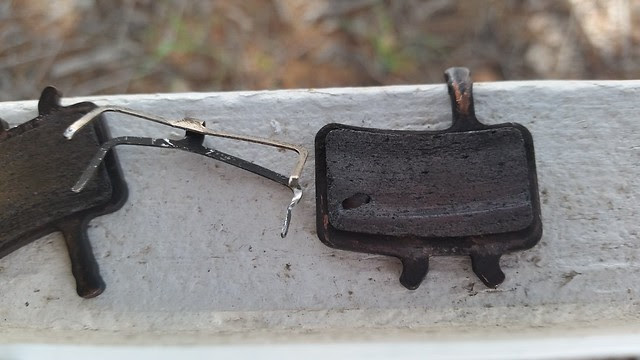
Well, other than the pads failing mid-ride, but that's another conversation.


Nick Favicchio

unread,
Mar 7, 2016, 12:49:17 PM3/7/16
to 650b
The last bit of Jan's post is the rather hopeful bit. His experience with the NFE and 48mm tires is the same as mine on a Soma GR with bigger tires. That much cushion makes frame/fork stiffness far less noticeable.

This makes me think discs are on the right bikes now, bikes designed for 2"+ tires. Discs creeping into bikes for smaller tires, for this reason of fork stiffness and others, is bummerish. Better braking vs numb hurty hands? Boo.

mgreene888

unread,
Mar 7, 2016, 12:52:46 PM3/7/16
to 650b
Yes - that bees my problem - hurty hands and wrists from ancient football and boxing injuries.

Mike

Fred Blasdel

unread,
Mar 7, 2016, 2:55:36 PM3/7/16
to mgreene888, 650b
On Mon, Mar 7, 2016 at 6:50 AM, mgreene888 <mgr...@surfbest.net> wrote:

I have recently been wondering if a disc rando style curved fork like the one on the Elephant National Forest Explorer retains any useful bump absorbing capability, given that the lower curve has become braced (and therefore apparently made rigid) by the caliper mount?

The NFE fork has plenty of flex in practical use. On a long rough gravel road descent without a front load, I can sight the hub through my front rack and watch the axle flutter.


I ask because I have been toying with the idea of trying a steel fork on my all-road bike,which currently has carbon forks. It seems like the exercise may be moot if the caliper mount makes the steel fork's "suspension" curve rigid.

I believe that the curve is an aesthetic distraction from where most forks actually flex: at the crown. When fork blades flex far enough from use to yield it's never near the dropouts. Even in landings to flat, they always bend/crumple/crack just below the crown.

Oversized tapered steerers were a great innovation for telescoping suspension forks, eliminating the flex there keeps the stanchions from binding in the seals. That improvement to small bump response makes those forks more supple by being stiffer. Tapered steerers on modern carbon rigid forks are done mostly for manufacturing reasons, they make it easy to have continuous fibers from tip to tip with much better strength-to-weight, but at the cost of losing suppleness.

Much more important than the curve is the dimensions of the blade, a smaller/thinner/rounder tube will flex much more. The Kaisei Special fork blades that Jan imports quickly taper away from the oval shape up top to a skinny round section. I think they'd make for a very supple fork even as straight blades with the offset at the crown. 

Curving the blades does have one effect that often goes unacknowledged: it makes the fork blades longer for the same fork height, and a longer unsupported member is always flexier.

avand...@gmail.com

unread,
Mar 7, 2016, 2:57:02 PM3/7/16
to 650b
Anecdotal observations. I have the NFE, and have a Surly Straggler as a commuter. I can observer some flex in NFE when the surface imperfection is also easily observable. If I can see the bump, I can see the fork flex. I can observe flex in the Straggler fork, as it is stout, only under hard front braking. 

mgreene888

unread,
Mar 7, 2016, 3:35:11 PM3/7/16
to 650b, mgr...@surfbest.net
Go Fred - that's what I call information!

Being over 200lbs, I was counting on the builder, if I go custom, to recommend the blade stock. I got the impression that the Kaisei blades were for thinner folks.

Thanks

Mike

Mark Bulgier

unread,
Mar 7, 2016, 3:44:25 PM3/7/16
to 650b, mgr...@surfbest.net
Fred Blasdel wrote:
> I believe that the curve is an aesthetic distraction from where most forks actually flex: at the crown

Fred, you're such a troll.  ;)
;)  Sorry, couldn't resist.
About the curve being an "aesthetic distraction", with the important flex happening above and below the crown: I used to say that, and I think it was pretty true for the forks I was looking at, mostly racing forks with less rake and a "modern" big radius curve, and not a very small diameter at the small end either.

But I have come to believe that the old French blades, small diameter with a lot of rake and at a small bending radius, really do add enough extra flex, and in the right direction, to be worthwhile.  Jan Heine helped force me to reassess my earlier position – thanks Jan for pointing out that the blades I was talking about were not optimized for comfort on rough roads. 

Yes the movement of the axle might still be coming mostly from flex at the top of the blades and in the steerer just above the crown.  But that doesn't mean the extra flex contribution from the curved  portion of the blades is insignificant.

Now, when we're wishing we had the advantages of a disk brake *and* we have the mitigating factor of supple balloon tires, then the additional comfort from "old Frenchy" blades might start to be seen as less significant, maybe an advantage we can live without.  But that doesn't mean it wasn't an advantage.
 
Much more important than the curve is the dimensions of the blade, a smaller/thinner/rounder tube will flex much more. The Kaisei Special fork blades that Jan imports quickly taper away from the oval shape up top to a skinny round section. I think they'd make for a very supple fork even as straight blades with the offset at the crown. 

Curving the blades does have one effect that often goes unacknowledged: it makes the fork blades longer for the same fork height, and a longer unsupported member is always flexier.

Fred, don't the above two paragraphs somewhat refute your initial hypothesis that the flex is happening at the crown?  I know I'm at least slightly misquoting you, you never said ALL the flex  is at the crown, but it seems like in these last two paragraphs you're now agreeing that the flex lower down is significant, at least worth talking about? Are we converging?

The bend does matter though. The small-radius bend also makes the force vector push on the bottom part of the blade more in the direction that flexes it.  A straight blade takes a higher proportion of the load as compression, and steel compresses extremely little with forces this low, an amount too small to bother mentioning.  The closer to horizontal the blade is, the more "leverage" the ground has to flex the blade rather than compressing it like a column. 

As a thought experiment, imagine hitting a big rock/pot-hole/whatever.  It doesn't hit the tire at the bottom, it hits somewhere out in front of the normal contact patch.  Now say you have straight blades (offset achieved by an angle at the crown) and the rock you're hitting is just the right size to where the point of impact is in a straight line with the blades.  There is no bending force on the blades from this impact, so the only attenuation you can get is from the compression of the steel, i.e. very close to zero.  With curved blade, there is no size of rock that creates a force straight up the blade with no bending, not possible.  (This is why compression columns are not curved.)

Even real-world size road imperfections like chip-seal, that hit the tire very close to straight down from the wheel axle, still apply more bending leverage to the bottom section of the blade if the blade is curved than if it is straight.  And even more for small-radius bends than for gradual bends.

Mark Bulgier
Seattle

Marc Pfister

unread,
Mar 7, 2016, 4:01:44 PM3/7/16
to 650b


On Monday, March 7, 2016 at 12:55:36 PM UTC-7, Fred Blasdel wrote:

I believe that the curve is an aesthetic distraction from where most forks actually flex: at the crown. When fork blades flex far enough from use to yield it's never near the dropouts. Even in landings to flat, they always bend/crumple/crack just below the crown.

This was granted as truth for at least 20 years of arguing about in on rec.bicycles.tech. But back when Jan did the flex test in VBQ (hanging pony kegs from the handlebars?) my interest was piqued and I built a simple FEA model of straight and curved forks. And lo and behold, the curved fork had more displacement. I think the explanation is quite simple - because the bottom of the curved blade is closer to horizontal you see more vertical displacement for a given angular amount of bending. This also means vertical loads create a larger bending moment on the bottom of the blade.The bottom of the blade also ends up somewhere in the neighborhood of 45 degrees to the horizontal which also means it will see a low bending moment from braking forces at the front hub.

- Marc


Jan Heine

unread,
Mar 7, 2016, 4:21:46 PM3/7/16
to Fred Blasdel, mgreene888, 650b
When we measured fork blade flex for Bicycle Quarterly, it become evident that a well-designed fork blade flexes in its lower 2/3 section. (Our test was designed to isolate the flex in that portion.) The amount of flex varied with fork offset and diameter/wall thickness of the fork blades, as you'd expect.

I am sure that there are forks that flex only at the fork crown, but that localizes the stresses in a place that can have a tendency to fail. That isn't a good design...

Jan Heine
Editor
Bicycle Quarterly

mgreene888

unread,
Mar 7, 2016, 4:41:10 PM3/7/16
to 650b, blas...@gmail.com, mgr...@surfbest.net, hei...@earthlink.net
Ok men, 

Design me a fork :) This could be fun - a max deflection rando disc fork for a husky guy. 

BTW: I have a Rube Goldberg-ish idea rolling around in my brain how one could attach the front caliper and have it float. The caliper would be mounted on bushings - the bottom one would be able to pivot and top bushing would be in a sliding track with say 5-10mm of unidrectional play. Might not be practical but run your minds over it boys!

Mike

Nick Favicchio

unread,
Mar 7, 2016, 5:18:08 PM3/7/16
to 650b
Cool thread.

Hey builders! What's the thinnest walled blade you'd use for a customer wanting discs? How much does rider weight factor? Tell us about this disc tab Alex!!

http://alexwetmore.org/archives/1173.html

Alex Wetmore

unread,
Mar 7, 2016, 5:42:33 PM3/7/16
to Nick Favicchio, 650b
I made two of those tabs. One is on the fork in that blog entry, the other is on Fred's NFE. There was a design flaw that makes it not work with many brakes (the tab is inline with the dropout which works for rear wheels, but not front ones. It needs to be offset 4mm outside).

The production Elephant NFE is using a pretty similar (but unique) tab that works well. I've built a fork with their tab too.

As far as I'm concerned these tabs do prevent the fork blade from flexing enough to provide any suspension. Given that I've always used stout blades that are beefier (larger diameter and thicker wall) than I'd ever use on a rim brake bike. For a very stout example the last fork that I built was for a mid-80s Univega touring bike, and I used Nova's disk-brake-ready fork blades:
http://www.cycle-frames.com/bicycle-frame-tubing/NOVA-ROAD-OVAL-Disk-Brake-Fork-Blade-.html

This fork ended up weighing approximately 80 grams more than the fork that it replaced (which already wasn't light). That is a stout fork.

The Nova disk blades are 17mm at the tips, which is huge. They are made from 1.1mm thick tubing, which most fork blades start with 0.9mm tubing (before tapering).

The fork in the blog entry that you linked to are Columbus SL, but I used a sloping fork crown so that I could cut off the smallest diameter portion of the blade. They are 0.9mm before tapering and probably 15mm at the dropouts given how I trimmed them.

I've thought about ways of getting a flexible fork with disk brakes. You need something other than a standard disk mount. There are ways to do it, and good examples in the motorcycle world.

alex

________________________________________
From: 65...@googlegroups.com <65...@googlegroups.com> on behalf of Nick Favicchio <nickfa...@gmail.com>
Sent: Monday, March 7, 2016 2:18 PM
To: 650b
Subject: Re: [650B] "Suspension" ability of a rando disc fork?

Cool thread.

Hey builders! What's the thinnest walled blade you'd use for a customer wanting discs? How much does rider weight factor? Tell us about this disc tab Alex!!

http://alexwetmore.org/archives/1173.html

Marc Pfister

unread,
Mar 7, 2016, 5:45:08 PM3/7/16
to 650b
It's not really wall thickness - it's outside diameter you should be looking for. 

But really, a fork with flexible ends is completely at odds with a disc brakes. If you have to have the classic look, use one of the disc specific legs with a traditional crown, or the True Temper round legs with a segmented or plate crown.

If you just want shock absorption, go with fatter tires. 

If you need a project, get someone to machine a low trail set of Cannondale Lefty crowns!

- Marc

Nick Favicchio

unread,
Mar 7, 2016, 8:12:47 PM3/7/16
to 650b
Hahn mentioned this in another thread (as did my buddy Zak who I guess has built forks with them)...

http://www.paragonmachineworks.com/cgi-bin/commerce.cgi?preadd=action&key=BK2009

I guess the question is, does it still make sense to build traditional style offset low bent forks with disks considering how stiff you need the fork legs to be?

Fred seems to be saying useful flex still exists despite the stiffness needed on his NFE, others say no.

If for aesthetics only, think I'd go that route. And hope for a little more mellowness.

Also sounds like twin plate fork crowns can help. Another aesthetic plus!

Rick Johnson

unread,
Mar 7, 2016, 8:45:54 PM3/7/16
to Marc Pfister, 650b
The Lefty and Headshok use an oversized head tube. I made a head tube drawing some years back for a custom frame using that spec. I could probably find it again if someone was serious about that concept. 


Message from Johnson mobile HQ


-------- Original message --------
From: Marc Pfister <marc.p...@gmail.com>
Date: 03/07/2016 2:45 PM (GMT-08:00)
To: 650b <65...@googlegroups.com>
Subject: Re: [650B] "Suspension" ability of a rando disc fork?

--

Alistair Spence

unread,
Mar 7, 2016, 8:49:54 PM3/7/16
to Mark Bulgier, 650b, mgr...@surfbest.net
On Mon, Mar 7, 2016 at 12:44 PM, Mark Bulgier <ma...@bulgier.net> wrote:

The bend does matter though. The small-radius bend also makes the force vector push on the bottom part of the blade more in the direction that flexes it.  A straight blade takes a higher proportion of the load as compression, and steel compresses extremely little with forces this low, an amount too small to bother mentioning.  The closer to horizontal the blade is, the more "leverage" the ground has to flex the blade rather than compressing it like a column. 


I believe that THIS is at the heart of the matter. Well stated Mark.


Alistair Spence,
Seattle, WA. 

Toby Whitfield

unread,
Mar 7, 2016, 10:23:51 PM3/7/16
to 650b
But, as I think I mentioned in another recent thread, what you really want to use is the older headshock design, more thsm the lefty version. The lefty was made to get around the travel limits of the headshock, but that is only really important for long travel mtb designs. The old headshock allows you to mount fenders and racks, so has benefits that other suspension forks don't have. I think it is the natural fit for rando/all road use more than the current version.

Of course, the downside is the large head tube and stem that work with it, but a contemporary interpretation for randonneur use could be figured out.

I have the XS800, which was the short lived cyclocross version with headshock. It actually works very well, but the rest of the setup is not something I am still interested in.

Toby
Toronto

Marc Pfister

unread,
Mar 7, 2016, 10:37:52 PM3/7/16
to 650b


On Monday, March 7, 2016 at 8:23:51 PM UTC-7, Toby Whitfield wrote:
But, as I think I mentioned in another recent thread, what you really want to use is the older headshock design, more thsm the lefty version. 

I was going to mention the Headshok and the possibility of doing something like this:


But I didn't want to get into the feasability of cryofitting new legs. 

There's also the Actiontec unit which is slimmer, but I have no idea if they are still in business.

- Marc

satanas

unread,
Mar 8, 2016, 11:11:00 AM3/8/16
to 650b
Not disc related but fork blade related... My first decent bike nearly 40 years ago used very small section Reynolds 531 blades (Toei like) with an almost flat Haden crown. The fork started off with ~40 mm of offset as the blades came raked that way. There was some visible flex but not a huge amount. After a while I switched from mainly using 28-630 tyres to tubulars and re-raked the forks a bit, to something like 50-55 mm. There was *a lot* more flex in the blades lower down afterwards even when not hitting bumps, to the point that riding out of the saddle was a bit disturbing visually. The blades were eventually de-raked to near the original amount, and flex decreased. So, from my experience with that fork, IMHO, 1) offset will affect the amount of flex, all else being equal, and 2) those old-style thin blades do indeed flex more than say Columbus SL, not that the latter cannot be seen to flex under heavy braking. Some other steel forks, like say Columbus Max, don't appear to flex noticeably.

Some of the alu forks Cannondale used in the 1980s and early 1990s didn't appear to flex at all, though I suspect the original Klein Attitude fork was up there too. Super-stiff forks are great for precise steering off-road at low speeds, but on washboards one's hands go numb almost immediately. Cannondale's "Sub 1" road fork used a 1 1/4" alu steerer and was perhaps the least forgiving road fork I've ever experienced, rather like an I-beam, as was the matching frame.

Re carbon forks: IME there has been a huge amount of variation with these. I have a mid-1990s Look fork with a 1" steel steerer on a ~1990 Specialized Allez Epic CF frame, and compared to the original Direct Drive alu fork there is considerably more flex, more comfort, but noticeably much less steering precision, unfortunately. It also seems that CF-everything keeps getting stiffer, perhaps in part so manufacturers can hype "improvements" in something racers can grasp, and perhaps also in the hope that if things are sufficiently over-designed there will be fewer lawsuits when  people manage to destroy them somehow.

BTW, does anyone know if there are wider crowns forthcoming (or NOS) which will fit the Toei Special fork blades and clear ~50mm tyres satisfactorily?

Later,
Stephen

Harold Bielstein

unread,
Mar 8, 2016, 12:35:28 PM3/8/16
to satanas, 650b
Since UBI no longer deals in Kaisei tubing, is Jan Heine the only source for Toei Special fork blades?
> --
> You received this message because you are subscribed to the Google Groups "650b" group.
> To unsubscribe from this group and stop receiving emails from it, send an email to 650b+uns...@googlegroups.com.
> To post to this group, send email to 65...@googlegroups.com.
> Visit this group at https://groups.google.com/group/650b.
> For more options, visit https://groups.google.com/d/optout.

Hal Bielstein
hkbie...@gmail.com


mgreene888

unread,
Mar 9, 2016, 7:34:56 AM3/9/16
to 650b, nsc.e...@gmail.com
OK - so I guess the only way to test this to actually try it. Based on Jan's comment that "any steel fork is better than a carbon fork", I pulled the trigger on a Soma fork. Found a Soma Disc cross fork on ebay for ~$115 - there was one more at that price if anybody is interested - note that the color is gold. The one review that I found that mentioned a similar Soma fork seemed to indicate that it added to ride comfort.

As bike parts go, not an expensive experiment. If it is a step in the right direction, maybe I will have one built in the future. 

I will report back.

Mike  
 

Mark Bulgier

unread,
Mar 9, 2016, 12:58:10 PM3/9/16
to 650b, nsc.e...@gmail.com
One problem is that the effect is small but cumulative, mostly felt at the end of a long ride.  But if you're a little more or less tired or numb at the end of a long ride, you can't attribute that to any one factor, because there are so many things that go into how beat up you are at the end of the day.  Combine that with the muting effect of fat/supple tires, and difficulty of remembering and comparing a subjective feeling of tired/numbness from one day to the next, plus issues of recovery -- you're bound to be a little more tired on the second day of testing due to residual tiredness from the day before.  Seems clear to me that it is virtually impossible to tease out the little contribution from the curve in the steel blade, if we're just relying on human perception.  Lab tests of fork compliance seems a more promising avenue, though designing the test to adequately measure what actually happens on the road, and what part of that actually matters to us, is probably also going to be very tricky.

Personally I don't hold out much hope for a definitive answer.  I'm so glad it doesn't matter to me, since I would never use a carbon fork and I'm unlikely to want a disk brake on a road bike, even an "all road" bike.  So the skinny/weak curved steel blade is a no-brainer, easy choice for me.

I'm not disparaging the people for whom this question does matter, namely people who want a comfortable fork with a disk brake.  That's a valid thing to want, it's just not for me.  I wish you luck!  Hopefully my inability to imagine a good scientific test for fork comfort is just a lack of imagination on my part, and good test numbers are right around the corner.

Mark Bulgier
Seattle

Eric Keller

unread,
Mar 10, 2016, 12:39:29 PM3/10/16
to 650b
On Wed, Mar 9, 2016 at 12:58 PM, Mark Bulgier <ma...@bulgier.net> wrote:
> One problem is that the effect is small but cumulative, mostly felt at the
> end of a long ride.

I am of the opinion that position and tires are much more important
than fork stiffness for long distance comfort. I have two sets of
wheels for my gravel bike, one road, one off road, 38mm tires in both
cases. That bike uses 700c, but I doubt it matters for this
discussion. I used the bike for randonneuring last year. I didn't
suffer any comfort issues. In fact, that's a horrible bike all-round,
but the contact points are in the right place and big tires make up
for a lot of ills.

I have ridden a 200km brevet that featured a mountain descent in the
snow, and for that application, discs are the way to go. My experience
with my gravel bike makes me wonder why I have so many bikes, not that
I'm going to change that.

Mark Bulgier

unread,
Mar 10, 2016, 2:07:13 PM3/10/16
to 650b
Eric Keller wrote:
> I am of the opinion that position and tires are much more important
> than fork stiffness for long distance comfort.

I mean no insult by it, but I would call that obviously true.  I doubt anyone would argue against it.
Fork stiffness, though clearly a lesser factor, still may be worth trying to optimize after you've taken care of the important stuff like rider position and tires.

Eric wrote:
> I didn't suffer any comfort issues.

It almost sounds like you're saying that means you shouldn't do anything more to make the bike more comfortable. "Not suffering" is great, but if it can still get a little better without too much compromise in another area, then why not?  Dare to want it all!

Mark Bulgier
Seattle

David Cummings

unread,
Mar 10, 2016, 7:43:26 PM3/10/16
to 650b
If you need a project, get someone to machine a low trail set of Cannondale Lefty crowns!

- Marc

Wonder if this is low trail?


Greg Achtem

unread,
Mar 10, 2016, 8:48:59 PM3/10/16
to David Cummings, 650b

WMdeR

unread,
Mar 11, 2016, 12:22:25 PM3/11/16
to 650b
Dear David, 

Nope. not low trail. 

You'd need to get new plates machined with more forward/angular offset. The plates in question are the two that that hold the fork column at the top and bottom of the head tube, analogous to the "triple tree" of a motorcycle.

Best,

Will 

Geeger_P

unread,
Mar 11, 2016, 8:22:50 PM3/11/16
to 650b
This is a great thread...love the benefits of disk brakes (wider selection of rims, wet weather braking and modulation, and rims not wearing out) but also keen to experience the benefits of the slender low trail fork...and want it all on the one bike.

I wonder if anyone (Jan...Bicycle Quarterly) has the resources to film with high speed camera forks in action to see where they flex for bump response and braking, and to film a variety of fork styles. Theres a doctorate thesis for a budding engineer!

I remember seeing high speed footage of how an arrow flexes as it leaves the archers bow and amazed me how the arrow still manages to fly straight given the energy transfer.

Whilst I'm posting...always wondered why no-one has set up disk caliper on leading side of fork (much like early disk brake motorcycles) in order to limit the need for a stiffer low section on the fork...rim brakes allow the whole leg to flex in response to heavy braking.

David Butcher
Seaford Meadows
South Australia

Steve Palincsar

unread,
Mar 11, 2016, 10:07:49 PM3/11/16
to 65...@googlegroups.com


On 03/11/2016 08:22 PM, Geeger_P wrote:
> This is a great thread...love the benefits of disk brakes (wider
> selection of rims, wet weather braking and modulation, and rims not
> wearing out) but also keen to experience the benefits of the slender
> low trail fork...and want it all on the one bike.

https://www.youtube.com/watch?v=7S94ohyErSw

Ray Varella

unread,
Mar 11, 2016, 10:17:05 PM3/11/16
to 65...@googlegroups.com
That was a welcome intermission Steve.

Ray

--
You received this message because you are subscribed to the Google Groups "650b" group.
To unsubscribe from this group and stop receiving emails from it, send an email to 650b+uns...@googlegroups.com.
To post to this group, send email to 65...@googlegroups.com.
Visit this group at https://groups.google.com/group/650b.
For more options, visit https://groups.google.com/d/optout.


--
Ray Varella
IAABC Parrot Division
Supporting Member

Steve Palincsar

unread,
Mar 11, 2016, 10:18:37 PM3/11/16
to 65...@googlegroups.com
and something you need to bear in mind.  Sometimes there are trade-offs and you really can't always get what you want, and I'm afraid this is one of those times.

Ray Varella

unread,
Mar 11, 2016, 10:20:09 PM3/11/16
to 65...@googlegroups.com
...not true, Wild Horses was next in the cue ;)

--
You received this message because you are subscribed to the Google Groups "650b" group.
To unsubscribe from this group and stop receiving emails from it, send an email to 650b+uns...@googlegroups.com.
To post to this group, send email to 65...@googlegroups.com.
Visit this group at https://groups.google.com/group/650b.
For more options, visit https://groups.google.com/d/optout.

David Cummings

unread,
Mar 12, 2016, 12:11:45 AM3/12/16
to 650b
Sorry, I forgot to hit the sarcasm button about the C-dale. ;)
It is somewhat amusing and encouraging while at the same time bitter/sweet to watch the big companies "discover" this Enduro Allroad concept. I guess we can't all be OG, I know I sure amn't (I just made that word up, so maybe I AM!).

David "Original Geek" Cummings

mgreene888

unread,
Mar 12, 2016, 2:12:39 PM3/12/16
to 650b
By way of not being able to have your cake...

What if we apply a THRU AXLE to a thin-walled steel, curvy rando fork with disc brake???

Might not we gain torsional stiffness while retaining vertical compliance (he said in a science-y voice :)?

Mike

On Monday, March 7, 2016 at 9:50:04 AM UTC-5, mgreene888 wrote:
Hey everybody, 

THis may be my first post here. I think this group, especially Jan and Fred, are perfectly positioned to answer this question:

I have recently been wondering if a disc rando style curved fork like the one on the Elephant National Forest Explorer retains any useful bump absorbing capability, given that the lower curve has become braced (and therefore apparently made rigid) by the caliper mount?

I ask because I have been toying with the idea of trying a steel fork on my all-road bike,which currently has carbon forks. It seems like the exercise may be moot if the caliper mount makes the steel fork's "suspension" curve rigid.

In my web research so far, it seems that those with an opinion seem to think that carbon forks absorb road buzz better than steel - but steel forks (with the right curves and tubes, I guess) have the ability to absorb larger bumps better than carbon. I'd appreciate any discussion of this point too.

Thanks

Mike

Rick Johnson

unread,
Mar 12, 2016, 2:19:59 PM3/12/16
to mgreene888, 650b
Why not bring back the HeadShok?
Separate the suspension from the fork blades entirely - tunable ride, rigid steering, run any brake or axle you like...

Rick Johnson
Bend, Oregon

Every revolutionary idea seems to evoke three stages of reaction...
One, it's completely impossible. 
Two, it's possible, but it's not worth doing. 
Three, I said it was a good idea all along.

Arthur C. Clarke
--

Evan Baird

unread,
Mar 12, 2016, 5:25:23 PM3/12/16
to 650b, mgr...@surfbest.net, RickCJ...@gmail.com

Alex Wetmore

unread,
Mar 12, 2016, 6:35:50 PM3/12/16
to Evan Baird, 650b, mgr...@surfbest.net, RickCJ...@gmail.com

Cute!  How is stiction on it?


I used to tour (on mixed surfaces) with a Softride stem back when I thought the Conti Top Touring was a good tire (it's extremely stiff, like a Schwalbe Marathon).  The Softride design was pretty good and the linkage made it active even on tiny bumps (better than most suspension forks at the time), but it was very heavy and only worked in longer lengths (110mm, 135mm, and 150mm I think).


http://static.flickr.com/107/295985123_37e5f065bd_o.jpg


alex


From: 65...@googlegroups.com <65...@googlegroups.com> on behalf of Evan Baird <vanst...@gmail.com>
Sent: Saturday, March 12, 2016 2:25 PM
To: 650b
Cc: mgr...@surfbest.net; RickCJ...@gmail.com
Subject: Re: [650B] Re: "Suspension" ability of a rando disc fork?
 
So compliant!

Ideal comfort option for threadless stem systems. This elastomer-equipped shock absorber installs onto the fork steerer and the stem installs onto it.

Evan Baird

unread,
Mar 12, 2016, 6:41:57 PM3/12/16
to Alex Wetmore, 650b, mgr...@surfbest.net, RickCJ...@gmail.com

Anything that makes your habdlebars move independantly of the rest of the bike is a fundementally bad idea. But what can I say, people keep making this stuff.

Mark Bulgier

unread,
Mar 12, 2016, 8:34:45 PM3/12/16
to 650b, al...@phred.org, mgr...@surfbest.net, RickCJ...@gmail.com
Evan Baird wrote:

> Anything that makes your handlebars move independently of the rest of the bike is a fundamentally bad idea. 


 "Fundamentally bad" might be putting it a bit strongly.  The Softride stem was good enough to be ridden to three World Pro MTB cross-country World Championships (Frischknecht and Matthes). I rode and raced extensively on them for a few years, and I rode several telescopic forks too so it's not like I didn't know what I was missing.  I thought the stem had advantages that made it the right choice for me, for a while at least until forks got better and/or Softride stopped making them.


> But what can I say, people keep making this stuff.

I wish they did!  But I have one and if I need another, they come up on eBay now and then...

Mark Bulgier
Seattle

satanas

unread,
Mar 13, 2016, 8:21:49 PM3/13/16
to 650b
+1 on Softride stems. The Girvin stems were another matter. Having the bars pivot down on dropouts wasn't a good thing, and then there's the time the pivot bolt came loose mid-ride. <shudder>

Re thru-axles plus thin blades: ain't gonna stop the blades bending or cracking, as illustrated earlier in the thread. Better not to apply too large a force to a small section never intended to deal with such a thing.

Later,
Stephen

mgreene888

unread,
Mar 24, 2016, 6:56:03 PM3/24/16
to 650b
Welp, I switched forks. The comfort difference is analogous to napping in my la-zboy vs getting beat up and choked by one of those UFC guys. Really.

OK - its marginally more subtle. The difference I feel, if put on an oscilloscope, would be that the carbon fork would be a sharp spike and the steel fork is more like a medium sine wave  over the same bump - the shock has a longer moment. I likes it! I'd say its a positive difference. The steel fork does feel heavy in your hand - but until I get down to 2% body fat (never) - what difference does it make? Feast thine eyes:


I feels a little eccentric at times....

Nick Favicchio

unread,
Mar 25, 2016, 12:56:40 AM3/25/16
to 650b
God those new chainrings are wild. That is a fun looking bike.

mgreene888

unread,
Mar 25, 2016, 9:33:29 AM3/25/16
to 650b
Yeah - my bike is kind of like an Armani suit with the pants hitched up to the ribcage :)

Mike


On Monday, March 7, 2016 at 9:50:04 AM UTC-5, mgreene888 wrote:

mitch....@gmail.com

unread,
Mar 26, 2016, 12:43:42 PM3/26/16
to 650b


On Thursday, March 24, 2016 at 4:56:03 PM UTC-6, mgreene888 wrote:
Welp, I switched forks. The comfort difference is analogous to napping in my la-zboy vs getting beat up and choked by one of those UFC guys. Really.

OK - its marginally more subtle. The difference I feel, if put on an oscilloscope, would be that the carbon fork would be a sharp spike and the steel fork is more like a medium sine wave  over the same bump - the shock has a longer moment. I likes it! I'd say its a positive difference. The steel fork does feel heavy in your hand - but until I get down to 2% body fat (never) - what difference does it make? Feast thine eyes:

 Nice, what stem is that?

--Mitch

mgreene888

unread,
Mar 26, 2016, 12:46:37 PM3/26/16
to 650b
Custom - made to my measurement.
Mike

mitch....@gmail.com

unread,
Mar 26, 2016, 12:48:45 PM3/26/16
to 650b


On Saturday, March 26, 2016 at 10:46:37 AM UTC-6, mgreene888 wrote:
Custom - made to my measurement.
Mike

Thanks. Any more information? I think I need one of these.

--Mitch 

mgreene888

unread,
Mar 26, 2016, 3:13:56 PM3/26/16
to 650b
Hey

The builder is rich adams -ri...@bicycleframes.com

I dialed in the position with one of those adjustable stems. Rich was very cool and didn't judge my old man stem position 😷

mitch....@gmail.com

unread,
Mar 26, 2016, 4:13:41 PM3/26/16
to 650b
thanks!
Reply all
Reply to author
Forward
0 new messages