Jarvis Operated Printer Farms

893 views
Skip to first unread message

SD3D

unread,
Jan 13, 2015, 5:24:48 PM1/13/15
to
Hey everyone, I'm new here but not new to 3D printing. I have had some rather lengthy discussions with vrfx via email who suggested I post here to gather feedback from the 3D printing gods and gurus of the world.

At SD3D we mainly do low volume production 3D printing to compete with conventional injection molding and other thermoplastic manufacturing methods. For something the size of an apple, we can typically beat injection molding prices out of China or Mexico for the first ~5000 units. This service has been heavily utilized by crowd-funding campaigns to achieve fulfillment of several hundred orders while maintaining profit margins that can eventually be rolled over to invest in molds once the market has been validated. This means that a Kickstarter campaign can lower their target goal at least five fold while still making a profit. We see this as the true disruptive nature of 3D printing; allowing new ideas to come to market that would have otherwise never made it due to lack of investment. 

Now the unique aspect about our offering is it is not your typical Printer Farm model where you just stick a bunch of printers in a room and run them 24/7. It is much more similar to that of a time-share arrangement, as the client actually purchases and owns the printer that will be used for their production. We then host that printer for them in our facility, providing their prints at the cost to us while we make our profit on level-loading the excess capacity of the printer while not being used for production by the owner. We offer one and two year contract terms which can lower the owners printing costs to under $0.05/cc (as opposed to the $0.25/cc outsourcing standard set by directories such as MakeXYZ and 3D hubs). If your printer goes down for maintenance during production, we seamlessly continue producing your parts on another printer in the farm until your printer is back on-line.

When we originally began offering this service, we actually accepted any open source 3D printer on the market, as well as Makerbots, into the Printer Farm. Within a few months we realized that was a big mistake. The reason for this is that we had absolutely no control over the design of the printers and supply of parts, which meant if a printer went down, it could stay down for weeks while we attempted to source parts from the original supplier. We also found it extremely difficult to scale up and keep up with the new contracts since we found the printer handling limit of a single full time technician to be a meager 10 printers when dealing with hobbiest level desktop 3D printers with questionable reliability and a multitude of required manual operations to get the perfect print. Dozens of industrial level printers from Stratysis or 3D Systems can be handled by a single technician, but the capital and material costs for these printers are prohibitively expensive for most of the clients that use our service.

This lead us to begin developing our own 3D printers; something we wanted to avoid at all cost, but our service model required a class of 3D printer that simply does not exist on the market today. We are now offering our printers, which we call Jarvis, exclusively through the Printer Farm. We no longer provide production off of hobbiest level desktop printers, but we will take them as a "trade-in" for a Jarvis. Jarvis is the first of it's kind (to our knowledge) completely cloud based industrial 3D printer. It connects to a web based operating system called Layer3Dcloud where the data from over a dozen feedback sensors inside the printer are analyzed and compared to data from historically successful prints network-wide. Layer3Dcloud then triggers events handled by the printer's patent pending Adaptive Build Environment (ABE) which is our version of a heated chamber with five zone gradient neutralizing temperature control. ABE also includes a fully mechanical precision calibration system which automatically calibrates the system with 10 micron resolution. This is done mechanically as opposed to through software in order to reduce the processing power required during the print, allowing the printer to move faster. Jarvis includes a patent pending gradient free heated bed with auto-ejection capabilities so that a technician is not required to clear the plate between prints. Layer3Dcloud also monitors all of the filament in our facility and can automatically load and unload filaments from Jarvis without a technician present. This means that you can assign a seemingly unlimited number of colors and materials to each print based off a specific layer or line trigger in the gcode. Since we can queue up prints for weeks at end, Jarvis publishes the estimated queued material and actual material remaining to Layer3Dcloud which can trigger automatic reorder when a minimum level is met. All of our filament is tagged by RFID which identifies the particular material in Layer3Dcloud. Auto material calibration can be performed on Jarvis to derive optimal print settings for that particular material. Environmental factors are then recorded with the material settings to Layer3Dcloud so that ABE can duplicate the exact environment the next time the material is used. All of these new features have been shown to reduce printer failure rate from ~30% to <1% which drastically lowers the labor cost involved with providing production.

I'm posting additional technical features below. Looking for any feedback regarding if we should continue selling these exclusively through the Printer Farm service for internal usage or if we should attempt to raise money to commercialize these units outside of the farm. Are there other applications that can use such sophisticated yet relatively affordable 3D printers or have we just made a Printer Farm specific printer (which was the original goal anyway)? Any other feedback regarding our general business model and other plausible usages for this kind of service would be greatly appreciated.

Full Jarvis feature list: 

Extrusion: Dual all-metal hotends with nozzle diameter options ranging from 0.25mm-0.8mm
Print Surface: 24V gradient free heated bed with auto-ejection capabilities
Print Area: configurable from 300mm x 300mm x 300mm (12in x 12in x 12in) up to 900mm x 900mm x 900mm (36in x 36in x36in)
Print Volume: 1-27 cubic feet of usable space
Top Print Speed: 200mm/sec (7.9in/sec)
Print Tolerance: 0.04mm (0.0016in) in X and Y axes. Z axis is dependent on layer thickness selected
Layer Thickness: 0.04mm to 0.6mm (0.0016in - 0.024in) limits dependent on nozzle selection
Supported Materials: ABS, PLA, HIPS, PVA, PC, TPE, and composite materials
Display: 5" full color LCD touchscreen display (800x480) 
Usable Filament Sizes: standard 3mm (0.1in)
Cooling: liquid cooling of all components, two sets of independent nozzle cooling fans and automatic gradient neutralizing climate control
Auto-calibration: bed level within 0.008° (~10 microns)
Filtration: true HEPA internal cabin filtration with pre-filter


Electrical

Power Requirements: 100 - 240 VAC; <750W
Temperature: Maximum operating temperature (Extruder), 400C (752F)
Temperature: Maximum operating temperature (Heated Bed), 150C (248F)
Temperature: Maximum operating temperature (Build Environment), 60C (140F)


Software & Connectivity

Dedicated on-board computer for instant remote printing and alerts from the cloud
Layer3Dcloud operating system with 32Gb local file storage (expandable)
3D Printing Pro Suite including : cloud slicing, filament monitoring, project management & more
LAN Connectivity: Wifi, bluetooth, USB
Browser compatibility: Internet Explorer, Chrome, Firefox
Phone compatibility: Android, Apple
Security: 4kbit RSA encryption


Warranty

Full protection plan for the duration of the Printer Farm Contract


4-6 week lead time 
Price $3,499 - 12"x12" Jarvis with dual all metal hotends

Ryan Carlyle

unread,
Jan 13, 2015, 6:00:19 PM1/13/15
to 3dprintertips...@googlegroups.com
Sounds pretty awesome. Can you post a picture?

Can you comment on how you are getting around Makerbot/Stratasys patents on:
- Automatic print removal
- Build chamber temp control
- Print farm job splitting / load-leveling
Not to mention potential Marvel IP around the name Jarvis for automated fabrication systems.
(I'm not saying you're infringing, just asking your opinion/justification why you don't think you're infringing.)

How do you see the value of one stand-alone unit versus a networked farm? To me, that seems like the big issue here. Many of your (awesome-sounding) features are low-value/no-value for hobbyists. Most of the low-cost 3DP market (for now) is single unit hobbyists/consumer purchasers or very small bot farms (below the "one tech can run it" threshold). That could change, of course, but the scaling component seems like a big part of your value proposition.

Kurt @ VR-FX

unread,
Jan 13, 2015, 6:13:49 PM1/13/15
to 3dprintertips...@googlegroups.com
FYI - yeah, it's me - Kurt the Bot-Guy who directed David to this forum. We've been emailing recently & I was intrigued by what he was doing - and suggested he post here.

And - I can see that our Chemicals expert - Ryan - was the 1st 2 reply! I'm off 2 read his reply now. And - yeah - David met me on MakeXYZ.

L8r,
-K-

Sent from my iPhone

On Jan 13, 2015, at 5:24 PM, SD3D <sd3dpr...@gmail.com> wrote:

Hey everyone, I'm new here but not new to 3D printing. I have had some rather lengthy discussions with vrfx via email who suggested I post here to gather feedback from the 3D printing gods and gurus of the world.

At SD3D we mainly do low volume production 3D printing to compete with conventional injection molding and other thermoplastic manufacturing methods. For something the size of an apple, we can typically beat injection molding prices out of China or Mexico for the first ~5000 units. This service has been heavily utilized by crowd-funding campaigns to achieve fulfillment of several hundred orders while maintaining profit margins that can eventually be rolled over to invest in molds once the market has been validated. This means that a Kickstarter campaign can lower their target goal at least five fold while still making a profit. We see this as the true disruptive nature of 3D printing; allowing new ideas to come to market that would have otherwise never made it due to lack of investment. 

Now the unique aspect about our offering is it is not your typical Printer Farm model where you just stick a bunch of printers in a room and run them 24/7. It is much more similar to that of a time-share arrangement, as the client actually purchases and owns the printer that will be used for their production. We then host that printer for them in our facility, providing their prints at the cost to us while we make our profit on level-loading the excess capacity of the printer while not being used for production by the owner. We offer one and two year contract terms which can lower the owners printing costs to under $0.05/cc (as opposed to the $0.25/cc outsourcing standard set by directories such as MakeXYZ and 3D hubs). If your printer goes down for maintenance during production, we seamlessly continue producing your parts on another printer in the farm until your printer is back on-line.

When we originally began offering this service, we actually accepted any open source 3D printer on the market, as well as Makerbots, into the Printer Farm. Within a few months we realized that was a big mistake. The reason for this is that we had absolutely no control over the design of the printers and supply of parts, which meant if a printer went down, it could stay down for weeks while we attempted to source parts from the original supplier. We also found it extremely difficult to scale up and keep up with the new contracts since we found the printer handling limit of a single full time technician to be a meager 10 printers when dealing with hobbiest level desktop 3D printers with questionable reliability and a multitude of required manual operations to get the perfect print. Dozens of industrial level printers from Stratysis or 3D Systems can be handled by a single technician, but the capital and material costs for these printers are prohibitively expensive for most of the clients that use our service.

This lead us to developing our own 3D printers; something we wanted to avoid at all cost, but our service model required a class of 3D printer that simply does not exist on the market today. We are now offering our printers, which we call Jarvis, exclusively through the Printer Farm. We no longer provide production off of hobbiest level desktop printers, but we will take them as a "trade-in" for a Jarvis. Jarvis is the first of it's kind (to our knowledge) completely cloud based industrial 3D printer. It connects to a web based operating system called Layer3Dcloud where the data from over a dozen feedback sensors inside the printer are analyzed and compared to data from historically successful prints network-wide. Layer3Dcloud then triggers events handled by the printer's patent pending Adaptive Build Environment (ABE) which is our version of a heated chamber with five zone gradient neutralizing temperature control. ABE also includes a fully mechanical precision calibration system which automatically calibrates the system with 10 micron resolution. This is done mechanically as opposed to through software in order to reduce the processing power required during the print, allowing the printer to move faster. Jarvis includes a patent pending gradient free heated bed with auto-ejection capabilities so that a technician is not required to clear the plate between prints. Layer3Dcloud also monitors all of the filament in our facility and can automatically load and unload filaments from Jarvis without a technician present. This means that you can assign a seemingly unlimited number of colors and materials to each print based off a specific layer or line trigger in the gcode. Since we can queue up prints for weeks at end, Jarvis publishes the estimated queued material and actual material remaining to Layer3Dcloud which can trigger automatic reorder when a minimum level is met. All of our filament is tagged by RFID which identifies the particular material in Layer3Dcloud. Auto material calibration can be performed on Jarvis to derive optimal print settings for that particular material. Environmental factors are then recorded with the material settings to Layer3Dcloud so that ABE can duplicate the exact environment the next time the material is used. All of these new features have been shown to reduce printer failure rate from ~30% to <1% which drastically lowers the labor cost involved with providing production.

--
You received this message because you are subscribed to the Google Groups "3D Printer Tips, Tricks and Reviews" group.
To unsubscribe from this group and stop receiving emails from it, send an email to 3dprintertipstricks...@googlegroups.com.
To post to this group, send email to 3dprintertips...@googlegroups.com.

Jetguy

unread,
Jan 13, 2015, 6:18:21 PM1/13/15
to 3dprintertips...@googlegroups.com
What gets me is a $3500 for a 12x12x12  dual extruder.

On one hand, you guys say it's reliable and accurate enough for extreme production. That sets the stage for what I think the machine looks like.
Sourcing and building my own printers, I know a BOM alone could be $1k-$1.5k just in the frame and a basic controller setup ready to print given your spec list (heated chamber, special bed, etc).
Not even going to a small embedded computer and so forth, you cloud application....

So, given that a Z18 is a ridonkulous $6K, I would say put that puppy on the market and sell the crap out of them.

But Ryan has a point, you have great IP and there is valid concern that Stratasys might go after you when you do start killing Z18 sales.

Tough call. 

Kurt @ VR-FX

unread,
Jan 13, 2015, 6:19:42 PM1/13/15
to 3dprintertips...@googlegroups.com
Ryan - I will respond 2 last Q.

It's why David contacted me.

Really - it's about the hobbyist who has his own printer - like the Bot-Guy - and is prototyping a design. But - after producing original prototype & perfecting - now wants to test out the market w/his/her design in a limited run production for Public distribution - and that's where his system comes in.

Makes sense now???

-K-

Sent from my iPhone

> On Jan 13, 2015, at 6:00 PM, Ryan Carlyle <temp...@gmail.com>

Kurt @ VR-FX

unread,
Jan 13, 2015, 6:22:33 PM1/13/15
to 3dprintertips...@googlegroups.com
Sir JetGuy - tis exactly why I wanted him 2 post to this forum - EXaCTLY because I expected U to ask the Really Tough Questions!!!  Bravo!

:-)
-K-

Sent from my iPhone
--

SD3D

unread,
Jan 13, 2015, 10:00:17 PM1/13/15
to 3dprintertips...@googlegroups.com
Our first production unit is nearing completion; just waiting for the ABE chamber to be fabricated to complete the assembly. We recently updated the design to allow extra travel for priming, head cleaning, etc. so the panels needed to be reworked. I will post some in-progress assembly pictures but just keep in mind that these are mid-assembly photos and not representative of what a finished Jarvis looks like. 

Regarding Stratasys/Makerbot patents:

Automatic print removal: We do not use the patented conveyor belt system to eject our parts. Our solution has everything to do with the material of our gradient-free HPB, and our precise control over bed calibration and initial layer heights. Everything from ABS to Ninjaflex pops right off the platform. The door opens and the print is pushed out into a finishing station conveyor belt with its own actuation system. 

Build chamber temp control: Our solution to a controlled build environment is fundamentally different than those tried before. The Stratasys patent is based on directly adding thermal energy to the system in selective quantities and areas. Our patent is based on indirectly removing thermal energy from the system in selective quantities and areas. ABE is a completely sealed system and does not ventilate heat externally whereas the Stratasys patent includes a ventilation aspect. 

Printer farm job splitting/load leveling: I'm actually not familiar with this patent; care to share? 

I'm not too sure about the potential Jarvis infringement either. Our version of Jarvis refers to the actual hardware of the printer whereas the comics/movies are referring to an AI program used for industrial applications. Jarvis is a fairly common British surname too which obviously predates Marvel. We are not really attached to the name; not sure how much Marvel would care about us selling a printer under the Jarvis name if we don't associate with their brand in any other way. Time will tell.

We definitely agree with the limited value of one unit, which is why we have targeted SMB's, startups and crowdfunding campaings to start with. However, I forgot to mention one aspect of our printer that always seems to get OEM's excited which is post-print QA verification. We do this through the use of a 10 camera projection scanner that takes 18 synchronized images and verifies print accuracy within two minutes of the finished print (before it has enough time to cool down for ejection). We have discussed the options of white labeling or licensing to a big OEM in the future, as they are interested in building on the high reliability QA platform to establish a pay-per-print network like the app store of the physical world. They see 99%+ reliability as a requirement for that network to be successful. If we did decide to bring our tech to the consumer market, that is likely how we would do it. The system is highly modular, so OEM's can add or remove any features they don't perceive to need for their target market.

SD3D

unread,
Jan 13, 2015, 10:20:06 PM1/13/15
to 3dprintertips...@googlegroups.com
@Jetguy, the $3500 price is only available when you sign up for a two year contract with the Printer Farm. Your ballpark figures are accuate for the mechanical pieces and nearly 50% of our BOM cost is in electronics, sensors and extra actuators so you will know I'm not lying when I say we sell this very near our actual costs to build them with labor built in. 

We don't intend to profit off of the printer initially when purchased through the farm because we know we will get to utilize it and profit off of it for years to come. We do this by loading up the excess capacity of the printer with one-off conventional prototyping jobs and other non-dedicated bulk orders. In order to get the lowest costs in the farm (~$0.05/cc) you can only use a maximum of 50% of your machine capacity measured on a weekly basis. Since the cost of the printer is relatively inexpensive, most clients have decided to purchase two printers running at 50% utility rather than one printer running at 100% through the farm in order to save on the variable costs, which typically more than make up for the extra printer throughout the production run. 

So if we were to sell Jarvis as a standalone retail unit for consumer or business use outside of the farm, the estimated price point would be $4999.

We already know we will end up in a court room some day getting sued by Stratasys and/or 3D Systems. That is how you know you are doing something right in our industry. When that day comes I feel relatively confident in the arguments we will make to explain the explicit differences between our IP and theirs. I'm sure there will be plenty of curve balls too, as nothing is straight forward when you are dealing with a company with patent applications in the tens of thousands. 

Jetguy

unread,
Jan 13, 2015, 10:57:42 PM1/13/15
to 3dprintertips...@googlegroups.com
Well, one way to look at this is:
$6K buys you a MakerNot Z18 -we all know what a good idea that is
$5k buys you a Mojo with a huge 5 inch build area......
or
$5k potentially buys you one heck of a 12x12x12 Jarvis

OK, I'm interested. I can't afford one today but I'm at least highly interested in the idea, especially since I think there is a growing market for that size and that capability.
If it's all that you say it is, and I have little reason to doubt you based on the background you provided, please move forward.

Heck, if I sold or traded the current fleet- we might have something going.

I've lost track but the short list:   ???????!!!!!!!!!!!
Duplicator 4
Duplicator 4X
MakerBot Replicator Dual
Rostock Max
Small Core XY
Mid sized Core XY
Insane sized Core XY (Ulti-Replicator 2 from Maker Faire
Duplicator 5
Ultimate Thing O Matic (type A machine running Sailfish)
Tall Acrylic Thing-O-Matic
100% Printed Cupcake with MK6
Makergear Prusa
Ultimaker  UM1
2013 Ulti-replicator (from Maker Faire 2013)
Regular wooden Thing-O-Matic
Regular Wooden Cupcake.
Cubify Gen 3 Cube
XYZ Da Vinci AIO
Ditto+
CubeX Duo (2 of these)
MakerNot 5th gen Mini
mUVe 3D Resin printer
Weistek, Ideawerk 150

Now I'm worried, I might have a minor addiction.

Jetguy

unread,
Jan 13, 2015, 11:20:47 PM1/13/15
to 3dprintertips...@googlegroups.com
I knew I'd forget one:
Flash Forge Dreamer

James Le

unread,
Jan 14, 2015, 12:11:33 AM1/14/15
to 3dprintertips...@googlegroups.com
I think you should move away from the Jarvis name, as the first thing comes to mind is the the Marvel-associated character, and a name that distinctly your own especially for an industrial printer is the direction I would go. Sounds like a great system though. Can't wait to see it. 

SD3D

unread,
Jan 14, 2015, 1:48:34 AM1/14/15
to 3dprintertips...@googlegroups.com
Awesome, thanks for the feedback; it's very much appreciated, especially coming from someone with a fleet of that proportion. Very impressive! 

Do you actually run all of those machines simultaneously? At the very least you would have to have a custom electrical setup to pull that off let alone the headache required to actually manage all of those different settings; unless you dedicated each printer to a single material (and why not with a fleet of that size). Regardless, you are definitely the perfect person to be talking to about our technology with the breadth of experience you must have picked up from dealing with all of those. 

We could definitely work something out with you; perhaps retrofitting one of your existing CoreXY's or some other kind of trade. 

Can't wait to finish up the trimmings so we can post some awesome pictures and video showing off the features. 

Ryan Carlyle

unread,
Jan 14, 2015, 4:24:43 PM1/14/15
to 3dprintertips...@googlegroups.com
SD3D --

Now that I re-read the Makerbot load-leveling patent, it's not related to your printer farm stuff unless you're sub-dividing large objects across multiple printers. Patent application: http://www.google.com/patents/US20140074274

What DOES seem applicable is 3D System's distributed prototyping patent application: http://www.google.com/patents/US20080309665
It's quite broad and, as a non-expert outsider, it sounds to me like your system would infringe. 

On the automatic build plate patent, as long as you're using an ejector / scraper device and not a moving build plate, you should be fine. 

Here's a very broad Stratasys patent that everyone who prints with an amorphous thermoplastic (ABS, PLA, PET, etc) and uses any kind of thermal control to prevent warping (HBC, HBP, heat lamp, whatever) infringes on: https://www.google.com/patents/US5866058
But Afinia is currently attempting to invalidate this one in court.

This is the Stratasys "heated chamber" patent -- the key thing being that the XYZ motion mechanism is outside / insulated from the heated chamber, not sure whether that applies to your bot or not: http://www.google.com/patents/US6722872

Could you talk a little more about your "gradient free build plate" and ABE and that stuff? I'm very interested in your methods there. 

Chris P

unread,
Jan 14, 2015, 8:23:32 PM1/14/15
to 3dprintertips...@googlegroups.com
Your business model is... interesting I guess.  From your perspective I can understand why you'd have your customers buy the systems, but you house and maintain them.  It reduces your need to make large capital expenditures to get the fleet up and running, because this capital is provided by your customers.  Hence why your price point is just above break-even.  And you've eliminated the need to actually train any customers how to use your 3D printers (ask me what I've been doing this week).  Clever.

That said, I don't think this business model makes sense for your potential customers.  You're basically selling 3D printing capacity similar to how every other 3DP job shop does it.  Sure the costs are distributed differently but that's beside the point.  By adopting the service bureau business model you're marketing to people who are interested in 3D printing capacity, not in owning the actual hardware.  I don't think someone trying to get a kickstarter off the ground is going to care about owning the 3D printer that runs their parts: they just want X parts for $Y by date Z.

Plus you've saddled your business with the traditional downsides of the service bureau model: Parts have to be run, shipped, evaluated, and only then can they iterate the design and try again.  You've stretched out what could be a few hours or a day if the printer was onsite with the customer into multiple days.

Another drawback: someone using this to launch a kickstarter is going to need an insane amount of throughput for about 3 months (meaning they'd need to buy multiples of your machines?) and then they're not going to need it again as they transition to injection molding or other conventional manufacturing processes.  With your model, they're going to be saddled with 1 to dozens of your printers stuck in a warehouse somewhere, unneeded and unused (by them).  How do they offset this cost?  Can they sell the machines back to you?  This is another reason I think selling capacity, not hardware, makes more sense for you and the people you say you're targeting.

Apologies if this comes across as overly critical, that's not my intention.  You and I are building and selling very similar (on paper) systems and it's interesting to see someone approach the problem a different way.

Chris

Kurt @ VR-FX

unread,
Jan 14, 2015, 8:52:32 PM1/14/15
to 3dprintertips...@googlegroups.com
I got a kick out of JetGuy getting a Good look inside my Mojo - and
checking it all out - it was like a Kid in a Candy Store! Yup - that's
how it works - a card board type of flexible accordian structure at top
of chamber helps keep heat away from the parts that may get affect - and
only the Tip of print head goes into the chamber - whilst the motor and
Chip are basically above and outside the chamber - although the motor,
extruder and Chip are ALL One unit that's attached to the plastic Cartridge!

Kurt @ VR-FX

unread,
Jan 14, 2015, 8:55:11 PM1/14/15
to 3dprintertips...@googlegroups.com
David - I'm going to jump in here - only cause I have had a lot of conversations with JetGuy - both by phone and in person. Many of the printers are off to the side, not in use - and some are non-functional with parts that are hi-jacked to make Other printers. JetGuy (or - to be honest - his name is Vernon) can correct me on this if need be - but, i think I am pretty much on Target. And, if i am right - the Wooden CupCake he referred to was my unmodified one - of which he removed electronics and such to build me a Super-CupCake!  
--

Kurt @ VR-FX

unread,
Jan 14, 2015, 8:47:58 PM1/14/15
to 3dprintertips...@googlegroups.com
Uh - hope you don't mind my comment - but, I suspect that is mine U R
speaking of. right? If so - it puts a smile on my face to know its been
added to a Fleet - which sounds kinda cool!


On 1/13/2015 10:57 PM, Jetguy wrote:
> Regular Wooden Cupcake.

Kurt @ VR-FX

unread,
Jan 14, 2015, 8:58:40 PM1/14/15
to 3dprintertips...@googlegroups.com
Chris - honestly - I think David will appreciate your Honest opinion. You are raising a Number of Valid points - which does make sense. Have you told him Your company - and your machines - which have been discussed here in other Threads. Might be an interesting thing to share with David - especially since I believe you also did a KickStarter - but, for VERY Different reasons. Am I right?

Thanks,
Kurt
The Bot-GUy!

SD3D

unread,
Jan 14, 2015, 9:09:48 PM1/14/15
to 3dprintertips...@googlegroups.com
Ryan,

Thanks for posting those. I was aware of the Stratasys patents on a heated chamber and we will not be infringing there. That absurdly broad patent by 3D Systems may force us to pivot how we do some little things with the printer communications, but after spending a few hours reading that I have a good idea of how to get around it if we need to down the line.

No ejector or scraper device for the auto-eject. An arm is used to push it out the door, but the print is already completely dislodged from the bed by that point.

ABE and our gradient free build plate are the two aspects that we are in the process of patenting. The gradient free plate utilizes a stack of different materials selected specifically for their thermal properties. When used as a composite stack, and with minor machining to the stack based on thermal imaging, we are able to achieve a gradient free top layer. We consider gradient free to be a max temperature difference of <2C between any point on the print platform. 

ABE utilizes isolated chambers and chilled air to indirectly control the build temperature inside the printer. There are four isolated chambers that handle X-Y gradients. Within these chambers are guide vanes which are precisely positioned to remove Z gradients (since as we all know heat tends to rise, causing a natural buoyancy gradient). The air does not come in direct contact with the build area, in fact, there is no air exchange between the inside and outside of the printer. HEPA/charcoal filtration is internally circulated (there is a patent on using an exhaust filter stack as well so circulating internally is key). The inlet and exit ports to ABE's cooling chambers can be connected directly to a filament feeding/storage container to achieve a continuously dehydrated environment for your hydroscopic materials while you print without adding any extra energy to the system. 

In addition to controlling gradients, ABE controls the material settings by matching the existing build environment readings to known successful material profiles historically used in that specific environment (success being defined by the QA checks described below). Everything from temperature, vibration, humidity and even sound is recorded and analyzed for any failure modes. Encoders and redundant filament monitoring methods are used on each stepper to complete the feedback loop. At the end of each print an QA verification scan is performed (if they purchased the scanner). Users can toggle how tight their desired tolerances are to pass the QA check for each part. If a scanner is not purchased, the user will be prompted to provide a 1-10 rating at the end of each print to provide manual QA feedback.

SD3D

unread,
Jan 14, 2015, 9:25:23 PM1/14/15
to 3dprintertips...@googlegroups.com
Hi Chris, 

Your feedback is very much appreciated; I came here to hear the hard questions because that is what the investors are asking.

Your point about us selling 3D printing capacity through the Printer Farm is exactly on target. Just about every client we have signed (and we have already done some rather large Kickstarter campaign fulfillment) couldn't care less what their printer looked like or how it functioned; they just wanted the best parts they could get at the best price possible. In order to make that happen, we have developed this business model which allows us to grow organically by allowing our customers to purchase their own capital equipment as they come along. As long as the price is lower then they can get anywhere else and the quality is on par or better, they couldn't be happier. 

Your point about iteration is also on point. Our customers typically also have a single 3D printer at their office to conduct true prototyping. Once they have a something they want to do a run of 100-10,000 they send the file to us and we take over. If injection molding would be cheaper at any point during their ramp up, we let them know and transition them over. Also, the vast majority of our production is done for local businesses (surprising number of startups in San Diego). As we complete the farm here in San Diego we have every intention to expand to other metro areas.

The final point about a Kickstarting needing insane throughput for a short period and then going dormant is actually selling point for our model. If they didn't have their printers parked with us they would be left dormant taking up unnecessary space in the startup's office! Instead they park it with us, get to take advantage of the economies of scale of a much larger farm since we pass on our savings to them and use the printers when they arent. Startups don't want to have to deal with the headache of watching those machines collect dust for several months; they just want their parts.  After their campaign we do offer a buyback which can recoup up to 50% of the initial capital costs.

In addition to this, we do sell just straight capacity, but the pricing for this is higher as they don't own the equipment. Pricing for bulk printer capacity is typically in the $0.10-$0.18/cc range for us. Still better than one-off but not quite cheap enough to do production.

Chris P

unread,
Jan 14, 2015, 9:57:38 PM1/14/15
to 3dprintertips...@googlegroups.com
Kurt,

Negative, we never did a kickstarter campaign.  Not sure who you're thinking of but it's not us :-)  All of our growth has been organic and primarily driven by our extremely satisfied customers.  The whole 3D printer-on-kickstarter dynamic is really toxic right now, and the trend was discernible early last year so we steered clear.  I don't see how anyone on there is going to build a sustainable business at the price points they're forced to advertise in order to generate any buzz (looking at you, Cobblebot, pirate3d, etc etc).

David - thanks for the clarification on the business model.  Like Jetguy and others, I'd be very interested in seeing pictures of your setup when you're able to share them.  You're describing a quite a few very interesting concepts!  Your heated bed is quite different than our approach to the same problem, to name one :-)

Chris

Ryan Carlyle

unread,
Jan 14, 2015, 10:03:46 PM1/14/15
to 3dprintertips...@googlegroups.com
Thanks for the explanation, really appreciate you taking the time. If you manage to cram all that stuff into a $5000 machine, that's a killer value proposition. I look forward to seeing pics :-)

SD3D

unread,
Jan 14, 2015, 10:13:05 PM1/14/15
to 3dprintertips...@googlegroups.com
We have decided to take some "under the hood" pictures tomorrow since the panels are taking so long and release them in the next few days. Some sneak peak images on their way for those who appreciate the look of a "naked" printer :)

Joseph Chiu

unread,
Jan 14, 2015, 10:39:58 PM1/14/15
to 3dprintertips...@googlegroups.com

I actually think that this "fractional ownership" model is a growing trend in what a friend of mine has called 'the rental economy'.  In a sense, its somewhat like the purchased server model of Rackspace, or more like the long-term committed but leased by the hour model of Amazon EC2 (where you pay a monthly fee for a term in exchange for a lower per-hour price over their standard hourly rate). 

The excess capacity can then be sold on the spot market. I once lost my servers running on a spot market rate on Amazon when (presumably a financial institution) a large spot demand for a few hours ate up all free machines and then started to gobble up other machines that were already deployed.  (The spot price actually spiked to 3x standard non-spot rate...)

Ryan Carlyle

unread,
Jan 14, 2015, 10:40:04 PM1/14/15
to 3dprintertips...@googlegroups.com
On Wednesday, January 14, 2015 at 9:13:05 PM UTC-6, SD3D wrote:
We have decided to take some "under the hood" pictures tomorrow since the panels are taking so long and release them in the next few days. Some sneak peak images on their way for those who appreciate the look of a "naked" printer :)

...I like my 3d printers the way I like my women: hot, naked, and ready to burn my house down if I leave them alone all night!

SD3D

unread,
Jan 14, 2015, 10:55:04 PM1/14/15
to 3dprintertips...@googlegroups.com
No dice. On the crazy - to - hot scale Jarvis is a unicorn. All hot, no crazy :)

Joseph Chiu

unread,
Jan 14, 2015, 10:56:18 PM1/14/15
to 3dprintertips...@googlegroups.com

Marry her!

On Jan 14, 2015 7:55 PM, "SD3D" <sd3dpr...@gmail.com> wrote:
No dice. On the crazy - to - hot scale Jarvis is a unicorn. All hot, no crazy :)

SD3D

unread,
Jan 15, 2015, 7:07:45 PM1/15/15
to

Here are the first few sneak peak pictures of Jarvis. Still plenty of cable management to do, but some of that needs to wait until we have the ABE panels ready. The panels are currently held up due to a design change where we expanded the x-axis to ensure both nozzles could travel the full 12" and still have space to do a prime/head clean outside the build platform. Replacing the smooth rods, extrusions and belts were easy but redesigning and fabricating new temperature controlling enclosure panels takes some time. We expect the paneling to be completed and installed in about two weeks. 

Between now and the panels coming in I will post a few more pictures of the naked build explaining more of the design; including our 12:1 geared NEMA 11 belt driven extruder (direct) drive. 

Some quick things to point out from these images.. there are two cooling fans for each nozzle which provide balanced cooling to the front and back of the extruded thread allowing you to acheive some pretty extreme overhangs. The extruders themselves are also actively cooled with a third fan to achieve operational temps up to 400C without allowing too much thermal creep up the filament. You should also notice that the bed tilts independently of the elevating platform, which accommodates our mechanical auto-calibration sequence. 


On Tuesday, January 13, 2015 at 2:24:48 PM UTC-8, SD3D wrote:
Hey everyone, I'm new here but not new to 3D printing. I have had some rather lengthy discussions with vrfx via email who suggested I post here to gather feedback from the 3D printing gods and gurus of the world.

At SD3D we mainly do low volume production 3D printing to compete with conventional injection molding and other thermoplastic manufacturing methods. For something the size of an apple, we can typically beat injection molding prices out of China or Mexico for the first ~5000 units. This service has been heavily utilized by crowd-funding campaigns to achieve fulfillment of several hundred orders while maintaining profit margins that can eventually be rolled over to invest in molds once the market has been validated. This means that a Kickstarter campaign can lower their target goal at least five fold while still making a profit. We see this as the true disruptive nature of 3D printing; allowing new ideas to come to market that would have otherwise never made it due to lack of investment. 

Now the unique aspect about our offering is it is not your typical Printer Farm model where you just stick a bunch of printers in a room and run them 24/7. It is much more similar to that of a time-share arrangement, as the client actually purchases and owns the printer that will be used for their production. We then host that printer for them in our facility, providing their prints at the cost to us while we make our profit on level-loading the excess capacity of the printer while not being used for production by the owner. We offer one and two year contract terms which can lower the owners printing costs to under $0.05/cc (as opposed to the $0.25/cc outsourcing standard set by directories such as MakeXYZ and 3D hubs). If your printer goes down for maintenance during production, we seamlessly continue producing your parts on another printer in the farm until your printer is back on-line.

When we originally began offering this service, we actually accepted any open source 3D printer on the market, as well as Makerbots, into the Printer Farm. Within a few months we realized that was a big mistake. The reason for this is that we had absolutely no control over the design of the printers and supply of parts, which meant if a printer went down, it could stay down for weeks while we attempted to source parts from the original supplier. We also found it extremely difficult to scale up and keep up with the new contracts since we found the printer handling limit of a single full time technician to be a meager 10 printers when dealing with hobbiest level desktop 3D printers with questionable reliability and a multitude of required manual operations to get the perfect print. Dozens of industrial level printers from Stratysis or 3D Systems can be handled by a single technician, but the capital and material costs for these printers are prohibitively expensive for most of the clients that use our service.

This lead us to begin developing our own 3D printers; something we wanted to avoid at all cost, but our service model required a class of 3D printer that simply does not exist on the market today. We are now offering our printers, which we call Jarvis, exclusively through the Printer Farm. We no longer provide production off of hobbiest level desktop printers, but we will take them as a "trade-in" for a Jarvis. Jarvis is the first of it's kind (to our knowledge) completely cloud based industrial 3D printer. It connects to a web based operating system called Layer3Dcloud where the data from over a dozen feedback sensors inside the printer are analyzed and compared to data from historically successful prints network-wide. Layer3Dcloud then triggers events handled by the printer's patent pending Adaptive Build Environment (ABE) which is our version of a heated chamber with five zone gradient neutralizing temperature control. ABE also includes a fully mechanical precision calibration system which automatically calibrates the system with 10 micron resolution. This is done mechanically as opposed to through software in order to reduce the processing power required during the print, allowing the printer to move faster. Jarvis includes a patent pending gradient free heated bed with auto-ejection capabilities so that a technician is not required to clear the plate between prints. Layer3Dcloud also monitors all of the filament in our facility and can automatically load and unload filaments from Jarvis without a technician present. This means that you can assign a seemingly unlimited number of colors and materials to each print based off a specific layer or line trigger in the gcode. Since we can queue up prints for weeks at end, Jarvis publishes the estimated queued material and actual material remaining to Layer3Dcloud which can trigger automatic reorder when a minimum level is met. All of our filament is tagged by RFID which identifies the particular material in Layer3Dcloud. Auto material calibration can be performed on Jarvis to derive optimal print settings for that particular material. Environmental factors are then recorded with the material settings to Layer3Dcloud so that ABE can duplicate the exact environment the next time the material is used. All of these new features have been shown to reduce printer failure rate from ~30% to <1% which drastically lowers the labor cost involved with providing production.

Chris P

unread,
Jan 15, 2015, 8:26:54 PM1/15/15
to 3dprintertips...@googlegroups.com
Looking good!  I don't see the second nozzle touching the build plate, are you retracting the inactive head, or is the tip not installed?

SD3D

unread,
Jan 15, 2015, 8:36:19 PM1/15/15
to 3dprintertips...@googlegroups.com
We just don't have the second tip installed at the moment. The alignment is fixed on this iteration, however, we are considering a few designs for the next iteration that will actually bring the active nozzle closer to the bed than the inactive nozzle.

Chris P

unread,
Jan 15, 2015, 9:53:05 PM1/15/15
to 3dprintertips...@googlegroups.com
For what it's worth, it looks like you're using dual E3D v6 hotends, which is the same as what we're using on our single and dual head machines.  With about 13mm tool change retraction we're seeing basically zero ooze on the inactive head without dropping the temp (because who wants to wait for it to heat back up?).  Wipe walls and moving nozzles are proving to be completely unnecessary.  The key is to pull the filament back far enough that the melt chamber is completely empty.

Also, Simplify makes dual head a lot less necessary, simply because their support material generation is quite good.  

Chris

SD3D

unread,
Jan 15, 2015, 10:32:25 PM1/15/15
to 3dprintertips...@googlegroups.com
Yes we are running dual E3D v6 hotends. Thanks for the feedback, we have found the (lack of) ooze to be superb as well. We have been running Simplify 3D for some time now as well and will be discussing licencing/custom distribution for the slicer core on Layer3Dcloud with them (along with a few other companies). 

The main reason for us running dual extrusion is to limit the amount of labor that goes into removing support material. When you are dealing with just a few printers, manually removing support with simplify 3D is fine, but it starts to take up a lot of time when you are doing continuous production off dozens of printers. We also like the ability to run multiple materials (aside from support) in a single print without having to schedule pauses and trek back to the printer. 

Our auto filament loading solution may eventually make dual extrusion completely unnecessary though, at least in the farm. We are working on a pellet-hopper based printer loading solution with a dedicated filament extruder and shared materials/colorant conveyor belt system that will allow us to print with virtually unlimited number of materials in a single print. We plan to precisely monitor the filament diameter and position in-line to the printer so that Jarvis can dynamically update the flow rate based on any deviance from the base diameter used for slicing. This should allow us to improve precision by another 2% while reducing material based failures (rare but they do happen). As for the potential "retail" version, we would be offering filament monitoring, but not the auto-loading, so dual extrusion may still be desirable.

But I agree for your average <$1000 printer consumer out there, dual extrusion is completely unnecessary. Definitely not the market we would be going after.   

SD3D

unread,
Jan 15, 2015, 10:35:56 PM1/15/15
to 3dprintertips...@googlegroups.com
Oh I forgot to mention. Once we move the farm to pellet based printing, we will be able to offer finished parts to our clients for the same price they would purchase the raw spool of filament at retail ($25-$30/kg). We should really start making an impact on injection molding business at that point. 

Dan Newman

unread,
Jan 15, 2015, 10:58:15 PM1/15/15
to 3dprintertips...@googlegroups.com

> The main reason for us running dual extrusion is to limit the amount of
> labor that goes into removing support material. When you are dealing with
> just a few printers, manually removing support with simplify 3D is fine,
> but it starts to take up a lot of time when you are doing continuous
> production off dozens of printers.

https://www.youtube.com/watch?v=hn1EAl7jdIk

(Sorry, couldn't resist.)

Dan

SD3D

unread,
Jan 15, 2015, 11:01:09 PM1/15/15
to 3dprintertips...@googlegroups.com
If only I were better at training squirrels! I wouldn't have to worry about all this difficult engineering stuff lol

Kurt @ VR-FX

unread,
Jan 17, 2015, 1:18:41 PM1/17/15
to 3dprintertips...@googlegroups.com
Hey Chris,


On 1/14/2015 9:57 PM, Chris P wrote:
Kurt,
Negative, we never did a kickstarter campaign.  Not sure who you're thinking of but it's not us :-)

Sorry - my Bad...


 All of our growth has been organic and primarily driven by our extremely satisfied customers.

Understood.


 The whole 3D printer-on-kickstarter dynamic is really toxic right now, and the trend was discernible early last year so we steered clear.

Yes - I've have seen discussions here blasting some of the KS campaigns - and blasting KS in general. So, yeah - I hear ya.


 I don't see how anyone on there is going to build a sustainable business at the price points they're forced to advertise in order to generate any buzz (looking at you, Cobblebot, pirate3d, etc etc).

"You" - you mean ME? With my KS project?? Yeah - it was a rough one - not hitting my required # of Backers - hell - NOT even Close! My problem - I wasn't really hitting the True Target Market for my campaign. And, even though its based upon prototypes that I 3D Printed - the 3D Printing community like this forum is NOT my Target market - and I was kinda wasting my time pitching it here for Backers - which I realize now...


David - thanks for the clarification on the business model.  Like Jetguy and others, I'd be very interested in seeing pictures of your setup when you're able to share them. 

+1 re:pics.


You're describing a quite a few very interesting concepts!  Your heated bed is quite different than our approach to the same problem, to name one :-)

I agree with you - what David is doing Definitely sounds VERY Interesting indeed. I will have to stop by and see his facility some time. And, since I have relatives in SD - maybe this summer time I may get just that chance...

-K-


On Wednesday, January 14, 2015 at 8:58:40 PM UTC-5, vrfx wrote:
Chris - honestly - I think David will appreciate your Honest opinion. You are raising a Number of Valid points - which does make sense. Have you told him Your company - and your machines - which have been discussed here in other Threads. Might be an interesting thing to share with David - especially since I believe you also did a KickStarter - but, for VERY Different reasons. Am I right?

Thanks,
Kurt
The Bot-GUy!

Kurt @ VR-FX

unread,
Jan 17, 2015, 1:20:27 PM1/17/15
to 3dprintertips...@googlegroups.com
HA HA Ryan - VERY Funny Comment - but, I gotta say:   +1

Kurt @ VR-FX

unread,
Jan 17, 2015, 1:28:47 PM1/17/15
to 3dprintertips...@googlegroups.com
ahhhh - poor little Girl - didn't get her Squirrel!

Maybe SD3D Could use some of Willy's Trained Squirrel's to do the job -
but, Willy ain't sellin'!!!

:-)
-K-

Kurt @ VR-FX

unread,
Jan 17, 2015, 1:29:57 PM1/17/15
to 3dprintertips...@googlegroups.com
Hey David - if its not too much of a Bother - I would love to see what
KS Projects you are speaking about - if that's OK w/you.

-K-


On 1/14/2015 9:25 PM, SD3D wrote:
> Hi Chris,
>
> Your feedback is very much appreciated; I came here to hear the hard
> questions because that is what the investors are asking.
>
> Your point about us selling 3D printing capacity through the Printer
> Farm is exactly on target. Just about every client we have signed (and
> we have already done some rather large Kickstarter campaign
> fulfillment...

Darrell jan

unread,
Jan 17, 2015, 1:38:41 PM1/17/15
to 3dprintertips...@googlegroups.com
There's a superhero named Squirrel Girl who might be willing to consult.

Dan Newman

unread,
Jan 17, 2015, 1:39:54 PM1/17/15
to 3dprintertips...@googlegroups.com
On 17/01/2015 10:29 AM, Kurt @ VR-FX wrote:
> ahhhh - poor little Girl - didn't get her Squirrel!
>
> Maybe SD3D Could use some of Willy's Trained Squirrel's to do the job - but, Willy ain't sellin'!!!

But there are some unemployed Oompa Loompas over in England who might be looking for work and/or
a more structured life,

http://www.dailymail.co.uk/news/article-2432371/Louis-Gelinas-Matthew-Wright-dressed-Oompa-Loompas-caught-camera-attacking-men.html
http://www.theguardian.com/uk/2013/jan/28/men-arrested-oompa-loompa-attack
http://www.inquisitr.com/462568/oompa-loompas-attack-man-in-norwich-uk/
http://www.themarysue.com/oompa-loompa-assult/

Dan

Dan Newman

unread,
Jan 17, 2015, 1:46:39 PM1/17/15
to 3dprintertips...@googlegroups.com
On 17/01/2015 10:38 AM, Darrell jan wrote:
> There's a superhero named Squirrel Girl who might be willing to consult.
>
> http://en.wikipedia.org/wiki/Squirrel_Girl

Now that's a Rodent of Unusual Size (ROUS).

Dan

Chris P

unread,
Jan 17, 2015, 1:54:32 PM1/17/15
to 3dprintertips...@googlegroups.com
"You" - you mean ME? With my KS project??

Kurt - sorry, it's a figure of speech.  I wasn't referring to your KS.   

SD3D

unread,
Jan 17, 2015, 3:27:12 PM1/17/15
to 3dprintertips...@googlegroups.com
No problem, I'm glad you asked.

The first campaign we did fulfillment for was Cleverpet back in April of 2014: https://www.kickstarter.com/projects/1453211280/cleverpet-a-console-that-teaches-and-feeds-your-do

An example of an active campaign we are doing fulfillment for is Ruku: https://www.kickstarter.com/projects/1772835819/ruku-a-rubiks-cube-solving-robot-for-stem-educatio

Unfortunately it does not look like Ruku is going to make their goal (any last minute push from the community would be much appreciated!) Their decision to launch their campaign, marketed towards educational institutions, during the winter break was probably a mistake.

The story behind Cleverpet is pretty interesting and worth writing about. Back in April Leo from Cleverpet found us through MakeXYZ and we did a few sample parts for them. After they were satisfied with the samples they had us quote out their FEU units. Without getting into NDA covered detail, at our standard one-off rate of $0.25/cc they could buy a printer for each prototype they had made. They decided to purchase their own printers to try to do the production themselves. Two weeks later I get a call from Leo asking if there was something we could work out to lower their quote, as they had been spending every waking moment since we had last spoke tending to their printer instead of their Kickstarter campaign. The idea and terms for the Printer Farm service were originated during that conversation and we were able to offer them an 80% discount off our standard pricing structure by signing them up for a dedicated hosting contract.

An example of a non Kickstarter client is Braincorp and the eyeRover robot: http://www.braincorporation.com/products/
We do continual production of the eyeRover robot allowing Braincorp to focus on R&D marketing and sales.

We also do the flowers behind the cash register at Nothing Bunt Cakes: http://www.nothingbundtcakes.com/photos
These used to be done by CNC and we were able to cut their costs in half while providing a completely finished product. This contract is one of the lowest costs we have offered at $0.05/cc, as they actually prefer course 0.4mm layer heights which retain the "wood-like" path lines from their original. 

SD3D

unread,
Jan 17, 2015, 3:34:38 PM1/17/15
to 3dprintertips...@googlegroups.com
Oh and you are welcome to come over to the shop any time! Open hours to the public are M-F: 10-6pm but we can work out a personal tour when you are in town. I'll try to post some pictures of the shop in the next few days. We are planning to move soon as we are now having to stack our printers vertically to conserve space. We are also running all of our printers on solar power at the moment and that grid is about to reach it's capacity :)

Darrell jan

unread,
Jan 17, 2015, 3:47:22 PM1/17/15
to 3dprintertips...@googlegroups.com
Are all of us invited, or just Kurt?

Dan Newman

unread,
Jan 17, 2015, 5:15:37 PM1/17/15
to 3dprintertips...@googlegroups.com
On 17/01/2015 12:47 PM, Darrell jan wrote:
> Are all of us invited, or just Kurt?

Only if he brings his dragon.

Dan

Message has been deleted

SD3D

unread,
Jan 17, 2015, 5:52:37 PM1/17/15
to 3dprintertips...@googlegroups.com
Upon approaching our facility you will be asked to present to me your finest 3D printed object. Your access will be granted or denied based on it's quality and difficulty :)

Dan Newman

unread,
Jan 17, 2015, 6:03:02 PM1/17/15
to 3dprintertips...@googlegroups.com
On 17/01/2015 2:51 PM, SD3D wrote:
> Upon approaching our facility you will be asked to present to me your
> finest 3D printed object. Your access will be granted or denied based on
> it's quality and difficulty :)

"finest" has multiple meanings... but I think I know someone who can check that box.
quality... and that box
difficulty... and that box too

So, if a buddy from nanoscribe is in town, maybe at least he can gain admittance,

http://www.nanoscribe.de/en/

Dan

SD3D

unread,
Jan 17, 2015, 6:12:27 PM1/17/15
to 3dprintertips...@googlegroups.com
Aww but he would be using lasers...thats too easy! 

Of course anyone is welcome into the shop (as much as I'd like to amend that rule sometimes). Although it can be a bit distracting being in a retail environment with people popping in all day long, it's great for lead generation and educating the community about 3D printing. Definitely looking forward to moving to a proper manufacturing facility shortly though.

Kurt @ VR-FX

unread,
Jan 17, 2015, 6:52:55 PM1/17/15
to 3dprintertips...@googlegroups.com
Got it - understood.

:-)
-K-


On 1/17/2015 1:54 PM, Chris P wrote:
"You" - you mean ME? With my KS project??

Kurt - sorry, it's a figure of speech.  I wasn't referring to your KS.   

Kurt @ VR-FX

unread,
Jan 17, 2015, 7:07:22 PM1/17/15
to 3dprintertips...@googlegroups.com

On 1/17/2015 3:27 PM, SD3D wrote:
No problem, I'm glad you asked.

Thanks so much for sharing the links!


The first campaign we did fulfillment for was Cleverpet back in April of 2014: https://www.kickstarter.com/projects/1453211280/cleverpet-a-console-that-teaches-and-feeds-your-do

Gotta say - a very interesting idea.


An example of an active campaign we are doing fulfillment for is Ruku: https://www.kickstarter.com/projects/1772835819/ruku-a-rubiks-cube-solving-robot-for-stem-educatio

Unfortunately it does not look like Ruku is going to make their goal (any last minute push from the community would be much appreciated!) Their decision to launch their campaign, marketed towards educational institutions, during the winter break was probably a mistake.

That's a bummer. They made a LOT - and came a long way towards reaching their goal - but, too bad in the end its going to fail. Its a Drag to see potentially exciting and educational projects like that fail!


The story behind Cleverpet is pretty interesting and worth writing about. Back in April Leo from Cleverpet found us through MakeXYZ and we did a few sample parts for them. After they were satisfied with the samples they had us quote out their FEU units. Without getting into NDA covered detail, at our standard one-off rate of $0.25/cc they could buy a printer for each prototype they had made. They decided to purchase their own printers to try to do the production themselves. Two weeks later I get a call from Leo asking if there was something we could work out to lower their quote, as they had been spending every waking moment since we had last spoke tending to their printer instead of their Kickstarter campaign. The idea and terms for the Printer Farm service were originated during that conversation and we were able to offer them an 80% discount off our standard pricing structure by signing them up for a dedicated hosting contract.

Thanks for those interesting insights.

An example of a non Kickstarter client is Braincorp and the eyeRover robot: http://www.braincorporation.com/products/
We do continual production of the eyeRover robot allowing Braincorp to focus on R&D marketing and sales.

Yeah - I like that little eyeRover - Very cool indeed.

Thanks again for sharing.

-K-


On Saturday, January 17, 2015 at 10:29:57 AM UTC-8, vrfx wrote:
Hey David - if its not too much of a Bother - I would love to see what
KS Projects you are speaking about - if that's OK w/you.

-K-


On 1/14/2015 9:25 PM, SD3D wrote:
> Hi Chris,
>
> Your feedback is very much appreciated; I came here to hear the hard
> questions because that is what the investors are asking.
>
> Your point about us selling 3D printing capacity through the Printer
> Farm is exactly on target. Just about every client we have signed (and
> we have already done some rather large Kickstarter campaign
> fulfillment...

Kurt @ VR-FX

unread,
Jan 17, 2015, 7:22:56 PM1/17/15
to 3dprintertips...@googlegroups.com
 HA HA HA - Funny one Darrell!

Gosh - we should have a 3D Printer Party at his place - that would be FUN!

-K-

Kurt @ VR-FX

unread,
Jan 17, 2015, 7:23:36 PM1/17/15
to 3dprintertips...@googlegroups.com
You Guys Slay me w/Ur Humor! That's also why I enjoy hanging out here on
this Forum!!!

:-)
-K-

SD3D

unread,
Jan 17, 2015, 7:31:30 PM1/17/15
to 3dprintertips...@googlegroups.com
Some more teaser pics today of the naked build:

The geared steppers shown here are for the Z-stage and both extruders. All steppers include an encoder as shown installed here. The Z stage will also have redundant encoders on each support rod to monitor for belt slippage. The belt shown used for the Z stage torque transmission is simply for fit up purposes. We took this from existing open loop gt2 supply stock and just sewed it together to get the required length when properly tensioned on the pulley. We are now waiting for the 15mm GT3 replacement close loop belt which will be able to drive much more torque. Surprisingly, we can still print with the temporary sewed together GT2 belt, but we wouldn't leave it unattended at the moment.

To unsubscribe from this group and stop receiving emails from it, send an email to 3dprintertipstricksreviews+unsub...@googlegroups.com.

Ryan Carlyle

unread,
Jan 17, 2015, 7:52:39 PM1/17/15
to 3dprintertips...@googlegroups.com
A couple random questions, if you don't mind...

Why all-thread instead of proper lead screws?

Why do you think you need so much torque on the Z stage? They're generally very low load, once you factor in the mechanical advantage from the screws.

SD3D

unread,
Jan 17, 2015, 8:13:08 PM1/17/15
to
Don't mind at all...

Our Z-stage is heavier than a normal heated bed due to the material stack we use to neutralize gradients on the print surface. In order to deal with the extra weight we added the support rods and reduced micro-stepping on the Z motor (since we didn't have any geared motors lying around at the time) to get some preliminary testing done. Because we needed to reduce the microstepping to get the extra torque, the pitch of a proper lead screw ended up being much too large for the z resolution we needed for testing. 

Now that we have changed the design to a geared stepper driving the Z stage, we will revert back to proper lead screws for those three support rods. The move to the GT3 belt is based off of testing and the sheer fact that a closed loop GT2 belt of the required length is basically impossible to find off-the-shelf. We will have the new Z lead screws installed once the GT3 belt and pulleys arrive in a week or so.

Ryan Carlyle

unread,
Jan 17, 2015, 8:31:32 PM1/17/15
to 3dprintertips...@googlegroups.com
Gotcha, makes sense, thanks.


On Saturday, January 17, 2015 at 7:13:08 PM UTC-6, SD3D wrote:
Don't mind at all...

Our Z-stage is heavier than a normal heated bed due to the material stack we use to neutralize gradients on the print surface. In order to deal with the extra weight we added the support rods and reduced micro-stepping on the Z motor (since we didn't have any geared motors lying around at the time) to get some preliminary testing done. Because we needed to reduce the microstepping to get the extra torque, the pitch of a proper lead screw ended up being much too large for the z resolution we needed for testing. 

Now that we have changed the design to a geared stepper driving the Z stage, we will revert back to proper lead screws for those three support rods. The move to the GT3 belt is based off of testing and the sheer fact that a closed loop GT2 belt of the required length is basically impossible to find off-the-shelf. We will have the new Z lead screws installed once the GT3 belt and pulleys arrive in a week or so.

On Saturday, January 17, 2015 at 4:52:39 PM UTC-8, Ryan Carlyle wrote:

Chris P

unread,
Jan 17, 2015, 10:30:49 PM1/17/15
to 3dprintertips...@googlegroups.com
Wow that z stage looks similar to ours ;-)

So you have a 3 point lift, but both your guide rods are in the back like a cantilevered z stage?  What's the logic there?

SD3D

unread,
Jan 17, 2015, 10:43:38 PM1/17/15
to
Our printers have auto-ejection and need to be able to push the full build volume out the door with 99%+ reliability. That means nothing can be blocking the front side of Jarvis.

The guide rods could also go on the sides, however, we are leaving that area open for an optional 3D scanning and print QA verification system which requires its own z-stage. Note that there is also space underneath the printer z-belt to fit another belt for the scanner z-belt. 

Kurt @ VR-FX

unread,
Jan 17, 2015, 10:57:59 PM1/17/15
to 3dprintertips...@googlegroups.com
David - thanks for those technical insights. I can relate to a lot of what U speak of - I built my CupCake from all parts - and some of the similar control concepts I have been looking to use on the Dragon - albeit a larger and more flexible version...

-K-


On 1/17/2015 8:13 PM, SD3D wrote:
Don't mind at all...

Our Z-stage is heavier than a normal heated bed due to the material stack we use to neutralize gradients on the print surface. In order to deal with the extra weight we added the support rods and reduced micro-stepping on the Z motor (since we didn't have any geared motors lying around at the time) to get some preliminary testing done. Because we needed to reduce the microstepping to get the extra torque, the pitch of a proper lead screw ended up being much too large for the z resolution we needed for testing. 

Now that we have changed the design to a geared stepper driving the Z stage, we will revert back to proper lead screws for those three support rods. The move to the GT3 belt is based off of testing and the sheer fact that a closed loop GT2 belt of the required length is basically impossible to find off-the-shelf. 
On Saturday, January 17, 2015 at 4:52:39 PM UTC-8, Ryan Carlyle wrote:
To unsubscribe from this group and stop receiving emails from it, send an email to 3dprintertipstricks...@googlegroups.com.

David (SD3D)

unread,
Apr 25, 2015, 1:42:21 AM4/25/15
to 3dprintertips...@googlegroups.com
Finally got a minute to update this thread with some images of our progress.

Here is the first iteration completed build with our farm in the background:

We expect to have the door opening automatically at the end of the print within the next week so that we can demonstrate the auto-eject sequence. We will begin to post some videos of the prints at that point.

This little guy is our filament monitor which senses the filament width and position throughout the print to check for slippage and update the flow rate in real time:

The beauty of the filament monitor is that we no longer have to worry about running out of filament during a print. The used filament is continuously logged via an RFID tracking system and will let us know definitively if the spool has enough material to finish the upcoming print. It's also incredibly helpful at dialing in slicing settings for any new materials being added to our network.


This dual hobb system (which has already been discussed elsewhere in the forum) is also very exciting for us. It doubles the surface area contact on the filament while reducing overall carriage weight and increasing available torque compared to the standard Greg's Wade extruder we were running before:

So now it's time to start planning for the water-cooled 600mm cubed build that is next. Some high level engineering thoughts regarding the general CoreXY platform:

Pros:
  • Extremely space efficient
  • Modular design
  • Low cost belt based transmission
Cons:

  • Time consuming assembly
  • Tensioning and maintaining belts can be difficult
In general we are happy with the CoreXY mechanics but are not married to it. For this next build, we are currently considering moving to a large pitch lead screw based X-Y motion platform for two main reasons:

  • It will allow us to completely eliminate belt slippage from the gamut of possible failure modes
  • We believe the assembly and maintanance will be simpler than maintaining the belt system of the CoreXY platform
I would also like to definitively answer the question of what generates the "waves" on the top (X-Y) surface of an otherwise perfect print. These are the type of waves that you can (almost) completely eradicate by reducing print move accelerations. The two theories I have heard are:
  1. Elastic tension backlash from high acceleration moves on a belt based motion platform
  2. Material based instability; inducing accelerations to a material while in an amorphous, semi-liquid state
My hypothesis based on real world experience is that it is actual theory #2 that is majorly responsible for this, but theory #1 is also plausible and will be definitively tested by moving to a lead screw based system. If the issue persists exactly as before I will accept theory #2 (until proven otherwise by the community) and simply reduce accelerations on prints that need a perfect surface.

Of course the impact of this move to all lead screws would be increasing the cost of our system by another few hundred dollars, but from the initial feedback we have gotten, that doesn't seem to be a deal breaker for our clients.

Thats all for now, videos and more pictures coming soon!


On Tuesday, January 13, 2015 at 2:24:48 PM UTC-8, SD3D wrote:
Hey everyone, I'm new here but not new to 3D printing. I have had some rather lengthy discussions with vrfx via email who suggested I post here to gather feedback from the 3D printing gods and gurus of the world.

At SD3D we mainly do low volume production 3D printing to compete with conventional injection molding and other thermoplastic manufacturing methods. For something the size of an apple, we can typically beat injection molding prices out of China or Mexico for the first ~5000 units. This service has been heavily utilized by crowd-funding campaigns to achieve fulfillment of several hundred orders while maintaining profit margins that can eventually be rolled over to invest in molds once the market has been validated. This means that a Kickstarter campaign can lower their target goal at least five fold while still making a profit. We see this as the true disruptive nature of 3D printing; allowing new ideas to come to market that would have otherwise never made it due to lack of investment. 

Now the unique aspect about our offering is it is not your typical Printer Farm model where you just stick a bunch of printers in a room and run them 24/7. It is much more similar to that of a time-share arrangement, as the client actually purchases and owns the printer that will be used for their production. We then host that printer for them in our facility, providing their prints at the cost to us while we make our profit on level-loading the excess capacity of the printer while not being used for production by the owner. We offer one and two year contract terms which can lower the owners printing costs to under $0.05/cc (as opposed to the $0.25/cc outsourcing standard set by directories such as MakeXYZ and 3D hubs). If your printer goes down for maintenance during production, we seamlessly continue producing your parts on another printer in the farm until your printer is back on-line.

When we originally began offering this service, we actually accepted any open source 3D printer on the market, as well as Makerbots, into the Printer Farm. Within a few months we realized that was a big mistake. The reason for this is that we had absolutely no control over the design of the printers and supply of parts, which meant if a printer went down, it could stay down for weeks while we attempted to source parts from the original supplier. We also found it extremely difficult to scale up and keep up with the new contracts since we found the printer handling limit of a single full time technician to be a meager 10 printers when dealing with hobbiest level desktop 3D printers with questionable reliability and a multitude of required manual operations to get the perfect print. Dozens of industrial level printers from Stratysis or 3D Systems can be handled by a single technician, but the capital and material costs for these printers are prohibitively expensive for most of the clients that use our service.

This lead us to begin developing our own 3D printers; something we wanted to avoid at all cost, but our service model required a class of 3D printer that simply does not exist on the market today. We are now offering our printers, which we call Jarvis, exclusively through the Printer Farm. We no longer provide production off of hobbiest level desktop printers, but we will take them as a "trade-in" for a Jarvis. Jarvis is the first of it's kind (to our knowledge) completely cloud based industrial 3D printer. It connects to a web based operating system called Layer3Dcloud where the data from over a dozen feedback sensors inside the printer are analyzed and compared to data from historically successful prints network-wide. Layer3Dcloud then triggers events handled by the printer's patent pending Adaptive Build Environment (ABE) which is our version of a heated chamber with five zone gradient neutralizing temperature control. ABE also includes a fully mechanical precision calibration system which automatically calibrates the system with 10 micron resolution. This is done mechanically as opposed to through software in order to reduce the processing power required during the print, allowing the printer to move faster. Jarvis includes a patent pending gradient free heated bed with auto-ejection capabilities so that a technician is not required to clear the plate between prints. Layer3Dcloud also monitors all of the filament in our facility and can automatically load and unload filaments from Jarvis without a technician present. This means that you can assign a seemingly unlimited number of colors and materials to each print based off a specific layer or line trigger in the gcode. Since we can queue up prints for weeks at end, Jarvis publishes the estimated queued material and actual material remaining to Layer3Dcloud which can trigger automatic reorder when a minimum level is met. All of our filament is tagged by RFID which identifies the particular material in Layer3Dcloud. Auto material calibration can be performed on Jarvis to derive optimal print settings for that particular material. Environmental factors are then recorded with the material settings to Layer3Dcloud so that ABE can duplicate the exact environment the next time the material is used. All of these new features have been shown to reduce printer failure rate from ~30% to <1% which drastically lowers the labor cost involved with providing production.

I'm posting additional technical features below. Looking for any feedback regarding if we should continue selling these exclusively through the Printer Farm service for internal usage or if we should attempt to raise money to commercialize these units outside of the farm. Are there other applications that can use such sophisticated yet relatively affordable 3D printers or have we just made a Printer Farm specific printer (which was the original goal anyway)? Any other feedback regarding our general business model and other plausible usages for this kind of service would be greatly appreciated.

Full Jarvis feature list: 

Extrusion: Dual all-metal hotends with nozzle diameter options ranging from 0.25mm-0.8mm
Print Surface: 24V gradient free heated bed with auto-ejection capabilities
Print Area: configurable from 300mm x 300mm x 300mm (12in x 12in x 12in) up to 900mm x 900mm x 900mm (36in x 36in x36in)
Print Volume: 1-27 cubic feet of usable space
Top Print Speed: 200mm/sec (7.9in/sec)
Print Tolerance: 0.04mm (0.0016in) in X and Y axes. Z axis is dependent on layer thickness selected
Layer Thickness: 0.04mm to 0.6mm (0.0016in - 0.024in) limits dependent on nozzle selection
Supported Materials: ABS, PLA, HIPS, PVA, PC, TPE, and composite materials
Display: 5" full color LCD touchscreen display (800x480) 
Usable Filament Sizes: standard 3mm (0.1in)
Cooling: liquid cooling of all components, two sets of independent nozzle cooling fans and automatic gradient neutralizing climate control
Auto-calibration: bed level within 0.008° (~10 microns)
Filtration: true HEPA internal cabin filtration with pre-filter


Electrical

Power Requirements: 100 - 240 VAC; <750W
Temperature: Maximum operating temperature (Extruder), 400C (752F)
Temperature: Maximum operating temperature (Heated Bed), 150C (248F)
Temperature: Maximum operating temperature (Build Environment), 60C (140F)


Software & Connectivity

Dedicated on-board computer for instant remote printing and alerts from the cloud
Layer3Dcloud operating system with 32Gb local file storage (expandable)
3D Printing Pro Suite including : cloud slicing, filament monitoring, project management & more
LAN Connectivity: Wifi, bluetooth, USB
Browser compatibility: Internet Explorer, Chrome, Firefox
Phone compatibility: Android, Apple
Security: 4kbit RSA encryption


Warranty

Full protection plan for the duration of the Printer Farm Contract


4-6 week lead time 
Price $3,499 - 12"x12" Jarvis with dual all metal hotends

Ryan Carlyle

unread,
Apr 25, 2015, 9:27:27 AM4/25/15
to 3dprintertips...@googlegroups.com
Can you post an example pic of the waves you're talking about? Not sure what effect you're referring to.

Personally, I dislike screw-based XY stages, for a number of reasons:
- High inertia to spin the screws up and down
- Even with long-pitch screws, the drivetrain steps/mm values are usually too high for good results with 8bit controllers
- The stage compliance and overhauling/back-driving friction is dramatically higher than with belts, meaning abrupt stops/turns due to motion planner shortcomings are more likely to cause machine damage due to high impulse forces (since the stepper rotor's spring-like torque/error behavior and belt's stretch isn't able to cushion the impulse -- the forces go prinarily to the thread flank)
- More expensive and harder to source than belts
- At high speeds/forces, screw buckling/whipping is a possibility
- Either significant backlash, or significant friction due to backlash nuts, or significant cost to go to ball screws
- More maintenance required for periodic lubrication and cleaning
- Practically impossible to build into a parallel motion stage, so you're forced to use high-moving-mass RepRap or Replicator 1/2 style serial Cartesian gantries, with all the associated acceleration limits and wire flex issues.

One nice thing about CoreXY belts is that tensioning is the same thing as squaring the gantry. If your frame is square and rigid, proper tensioning is accomplished by tightening the belts until the slop is out and the X bridge is parallel with the frame. Personally, I find this quite easy. It's more or less a one-time setup activity, maybe twice after some run-in stretch. There shouldn't be any significant long-term maintenance component.

David (SD3D)

unread,
Apr 25, 2015, 12:47:54 PM4/25/15
to 3dprintertips...@googlegroups.com
Those were the kind of counter points that I was hoping someone would bring up. There are always trade-offs between any design change so it's great to hear this input before we make a final decision. We think the CoreXY platform is great too, just always searching for anything that may be better, particularly when it comes to the initial setup. We can put together a set of linear actuators in under an hour but running the belt line and squaring up the gantry properly on a CoreXY certainly takes longer than that at the moment. 

It is in our interest to ensure that if the X-Y axis does fail, it fails from the motor stalling and not belt slippage. We can sense motor failure with encoders but it's nearly impossible to sense belt slippage accurately. We have plenty of torque availability to handle the friction as long as backlash is accounted for with a spring loaded nut. The main drawback I see from making this change, as you mentioned, is the long term maintenance aspect of lubricating the screws.

Here is a classic example of the ringing I mentioned:

David (SD3D)

unread,
Apr 25, 2015, 1:13:46 PM4/25/15
to 3dprintertips...@googlegroups.com
The alternative course of action would be to further edit the CoreXY mounting blocks to allow better accessibility to the belt during installation and moving to GT3 belt to increase the torque required for the belt to slip. This would likely be an easier design modification than moving to lead screws and would allow us to avoid increasing the cost, mass and maintenance on the system. 

Unfortunately it will not allow us to definitively test if there is any association between "ringing" and belt elasticity. Perhaps someone else in the community has already done a screw based design and can provide some definitive insight regarding the origins of that issue.

Ryan Carlyle

unread,
Apr 25, 2015, 3:27:51 PM4/25/15
to 3dprintertips...@googlegroups.com
Oh, that kind of ringing. The waves you see on the sides of prints when you turn corners. That's just mechanical oscillation induced by the impulse force required to make an instantaneous velocity change at the corner. You reduce that with damping, stiffer mechanisms, lower moving mass & rotor mass, higher motor torque, and reduced corner speed.

All the GRBL-based 3DP controllers (eg everything but MachineKit) let you traverse segment vertices (corners) at non-zero speed. This is good for reducing corner blobbing and improving print speed, but obviously any instantaneous velocity vector change will require a (theoretically infinite) spike in acceleration force. That should break things, but it doesn't. Stepper+belt systems easily handle this apparent abuse because the rotor torque/error characteristic acts like a spring and the belt acts like a spring and together they greatly smooth out the force impulse at the corner, below the peak torque for the motor. But it's still a mechanical system subjected to an impulse disturbance, so it's going to experience some oscillation at its natural frequency until the disturbance energy dissipates and the ringing settles out.

The biggest contributors to ringing appear to be the rotor's error/torque characteristic, and rod flex. These are very springy components with minimal hysteresis losses so they tend to keep oscillating. Belt stretch is a highly viscously-damped form of compliance so I believe it actually tends to reduce the visual effect of ringing more than it increases it. Likewise, stepper motor dampers (eg Astrosyns) increase motion stage compliance but typically decrease corner ringing because they damp the oscillations.

Yes, if you make the motion stage stiff enough with screws and giant linear rails, you'll more or less eliminate corner ringing, but at vastly greater cost. My experience is that CoreXY is one of the better options for reducing ringing. Specifically, the fact that the rotor position oscillation mode is 45 degrees out of alignment with the rod flex oscillation mode seems to greatly improve print quality.

Why do you see belt slip as a significant issue? I've never seen a belt slip on printer that was tensioned properly and had 180 degrees of pulley contact. A properly-tensioned 6mm GT2 belt can provide way more line pull than I'd ever want to apply. If you're exerting THAT much force on the motion stage, I'm pretty sure that means something catastrophic is happening, and you WANT it to slip or skip steps to prevent structural damage to the machcine.

TRAMMALOT

unread,
Apr 25, 2015, 5:25:38 PM4/25/15
to 3dprintertips...@googlegroups.com
I agree, there is two solutions, faster or slower, either shake the bot or caress it , like all weddings the middle is the best,,,, on top, i only respect (women)


David (SD3D)

unread,
Apr 25, 2015, 11:54:58 PM4/25/15
to 3dprintertips...@googlegroups.com
I don't see belt slippage as a major issue, we have taken care of the major failure modes and now we are driving down the list of low frequency failures as much as possible. Belt slippage accounts for less than 0.5% of overall failures that we have seen in our farm, but that is still enough to address when you are building a fully autonomous system to be used for distributed manufacturing. 

Thank you for your detailed technical description of those surface oscillations and their origin. It is interesting that you described the belt as both a dampener and a spring in the system; that description does make sense, its a dampener when being stretched and a spring on recoil. It would also mean that you would have better surface quality with a lightly tensioned belt than a tighter one, but that would also leave the machine more vulnerable to belt slippage under those high acceleration moves. Moving to 6mm GT3 would most definitely help if this is the case; of course we would also need to go with a higher resolution stepper/pulley configuration to account for the longer belt pitch.

In your experience, when the machine and geometry are held constant do you see identical surface oscillation on each material you run? Do you believe the material characteristics play any direct role in the magnitude of appearance of these oscillations?

TRAMMALOT

unread,
Apr 26, 2015, 12:46:23 AM4/26/15
to 3dprintertips...@googlegroups.com
the longer the belt the more error, but it really does not matter because in the end filament variations are the viper/killer.. rapid PROTOTYPING 

David (SD3D)

unread,
Apr 26, 2015, 12:53:41 AM4/26/15
to 3dprintertips...@googlegroups.com
That's what the filament monitor is for!

These systems are intended to be used for continuous end-user production, not the traditional periodic rapid prototyping application.

Ryan Carlyle

unread,
Apr 26, 2015, 12:37:49 PM4/26/15
to 3dprintertips...@googlegroups.com
I'd say it's purely mechanical and not related to filament type. That's my observation from printing different materials on the same printer, and the same material on different printers. There might be some minor surface tension or strain relaxation effects, but I don't really see that as a big impact. The three most important things seem to be:
  • Moving mass
  • Motion stage stiffness along the "old" direction of motion before the corner (because position error perpendicular to the new direction of motion is the most visible)
  • Firmware corner dynamics -- what matters most isn't so much acceleration as the corner speed. Changing velocity "instantly" at the corner is the largest force the mechanism has to withstand, so it should also be the largest contributor to ringing. In Marlin this is called "jerk," Sailfish it's "max speed change," Smoothie does something a bit different but the equivalent parameter to adjust is "junction deviation." If you drop this corner speed change parameter to a very small number, ringing should disappear. (But you might get more flow lag blobbing on the corner.)
On the belt damping thing... don't forget that all 3DP belt runs are closed-end in some form or fashion (unless you have a cable-tension drawbot, which I doubt) so all belt tensioning/slacking events are symmetrical. One side of the belt gains tension when the other side of the belt loses tension. It doesn't make a lot of sense to say it's acting like a spring in one direction and like a damper in the other, it's all just deflections from the equilibrium position, and those deflections involve hysteresis that converts mechanical energy to heat.

I'm in the "tighter is better" camp. The construction of typical 3DP belts (fiberglass yarn inside rubber) gives them a non-linear stress/strain curve. They're relatively stretchy at low tensions, but pretty stiff as the fiberglass yarn gets pulled tight. So tighter means less deflection due to tension changes. But there's no fiberglass in the teeth, they're just rubber, so there's always going to be a small amount of elastomer compliance for good damping. (This tooth flex seems to be why multi-stage belt drivetrains have some backlash even with "backlash-free" belts like GT2/GT3.) If you have a nice strong frame, the only downside I can see to tighter belts is a little bit of accelerated belt wear (black snow). I mean, you obviously don't want to pull them so tight you exceed the radial bearing capacity for the stepper shaft, but that's hard to do. 

Overall, damping is an issue that the hobbyist community hasn't put much thought into... I'm realizing how important it is as I do research for my book. For example, using a solid coupler between a stepper and a lead screw may make the system dramatically more prone to resonance issues than using a rubber isolator coupler. Slightly increasing anti-backlash-nut friction or loading a ball screw with grease can completely eliminate resonance if the system is on the edge of stability. But you don't want too much friction and damping, because that introduces more position error and motor load. Over-damped systems will produce just as many print quality issues as under-damped systems. It's really a complex subject.

Jetguy

unread,
Apr 26, 2015, 12:59:13 PM4/26/15
to 3dprintertips...@googlegroups.com
FWIW. all of my printers have been using Astrosyn dampeners on all the motors except the extruder itself.

David (SD3D)

unread,
Apr 26, 2015, 1:02:33 PM4/26/15
to 3dprintertips...@googlegroups.com
Yes, it is complex and very important, thanks again for that explanation. When are you planning to release the book? Sounds like it will be good!

So tooth deflection is your final answer. It has nothing to do with the material or belt length but simply the jerk forces and deflection on the non-fiberglass reinforced teeth. Now that I understand you're talking about using the elasticity of the tooth as a dampener/spring (taking an isolated view of course) and not the actual belt length itself, your position in the "tighter" camp makes sense. 

Doesn't sound like there is anything you can really do on the mechanical side to reduce those surface effects without compromising on at least one other major factor. 
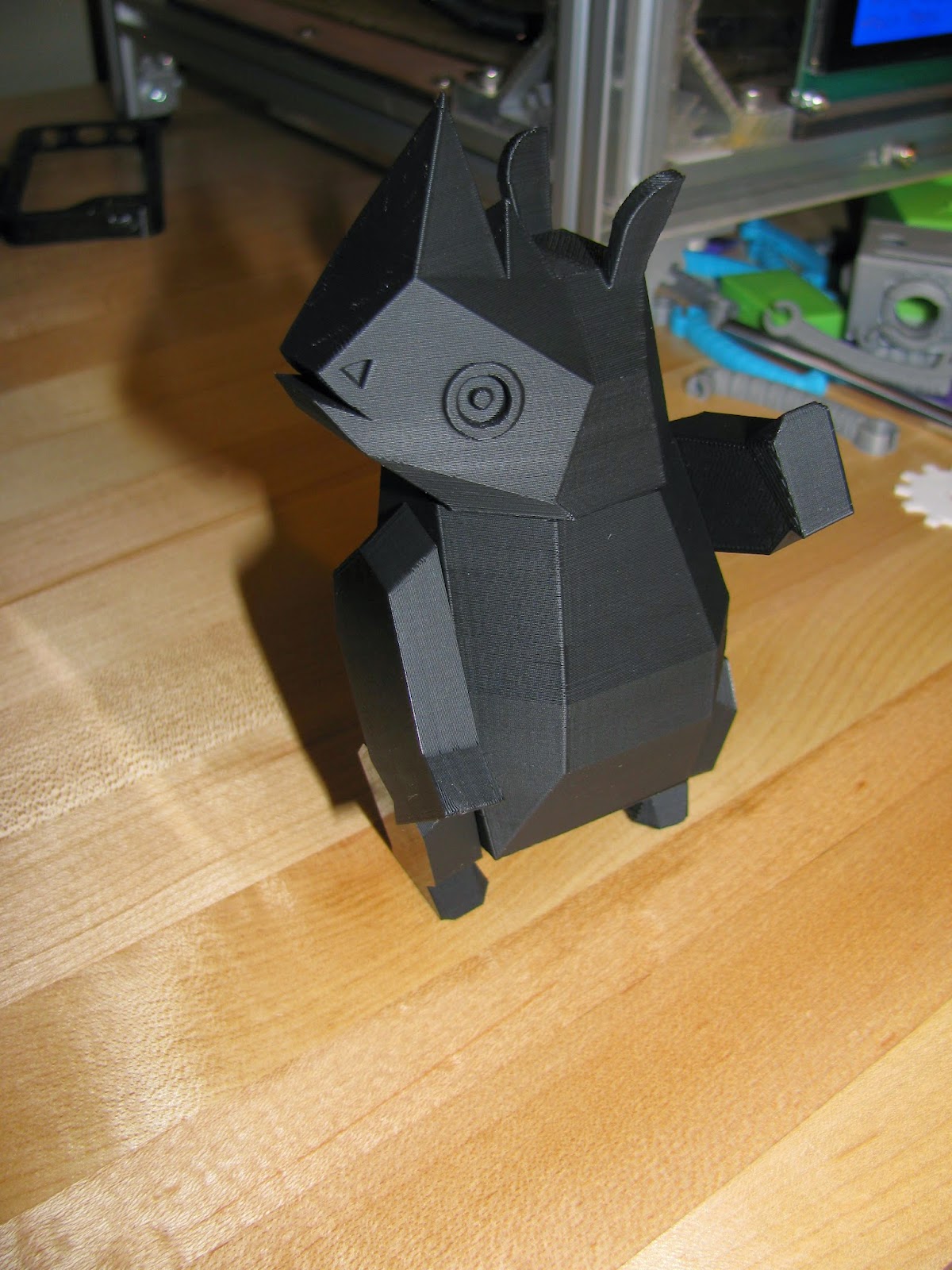
Ryan Carlyle

unread,
Apr 26, 2015, 3:41:39 PM4/26/15
to 3dprintertips...@googlegroups.com
On Sunday, April 26, 2015 at 12:02:33 PM UTC-5, David (SD3D) wrote:

Doesn't sound like there is anything you can really do on the mechanical side to reduce those surface effects without compromising on at least one other major factor. 

Well, you can build a machine to handle high accelerations (low mass / high stiffness), reduce corner speeds to a slow number, and utilize firmware with an extruder pressure advance function to take care of the lag blobbing. That seems to be a proven recipe.

I have to look really closely to see any corner defects on my CoreXY prints, and it's really not tuned "down" all that much. This is sharp polygon corners.

(make sure you zoom in, the picture compression creates some apparent moire patterns)


New3dGuy

unread,
Apr 26, 2015, 4:16:38 PM4/26/15
to 3dprintertips...@googlegroups.com
@JetGuy 

Are the Astrosyn 17RMDAMP Dampers being Stel & rubber Better then the Cork Style NEMA 17 Damper like these from Makergeeks also saw Rostock Damper kit NEMA 17 similar to the Astrosyn.

Assume that the Steel & Rubber are a Step up from the Cork...
  1. Nothing
  2. Cork
  3. Steel/Rubber
Also Figure Rubber Hardness/ Type will affect Damping Cabaility

Do you have a CloseUp picture of one of these mounted, cased on my reading looks like you bolt one flange to the motor the other to the frame/ structure.  so the motor does NOT directly bolt up to the frame/ structure as before.

Do you see vast improvement with using these ?? more quiet, smoother operations, anything ?

Jetguy

unread,
Apr 26, 2015, 4:31:13 PM4/26/15
to 3dprintertips...@googlegroups.com
Yes, they are extremely quiet, that's why I went to them.

Yes, they isolate the body of the motor- which is what vibrates- from the frame. I bought enough for every printer I own or plan to build in the near future.

Ryan Carlyle

unread,
Apr 26, 2015, 4:35:14 PM4/26/15
to 3dprintertips...@googlegroups.com
Good heavens, the Astrosyn dampers are AMAZING. In terms of noise reduction, I'd say cork is <20% and the Astrosyns are >50%. They also seem to reduce ringing and skipped steps. I don't want to say they're magical, but I no longer want to build printers without them. From what I understand, the hardness of the rubber is specifically tuned to the motor frame size typical torque range to provide good damping without adding too much flex.

Yes, they just go between the motor and whatever existing structural mount the motor used to be attached to. You'll need two short M3 screws (4-6mm or so) to attach the damper to the motor, then two existing mounting screws should fit to attach the damper to the printer. 

Alex Borro

unread,
Apr 26, 2015, 4:39:08 PM4/26/15
to 3dprintertips...@googlegroups.com

What about the spring effect these Astrosyn dampers induce in the system? I mean, when the motor applies torque to the belt it should flex a little bit since the dampers are quite flexible, doesn't it?

@Ryan, you told something about CoreXY bot I'm thinking about. The correctly tensioning of both belts. If one is more tight than the other, the X bridge get off square, I mean, not more perpendicular to Y axis. Any hint or do available for how to get it properly tightened? My main concern is long therm operation where the belts stretch (maybe one more than other).

Cheers

Alex

--

David (SD3D)

unread,
Apr 26, 2015, 4:48:33 PM4/26/15
to 3dprintertips...@googlegroups.com
Right, I'm familiar with that recipe. I was referring to anything further than that which could be designed into the mechanical system to make the settling period more favorable, allowing the machine to run higher jerk/accelerations cet par. As we discussed, moving to a rigid linear rail system would accomplish this, but those impulse forces would be transferred to the motor, frame and mounting brackets, potentially destroying the machine or significantly increasing the required maintenance frequencies. Obviously that is not a road we want to go down so I will be content with optimizing the CoreXY platform to its limitations. As you mentioned, an extruder pressure advance function will compensate for the slowdown at the corner and any additional potential gains in speed would likely be negligible to print times and surface quality anyway.  

Dan Newman

unread,
Apr 26, 2015, 4:57:47 PM4/26/15
to 3dprintertips...@googlegroups.com
On 26/04/2015 1:39 PM, Alex Borro wrote:
> What about the spring effect these Astrosyn dampers induce in the system? I
> mean, when the motor applies torque to the belt it should flex a little bit
> since the dampers are quite flexible, doesn't it?
>
> @Ryan, you told something about CoreXY bot I'm thinking about. The
> correctly tensioning of both belts. If one is more tight than the other,
> the X bridge get off square, I mean, not more perpendicular to Y axis. Any
> hint or do available for how to get it properly tightened? My main concern
> is long therm operation where the belts stretch (maybe one more than
> other).

The belts aren't going to measurably stretch.

The technique I use on a Core-XY is to move the carriage system all the way
to the front of the bot and see how close each end is to the inside of the frame.
When I first set things up, usually one end comes closer. (Actually hits the
inside front of the frame hardware). The other end still has a gap between
it and the frame. I then push the other end forward till it touches the frame
AND while holding it there, I identify which belt section now has a little slack.
That's the belt section which needs to be tightened. The clamps I use (courtesy
of Ryan) allow me to tighten an individual belt section in 2mm increments (by
advancing/retarding the belt section by one full tooth in the cleat).

The above works well for getting the belts "balanced".

Then there's the overall tightening. That I don't have good advice for. I've
done about 11 or 12 Core-XY's now and I just know what's approx. correct for
the design I've been using: not too tight, not too loose, just in the "goldilocks"
region. No good way to communicate it. (I suppose I could take my spectral
analyzer, twang them, and tell you the pitch.)

Dan

Alex Borro

unread,
Apr 26, 2015, 5:06:03 PM4/26/15
to 3dprintertips...@googlegroups.com

Thanks Dan. I have used similar procedure. Using something on the frame as reference and make the Y carriages aligned.

By the way, any pictures of this clamps provided by Ryan?

Cheers.

Alex.

Dan Newman

unread,
Apr 26, 2015, 5:16:34 PM4/26/15
to 3dprintertips...@googlegroups.com
On 26/04/2015 2:06 PM, Alex Borro wrote:
> Thanks Dan. I have used similar procedure. Using something on the frame as
> reference and make the Y carriages aligned.
>
> By the way, any pictures of this clamps provided by Ryan?

Alex,

See

http://www.thingiverse.com/thing:393155/#files

Look for "Belt_Clip_right_tensioning.stl" and a similar STL but "left".

Ciao,
Dan

Ryan Carlyle

unread,
Apr 26, 2015, 8:25:03 PM4/26/15
to 3dprintertips...@googlegroups.com
I also posted the clips on their own here, with a pic: http://www.thingiverse.com/thing:357660

Adjust belt positions in the clip notches to get it square, then push the clips inward for tensioning and tighten screws. Repeat as needed until the gantry is square to the frame.

Ryan Carlyle

unread,
Apr 26, 2015, 8:30:43 PM4/26/15
to 3dprintertips...@googlegroups.com
In theory, yes, the dampers add springiness to the drivetrain and SHOULD add error when torque changes significantly. But they don't add any error, as far as I can tell. My print quality improved slightly when I added them. I have various theories for that, mainly to do with splitting disturbance kinetic energy between two different resonant frequencies. Not sure if that makes sense or not though.

I don't think I'd use them in a CNC mill where forces are high, but eh, maybe they'd work there too if you get the gear reduction right. Gotta remember, the rotor itself has springiness, probably just as much as the damper if not more. It takes 0.2mm of error or so (one full step) before a stepper develops full torque. Nobody runs their 3D printers that hard.

CLine

unread,
Apr 27, 2015, 7:50:38 AM4/27/15
to 3dprintertips...@googlegroups.com
Another significant factor I haven't seen mentioned here is belt quality. In my experience the Chinese "GT2" belting sold by the meter on eBay and elsewhere is far stretchier than the American (Gates) and Japanese (SDP/SI) belts I now use.

New3dGuy

unread,
Apr 27, 2015, 10:00:28 AM4/27/15
to 3dprintertips...@googlegroups.com
That makes sense on the belt quality. Also have found out that when we source from china what we get today will not be the same we got last week or wht we will get next week. Their control is not there. Very inconsistent and drives us nuts. No material control process to follow. Remember they are still developing process and procedures. There is a reason why Made in USA costs more.

Ryan Carlyle

unread,
Apr 27, 2015, 12:26:16 PM4/27/15
to 3dprintertips...@googlegroups.com
I suspect a lot of "stretchy" belts might use something like aramid or nylon yarn rather than fiberglass. You definitely want fiberglass yarn.

Robert Bilbrey

unread,
Apr 27, 2015, 3:16:38 PM4/27/15
to 3dprintertips...@googlegroups.com
Rather than " pull and clamp " I plan to implement the gadgets in these screen shots whereby I can fine trim belt tension (GT2).

Ryan Carlyle

unread,
Apr 27, 2015, 3:40:46 PM4/27/15
to 3dprintertips...@googlegroups.com
That's a nifty little gizmo. You posting the files anywhere?

Robert Bilbrey

unread,
Apr 27, 2015, 5:26:37 PM4/27/15
to 3dprintertips...@googlegroups.com
Can do - where do you suggest, never having done so before other than privately.

New3dGuy

unread,
Apr 27, 2015, 5:53:00 PM4/27/15
to 3dprintertips...@googlegroups.com
Have to say that is a pretty ingenious little gizmo

holds the belt and allows you to adjust the tension as well !!  Very Nice

Ryan Carlyle

unread,
Apr 27, 2015, 8:35:50 PM4/27/15
to 3dprintertips...@googlegroups.com
Most people upload stuff to Thingiverse or YouMagine.

Robert Bilbrey

unread,
Apr 28, 2015, 1:55:28 PM4/28/15
to 3dprintertips...@googlegroups.com
Files now up on Thingyverse.

New3dGuy

unread,
Apr 28, 2015, 6:38:27 PM4/28/15
to 3dprintertips...@googlegroups.com
Do you have a picture of ONE installed 

would like to see how you are using them, and where you are bolting/ securing them to the printer/ structure

Jetguy

unread,
Apr 28, 2015, 9:56:56 PM4/28/15
to 3dprintertips...@googlegroups.com
Hey, thanks for posting that part. I do like it.

I'm just a bit curious how well it works at tensioning in situ.
My concern is the back side of a rubber belt, making a 90 corner (BTW, I do like that too in the design making it "universal" for both straight on and right angle) with the back of the belt scrubbing against the plastic might not let you tension the belt before the teeth deform??

I could be completely wrong about that, so please don't take that comment harshly.
Just saying, I would tug on the belt to hand tighten it while tensioning the screw adjuster so as to help it out in a right angle situation. Straight on belt pull probably no big deal.

Robert Bilbrey

unread,
Apr 29, 2015, 1:01:12 PM4/29/15
to 3dprintertips...@googlegroups.com
The key is in making the clearances " just snug enough" for a close slip fit to mitigate deformation and rubber extrusion.  I hung a 20 pound pull cell for an hour with no noticeable effect ( a short loop of belt producing 10 pounds per side ).  You sure don't want that much tension in any GT2 system.
Also tested a belt smoothside liner of PTFE pipe tape to minimize friction around the bends.  I couldn't notice a difference but didn't do any real measurements - ABS is pretty slippery.
Reply all
Reply to author
Forward
0 new messages