
Worm gear pump extruder
545 views
Skip to first unread message

Ryan Carlyle
May 23, 2016, 3:52:59 PM5/23/16
to 3dp-...@googlegroups.com
Background before I introduce the idea:
- Screw extruders are well-understood, can plasticize pellets, and can deliver high flow rates. BUT, they don't have positive volume control. Flow rate is a function of nozzle/die backpressure. Retraction is difficult. A large-format screw extruder printer like the PartDaddy or the BAAMCI is very much a custom-tuned system.

- Gear pumps are often used for flow-rate-critical polymer extrusion. It's not unusual in the extrusion industry to use a melting/plasticizing screw to feed the gear pump, and the gear pump does positive-displacement volume control. The big problem with gear pumps for our purposes (low-cost 3d printing) aside from screw+pump system complexity is drive shaft sealing. Elastomers don't hold up well at this temp and pressure. High-cost industrial polymer melt gear pumps do fancy stuff like cut spiral grooves on the drive shaft to act as a mini-screw and dynamically contain the internal pressure. That's not really cost-effective for us.

- Intermeshing double-screw or triple-screw extruders have positive displacement characteristics, but for plasticizing/melting pellets, they need a carefully-calibrated amount of air in each trapped screw flight to allow for thermal expansion. They also require extreme fabrication precision, synchronization gears, fancy bearings, etc. Not a great solution for us.

I want a way to get the best features of these without the downsides. And what do you get when you combine a gear and a screw? A worm gear!

Imagine feeding pellets at one end of the screw (like a standard single-screw extruder) for plasticizing and melting. Then the extruder screw drives an idler worm gear that sits in a captive bushing pocket. As the screw turns and meshes with the gear, that creates 1-2 trapped flights on the screw. (Similar to a very short double-screw extruder.) This positive displacement action should create good volume control. No external drive shaft or sync gearing required: the screw will drive the gear, and the gear makes the screw a positive displacement pump.
The first big problem I see with this is the fact that the gear conveys plastic in the opposite direction of the screw. If the screw is spinning to push plastic in one direction, a smaller amount of plastic is being carried back the other way between the gear teeth. You'll still get net-forward flow with good volume control (because the volume of one screw flight is more than the volume in one gear tooth gap) but it's inefficient and you may get material degradation if the plastic recirculates too long.
You can imagine solutions with additional gears to clean the plastic off the primary worm gear. I think this would work, but it could cause foaming or vacuum boiling issues as the evacuated teeth rotate back around to the inlet. You may need to vent the "empty" side of the gears back to the screw's initial melting region or something. There will also be a little bit of flow pulsing as the "empty" teeth rotate back into the pressure cavity. (More on that later.)

The second big problem is the unbalanced forces on the screw. The worm gear's reaction forces will push the screw away from the gear. That would rub the screw on the barrel and introduce wear/friction issues. We're just hobbyists, so it would be really nice to avoid high-tech things like polymer-lubricated support bearings on the discharge end. Plus, like any typical screw extruder, we'll obviously need large thrust bearings to resist the pressure generated. It's just a lot of reaction force to handle.
Many double or triple screw pumps use a two-sided opposing feed to axially balance the shaft forces:
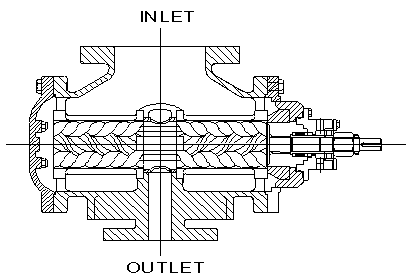
Because the outlet is in the middle and the inlets are on the outside, the axial screw forces produced by pressure are resisted by tension in the shaft. There's no risk of buckling because there's no compression/thrust loads. It's very stable.
We can do something similar to balance our worm gear pump. First, put worm gears on either side of the screw to balance the side-load forces. (This version would recirculate some plastic around the gears.) How is this better than a regular gear pump? Firstly, it doesn't require a separate screw unit and a pump unit -- it's integral. And second, you don't need a gear driveshaft, because the drive power is coming in from the cool solid feed end via the screw rotation.

Then, incorporate two opposing screws. This can use the same concept as the "cleaner gear" above, but with both gears driven and meshing. The opposing screws will be clocked 180 degrees out of phase so the adjacent gears will mesh. Then the opposing gears obviously must be clocked 180 degrees out of phase because they're on opposite sides of the same screw. This helps resolve the flow pulsing issue from the cleaner-gear concept: while one empty tooth gap is filling, the opposite gear tooth is entering the pressure cavity. I THINK that'll cancel out to produce relatively even flow.

So, in total, we have:
- The melting/plasticating of a single- screw extruder with good positive-displacement flow characteristics of a gear pump, in one unit
- Balanced loads so the screw is easily supported (if you don't mind the whole thing being very long...)
- No shaft seals required, all drive torque comes from the cool solid feed region outside the pressure zone

Ben Holmes
May 23, 2016, 7:05:05 PM5/23/16
to Ryan Carlyle, 3DP Ideas
I guess the other option is to have a properly balanced custom tuned system like option one above. I think that is primarily what the felfil people are attempting to do (http://felfil.com/). I've got one coming in the next couple months so I'll provide my report.
Ben
--
You received this message because you are subscribed to the Google Groups "3DP Ideas" group.
To unsubscribe from this group and stop receiving emails from it, send an email to 3dp-ideas+...@googlegroups.com.
To post to this group, send email to 3dp-...@googlegroups.com.
To view this discussion on the web visit https://groups.google.com/d/msgid/3dp-ideas/85dfc72b-be18-49a0-bd2f-126f5d7fe5ad%40googlegroups.com.
For more options, visit https://groups.google.com/d/optout.
Reply all
Reply to author
Forward
0 new messages