
Thoughts on pellet extruders
683 views
Skip to first unread message

Ryan Carlyle
Jul 5, 2015, 12:45:47 PM7/5/15
to 3dp-...@googlegroups.com
I've been reading up on injection-molding and plastic profile extruding lately. Lots of interesting things going on there.
I'm going to make a simple and factual statement: pellet screw-augers suck for 3D printing. You know why? They're not positive-displacement pumps. They're drag-flow pumps or viscosity pumps: they generate pressure via viscous shear roughly in proportion to screw speed and melt viscosity. And they're extremely laggy: after changing screw speed, the new pressure establishes asymptotically over a period of many seconds because of melt backflow up the screw threads. Nozzle back-pressure causes recirculating flow through the screw channels. Also, the melt-front (between pellets and liquid) moves around as you change flow rate, because of different amounts of shear-work heating and residence time. All of that plays hell with your volume control.


This diagram shows how the actual flow at steady state is the intersection of the die/nozzle back-pressure curve and the screw's forward-pressure curve. Both these curves are typically non-linear and move around when you change screw speed, because the shear history affects the material viscosity.
Screws are good for constant-rate extrusion. But you can't print anything more complex than a spiral vase at constant flow rate. The concept of a plain-jane single-screw pellet extruder is a dead-end for 3D printing control. The underlying physics don't support the concept.
One possible approach to overcome the flow issues is to use a screw as a pressure-generation device and then use a flow-control valve to control extrusion rate. This is just insanely complex though:
- High-temperature valve stem seals and actuators aren't cheap or easy to build
- Dynamic screw pressure is insanely difficult to calculate, so pressure feedback control over screw speed will almost certainly be required, which means a high-temp, high-pressure, high-viscosity pressure transducer is required (eg a grease-packed pressure probe from the injection molding industry)
- Even with a pressure transducer, the speed/pressure relationship for the screw is laggy and sometimes reverses altogether due to shear-dependent melt-rate and viscosity effects, so a simple PID algorithm is unlikely to perform well
- Even if we do manage really good pressure control, polymer viscosity is still a function of recent shear history, so flow through the rate-control valve is NOT going to be a simple function of pressure and valve position... it'll also have its own non-linear time dependence on recent screw speed
- Dead-flow or low-flow conditions tend to cause localized work-overheating in screw extruders due to high material shear, so multi-zone barrel COOLING may be required in addition to barrel heating
When you start adding up all this equipment and control complexity, it gets impractical fast. It might make sense for a $100k industrial machine, but it's never going to be economical for a typical user to save money on filament. It also probably ties you to an XYZ moving bed and stationary extruder. That's going to be impractical for extra-large-format printing, which is the primary value proposition for pellet extruders in the first place.
In comparison, the huge advantage of a filament-pushing extruder is that it's very nearly a positive-displacement pumping device. Aside from a small amount of shear elasticity (eg drive gear bite pitch changing with applied force) and a small amount of flow rate lag, it's extremely efficient at converting motor motion to flow. Filament-pushing extruders are almost perfectly linear (speed=k*flow) at low speeds and only start to significantly deviate from linearity (eg >15% error) and lose efficiency when pushed beyond the practical grip strength of the hob.
This positive-displacement behavior is critical to effective volume control. So a practical pellet extruder needs some kind of positive-displacement pump action.
The injection-molding industry has two main types of positive-displacement pump:
Dual-screw pumps

The benefit to the dual screw pump is that it can serve as both the liquefier (melting+shearing pellets) and the metering pump device. The two screws produce a progressing cavity with fixed displacement. But the density of the material changes along the length of the screw, first increasing density via eliminating interstitial air between pellets and then decreasing density via thermal expansion, so some air must be included in each screw cavity to allow for expansion/contraction effects. The amount of ingested air will depend on running speed and other conditions. It's actually possible to over-fill the screw and cause it to burst due to thermal expansion, so pellet feed itself must be metered. Basically, dual-screw pumps require a lot of rate-dependent flow/fill tuning and additional feed-control equipment. That's not very practical for what we're doing.
Gear pumps
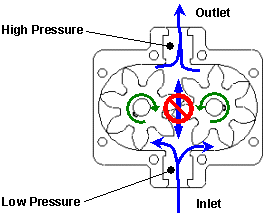
Gear pumps are small and simple. They're very common in industrial hydraulics and are very efficient (meaning linear displacement/speed relationship) with high-viscosity fluids. Industrial plastic extrusion systems often put a gear pump between the nozzle/die and a single-screw auger as both a primary flow control device and means of buffering/isolating pressure effects. So screw pressure changes are prevented from affecting nozzle flow. This is pretty much the ideal positive-displacement pump for 3D printers.
Downside is, gear pumps cannot liquefy the pellet feed. They require an external boost device to provide adequate melt pressure at the inlet. So you need a simple screw-auger to feed the gear pump. That screw auger will require some sort of basic speed control to keep up with the gear pump flow without over-shearing the material during low-flow conditions. But I think that could be handled via a simple speed control function, such as setting a low no-flow speed and then adding a linear increase in screw speed with higher flow requirements. The pressure generation lag is less critical here because the gear pump is controlling take-off flow from the screw, and inlet pressure to the pump can vary significantly without major issues.
In theory, a gear pump should also be able to do retraction much better than they kind of screw-based system. Probably. It might take a lot of torque to back-flow against the boost screw.
I'm imagining buying used/surplus gear pumps from the plastic extrusion industry, and retrofitting them onto a 3D printer. I really like the idea of making the hopper+screw stationary and putting the gear pump on an extruder carriage, but I'm not entirely sure if any high-conductivity tubing will be practical to connect the two with a flex-loop. The tubing between the gear pump and screw will need to be heated fairly precisely to keep the "boost" plastic liquid. Which could mean insulated thick-wall copper tubing and electric heaters (so conductivity keeps the temperature steady) or it could mean a hot oil circulating system. The length of tubing required to prevent fatigue is probably impractical. So that means an XYZ moving-bed approach is probably required.

dan...@puptv.com
Jul 5, 2015, 1:21:29 PM7/5/15
to 3dp-...@googlegroups.com
Actually there are a number of other pump styles that may prove worthwhile.
The first to consider is Rene Moineau's Progressive Cavity Pump:
https://en.wikipedia.org/wiki/Progressive_cavity_pump
Another source of pumps to consider is:
http://www.pumpfundamentals.com/pump_glossary.htm
The lode pumps are very much like the gear pump, but it seems as though the 3 rounded toothed version might work much better for high viscosity liquids.
--
Meanwhile, there is one other way a single screw extruder could work with 3d printing. Although it has one more step of complexity.
A single screw extruder works well in one direction at a nearly constant speed... so, let's let it do that.
Meanwhile route the filament output of the extruder through a loop, and then to a normal 3d printer. This then gives the printer full control for immediate retractions, etc. The big benefit is that you now have an endless source of inexpensive filament!
The loop:
The loop is used to control the relative speed of the two systems. If the loop gets large, slow the pellet extruder down or speed up printing. If the loop gets small, slow down printing or speed up pellet extrusion.
Daniel - http://www.TriDPrinting.com/
The first to consider is Rene Moineau's Progressive Cavity Pump:
https://en.wikipedia.org/wiki/Progressive_cavity_pump
Another source of pumps to consider is:
http://www.pumpfundamentals.com/pump_glossary.htm
The lode pumps are very much like the gear pump, but it seems as though the 3 rounded toothed version might work much better for high viscosity liquids.
--
Meanwhile, there is one other way a single screw extruder could work with 3d printing. Although it has one more step of complexity.
A single screw extruder works well in one direction at a nearly constant speed... so, let's let it do that.
Meanwhile route the filament output of the extruder through a loop, and then to a normal 3d printer. This then gives the printer full control for immediate retractions, etc. The big benefit is that you now have an endless source of inexpensive filament!
The loop:
The loop is used to control the relative speed of the two systems. If the loop gets large, slow the pellet extruder down or speed up printing. If the loop gets small, slow down printing or speed up pellet extrusion.
Daniel - http://www.TriDPrinting.com/
Ryan Carlyle
Jul 5, 2015, 2:54:59 PM7/5/15
to 3dp-...@googlegroups.com, dan...@puptv.com
Yeah, there are multiple types of PD-pumps that could potentially be used, but I think the gear pump is the best option.
- Moineau pumps have the same disadvantages as double-screw pumps in terms of varying melt density as the cavity travels, so they can't be used as liquefiers. Plus they're dramatically more complex to fabricate and typically use elastomeric stator elements which won't survive at our service conditions. An all-metal stator design is just idiotically expensive to fabricate for this application. (Complex five-axis CNC contouring on an inside diameter.) A two-screw pump will always be cheaper and easier to make and has equivalent performance for non-solids-carrying fluids.
- Lobe pumps require external synchronization gearing and two drive shafts, so you might as well use a gear pump that is inherently synchronized and only needs one drive shaft. (Remember, each drive shaft on the pump requires viscosealing with its own miniature screw mechanism, and typically water-cooling to get the viscosity high enough to prevent leakage.) The reduced material shear and solids tolerance of the lobe pump aren't real beneficial here. Might be better option for filled composite filaments though.
- Peristaltic pumps require elastomeric tubing and don't tolerate high temperatures or pressures.
- Piston pumps rely on check valves and have flow pulsation issues, along with serious piston sealing challenges. This includes axial piston, triplex, swashplate, etc.
- Vane pumps don't typically do well with high-viscosity fluids or slow rotation rates because they rely on high speed (centrifugal force) to push the vanes against the housing.
- Diaphragm pumps don't generate anywhere near enough pressure, rely on elastomers, and don't actually have fixed displacement per stroke.
A gerotor is a viable option, but I think the clearances and machining and sealing around the outer gear will be less favorable (read: higher cost) than the standard gear pump design. Gerotors tend to work best with self-lubricating fluids like oils. Might work though.
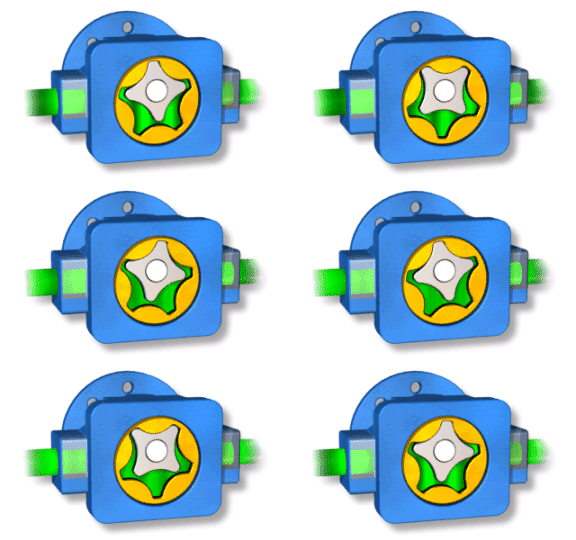
In the end, I think there's probably a mix of good reasons why gear pumps are used in the industrial sector for this exact molten-plastic service environment.
Ryan Carlyle
Nov 27, 2015, 10:40:04 PM11/27/15
to 3DP Ideas
This is an intriguing patent.


The conical logarithmic spiral viscosity pump design is well suited for pumping applications where small size, high pressure, valveless, and gasketless operation are important. Examples include:
pumping grease or other lubricants through a mechanical system;
injection molding;
high temperature pumping of plastics, tars, and waxes;
liquid chromatography analysis;
hydraulic power conversion;
deposition of molten metal alloys and composites.
In addition to the properties that the pump can generate high pressure at high temperature, the design also has very low pressure fluctuation (unlike gearpumps). It can change pressure very quickly, allowing the flow rate to track with other variable such as the velocity of an extruding nozzle. The mass is low enough (due to the small size) that the pump itself can be mounted at the depositing nozzle of a robotic system.
So... possibly rather ideal as an intermediate flow control pump between a screw-liquefier stage and a 3d printer nozzle. This looks like something that a CNC lathe could make without too much difficulty.
As an aside, this is a great example of the best kind of patent -- thoroughly explains the concept, includes performance data, and provides design equations for implementation. And, most importantly, it's expired :-)

ekaggrat singh kalsi
Nov 28, 2015, 10:01:47 AM11/28/15
to 3DP Ideas
Wont it be possible to get shapeways to print one in metal, or would the finish be to rough for this application?
Ryan Carlyle
Nov 28, 2015, 11:38:36 AM11/28/15
to 3DP Ideas
Hmm, good idea, maybe it could be printed in metal and then honed smooth by hand in a drill or something.
ekaggrat singh kalsi
Nov 29, 2015, 10:44:25 PM11/29/15
to 3DP Ideas
i think a start point would be to build a paste extruder to validate that the concept works at this scale.
Ryan Carlyle
Nov 30, 2015, 4:34:39 PM11/30/15
to 3DP Ideas
Hmm yeah not a bad idea.
Will need to figure out a reasonable way to model a logarithmic spiral on a cone...

whosawhatsis
Nov 30, 2015, 4:37:58 PM11/30/15
to Ryan Carlyle, 3DP Ideas
OpenSCAD makes that kind of thing easy. It's just math. Sure, it's not the easiest thing to go from an OpenSCAD design to machining, but if the idea is to direct metal print the piece, it's not a problem.
On Monday, November 30, 2015 at 13:34, Ryan Carlyle wrote:
Hmm yeah not a bad idea.Will need to figure out a reasonable way to model a logarithmic spiral on a cone...
--You received this message because you are subscribed to the Google Groups "3DP Ideas" group.To unsubscribe from this group and stop receiving emails from it, send an email to 3dp-ideas+...@googlegroups.com.To post to this group, send email to 3dp-...@googlegroups.com.To view this discussion on the web visit https://groups.google.com/d/msgid/3dp-ideas/4f1d680c-a386-4d2c-b069-28f0176c0fee%40googlegroups.com.For more options, visit https://groups.google.com/d/optout.
Ryan Carlyle
Nov 30, 2015, 5:02:04 PM11/30/15
to 3DP Ideas
Well, there's "Boolean some primitives" easy and there's "decompose a complex 3D shape into a series of non-linear equations" easy. Not exactly an "intro to OpenSCAD" level project, I don't think. Wouldn't mind being proven wrong if you want to take a stab at it though...?
whosawhatsis
Nov 30, 2015, 5:49:56 PM11/30/15
to Ryan Carlyle, 3DP Ideas
For me, the hardest part is deciding whether to build it on top of the screw ahead script I just wrote (which would be easier for me, but harder to comprehend) or to do it the "intro to openscad" way.
On Monday, November 30, 2015 at 14:02, Ryan Carlyle wrote:
Well, there's "Boolean some primitives" easy and there's "decompose a complex 3D shape into a series of non-linear equations" easy. Not exactly an "intro to OpenSCAD" level project, I don't think. Wouldn't mind being proven wrong if you want to take a stab at it though...?
--You received this message because you are subscribed to the Google Groups "3DP Ideas" group.To unsubscribe from this group and stop receiving emails from it, send an email to 3dp-ideas+...@googlegroups.com.To post to this group, send email to 3dp-...@googlegroups.com.
To view this discussion on the web visit https://groups.google.com/d/msgid/3dp-ideas/1b152330-29b1-4fce-a85d-b6e60a4fd1e9%40googlegroups.com.
Ryan Carlyle
Nov 30, 2015, 6:20:05 PM11/30/15
to 3DP Ideas
Either's fine by me if you actually do it :-)
Make sure you check the patent description, the IBM guys claim there's some pretty specific geometry you want to hit.
On Monday, November 30, 2015 at 4:49:56 PM UTC-6, Whosa whatsis wrote:
For me, the hardest part is deciding whether to build it on top of the screw ahead script I just wrote (which would be easier for me, but harder to comprehend) or to do it the "intro to openscad" way.On Monday, November 30, 2015 at 14:02, Ryan Carlyle wrote:
Well, there's "Boolean some primitives" easy and there's "decompose a complex 3D shape into a series of non-linear equations" easy. Not exactly an "intro to OpenSCAD" level project, I don't think. Wouldn't mind being proven wrong if you want to take a stab at it though...?--You received this message because you are subscribed to the Google Groups "3DP Ideas" group.
To unsubscribe from this group and stop receiving emails from it, send an email to 3dp-ideas+unsubscribe@googlegroups.com.
whosawhatsis
Nov 30, 2015, 6:28:25 PM11/30/15
to Ryan Carlyle, 3DP Ideas
Not having looked at the patent description or any of the numbers (just solving the "how to model a logarithmic spiral on a cone" problem for now), here it is in OpenSCAD. I chose the "intro to OpenSCAD method, which isn't as clean (and is much slower to render), but will allow you to get in there and play with the values more easily.
e = 2.71828;
a = 1;
b = .002;
step = .2;
difference() {
cylinder(r = 100, r1 = 0, h = 100);
for(r1 = [0:step:100]) hull() for(r = [r1, r1 + step], theta = 1/b * ln(r/a)) rotate(theta) translate([r, 0, r]) rotate([0, 45, 0]) rotate(74) cube([.1, r/3, r/3], center = true);
}
To unsubscribe from this group and stop receiving emails from it, send an email to 3dp-ideas+...@googlegroups.com.
To view this discussion on the web visit https://groups.google.com/d/msgid/3dp-ideas/b7df5e6b-3f54-442d-acc6-3e3d608d7b2e%40googlegroups.com.
Ryan Carlyle
Nov 30, 2015, 6:38:54 PM11/30/15
to 3DP Ideas
Not too shabby :-)
ekaggrat singh kalsi
Nov 30, 2015, 7:33:36 PM11/30/15
to 3DP Ideas
sorry for my bad math. is it a standard log spiral on a cone? i can model that easily in grasshopper/python
On Tuesday, December 1, 2015 at 7:38:54 AM UTC+8, Ryan Carlyle wrote:
Not too shabby :-)
On Monday, November 30, 2015 at 5:28:25 PM UTC-6, Whosa whatsis wrote:
Not having looked at the patent description or any of the numbers (just solving the "how to model a logarithmic spiral on a cone" problem for now), here it is in OpenSCAD. I chose the "intro to OpenSCAD method, which isn't as clean (and is much slower to render), but will allow you to get in there and play with the values more easily.e = 2.71828;a = 1;b = .002;step = .2;difference() {cylinder(r = 100, r1 = 0, h = 100);for(r1 = [0:step:100]) hull() for(r = [r1, r1 + step], theta = 1/b * ln(r/a)) rotate(theta) translate([r, 0, r]) rotate([0, 45, 0]) rotate(74) cube([.1, r/3, r/3], center = true);}On Monday, November 30, 2015 at 15:20, Ryan Carlyle wrote:
Either's fine by me if you actually do it :-)
Make sure you check the patent description, the IBM guys claim there's some pretty specific geometry you want to hit.
On Monday, November 30, 2015 at 4:49:56 PM UTC-6, Whosa whatsis wrote:
For me, the hardest part is deciding whether to build it on top of the screw ahead script I just wrote (which would be easier for me, but harder to comprehend) or to do it the "intro to openscad" way.On Monday, November 30, 2015 at 14:02, Ryan Carlyle wrote:
Well, there's "Boolean some primitives" easy and there's "decompose a complex 3D shape into a series of non-linear equations" easy. Not exactly an "intro to OpenSCAD" level project, I don't think. Wouldn't mind being proven wrong if you want to take a stab at it though...?--You received this message because you are subscribed to the Google Groups "3DP Ideas" group.
To unsubscribe from this group and stop receiving emails from it, send an email to 3dp-ideas+...@googlegroups.com.
To post to this group, send email to 3dp-...@googlegroups.com.To view this discussion on the web visit https://groups.google.com/d/msgid/3dp-ideas/1b152330-29b1-4fce-a85d-b6e60a4fd1e9%40googlegroups.com.For more options, visit https://groups.google.com/d/optout.
--
You received this message because you are subscribed to the Google Groups "3DP Ideas" group.
To unsubscribe from this group and stop receiving emails from it, send an email to 3dp-ideas+...@googlegroups.com.
Ryan Carlyle
Nov 30, 2015, 8:44:39 PM11/30/15
to 3DP Ideas
The patent details explain it in words and equations, I think the underlying goal is to keep the thread angle constant with respect to the rotational axis of the screw. The log spiral is just how you get there on a cone surface. (I guess. I haven't spent the time to wrap my head around the math yet.)
Reply all
Reply to author
Forward
0 new messages