
Re: USA Africa Dialogue Series - The Revolution Won’t Start from the North—Or Anywhere
3 views
Skip to first unread message

OLAYINKA AGBETUYI
May 11, 2019, 9:25:52 AM5/11/19
to usaafric...@googlegroups.com
While I share the optimism if this writer in theory that a revolution might right old wrongs allow the nation start on a clean slate, the realities of a revolution may be fractious judging from past global experience and Nigeria's past experience I.e.
logistics of a revolution.
Authorities will not idly stand by while the vanguard mobilises. I can't imagine the country of the writers domiciliation standing by and watching a revolution succeed in Nigeria. Half way through its success or during its nascent stage the new administration
will be forced on its knees by American led sanctions.
OAA
Sent from my Samsung Galaxy smartphone.
-------- Original message --------
From: "Farooq A. Kperogi" <farooq...@gmail.com>
Date: 11/05/2019 05:30 (GMT+00:00)
To: USAAfrica Dialogue <usaafric...@googlegroups.com>
Subject: USA Africa Dialogue Series - The Revolution Won’t Start from the North—Or Anywhere

 This message is eligible for Automatic Cleanup! (
Saturday, May 11, 2019
The Revolution Won’t Start from the North—Or Anywhere
By Farooq A. Kperogi, Ph.D.
Twitter: @farooqkperogi
Northern Nigeria’s cascading descent into the abyss of anarchy, particularly with the ongoing indiscriminate abductions of moneyed aristocrats in the region, has stimulated a flurry of prognostications that “the revolution” will start
from there; that it foretells the nascence of a revolt from below; that the forgotten, despised, and hungry almajirai are striking back. That’s wishful, erroneous thinking.
The emerging picture of the demographic profiles of the kidnappers that have been tormenting northern Nigeria does not square with the image of distraught, economically disaffiliated almajirai. They are former herders, from within
and outside Nigeria, who have lost their cattle for any number of reasons, and who have taken to mindless, avaricious, and self-interested banditry. Anyone who expects the seeds of a revolution to sprout from the thoughtless brigandage of these sorts of insensate
philistines must be clueless about what revolution entails.

Disparate strands of resentments might coalesce into a mass resistance, then blossom into a protest, and culminate in a rebellion without ever achieving the status of a revolution. In a revolution, a vanguard takes ownership of the rebellion
and uses it as a ladder to climb to substantive power. The kidnappings in the far north are not a mass resistance. Nor are they a self-conscious, systematic protest, or even a rebellion. So they have not a snowball’s chance in hell of ever transforming into
a revolution.
The northern hoi polloi who bear the real brunt of Buhari’s cruelly strangulating and escalating incompetence won’t resist, protest, rebel, much less revolt, because they have been socialized into accepting their economic suffering with
equanimity. The only thing that rouses their passions, that animates them to mindless violence, is religion.
You can smolder the Northern masses with economic asphyxiation, as Buhari is doing now, and they would make peace with their fate with listless acquiescence, but blaspheme their religion, or even icons of their religion, and they would
rise up in arms and murder indiscriminately. Appeals to religion is the easiest way to ignite the raw emotions and solidarity of the northern masses. The region’s elite know that intimately and habitually exploit it to perpetuate themselves in power.
With a few honorable exceptions, the region’s clerical elites, known as the Ulama, are in bed with the political elites to keep the masses perpetually in a state of suspended animation. Amid the inexorably intensifying breakdown of security
in the region, compromised clerical elites are also intensifying fraudulent theological rationalizations for the rise of kidnappings— and, of course, exculpating Buhari of responsibility for this.
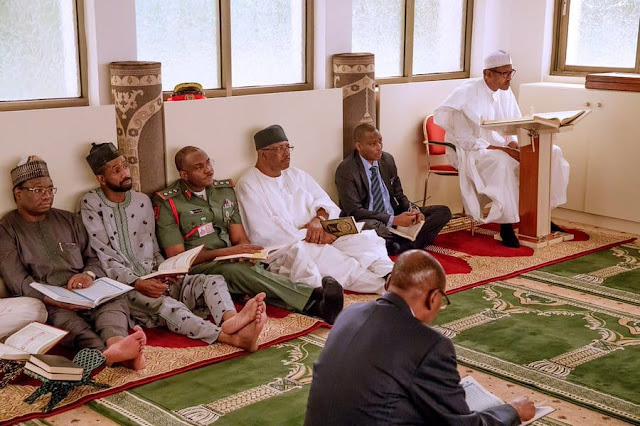
Many people were scandalized when the Chief Imam of the Presidential Villa, Sheikh Abdulwaheed Sulaiman, was
reported to have said, on May 8, that the widening and deepening of insecurity in the North was a “test from God.” The imam didn’t implore Buhari, who sat by him, to devise creative ways to contain the insecurity that has made people prisoners in their
homes; he instead shifted the burden to the very people who are traumatized by a problem that is aggravated by the president’s incompetence. He beseeched beleaguered Northerners “for repentance and prayers to avert the current security challenges confronting
the nation.”
The Aso Rock Imam’s exasperatingly bald-faced theological fraud is unfortunately the template the vast majority of the Ulama in Northern Nigeria deploy when they protect leaders who feather their nests. And it’s intended to keep the masses
in check and to anesthetize them into not just accepting the incompetence of their leaders as an inescapable divine design but to bear responsibility for it.
In other words, Northern masses are fed the sterile, mendacious theological staple that the avoidable tragedies that befall them are not the consequence of the ineptitude of their leaders but a product of divine punishment for the iniquities
of the masses. So in addition to the trauma of living with the disabling dysfunctions created by their elites, they are blackmailed by cold, calculating, conscienceless clerical aristocrats into internalizing moral guilt for their conditions.
My good friend Sheikh Dr. Ali Isa Pantami is now the object of Twitter attacks by young educated northerners who remind him that his cold detachment from the horrors that afflict northern Muslims today is such a disconcerting contrast
from his erstwhile persistent, shrill, and lachrymose attacks on former President Goodluck Jonathan from his pulpit. In a widely circulated audio tape, he tearfully told Jonathan that, as president and commander-in-chief, he should take responsibility for
the daily mass murders of Muslims in the North.
Today, more Northern Muslims are dying and being violently kidnapped than at any time in Nigeria’s entire history, but Sheikh Pantami hasn’t placed the blame for this on Buhari in whose government he now works as DG of NITDA. He defended
his curious silence by pointing out that because he has access to the president, he routinely reminds him, in private, of his responsibility to secure the lives of people he swore to protect.
I don’t doubt the Sheikh whom I have known to be an embodiment of righteousness and honor. Nevertheless, he has rendered himself vulnerable to charges of weak convictions. It means, at best, that his earnest, impassioned harangues against
Goodluck Jonathan were actuated by his lack of access to the man. In other words, if he had had access to Jonathan, as he does to Buhari now, he wouldn’t have expressed any public outrage over the mass murders of Muslims in the North.
While that reality diminishes his moral standing, I can understand it. Access to people in the corridors of power tends to blunt revulsion toward them. That is why people who want to stay true to their convictions should avoid dalliance
with wielders of power. Power does not brook opposition within its reaches; it coopts, contaminates, or neutralizes.
Since 2016, at least three prominent people have arranged a meeting between Buhari and me, and I politely declined. I also refused to speak with Atiku Abubakar and spurned his emissary’s invitation to meet with him when he visited the
United States in January 2019. I make no claims to being an unblemished, nonpareil moral superior, but nothing is more important to me than my independence of thought. When you gain privileged access to people in power whose feet you hold to the fire, you
can’t sustain your independence because they will strategically coopt and silence you.
Now, if the revolution can’t come from the North because the masses of the people there are under the grip of a corrupt clerical establishment, is there hope from other parts of the country? None that I can see. Much of the rest of Nigeria
is beset by a different iteration of the same problem in the North.
The deeper the nation descends into the nadir of despair, the more fatalistic, superstitious, and pre-scientific many people tend to become. Nigerian Christian Pentecostalism has particularly predisposed many people in the South to believe
that they can “pray” all their problems away, that they don’t need to take their destinies into their own hands. It’s akin to what anthropologists call cargo cult mentality, that is, the superstitious belief, first recorded among pre-modern tribes in Melanesia,
that all the goodies of this world will magically and effortlessly appear because people wish it into existence through staid rituals.
That’s not the way the world works. Any society where the vast majority of the people recoil in fatalistic resignation while their oppressors have a field day will be stuck in protracted infancy. Revolutionary tremors are good for every
society every once in a while.
Farooq A. Kperogi, Ph.D.
Associate Professor
Journalism & Emerging MediaSchool of Communication & Media
Social Science Building
Room 5092 MD 2207
402 Bartow Avenue
Kennesaw State University
Kennesaw State University
Kennesaw, Georgia, USA 30144
Cell: (+1) 404-573-9697
Personal website: www.farooqkperogi.com
Cell: (+1) 404-573-9697
Personal website: www.farooqkperogi.com
Twitter:
@farooqkperogi
Author of
Glocal English: The Changing Face and Forms of Nigerian English in
a Global World
"The nice thing about pessimism is that you are constantly being either proven right or pleasantly surprised." G. F. Will
"The nice thing about pessimism is that you are constantly being either proven right or pleasantly surprised." G. F. Will
Listserv moderated by Toyin Falola, University of Texas at Austin
To post to this group, send an email to USAAfric...@googlegroups.com
To subscribe to this group, send an email to USAAfricaDial...@googlegroups.com
Current archives at http://groups.google.com/group/USAAfricaDialogue
Early archives at http://www.utexas.edu/conferences/africa/ads/index.html
---
You received this message because you are subscribed to the Google Groups "USA Africa Dialogue Series" group.
To unsubscribe from this group and stop receiving emails from it, send an email to usaafricadialo...@googlegroups.com.
To view this discussion on the web visit https://groups.google.com/d/msgid/usaafricadialogue/CAPq-FWuXwLKVY6BpQbu9CxnbTN8WS_LHjik%2BeVFUtYEV6DApdw%40mail.gmail.com.
For more options, visit https://groups.google.com/d/optout.

Adeshina Afolayan
May 11, 2019, 10:11:21 AM5/11/19
to usaafric...@googlegroups.com
I quite agree. The occurrence of a revolution happening is not something that could be subjected to analyses. There are so many revolutionary moments that had bypassed so many societies including Nigeria. If and when the revolution will occur, it will be spontaneous and there is no mapping of its depth and reach. We cannot even say, as Kperogi did, that certain segments of the society would not be able to jumpstart it. Who could have predicted that Bouazizi would have the strength for self-immolation based on frsutration? Who could have predicted that his act of defiance would be taken up by others? Who could have predicted that the revolt would spread that far? Revolution is often a most unpredictable and complex business, with regards to both its commencement and its management.
But then, who could also have predicted that the Middle East would still retain its dictatorial character after the so-called Arab Spring? I agree with Kperogi, revolt, rebellion and resistance need not devolve into a revolution. That remains my argument concerning the Arab Spring. To still have Abdel Fattah el-Sisi in power after Mubarak and Morsi were ousted after the Egyptian uprising is a justification of that argument. It is a further discrediting of the elite and vanguard theory of revolution.
I hold on to what i have called Hannah Arendt's "freedom argument" (I deployed this argument in my analysis of the Arab Spring in an essay titled "In Search of a Revolution: Raison d'etat and the Freedom Argument", History Compass, Vol. 16, Issue 8, 2018
https://onlinelibrary.wiley.com/doi/abs/10.1111/hic3.12483). There is a minimal justification for any revolution: it must transcend the ancien regime and enhance popular freedom(s).
If and when revolution will come to Nigeria, it will be not like a thief in the night, but like a Tornado Naija that suddenly burst on our national complacence.
Adeshina Afolayan, PhD
Department of Philosophy
University of Ibadan
+23480-3928-8429
Department of Philosophy
University of Ibadan
+23480-3928-8429
To view this discussion on the web visit https://groups.google.com/d/msgid/usaafricadialogue/DBBPR08MB482458848EEE03D7787AD1FCA60D0%40DBBPR08MB4824.eurprd08.prod.outlook.com.
Reply all
Reply to author
Forward
0 new messages