
Kano Against COVID-19

Jibrin Ibrahim
Kano Against Covid-19
Jibrin Ibrahim, Friday Column, Daily Trust, 8th May 2020
Northern Nigerian States such as Jigawa, Sokoto, Borno and Yobe have joined the list of States with rapidly growing cases of Covid-19. The rapid growth has been linked to poor physical distancing practices such as the continuation of congregational prayers, burial and funeral practices, persistence of doubts within the community about the existence of the disease and disarray and inadequate resources in the health care system. To address these issues in the State, a citizens and civil society initiative, Kano Against Covid-19 was established. In a press statement signed by A. B. Mahmoud SAN and others, they sought to define the nature of the crisis and the best way of addressing it.
They point out that the Covid-19 pandemic has created an unprecedented crisis globally and nationally. In Nigeria, it was obvious that there was a very slow start to the response of governments both at Federal and State levels. However, the response has picked up and gathered momentum at the National level with business leaders and philanthropists playing a very significant role. Some states such as Lagos, have exhibited much greater capability and professionalism in dealing with the crisis and have been able to mobilize resources within a short span of time to put effective structures on ground and also address some of the humanitarian needs of their people.
Unfortunately, the situation in Kano State has been quite worrisome if not alarming. There is evidence of full-scale community transmission with significant increase in the number of deaths recorded in the last three weeks. It was obvious that there was inadequate preparation at the state level and control measures were ineffective. There was lack of clear messaging to the citizens by the State Government. Discordant tunes were also coming from some religious and community leaders expressing doubts about the disease. The lockdown subsequently introduced by the State authorities and extended by the Federal Government was not vigorously enforced. There was seeming dissonance in the institutional framework for the coordination of the State Covid-19 Control efforts including crisis within the State Task Force after some of its members became infected. The only testing facility at the Aminu Kano Teaching Hospital (AKTH) was temporarily closed after being contaminated and although two additional testing centres have been opened, the testing capacity remains low.
It was in this context that Kano stakeholders and community leaders came together to establish the citizen initiative – Kano Against Covid-19. Its objectives are to engage in advocacy and mobilization along the three tiers of government, within the community, the private sector, civil society and international partners to combat the pandemic; identify the key problems and challenges that bedevil the efforts to curb the spread of COVID 19 In the State; develop an intervention logic and set of practices that will address the problems and challenges identified and finally, develop a framework on how to engage collectively to contribute to a better strategy of curtailing and containing the spread of the virus in Kano
People who have been engaged in the initiative are prominent community leaders, professionals of various backgrounds and civil society leaders. The leadership of the initiative include Bashir Othman Tofa, Abba Dabo, Prof. M. Y. Bello, Dr. Shamsuddeen Usman, Isyaku Umar Tofa, Fatima Wali, Sule Yahaya Hamma, A. B. Mahmoud SAN, Maryam Uwais, Amal Hassan and professors M. Y. Bello, Auwal Yadudu, Mohammed Tabiu and Jibrin Ibrahim. Participants in virtual meetings by the initiative include Dr. Sani Aliyu, Chief Coordinator of the Presidential Task Force on Covid-19, Dr. Nasir Sani Gwarzo, Head of the Presidential Task Force to Kano along with his colleague Dr. Mukhtar Mohammed. Others are Prof. Musa Mohammed Borodo the Head of the Scientific Committee of the Kano State Government on Covid-19 and Ms Zouera Youssoufou, CEO of Aliko Dangote Foundation.
Kano Against Covid-19 has been concerned about the situation because assessments have demonstrated that Kano is at the stage of widespread community spread of the disease especially in the densely populated core local government areas of the metropolis: Dala, Municipal and Gwale. It recommends that it is it is urgent to establish the extent and pattern of the epidemic by rapidly expanding testing and the provision of more testing centres and kits; the provision of more bed spaces for isolation, setting up triage and holding areas to facilitate safe case management of patients and the the adoption of a unified management protocols for all COVID patients in the State. Given that a significant number of medical personnel have become infected, there is urgent need for the procurement and delivery of sufficient PPEs for their protection. Most medical centres in the State have stopped admitting patients for non-covid-19 infections and a system of triage, sorting and provision of telemedicine facilities should be introduced urgently to ensure medical care for all sick persons. Urgent measures to provide for the welfare of Advocacy for health care workers - Remuneration, Accommodation, Adequate protection, Health Insurance. Establishment of a joint task force consisting of the members of the current state Task Force and representation from AKTH and NOH Dala – for improved synergy and coordination and for unified decisions and implementation strategies.
One of the problems identified is that there is a profound series of misunderstanding of the disease in Kano and working with key stakeholders – the State Government, traditional rulers and religious leaders, the initiative would work towards improving public enlightenment on combatting the epidemic. Currently, the continuation of congregational prayers in some mosques, playing of football and other sports, mass attendance of burials all indicate a very poor understanding of physical distancing which the initiative would work towards addressing. It is also necessary to work with stakeholders to popularize the advisory delivered by the Nigerian Supreme Council for Islamic Affairs (NSCIA) on the interment of possible victims of COVID-19 pandemic which recommends safer and Islamically legitimate ways of washing, shrouding carrying out Janazah prayers for suspected Covid-19 victims.Same for the recommendation that attendance at Funerals (Salatul Janazah and Burial) for all Deceased (COVID19 and Non-COVID19) during the period of the Pandemic should NOT be attended by people vulnerable to COVID19.
The Kano Against Covid-19 Initiative is also deploying mechanisms to support the use of technology to address the crisis. This includes working with relevant stakeholders to develop content to mount a social media enlightenment campaign; setting up a call centre facility to support easier contact with NCDC and another call centre for the public seeking interventions. An App is also being developed that would enable people to self-test themselves based on questions provided by the Ministry of Health. The result of the self-test would go directly to the NCDC and it can use it as basis to act.
The Kano Against Covid-19 Initiative has developed a governance and delivery framework. The main organs of the initiative are a Governing Council that provides oversight and serves as a liaison organ with Federal and State authorities as well as other stakeholders such as Ulama religious and traditional leaders. There is also a Steering Committee which is the main decision organ of the Initiative. The main work is however done by technical committees. The Secretariat of Kano Against Covid-19 is at the Centre for Technology and Development (CITAD).

Yusuf Adamu
--
Listserv moderated by Toyin Falola, University of Texas at Austin
To post to this group, send an email to USAAfric...@googlegroups.com
To subscribe to this group, send an email to USAAfricaDial...@googlegroups.com
Current archives at http://groups.google.com/group/USAAfricaDialogue
Early archives at http://www.utexas.edu/conferences/africa/ads/index.html
---
You received this message because you are subscribed to the Google Groups "USA Africa Dialogue Series" group.
To unsubscribe from this group and stop receiving emails from it, send an email to usaafricadialo...@googlegroups.com.
To view this discussion on the web visit https://groups.google.com/d/msgid/usaafricadialogue/CAPWX8rWFCLqJ3RJAn1w%2BvY_9R7aeWOUeaO1CJ8gq6rq8u9EDTg%40mail.gmail.com.

Harrow, Kenneth
kenneth harrow
professor emeritus
dept of english
michigan state university
Sent: Friday, May 8, 2020 9:06 AM
To: usaafric...@googlegroups.com <usaafric...@googlegroups.com>
Subject: Re: USA Africa Dialogue Series - Kano Against COVID-19

Emeagwali, Gloria (History)
Sent: Friday, May 8, 2020 10:26 AM
To: usaafric...@googlegroups.com <usaafric...@googlegroups.com>
Subject: Re: USA Africa Dialogue Series - Kano Against COVID-19
Please be cautious: **External Email**
Jibrin Ibrahim
To view this discussion on the web visit https://groups.google.com/d/msgid/usaafricadialogue/DM5PR12MB2456C86224DE4A57AA2D8AE4DAA20%40DM5PR12MB2456.namprd12.prod.outlook.com.
Harrow, Kenneth
kenneth harrow
professor emeritus
dept of english
michigan state university
Sent: Friday, May 8, 2020 12:55 PM

Gloria Emeagwali
On May 8, 2020, at 1:22 PM, Harrow, Kenneth <har...@msu.edu> wrote:
To view this discussion on the web visit https://groups.google.com/d/msgid/usaafricadialogue/DM5PR12MB2456AF20C583AC5E52808421DAA20%40DM5PR12MB2456.namprd12.prod.outlook.com.

Okey Iheduru
Coronavirus deaths in Iran: Mass graves, no burial rites and state TV says ‘millions’ could die

Grieving families are not allowed to enter cemeteries.
Bodies that arrive for burial are not washed as they should be under Islamic custom. Nor are they wrapped in traditional white cloth. They are covered in hospital plastic, marking them as victims — both young and old — of the coronavirus. As their loved ones are lowered into mass graves, uncles, fathers and daughters say their farewells from far away. There are no fresh flowers, only powdered swaths of lime to mask the scent of decay.

Clerics no longer come to pray over the dead. Instead their voices, like distant ghosts, echo from portable speakers.
Battered by the coronavirus, Iran’s religious Shiite-clerics are abandoning Islamic burial rituals to prevent further infections and stem a rapidly rising death toll. Each day hundreds of new people test positive for the virus. But with infections now above 17,000 and the death toll rising well above 1,000, the lines outside cemeteries lengthen even as state TV warns that millions may perish.
Iran reported its single biggest jump in deaths from the new coronavirus on Wednesday as another 147 people died, raising the country's overall death toll to 1,135.
The nearly 15% spike in deaths — amid a total of 17,361 confirmed cases in Iran — marks the biggest 24-hour rise in fatalities since officials first acknowledged cases of the virus in Iran in mid-February.
New protocols for burying the dead have been issued by the Ministry of Health. Within 24 hours, workers wearing protective gear are to cover and deliver bodies to cemeteries. The dead are not to be washed and only a few family members are allowed to attend the funeral and should stand far away from the grave.
Iranian state TV journalist, Dr. Afruz Eslami, cited a study by Tehran’s prestigious Sharif University of Technology, which offered three scenarios: If people begin to cooperate now, Iran will see 120,000 infections and 12,000 deaths, she said. If they offer some cooperation, there will be 300,000 cases and 110,000 deaths.
But if people fail to follow any guidance, it could collapse Iran’s already-strained medical system, Eslami said. If the “medical facilities are not sufficient, there will be 4 million cases, and 3.5 million people will die."


Even as the number of cases continues to grow each day, food markets were still packed with shoppers Wednesday and highways were crowded with traffic as families traveled between cities ahead of the Persian New Year, Nowruz, on Friday.
Iran’s deputy health minister, Alireza Raisi, urged the public to avoid travel and crowded places. In a statement on state TV, Raisi told Iranians the coming period represented two “golden weeks” to try curb the virus from spreading further.
But in recent weeks, religious leaders have given contradictory statements about whether the new rules — which strike at both tradition and faith — should be imposed.
Grand Ayatollah Yousef Sanei in Qom said it is not necessary to follow religious rules if there is a danger of spreading the virus. But Iran’s Supreme Leader Ayatollah Ali Khamenei and Ayatollah Shabiri Zanjani have stated that the bodies should be washed using safety equipment. But the rules, like so much else in Iran, are exasperating.

When Maryam Rahmati learned last week that her mother died from a supposed heart attack in Gonbad Kavus city, she was confused after learning from officials that the family wouldn’t be allowed to bury the body. Since the death certificate stated her mother had passed away because of a heart attack, they had no reason to believe that the cause of death was in fact coronavirus.
So Rahmati’s family struck a deal with the municipality: Authorities would give the body back and allow the family to bury it themselves in exchange for about $2,150.
Such negotiations are often reached in a nation enduring sanctions from abroad and repression at home. The family, unaware of the deception folded into the bargain, agreed.
Rahmati’s aunt cleansed her mother’s body with the help of two cemetery body washers. None wore masks or gloves. After they placed the body in the ground, Rahmati’s brother jumped in and hugged his mother one last time. More than 50 mourners who attended the funeral watched from above.
Now, Rahmati’s family may face greater tragedy. Her four aunts have tested positive for the virus; her father is currently hospitalized and her husband is also infected and self-quarantining at home in Tehran.
“I insisted that all family members go and take lung CT scans,” she said. “They falsified my mother’s death certificate to hide the real numbers and now they caused the virus to spread.”
It is like this these days in Iran; perplexing questions wrapped in sorrow and anger, most of them directed at a government that lost the trust of much of its population years ago. In Iran’s holy city of Qom, the epicenter of the country’s outbreak, some corpses are washed with water and soap by volunteer clerics. Many are then taken and buried in what’s known as the “42nd site” and “Crisis Site” — euphemisms for mass graves.
Meysam Behroom, a political science student studying in Qom, said his friend and fellow classmate died from the coronavirus. He said his friend’s son contracted the virus and died soon afterward.
Both were laid to rest in Baqi Cemetery. Families must present the death certificate of a loved one and get permission from the Ministry of Health to get permission to enter the cemetery, said Behroom, who attended his friend’s funeral.
The images of the burial site are etched in his mind. Graves were dug deep; they looked like pits and trenches. The cemetery was dusted in lime, rows and rows of it. Some graves had the names of the deceased written on paper, others cardboard, a testament to the suddenness of a novel virus that has swept the world.
Then there are plots of land with no names.
“I think it was a mass grave,” Behroom said.
“In my last visit before my friend’s funeral, half of the cemetery was empty land and the graves were spaced but now it’s completely dug up,” he said.
A special correspondent in Tehran and the Associated Press contributed to this story
COVID-19 and Islamic burial laws: safeguarding dignity of the dead
April 30, 2020, Analysis / COVID-19 and conflict / Islamic Law
Ahmed Al-Dawoody & Oran Finegan

Losing a loved one is one of the most difficult things we have to go through in life, even under the best of circumstances. Every culture and community has its own set of rituals to help ease the pain, from Hindus gathering to burn corpses along the Ganges River to the Jewish tradition of receiving condolences at home during a seven-day mourning period.
Under Islamic law, as in many cultures and religions, the management of dead bodies is the object of specific rules that aim at ensuring the dignity and respect of the dead as well as for their living relatives. The nature and sheer scale of the current coronavirus (COVID-19) pandemic, however, has created a number of questions, challenges and even rumours in Muslim-majority states as well as for Muslim communities around the globe.
Humanitarian organizations such as the International Committee of the Red Cross (ICRC) have developed experience and specialized expertise in crisis management and emergency response, medical care in detention, and humanitarian forensics. This experience is accumulated from more than 150 years of operating in conflict zones and from an operational presence in more than 90 countries, positioning the ICRC to provide valuable guidance and assist state authorities and non-state armed groups (NSAGs) in the response to the COVID-19 pandemic.
On the basis of this experience, this article offers expertise on one of the humanitarian challenges caused by the COVID-19 crisis: how Islamic burial laws can be referenced and adapted to the numerous protection challenges in Muslim contexts for a more dignified handling of mortal remains.
Islamic burial laws: protecting life, first and foremost
According to Islamic tradition, the burial of a deceased person is a collective obligation (farḍ kifāyah) by the Muslim community. This obligation consists of ghusl, ritual washing of dead bodies, kafan, or shrouding the body with pieces of cloth and finally salat al-janazah, a funeral prayer.
In handling the remains of COVID-19 victims, whether in Muslim or non-Muslim majority states, Islamic rules developed by Muslim jurists and Islamic authorities must be guided by two considerations:
First, the lives of body handlers and rest of the community must not be endangered. The protection of life (hifẓ al-nafs) is the first of the five ultimate objectives of Islamic law (maqāṣid al-sharīʻah) and therefore overrides any other Islamic obligations. It is therefore of paramount importance to keep in mind, as discussed below, that determining the Islamic position on any of these three Islamic burial laws for the victims of COVID-19 is dependent on the available medical evidence of how such a practice could put a life at risk.
Second, according to Islamic burial rituals, the dignity of the dead and the emotions of their loved ones are to be respected as much as is practically possible in extraordinary situations such as armed conflicts, epidemics, disasters or other catastrophes. This pragmatic approach is characteristic of Islamic law, as evidenced in the Islamic legal maxims[1] pertinent to the COVID-19 pandemic:
- Harm must be removed (al-ḍarar yuzāl);
- Hardship begets ease (Al-mashaqqah tajlib al-taysīr);
- Necessity lifts prohibitions/makes the unlawful lawful (Al-ḍarūrāt tubīḥ al-maḥẓūrāt);
- Necessity is measured according to its proportion (Al-ḍarurah tuqaddar biqadariha); and
- Matters shall be judged by their objectives (Al-umūr bimaqāṣidhā).
Current Islamic burial practices in both Muslim and non-Muslim majority states must be shaped by the available medical evidence and forensic guidelines. However, to date, the medical knowledge and scientific evidence related to the COVID-19 pandemic are incomplete. The guidance provided by Islamic and health authorities in Muslim-majority states and Islamic organizations in the West therefore differ with regard to the three core Islamic burial laws:
Ritual washing (ghusl)
 The required ghusl, or ritual washing of the body, can be performed as normal for COVID-19 victims, provided that the necessary protective measures are put in place. Forensic guidance includes wearing complete Personal Protective Equipment (PPE) – including gloves, gown, a waterproof apron, face shield and goggles, and a mask – as well as avoiding direct contact with blood or bodily fluids, making sure that wounds are covered with waterproof bandages, and avoiding contact with the face and mouth, as well as food, drink, or eating and drinking utensils.
To date, ghusl has been administered on the bodies of COVID-19 victims in most cases, as for example in Egypt, the UK or Canada. The most detailed procedural guide on the burial of COVID-19 Muslim victims has been issued by the Canadian Council of Imams and the Muslim Medical Association of Canada. Another guiding manual has just been released by Al-Azhar Global Fatwa Center.
If health authorities conclude that normal ghusl, which includes scrubbing the body of the deceased person, could lead to infection, then merely pouring or just spraying water onto the body is sufficient. This was confirmed by Jordanian Iftaa Board Resolution No. 283, issued on 19 March 2020 and typifying the pragmatic and practical Islamic approach to the issue under discussion. The resolution makes clear that all necessary protective measures must be taken to prevent infection and that as much as possible of the burial rituals shall be performed provided that no infection can be transmitted. Otherwise, merely spraying water on the body and shrouding will suffice.
The Ministry of Health in Morocco has also issued instructions for the handling of dead bodies of confirmed or potential COVID-19 victims, stating that ‘the ritual of washing the body, whether at the hospital morgue or the city morgue, must be supervised by the local management team (reducing to a minimum the use of water, spraying and other rituals used)’. Afterwards, all areas used should be disinfected, including trolleys and tables, and disposable objects should be treated as medical waste.
If spraying water could also lead to infection, then dry purification, or tayammum, should be performed. Both Iran’s Supreme Guide, Ali Khamenei and his eminence Al-Sayyid Ali Al-Husseini Al-Sistani, the prominent Shi‘̄ī authorities, have issued recent fatwas to this effect.
If none of the above is permitted by the health authorities, as is the case for example in Algeria, France and Tunisia, then the body should be buried without ghusl or tayammum. This is not a new Islamic position. In fact, premodern Muslim jurists permitted burials without performing ghusl in cases where the high number of bodies resulting from an epidemic would make it impossible.[2]
Shrouding (kafan)
 Following the same approach as with ghusl, shrouding shall be done only if there is no risk of infection. In his fatwa on 27 March 2020 regarding the burial of those who have died from COVID-19, Ayatollah Al-Sistani proclaimed that the three layers of shroud could wrap the body even from outside the body bag and, if that is not possible, then a single shroud could cover the whole body.
Funeral prayer (salat al-ghā’ib)
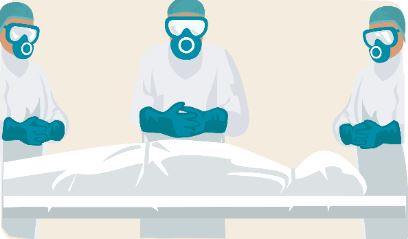 The funeral prayer requirement should not constitute an issue in the context of COVID-19 because it can be performed by a minimum of two individuals. Furthermore, funeral prayers can be performed at the grave after the burial of the dead. Alternatively, absentee funeral prayers (salat al-ghā’ib) can be performed on COVID-19 victims, as advocated in a recent fatwa issued during a Facebook live session by Sheikh Ahmad Wisam, the Secretary of Fatwa at Dar al-Ifta in Egypt.
Most Muslim-majority states have closed mosques and advised that funeral prayers should be performed in open spaces or cemeteries. They have also advised keeping the number of those who perform the funeral prayer on the COVID-19 victims to a minimum and ensuring that burial can be carried out on the same day.
Protection challenges
There are several protection challenges in Muslim contexts that the COVID-19 pandemic poses for the humanitarian community. These require a transversal inter- and intra-disciplinary approach.
Denying burial of COVID-19 victims
The refusal to bury the mortal remains of COVID-19 victims is due to the misperception that corpses could spread infection in nearby population centers. These types of rumours led Dr Ahmed al-Tayyeb (the Grand Imam of Al-Azhar, the highest religious authority in the Sunni world) and Dr. Shawki Allam (the Grand Mufti of Egypt) to issue statements condemning and prohibiting this practice.
This illustrates the need for strengthened cooperation between authorities, Islamic institutions and humanitarian organizations – more specifically, humanitarian forensics experts – to ensure a dignified burial of the dead. Dissemination and communication is crucial, both on the relevant scientific evidence as well as the fact that burying the dead as a collective obligation (farḍ kifāyah) in Islam means that the entire Muslim community would be guilty if they failed to fulfil this communal duty.
Collective graves
While Islamic law provides that every dead body should be buried in an individual grave, Muslim jurists agree that, in case of necessity such as armed conflicts or disasters, collective graves are permitted. Male and female bodies should be buried in separate graves, but if necessity dictates otherwise, classical Muslim jurists stipulate that a barrier of dust should be placed between the bodies.
Classical Muslim jurists also agree that Muslims and non-Muslims should be buried in separate graves.[3] However, in situations where the religious identity of bodies is unknown, Muslim jurists have disagreed as to whether they should be buried in Muslim or non-Muslim graves or whether they should be buried in special graves that do not belong to either the Muslim or the non-Muslim graves. This practice of burying the dead in separate graves based on religious identity is still observed in some Muslim-majority states and can hinder the dignified burial of unidentified dead bodies if there are no graves allocated for non-Muslim bodies.
Cremation
In Islamic law and Muslim cultures, burying the dead in the ground is regarded as the correct way of respecting dead bodies, while cremation is prohibited because it is considered a violation of the dignity of the human body.[4] Cremation of the remains of individuals that have died from COVID-19 has therefore been a great concern for Muslim communities in some non-Muslim majority states.
In the UK, the government has amended an emergency COVID-19 bill to stop cremation against the wishes of Muslim and Jewish families, since cremation is strictly prohibited in both faiths. In Sri Lanka, the Muslim community appealed on 26 March 2020 to President Gotabaya Rajapaksa to stop the cremation of COVID-19 Muslim victims. On 3 April 2020, Amnesty International expressed concern that ‘religious tensions could be inflamed if Muslim families not allowed to bury relatives in accordance with religious practice’, noting that two of the early COVID-19 victims belonging to the Muslim faith were ‘forcibly cremated on the instructions of the authorities and against the wishes of the deceased’s families’.
The World Health Organization’s guidance on infection prevention and control for the safe management of bodies in the context of COVID-19 shines a clear light on the debate, stating that ‘To date there is no evidence of persons having become infected from exposure to the bodies of persons who died from COVID-19’. However, a low risk does still exist from the aerosolization of fluids from the body, a risk that is greater for health care and death care workers who may be involved in the examination of a dead body or the cleaning of a mortuary area following autopsy.
Challenges for death care workers and the forensic community
The impacts of the COVID-19 pandemic will be felt by the forensic community for many years to come. Its scale has had a devastating impact on health and death care workers, leaving all involved overwhelmed and desperate for a response to match the strength of the virus and the resulting pandemic. There is a need for greater coordination between those actors involved and for clearer messaging for communities affected.
The ICRC, like many institutions, has worked to develop guidance on COVID-19 for its teams – and for all those working on tackling the pandemic – to help dispel misinformation that has been increasingly filling the gaps of knowledge about the virus and its effects. From the onset of the crisis, we found ourselves confronted with a sea of information and guidance, some aligned and substantiated, some less so. From questions surrounding the level of contagion of the virus from the dead to the living, to what type or level of PPE is required for handling dead bodies, the ICRC finds itself still confronted by much of the same lack of clarity that existed only a month ago.
While there will always be some degree of disagreement within the scientific community, especially at such an early stage when much of the needed research is still ongoing, we must ask ourselves if there is more that could have and still can be done in the coming weeks and months to align globally messaging more coherently between different agencies.
Until then, we can at least agree that there are serious issues regarding a lack of preparedness for emergency planning at national and regional level, and major issues over a lack of adherence to health and safety procedures in many institutions where the dead are managed. These shortcomings have been very much exposed by the current pandemic and beg the question of whether these lessons will be learned for future scenarios.
We also see the role the media, in particular social media, has played in bringing to our attention instances of suspected mismanagement of the dead. The speed at which these stories have hit us has left little time for a full analysis of the validity of claims, reinforcing the need for clear messaging on the risks and the myths surrounding the current outbreak. The ICRC Forensic Unit, in cooperation with other departments internally, has worked to develop key messages targeting decision makers, practitioners, and affected communities themselves. Awareness-raising and coherent messaging can play an important role, in collaboration with other agencies, to reassure concerned communities at a time when they are at their most vulnerable.
For example, clear messaging in social media, as outlined by Islamic law experts, on the Islamic burial laws in the case of COVID-19 is an important example of how such messaging matters. Our experience from dealing with the dead in large-scale disasters has shown how the failure to act and provide quick, coherent messages dispelling common myths can have a serious negative impact on mitigating the risk of panic mass burials and mistreatment of the dead. The impact of these actions on the families of those who have died can be devastating, and only goes to further undermine the dignity of the dead themselves.
We also forget the impact the handling of the dead can have on untrained or unprepared volunteers, drafted in to deal with the dead when the system can no longer cope. The long-term impact on such individuals is something that warrants urgent research.
Finally, we need to remember that we live in a world of amazing diversity and richness of culture and religion. The treatment of the dead in line with these important traditions must not be forgotten. To do otherwise only further undermines their dignity and the needs of the affected community. In the case of Islam, we must seek guidance from those Islamic scholars and religious and community leaders who can best guide us, and work together with them to define a response that speaks to those who this pandemic is affecting. This will help ensure that the response implemented is the one that brings reassurance and comfort to the affected community as a whole, while respecting health and safety concerns.
Conclusion
Islamic burial laws and instructions from health authorities in Muslim-majority states are considerably and continuously shaped by the available medical evidence and forensic guidelines, demonstrating that Islamic law is able to adapt to the reality of handling the remains of people who have died from COVID-19. In other words, it is realistic to follow authorities’ medical and forensic instructions while also respecting Islamic burial laws.
Nonetheless, handling the remains of COVID-19 victims could aggravate this global crisis if adequate coordination between health authorities, humanitarian forensics and Islamic religious authorities does not take place and if guidance on the burial of the COVID-19 Muslim victims is not communicated and explained to the Muslim public through local imams, the media, and community leaders – a scenario that will allow misconceptions and rumours to persist.
In the Islamic legislative process, Muslim jurists use certain Islamic sources and legal tools to develop laws regulating the handling of remains of individuals who have died from COVID-19, guided by the objectives of preventing individual and communal harm and maintaining the dignity of the dead. To fulfil these objectives, humanitarian forensic scientists, protection, communication and networking delegates require basic understanding of the above Islamic positions, the Islamic legal system, its sources and legal tools – coupled with an awareness of the different practices in various Muslim cultures and contexts – that will help them to communicate key messages and facilitate discussions on common ground using a culturally sensitive approach.
[1] On Islamic legal maxims, see for example, Luqman Zakariyah, Legal Maxims in Islamic Criminal Law: Theory and Applications (Brill Nijhoff: Leiden; Boston: 2015).
[2] See ʻAbd Allah ibn Najm al-Khallal, ʻIqd al-Jawāhir al-Thamīnah fī madhhab ʻālim al-Madīnah, ed. Mohammad ʻUthmān, (Beirut: Dār al-Kutub al-ʻIlmiyyah, 2010), pp. 236-237.
[3] Ahmed Al-Dawoody, “Management of the dead from the Islamic law and international humanitarian law perspectives: Considerations for humanitarian forensics,” International Review of the Red Cross, (2017), 99 (2), pp. 769–770.
[4] On the Islamic position on cremation in general and a fatwa by the current Grand Mufti of Egypt on the cremation of the dead bodies of Ebola victims, see Ibid., p. 774.
To view this discussion on the web visit https://groups.google.com/d/msgid/usaafricadialogue/DM5PR12MB2456C86224DE4A57AA2D8AE4DAA20%40DM5PR12MB2456.namprd12.prod.outlook.com.

OLAYINKA AGBETUYI

 This message is eligible for Automatic Cleanup! (
kenneth harrow
professor emeritus
dept of english
michigan state university
Sent: Friday, May 8, 2020 9:06 AM
To: usaafric...@googlegroups.com <usaafric...@googlegroups.com>
Subject: Re: USA Africa Dialogue Series - Kano Against COVID-19
Listserv moderated by Toyin Falola, University of Texas at Austin
To post to this group, send an email to USAAfric...@googlegroups.com
To subscribe to this group, send an email to USAAfricaDial...@googlegroups.com
Current archives at http://groups.google.com/group/USAAfricaDialogue
Early archives at http://www.utexas.edu/conferences/africa/ads/index.html
---
You received this message because you are subscribed to the Google Groups "USA Africa Dialogue Series" group.
To unsubscribe from this group and stop receiving emails from it, send an email to usaafricadialo...@googlegroups.com.
Harrow, Kenneth
kenneth harrow
professor emeritus
dept of english
michigan state university
Sent: Friday, May 8, 2020 1:29 PM
Gloria Emeagwali
For starters there is evidence through
To view this discussion on the web visit https://groups.google.com/d/msgid/usaafricadialogue/DM5PR12MB2456C73B1FA914FBFBD9F9D4DAA30%40DM5PR12MB2456.namprd12.prod.outlook.com.
Harrow, Kenneth
kenneth harrow
professor emeritus
dept of english
michigan state university