
History of Abacha’s Theft is Being Rewritten Before Our Eyes

Farooq A. Kperogi
Saturday, May 23, 2020
History of Abacha’s Theft is Being Rewritten Before Our Eyes
By Farooq A. Kperogi
Twitter: @farooqkperogi
In her historical fictional narrative titled “The Lost Sisterhood,” Danish-Canadian writer Anne Fortier quotes one of her characters as saying that “those who control the present can rewrite the past.” This is playing out right before us in what I called the curious posthumous deodorization of Abacha’s grand larceny in a May 7, 2020 social media update.
Loyalists and beneficiaries of Sani Abacha’s dictatorship control Nigeria’s present, and they are trying to exploit this privilege to rewrite the sordid past of their benefactor while the rest of the country is fixated on other issues.
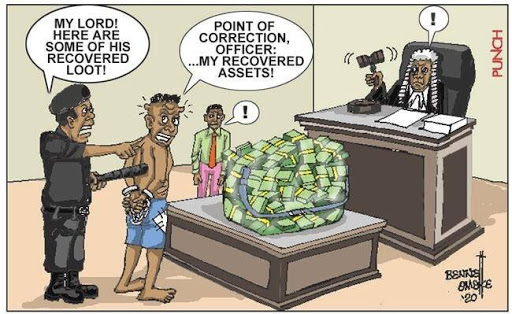
Muhammadu Buhari has always been invested in cleansing Abacha’s appallingly grubby reputation as a murderous larcener. During the 10th-year-rememberance anniversary of Abacha in Kano in June 2008, for instance, Muhammadu Buhari remarked that, contrary to settled narratives in the Nigerian public sphere, Abacha never stole from Nigeria.
This 2008 Buhari declaration birthed a fringe, outlandish but nonetheless popular narrative in northern Nigeria that Abacha’s reputation as a ruthless crook who stole billions of Nigeria’s patrimony and salted it away in Euro-American financial institutions was the handiwork of Olusegun Obasanjo who was taking a posthumous pound of flesh from Abacha for imprisoning him.
In the aftermath of the unrelenting repatriation of what has now been called the “Abacha loot” from Western banks, a new farcical story line was fabricated, which is that Abacha actually “saved” the money for Nigeria for a rainy day!
Apart from Buhari’s public defense of Abacha’s larceny in 2008, the posthumous discursive purification of Abacha’s image as a greedy, conscienceless thief was largely informal and took place on the margins of polite society.
Abubakar Malami, Buhari’s Attorney General and Minister of Justice, officialized the revisionism of Abacha’s thievery. In a May 4, 2020 tweet, Malami described repatriated Abacha loot as “Abacha assets.” “I am happy to confirm that the Federal Republic of Nigeria on Monday 4th May, 2020 received $311,797,866.11 of the Abacha assets repatriated from the United States and the Bailiwick of Jersey,” he wrote.
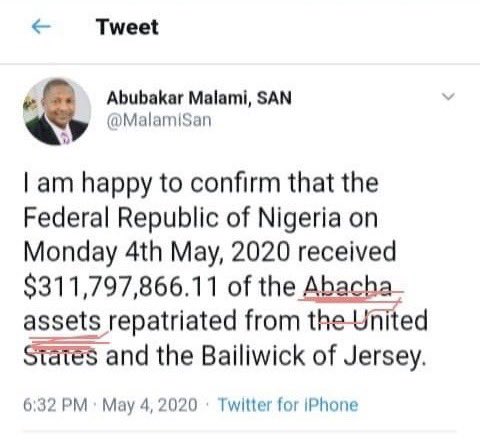
The change from “Abacha loot” to “Abacha assets” was a willful rhetorical move designed to lend official credence to the hitherto fringy, informal but nevertheless robust narrative that Abacha didn’t steal Nigeria’s money.
Led by Sahara Reporter’s Omoyele Sowore, Nigerians on social media pounced on Malami’s tweet and compelled him to retract his incompetent attempt at revisionism. In a woolly, shamefaced, error-ridden retraction, Malami said, “It is to be noted that by way of antecedence [sic] that Attorney-General of the Federation and Minister of Justice, Abubakar Malami, SAN has been consistently describing the recovered funds as ‘Abacha loot’ at several fora during the process of recovery of the looted funds, particularly before the eventual repatriation of the funds.”
But it didn’t stop there. Buba Galadima, a former Buhari protégé who is now at loggerheads with him because he has been shut out of the orbit of governance, has taken off from where Malami backed off. In a May 17, 2020 interview with The Nation, he said the estimated $5 billion Sani Abacha stole from Nigeria's trough was actually "saved" for Nigeria—on the advice of Gaddafi and Saddam Hussein—in anticipation of US sanction against Nigeria so that "even if Nigeria's account was blocked by the US, there won't be panic."
Galadima, who was Director General of the National Maritime Authority during the Abacha junta, said the notion that Abacha stole from Nigeria’s till is “based on ignorance.” When an editor forwarded excerpts of the interview to me on WhatsApp, I’d dismissed it as fabricated. I was wrong.
As I pointed out on social media on May 17, the idea that the Abacha loot was “saved” for Nigeria stands logic on its head, considering that Abacha "saved" some of that money in the US whose impending blockage he was allegedly plotting against. How do you "hide" something from someone by "saving" it in his house?
Plus, even Buhari, the choirmaster of the Abacha sanitization chorus, has grudgingly conceded that his former boss stole from Nigeria’s public treasury. For example, in an April 27, 2016 tweet, Buhari said, “Nigeria is awaiting receipt from Swiss Govt. of $320 million, identified as illegally taken from Nigeria under Abacha.”
“Illegally taken” is merely a synonym for stealing. In a February 4, 2020 statement from the US Embassy in Nigeria about the repatriation of the “Abacha loot” from US banks, the US government was unambiguous in stating how the money got to its banks.
“The monies were laundered by [Abacha’s] family, including his sons Ibrahim and Mohammed, and a number of close associates,” the statement from the US reads. “The laundering operation extended to the United States and European jurisdictions such as the UK, France, Germany, Switzerland, Lichtenstein and Luxembourg.”
One of those associates who helped Abacha launder huge sums of money is Kebbi State Governor Atiku Bagudu to whom the Buhari regime wanted to hand over $100 million of the recovered money, according to Bloomberg, but for the resistance of the US government. If the money was “saved” for Nigeria, why did Buhari want to hand over some it to a person who has been identified as an accomplice in its theft?
The US Department of Justice identified Bagudu as one of Abacha’s network of proteges that, “embezzled, misappropriated and extorted billions from the government of Nigeria.”
It isn’t only the US that unequivocally describes the repatriated funds as the product of Abacha’s criminal despoliation of Nigeria’s resources. In a June 12, 2017 Radio France International report titled “Swiss make deal with Nigeria on final payout for Abacha loot,” we learn that “The cash was originally frozen in Luxembourg and confiscated by the Swiss as part of a criminal investigation into Abba Abacha, Sani Abacha’s son. Switzerland had already returned some 700 million dollars following appeals by Nigeria.”
In a “Stolen Asset Recovery Initiative - Asset Recovery Watch” bulletin, there’s also a case against “Family of former President Sani Abacha,” where we read that, “In 2006, the World Bank was involved in a similar framework, providing institutional support for the return and use of approx. $723 million in public funds that had been corruptly diverted by General Abacha.”
Not all the money Abacha stole has been recovered. Of the $5 billion that Abacha looted and squirreled away—or "saved" for Nigeria, to use Galadimian logic—in the banks of countries that wanted to "block" Nigeria's money, $3.624 billion has been recovered so far. Can Galadima help Nigeria recover the rest of the money since he appears to know where the money has been "saved"?
The purveyors of the transparently fraudulent narrative that Abacha “saved” money for Nigeria in foreign banks which his detractors have decided to call “loot” should be told that they can’t rewrite history.
People, mostly young northerners who hadn’t come of age when Abacha’s evil regime reigned, have sent me private messages asking that I help stop the “demonization” of Abacha. For them, it’s a regional and religious project. But that’s misguided. Islam teaches us to be fair, just, and truthful. It doesn’t teach us to lie to salvage the image of a dead thief among us.
The unvarnished truth is that Abacha did NOT save money for Nigeria; he STOLE from it with conscienceless glee. It’s distressing that one has to even say this in spite of the clear evidence that stares us in the face.
Kennesaw State University
Cell: (+1) 404-573-9697
Personal website: www.farooqkperogi.com
"The nice thing about pessimism is that you are constantly being either proven right or pleasantly surprised." G. F. Will

Emmanuel Udogu
This piece leaves many—especially those of my generation—scratching their head (wondering about the number of modern hospitals, roads, et cetera that could have been built in the Niger Delta and the nation-state itself with the doughs). I was in the country when Nigerians were applauding General Abacha (despite his political sins) for lambasting corrupt Nigerians. I recalled brother Wole Soyinka’s response to Abacha’s tirades against those looting the national coffers. He noted perceptively that “when the head of a fish is rotten, what do you expect of its body?” Ironically, we had Abacha pointing his proverbial finger at pillagers, while three fingers were pointed at him.
Ike Udogu
--
Listserv moderated by Toyin Falola, University of Texas at Austin
To post to this group, send an email to USAAfric...@googlegroups.com
To subscribe to this group, send an email to USAAfricaDial...@googlegroups.com
Current archives at http://groups.google.com/group/USAAfricaDialogue
Early archives at http://www.utexas.edu/conferences/africa/ads/index.html
---
You received this message because you are subscribed to the Google Groups "USA Africa Dialogue Series" group.
To unsubscribe from this group and stop receiving emails from it, send an email to usaafricadialo...@googlegroups.com.
To view this discussion on the web visit https://groups.google.com/d/msgid/usaafricadialogue/CAPq-FWvpp%2BqotKbit2ChfHxCLfqQv%2BG-ta-%3D5yaUPJDEjzjk%3DA%40mail.gmail.com.

Okey Iheduru
To view this discussion on the web visit https://groups.google.com/d/msgid/usaafricadialogue/CAAVj7VpydRV1%2BJJpVqWNCTaCbTu3v1B_5KTkk95YxybBJhTanA%40mail.gmail.com.

Cornelius Hamelberg
There’s a street named after Sani Abacha in central Freetown, Sani Abacha Street. That too is part of his legacy. Without Sani Abacha’s strong stand, the RUF would have completely taken over Sierra Leone. The Nigerian Ambassador to Sweden told me about the astronomical amount of money that Sani Abacha’s Nigeria had spent in helping Sierra Leone. When I marvelled at this, he said “No price is too high to pay when helping your brother get his freedom!” In like manner Nigeria helped in the fight against Apartheid South Africa, mostly money and other ” things”, under the table.
Wole Soyinka devoted a whole year of theatre against Apartheid. Wole Soyinka also went on a world tour ( stopped over in Stockholm ) and found himself in Jerusalem, from where he flew to Paris on the day that Abacha quenched.
It’s a sad story, coming on the eve of the Eid. If I the character flaw had been of Greek or Shakespearean proportions then it would have been a tragedy. As fate would have it his life ended happily in the arms of a prostitute, but what Kperogi is most concerned about is what happened with the loot, and the contention was it Nigerian assets or merely the “curious posthumous deodorization of Abacha’s grand larceny”, i.e. the General’s personal loot?
Fast forward the summary flashes on. Catch the drift, here’s the gist in a flash, take it all in in one stanza:
“Abacha’s appallingly grubby reputation as a murderous larcener… the posthumous discursive purification of Abacha’s image as a greedy, conscienceless thief… officialized the revisionism of Abacha’s thievery… a willful rhetorical move designed to lend official credence to the hitherto fringy, informal but nevertheless robust narrative that Abacha didn’t steal Nigeria’s money… incompetent attempt at revisionism… a woolly, shamefaced, error-ridden retraction… in anticipation of US sanction against Nigeria… Buhari, the choirmaster of the Abacha sanitization chorus… f Abacha’s criminal despoliation of Nigeria’s resources… People, mostly young northerners who hadn’t come of age when Abacha’s evil regime reigned, have sent me private messages asking that I help stop the “demonization” of Abacha.”
That last sentence whets my curiosity. Not at all funny about where Abacha stashed the honey. My only question is, how many of the “mostly young northerners who hadn’t come of age when Abacha’s evil regime reigned” sent Kperogi private messages asking that he should help stop the “demonization” of Abacha.”?
The eighth commandment commands “ Do not steal”
In addition to the obvious normal understanding of the word, the Rabbinic emphasis is on kidnapping, which sometimes makes me feel a little uncomfortable when I think that in 1984, when Brother Buhari was Nigeria’ head of state MOSSAD had actually kidnapped Umaru Dikko and were going to bring him to Justice, back home to Nigeria. We were waiting for his arrival at the airport, but sadly, as they say,” the best-laid plans of mice and men often go awry”
When thinking of Abacha or indeed any other looter we can all agree to abide by the definition that is made so abundantly clear in the four sons of the Haggadah.
We the male members of this forum, this country, that country can sincerely answer the question which of these four sons/ human types are you and which do you think is Sani Abacha, the wise son, the wicked son, the simple-minded son or the son who did not know how to ask a question?
Rabbi Manis Friedman puts it so succinctly:
“The ancient sages taught that there are four basic kinds of people. The first person says, "What's mine is mine and what's yours is mine." This kind of person is wicked and selfish.
The second says, "What's mine is yours and what's yours is yours." This is a generous person, a saintly person, a person to be admired.
The third says, "What's yours is yours and what's mine is mine." Not too generous but not too selfish either.
And the fourth says, "What's mine is yours and what's yours is mine." The sages called this kind of person an ignoramus. (Borders by Rabbi Manis Friedman)
It was easy to get to Kperogi's main point, it’s Abacha, gotcha !
The erudite Kperogi , said to be an authority (on the English Language) but not necessarily in full control of the thoughts expressed through his chosen vehicle states the main point, actually, the only point, over and over again, probably, either because he doesn’t want you to miss it or because he himself does not want to lose his focus on his target that could inadvertently get buried in the kaleidoscope of the garbage that in the long haul could be indistinguishable from the verbiage.
At best, Orwell’s six rules for writing can be regarded as good advice, not necessarily from an expert. Master or authority, or a Ph.D. – and just like what’s known as a fatwa, here, George Orwell was not legislating, he was only giving an advisory opinion and there’s no crime committed by not following his recommendations , on my part the recommendations come as second nature when I read what others have written and in that regard I am always impressed, sometimes bowled over by the simplicity, ease, and directness with which Obododimma Oha writes - it’s as if he does not write to impress – with the extent of the vocabulary that is at hand for all of us, if indeed like pretentious chattering monkeys, we want to inflate everything that we say, so that it’s never at the start or at the beginning of his presidency. It has to be “at the incipience” of his presidency.
Another person whose prose puts me at ease is Bernard Porter, since I read him frequently – all the time actually because I follow his blog, Porter's Pensées, have read a few of his books and above all, he is a delightful conversationalist , such is his sense of humour!
--

Harrow, Kenneth
kenneth harrow
professor emeritus
dept of english
michigan state university
Sent: Saturday, May 23, 2020 3:33 PM
To: usaafric...@googlegroups.com <usaafric...@googlegroups.com>
Subject: Re: USA Africa Dialogue Series - History of Abacha’s Theft is Being Rewritten Before Our Eyes

Julius Eto
On Saturday, May 23, 2020, 09:05:22 AM GMT+1, Farooq A. Kperogi <farooq...@gmail.com> wrote:
Saturday, May 23, 2020History of Abacha’s Theft is Being Rewritten Before Our Eyes
By Farooq A. Kperogi
Twitter: @farooqkperogi
In her historical fictional narrative titled “The Lost Sisterhood,” Danish-Canadian writer Anne Fortier quotes one of her characters as saying that “those who control the present can rewrite the past.” This is playing out right before us in what I called the curious posthumous deodorization of Abacha’s grand larceny in a May 7, 2020 social media update.
Loyalists and beneficiaries of Sani Abacha’s dictatorship control Nigeria’s present, and they are trying to exploit this privilege to rewrite the sordid past of their benefactor while the rest of the country is fixated on other issues.
This 2008 Buhari declaration birthed a fringe, outlandish but nonetheless popular narrative in northern Nigeria that Abacha’s reputation as a ruthless crook who stole billions of Nigeria’s patrimony and salted it away in Euro-American financial institutions was the handiwork of Olusegun Obasanjo who was taking a posthumous pound of flesh from Abacha for imprisoning him.
In the aftermath of the unrelenting repatriation of what has now been called the “Abacha loot” from Western banks, a new farcical story line was fabricated, which is that Abacha actually “saved” the money for Nigeria for a rainy day!
Apart from Buhari’s public defense of Abacha’s larceny in 2008, the posthumous discursive purification of Abacha’s image as a greedy, conscienceless thief was largely informal and took place on the margins of polite society.
Abubakar Malami, Buhari’s Attorney General and Minister of Justice, officialized the revisionism of Abacha’s thievery. In a May 4, 2020 tweet, Malami described repatriated Abacha loot as “Abacha assets.” “I am happy to confirm that the Federal Republic of Nigeria on Monday 4th May, 2020 received $311,797,866.11 of the Abacha assets repatriated from the United States and the Bailiwick of Jersey,” he wrote.
Led by Sahara Reporter’s Omoyele Sowore, Nigerians on social media pounced on Malami’s tweet and compelled him to retract his incompetent attempt at revisionism. In a woolly, shamefaced, error-ridden retraction, Malami said, “It is to be noted that by way of antecedence [sic] that Attorney-General of the Federation and Minister of Justice, Abubakar Malami, SAN has been consistently describing the recovered funds as ‘Abacha loot’ at several fora during the process of recovery of the looted funds, particularly before the eventual repatriation of the funds.”
But it didn’t stop there. Buba Galadima, a former Buhari protégé who is now at loggerheads with him because he has been shut out of the orbit of governance, has taken off from where Malami backed off. In a May 17, 2020 interview with The Nation, he said the estimated $5 billion Sani Abacha stole from Nigeria's trough was actually "saved" for Nigeria—on the advice of Gaddafi and Saddam Hussein—in anticipation of US sanction against Nigeria so that "even if Nigeria's account was blocked by the US, there won't be panic."
Galadima, who was Director General of the National Maritime Authority during the Abacha junta, said the notion that Abacha stole from Nigeria’s till is “based on ignorance.” When an editor forwarded excerpts of the interview to me on WhatsApp, I’d dismissed it as fabricated. I was wrong.
As I pointed out on social media on May 17, the idea that the Abacha loot was “saved” for Nigeria stands logic on its head, considering that Abacha "saved" some of that money in the US whose impending blockage he was allegedly plotting against. How do you "hide" something from someone by "saving" it in his house?
Plus, even Buhari, the choirmaster of the Abacha sanitization chorus, has grudgingly conceded that his former boss stole from Nigeria’s public treasury. For example, in an April 27, 2016 tweet, Buhari said, “Nigeria is awaiting receipt from Swiss Govt. of $320 million, identified as illegally taken from Nigeria under Abacha.”
“Illegally taken” is merely a synonym for stealing. In a February 4, 2020 statement from the US Embassy in Nigeria about the repatriation of the “Abacha loot” from US banks, the US government was unambiguous in stating how the money got to its banks.
“The monies were laundered by [Abacha’s] family, including his sons Ibrahim and Mohammed, and a number of close associates,” the statement from the US reads. “The laundering operation extended to the United States and European jurisdictions such as the UK, France, Germany, Switzerland, Lichtenstein and Luxembourg.”
One of those associates who helped Abacha launder huge sums of money is Kebbi State Governor Atiku Bagudu to whom the Buhari regime wanted to hand over $100 million of the recovered money, according to Bloomberg, but for the resistance of the US government. If the money was “saved” for Nigeria, why did Buhari want to hand over some it to a person who has been identified as an accomplice in its theft?
The US Department of Justice identified Bagudu as one of Abacha’s network of proteges that, “embezzled, misappropriated and extorted billions from the government of Nigeria.”
It isn’t only the US that unequivocally describes the repatriated funds as the product of Abacha’s criminal despoliation of Nigeria’s resources. In a June 12, 2017 Radio France International report titled “Swiss make deal with Nigeria on final payout for Abacha loot,” we learn that “The cash was originally frozen in Luxembourg and confiscated by the Swiss as part of a criminal investigation into Abba Abacha, Sani Abacha’s son. Switzerland had already returned some 700 million dollars following appeals by Nigeria.”
In a “Stolen Asset Recovery Initiative - Asset Recovery Watch” bulletin, there’s also a case against “Family of former President Sani Abacha,” where we read that, “In 2006, the World Bank was involved in a similar framework, providing institutional support for the return and use of approx. $723 million in public funds that had been corruptly diverted by General Abacha.”
Not all the money Abacha stole has been recovered. Of the $5 billion that Abacha looted and squirreled away—or "saved" for Nigeria, to use Galadimian logic—in the banks of countries that wanted to "block" Nigeria's money, $3.624 billion has been recovered so far. Can Galadima help Nigeria recover the rest of the money since he appears to know where the money has been "saved"?
The purveyors of the transparently fraudulent narrative that Abacha “saved” money for Nigeria in foreign banks which his detractors have decided to call “loot” should be told that they can’t rewrite history.
People, mostly young northerners who hadn’t come of age when Abacha’s evil regime reigned, have sent me private messages asking that I help stop the “demonization” of Abacha. For them, it’s a regional and religious project. But that’s misguided. Islam teaches us to be fair, just, and truthful. It doesn’t teach us to lie to salvage the image of a dead thief among us.
Personal website: www.farooqkperogi.comTwitter: @farooqkperogiAuthor of Glocal English: The Changing Face and Forms of Nigerian English in a Global WorldNigeria's Digital Diaspora: Citizen Media, Democracy, and Participation
"The nice thing about pessimism is that you are constantly being either proven right or pleasantly surprised." G. F. Will
Cornelius Hamelberg
Dear Ken,
Of course a big vote of thanks for the UK’s intervention in the RUF War. That intervention would have happened a lot earlier but nobody was taking the RUF seriously until about a year before they advanced on Freetown. When it comes to UK – Sierra Leone relations we should always bear in mind that Sierra Leone was Britain’s first colony in Africa and for the longest period of time: 150 years and that they left some strong institutions behind, after Sierra Leone became Independent on 27th April 1961.
I sympathise and empathise with you and understand that as a member of Amnesty International you tend to see everything from a Human Rights point of view. It’s just that in many of these wars it’s not all the fighters and the terrorists among them that have heard of any Geneva Convention.
It’s good to know that a Rwandan genocide suspect has been arrested, but with the Janjaweed it’s a different story…
It’s good to note that the Talban of Afghanistan have declared a three-day cease-fire to cover the Eid-ul-Fitr celebrations throughout the nation and then it will be back to business as usual; perhaps ditto with Boko Haram and the contending political factions (Sunni- vs Shia) in Yemen. Sad that in Libya there were no ceasefire concessions during Ramadan, the month of mercy and that even Eid-ul Fitr is being celebrated with more artillery and rocket fire, and that only a few hours ago the main airport in Tripoli was under heavy bombardment. It must be Gaddafi’s ghost that has come back to haunt his opponents. I liked Gaddafi up to a point, but started looking upon him differently after I was told that he insisted that the new main highway that he was contracting had to go precisely right through the heart of the Jewish cemetery in Tripoli and that he refused to change his mind about allowing the people buried there to be able to rest in peace, and that on the contrary, it was around then that he summoned a special meeting of his top functionaries and when they were all seated in the hall he kickstarted the meeting by announcing, “I have been made to understand that there’s a rumour flying around that my blessed mother is Jewish. if there’s anybody in this assembly who believes this to be true please let him indicate this by raising up his hand.”
There was a deathly silence in the hall. All hands were down.
Maybe, it’s because of these lines From the Sierra Leone National Anthem
Blessing and peace be ever thine own,
Land that we love, our Sierra Leone…
We pray that no harm on thy children may fall,
That blessing and peace may descend on us all;
We pledge our devotion, our strength and our might,
Thy cause to defend and to stand for thy right;
One of Sierra Leone’s great blessings is that we don’t have any religion problem (and I’m subject to correction by Professor Ibrahim Abdullah (Muslim) and Brother O’ Bai William Bangura (Christian ) that there’s absolute peace and harmony between Christians and Muslims in Sierra Leone, and that they enjoy inter-religious harmony and even celebrate the Christian and Muslim holidays together – my only problem is that I have never seen a mosque in Sierra Leone – and the only thing I knew about Islam was that Muslim men had many wives and the Fulani traders, universally known by the Creoles and in Krio as “Kotoh Ahmadu”, that they were forever washing their hands and feet - this I observed first-hand – morning, noon, late afternoon, evening and even at night, along upper Pademba Road you would go past “ Kotoh Ahmadu “ and you would see him washing his hands, pouring the water from a little silver kettle, first one hand, up to the sleeve, and then the other, then he would wash his face, his mouth, take in some water through his nostrils a couple of times and then he would wash his right foot and then his left foot, rubbing his heels. I used to wonder, what kind of people are these? And the Fullah girls were invariably very beautiful. At least so I thought. My ignorance persisted because the secondary school I attended did not offer religion as a subject and of course nobody in Sierra Leone ever tried to convert me. In 1991 when I met His Excellency Ahmadu Jalloh the then Sierra Leone Ambassador to Saudi Arabia in Cairo ( I had shared a flat with him in Magburaka for a good three months before leaving for Ghana) so, when we went up to his hotel room I reminded him that he had never breathed a word to me about Islam, and he replied, “ How could I have ever preached Islam to a good Creole boy like you? “
The War – especially the later years of that war, is the greatest evil thing that has ever happened to Sierra Leone. Weisman’s conclusions – and I assume that he must know what he’s talking about, that when “ecowas, nigeria, etc, came in, their practices and violence did not differ so much from that of the ruf”.
From my own Sierra Leone point of view, I can only say, “ May God bless Sani Abacha “ for having the political will and acting when time was of the essence on that fateful day, 6th of January 1998 when the RUF invaded Freetown in their Operation No Living Thing . The only way of putting out that fire was with fire – in this case fire from the Nigerian-led ECOWAS. There are some tearful RUF supporters who up till today are still crying that Nigerian warplanes “bombed Freetown” and are still crying about violations of Sierra Leone airspace, Sierra Leone’s territorial sovereignty/ integrity etc. Some started crying a little later that Nigerians soldiers had started mining diamonds in the Kono area. AS far as I’m concerned, that could be regraded as temporary spoils of war ( some war booty )and May God bless them for averting the genocide of the Freetown population by the genocidal RUF Operation Spare No Soul – the genocidal RUF children of lucifer…
About wars and reports from the war front, even first-person reports, one has to be careful, judicious. I had people (Swedes) going and coming almost throughout until the very bloody last phase with the amputations and so on. In London, especially when I was physically there, I had first class connections and knew absolutely, the state of affairs from diverse sources. The saddest part is that during nine years of that ten-year war, some moneyed and well-connected people from Belgium and Holland and sone other places would arrive in Freetown, take a helicopter to the diamond centre and be back to Antwerp and Amsterdam the next day or a few days later, with a few kilos of diamonds. Expressen (a Swedish newspaper) was the first in the world to break the news that Valentine Strasser had arrived in Belgium with a cache of diamonds worth a mere £ 300 million (a conservative estimate) - the kind of money that could make some dentists desert their practice and some professors abandon their professorships and start digging
Up to now, I haven’t had the courage to watch Blood Diamond (but I was given some first-hand real war footage, several hours of bloody carnage – I gave the tapes to Kelfala Marah, Sierra Leone’s, national goalkeeper, sometime during the war, over here in Stockholm) I started watching it - it was far too bloody, I couldn’t continue - my Swedish sister in law ( a professor of medicine) she had the presence of mind, she said that they had to dissect some rats in the first year at medical school and started doing autopsies shortly thereafter. I couldn’t do that, not for all the diamonds in the world.
The best report that I have read so far is Lansana Gberie: A Dirty War in West Africa : The RUF and the destruction of Sierra Leone and some other books he has written about Sierra Leone’s war and peace. But, even Lansana Gberie cannot claim to be absolutely objective and totally devoid of any personal bias
I found this gem when I googled Professor Bernard Porter ( Historian – a nice piece of
pre-Brexit history which I’m going to listen to after I post this.
Bobby Cruz: Eres alguien como yo
To view this discussion on the web visit https://groups.google.com/d/msgid/usaafricadialogue/DM5PR12MB245625E5E333B8BEDF87AEEDDAB20%40DM5PR12MB2456.namprd12.prod.outlook.com.
Cornelius Hamelberg
Julius Eto,
I don’t get it.
Are Muslims from the north less honest and patriotic than Muslims from the South?
What about Christians?
I ask because I can not fathom why you should write “Thanks for your honesty and patriotism on this issue Farooq although you are Muslim from the north”
I am not a Muslim from the North, nor is Baba Kadiri. Does that make us less honest or less patriotic?? Honest about Abacha? Who is not more honest? In the Gambia, Sierra Leone, Liberia, the Ivory Coast, Ghana, unto Nigeria, this is what happens: post mortems on earlier president’s even if they are not dead yet, and they are all eventually found guilty by all kinds of Commissions of Enquiry into Corruption.
Pointing out that Judas Iscariot was corrupt – that’s easy. Abu Dharr al-Ghifari was banished to the desert for pointing out corruption just as the recently deposed Emir of Kano was dethroned and then banished.
This is what Shakespeare’s Mark Antony said at Julius Caesar’s funeral:
“The evil that men do lives after them;
The good is oft interred with their bones;”
So let it be with Sani Abacha? No redeeming features? Not even one?
Well, as for the patriotism thing, who do you think is a greater Nigerian patriot and who was more honest,
Zik or AWO?
Babangida or Buhari?
Yar'Adua or Goodluck Jonathan?
Julius Eto or Sani Abacha?
Just shmiling and asking, and I’m not sufficiently anti-intellectual to protest that we cannot – it’s forbidden to discuss article x.
Maybe you would also like to discuss this:
“They say that patriotism is the last refuge
To which a scoundrel clings
Steal a little and they throw you in jail
Steal a lot and they make you king.” ( Sweetheart Like You)
To view this discussion on the web visit https://groups.google.com/d/msgid/usaafricadialogue/1636742204.2775054.1590343682248%40mail.yahoo.com.
O O
Sent from my iPhone

Salimonu Kadiri
Skickat: den 24 maj 2020 20:08
Till: USAAfrica Dialogue <usaafric...@googlegroups.com>
Ämne: Re: USA Africa Dialogue Series - History of Abacha’s Theft is Being Rewritten Before Our Eyes
Julius Eto

Ibrahim Abdullah
======