
Re: krakenSDR - KrakenSDR Installation & Some Errors
2,002 views
Skip to first unread message

Anthony
Sep 8, 2022, 8:01:35 PM9/8/22
to Society of Amateur Radio Astronomers, hamish...@gmail.com
Hi Hamish,
I decided to move forward with the installs for the KrakenSDR. My first attempt was a manual install using an X86 machine and Ubuntu 22.04, instead of a Pi4.
I decided to move forward with the installs for the KrakenSDR. My first attempt was a manual install using an X86 machine and Ubuntu 22.04, instead of a Pi4.
The first install required the installation of heimdall and several other libraries along with the Intel Optimizations (x86), conda for highly optimizing the MKL BLAS and Intel SVML, as stated in the instructions.
There were a few glitches along the way, like the kraken_doadsp_main configuration page (http:127.0.0.1/config), didn't pull up, even after going into the krakensdr_daq directory down to the Firmware directory and configuring the daq_chain_config.ini file to change the shared memory (shmem) configuration to "[data_interface]out_data_iface_type = eth" (eth).


There were a few glitches along the way, like the kraken_doadsp_main configuration page (http:127.0.0.1/config), didn't pull up, even after going into the krakensdr_daq directory down to the Firmware directory and configuring the daq_chain_config.ini file to change the shared memory (shmem) configuration to "[data_interface]out_data_iface_type = eth" (eth).
The default is localhost, which is the local IP loopback IP address of 127.0.0.1. I even changed the IP from the loop back to a network IP address on my home network, with no results. Even in GNU Radio, the Kraken Example 3 - "Cross Correlation Sample and Phase Coherent Check" would not work.
The manual install was more in favor of using a Pi4, with 2GB, 4GB or 8GB and the option for ARM or X86 is also mentioned in the install. I ended up using the automatic install script for X86:
The script takes about 15 - 20 minutes to completed, guess depending on the PCs hard disk, CPU & RAM performance, but once the script has completed, the KrakenSDR radar finder page (kraken_doadsp_main) will pull up, once you configure the daq_chain_config.ini file from "shmem" to "eth".
After I launched GNU Radio, which would only pull up from the directory, not sure if there was some error that took place when I grab a cup of coffee, but anyhow, that was fixed by installing GNU Radio (maybe the install failed or it wasn't included).
Once I pulled up GNU, I ran a few of the KrakenSDR GNURadio test blocks. The Example 2 "Radio Direction Finding with the DOA Music block" worked fine. Example 1 "Simple Multichannel FFT" and Example 3 "Cross Correlation Sample and Phase Coherent Check" had errors pasted below.
I have an issue ticket open with Kraken. I spent some time trying to figure out what the error was, even going into the corrolate_py configuration file. There was an error "Warning: failed to XInitThreads()", but I fixed that by performing a sudo apt-get install libx11-dev.
Below Errors:
"Warning: Ignoring XDG_SESSION_TYPE=wayland on Gnome. Use QT_QPA_PLATFORM=wayland to run on Wayland anyway.
Sending control message
Control interface communication finished
Reconfiguration succesfully finished
Sending control message
Control interface communication finished
Reconfiguration succesfully finished
Sending control message
Control interface communication finished
Reconfiguration succesfully finished
/usr/local/lib/python3.10/dist-packages/gnuradio/krakensdr/krakensdr_correlator.py:46: RuntimeWarning: divide by zero encountered in log10
x_corr_plot = 10*np.log10(np.abs(x_corr))
Failed to put IQ Samples into the Queue
Exception"
Sending control message
Control interface communication finished
Reconfiguration succesfully finished
Sending control message
Control interface communication finished
Reconfiguration succesfully finished
Sending control message
Control interface communication finished
Reconfiguration succesfully finished
/usr/local/lib/python3.10/dist-packages/gnuradio/krakensdr/krakensdr_correlator.py:46: RuntimeWarning: divide by zero encountered in log10
x_corr_plot = 10*np.log10(np.abs(x_corr))
Failed to put IQ Samples into the Queue
Exception"
I did have to configure the correlation check to have a constant noise source by making changes to Firmware /_daq_core/rtl_daq.c, using a text editor, changing the last "0" to a "1" (on), and running the "Make" command and after completion, undoing the changes and run "Make" again. My last attempt was working configuring the krakensdr_correlator.py file, trying to figure out the RuntimeWarning: divide by zero encountered in log10 x_corr_plot=10*np.log10(np.abs(x_corr)).
A few attempts, I changed the "10*" to "10**-10" with no success. My knowledge is very limited. 😊
Guess I will have to wait on the trouble ticket to Kraken. Though the Example 3 & Example 1 run with GUI, I am not sure why the "Failed to put IQ Samples into the Queue" error. The TCP socket connection looks good, when running either the Heimdall only command or Kraken start commands, below. I've also added screenshots in case anyone has encountered this erro with GNU Radio.
./kraken_doa_start.sh #start kraken local operations #Starts Radar finder GUI
./kraken_doa_stop.sh #start kraken local operations #Stops Radar finder GUI
To run only Heimdall use: ./heimdall_only_start.sh #for GNU radio
./kraken_doa_stop.sh #start kraken local operations #Stops Radar finder GUI
To run only Heimdall use: ./heimdall_only_start.sh #for GNU radio
Well, until next time and thanks for reading this lengthy post! 😊

Marcus D. Leech
Sep 8, 2022, 8:29:09 PM9/8/22
to sara...@googlegroups.com
The problem is that
taking the log10 of anything <= 0 is undefined
mathematically, and Python is (quite rightly)
raising an exception.
I guess the KrakenSDR correlator block calls log10 underneath, and it doesn't take care to avoid the zone
of undefinedness.
When I've encountered this problem, I just add a *tiny* amount to my samples to make sure they're never
<= 0. This usually only happens at startup, when buffers may have been zero-padded in the beginning.
This is a tidiness thing that they should have taken care of.
raising an exception.
I guess the KrakenSDR correlator block calls log10 underneath, and it doesn't take care to avoid the zone
of undefinedness.
When I've encountered this problem, I just add a *tiny* amount to my samples to make sure they're never
<= 0. This usually only happens at startup, when buffers may have been zero-padded in the beginning.
This is a tidiness thing that they should have taken care of.
Anthony
Sep 8, 2022, 8:34:47 PM9/8/22
to sara...@googlegroups.com
Hi Marcus!
I agree, even the manual install was a bit daunting, but thank you for the tibits! I saw a post on something similar.
Calling it quits for the night.. 😊
--
--
You received this message because you are subscribed to the Google
Groups "Society of Amateur Radio Astronomers" group.
To post to this group, send email to sara...@googlegroups.com
To unsubscribe from this group, send email to
sara-list-...@googlegroups.com
For more options, visit this group at
http://groups.google.com/group/sara-list?hl=en
---
You received this message because you are subscribed to the Google Groups "Society of Amateur Radio Astronomers" group.
To unsubscribe from this group and stop receiving emails from it, send an email to sara-list+...@googlegroups.com.
To view this discussion on the web visit https://groups.google.com/d/msgid/sara-list/4627e399-f8cc-3b20-c90e-04ad814d1967%40gmail.com.

Dave Typinski
Sep 8, 2022, 9:42:36 PM9/8/22
to sara...@googlegroups.com
"Zone of undefinedness" -- I like that! :)
--
Dave
On 9/8/22 20:29, Marcus D. Leech wrote:
> On 2022-09-08 20:01, Anthony wrote:
>> Hi Hamish,
>>
>> I decided to move forward with the installs for the KrakenSDR. My first
>> attempt was a manual install using an *X86* machine and *Ubuntu 22.04*,
>> instead of a *Pi4*.
>> The first install required the installation of *heimdall *and several other
>> pull up, even after going into the _krakensdr_daq directory_ down to the
>> _Firmware_ directory and configuring the *daq_chain_config.ini *file to change
>> *https://github.com/krakenrf/krakensdr_docs/wiki/10.-VirtualBox,-Docker-Images-and-Install-Scripts#install-scripts.*
>> *Example 1 *"Simple Multichannel FFT" and *Example 3 *"Cross Correlation
>> performing a *sudo apt-get install libx11-dev. *
>> *
>> *
>> *https://github.com/krakenrf/krakensdr_docs/issues/9
>> *
>> *Below Errors:*
>>
>> *"Warning: Ignoring XDG_SESSION_TYPE=wayland on Gnome. Use
> *
--
Dave
On 9/8/22 20:29, Marcus D. Leech wrote:
> On 2022-09-08 20:01, Anthony wrote:
>> Hi Hamish,
>>
>> I decided to move forward with the installs for the KrakenSDR. My first
>> instead of a *Pi4*.
>> The first install required the installation of *heimdall *and several other
>> libraries along with the Intel Optimizations (x86), conda for highly
>> optimizing the MKL BLAS and Intel SVML, as stated in the instructions.
>>
>> There were a few glitches along the way, like the kraken_doadsp_main
>> configuration page (http:127.0.0.1/config <http://127.0.0.1/config>), didn't
>> optimizing the MKL BLAS and Intel SVML, as stated in the instructions.
>>
>> There were a few glitches along the way, like the kraken_doadsp_main
>> pull up, even after going into the _krakensdr_daq directory_ down to the
>> _Firmware_ directory and configuring the *daq_chain_config.ini *file to change
>> the shared memory (shmem) configuration to
>> "[*data_interface]out_data_iface_type = eth*" (eth).
>>
>> The default is localhost, which is the local IP loopback IP address of
>> 127.0.0.1. I even changed the IP from the loop back to a network IP address on
>> my home network, with no results. Even in GNU Radio, the Kraken Example 3 -
>> "*Cross Correlation Sample and Phase Coherent Check*" would not work.
>> The default is localhost, which is the local IP loopback IP address of
>> 127.0.0.1. I even changed the IP from the loop back to a network IP address on
>> my home network, with no results. Even in GNU Radio, the Kraken Example 3 -
>>
>> The manual install was more in favor of using a Pi4, with 2GB, 4GB or 8GB and
>> the option for ARM or X86 is also mentioned in the install. I ended up using
>> the *_automatic install script for X86_*:
>> The manual install was more in favor of using a Pi4, with 2GB, 4GB or 8GB and
>> the option for ARM or X86 is also mentioned in the install. I ended up using
>> *https://github.com/krakenrf/krakensdr_docs/wiki/10.-VirtualBox,-Docker-Images-and-Install-Scripts#install-scripts.*
>>
>> The script takes about 15 - 20 minutes to completed, guess depending on the
>> PCs hard disk, CPU & RAM performance, but once the script has completed, the
>> KrakenSDR radar finder page (kraken_doadsp_main) will pull up, once you
>> configure the _daq_chain_config.ini_ file from "shmem" to "eth".
>> The script takes about 15 - 20 minutes to completed, guess depending on the
>> PCs hard disk, CPU & RAM performance, but once the script has completed, the
>> KrakenSDR radar finder page (kraken_doadsp_main) will pull up, once you
>>
>> After I launched GNU Radio, which would only pull up from the directory, not
>> sure if there was some error that took place when I grab a cup of coffee, but
>> anyhow, that was fixed by installing GNU Radio (maybe the install failed or it
>> wasn't included).
>>
>> Once I pulled up GNU, I ran a few of the KrakenSDR GNURadio test blocks.
>> The*Example 2* "Radio Direction Finding with the DOA Music block" worked fine.
>> After I launched GNU Radio, which would only pull up from the directory, not
>> sure if there was some error that took place when I grab a cup of coffee, but
>> anyhow, that was fixed by installing GNU Radio (maybe the install failed or it
>> wasn't included).
>>
>> Once I pulled up GNU, I ran a few of the KrakenSDR GNURadio test blocks.
>> *Example 1 *"Simple Multichannel FFT" and *Example 3 *"Cross Correlation
>> Sample and Phase Coherent Check" had errors pasted below.
>>
>> I have an issue ticket open with Kraken. I spent some time trying to figure
>> out what the error was, even going into the corrolate_py configuration file.
>> There was an error "*Warning: failed to XInitThreads()*", but I fixed that by
>>
>> I have an issue ticket open with Kraken. I spent some time trying to figure
>> out what the error was, even going into the corrolate_py configuration file.
>> performing a *sudo apt-get install libx11-dev. *
>> *
>> *
>> *https://github.com/krakenrf/krakensdr_docs/issues/9
>> *
>> *Below Errors:*
>>
>> *"Warning: Ignoring XDG_SESSION_TYPE=wayland on Gnome. Use
>> QT_QPA_PLATFORM=wayland to run on Wayland anyway.
>> Sending control message
>> Control interface communication finished
>> Reconfiguration succesfully finished
>> Sending control message
>> Control interface communication finished
>> Reconfiguration succesfully finished
>> Sending control message
>> Control interface communication finished
>> Reconfiguration succesfully finished
>> /usr/local/lib/python3.10/dist-packages/gnuradio/krakensdr/krakensdr_correlator.py:46:
>> RuntimeWarning: divide by zero encountered in log10
>> x_corr_plot = 10*np.log10(np.abs(x_corr))
>> Failed to put IQ Samples into the Queue
>> Exception"*
>> Sending control message
>> Control interface communication finished
>> Reconfiguration succesfully finished
>> Sending control message
>> Control interface communication finished
>> Reconfiguration succesfully finished
>> Sending control message
>> Control interface communication finished
>> Reconfiguration succesfully finished
>> /usr/local/lib/python3.10/dist-packages/gnuradio/krakensdr/krakensdr_correlator.py:46:
>> RuntimeWarning: divide by zero encountered in log10
>> x_corr_plot = 10*np.log10(np.abs(x_corr))
>> Failed to put IQ Samples into the Queue
>>
> The problem is that taking the log10 of anything <= 0 is undefined
> mathematically, and Python is (quite rightly)
> raising an exception.
>
> I guess the KrakenSDR correlator block calls log10 underneath, and it doesn't
> take care to avoid the zone
> of undefinedness.
>
> When I've encountered this problem, I just add a *tiny* amount to my samples to
> make sure they're never
> <= 0. This usually only happens at startup, when buffers may have been
> zero-padded in the beginning.
>
> This is a tidiness thing that they should have taken care of.
>
>
> *
> The problem is that taking the log10 of anything <= 0 is undefined
> mathematically, and Python is (quite rightly)
> raising an exception.
>
> I guess the KrakenSDR correlator block calls log10 underneath, and it doesn't
> take care to avoid the zone
> of undefinedness.
>
> When I've encountered this problem, I just add a *tiny* amount to my samples to
> make sure they're never
> <= 0. This usually only happens at startup, when buffers may have been
> zero-padded in the beginning.
>
> This is a tidiness thing that they should have taken care of.
>
>
> *
>
> --
> --
> You received this message because you are subscribed to the Google
> Groups "Society of Amateur Radio Astronomers" group.
> To post to this group, send email to sara...@googlegroups.com
> To unsubscribe from this group, send email to
> sara-list-...@googlegroups.com
> For more options, visit this group at
> http://groups.google.com/group/sara-list?hl=en
> ---
> You received this message because you are subscribed to the Google Groups
> "Society of Amateur Radio Astronomers" group.
> To unsubscribe from this group and stop receiving emails from it, send an email
> to sara-list+...@googlegroups.com
> <mailto:sara-list+...@googlegroups.com>.
> --
> --
> You received this message because you are subscribed to the Google
> Groups "Society of Amateur Radio Astronomers" group.
> To post to this group, send email to sara...@googlegroups.com
> To unsubscribe from this group, send email to
> sara-list-...@googlegroups.com
> For more options, visit this group at
> http://groups.google.com/group/sara-list?hl=en
> ---
> You received this message because you are subscribed to the Google Groups
> "Society of Amateur Radio Astronomers" group.
> To unsubscribe from this group and stop receiving emails from it, send an email
> to sara-list+...@googlegroups.com
> To view this discussion on the web visit
> https://groups.google.com/d/msgid/sara-list/4627e399-f8cc-3b20-c90e-04ad814d1967%40gmail.com
> <https://groups.google.com/d/msgid/sara-list/4627e399-f8cc-3b20-c90e-04ad814d1967%40gmail.com?utm_medium=email&utm_source=footer>.
> https://groups.google.com/d/msgid/sara-list/4627e399-f8cc-3b20-c90e-04ad814d1967%40gmail.com
Marcus D. Leech
Sep 8, 2022, 9:48:40 PM9/8/22
to sara...@googlegroups.com
On 2022-09-08 21:42, Dave Typinski wrote:
> "Zone of undefinedness" -- I like that! :)
> --
> Dave
"Warning: This part of the graph is undefined. TURN BACK NOW, FOR
> "Zone of undefinedness" -- I like that! :)
> --
> Dave
CTHULU'S SAKE. SAVE YOUR CHILDREN!"
Anthony
Sep 8, 2022, 10:17:19 PM9/8/22
to sara...@googlegroups.com
😀
To unsubscribe from this group and stop receiving emails from it, send an email to sara-list+...@googlegroups.com.
To view this discussion on the web visit https://groups.google.com/d/msgid/sara-list/631A9A08.9080409%40typnet.net.
Anthony
Sep 8, 2022, 10:20:48 PM9/8/22
to sara...@googlegroups.com
Lol, hopefully by this weekend, I'll have the KrakenSDR, GNU Radio and Python configurations completed. 😊
If those honey dues don't get in the way. 😀
To unsubscribe from this group and stop receiving emails from it, send an email to sara-list+...@googlegroups.com.
To view this discussion on the web visit https://groups.google.com/d/msgid/sara-list/9182540d-2c0b-b9da-654a-089913aeda65%40gmail.com.
Anthony
Sep 14, 2022, 12:24:53 AM9/14/22
to sara...@googlegroups.com
Hello everyone!


Finally figured out several issues with my KrakenSDR. One, I have a weak power supply of only 2.0A, instead of the required 2.4A. The KrakenSDR will run on 2.1 amps but can scale up to 2.2 & 2.4 amps.
The weak power supply was causing instability issues with the KrakenSDR, causing the Heimdall DOA software to recalibrate once power fluctuated. Which in turn caused failed IQ samples being sent to the queue for GRC.
KrakenSDR support helped with resolving the issue. Took me a short time to figure out how to just let the KrakenSDR sit for 10 minutes which allowed the SDR to run through several GRC OOT blocks and maintain stability for a short time.
Until the power supply comes in this week, I ended up configuring the KrakenSDR to only use 2 thru 3 of the five RTL-SDR channels, which stabilized it as well.
A simple configuration of the daq_chain_config.ini file did the trick. I ended up playing around last night and this evening with the KrakenSDR & GNU Radio. I'm in no way as excellent with GNU Radio as Marcus Leech is. 😊
But, it was quite entertaining configuring the KrakenSDR & GNU Radio. 😀.
Here are some screenshots of the simplified GNURadio OOT blocks configured for testing. They're not in order because I played with so many last night. You can tell by the naming convention, what my thoughts were on. 😀
Well have a great evening everyone, exhausted and heading to bed.


--
--
You received this message because you are subscribed to the Google
Groups "Society of Amateur Radio Astronomers" group.
To post to this group, send email to sara...@googlegroups.com
To unsubscribe from this group, send email to
sara-list-...@googlegroups.com
For more options, visit this group at
http://groups.google.com/group/sara-list?hl=en
---
You received this message because you are subscribed to the Google Groups "Society of Amateur Radio Astronomers" group.
To unsubscribe from this group and stop receiving emails from it, send an email to sara-list+...@googlegroups.com.
To view this discussion on the web visit https://groups.google.com/d/msgid/sara-list/4627e399-f8cc-3b20-c90e-04ad814d1967%40gmail.com.

Hamish Barker
Sep 14, 2022, 12:33:35 AM9/14/22
to Society of Amateur Radio Astronomers
Was this with any antennae attached?
Any results showing cross correlated signal output?
Anthony
Sep 14, 2022, 12:57:45 AM9/14/22
to sara...@googlegroups.com
Hi Hamish,
No, this was just playing around at my office desk.
I wanted to verify the KrakenSDR & Heimdall were running stable. I will not get as far as first light with the KrakenSDR until next month. 😊
The cross correlated signal output will require a stable power supply. The Example 3 - Cross correlation Sample and Phase Coherence Check, exceptions are caused by the power supply.
The KrakenSDR fan isn't running well with all 5 RTL-SDR channels enabled. I'll configure GNU Radio for cross correlation checks on two of the RTL-SDR channels tomorrow.
Testing all five of the Kraken RTL-SDRs for correlation won't happen until Thursday. Will keep you posted and send the results.
Good night. 😊
To view this discussion on the web visit https://groups.google.com/d/msgid/sara-list/0bf2e0d1-4675-4f78-b4de-c4aeceaa187dn%40googlegroups.com.
Anthony
Sep 14, 2022, 1:01:18 AM9/14/22
to sara...@googlegroups.com
Oops, I forgot to mention I had the KrakenSDR internal noise source set to run continuously.......
On Wed, Sep 14, 2022 at 12:33 AM Hamish Barker <hamish...@gmail.com> wrote:
To view this discussion on the web visit https://groups.google.com/d/msgid/sara-list/0bf2e0d1-4675-4f78-b4de-c4aeceaa187dn%40googlegroups.com.
Marcus D. Leech
Sep 14, 2022, 1:06:09 AM9/14/22
to sara...@googlegroups.com
On 2022-09-14 00:57, Anthony wrote:
Hi Hamish,
No, this was just playing around at my office desk.
I wanted to verify the KrakenSDR & Heimdall were running stable. I will not get as far as first light with the KrakenSDR until next month. 😊
The cross correlated signal output will require a stable power supply. The Example 3 - Cross correlation Sample and Phase Coherence Check, exceptions are caused by the power supply.
The KrakenSDR fan isn't running well with all 5 RTL-SDR channels enabled. I'll configure GNU Radio for cross correlation checks on two of the RTL-SDR channels tomorrow.Testing all five of the Kraken RTL-SDRs for correlation won't happen until Thursday. Will keep you posted and send the results.
Good night. 😊
You absolutely DO NOT NEED a throttle block in there if hardware is
involved. I don't see where the KrakenSDR block takes
a sample-rate specification, though, so maybe that's in a config file on the DAQ side of things?
a sample-rate specification, though, so maybe that's in a config file on the DAQ side of things?
Anthony
Sep 15, 2022, 7:19:35 AM9/15/22
to Society of Amateur Radio Astronomers
Hi Marcus,
The confg.ini has a lot of hardware control for the KrakenSDR. The Throttle block, yes isn't needed and is used keeping the PC, CPU from freezing up, absent hardware. I was trying all kinds of test together this thing running and stop GNU Radio from freezing up. 🤔
I'm having so many issues with the KrakenSDR it's not working at the moment.. Once the 2.4A power block arrives today I'll put KrakenSDR supports claim of power is the issue to the test. Unless it's the USB c cables causing the exception with IQ Samples? I also changed the KrakenSDR IQ out put ports and it made a big fuss about the Ethernet connection, so I know the connection is open. So, waiting on the pwr block.
Now I totally understand your statement, futzing around with KrakenSDR! I'll swap out cables, and im open for suggestions.
--
--
You received this message because you are subscribed to the Google
Groups "Society of Amateur Radio Astronomers" group.
To post to this group, send email to sara...@googlegroups.com
To unsubscribe from this group, send email to
sara-list-...@googlegroups.com
For more options, visit this group at
http://groups.google.com/group/sara-list?hl=en
---
You received this message because you are subscribed to the Google Groups "Society of Amateur Radio Astronomers" group.
To unsubscribe from this group and stop receiving emails from it, send an email to sara-list+...@googlegroups.com.
To view this discussion on the web visit https://groups.google.com/d/msgid/sara-list/832663bf-af09-f995-f780-25ffdebd9abb%40gmail.com.
Anthony
Sep 16, 2022, 1:58:03 AM9/16/22
to sara...@googlegroups.com
The replacement power supply arrived and I've resumed testing the KrakenSDR with GNU Radio. Seems to work, outside of fooling around with some of Krakens Example GNURadio out of tree-modules (OOT) blocks.
Their correlation test for the KrakenSDR still fails, and support states, the reasons are no data is being supplied. Even with setting the noise source to continuously on?
I'll test it with a Sawbird + H1, BPF along with an antenna sometime this weekend. The KrakenSDR is a fickle little box, maybe I have a defective model or it's still a work in progress with GNU Radio?
Attached is a GNU Radio FFT spectrum I was working on with an LNA attached with external power instead of testing out the KrakenSDR bias Tee, if it has one, will check that out as well.
@Marcus, I did place an order for a Ettus USRP-B210 & enclosure, very $$costly! But if the KrakenSDR is this much headache, I would rather have a stable RTL-SDR with a reputation for coherency than to spend days troubleshooting and pulling what's left of my hair out guessing if my RTL-SDR is working or not. I'll most likely request a refund on the Kraken, unless support can prove it works as described, a coherent SDR for Radio Astronomy Interferometry.
Here are a few screenshots of the Heimdall_doa server software running the TCP Socket connection.
Very late here, going to sleep....


--
--
You received this message because you are subscribed to the Google
Groups "Society of Amateur Radio Astronomers" group.
To post to this group, send email to sara...@googlegroups.com
To unsubscribe from this group, send email to
sara-list-...@googlegroups.com
For more options, visit this group at
http://groups.google.com/group/sara-list?hl=en
---
You received this message because you are subscribed to the Google Groups "Society of Amateur Radio Astronomers" group.
To unsubscribe from this group and stop receiving emails from it, send an email to sara-list+...@googlegroups.com.
To view this discussion on the web visit https://groups.google.com/d/msgid/sara-list/832663bf-af09-f995-f780-25ffdebd9abb%40gmail.com.
Anthony
Sep 24, 2022, 10:47:32 PM9/24/22
to sara...@googlegroups.com
Hi Hamish!
I was able to perform a two channel correlator test successfully! I am unable to perform more than two channel testing, due to the Mini PC being used has poor performance, under powered. In my opinion the Mini PC should have been able to handle the Heimdall software, digital signal processing and GNU Radio; software and data flow process running, all happening at once.
Below is the link to the Mini PC specs.
The mini-PC freezes up at times, so I've decided to purchase a much more powerful PC designed for Ubuntu.
So far, the KrakenSDR is performing well, I'm using the internal noise source to perform the correlation testing of two channels.
Screenshots attached below. You'll notice the center peak shows both channels have correlation in the KrakenSDR FFT Spectrum shown below.
The other GRC blocks are just me playing around with GNU Radio. 😊
Honestly, I'm looking forward to the USRP-B210 arriving. My estimated arrival date is January 2023.
Now it's time to set up the equipment in the equipment shed.
The dual hose AC unit, humidifier and heater is on the way. I've also decided to use Titan RF inside the equipment shed for a Faraday cage, to prevent as much RFI in or out. I'm unsure if the portable AC unit will cause RFI of some type?


--
--
You received this message because you are subscribed to the Google
Groups "Society of Amateur Radio Astronomers" group.
To post to this group, send email to sara...@googlegroups.com
To unsubscribe from this group, send email to
sara-list-...@googlegroups.com
For more options, visit this group at
http://groups.google.com/group/sara-list?hl=en
---
You received this message because you are subscribed to the Google Groups "Society of Amateur Radio Astronomers" group.
To unsubscribe from this group and stop receiving emails from it, send an email to sara-list+...@googlegroups.com.
To view this discussion on the web visit https://groups.google.com/d/msgid/sara-list/4627e399-f8cc-3b20-c90e-04ad814d1967%40gmail.com.

Kimmo
Sep 30, 2022, 8:00:42 AM9/30/22
to Society of Amateur Radio Astronomers
Hi
I am interested to know if all the five channels stay phase coherent over a time which is long enough for interferometric observations ?
I have been dreaming of a system which could be used to make some 'simple and crude' imaging interferometry. My goal is just to observe the Sun as a point source, or as a resolved source if the baselines are long enough.
The instrument could be used to study interferometry. I am hoping that KrakenSDR could be used for that.
If you want to lower the CPU load you can use the 'Keep 1 in N' or 'Keep M in N' blocks instead of the 'Throttle' block.
cheers, Kimmo
Marcus D. Leech
Sep 30, 2022, 2:06:02 PM9/30/22
to sara...@googlegroups.com
On 2022-09-30 08:00, Kimmo wrote:
Hi
I am interested to know if all the five channels stay phase coherent over a time which is long enough for interferometric observations ?
I have been dreaming of a system which could be used to make some 'simple and crude' imaging interferometry. My goal is just to observe the Sun as a point source, or as a resolved source if the baselines are long enough.
The instrument could be used to study interferometry. I am hoping that KrakenSDR could be used for that.
The design requirement for the KrakenSDR system (including the DAQ
software layer) was to provide long-term multi-channel
coherence.
coherence.
If you want to lower the CPU load you can use the 'Keep 1 in N' or 'Keep M in N' blocks instead of the 'Throttle' block.
One should NEVER use a throttle block when hardware is involved--all
the "pacing" is provided by the hardware, and a
throttle block will simply mess with everything. The throttle block is designed mostly for doing simulation work, where
there's no hardware at either end of the flow to provide "pacing". The Gnu Radio scheduler itself generally has *ZERO*
idea about sample-rates. It has a "stream samples, get stuff done as fast as possible" scheduling doctrine. Sample rates
are an "artifice" of external hardware only.
Using "keep on in N" prior to correlation will simply result in a lower effective bandwidth and a loss in sensitivity
proportional to the square-root of the reduction factor. I don't recommend it with KrakenSDR in particular because
the sample bandwidth is already quite low for radio astronomy work...
throttle block will simply mess with everything. The throttle block is designed mostly for doing simulation work, where
there's no hardware at either end of the flow to provide "pacing". The Gnu Radio scheduler itself generally has *ZERO*
idea about sample-rates. It has a "stream samples, get stuff done as fast as possible" scheduling doctrine. Sample rates
are an "artifice" of external hardware only.
Using "keep on in N" prior to correlation will simply result in a lower effective bandwidth and a loss in sensitivity
proportional to the square-root of the reduction factor. I don't recommend it with KrakenSDR in particular because
the sample bandwidth is already quite low for radio astronomy work...
To view this discussion on the web visit https://groups.google.com/d/msgid/sara-list/78ab95de-b562-4118-93d4-c675e4528d36n%40googlegroups.com.
Anthony
Sep 30, 2022, 6:27:17 PM9/30/22
to sara...@googlegroups.com
Hi Kemmo!
As Marcus stated, the KrakenSDR has a sample rate of only 2.4MHz, the USRP-B210 is one of the best options for higher sample rates, bandwidth if you're looking for inherently built coherent RTL-SDR out of the box, for a RAS Interferometer.
Here is some of the work I'm doing, in order to get my interferometer up and running, using two, 3-meter satellite dishes. I'm planning on rotors but based on my satellite mounting poles, that will be a challenge. Unless I can remember my MIG & TIG welding days, back in my 20s working on military aircraft (F18 Hornets, Apache AH64, Black Hawks and A10 WartHogs). 😊
The KrakenSDR is cheaper and is stable, once you do a lot of tweaking with it.
You will need to acquire a powerful PC in order to run the Heimdall DAQ software along with other programs for RAS.
I'm running Ubuntu 22.04 as my OS, on a Core I3-4005U (1.7 GHz) processor, 16GB of RAM, 128GB SSD drive and 1TB hard drive. I'm noticing the Heimdall DAQ TCP socket connection is far more stable versus running the same setup on a Intel Celeron processor of 2.4 GHz, even with 4-cores.


I'm running only two channels on the KrakenSDR, by simply configuring the daq_chain_config.ini, from five to 2 channels so as not to draw more power; mind you not to forget changing also the bias-tee from five to only support two, RTL-SDR channels as well.
I'm playing with some custom out of tree (OOT) GNU Radio blocks from DSPIRA, designed for the single RTL-SDR Airspy R2 SDR receiver, with a sample rate of 6MHz. The KrakenSDR only supports 2.4MHz sample rates, so that was just a matter of tweaking the OTT GRC variables.
I've tweaked a few more GUI Sink displays, and need to still do more work on the OOT GNU Radio blocks. I'm nowhere near as savvy as Marcus and he's been a great help! 😊
Thank you, Marcus!
The image below shows the KrakenSDR running two RTL-SDR coherent, phased RTL-SDR channels with the noise source configured from the rtl-daq.c file to stay constantly on.
The sample intensity & km/sec are shown

The screenshot #2 shows the OOT GRC, intensity in Kelvins, similar to the screenshot above, but with Frequency in MHz.

Below screenshot shows the data that would be captured once the Record - OOT GNU Radio button is selected and stored in a data file-folder.
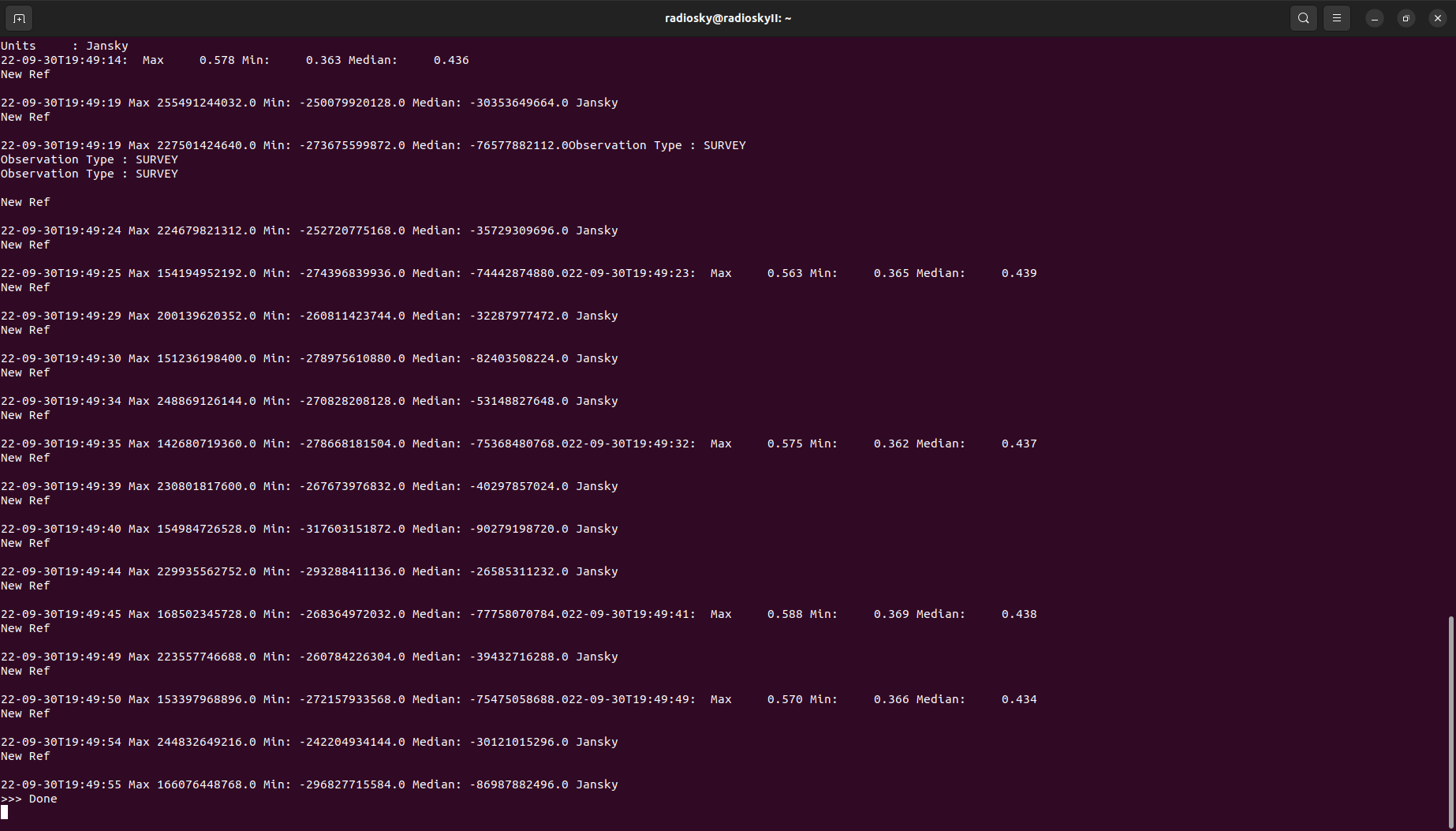

Last, I've included a PDF of the OOT GNU Radio blocks, modified from the original DISPIRA GRC blocks.
I will also say, the KrakenSDR fan is much to be desired. It at times may hit against the cage housing.
Which may signal issues with the vendor's quality control, dust getting into the fan bearing, electrical wiring interference, or perhaps poor design, take your pick! The housing and system though seems rock solid, meaning no moving parts shaking around.
I've been treating and handling Krakensdr like gold, because of the awfully long arrival time of 9 plus months!
The low sample rate of 2.4MHz and running the finicky Heimdall DAQ software, the USRP-B210, even with its steep price range, 🤑 was worth the purchase!
With that said, the Krakensdr does work, once you get to understand how the Heimdall DAQ TCP socket connection software works and configure; as well as how to use it with GNU Radio, and getting the benefits of a low sample rate RAS Interferometer. 😊
To view this discussion on the web visit https://groups.google.com/d/msgid/sara-list/18c020ab-54a1-5a8b-7d68-d722562c2a74%40gmail.com.
Anthony
Sep 30, 2022, 6:37:17 PM9/30/22
to sara...@googlegroups.com
My apologies, Kimmo for my misspelling your name!
Marcus D. Leech
Sep 30, 2022, 7:44:02 PM9/30/22
to sara...@googlegroups.com
On 2022-09-30 18:26, Anthony wrote:
Hi Kemmo!
As Marcus stated, the KrakenSDR has a sample rate of only 2.4MHz, the USRP-B210 is one of the best options for higher sample rates, bandwidth if you're looking for inherently built coherent RTL-SDR out of the box, for a RAS Interferometer.
Keep in mind that RTL-SDR refers to a very specific type of
super-cheap Software Defined Radio. Neither the USRP B210 nor
the AirSpy R2 are based on the RTL-SDR, whereas the KrakenSDR *IS* based on the RTL-SDR.
the AirSpy R2 are based on the RTL-SDR, whereas the KrakenSDR *IS* based on the RTL-SDR.
Here is some of the work I'm doing, in order to get my interferometer up and running, using two, 3-meter satellite dishes. I'm planning on rotors but based on my satellite mounting poles, that will be a challenge. Unless I can remember my MIG & TIG welding days, back in my 20s working on military aircraft (F18 Hornets, Apache AH64, Black Hawks and A10 WartHogs). 😊
The KrakenSDR is cheaper and is stable, once you do a lot of tweaking with it.
You will need to acquire a powerful PC in order to run the Heimdall DAQ software along with other programs for RAS.
If and when I get a KrakenSDR, I'll likely run the Heimdall DAQ
software on an rPi4--they have a pre-built image for it,
and that turns the radio into an "ethernet appliance".
and that turns the radio into an "ethernet appliance".
Anthony
Sep 30, 2022, 7:55:18 PM9/30/22
to sara...@googlegroups.com
I agree!
Using the rPi4 and the Kraken's install script: https://github.com/krakenrf/krakensdr_docs/wiki/10.-VirtualBox,-Docker-Images-and-Install-Scripts#install-scripts
I have a rPi4, but decided to run other software programs and chose the painstaking way of a PC.
In Fact the rPi4 is what Kraken recommends.
--
--
You received this message because you are subscribed to the Google
Groups "Society of Amateur Radio Astronomers" group.
To post to this group, send email to sara...@googlegroups.com
To unsubscribe from this group, send email to
sara-list-...@googlegroups.com
For more options, visit this group at
http://groups.google.com/group/sara-list?hl=en
---
You received this message because you are subscribed to the Google Groups "Society of Amateur Radio Astronomers" group.
To unsubscribe from this group and stop receiving emails from it, send an email to sara-list+...@googlegroups.com.
To view this discussion on the web visit https://groups.google.com/d/msgid/sara-list/dd347e01-2d63-81f8-c8c7-7351a89d480f%40gmail.com.
Marcus D. Leech
Sep 30, 2022, 8:05:57 PM9/30/22
to Anthony, Society of Amateur Radio Astronomers
On 2022-09-30 19:58, Anthony wrote:
Like I said, the "RTL-SDR" name refers to very specific hardware--namely, the RTL2832 chip from RealTek, with usually anThat is good info, Marcus!! Didn't realize the USRP-B210 or AirSpy were not true RTL-SDRs. I'm still learning a lot from you! 😊
R820T2 receiver chip feeding it.
But in the very very broad world of Software Defined Radios (SDRs), there are lots and lots of different implementations,
with lots and lots of different bits and pieces of hardware. In fact, the USRP "family" has been around since around 2003,
and pre-dates the uber-cheap RTL-SDR "sticks" by many years. There are HackRFs, and AirSpys, and BladeRFs (both older
and newer versions), the SDRPlay radios, the LimeSDR radios, and several others. None of them have much in common
with the RTL-SDR "sticks", other than they're Software Defined Radio receivers/transceivers. What brings this all together
is the software side of things (hence, "Software Defined Radio"), and the ability of DSP toolkits to be partially or almost
entirely "agnostic" with respect to the hardware you're using.
--
--
You received this message because you are subscribed to the Google
Groups "Society of Amateur Radio Astronomers" group.
To post to this group, send email to sara...@googlegroups.com
To unsubscribe from this group, send email to
sara-list-...@googlegroups.com
For more options, visit this group at
http://groups.google.com/group/sara-list?hl=en
---
You received this message because you are subscribed to the Google Groups "Society of Amateur Radio Astronomers" group.
To unsubscribe from this group and stop receiving emails from it, send an email to sara-list+...@googlegroups.com.
To view this discussion on the web visit https://groups.google.com/d/msgid/sara-list/dd347e01-2d63-81f8-c8c7-7351a89d480f%40gmail.com.
Kimmo
Oct 3, 2022, 4:42:00 PM10/3/22
to Society of Amateur Radio Astronomers
Hi
Several years ago I build the SIDI (Simple Digital Interferometer), developed by Marko Cebokli ( http://lea.hamradio.si/~s57uuu/astro/sidi1/index.htm ). The sampling frequency was about 150kHz, through a printer port of a PC :-)
The fringes from the Sun were easily observed and they had a very good quality. I was working in the 23cm HAM band, using Yagi-Uda antennas. So I believe that 2.4MHz sample rate is more than enough to detect fringes from the Sun with your 3m antennas.
Anthony, can you make a two-antenna interferometer, the antennas located approximately along East-West, then let the Sun go through the beams, and use GNU Radio to record the data from two channels of KrakenSDR ?
Well, if you have 3m antennas, you may not be willing to move them :-) Do you have smaller antennas ?
Anyway, it should work unless the antennas are along North-South.
It would be interesting to analyze the data and see the fringes...
cheers, Kimmo
Marcus D. Leech
Oct 3, 2022, 5:36:30 PM10/3/22
to sara...@googlegroups.com
On 2022-10-03 16:42, Kimmo wrote:
Hi
Several years ago I build the SIDI (Simple Digital Interferometer), developed by Marko Cebokli ( http://lea.hamradio.si/~s57uuu/astro/sidi1/index.htm ). The sampling frequency was about 150kHz, through a printer port of a PC :-)
The fringes from the Sun were easily observed and they had a very good quality. I was working in the 23cm HAM band, using Yagi-Uda antennas. So I believe that 2.4MHz sample rate is more than enough to detect fringes from the Sun with your 3m antennas.
Anthony, can you make a two-antenna interferometer, the antennas located approximately along East-West, then let the Sun go through the beams, and use GNU Radio to record the data from two channels of KrakenSDR ?
There's no reason to record the raw I/Q data. Gnu Radio is
perfectly capable of doing the required conjugate multiply itself,
and
then you just integrate and decimate, and then log the resulting complex correlation at some more-leisurely pace.
then you just integrate and decimate, and then log the resulting complex correlation at some more-leisurely pace.
To view this discussion on the web visit https://groups.google.com/d/msgid/sara-list/54f21da5-8d47-4252-bda3-f6093d373b92n%40googlegroups.com.
Reply all
Reply to author
Forward
0 new messages