
Restoring Nature Is Our Only Climate Solution - resilience

Philip Bogdonoff
Restoring Nature Is Our Only Climate Solution - resilience
https://www.resilience.org/stories/2024-07-01/restoring-nature-is-our-only-climate-solution/
-- Philip

rob...@rtulip.net
Hello Philip. I don’t agree with your comment that this article is very good. While it does contain much excellent information, its strategic vision is romantic, impractical and wrong, with no workable theory of change. The measures it promotes to fix the carbon problem are far too small and slow to prevent dangerous warming before tipping points overwhelm Earth systems.
The basic problem, like numerous similar articles, is the total failure to recognise the central role of albedo in global warming and Earth System Sensitivity. The author relies on this appalling article to defend his ridiculous dismissive line that solar geoengineering might be “worse than the problem they are trying to solve.” It is profoundly biased for him to say “critics point out” something that is totally disputed by knowledgeable scientists. This attack on sunlight reflection is alarmist political rhetoric with no scientific basis, failing to recognise the central roles of research and governance in albedo enhancement. Just because some ignorant activists can speculate about what “might” happen is not a moral or sensible basis for policy recommendation.
It would be far more balanced if this article engaged with James Hansen’s recent assessment that the darkening of the world since 2015 has warming effect equivalent to 110 ppm of CO2. This recent driver of warming is many orders of magnitude more critical than any carbon effect, and needs to be recognised in any good analysis of the climate situation. Hansen states “the large increase of global absorbed solar radiation since 2015 is a decrease of Earth’s albedo (reflectivity) by 0.4%. This reduced albedo is equivalent to a sudden increase of atmospheric CO2 from 420 to 530 ppm.”
Hansen’s 0.4% calculation uses a conservative method. This sudden albedo collapse could equally be calculated as 1.4%, and even worse since 2000, about 2%. This problem is the primary driver of accelerating feedbacks.
Restoring lost albedo needs to become the primary climate focus, creating governance systems to rebrighten the planet that will buy time and create political awareness to address the much slower and more difficult real challenges of carbon that are covered in this article. Thinking globally means understanding the need for net zero heating.
Regards
Robert Tulip
--
You received this message because you are subscribed to the Google Groups "Planetary Restoration" group.
To unsubscribe from this group and stop receiving emails from it, send an email to planetary-restor...@googlegroups.com.
To view this discussion on the web visit https://groups.google.com/d/msgid/planetary-restoration/CADBd-rkG0%3DvG1_99bL%2BXDZfPbp_DbOoAtVtDOpn5yze9TAO6CQ%40mail.gmail.com.

Bruce Melton -- Austin, Texas
Natural systems are a good sounding idea that is no longer so good and sound. This used to be a fundamental solution, but not since we crossed the tipping collapse activation threshold. Earth systems are collapsing (tipping systems) and once a system begins collapse --any system-- it does not stabilize unless the perturbation to the system that caused the collapse to begin is stabilized. Because Earth systems are only very modest sequestering agents on a per unit basis, it is likely on average, that those systems that have seen their tipping collapses activated are now emitting and no longer sequestering.
(From Heinberg's article - Restoring
Nature Is Our Only Climate Solution)
The biggest contributors to the small water cycle are intact forests; therefore, our first order of business should be to protect existing old-growth forests (you can plant a tree in a few minutes, but an old-growth forest requires centuries to mature). At the same time, we can plant millions more trees—but they must be the right kinds of trees in the right places. We must anticipate climate change and assist forests to migrate to suitable climate zones.
On average globally, forests have seen a doubling of mortality, meaning a halving of forest age and carbon storage with time relative to the age of the forest. This is one of the major things we film. These collapses will not stop until we have restored Earth's temperature back to within the evolutionary boundaries of our forests. A doubling of mortality means a doubling of tree death from (generally) 1 per 200 to 1 per 400 per year, to 2 per 200 to 2 per 400 per year. Some of the science on forest mortality is below but I want to emphasize the above statement "our first order of business should be to protect existing old-growth forests."
Our planet's oldest, old growth forests in California and along the West Coast are in active collapse from water stress, disease, insect attack and fire. These forest contain not only wildly old, old growth sequoias and redwoods, but the fabulous climate of the West Coast also includes numerous other species that attain a giant stature and age: sugar, ponderosa, limber, bristlecone, and lodgepole pines, white and Douglas fir, western hemlock, incense cedar, sitka spruce, western juniper, -- it's an amazing list of giants, much larger list than this.
There are too many indicators of forest collapse and regeneration
failure to list now, but below I have copied in some of my forest
health notes I have collected over the years in the form of
summarized academic findings.
Also, the following link is a deeply referenced article I wrote
for Truthout in 2022 on the collapse of the sequoia ecosystem in
the Sierra Nevada.
Steep trails,
B
Mass Death of Sequoias Is the Harbinger of Earth Systems
Collapse
We have entered an era where burned forests may not return unless
we cool Earth to below the tipping point.
By Bruce Melton , TRUTHOUT
Published August 9, 2022
https://truthout.org/articles/mass-death-of-sequoias-is-the-harbinger-of-earth-systems-collapse/
(An unabridged version with summarized references is here - https://climatediscovery.org/giant-sequoias-a-tipping-point/)

~ ~ ~
These notes below include summaries and references for
Forest Mortality, Wildfire and
Forest Regeneration failure.
~ ~ ~
Forest Mortality Master
~ ~ ~
Summary with citations 111123 Mortality, Emissions and Regeneration Failure
~ ~ ~
Earth's natural systems carbon sequestration permanence is failing...
A simple interpretation of findings reveals that except for our oceans, the most important Earth systems for sequestration are in collapse. McDowell 2020 says that on average in the US and Europe, forests have seen a doubling of mortality. A doubling of mortality halves a forest's life and halves carbon storage, creating emissions instead of sequestration because forests are only modest sequestration resources when healthy. Work in the Amazon, western North American forests, from Canada and Australia, all show a doubling or greater of forest mortality. Work from the Amazon, permafrost lands that include forest drowning, and Canadian forests show net greenhouse gas emissions instead of sequestration. If these subcontinental-scale areas are seeing forest failure, similar forests globally are likely behaving similarly. When it is understood that even if the global temperature were stabilized tomorrow morning, not only would currently extreme chronic and acute weather events that have caused mortality to increase still occur, rarer and even more extreme weather events would still occur as time passed because of the distribution of different extremeness of weather events as a part of frequentist statistics. It is clear then that with our current global temperature, forest mortality rates will continue to worsen. This singular concept of, once a natural system collapse begins it does not stabilize unless the perturbation to the system that activated the collapse is removed, bodes poorly for continued sequestration of natural systems globally. The reality is that natural systems collapses generally create feedback emissions quite soon after collapse initiation. There is a high risk that if we use these systems to offset emissions or provide drawdown, the systems will not only fail at the task, but reverse the intention through feedback emissions. Below are numerous findings that show that it is plausible if not likely that globally, our natural systems are failing and likely even emitting greenhouse gases, not sequestering them as the standard body of the science climate change mitigation continues to suggest is reality.
~ ~ ~
Many other lines of research collaborate a general global flip of forests to emissions from increased mortality: Bauman 2022 - doubling of Australian tropical forest mortality in the previous 35 years, with a plausible similar shift in southeast Asian tropical forests, Mantgem 2009 - US West tree mortality from the mid 1950s to late 2000s, more than double, McDowell 2015 - Western North American forest mortality increased two to four times between 1980 and the mid-2000s with much of the increase happening recently, Rosenblad 2023 - Thermophilization: Mortality increased eight times in western US forests, Liu 2023 - Canada's boreal forest mortality about doubled 1970 to 2020 and lost (net) 3.5 Gt carbon as CO2, about 90 percent since 2000, and Allen 2015 – Ten drivers of a warmer climate that reveal underestimation in forest mortality.
Emissions from these collapsing systems are now being documented: Forzieri 2022 - Forest collapse globally of 12.2 Gt CO2 2000-2022, equal to 23 percent of intact undisturbed forests at a critical threshold, Qin 2021 - From 2000 to 2019 the Amazon had a gross above ground carbon loss of 0.6 gigatons, or 2.45 Gt CO2eq, with 73 percent from forest degradation and 27 percent from deforestation, Gatti 2021 - Amazon emitting, not absorbing, 1 Gt CO2 annually on average from 2010 to 2018, Canadian Forest Service 2020 - Canadian forests emitting 250 Mt CO2eq annually, and Natali 2019 - Permafrost collapse of 2.3 Gt CO2eq annually, including emissions from drowned forest.
Mortality alone is just a part of the picture. Regrowth can minimize emissions, but forest regeneration is failing: Hill 2023 - Increased regeneration failure and wildfire risk from warming across the Sierra Nevada, Hill and Field 2022 - Seedling regeneration in unburned plots is reduced by 15 to 36 percent from 2000 to 2019 in Western forests, Singleton 2021 - Poor ponderosa regeneration because of climate warming and moisture limitation, Coop 2020 - An era when prefire forests may not return, Davis 2019 -- Forests exceed climate change regeneration threshold leading to non-forested states, Stevens-Rumann 2017 - One third of burned Western US forests are not regenerating at all, Crasubay 2017 - Anticipated transition from forested to shrubland ecosystems, and Singleton 2021 - Poor Ponderosa Regeneration because of climate warming and moisture limitation.
(Summary)
Global tropical, high altitude and high latitude forests have likely flipped on average from sequestration sink to emissions source, based on Bauman 2022 and McDowell 2015…
Bauman 2022 shows Australian tropical forests have seen a doubling of forest mortality which translates to a halving of forest age and a halving of carbon storage. Because forests are only modest carbon sinks, Bauman 2022 suggests Australian tropical forests have now flipped to emitting GHGs. They also suggest that southeast Asian forests are likely behaving similarly. I spoke to Bauman to confirm and he said what he now believes is that globally, because of the same water stress that created a doubling of Australian tropical forest mortality, all tropical forests globally are likely now behaving similarly. McDowell 2015 describes forest mortality across western North America with ranges from nearly doubling to quadrupling and using the same logic as Bauman 2022, this means these forests are now emitting, not absorbing.
Assuming that western North American high altitude and high latitude forests are also analog to similar ecologies across the globe where a doubling of mortality results in a halving of carbon storage, on average then it is likely that in addition to tropical forests globally, high altitude and high latitude forests globally have also flipped from sink to source.
This interpretation is backed up by flips of the Amazon (1 Gt CO2eq emissions annually - Gatti 2021, Quin 2021), Canadian forests (250 Mt CO2eq emissions annually - Canadian Forest Service 2020), and permafrost (2.3 Gt CO2eq emissions annually - Natali 2019, where this is net emissions that include drowned forests). We also need to consider the Amazon and permafrost emissions are averages, and both were likely stable at the beginning of the averaging period, therefor emissions at the end of the averaging period could be interpreted as being double the average, assuming a linear increase. This would put emissions from just the Amazon, Canadian forests and permafrost regions at about 7 Gt CO2 annually.
(End
Summary)
Australian tropical forest
mortality
doubled in the last 35 years, mostly recently. A personal
communication with
Bauman says global tropical forests are likely behaving
similarly because of
the same water stress… Bauman 2022 analyzed a 49-year record
across 24
old-growth tropical forests in Australia and found mortality has
doubled
because of water stress across all plots in the last 35 years
indicating a
halving of life expectancy and carbon residence time and
suggesting that
Australian tropical forests have now flipped from a CO2 sink to a
source of CO2
emissions. Further, they suggest Southeast Asian tropical forests
are behaving
similarly. When I asked Bauman to confirm that Australian tropical
forests are
analog to Southeast Asian tropical forests,
he suggested what he believed now was that the same water
stress is
likely affecting all tropical forests globally in a similar way.
Bauman et al., Tropical tree mortality has increased with rising
atmospheric
water stress, Nature, May 17, 2022.
(Researchgate, free account required) https://www.researchgate.net/publication/360691427_Tropical_tree_mortality_has_increased_with_rising_atmospheric_water_stress
Understanding this relationship with mortality doubling resulting in a halving of carbon storage, I recalled McDowell 2015 discussed mortality rates of forests across Western North America:
Western North American forest mortality increased two to four times between 1980 and the mid-2000s with much of the increase happening recently… It is also pertinent that warming since the mid-2000s has just about doubled as of 2022, and that much of the recent western US forest mortality from bark beetles and increase in burn area was not captured in McDowell 2015:
Mortality of Western North American forests from
McDowell
2015:
-- Sierra Nevada mortality has doubled from 0.75 to 1.5 percent
-- Western Canadian forest mortality has quadrupled from 0.6
percent to 2.5
percent
-- Eastern Canadian forest mortality has nearly doubled from 0.8
to 1.45
percent
-- Western US interior forests mortality has more than doubled
from 0.3 percent
to 0.65 percent.
-- Pacific Northwest forests mortality has tripled from 0.45 to
1.25 percent
McDowell
et al., Multi-scale predictions of massive conifer mortality due
to chronic
temperature rise, Los Alamos National lab, Nature Climate Change,
December 21,
2015.
https://www.acsu.buffalo.edu/~dsmackay/mackay/pubs/pdfs/nclimate2873.pdf
US
West tree
mortality from the mid 1950s to late 2000s, more than doubled…
This is a
good view of early tree mortality trends showing the increasing
trend
accelerating after the 1970s. Regional mortality in prior to the
1970s was 0.2,
0.4 and 0.8 percent in Pacific Northwest, Coastal California, and
the interior.
After the 1970s mortality rate accelerated and at 2008 was 0.5,
1.3 and 1.8
percent, indicating a more than doubling to a more than tripling
or mortality.
Average forest age was 450 to 1000 years.
Mantgem et al., Widespread increase of tree mortality rates in the
Western
United States, Science , January 23, 2009.
https://www.fs.usda.gov/pnw/pubs/journals/pnw_2009_vanmantgem001.pdf
US and European Forests
mortality more than
doubled… "The impacts of global change on forest
demographic rates may
already be materializing. In mature ecosystems, tree mortality
rates have
doubled throughout much of the Americas and in Europe over the
last four
decades (7-9)… Beyond
changing
vegetation dynamics within “intact” or relatively undisturbed
forests, episodic
disturbances are tending to be larger, more severe and, in some
regions, more
frequent under global
change(17-20). Similarly,
the rates and
types of land-use change (LUC) vary widely (21) but have, on
average, increased
globally in the past few centuries (2,22,23)… Thus, at the global
scale,
disturbances [climate change related] and LUC [land use change]
have likely
amplified tree mortality beyond that suggested by the doubling of
background
mortality rates in undisturbed forests (7-9)."
McDowell et al, Pervasive shifts in forest dynamics in a changing
world,
Science, May 29, 2020.
https://www.dora.lib4ri.ch/wsl/islandora/object/wsl%3A23827/datastream/PDF2/McDowell-2020-Pervasive_shifts_in_forest_dynamics-%28accepted_version%29.pdf
Rosenblad 2023,
Thermophilization –
Mortaity increased eight times in Western US Forests 2010 to
2018 … Simply
put, thermophilization is forest evolution due to warming. It is
driven in
Western US forests by two factors, recruitment of new heat and
drought tolerant
species and mortality of less heat and drought tolerant species.
Mortality is
winning by 2:1. Rosenblad reveals a 20 percent mortality rate in
10 years -
four to eight times normal. A doubling of mortality rate halves
carbon
storage... ""Here, we analyze 10-y changes in tree community
composition across 44,992 forest subplots in the western United
States... The
dataset comprised 316,519 trees that survived between censuses
(mean = 5.6 per
subplot), 64,024 that died (1.1 per subplot), and 35,836 that
recruited (0.63
per subplot)."
Thermophilization... Rosenblad et al., Climate change, tree
demography, and
thermophilization in western US forests, PNAS, April 24, 2023.
https://www.pnas.org/doi/epdf/10.1073/pnas.2301754120
Canada's boreal forest
mortality about
doubled 1970 to 2020 and lost
(net) 3.5
Gt carbon as CO2, about 90 percent since 2002… "From 1970 to
2020. We
show that the average annual tree mortality rate is approximately
2.7%.
Approximately 43% of Canada's boreal forests have experienced
significantly
increasing tree mortality trends (71% of which are located in the
western region
of the country), and these trends have accelerated since 2002.
This increase in
tree mortality has resulted in significant biomass carbon losses
at an approximate rate of
1.51 ± 0.29 MgC
ha−1 year−1 (95% confidence interval) with an approximate total
loss of 0.46 ± 0.09 PgC
year−1 (95% confidence interval). Under the drought condition
increases
predicted for this century, the capacity of Canada's boreal
forests to act as a
carbon sink will be further reduced, potentially leading to a
significant
positive climate feedback effect… The boreal ecosystem accounts
for about a
third of the Earth's extant forests, containing an estimated
one-third of the
stored terrestrial C stocks (Bradshaw & Warkentin, 2015; Pan
et al., 2011).
The land area of Canada's boreal forests (including other wooded
land types)
covers 309 Mha (Brandt et al., 2013), nearly 30% of the global
boreal forested
area (Brandt, 2009)… The overall increase in the biomass loss rate
led to a
significant reduction in biomass over the study period. From 1970
to 2020, the
reduction in biomass was estimated at 3.01 ± 0.58 Mg ha−1 year−1
(95%
confidence interval) with a total biomass loss throughout the
entire boreal
forested area of Canada (310 Mha) of approximately 0.93 ± 0.18 Pg,
[3.4 Gt
CO2eq] of which 83% was aboveground biomass and 17% was
belowground
biomass." Mortality increase from Figure 1b.
Liu et al., Drought-induced increase in tree mortality and
corresponding
decrease in the carbon sink capacity of Canada's boreal forests
from 1970 to
2020, Global Change Biology, January 3, 2023.
https://www.osti.gov/servlets/purl/1962503
Forests
in the
Canadian Rockies have seen a ten times increase in mortality
in the last fifty
years … Peng
et al., A drought induced pervasive increase in tree mortality
across Canada’s
boreal forests, Nature
Climate Change,
December, 2011. http://www.crc.uqam.ca/Publication/2011/Peng%20et%20al_Nature_CC_Nov20_2011.pdf
Canada's boreal forest
mortality about
doubled 1970 to 2020 and lost
(net) 3.5
Gt carbon as CO2, about 90 percent since 2002… "From 1970 to
2020. We
show that the average annual tree mortality rate is approximately
2.7%.
Approximately 43% of Canada's boreal forests have experienced
significantly
increasing tree mortality trends (71% of which are located in the
western region
of the country), and these trends have accelerated since 2002.
This increase in
tree mortality has resulted in significant biomass carbon losses
at an approximate rate of
1.51 ± 0.29 MgC
ha−1 year−1 (95% confidence interval) with an approximate total
loss of 0.46 ± 0.09 PgC
year−1 (95% confidence interval). Under the drought condition
increases
predicted for this century, the capacity of Canada's boreal
forests to act as a
carbon sink will be further reduced, potentially leading to a
significant
positive climate feedback effect… The boreal ecosystem accounts
for about a
third of the Earth's extant forests, containing an estimated
one-third of the
stored terrestrial C stocks (Bradshaw & Warkentin, 2015; Pan
et al., 2011).
The land area of Canada's boreal forests (including other wooded
land types)
covers 309 Mha (Brandt et al., 2013), nearly 30% of the global
boreal forested
area (Brandt, 2009)… The overall increase in the biomass loss rate
led to a
significant reduction in biomass over the study period. From 1970
to 2020, the
reduction in biomass was estimated at 3.01 ± 0.58 Mg ha−1 year−1
(95%
confidence interval) with a total biomass loss throughout the
entire boreal
forested area of Canada (310 Mha) of approximately 0.93 ± 0.18 Pg,
[3.4 Gt
CO2eq] of which 83% was aboveground biomass and 17% was
belowground
biomass." Mortality increase from Figure 1b.
Liu et al., Drought-induced increase in tree mortality and
corresponding
decrease in the carbon sink capacity of Canada's boreal forests
from 1970 to
2020, Global Change Biology, January 3, 2023.
https://www.osti.gov/servlets/purl/1962503
From 2000 to
2019
the Amazon had a gross above ground carbon loss of 0.6
gigatons, or 2.45 Gt
CO2eq, with 73 percent from forest degradation and 27 percent
from
deforestation… This
is the second major finding that ht Amazon has flipped from
carbon sink to
carbon source. See also Gatti 2019.
Qin et al., Carbon loss from forest degradation exceeds that
from deforestation
in the Brazilian Amazon, Nature Climate Change, April 29, 2021.
https://arxiv.org/ftp/arxiv/papers/2206/2206.07363.pdf
Amazon emitting, not absorbing, 1 Gt CO2 annually on average from 2010 to 2018… based on atmospheric measurements over time… "Considering the upwind areas of each site, we combine fluxes from all sites to calculate a total Amazonia carbon balance for our nine-year study period (see Methods) of 0.29±0.40 Pg Cyr−1 (FCTotal=0.11±0.15gCm−2d−1), where fire emissions represent 0.41±0.05PgCyr−1 (FCFire=0.15±0.02gCm−2d−1), with NBE removing −0.12±0.40PgCyr−1 (31% of fire emissions) from the atmosphere (FCNBE=−0.05±0.15gCm−d−1). The east (region 1 in Extended Data Fig.6), which represents 24% of Amazonia (of which 27% has been deforested), is responsible for 72% of total Amazonian carbon emissions, where 62% is from fires. One recent study showed cumulative gross emissions of carbon of about 126.1MgCO2 ha−1 for 30yr after a fire event, where cumulative CO2 uptake from forest regrowth offsets only 35% of the emissions. Another recent study13 reported that fire emissions from Amazonia are about 0.21±0.23PgCyr−1. Recently, vander Werf etal.24 estimated for the period 1997–2009 that globally, fires were responsible for an annual mean carbon emission of 2.0PgCyr−1, where about 8% appears to have been associated with South American forest fires, according to estimates from the Global Fire Emission Data set (GFED V.3). The Amazon Forest Inventory Network (RAINFOR) project showed a decline in sink capacity of mature forests due to an increase in mortality1–3. Adjusting the three RAINFOR studies to a consistent area (7.25×10⁶km2) and taking their mean yields a basin-wide sink for intact forests of about −0.57, −0.41 and −0.23PgCyr−1 for 1990–1999, 2000–2009 and 2010–2019, respectively. The NBE from this study is consistent with the RAINFOR results for the last decade, because NBE represents the uptake from forest but also all non-fire emissions, such as decomposition, degradation and other anthropogenic emissions (see Supplementary Table 3)."
Gatti et al., Amazonia as a carbon source linked to deforestation and climate change, Nature, July 14, 2021.
https://pure.rug.nl/ws/files/176729920/s41586_021_03629_6.pdf
Permafrost Collapse is
Underway
With Emission Plausibly Rivaling All of Global
Transportation... "Here we synthesize regional in situ observations of CO2
flux from Arctic and boreal soils to assess current and future
winter carbon
losses from the northern permafrost domain. Across the Northern
Hemisphere,
permafrost melt emitted 630 TgC, or 2.3 Gt CO2eq. "We estimate a
contemporary loss of 1,662 TgC per year from the permafrost
region during the
winter season (October–April). This loss is greater than the
average growing
season carbon uptake for this region estimated from process
models (−1,032 TgC
per year)." Of critical note, emission are average per year from
2003 –
2017. With permafrost melt increasing rapidly today, this means
emission in
2017 were much more than in 2003, therefore emissions today are
much more than
the 2.3 Gt per year estimated on average, quite likely double
the 2.3 Gt and
possibly triple or quadruple and rivalling global transportation
CO2 emissions
for about 6.7 Gt CO2 per
year... "The
dataset represents more than 100 high-latitude sites and
comprises more than
1,000 aggregated monthly fluxes. We examined patterns and
processes driving
winter CO2 emissions and scaled fluxes to the permafrost domain
using a boosted
regression tree (BRT) machine learning model based on
hypothesized drivers of
winter CO2 flux. Environmental and ecological drivers (for
example, vegetation
type and productivity, soil moisture and soil temperature)
obtained from
satellite remote sensing and reanalysis data were used to
estimate regional
winter CO2 emissions for contemporary (2003–2017) climatic
conditions."
Natali et al., Large loss of CO2 in winter observed across the
northern
permafrost region, Nature Climate Change, October 21, 2019.
https://www.uarctic.org/media/1600119/natali_et_al_2019_nature_climate_change_s41558-019-0592-8.pdf
Transportation emissions of 7 GT CO2eq or 6.7 Gt CO2 annually…
IPCC 2013, Physical Science Basis, Chapter 8, Transport
https://www.ipcc.ch/site/assets/uploads/2018/02/ipcc_wg3_ar5_chapter8.pdf
Forzieri 2022 - Forest collapse globally of
12.2 Gt CO2
2000-2022, equal to 23 percent of intact undisturbed forests at
a critical
threshold… "We
show that
tropical, arid and temperate forests are experiencing a
significant decline in
resilience, probably related to increased water limitations and
climate
variability [during 2000 – 2022]… Reductions in resilience are
statistically
linked to abrupt declines in forest primary productivity,
occurring in response
to slow drifting towards a critical resilience threshold.
Approximately 23% of
intact undisturbed forests, corresponding to 3.32 Pg C (12.2 Gt
CO2e) of gross
primary productivity (above ground carbon), have already reached a
critical
threshold and are experiencing a further degradation in
resilience. Together,
these signals reveal a widespread decline in the capacity of
forests to
withstand perturbation that should be accounted for in the design
of land-based
mitigation and adaptation plans."
Forzieri et al., Emerging signals of declining forest resilience
under climate
change, Nature, July 13, 2022.
https://www.nature.com/articles/s41586-022-04959-9.pdf
End Forest Mortality Master
~ ~ ~
Wildfire Master
*^*^*^*^*^*^*^*^*^
ONLY ONE OF SEVEN INCREASED FIRE BEHAVIOR ENHANCING FACTORS WE KNOW OF TODAY IS NOT CAUSED BY CLIMATE CHANGE
The seven fire behavior factors that have caused these repeatedly unprecedented climate change-caused wildfires are: record dry fuels, a longer dry season with earlier spring and later fall, easier ignition with warmer temperatures, bigger wind storms, delayed onset of fall precipitation, increased nighttime fire behavior, and increased fuels because of fire suppression. Only increased fuels because of fire suppression is not climate change caused, but 100 million acres of native bark beetle kill across North America, plus millions more acres in mortality from drought, other insects and disease, a re certainly a climate change-caused enhancement of the excess fuels issue. Together, CalFire says these increased extremeness of fires because of these seven enhancement factors are now causing fires to burn 400 degrees F hotter, and area burned in 2020 was similar to pre-European times, only CalFire spent $3 billion fighting fires in 2020. These fire behavior enhancing mechanisms have increased extreme severity fire by 800 percent with 95 percent of burned area in 2020 and 2021 being extreme severity fire.
Extreme fire weather days have more than doubled since 1980 in California…
"Observed frequency of autumn days with extreme (95th percentile) fire weather—which we show are preferentially associated with extreme autumn wildfires—has more than doubled in California since the early 1980s."
Goss
et al., Climate change is increasing the likelihood of extreme
autumn wildfire
conditions across California, Environmental Research Letters,
August 20, 2020.
https://iopscience.iop.org/article/10.1088/1748-9326/ab83a7/pdf
Climate
Change Caused Wildfires: Columbia University, University of
Idaho, Scripps
Institution of Oceanography, University of Colorado
Boulder...
"During 1972–2018, California experienced a fivefold increase in
annual
burned area, mainly due to more than an eightfold increase in
summer forest‐fire
extent. Increased summer forest‐fire area very likely occurred due to
increased atmospheric
aridity caused by warming. Since the early 1970s, warm‐season
days warmed by approximately 1.4 °C as part of a centennial
warming trend,
significantly increasing the atmospheric vapor pressure deficit
(VPD). These
trends are consistent with anthropogenic trends simulated by
climate models.
The response of summer forest‐fire area to VPD is exponential, meaning
that warming has
grown increasingly impactful. Robust interannual relationships
between VPD and
summer forest‐fire
area strongly suggest that nearly all of the increase in summer
forest‐fire
area during 1972–2018 was driven by increased VPD. Climate
change effects on summer
wildfire were less evident in nonforested lands. In fall, wind
events and
delayed onset of winter precipitation are the dominant promoters
of wildfire.
While these variables did not change much over the past century,
background
warming and consequent fuel drying is increasingly enhancing the
potential for
large fall wildfires. Among the many processes important to
California's
diverse fire regimes, warming‐driven fuel drying is the clearest link
between
anthropogenic climate change and increased California wildfire
activity to
date."
Williams et al., Observed Impacts of Anthropogenic Climate
Change on Wildfire
in California, American Geophysical Union, Earths Future, August
4, 2019
https://agupubs.onlinelibrary.wiley.com/doi/epdf/10.1029/2019EF001210
400 Degrees Hotter… Wildfires are burning 400
degrees F hotter
because of drier fuels. "The infernos bellowed by those winds
once reached
a maximum temperature of 1,700 degrees Fahrenheit, Cal Fire’s
Angie Lottes
says; now they reach 2,100 degrees, hot enough to turn the
silica in the soil
into glass."
Wallace-Wells, Los Angeles Fire Season Is Beginning Again.
And It Will
Never End. A bulletin from our climate future.
By David Wallace-Wells, NYMag, May 12, 2019.
http://nymag.com/intelligencer/2019/05/los-angeles-fire-season-will-never-end.html
Cal Fire says fire season is year-long now… Yahoo News is reporting that Cal Fire (California Department of Forestry and Fire Protection) says the fire season is now year-long.
Walsh,
California fights wildfires year-round now: 'There's no such
thing as a fire
season', Yahoo News, November 19, 2018.
https://www.yahoo.com/news/california-fights-wildfires-year-round-now-theres-no-thing-fire-season-200437814.html?guccounter=1
The
climate change connection… Summary and Conclusions: "most acute fire
weather in
over two decades… longest duration Santa Ana wind event in the
70-year record…
the most extreme drought on record… lowest fuel moisture on
record… driest
March through December since 1895."
Abstract: " Two extreme wind-driven wildfire events impacted
California in
late 2017, leading to 46 fatalities and thousands of structures
lost. This
study characterizes the meteorological and climatological
factors that drove
and enabled these wildfire events and quantifies their rarity
over the
observational record. Both events featured key fire-weather
metrics that were
unprecedented in the observational record that followed a
sequence of climatic
conditions that enhanced fine fuel abundance and fuel
availability. The North
Bay fires of October 2017 occurred coincident with strong
downslope winds, with
a majority of burned area occurring within the first 12 hours of
ignition. By
contrast, the southern California fires of December 2017
occurred during the
longest Santa Ana wind event on record, resulting in the largest
wildfire in
California’s modern history. Both fire events occurred following
an
exceptionally wet winter that was preceded by a severe four-year
drought. Fuels
were further preconditioned by the warmest summer and autumn on
record in
northern and southern California, respectively. Finally, delayed
onset of
autumn precipitation allowed for critically low dead fuel
moistures leading up
to the wind events. Fire weather conditions were well forecast
several days
prior to the fire. However, the rarity of fire-weather
conditions that occurred
near populated regions, along with other societal factors such
as limited
evacuation protocols and limited wildfire preparedness in
communities outside
of the traditional wildland urban interface were key
contributors to the
widespread wildfire impacts."
Nauslar et al., The 2017 North Bay and Southern California
Fires, A Case Study,
Fire, June 9, 2018.
https://www.mdpi.com/2571-6255/1/1/18/htm
Exponential
increase in extreme fire behavior from drying…
"Increases in large wildfires associated with earlier spring
snowmelt
scale exponentially with changes in moisture deficit, and
moisture deficit
changes can explain most of the spatial variability in forest
wildfire regime
response to the timing of spring." Westerling, Increasing
western US
forest wildfire activity, sensitivity to changes in the timing
of spring,
Philosophical Transactions of the Royal Society B, May 23, 2016,
abstract.
http://rstb.royalsocietypublishing.org/content/371/1696/20150178
Westerling - large California Wildfires
are increasing
nonlinearly with drying and earlier onset of spring...
"Increases in large wildfires associated with earlier spring
snowmelt
scale exponentially with changes in moisture deficit, and
moisture deficit
changes can explain most of the spatial variability in forest
wildfire regime
response to the timing of spring."
Westerling, Increasing western US forest wildfire activity,
sensitivity to
changes in the timing of spring, Philosophical Transactions of
the Royal
Society B, May 23, 2016, abstract.
http://rstb.royalsocietypublishing.org/content/371/1696/20150178
Modest
increase in Santa Ana Wind Events 1948 to 2010… Results
show a modest increase in intensity of extreme events. The
authors identified
two 2015 Santa Ana events were exceptional in the record, but
not included in
this research.
Guzman Morales et al., Santa Ana Winds of Southern California,
Six Decades,
GEophysical Resaerch Letters, March 14, 2016.
https://scripps.ucsd.edu/programs/cnap/wp-content/uploads/sites/109/2017/02/GuzmanMorales2016_SantaAnaWinds.pdf
Extremely
large Santa Ana fires increased since 2003… Abstract,
Jin et al.,
Contrasting controls on wildland fires in Southern California
during periods
with and without Santa Ana winds, Journal of Geophysical
Research,
Biogeosciences, March 28, 2014.
https://agupubs.onlinelibrary.wiley.com/doi/epdf/10.1002/2013JG002541
Wildfire
season increased 60 percent, burn time has increased 800
percent, burned area
increased 1,271 percent, human-caused ignition has played a
very small role in
increasing wildfire trends… Westerling, Increasing western US forest
wildfire activity,
sensitivity to changes in the timing of spring, Philosophical
Transactions of
the Royal Society B, June 15, 2016, Table 2.
http://rstb.royalsocietypublishing.org/content/371/1696/20150178
Wildfire area burned… Too little left to burn
• Ten percent of western forests have burned total in the last 30 years.
• Most of the increase has happened since 2000, about 75 percent.
• Beetle kill enhancement is not included. (40 million acres +/- in the US West has been killed by beetles.)
• In the next 15 years up to 30 percent of western US forests will burn.
• In 20 to 30 years, so much of the forest will have burned that the rate will fall even with continued warming because there will be too little forest left to burn. ***
*** Personal communications, John Abatzgoglou, 10/2016.
Abatzoglou and Williams, Impact of anthropogenic climate change on wildfire in the western US, PNAS, October 16, 2016.
https://www.pnas.org/content/113/42/11770
The
four biggest wildfire in Colorado's history happened in 2020 and
the two
biggest in new Mexico in 2022.
https://en.wikipedia.org/wiki/List_of_Colorado_wildfires
https://www.cnn.com/2022/06/09/weather/historic-simultaneous-new-mexico-wildfires-weekend/index.html
Forests are recovering after fire… It's a long-term look since 1950. Looking at the results, fires in the 1998 to 2018 period have very little return to conifers. The rest of the story is that a third of fires that have burned since the late 1990s have not recovered and half of the remaining that are recovering are recovering at half the 20th century rate. The Phys.org article states, "The researchers note this may not be permanent; recent decades have seen an uptick in fire disturbance in these forests, so in the future, the return to coniferous cover may take longer than it has in the past. As the climate continues to get warmer and drier, that also will affect how forests burn and how they recover."
If conifers return, and they are in many places, just not as robustly; when they do return, as they age and become less vigorous, degradation becomes greater nonlinearly with warming... not counting fires that are burning far more extremely, and far more frequently. In California in 2020, as many acres burned as burned annually in pre-European times, only in 2020 California spent $3.1 billion fighting those fires.
One other thing - they found near neutral changes in albedo (reflectivity). Their evaluation was over the long term. Immediately after a fire and for several years until vegetation grows back up above the snow line, there are obvious and large changes to not only albedo, but to ground temperature. Without the shade of the forest, before the vegetation grows back, the forest floor warms significantly. In areas where the boreal is atop permafrost, this usually initiates permafrost. Also, for numerous years after a burned before vegetation grows back above the snow line, albedo in winter is greatly increased from a near solid snow cover versus the very dark forest pre-fire. This also creates very large but local ecological changes.
And further, it's not fire that modelers are so concerned with about changing northern lands albedo, it's vegetation growing up in the tundra or scrublands. This taller vegetation allowed by a longer growing season and less fierce winter temps greatly changes albedo from what was once snow covered tundra and scrub. The problem with fire in boreal lands is what I stated above - permafrost collapse activation from loss of shaded tree cover.
Massey,
Forest composition change and biophysical climate feedbacks across
boreal North
America, Nature Climate Change, October 23, 2023.
https://www.nature.com/articles/s41558-023-01851-w
AUSTRALIA'S BLACK SUMMER
The 46 million acre Australian fire season 2019-2020 influenced the uncommon three-peat La Nina 2020-2022… "In response to the fires, an increase in biomass aerosol burdens across the southern hemisphere is simulated through late 2019 and early 2020, accompanied by an enhancement of cloud albedo, particularly in the southeastern subtropical Pacific Ocean. In turn, the surface cools, the boundary layer dries, and the moist static energy of the low-level flow into the equatorial Pacific is reduced. In response, the intertropical convergence zone migrates northward and sea surface temperature in the Niño3.4 region cools, with coupled feedbacks amplifying the cooling. A subsequent multiyear ensemble mean cooling of the tropical Pacific is simulated through the end of 2021, suggesting an important contribution to the 2020–2022 strong La Niña events ."
Fasullo
et al., A multiyear tropical Pacific cooling response to recent
Australian
wildfires in CESM2, Science Advances, May 10, 2023.
https://www.science.org/doi/epdf/10.1126/sciadv.adg1213
The
record 2019-2020 fire year in Australia saw 21 percent of
eucalyptus forests
burn where on average less than 2 percent burn every year… "The
area burned in eastern Australian eucalypt forests, well-known
for being
fire-prone, is only 2% or less on average, even in extreme fire
seasons,
similar to the average areas burned of temperate broad-leaf
forests on other
continents, where the fraction is well below 5% (apart from
Africa and Asia,
where the burn area can reach 8-9%). However, the 2019/2020
eastern Australian
fires consumed over 21% of the total forested area, an area far
beyond anything
previously experienced in Australia, or in the rest of the
world."
Norman et al., Apocalypse now: Australian bushfires and the
future of urban
settlements, Nature, February 23, 2021.
https://www.nature.com/articles/s42949-020-00013-7
Of the 17 million acres
burned in
2019-2020 in SE Australia, 44 percent were high severity
representing 44
percent of all high severity burned in the last 33 years…
"The
absolute area of high-severity fire in 2019/2020 (∼1.8
M
ha) was larger than previously seen, accounting for ∼44%
of
the area burnt by high-severity fire over the past 33 years.
Collins et al., The 2019-2020 mega-fires exposed Australian
ecosystems to an
unprecedented extent of high-severity fire, Environmental
Research Letters,
March 24, 2021.
https://iopscience.iop.org/article/10.1088/1748-9326/abeb9e/meta
Black Summer Fires in
Australia emitted
0.715 gigatons CO2 from smoke, future emissions from further
decomposition and
volatilization of soils not included. Loss of future
sequestration not
included… "All evidence points towards increases in the
frequency of
severe fire seasons in Southeast Australia34–36, indicating that
at least part
of the emissions will not be offset in the future. From a
climate perspective,
these wildfires may therefore present a new category of
fires
that are neither CO2 neutral nor fully net CO2 emissions but fall in between. Given
the large
magnitude of these events, as exemplified by our work,
fire-driven
climate-carbon feedbacks may become an increasingly relevant
factor in
determining future CO2 levels."
van der Velde at al., Vast CO2 release from Australian fires in
2019–2020
constrained by satellite, Nature, September 15, 2021.
https://research.vu.nl/ws/files/152420184/Vast_CO2_release_from_Australian_fires_in_2019_2020_constrained_by_satellite.pdf
Black Summer fires in Australia created a plankton bloom in the South Pacific that was as big as Australia…
Tang
et al., Widespread phytoplankton blooms triggered by 2019–2020
Australian
wildfires, Nature, September 15, 2021.
https://www.researchgate.net/publication/354614634_Widespread_phytoplankton_blooms_triggered_by_2019-2020_Australian_wildfires
NASA - Australian Fires Fueled Unprecedented Blooms, January 6,
2020.
https://earthobservatory.nasa.gov/images/149039/australian-fires-fueled-unprecedented-blooms
Australian fires of 2020 created an unprecedented puncture of the stratosphere with a smoke column 50 percent higher than the tallest thunderstorm ever recorded and a 700 mile-wide ozone hole that persisted for thirteen weeks. The smoke persisted for 13 weeks generating an average cooling effect across the globe similar to a medium size volcanic eruption…
"The Australian bushfires around the turn of the year 2020 generated an unprecedented perturbation of stratospheric composition, dynamical circulation and radiative balance. Here we show from satellite observations that the resulting planetary-scale blocking of solar radiation by the smoke is larger than any previously documented wildfires and of the same order as the radiative forcing produced by moderate volcanic eruptions. A striking effect of the solar heating of an intense smoke patch was the generation of a self-maintained anticyclonic vortex measuring 1000 km in diameter and featuring its own ozone hole. The highly stable vortex persisted in the stratosphere for over 13 weeks, travelled 66,000 km and lifted a confined bubble of smoke and moisture to 35 km altitude. Its evolution was tracked by several satellite-based sensors and was successfully resolved by the European Centre for Medium- Range Weather Forecasts operational system, primarily based on satellite data. Because wildfires are expected to increase in frequency and strength in a changing climate, we suggest that extraordinary events of this type may contribute significantly to the global stratospheric composition in the coming decades."
Khaykin
et al,. The 2019 to 20 Australian wildfires generated a
persistent
smoke-charged vortex rising up to 35 km altitude, Nature Communications Earth
and Environmental,
September 21, 2020.
https://www.nature.com/articles/s43247-020-00022-5.
Black
Summer: 60 million acres burned in Australia… The
2019-2020 bushfires
Australia occurred during the hottest and driest year on record,
with much of
the country that burnt already impacted by drought. The Forest
Fire Danger
Index was the highest ever recorded.
Royal Commission into National Natural Disaster Arrangements
Report 28 October
2020.
https://naturaldisaster.royalcommission.gov.au/system/files/2020-11/Royal%20Commission%20into%20National%20Natural%20Disaster%20Arrangements%20-%20Report%20%20%5Baccessible%5D.pdf
PYROCUMULONIMBUS – CUMULONIMBUS FLAMMANGENITUS
They rain lightning, generally no liquid, start fires 22 miles
away
Create fire tornados, far more extreme than fire devils
Puncture the stratosphere like volcanoes with feedback capacity
to warm ? Or
cool?
As much energy and impact as moderate-sized volcanic eruptions
Pyrocumulonimbus events appear to be increasing dramatically,
producing more
energy, and erupting in places where they have never been seen
before. No one
knows what the rate of increase is for pyroCbs. (Yale
Environment 360)
https://e360.yale.edu/features/fire-induced-storms-a-new-danger-from-the-rise-in-wildfires
Image: Willow Fire Arizona 07082004 Eric Neitzel, Wikimedia
Commons
Australia
– CBS News -
https://www.cbsnews.com/news/fires-in-australia-pyrocumulonimbus-thunderstorm-clouds-victoria-sydney/
NASA - https://www.nasa.gov/topics/earth/features/pyrocb.html
A
meteorological note: Pyrocumulonimbus clouds can occur when the
plumes of very
intense, hot-burning fires breach the cap atop a deep,
well-mixed boundary
layer (characteristic environments of extreme fire behaviour),
sending deep,
vigourous updrafts rocketing toward the tropopause when the
large scale
environment is favourable for their development - usually
resulting from
cooling aloft owing to synoptic forcing. These are effectively
the same
environments that support high-based thunderstorms, and can
result in the
injection of incinerated biomass into the stratosphere. The
strong updrafts
associated with these plumes can influence the local wind field
near the base,
drawing more oxygen-rich air into the fire, and can transport
fire brands up to
5 kilometres downwind of the fire itself. Perhaps more
frighteningly, these
clouds can generate intense cloud-to-ground lightning (much of
which can be of
a more powerful positive polarity) that can start new fires. On
the June 30th
event, numerous new wildfire starts occurred beneath the plume
between 50-100km
to the north of the fire itself. One witness noted that there
were
"several lightning strikes all at once" for a time.
http://stormchaserkyle.blogspot.com/2021/07/record-breaking-heat-and.html
Pyrocumulonimbus, Pyroconvective: Rivalling or exceeding those in tornadic supercell thunderstorms… "Massive wildfires (i.e., megafires) produce enough heat to generate powerful updrafts that are as strong as those observed during tornadic supercell thunderstorms. Weather radar data show that these updrafts are as strong as 130 mph… and even contribute to deadly fire‐generated vortices (firenadoes)… [Updrafts] can be extreme, reaching at least 58 m s−1, more than double previous estimates (Banta et al., 1992) and rivaling those in tornadic supercell thunderstorms,
for which updraft speeds of 20–55 m s−1… The magnitude and width of the observed updrafts have important implications for fire behavior. First, mass continuity requires strong inflow winds to replace the evacuated updraft air. These inflows are poorly understood yet can have a profound impact on the rate and direction of fire spread. Second, updrafts of this magnitude can loft large burning debris capable of initiating “spot fires” that merge to form “mass fire,” which can feedback on fire intensity (Finney & McAllister, 2011). Third, these updrafts may help stretch, tilt, and twist fire‐generated and ambient sources of vorticity, providing a pathway to tornado‐strength vortices in wildfire plumes… We conclude by noting that extreme pyroconvective updrafts are also a previously undocumented aviation risk. Upon penetrating the 35 m s−1 updraft in the flanking plume (Figures 3a and 3b), the UWKA experienced a dramatic vertical displacement, injuring a flight scientist. Similarly, a Qantas Airlines flight en route to Canberra, Australia, was forced to make an emergency landing after encountering extreme turbulence in a developing pyroCu/Cb in January 2020 (Black & Hayne, 2020). Both the UWKA and Qantas pilots indicated their weather‐avoidance radars did not alert them to these hazards, likely due to the low radar reflectivity of the pyrometeors (e.g., 25 dbZ in the updraft Figure 1c), as compared with the high reflectivity (50–75 dbZ) in precipitation‐loaded thunderstorm updrafts, which are a well‐known aviation hazard (Allen, 2013). Both pilots also reported dramatic reductions in ambient light within the plumes (i.e., nearly black), consistent with previous research flights documenting radiances reduced by several orders of magnitude in pyroCu plumes (Gatebe et al., 2012)."
Rodriguez
et al., Extreme Pyroconvective Updrafts During a Megafire,
Geophysical Research
Letters, September 9, 2020.
https://www.researchgate.net/publication/346573430_Extreme_Pyroconvective_Updrafts_During_a_Megafire
GLOBAL FIRE
Siberia
forest fire threshold crossed... "Satellite
observations
reveal that fires burned ~4.7 million hectares in 2019 and 2020,
accounting for
44% of the total burned area in the Siberian Arctic for the
entire 1982–2020
period."
Descals,
Unprecedented fire activity above the Arctic Circle linked to
rising
temperatures, Science, November 3, 2022.
https://www.science.org/doi/10.1126/science.abn9768
Area
burned globally doubled 2001 to 2018, 10 times more in
tropical forests...
MacCarthy
et al., New Data Confirms: Forest Fires Are Getting Worse, World
Resources
Institute, August 17, 2022.
https://www.wri.org/insights/global-trends-forest-fires
Full
paper - Tyukavina et al., Global Trends of Forest Loss Due to
Fire From 2001 to
2019, Frontiers in Remote Sensing, March 15, 2022.
https://www.frontiersin.org/articles/10.3389/frsen.2022.825190/full
FIRE IN CALIFORNIA, THE WESTERN US AND CANADA
California's 100-year carbon credit buffer pool has almost completely burned, mostly in fires in 2020 and 2021, showing extreme lack of permanence… "Wildfires have depleted nearly one-fifth of the total buffer pool in less than a decade, equivalent to at least 95 percent of the program wide contribution intended to manage all fire risks for 100 years. We also show that potential carbon losses from a single forest disease, sudden oak death, could fully encumber all credits set aside for disease and insect risks. These findings indicate that California’s buffer pool is severely undercapitalized and therefore unlikely to be able to guarantee the environmental integrity of California’s forest offsets program for 100 years." … "Estimated carbon losses from wildfires within the offset program’s first 10 years have depleted at least 95 percent of the contributions set aside to protect against all fire risks over 100 years." … "the potential carbon losses associated with a single disease (sudden oak death) and its impacts on a single species (tanoak) is large enough to fully encumber the total credits set aside for all disease- and insect-related mortality over 100 years." … "From the program’s inception through our study cut-off date of January 5, 2022, a total of 31.0 million credits (13.4 percent) had been contributed to the buffer pool out of a total 231.5 million issued credits, such that the 31.0 million buffer pool credits insure a portfolio of 200.5 million credits against permanence risks."
Badgley
et al., California's forest carbon offsets buffer pool is
severely
undercapitalized, Frontiers in Forests and Global Change, August
5, 2022.
https://www.frontiersin.org/articles/10.3389/ffgc.2022.930426/full
Burned
Forest Carbon Credits…
California ARB buffer mitigates current wildfire risk to forest
carbon
projects, (undated)
https://climatetrust.org/california-arb-buffer-mitigates-current-wildfire-risk-to-forest-carbon-projects/
The
2018 Camp Fire in Paradise burned 14,000 homes in just 6
hours… The
Camp Fire in Paradise, California became the most destructive
and deadly fire
in California history, with over 18,000 destroyed structures,
700 damaged
structures, and 85 fatalities.
Maranghides, A study of the Camp Fire - Fire Progression
Timeline, NIST
Technical Note 2135, February 8, 2021.
Summary and link to paper - https://www.nist.gov/publications/case-study-camp-fire-fire-progression-timeline
Paper - https://nvlpubs.nist.gov/nistpubs/TechnicalNotes/NIST.TN.2135.pdf
Excess
deaths in California from smoke, August 1 to September 10,
2021: 1200 - over the
90 days after the smoke event
there were 3000 excess deaths… In a blog post from G-feed, an
interdisciplinary group
working cooperatively to understand the relationship between
society and the
environment, found that, " There are about 6 million people aged
65+ in
CA. Applying the Deryugina et al estimates to the change in PM
and the exposed
population, we arrive at 1200 excess deaths (deaths that would
not have
happened otherwise) and 4800 additional ER visits among the
elderly. If we use the
Deryugina 2019 estimates
of how much one day of
additional PM2.5 increases mortality over the next month (not
just next three
days), the estimated number of deaths rises to 3000. This is just in CA alone! And just for people aged
65+. Oregon and
Washington are being hit very hard
right now too, and non-elderly are also surely affected. So this is likely a
substantial lower bound
on total health costs."
Burke and Heft-Neal, G-FEED_ Indirect mortality from recent
wildfires in CA,
September 11, 2021.
http://www.g-feed.com/2020/09/indirect-mortality-from-recent.html
Extreme
wildfires in California are responsible for 97 percent of the
area burned in
California in the last two decades… have increased
significantly in the last
two decades with the cause being climate warming related…
"Between 2000 and 2019, compared to 1920 to 1999, the proportion
of
extreme wildfires larger than 10,000 acres (40.47 km2 ) has
increased
significantly… The burned area of large wildfires accounted for
97.04 % of the
total burned area (13,089.68 out of 13,488.19 thousand acres,
that is 52,972.05
out of 54,584.77 km2 ) in the past two decades… The frequency
and burned area
growth of wildfires in the past
two decades are much higher than that during the 80 years in history from 1920 to 1999… The frequency of large wildfires and the burned area of small wildfires in the recent 20 years even have decreased… From 2000 to 2019, the frequency of wildfires in July increased significantly and became much more considerable than in other months. Meanwhile, the start of the wildfire season has also advanced to May (from June) and the duration has increased each month… there has been a major increase in the natural wildfires in July in the past two decades."
Summary: "We found that the frequency and total burned area of all wildfires have increased significantly. The start time and peak months of the wildfire season have been advanced, and the covered months have been lengthened. For large and small wildfires, the annual frequency of large wildfires has remained stable for the last 100 years, but the total burned area has increased rapidly in the past two decades… illustrat[ing] that the comprehensive environmental conditions, such as changes in climate
and
vegetation, have increased the coverage of potential wildfire
ignitions… slope,
temperature and maximum vapor pressure deficit have positive
correlation with
wildfire occurrence… natural factors, especially climate
variables, have a
greater impact on the density of wildfires."
Li and Banerjee, Spatial and temporal pattern of wildfires in
California from
2000 to 2019, Nature Scientific Reports, April 22, 2021.
https://www.nature.com/articles/s41598-021-88131-9
California
Wildfires in 2020 emit twice the amount of carbon as that the
total California
emissions reductions from 2003 to 2019… "We first
compared
sectoral emissions to wildfire emissions, which indicate an
approximate release
of 127 mmtCO2e in 2020, nearly seven times the 2003–2019 mean.
From 2003 to
2019, California’s GHG emissions declined by 65 mmt CO2e (-13%),
largely driven
by reductions from the
electric power
generation sector. The 2020 fire season alone is two times
higher than
California’s total GHG emissions reductions and would comprise
49 percent of
California’s 2030 total greenhouse emissions target of 260
mmtCO2e (Fig. 1)
(CARB, 2017)."
Jerret et al., Up in smoke: California's greenhouse gas
reductions could be
wiped out by 2020 wildfires, Science Direct - Environmental
Pollution, October
1, 2022.
https://www.sciencedirect.com/science/article/pii/S0269749122011022#bbib30
Wildfire-Caused Stratospheric Injection… Creates Major Ozone Hole over Australia
NASA on the 2020 Western Fire Season – the ten largest wildfires in California all happened in 2020…
"Five of California’s 10 largest wildfires on record happened in 2020, and the state set a new record for acres burned. According to CAL FIRE, the state’s Department of Forestry and Fire Protection, more than 9,600 wildfires burned nearly 4.2 million acres through mid-December, causing more than 30 fatalities and damaging or destroying nearly 10,500 structure... Oregon, Washington, and Colorado were also particularly hard hit. In fact, as of mid-December 2020, the National Interagency Fire Center reported more than 10.6 million acres burned and nearly 17,800 buildings destroyed…
Buis, The Climate Connections of a Record Fire Year in the U.S. West, NASA Jet Propulsion Lab, February 22, 2021.
Western
wildfires increase extreme weather in the Central US with hail
greater than 2
inches increasing 34 percent and extreme precipitation
increasing 38 percent… Abstract, " Wefindthat
the western US
wildfires notably increase the occurrences of heavy
precipitationrates by 38%
and significant severe hail (≥2 in.) by 34% in the central
United States. Both
heat and aerosols from wildfires play an important role. By
enhancing surface
high pressure and increasing westerly and southwesterly winds,
wildfires in the
western United States produce (1) stronger moisture and aerosol
transport to
the central United States and (2) larger wind shear and
storm-relative helicity
in the central United States. Both the meteorological
environment more
conducive to severe convective storms and increased aerosols
contribute to the
enhancements of heavy precipitation rates and large hail."
Zhang et al., Notable impact of wildfires in the western United
States on
weather hazards in the central United States, PNAS, October 17,
2022.
https://www.pnas.org/doi/epdf/10.1073/pnas.2207329119
Average
area burn area per fire in the US has increased by 400 percent
and the number
of fires has decreased by 20 percent... Fires are
getting bigger
and harder to control resulting in greater burned area, where
prevention and
education have resulted in fewer overall fires.
Wildfire Statistics, Congressional Research Service, October 3,
2022.
https://sgp.fas.org/crs/misc/IF10244.pdf
Global
models have underestimated needleleaf evergreen mortality from
drought and
future projections of greater than 50 percent mortality of
Norther Hemisphere
conifers by 2100, considering the underestimating models,
"predict
widespread conifer loss in coming decades under projected
global
warming."…
"Global
temperature rise and extremes accompanying drought threaten
forests1,2 and
their associated climatic feedbacks3,4. Our ability to
accurately simulate
drought-induced forest impacts remains highly uncertain5,6 in
part owing to our
failure to integrate physiological measurements, regionalscale
models, and
dynamic global vegetation models(DGVMs).
Here we show consistent predictions of widespread mortality of
needleleaf
evergreen trees (NET) within Southwest USA by 2100 using
state-of-the-art
models evaluated against empirical data sets. Experimentally,
dominant
Southwest USA NET species died when they fell below predawn
water potential
thresholds (April–August mean) beyond which photosynthesis,
hydraulic and
stomatal conductance, and carbohydrate availability approached
zero. The
evaluated regional models accurately predicted NET predawn water
potentials and
91% of predictions (10 out of 11) exceeded mortality thresholds
within the
twenty-first century due to temperature rise. The independent
DGVMs predicted
50% loss of Northern Hemisphere NET by 2100, consistent with the
NET findings
for Southwest USA. Notably, the global models underestimated
future mortality
within Southwest USA, highlighting that predictions of future
mortality within
global models may be underestimates. Taken together, the
validated regional
predictions and the global simulations predict widespread
conifer loss in
coming decades under projected global warming."
McDowell et al., Multi-scale predictions of massive conifer
mortality due to
chronic temperature rise, Los Alamos National lab, nature
Climate Change,
December 21, 2015.
https://www.acsu.buffalo.edu/~dsmackay/mackay/pubs/pdfs/nclimate2873.pdf
Forest Mortality in Western North America between 1980 and the first two decades of the 20th century, doubled to quadrupled, with much of the increase happening recently rather than earlier…It is also pertinent that warming since the mid-2000s has just about doubled as of 2022, and that much of the western US forest mortality from bark beetles was not captured in these evaluations.
Sierra
Nevada mortality has about doubled from 0.75 to 1.5 percent
Western Canada mortality has quadrupled from 0.6 percent to 2.5
percent
Eastern
Canada has nearly doubled from 0.8 to 1.45 percent
Western US interior forests have more than doubled from 0.3
percent to 0.65
percent.
Pacific
Northwest has tripled from 0.45 to 1.25 percent
McDowell et al., Multi-scale predictions of massive conifer
mortality due to
chronic temperature rise, Los Alamos National lab, nature
Climate Change,
December 21, 2015.
https://www.acsu.buffalo.edu/~dsmackay/mackay/pubs/pdfs/nclimate2873.pdf
from :
Peng, S. et al. A drought-induced pervasive increase in tree
mortality across
Canada's boreal forest. Nature Clim. Change 1, 467471 (2011).
and,
Van Mantgem, P. J. et al. Widespread increase of tree mortality
rates in the
western
United States. Science 323, 521524 (2009)
An eightfold increase (800 percent) in high-severity fire (95% or greater mortality, Stevens 2017) burned area from 1985 to 2017, implicates increased probability of conversion of forests to alternative vegetation types…
"Significant increases in annual area burned at high severity (AABhs) were observed across most ecoregions, with an overall eightfold increase in AABhs across western US forests. The relationships we identified between the annual fire severity metrics and climate, as well as the observed and projected trend toward warmer and drier fire seasons, suggest that climate change will contribute to increased fire severity in future decades where fuels remain abundant. The growing prevalence of high‐severity fire in western US forests has important implications to forest ecosystems, including an increased probability of fire‐catalyzed conversions from forest to alternative vegetation types."
Parks
and Abatzoglou, Warmer and Drier Fire Seasons Contribute to
Increases in Area
Burned at High Severity in Western US Forests From 1985 to 2017,
Geophysical
Research Letters, October 22, 2020.
https://agupubs.onlinelibrary.wiley.com/doi/10.1029/2020GL089858
Mortality
of 95 percent or greater in high-severity fire…
Stevens et al., Changing spatial patterns of stand-replacing
fire in California
conifer forests, Forest and Ecology Management, June 23, 2017.
https://www.fs.fed.us/psw/publications/north/psw_2017_north005_stevens.pdf
Unprecedented Arctic Wildfires Caused by
Heat - World
Meteorological Organization
"Since the start of June, the Copernicus Atmosphere Monitoring
Service (CAMS)
has
tracked over 100 intense and long-lived wildfires in the Arctic
Circle. In June
alone, these fires emitted 50 megatonnes of carbon dioxide into
the atmosphere,
which is equivalent to Sweden’s total annual emissions. This is
more than was
released by Arctic fires in the same month between 2010 and 2018
combined."
Unprecedented Wildfires in the Arctic, World Meteorological
Organization, May
12, 2019.
https://public.wmo.int/en/media/news/unprecedented-wildfires-arctic
Unprecedented Arctic Wildfires Caused by
Heat - Smithsonian
The
fires are burning through long-term carbon stores, … emitting
greenhouse gases,
which will further exacerbate greenhouse warming, leading to
more fires,”
Solly,
The Arctic Is Experiencing Its Worst Wildfire Season on
Record, Smithsonian,
July 29, 2019.
Federal
wildfire suppression costs in the United States have spiked from
an annual
average of about $425 million from 1985 to 1999 to $1.6 billion
from 2000 to
2019, according to data from the National Interagency Fire
Center.
https://www.nfpa.org/News-and-Research/Publications-and-media/NFPA-Journal/2020/November-December-2020/Features/Wildfire
Cal Fire alone spent $3.1 billion in fire
suppression costs
in 2020…
As of October 19, 2020, the California Legislative Analyst's
Office projected
the 2020 fire season's fire suppression costs to be $3.1
billion. This does not
count local, Bureau of land management or National Forest
Service expenditures.
State Wildfire Response Costs Estimated to Be Higher Than
Budgeted, California
Legislative Analyst's Office, October 19, 2020.
https://lao.ca.gov/Publications/Report/4285
Suppression Costs
Federal Firefighting Costs (Suppression Only)
https://www.nifc.gov/fire-information/statistics/suppression-costs
Fire Fighting Suppression Costs in
California…
Costs
have risen by 176 percent since 2003 from $174 million to $470
million in 2017
dollars. Kousy et al, Wildfire Costs in California and the Role
of Electric
Utilities, Wharton University of Pennsylvania, August 2018.
https://riskcenter.wharton.upenn.edu/wp-content/uploads/2018/08/Wildfire-Cost-in-CA-Role-of-Utilities-1.pdf
Pre-European burned area in California… Abstract, " Approximately 1.8 million ha (4.5 million acres) burned annually in California prehistorically (pre 1800)." In 2020 California saw 4.4 million acres burn, equaling their pre-European area burned area average of 4.5 million acres, doubling their previous contemporary record set in 2018 of 1.975 million acres, which doubled the previous record set in 2003 of 1.02 million acres.
Prehistoric area burned "annually in California varied from 1,814,614 to 4,838,293 ha (excluding the desert region in Southeastern California) during the prehistoric period. With the land area of California equaling 40,396,822 ha (CCDB, 2003), this results in 4.5–12.0% of the state’s lands burning annually.
Stephens
et al., Prehistoric fire area and emissions from California’s
forests,
woodlands, Forest Ecology and Management, June 6, 2007.
https://www.sierraforestlegacy.org/Resources/Conservation/FireForestEcology/FireScienceResearch/FireHistory/FireHistory-Stephens07.pdf
Climate Change and Western Wildfires - Pro Prescribed Burn
A collection of pro management forestry strategies, mostly prescribed burning, that omits knowledge on our new climate where regeneration is limited today, where compound impacts form warming further decrease regeneration failure with no additional warming.
First published: 21 July 2021
Last updated: 10 February 2022
Three articles on climate change and western wildfires (Hessburg et al below is a synthesis of the other two articles in this series: Hagmann 2021 and Prichard 2021)
Fire exclusion caused profound changes in many western North American forested landscapes, leaving them vulnerable to seasonal increases in drought and wildfire. As climate warms, the likelihood of severe, large-scale disturbance increases. There is generally strong agreement that wildfires, insects and disease are rapidly changing western landscapes and that the pace and scale of adaptive management (prescribed burning mostly) is insufficient. However, confusion persists regarding the need for proactive management. In three articles, this Invited Feature evaluates the strength of scientific evidence regarding changing forest conditions, fire regimes, and science-based strategies for adapting western forests to climate change and future wildfires
Climate Change and Western Wildfires – Results of Prescribed Burn In Our New Climate
An era when prefire forests may not return… "Changing disturbance regimes and climate can overcome forest ecosystem resilience. Following high-severity fire, forest recovery may be compromised by lack of tree seed sources, warmer and drier postfire climate, or short-interval reburning. A potential outcome of the loss of resilience is the conversion of the prefire forest to a different forest type or nonforest vegetation. Conversion implies major, extensive, and enduring changes in dominant species, life forms, or functions, with impacts on ecosystem services. In the present article, we synthesize a growing body of evidence of fire-driven conversion and our understanding of its causes across western North America. We assess our capacity to predict conversion and highlight important uncertainties. Increasing forest vulnerability to changing fire activity and climate compels shifts in management approaches, and we propose key themes for applied research coproduced by scientists and managers to support decision-making in an era when the prefire forest may not return."
Coop
et al., Wildfire Driven Forest Conversion in Western North
American Landscapes,
BioScience, July 1, 2020.
https://doi.org/10.1093/biosci/biaa061
Old
trees just don't die, they are killed by something and old
forests are a part
of a stable ecology…
"Large, majestic trees are iconic symbols of great age among
living
organisms. Published evidence suggests that trees do not die
because of
genetically programmed senescence in their meristems, but rather
are killed by
an external agent or a disturbance event. Long tree lifespans
are therefore
allowed by specific combinations of life history traits within
realized niches
that support resistance to, or avoidance of, extrinsic
mortality. Another
requirement for trees to achieve their maximum longevity is
either sustained
growth over extended periods of time or at least the capacity to
increase their
growth rates when conditions allow it. The growth plasticity and
modularity of
trees can then be viewed as an evolutionary advantage that
allows them to
survive and reproduce for centuries and millennia. As more and
more scientific
information is systematically collected on tree ages under
various ecological
settings, it is becoming clear that tree longevity is a key
trait for global
syntheses of life history strategies, especially in connection
with disturbance
regimes and their possible future modifications."
Piovesan and Biondi, On tree longevity, New Phytologist,
November 25, 2020.
https://nph.onlinelibrary.wiley.com/doi/epdf/10.1111/nph.17148
Forest carbon sequestration policy does not always consider climate impact risks to forests stability where widespread climate change-induced forest die-offs are creating dangerous feedbacks…
"Forests have significant potential to help mitigate human-caused climate change and provide society with a broad range of co-benefits. Local, national, and international efforts have developed policies and economic incentives to protect and enhance forest carbon sinks – ranging from the Bonn Challenge to restore deforested areas to the development of forest carbon offset projects around the world. However, these policies do not always account for important ecological and climate-related risks and limits to forest stability (i.e. permanence). Widespread climate-induced forest die-off has been observed in forests globally and creates a dangerous carbon cycle feedback, both by releasing large amounts of carbon stored in forest ecosystems to the atmosphere and by reducing the size of the future forest carbon sink. Climate-driven risks may fundamentally compromise forest carbon stocks and sinks in the 21st century. Understanding and quantifying climate-driven risks to forest stability is a crucial component needed to forecast the integrity of forest carbon sinks and the extent to which they can contribute towards the Paris Agreement goal to limit warming well below 2 °C. Thus, rigorous scientific assessment of the risks and limitations to widespread deployment of forests as natural climate solutions is urgent."
Anderegg
et al., Climate-driven risks to the climate mitigation potential
of forests,
Science, June 19, 2020.
https://par.nsf.gov/servlets/purl/10182667
Prescribed Burning… While standard practice and a good one in our old climate, this is not our old climate. These practices result, not in restoration, but in further degradation because our forests cannot respond to these practices like they did in our old climate. It is just too dry and hot during weather extremes and it is the extremes that create the most significant mortality, and that prevent young trees from maturing.
Prescribed burning significantly reduces carbon storage - California Carbon stocks in 2069 modeled at 25 percent of today's values with 870 megatons net emissions in the next 50 years… With restoration of forests using fuels reductions strategies that reduce the number of trees per acre, in combination with both current and additional warming that favors lower tree density and more pines, total carbon storage in California's forests in 2069 is only 25 percent of carbon storage today.
Abstract, "Restoration of fire-prone forests can promote resiliency to disturbances, yet such activities may reduce biomass stocks to levels that conflict with climate mitigation goals. Using a set of large-scale historical inventories across the Sierra Nevada/southern Cascade region, we identified underlying climatic and biophysical drivers of historical forest characteristics and projected how restoration of these characteristics manifest under future climate. Historical forest conditions varied with climate and site moisture availability but were generally characterized by low tree density (∼53 trees ha−1 ), low live basal area (∼22 m2 ha−1 ), low biomass (∼34 Mg ha−1 ), and high pine dominance. Our predictions reflected broad convergence in forest structure, frequent fire is the most likely explanation for this convergence. Under projected climate (2040–2069), hotter sites become more prevalent, nearly ubiquitously favoring low tree densities, low biomass, and high pine dominance. Based on these projections, this region may be unable to support aboveground biomass >40 Mg ha−1 by 2069, a value approximately 25% of current average biomass stocks. Ultimately, restoring resilient forests will require adjusting carbon policy to match limited future aboveground carbon stocks in this region." and, "Based on the relationship between AGLB and total biomass (supplementary figure 8), these forests store a total of 1,167 MMT CO2e. We project that the median AGLB in 2069 will be no more than 40 Mg ha−1, which translates to 307 MMT CO2e stored in the total biomass pool. These extrapolations suggest that this region could emit 860 MMT CO2e over the next 50 years (2019–2069). Liang et al (2017a) projected the Sierra Nevada’s carbon carrying capacity under climate-wildfire interactions through the late 21st century and found that the region could lose as much as 78% of current aboveground carbon stocks, which aligns with our projections of climate resilient forests supporting <25% of current AGLB."
Bernal_
et al., Biomass stocks in California's fire-prone forests,
mismatch in ecology
and policy, Environmental Research Letters, March 25, 2022.
https://iopscience.iop.org/article/10.1088/1748-9326/ac576a/pdf
Increased
frequency of disturbance decreases carbon storage,
particularly in management
practices that emphasize prescribed fire… "Our
results suggest
increasing the frequency of disturbances (a lower DRI) would
reduce the
percentage of high-severity fire on landscape but not the total
amount of
wildfire in general. However, a higher DRI reduced carbon
storage and
sequestration, particularly in management strategies that
emphasized prescribed
fire over hand or mechanical fuel treatments…Climate change is
moving the
landscape toward becoming a carbon source (Fig. 3, left). This
can be moderated
or accelerated by the type of management actions taken on the
landscape, which
is reflected in the different management areas present (see
Table 3). Higher
removals of biomass (whether from combustion of litter/downed
woody material or
from higher mortality than other forms of treatment) by
prescribed fires in
Scenarios 4 and 5 on the landscape affected the carbon balance
(Fig. 3, right),
where both live and dead C pools decreased through time… Our
analysis suggests
that, with the management approaches tested, there was a
trade-off between C
storage and fire severity. Although a lower DRI reduced
high-severity fire, the
net effect was reduced C storage."
Maxwell et al., Frequency of disturbance mitigates high-severity
fire in the
Lake Tahoe basin, Ecology and Society, 2022.
https://www.fs.usda.gov/research/treesearch/63891
Regardless
of prescribed burn treatment, fire weather conditions in
Australia resulted in
a doubling of fire risk across all categories …
"There is an imperative for fire agencies to quantify the
potential for
prescribed burning to mitigate risk to life, property and
environmental values
while facing changing climates. The 2019–2020 Black Summer fires
in eastern
Australia raised questions about the effectiveness of prescribed
burning in
mitigating risk under unprecedented fire conditions. We
performed a simulation
experiment to test the effects of different rates of prescribed
burning
treatment on risks posed by wildfire to life, property and
infrastructure. In
four forested case study landscapes, we found that the risks
posed by wildfire
were substantially higher under the fire weather conditions of
the 2019–2020
season, compared to the full range of long-term historic weather
conditions.
For area burnt and house loss, the 2019–2020 conditions resulted
in more than a
doubling of residual risk across the four landscapes, regardless
of treatment
rate (mean increase of 230%, range 164–360%). Fire managers must
prepare for a
higher level of residual risk as climate change increases the
likelihood of
similar or even more dangerous fire seasons."
Clarke et al., The 2019–2020 Australian forest fires are a
harbinger of
decreased prescribed burning effectiveness under rising extreme
conditions,
Nature, July 13, 2022.
https://www.nature.com/articles/s41598-022-15262-y
Fire suppression and fuels management (prescribed burning generally) are inadequate to address a new era of western wildfire…
"Policy and management have focused primarily on specified resilience approaches aimed at resistance to wildfire and restoration of areas burned by wildfire through fire suppression and fuels management. These strategies are inadequate to address a new era of western wildfires. In contrast, policies that promote adaptive resilience to wildfire, by which people and ecosystems adjust and reorganize in response to changing fire regimes to reduce future vulnerability, are needed. Key aspects of an adaptive resilience approach are (i) recognizing that fuels reduction cannot alter regional wildfire trends; (ii) targeting fuels reduction to increase adaptation by some ecosystems and residential communities to more frequent fire; (iii) actively managing more wild and prescribed fires with a range of severities; and (iv) incentivizing and planning residential development to withstand inevitable wildfire. These strategies represent a shift in policy and management from restoring ecosystems based on historical baselines to adapting to changing fire regimes and from unsustainable defense of the wildland–urban interface to developing fire-adapted communities. We propose an approach that accepts wildfire as an inevitable catalyst of change and that promotes adaptive responses by ecosystems and residential communities to more warming and wildfire."
Schoennagel
et al., Adapt to more wildfire in western North American forests
as climate
changes, PNAS, February 24, 2017.
https://www.ncbi.nlm.nih.gov/pmc/articles/PMC5422781/pdf/pnas.201617464.pdf
Meta review of management to return forest conditions to pre-European times (via prescribed burning generally) does not include enhanced extreme fire behavior from warming…
"Coupled thinning and prescribed burning treatments are proven approaches to mitigating wildfire severity in many seasonally dry forests, but they are not appropriate to all forest types, land allocations, and conditions. These treatments require regular maintenance application of prescribed or cultural burning to maintain low surface fuel levels and remove developing fuel ladders. The vast scale of ongoing fuel reduction necessitates wise use of naturally ignited future fires during moderate fire weather as well. Considering the narrow seasonal operating window and spatial imprecision concerns, managed wildfires cannot be a cure-all, but can be one of several options in a broader toolkit… Many studies show that fuel reduction treatments are effective at moderating subsequent fire severity, even under extreme weather Far fewer experimental or
empirical studies challenge this premise. Moreover, there is strong evidence that some prior burn and reburn mosaics reduce landscape contagion, which limits subsequent spread and severity of wildfires… Prior to fire exclusion, historical landscapes in seasonally dry regions of wNA were the
product of complex mosaics of low-, moderate- and high-severity fire patches, which yielded highly variable patterns of surviving forest and scattered fire refugia (ie., unburned patches that functioned as seed sources for postfire tree regeneration in their vicinity). After contemporaneous wildfires, this mosaic is often simplified by large high-severity fire patches, and fire refugia are operationally burned out in closing suppression actions. Within one to two decades after a high-severity fire, dead wood accumulations contribute to uncharacteristically high surface fuel loads. Post-fire removal of the dead understory stems (i.e., those that had previously colonized the landscape during the lengthy period of fire exclusion) by harvest or reburning can mimic this historical reburn influence, thereby minimizing surface fuels in some developing new forests
(Stevens-Rumann and Morgan 2016), and reducing future wildfire vulnerability (Coppoletta et al.
2016). The ecological justification for this post-fire removal of the smaller dead understory trees can be observed in the low surface fuel loads associated with the frequent reburning of pre-management era landscapes and modern-day wilderness areas. It is also clearly revealed in intentional Indigenous cultural burning practices. Indigenous fire stewardship actively mediated post-fire landscape effects to stagger the availability of desired resources and species over time, and ensure their quality, quantity, and abundance."
Hessburg
et al., Wildfire and climate change adaptation of western North
American
forests, case for intentional management, Ecological
Applications, August 2,
2021.
https://esajournals.onlinelibrary.wiley.com/doi/epdf/10.1002/eap.2432
POOR COMMUNICATIONS IN MEDIA REPORTS
The
doubling of California's previous fire record in 2020, caused
by dryness and
winds…
"In 2020, 1.74 million ha [4 million acres] burned in
California, 2.2
times more than the previous historical record but only average
when compared
with pre-Euroamerican conditions. Economic losses exceeded $19
billion, and 33
people were killed directly by fire.
Vegetation type and recent fire history had important
effects on
burning. Variability in high-severity burning among vegetation
types was driven
principally by vapour pressure deficit and wind speed;
variability among fire
events was related principally to time since the last fire (a
surrogate for
fuel loading)."
Safford et al., The 2020 California fire season: A year like no
other, a return
to the past or a harbinger of the future? Global Ecology and
Biogeography,
March 19, 2022.
https://onlinelibrary.wiley.com/doi/epdf/10.1111/geb.13498#accessDenialLayout
Bloomberg/LA Times fuel the myth of increased fuels from fire suppression… An article in in Bloomberg by Todd Woody, (see LA Times link below) wrongly stated that Safford 2022 said the following about the cause of the fires in California in 2020, "A century of fire suppression has left California with what the researchers call a “massive fire deficit” as forests become choked with trees and undergrowth. The payback in 2020 was devastating. All that fuel, rising temperatures, drought and high winds dramatically increased the intensity and speed of wildfires, which burned 2.2 times more land than the previous record set only two years earlier."
SAFFORD 2020 said in their findings was, "In 2020, 1.74 million ha burned in California, 2.2 times more than the previous historical record but only average when compared with pre-Euroamerican conditions. Economic losses exceeded $19 billion, and 33 people were killed directly by fire. Vegetation type and recent fire history had important effects on burning. Variability in high-severity burning among vegetation types was driven principally by vapour pressure deficit and wind speed; variability among fire events was related principally to time since the last fire (a surrogate for fuel loading)."
DISCUSSION: Blomberg's article repeatedly blames excess fuels as the primary cause of the 2020 fires in California, and they said that Safford 2020 revealed this in their findings. This is not the case. What Safford 2022 said was that vapour pressure deficit (low humidity) and wind speed, both were made more extreme by climate warming. The mention of "fuel loading" by Safford was only in reference to the variability among fire events, i.e. burn severity." This misinterpretation is common among journalist and environmental advocates as the primary concern with forest fire in our legacy climate was with these excess fuels from fire suppression. Today in a warmer climate, this is no longer the case as the principle driver of fire is record dry humidity and increased winds among other things.
Woody (Bloomberg), Fire suppression fueled California’s destructive 2020 blazes, study says
https://www.latimes.com/environment/story/2022-05-06/fire-suppression-fueled-california-2020-blazes
END Wildfire
Master
*^*^*^*^*^*^*^*^*^
~ ~ ~
Regeneration failure
Intensifying wildfire regimes are increasingly exceeding biological thresholds of resilience… (Abstract) "In an increasingly flammable world, wildfire is altering the terrestrial carbon balance. However, the degree to which novel wildfire regimes disrupt biological function remains unclear. Here, we synthesize the current understanding of above- and belowground processes that govern carbon loss and recovery across diverse ecosystems. We find that intensifying wildfire regimes are increasingly exceeding biological thresholds of resilience, causing ecosystems to convert to a lower carbon-carrying
capacity. Growing evidence suggests that plants compensate for fire damage by allocating carbon belowground to access nutrients released by fire, while wildfire selects for microbial communities with rapid growth rates and the ability to metabolize pyrolysed carbon. Determining controls on carbon
dynamics following wildfire requires
integration of
experimental and modelling frameworks across scales and
ecosystems."
Hudiburg et al., Terrestrial carbon dynamics in an era of
increasing wildfire,
Nature, December 4, 2023.
(Paywall) https://www.nature.com/articles/s41558-023-01881-4
Increased
regeneration failure and wildfire risk from warming across the
Sierra Nevada…
Warming has created regeneration failure and a greater risk of
wildfire across
up to 19.5 percent of the Sierra Nevada. In this study that
compared assumed
stable forest conditions from 1915 to 1955, a mismatch in climate
and forest
regeneration for forest stability was found compared to the period
2000 to
2022. This mismatch is degrading or eliminating regeneration or
the ability of
sapling trees to survive because of water stress in the warmed
environment at
lower elevation areas along the western slope of the Sierras. Of
most
importance in this study, the comparison was made between the
average
conditions from 1915 to 1955 and 2000 to 2022. Because it is quite
likely that
the period 2000 to 2022 has seen more warming later rather than
sooner during
this period, the 19.5 percent mismatch is biased low or is
understated.
Full - Hill et al., Low-elevation conifers in California’s Sierra
Nevada are
out of equilibrium with climate, PNAS, February 28, 2023.
https://academic.oup.com/pnasnexus/article-pdf/2/2/pgad004/49406200/pgad004.pdf
Press Release - Jordan, Stanford-led study reveals a fifth of
California’s
Sierra Nevada conifer forests are stranded in habitats that have
grown too warm
for them, Stanford, February 28, 2023.
https://news.stanford.edu/press-releases/2023/02/28/zombie-forests/
Seedling regeneration in unburned plots is reduced by 15 to 36 percent from 2000 to 2019 in Western forests... In burned plots, seedling regeneration is 89 percent greater than in unburned plots with regeneration reduced by 28 to 68 percent. This study is based on the average regeneration of 28 different tree species. It also includes a bias where recent warming is greater than earlier warming during the study period of 2000 to 2019, as well as not including the most warming during the period 2020 to present where wildfire burn area in California increased to Pre-European burned area in 2020.
Hill and Field, Forest fires and
climate-induced tree range
shifts in the western US, Nature Communications, November 15,
2022.
https://www.nature.com/articles/s41467-021-26838-z
Press Release - Jordan, Stanford researchers reveal how wildfire
accelerates
forest changes, Stanford, November 15, 2022.
https://news.stanford.edu/2021/11/15/trees-on-the-move/
Poor Ponderosa Regeneration because of climate warming and moisture limitation… "Regeneration density varied among fires but analysis of regeneration in aggregated edge and core plots showed that abundance of seed availability was not the sole factor that limited ponderosa pine regeneration, probably because of surviving tree refugia within high-severity burn patches. furthermore, our findings emphasize that ponderosa pine regeneration in our study area was significantly impacted by xeric topographic environments and vegetation competition. Continued warm and dry conditions and increased wildfire activity may delay the natural recovery of ponderosa pine forests, underscoring the importance of restoration efforts in large, high-severity burn patches."
Singleton, Moisture and
vegetation cover limit ponderosa pine regeneration in
high-severity burn
patches in the southwestern US, Fire Ecology, May 7, 2021.
https://fireecology.springeropen.com/articles/10.1186/s42408-021-00095-3
An era when prefire forests may not return… "Changing disturbance regimes and climate can overcome forest ecosystem resilience. Following high-severity fire, forest recovery may be compromised by lack of tree seed sources, warmer and drier postfire climate, or short-interval reburning. A potential outcome of the loss of resilience is the conversion of the prefire forest to a different forest type or nonforest vegetation. Conversion implies major, extensive, and enduring changes in dominant species, life forms, or functions, with impacts on ecosystem services. In the present article, we synthesize a growing body of evidence of fire-driven conversion and our understanding of its causes across western North America. We assess our capacity to predict conversion and highlight important uncertainties. Increasing forest vulnerability to changing fire activity and climate compels shifts in management approaches, and we propose key themes for applied research coproduced by scientists and managers to support decision-making in an era when the prefire forest may not return."
Coop et al., Wildfire Driven Forest Conversion
in Western
North American Landscapes, BioScience, July 1, 2020.
https://doi.org/10.1093/biosci/biaa061
Old
trees just don't
die, they are killed by something and old forests are a part of
a stable
ecology…
"Large, majestic trees are iconic symbols of great age among
living
organisms. Published evidence suggests that trees do not die
because of
genetically programmed senescence in their meristems, but rather
are killed by
an external agent or a disturbance event. Long tree lifespans are
therefore
allowed by specific combinations of life history traits within
realized niches
that support resistance to, or avoidance of, extrinsic mortality.
Another
requirement for trees to achieve their maximum longevity is either
sustained
growth over extended periods of time or at least the capacity to
increase their
growth rates when conditions allow it. The growth plasticity and
modularity of
trees can then be viewed as an evolutionary advantage that allows
them to
survive and reproduce for centuries and millennia. As more and
more scientific
information is systematically collected on tree ages under various
ecological
settings, it is becoming clear that tree longevity is a key trait
for global
syntheses of life history strategies, especially in connection
with disturbance
regimes and their possible future modifications."
Piovesan and Biondi, On tree longevity, New Phytologist, November
25, 2020.
https://nph.onlinelibrary.wiley.com/doi/epdf/10.1111/nph.17148
Davis
2019 -- Forests Exceed Climate Change Regeneration Threshold
Leading to
Non-forested States
The take-away, "In areas that have crossed climatic thresholds for
regeneration, stand-replacing fires may result in abrupt ecosystem
transitions
to nonforest states." The authors "examine[d] the relationship
between annual climate and postfire tree regeneration of two
dominant,
low-elevation conifers (ponderosa pine and Douglas-fir) using
annually resolved
establishment dates from 2,935 destructively sampled trees from 33
wildfires
across four regions in the western United States... [They]
demonstrate[d] that
... forests of the western United States have crossed a critical
climate threshold
for postfire tree regeneration. [They] found abrupt declines in
modeled annual
recruitment probability in the 1990s for both species and across
all
regions. Annual rates of tree regeneration exhibited strongly
nonlinear
relationships with annual climate conditions, with distinct
threshold responses
to summer VPD [humidity], soil moisture, and maximum surface
temperatures.
Across the study region, seasonal to annual climate conditions
from the early
1990s through 2015 have crossed these climate thresholds at the
majority of
sites. [Their] findings suggest that many low elevation mixed
conifer forests
in the western United States have already crossed climatic
thresholds beyond
which the climate is unsuitable for regeneration. The nonlinear
relationships
between annual climate and regeneration observed in this study are
likely not
unique to these two species."
Davis et al., Wildfires and climate change push low-elevation
forests across a
critical climate threshold for tree regeneration, PNAS, March 26,
2019.
https://www.pnas.org/content/116/13/6193
Stevens-Rumann 2017 - One third of burned Western US forests are not regenerating at all… Conclusion, "Significantly less tree regeneration is occurring after wildfires in the start of 21st century compared to the end of the 20th century, and key drivers of this change were warmer and drier mean climatic conditions. Our findings demonstrate the increased vulnerability of both dry and moist forests to climate-induced regeneration failures following wildfires. The lack of regeneration indicates either substantially longer periods of forest recovery to pre-fire tree densities, or potential shifts to lower density forests or non-forest cover types after 21st-century wildfires… Our results suggest that predicted shifts from forest to non-forested vegetation may be underway, expedited by fire disturbances [and] that short post-fire periods of wetter climate that have favoured tree regeneration in the past may not occur frequently enough to facilitate tree regeneration in the future, across a broad region and multiple forest types in the Rocky Mountains… Our results suggest a high likelihood that future wildfires will facilitate shifts to lower density forest or non-forested states under a warming climate."
Data, "For sites burned at the end of the 20th century vs. the first decade of the 21st century, the proportion of sites meeting or exceeding pre-fire tree densities (e.g. recruitment threshold of 100%) decreased by nearly half (from 70 to 46%) and the percentage of sites experiencing no post-fire tree regeneration nearly doubled (from 19 to 32%)… This negative relationship demonstrates the potential increased vulnerability and lack of resilience on hotter and drier sites, or of dry forest species, to climate warming… Tree seedlings may establish in response to short-term anomalous wetter periods in the future, but our results highlight that such conditions have become significantly less common since 2000, and they are expected to be less likely in the future… Further, persistent or long-lasting vegetation changes following wildfires have been observed worldwide." … Sevenens-Rumann 2017 found a significant decrease in tree regeneration in post fire landscapes in the last 15 years (since 2015) vs. the previous 15 years. For fires that burned in the early 21st century, regeneration tree density decreased by nearly half, and sites experiencing no post-fire regeneration nearly doubled, over fires that burned at the end of the 20th century.
From the abstract, "Forest resilience to climate change is a global concern given the potential effects of increased disturbance activity, warming temperatures and increased moisture stress on plants. We used a multi-regional dataset of 1485 sites across 52 wildfires from the US Rocky Mountains to ask if and how changing climate over the last several decades impacted post-fire tree regeneration, a key indicator of forest resilience. Results highlight significant decreases in tree regeneration in the 21st century. Annual moisture deficits were significantly greater from 2000 to 2015 as compared to 1985–1999, suggesting increasingly unfavourable post-fire growing conditions, corresponding to significantly lower seedling densities and increased regeneration failure. Dry forests that already occur at the edge of their climatic tolerance are most prone to conversion to non-forests after wildfires. Major climate-induced reduction in forest density and extent has important consequences for a myriad of ecosystem services now and in the future."
Stevens-Rumann
et al., Evidence for declining forest resilience to wildfires
under climate,
Ecology Letters, December 12, 2017.
(Paywall)
https://onlinelibrary.wiley.com/doi/abs/10.1111/ele.12889
Full (Researchgate free account required)
https://www.researchgate.net/profile/Monica_Rother/publication/321753770_Evidence_for_declining_forest_resilience_to_wildfires_under_climate_change/links/5a315ae90f7e9b2a284cea8f/Evidence-for-declining-forest-resilience-to-wildfires-under-climate-change.pdf
Press Release, University of Montana -
https://www.eurekalert.org/pub_releases/2017-12/tuom-sfr121317.php
Ecological Drought, shifting ecosystems –
New Climate
Change Drought Category…
“Ecological
drought has recently been proposed as a fifth drought metric
classification. In
contrast to other drought classifications, ecological drought
metrics attempt
to describe abnormal departures from moisture conditions when
accounting
for local ecosystems without a human-specific viewpoint of
drought effects.
Ecological drought metrics identify droughts on longer time and
larger spatial
scales that have the potential to shift ecosystems—as well as
human
systems—past their adaptive capacity (Crausbay et al. 2017).
Addressing the
prevalence of ecologically significant droughts in the twentieth
and
twenty-first centuries requires a metric suited to addressing
long-term ecosystem
trends.”
Crockett and Westerling, Greater Temperature and Precipitation
Extremes
Intensify Western US Drought, Wildfire Severity, and Sierra
Nevada Tree
Mortality, Journal of Climate, January 2018.
https://journals.ametsoc.org/doi/pdf/10.1175/JCLI-D-17-0254.1
Allen 2015 – Ten drivers of a warmer
climate that reveal
underestimation in forest mortality, a literature review… "Studies
from diverse forest biomes show increased background tree
mortality rates that
have been associated with warmer temperatures.. High confidence
drivers –
Drought occurs everywhere, Warming creates hotter droughts,
nonlinear vapor
pressure deficit, faster death fro from water stress,increased
frequency of
lethal drought and forest death in a warmer climate is faswtser
than
growth."
Allen et al., On underestimation of global vulnerability to tree
mortality and
forest die‐off from hotter drought in the Anthropocene,
Ecosphere, August 7,
2015.
https://esajournals.onlinelibrary.wiley.com/doi/epdf/10.1890/ES15-00203.1
Crasubay
2017 - Anticipated transition from forested to shrubland
ecosystems...
"Droughts of the 21st century are characterized by hotter
temperatures,
longer duration and greater spatial extent, and are increasingly
exacerbated by
human demands for water. This situation increases the
vulnerability of
ecosystems to drought, including a rise in drought-driven tree
mortality
globally (Allen et al. 2015) and anticipated ecosystem
transformations from one
state to another, e.g., forest to a shrubland (Jiang et al.
2013)."
Crausbay et al., Defining ecological drought for the 21 st
century, BAMS, July
27, 2017.
https://journals.ametsoc.org/doi/full/10.1175/BAMS-D-16-0292.1
Singleton 2021 - Poor Ponderosa Regeneration because of climate warming and moisture limitation… "Regeneration density varied among fires but analysis of regeneration in aggregated edge and core plots showed that abundance of seed availability was not the sole factor that limited ponderosa pine regeneration, probably because of surviving tree refugia within high-severity burn patches. furthermore, our findings emphasize that ponderosa pine regeneration in our study area was significantly impacted by xeric topographic environments and vegetation competition. Continued warm and dry conditions and increased wildfire activity may delay the natural recovery of ponderosa pine forests, underscoring the importance of restoration efforts in large, high-severity burn patches."
Singleton,
Moisture and vegetation cover limit ponderosa pine regeneration
in
high-severity burn patches in the southwestern US, Fire Ecology,
May 7, 2021.
https://fireecology.springeropen.com/articles/10.1186/s42408-021-00095-3
~ ~ ~ ~
END FOREST REGENERATION MASTER
Director, Climate Change Now Initiative, 501c3
President, Melton Engineering Services Austin
8103 Kirkham Drive
Austin, Texas 78736
(512)799-7998
ClimateDiscovery.org
ClimateChangePhoto.org
MeltonEngineering.com
Face...@Bruce.Melton.395
Inst...@Bruce.C.Melton
The Band Climate Change
Twitter - BruceCMelton1
--
You received this message because you are subscribed to the Google Groups "Healthy Climate Alliance" group.
To unsubscribe from this group and stop receiving emails from it, send an email to healthy-climate-al...@googlegroups.com.
To view this discussion on the web visit https://groups.google.com/d/msgid/healthy-climate-alliance/CADBd-rkG0%3DvG1_99bL%2BXDZfPbp_DbOoAtVtDOpn5yze9TAO6CQ%40mail.gmail.com.
Bruce Melton -- Austin, Texas
Hi Jon.
How does one restore a system that is in collapse? The definition
of ecological systems collapse is; the system collapses so new
species and mechanisms can evolve a new system tolerant of the
changed conditions. Current warming then, has locked-in complete
collapse of our Earth systems that have already seen collapse
initiated (tipping collapses), because only removing the
perturbation (warming) to the systems that caused the collapse to
begin can halt the collapse. Traditional natural systems
conservation and preservation philosophy is now on its head, as
this philosophy is only valid in the climate where our natural
systems evolved.
I am a long-time leader at Sierra Club and I immensely respect
and understand the principles of ecological restoration, so I ask
this question based on climate change, not the science of
restoration. This science, upon which the literature almost
exclusively describes as being based upon recovering an ecology
from degradation in our old climate, is no longer accurate because
our climate has now warmed beyond its natural variation.
Today, our climate is simply hostile to many ecologies that
evolved in our old climate. Recovery of these systems may seem
valid, as the new recruits are vigorous, if they can survive
recruitment. Once they start to age though, and their vigor wanes,
repeated stress events degrade them until they succumb. They
succumb so that new species tolerant of the new conditions can
evolve a new system. I have read this in the findings and
witnessed it in the field across North America. It doesn't happen
all the time, but it is happening more and more as the stress
events become more extreme and more frequent.
Climate restoration then, is fundamental to restoration of natural systems. One just cannot "restore" a degraded systems in a hostile environment. I see this constantly in my witnessing of climate impacts. Here and there, there are examples of success, maybe, as restoration remains time-dependent. But the science of restoration is based on work from our old climate, where the ecologies that evolved there were still viable.
The great benefit of restoration actions today, is that when we
restore our climate in a few decades, many restoration efforts
that can survive that long will plausibly still be viable and as
the temperature falls, risks of collapse completion or recurring
collapse will diminish. Fundamentally though, if restoration to
within the natural variation of our old climate is forestalled,
there is great risk that restoration efforts will fail.
At the very bottom of this email are my notes on regeneration
failure findings of forests across western North America. A third
of forests that burned at the turn of the century are not
regenerating at all and half of the rest are regenerating at only
half the normal 20th century rate (Stevens-Rummans 2017). The
reason is drought and heat. The pervasive drought across the West
is caused by heat, where evaporation increases nonlinearly with
temperature. Even with "normal" precipitation then, drought can
persist because of the nonlinear relationship between heat and
evaporation.
I shot the mesa tops at Mesa Verde National Park a couple of
times recently (see
our filming report here). Fires there at the turn of the
21st century, unprecedented in the tree ring records dating back
over a thousand years, have created an "emerging grassland" with
zero regeneration of the juniper-pinyon woodland. Across the West
I see this at least in proportion to what the research says and it
is occurring in beetle kill too. Findings have identified this
new kind of drought as ecological drought, a drought so severe it
shifts ecosystems. Replanting may seem to be successful, but why
in the first place has the ecology's collapse been initiated?
Because current environmental conditions are beyond the
evolutionary boundaries of the existing system and the species in
the existing system can no longer survive the hostile conditions.
Planting new species?
The Club is definitively against this (and I agree), as
establishment of a new ecological system in place of an old
collapsed system has exceedingly troublesome drawbacks. To start
with carbon sequestration is a two-part system: above and below
ground, where both systems are reliant upon one another and the
underground system accounts for about half of sequestration
generally and cannot be transferred to a new system with different
species because of co-dependencies. Carbon sequestration in a
regenerated system does not happen for human generations in
general, as the carbon balance is such that it simple takes that
long for the new system to recover the lost carbon from the
collapsed system.
But the most egregious loss from collapsing Earth systems is
environmental services. We cannot expect that a system with
species foreign to the old system will provide the same
environmental services, services that all species on this planet
evolved with and depend upon, including humans. This is literally
one of the fundamental reasons I was able to convince Sierra Club
to change their warming target from a further warming 1.5 C, to a
restoration 1 C, so that our natural systems have a chance of
regeneration, so that their environmental services are available
to the rest of the species on the planet.
Steep trails,
Bruce
Director, Climate Change Now Initiative, 501c3
President, Melton Engineering Services Austin
8103 Kirkham Drive
Austin, Texas 78736
(512)799-7998
ClimateDiscovery.org
ClimateChangePhoto.org
MeltonEngineering.com
Face...@Bruce.Melton.395
Inst...@Bruce.C.Melton
The Band Climate Change
Twitter - BruceCMelton1
If sequestration was the only mitigator, and if CO2 were the only issue, I would agree "Earth systems are modest sequestering agents on a per unit basis" (though they much better than anything else available to us.)
However, restoring nature does far more than restore sequestration rates.
Healthy ecosystems mediate homeostatic processes that
- remove heat from the earth's surface,
- modulate cloud formation (which further reduces surface heat by making shade)
- stimulate and moderate rainfall via bioaerosols
- draw moisture inward from oceans and across continents (biotic pump)
- increase resilience against warming, storming, fires, floods, and drought
Heat, not CO2 per se, is causing chaos, not CO2 levels.Restoring nature has direct effects on heat, independent of sequestration.
It will be centuries before CO2-charged oceans stop outgassing carbon.
We can't wait.
Fortunately, the salutary effects of ecorestoration kick in within a single year, with temperature and resilience benefits focussed on the site of restoration (and the people who invest in restoration).
We need to go beyond carbon tunnel vision to focus on the necessary and essential solution to the metacrisis: restoring nature.
You received this message because you are subscribed to the Google Groups "Planetary Restoration" group.
To unsubscribe from this group and stop receiving emails from it, send an email to planetary-restor...@googlegroups.com.
To view this discussion on the web visit https://groups.google.com/d/msgid/planetary-restoration/6adee290-ed3f-427b-831e-cdcc9a3515cb%40earthlink.net.
--
jsc...@gmail.com cell: 585-738-6696
Co-Founder EcoRestorationAlliance: Climate mitigation through eco-restoration.
Co-founder, e-NABLE: volunteers worldwide making free, 3D printed prosthetics
Innovation Fellow, JMK Innovation Fund

Andre Leu

--
This google group is for farmers, policy makers, investors, philanthropists, scientists, innovators, and healthy soils advocates committed to scaling the field of healthy soils and soil carbon sequestration.
Subscribe here: https://groups.google.com/u/0/g/sequestering-carbon-in-soil-addressing-the-climate-threat
---
You received this message because you are subscribed to the Google Groups "Sequestering Carbon In Soil: Addressing The Climate Threat" group.
To unsubscribe from this group and stop receiving emails from it, send an email to sequestering-carbon-in-soil-addres...@googlegroups.com.
To view this discussion on the web visit https://groups.google.com/d/msgid/sequestering-carbon-in-soil-addressing-the-climate-threat/CADBd-rkG0%3DvG1_99bL%2BXDZfPbp_DbOoAtVtDOpn5yze9TAO6CQ%40mail.gmail.com.

Elizabeth Kucinich
On Jul 3, 2024, at 08:11, Andre Leu <andre...@gmail.com> wrote:
To view this discussion on the web visit https://groups.google.com/d/msgid/sequestering-carbon-in-soil-addressing-the-climate-threat/CAD02OARSbArB5oe_mO_cSqcjK3__4%3DMJ8uDB2a%3DuPt9bYv3uPA%40mail.gmail.com.

Jon Schull
- remove heat from the earth's surface,
- modulate cloud formation (which further reduces surface heat by making shade)
- stimulate and moderate rainfall via bioaerosols
- draw moisture inward from oceans and across continents (biotic pump)
- increase resilience against warming, storming, fires, floods, and drought
You received this message because you are subscribed to the Google Groups "Planetary Restoration" group.
To unsubscribe from this group and stop receiving emails from it, send an email to planetary-restor...@googlegroups.com.
To view this discussion on the web visit https://groups.google.com/d/msgid/planetary-restoration/6adee290-ed3f-427b-831e-cdcc9a3515cb%40earthlink.net.
Andre Leu
--
This google group is for farmers, policy makers, investors, philanthropists, scientists, innovators, and healthy soils advocates committed to scaling the field of healthy soils and soil carbon sequestration.
Subscribe here: https://groups.google.com/u/0/g/sequestering-carbon-in-soil-addressing-the-climate-threat
---
You received this message because you are subscribed to the Google Groups "Sequestering Carbon In Soil: Addressing The Climate Threat" group.
To unsubscribe from this group and stop receiving emails from it, send an email to sequestering-carbon-in-soil-addres...@googlegroups.com.
To view this discussion on the web visit https://groups.google.com/d/msgid/sequestering-carbon-in-soil-addressing-the-climate-threat/CAAAR4pUehOxWs%3D6ha%2B5UN3qL%3DxhWEro5kffJiM4bXnvZekZFrA%40mail.gmail.com.

David Ellison
You received this message because you are subscribed to the Google Groups "Planetary Restoration" group.
To unsubscribe from this group and stop receiving emails from it, send an email to planetary-restor...@googlegroups.com.
To view this discussion on the web visit https://groups.google.com/d/msgid/planetary-restoration/6adee290-ed3f-427b-831e-cdcc9a3515cb%40earthlink.net.

Didi Pershouse
To view this discussion on the web visit https://groups.google.com/d/msgid/sequestering-carbon-in-soil-addressing-the-climate-threat/CAD02OASEj4nCZpRBpfoyxYC%2BRdPL46Ns12Y7NZrmN6Xta4fHYQ%40mail.gmail.com.

Tom Goreau
Here’s a great new book by people who have spent decades regenerating the land:
https://www.amazon.com/Regenerative-Agriculture-Solution-Revolutionary-Resilience/dp/1645022692/
The Regenerative Agriculture Solution: A Revolutionary Approach to Building Soil, Creating Climate Resilience, and Supporting Human and Planetary Health Paperback – September 26, 2024
by André Leu (Author), Ronnie Cummins (Author), Vandana Shiva (Foreword)
Pre-order Price Guarantee. Terms
Is it possible that the solution to the global climate emergency lies in a “waste” agricultural product?
The best-kept secret in today's world is that solutions to some of our most pressing issues―food insecurity, deforestation,
overgrazing, water scarcity, rural poverty, forced migration―lie in adopting, improving, and scaling up organic and regenerative agriculture best practices.
The Regenerative Agriculture Solution starts with the story of how two brothers―Jose and Gilberto Flores―are at the leading edge of this approach, pioneering the use of the previously discarded leaves of the prodigious
agave plant to regenerate agricultural soils, reduce erosion, and improve water capture.
When Ronnie Cummins, the cofounder of Organic Consumer Association (OCA) and Regeneration International, met the Flores brothers in 2019 and witnessed their revolutionary agave agroforestry system, he knew they were onto something important.
Cummins had spent decades studying the potential and pitfalls of organic and regenerative agriculture and knew best practices when he saw them. He started to write a book about Flores’s brother and other visionary people, such as Dr Vandana Shiva, Allan Savory,
and John Liu, who started landscape-scale regeneration projects. The scientific data was even more convincing, suggesting that these projects―and others like it―could revolutionize how we understand the climate catastrophe.
Sadly, Cummins passed away in April 2023, in the midst of working on the book. Not to leave this work unfinished, Ronnie’s widow and OCA cofounder, Rose, called on their friend, colleague, and collaborator, Regeneration International’s cofounder André Leu,
to complete the work and place the Flores brothers’ breakthroughs in the broader context of regenerative agriculture solutions to the world’s many interlocking ecological crises.
The result isThe Regenerative Agriculture Solution, a book that shows how regenerating our forests, rangelands, and farming ecosystems can cool our planet, restore the climate, and enrich our communities.
208 pages
2. Language
English
3. Publisher
Chelsea Green Publishing
4. Publication date
September 26, 2024
5. Dimensions
5.5 x 1 x 8.5 inches
Editorial Reviews
About the Author
André Leu is the International Director of Regeneration International, an organization he cofounded in 2015 with Dr. Vandana Shiva, Ronnie Cummins, Dr. Hans Herren, and Steve Rye, and which has now grown to 540 partners in 75 countries, advancing projects in agroecology, permaculture, AMP grazing, agroforestry, and biological, organic, and ecological agriculture. Dr. Leu holds a Doctor of Science in Environmental and Agricultural Systems and is an Adjunct Professor of regenerative agriculture at South Seas University. His books include Growing Life, Poisoning Our Children, and The Myths of Safe Pesticides. Dr. Leu and his wife, Julia, live on their organic tropical fruit farm in Daintree, Australia.
Ronnie Cummins was the cofounder and director of the Organic Consumers Association (OCA), a nonprofit, US-based network of more than two million consumers dedicated to safeguarding organic standards and promoting a healthy, just, and regenerative system of food, farming, and commerce. Cummins also served on the steering committee of Regeneration International and OCA’s Mexican affiliate, Vía Orgánica. He was the coauthor of The Truth About COVID-19 and author of Grassroots Rising and Genetically Engineered Food.
Vandana Shiva is a world-renowned environmental thinker and activist, a leader in the International Forum on Globalisation, and of the Slow Food Movement. Director of Navdanya and of the Research Foundation for Science, Technology and Ecology, and a tireless crusader for farmers’, peasants’, and women’s rights, she is the author and editor of a score of influential books, among them Oneness vs. the 1%; Making Peace with the Earth; Soil Not Oil; Globalization’s New Wars; Seed Sovereignty, Food Security: Women in the Vanguard; and Who Really Feeds the World?
Shiva is the recipient of over twenty international awards, including the Right Livelihood Award (1993); the Medal of the Presidency of the Italian Republic (1998); the Horizon 3000 Award (Austria, 2001); the John Lennon-Yoko Ono Grant for Peace (2008); the Save the World Award (2009); the Sydney Peace Prize (2010); the Calgary Peace Prize (2011); and the Thomas Merton Award (2011). She was the Fukuoka Grand Prize Laureate in 2012.
Product details
· Publisher : Chelsea Green Publishing (September 26, 2024)
· Language : English
· Paperback : 208 pages
· ISBN-10 : 1645022692
· ISBN-13 : 978-1645022695
· Item Weight : 1.25 pounds
· Dimensions : 5.5 x 1 x 8.5 inches
· Best Sellers Rank: #675,693 in Books (See Top 100 in Books)
o #11 in Irrigation
o #61 in Agronomy (Books)
o #75 in Crop Science (Books)
.
To view this discussion on the web visit https://groups.google.com/d/msgid/planetary-restoration/CAAAR4pUehOxWs%3D6ha%2B5UN3qL%3DxhWEro5kffJiM4bXnvZekZFrA%40mail.gmail.com.

H simmens
We advocate the world community urgently come together to carry out an equitable, science-based plan of action that includes what HPAC calls, the Climate Triad:
directly cooling the climate through sunshine reflection, ecosystem restoration, and other safe and effective means,
accelerating emission reductions, and
deploying large scale removal of atmosphere carbon dioxide and other greenhouse gasses.
Author of A Climate Vocabulary of the Future
@herbsimmens
HerbSimmens.com
On Jul 5, 2024, at 1:42 PM, Tom Goreau <gor...@globalcoral.org> wrote:
You received this message because you are subscribed to the Google Groups "Healthy Planet Action Coalition (HPAC)" group.
To unsubscribe from this group and stop receiving emails from it, send an email to healthy-planet-action...@googlegroups.com.
To view this discussion on the web visit https://groups.google.com/d/msgid/healthy-planet-action-coalition/BY3PR13MB4994B0A9725CAC1E9E55FE34DDDF2%40BY3PR13MB4994.namprd13.prod.outlook.com.


Peter Fiekowsky
Bruce-
Thank you for an important new message.
Traditional natural systems conservation and preservation philosophy is now on its head, as this philosophy is only valid in the climate where our natural systems evolved.
Today’s CO2 level, 50% higher than pre-industrial levels, and temperature 1.5C warmer, corresponds to a new epoch, often called “hothouse earth”. Stabilizing at today’s level means regenerating most of Earth’s ecosystems for these new conditions. Choosing to do that, rather than restore preindustrial CO2 and temperatures makes the 1980’s UNFCCC choice for stabilization rather than restoration into a radical choice today. The decision must be remade in favor of restoring preindustrial CO2 levels, now that we are seeing the predicted impacts of warming…and now that we see the NOAA Keeling curve data showing that nature removed 20 Gt CO2 in just one year, 1992, following the Mt. Pinatubo eruption.
Naturally there will be people who prefer to let nature evolve in this new hothouse Earth, but everyone I ask with prefers that we go back to pre-industrial climate and ecosystems. It’s a choice between life as we know it, and a totally uncertain future. Earth’s conditions have changed since the UNFCCC’s decision to stabilize. The UNFCCC mission, along with the climate community’s needs to change accordingly.
Give our children the safe CO2 levels we were given as children. Nature has done it (randomly), and we can do it too (carefully, intentionally and quickly, by 2050).
Peter
From:
healthy-clim...@googlegroups.com <healthy-clim...@googlegroups.com> on behalf of Bruce Melton -- Austin, Texas <bme...@earthlink.net>
Date: Thursday, July 4, 2024 at 10:32
AM
To: Jon Schull <jsc...@gmail.com>
Cc: Philip Bogdonoff <pbogd...@gmail.com>, healthy-planet-action-coalition <healthy-planet-...@googlegroups.com>, Planetary Restoration <planetary-...@googlegroups.com>, Healthy Climate Alliance <healthy-clim...@googlegroups.com>,
Sequestering Carbon in Soil: Addressing The Climate Threat <sequestering-carbon-in-soil-...@googlegroups.com>
To view this discussion on the web visit https://groups.google.com/d/msgid/healthy-climate-alliance/dcf48964-514b-4a03-8171-349c416afaff%40earthlink.net.

Laura Madden
--

David Price
On Jul 5, 2024, at 5:42 AM, Tom Goreau <gor...@globalcoral.org> wrote:
You received this message because you are subscribed to the Google Groups "Healthy Planet Action Coalition (HPAC)" group.
To unsubscribe from this group and stop receiving emails from it, send an email to healthy-planet-action...@googlegroups.com.
To view this discussion on the web visit https://groups.google.com/d/msgid/healthy-planet-action-coalition/BY3PR13MB4994B0A9725CAC1E9E55FE34DDDF2%40BY3PR13MB4994.namprd13.prod.outlook.com.
<81agZW4cscL._SL1500_.jpg>

Linda VerNooy
Bruce Melton -- Austin, Texas
HPAC Presentation July 11, 5:30 PM EDT.
Colleagues - Please join the founder of the global climate
restoration movement, Peter Fiekowsky, for our presentation this
Thursday, the 11th.
The Climate Restoration Roadmap
Peter Fiekowsky

We all want to give our children a safe climate like the one we
were given. We know that nature has removed about 1 trillion tons
of CO2 before ice ages, so we know that it is theoretically
possible. However climate leadership does not yet support or even
discuss restoring safe CO2 levels.
In the 1980s, as the UNFCCC and IPCC were developing, the concept
of restoring a safe climate made no sense because the climate was
still safe. In the last 30 years, though, our planet has moved
into climate chaos, and it is clear that we need to shift our goal
to restoration.
How will we do it? I'll present an engineering and scientific
roadmap to getting CO2 back to safe levels below 300 (or 350 ppm
CO2e) by 2050. It's a fascinating and surprising pathway.
PAC Presentation - Peter Fiekowsky, author of Climate
Restoration: The Only Future That Will Sustain the Human Race
(2022), is an MIT-educated physicist and Silicon Valley
entrepreneur and philanthropist with 27 patents. He has 30 years’
experience as a citizen lobbyist for poverty and climate issues,
and recently has been working to build the organizations required
to ensure the survival and flourishing of humanity. His mission
is to leave a world we’re proud of to our children. To that end,
he founded the Foundation for Climate Restoration, Methane Action,
Stable Planet Alliance, the Climate Restoration Safety &
Governance Board, the Humanity Day organization and most recently
RestoreTheClimate.

rob...@rtulip.net
This is a very informative discussion with Peter, who is one of the most influential advocates for effective climate policies.
Link to the recording is at https://youtu.be/lx1vJ7kTfxo?t=1
Regards
Robert Tulip
--
You received this message because you are subscribed to the Google Groups "Planetary Restoration" group.
To unsubscribe from this group and stop receiving emails from it, send an email to planetary-restor...@googlegroups.com.
To view this discussion on the web visit https://groups.google.com/d/msgid/planetary-restoration/21c2c2b8-e0ed-4ff8-bc43-0dd0be199b32%40earthlink.net.

Ron Baiman
To view this discussion on the web visit https://groups.google.com/d/msgid/planetary-restoration/07a001dad46b%248c818aa0%24a5849fe0%24%40rtulip.net.
--

Dana Woods
You received this message because you are subscribed to the Google Groups "Healthy Planet Action Coalition (HPAC)" group.
To unsubscribe from this group and stop receiving emails from it, send an email to healthy-planet-action...@googlegroups.com.
To view this discussion on the web visit https://groups.google.com/d/msgid/healthy-planet-action-coalition/CAPhUB9AS1R2-tk2DCJO0QE1yejKOmbh1m5deA%3DuoAbOXWWybFQ%40mail.gmail.com.
Ron Baiman
To view this discussion on the web visit https://groups.google.com/d/msgid/healthy-planet-action-coalition/CAKum48sChzfhBE70FjFdyB5o4imsYM_sATi6WhCte0fHtXreOA%40mail.gmail.com.
Peter Fiekowsky
Ron-
Thank you for the good review and excellent question: Can OIF remove the required 1000 Gt of CO2 by 2050? (and another 500-1000 Gt from 2050 to 2100). Here is a quick response. Maybe we can write up a longer one together.
How does one answer the question, “is it possible?”. One of the strongest answers to that is, “Yes, it’s been done before.” It is hard to defend a claim of impossibility when the process in question has been done before, especially if it’s been done recently.
We know that Earth has ice ages in which 1000 Gt of CO2 get removed into biocarbon dissolved in the deep ocean. That has happened roughly dozen times in the last million years.
The question from the science community is, “Can humans design a process to replicate what nature did randomly, and do it 1000 times faster?” As you know, the majority opinion in science is, “No, we have not proven that we can replicate that CO2 removal, so it’s safest to assume it’s impossible.”
There is no arguing with that logic calling for more research. It assumes that our top priority is the same as science’s: Avoid the embarrassment of calling for doing something that’s never been done before and will probably have several failures before success. I suggest we abandon that assumption.
Last year we showed that nature removed 20 Gt / year in 1992, following the Pinatubo eruption in the Philippines. This is separate from the half degree of cooling in 1992 from aerosols in the upper atmosphere. CO2 removal is from the gigatons of fine ash that fell into the ocean nearby. This CO2 removal from less than 0.1% of the ocean area is five times faster than current ocean theory says is possible with OIF done on the whole ocean. This CO2 capture rate per square meter is consistent with observed photosynthesis rates in nutrient-rich areas, but over large areas it requires that nitrogen-fixing algae provide the needed nitrates, which I am told, is not part of current theory.
There are two approaches to that incongruity between theory and data: Either the theory is insufficient, or the data is wrong. Oceanographers write that cooling from the eruption caused the CO2 level change. This is despite the fact that 4 other eruptions in the last 250 years caused similar cooling, but no significant CO2 impact (see Appendix B of our white paper), and the fact that the numbers don’t work (footnote 9, p7). Scientific consensus still dismisses the NASA / NOAA / Scripps Keeling curve interpretation, but that’s shifting.
There are a couple oceanographers now supporting the Pinatubo pause replication test we are developing. More scientists will probably switch sides eventually and agree that the theory should be updated to match the 1992 data.
Bottom line: CO2 removal at 20 Gt CO2 / year ( 1/3 the rate required to get to 300 ppm by 2050) was recorded in 1992. It is almost certain that humans can optimize this process and remove CO2 from 1% of the ocean and restore a safe CO2 level by 2050. No attempt to do so has been made in the 30 years since the first 1993 Pinatubo pause report, so it is reasonable to predict that no attempt will be made in the next 30 years.
However, we have a group organizing funding and a project to break the log-jam.
The speed and cost of scaling up the Pinatubo pause (3-5 years and less than a billion dollars), plus the fact that Nature has demonstrated the CO2 removal already makes a compelling argument to prioritize the testing.
Peter
Ron Baiman

John Nissen
To view this discussion on the web visit https://groups.google.com/d/msgid/planetary-restoration/CAPhUB9DjF2pv5XyeTE1u58z3hoFVpUs4cbMWH1ee3UKSSaNiYA%40mail.gmail.com.
Bruce Melton -- Austin, Texas
A quote from Peter F from the very beginning of the Healthy
Climate Alliance in 2013, "First we have to create the mission of
restoration, because restoration solutions do not make sense with
a mission of only limiting further warming." (and I paraphrase you
Peter, this may not be your exact words, but it does reflect the
idea that we cannot achieve climate restoration at any cost, if we
continue with our current civilization's mission of limiting
further warming." I say this because the Triad neglects this
fundamental. Without a mission of restoration, in my opinion, the
Triad is not very meaningful.
I also want to add another piece of the history of geoengineering
that is often overlooked. During post WWII industrial expansion,
we emitted an enormous amount of sulfur from burning fossil fuels.
These emissions not only cooled Earth by about 0.1 C by the 1970s
when air pollution regulations became strong enough to overcome
some of the cooling from sulfate emissions, but this cooling
period permanently lowered the resulting Earth temperature. Why?
Because geoengineering lowers the increase of the load of
long-lived warming pollutants in the atmosphere from natural
feedback emissions. This is because Earth's natural feedback
emissions of climate pollutants increase with increasing
temperature. Anything that lowers Earth's temperature then, lowers
natural feedback emissions of climate pollutants that are
long-lived in our atmosphere. This reduction is semi-permanent,
likely in human generational time frames, depending on the warming
rate. Net then, aerosol cooling from WWII to the 1970s was not
0.1 C as the thermometer record indicates. If the warming trend
remained linear from prior to WWII, the cooling would have been
about 0.5 C by the mid-1970s when warming resumed after air
pollution regulations began affecting aerosol emissions enough to
matter.
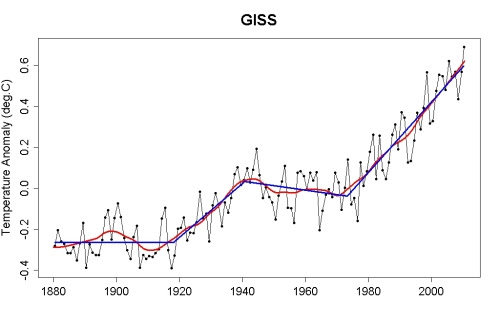
(From) How much did aerosols contribute to mid-20th century
cooling?
Posted on 16 September 2010 by dana1981 at Skeptical Science
https://skepticalscience.com/How-much-did-aerosols-contribute-to-mid-20th-century-cooling.html
-MeltOn
Director, Climate Change Now Initiative, 501c3
President, Melton Engineering Services Austin
8103 Kirkham Drive
Austin, Texas 78736
(512)799-7998
ClimateDiscovery.org
ClimateChangePhoto.org
MeltonEngineering.com
Face...@Bruce.Melton.395
Inst...@Bruce.C.Melton
The Band Climate Change
Twitter - BruceCMelton1
You received this message because you are subscribed to the Google Groups "Healthy Climate Alliance" group.
To unsubscribe from this group and stop receiving emails from it, send an email to healthy-climate-al...@googlegroups.com.
To view this discussion on the web visit https://groups.google.com/d/msgid/healthy-climate-alliance/CACS_FxpnGrcu%2BBRiy%3DrcV%2BK%3Dj1DH_u3XJCYq%3DxChpEeAMhYDBg%40mail.gmail.com.
H simmens
i
Cool, reduce, and remove to restore the climate.
Later is too late!
We advocate the world community urgently come together to carry out an equitable, science-based plan of action that includes what HPAC calls, the Climate Triad:
directly cooling the climate through sunshine reflection, ecosystem restoration, and other safe and effective means,
accelerating emission reductions, and
deploying large scale removal of atmosphere carbon dioxide and other greenhouse gasses.
The goal of these actions, along with enhanced and transformative adaptation and regeneration measures, is to reduce the average global temperature increase to well below 1°C in the coming decades. Doing so will sharply reduce weather extremes, slow or stop the collapse of key ecosystems, and help ensure a livable planet for humanity and the natural world.
Author of A Climate Vocabulary of the Future
@herbsimmens
HerbSimmens.com
On Jul 17, 2024, at 12:49 PM, Bruce Melton -- Austin, Texas <bme...@earthlink.net> wrote:

We all want to give our children a safe climate like the one we were given. We know that nature has removed about 1 trillion tons of CO2 before ice ages, so we know that it is theoretically possible. However climate leadership does not yet support or even discuss restoring safe CO2 levels.
In the 1980s, as the UNFCCC and IPCC were developing, the concept of restoring a safe climate made no sense because the climate was still safe. In the last 30 years, though, our planet has moved into climate chaos, and it is clear that we need to shift our goal to restoration.
How will we do it? I'll present an engineering and scientific roadmap to getting CO2 back to safe levels below 300 (or 350 ppm CO2e) by 2050. It's a fascinating and surprising pathway.
PAC Presentation - Peter Fiekowsky, author of Climate Restoration: The Only Future That Will Sustain the Human Race (2022), is an MIT-educated physicist and Silicon Valley entrepreneur and philanthropist with 27 patents. He has 30 years’ experience as a citizen lobbyist for poverty and climate issues, and recently has been working to build the organizations required to ensure the survival and flourishing of humanity. His mission is to leave a world we’re proud of to our children. To that end, he founded the Foundation for Climate Restoration, Methane Action, Stable Planet Alliance, the Climate Restoration Safety & Governance Board, the Humanity Day organization and most recently RestoreTheClimate.

To view this discussion on the web visit https://groups.google.com/d/msgid/planetary-restoration/26c9e449-ed0f-4c07-9084-71abced723c4%40earthlink.net.

Michael MacCracken
Dear Bruce--Just a note on the temperature record
you are showing (so a separate point than what Herb has made).
I've attached the land and the ocean temperature records from
NOAA. If you look at the land record, it is quite flat from the
1930s to 1970s, with the years of World War II being slightly
high (up an average of say 0.2 F). Hard to see much cooling,
except around the time of the 1963 Agung eruption. And note the
scaling goes up to 3.6 F--so, that the temperature was so stable
is pretty impressive.
Now look at the ocean record--due to limited areal coverage, the records from the 19th century have pretty large gaps, so a bit more variable due to less good coverage. Note that the scaling is half that of the atmosphere. Note that the WWII years really stand out as different, up by 0.4 F, twice as much as over land. This is really rather strange as land tends to change more than the ocean. It has long been recognized that there were a lot of changes going on in how SST was measured starting in the war years. Aside from different ship routings, different mix of ship types and loading, the way SST was measured was changed from throwing a canvas bucket over board and sticking a thermometer in it as it cooled to measuring the cooling water intake temperature in the engine room (likely of a freighter running its engines hot for fast crossing with heavy load and so drawing water from a different depth than the bucket--or coming back empty and bobbing like a cork on the ocean). Also, instead of taking nighttime air temperature with a seaman holding up a thermometer at the bow of the ship and doing the reading by shining a flashlight, the temperature was taken just outside a wheelhouse door that was opened a crack right next to the ship structure that had been heated by the sun all day; this was done so as to reduce likelihood of the light being spotted by an enemy submarine . While these and other factors are known and surely contributed to a bias in the record, correcting the record has been viewed as near impossible to do. And so, when one now combines the land and ocean records (ocean about twice as much area as the land), one gets the temperature record you are using showing a cooling from the 1940s to 1970s.
What is interesting to do is to put your finger over the WWII years and then look at the ocean record. To me, it doesn't look like there is a cooling--rather a rather steady warming from the 19th century, with GHG loading the likely cause. The land temperature record ends up relatively flat, so perhaps sulfate cooling offsetting GHG warming until the 1970s when SO2 emissions were reduce and GHG emissions accelerated. Another possible explanation is that the pollution clean up that started in the 1930s or so of not cutting emissions, but emitting them through a tall stack increased the atmospheric lifetime of atmospheric sulfur (it would transform from SO2 to sulfate) and so the cooling offset due to sulfate grew along with the CO2 induced increase in radiative forcing, and they roughly balanced.
In any case, I'd be very cautious about drawing conclusions based on what was happening in the middle of the 20th century. WWII is about the only time in the temperature record where the model simulations don't agree with the observations. Steve Koonin in his book blames the models and so discounts their results; an open-minded physicist would look also at data problems and perhaps suggest it is the data that is problematic and that the models may well have things right.
Best, Mike
To view this discussion on the web visit https://groups.google.com/d/msgid/healthy-climate-alliance/3C9418BF-F8BF-4041-AAED-4D525974ED30%40gmail.com.
Ron Baiman
Ron Baiman
Peter Fiekowsky
Excellent discussion here.
A few points of clarification:
- CO2 restoration is assumed intuitively--I'm working to make that assumption explicit so that it can be budgeted. It's independent of cooling.
CO2 restoration and cooling are ‘both-and ‘;not ‘either-or’. Economics discusses buying decisions as either-or: We either buy a Ford or a Chevy, and their marketing is aimed at influencing that either-or decision. We often hear “CDR vs. Cooling” like an economic choice. It isn’t.
CO2 restoration is required, it seems that everyone agrees, at least unconsciously. It's sort of like eating breakfast is required. We don't debate "breakfast or cooling?". We assume that people will eat (and sometimes skip breakfast). independent of advocating cooling. The same is true for CO2 restoration (and the energy transition). Not to restore safe CO2 (and switch to clean energy) is suicidal. And even if we committed that suicide, CO2 would still fall gradually, and fossil fuel use would disappear.
- Given that we should pursue both CDR at scale and cooling, which deserves HPAC top focus? This is the real question in discussion, right? We want to weigh:
- Which is most critical to humanity surviving & flourishing? I propose that is CO2 restoration. Cooling just “buys time” for more CDR, if we survive that long, if ‘the ship hasn’t already sunk’.
- Which is most likely to succeed? Ocean fertilization can be justified by its observed large benefit to certain indigenous (and commercial) fisheries. The anti-geoengineering radicals are unlikely to oppose relatively small scale indigenous fishery restoration projects (which just happen to restore CO2 levels as ‘by-catch’). We already see various forces aligning loudly against MCB and SAI, making their success at scale a long-shot.
- Which is in the most need of support? Which has roughly zero support now? Again it’s ocean fertilization. There is zero discussion of Pinatubo pause replication in government funding agencies today. ARIA is already proposing several million in funding for MCB, and the White House has done studies on SRM, but not on replicating the 20 Gt CO2 removal from 1992—it’s simply not being considered.
- OIF is most critical, most likely to succeed, and most in need of support today.
I recommend that HPAC put OIF (Pinatubo pause replication) as the top priority for private and government funding for the next few years.
- We don’t know what caused the Pinatubo pause but there are hypotheses. The concept of ash fertilizing phytoplankton growth in the downwelling eddy just downwind of Pinatubo is by far
the most likely explanation. In fact, it is the only testable explanation proposed so far that survives mathematical analysis. That makes it the first pathway to test. The replication test is insanely cheap—2-3 million dollars. If the test shows it’s something
other than iron + phosphorus, then that’s the progress we need to make this year.
- CO2 removal related to Cooling is tiny, much smaller than you probably think (about 0.1 Mt CO2 per degree of cooling). It’s important to quantify this claim so that we’re believable, not seen as speculative zealots. If SAI or MCB is used to cool the planet this decade (by a degree, let’s say), that cooled ocean surface would absorb 0.0001 Gt CO2, or 0.00001 ppm. See footnote 9, P7 for the simple calculation. That is 30 minutes of global emissions, insanely small. Please, let’s be at least believable, even rigorous.
Ron Baiman
<image001.jpg>
We all want to give our children a safe climate like the one we were given. We know that nature has removed about 1 trillion tons of CO2 before ice ages, so we know that it is theoretically possible. However climate leadership does not yet support or even discuss restoring safe CO2 levels.
In the 1980s, as the UNFCCC and IPCC were developing, the concept of restoring a safe climate made no sense because the climate was still safe. In the last 30 years, though, our planet has moved into climate chaos, and it is clear that we need to shift our goal to restoration.
How will we do it? I'll present an engineering and scientific roadmap to getting CO2 back to safe levels below 300 (or 350 ppm CO2e) by 2050. It's a fascinating and surprising pathway.
PAC Presentation - Peter Fiekowsky, author of Climate Restoration: The Only Future That Will Sustain the Human Race (2022), is an MIT-educated physicist and Silicon Valley entrepreneur and philanthropist with 27 patents. He has 30 years’ experience as a citizen lobbyist for poverty and climate issues, and recently has been working to build the organizations required to ensure the survival and flourishing of humanity. His mission is to leave a world we’re proud of to our children. To that end, he founded the Foundation for Climate Restoration, Methane Action, Stable Planet Alliance, the Climate Restoration Safety & Governance Board, the Humanity Day organization and most recently RestoreTheClimate.
<image002.jpg>
<image001.jpg><image002.jpg>

Sev Clarke
To view this discussion on the web visit https://groups.google.com/d/msgid/planetary-restoration/FBA564E4-D7EE-4B5B-A54D-62BD95FAD63B%40gmail.com.
Peter Fiekowsky
Ron-
A great question: “wouldn’t it make more sense for the climate restoration movement to support the climate triad rather than posing restoration and cooling as competing strategies? “
I find that the answer depends on your perspective.
My perspective is that without CO2 restoration, life as we know it is over, period. I get that "life is over" feeling now in talking with my millennial and gen-Z connections. I consider giving them the same climate we were given to be top priority. Don’t you?
Reducing emissions faster than we are now produces health and economic benefits but practically no climate impact. Tell me if you don’t believe that, and I’ll show you how to do the modeling yourself with the on-line MAGICC system. Reducing emissions is inevitable and thus necessary, just as dying is necessary—campaigning for the inevitable is a sign of deep resignation.
Global cooling and saving ice might reduce suffering, but won’t keep humanity alive, at least not for long. That's physically true, but physical reality is probably not what you're thinking about.
I think you're asking, "How do we get society to act to preserve ourselves? Don't we need to agree with the UN and scientists who say, "First focus on net-zero emissions. If we make it there, then remove the remaining excess CO2."
I'm inclined to the approach that won WW II in 4 years and landed a man on the moon in just 8 1/2 years. In that approach national leadership declares a specific goal which seems impossible but deeply meaningful at the time: "Win the war"; "Land a man on the moon and bring him back safely by the end of the decade"; "Restore the climate by 2050".
Later-- "Net-zero by 2030 to restore the climate by 2050"
Do you think anything less bold will work in today's emergency?
Would "Tanks, Planes, and Ships to win the war" have worked better to generate action in 1942?
Ron Baiman
Peter Fiekowsky
Ron-
Good work together here. Indeed, this is a useful dialog. I’m learning a lot from it.
You say that you don’t believe that we can remove CO2 as fast as nature did in 1992, and therefore we (society) should focus first on SRM or direct climate cooling (DCC) to buy us time. I believed that too, ten years ago, before I studied OIF, and especially before last year where I rediscovered the fact (reported in Nature 1993), hidden in plain view, that nature removed 20 Gt CO2 / year in 1992. (In 1993 it was reported as 1.5 ppm, or 12 Gt CO2 because the impact of the El Nino at the time was unclear).
Given your premise that we can’t replicate Nature’s rate of CO2 removal, your Triad conclusion makes perfect sense.
On the other hand, I see little evidence that DCC will get implemented. Who specifically might budget the money, and with what justification? It won’t help investors or voters—and in fact the almost certainty of huge lawsuits blaming any bad weather on the DCC perpetrators would dissuade most investors. That thinking is demonstrated in the marine cloud brightening ban in Alameda.
What would it take to convince you that we can replicate (and eventually increase) Nature’s 20 Gt CO2 / year removal? Further, since it also produces food for fish and fisheries (indigenous and commercial), it will be hard for environmentalists to block. I acknowledge that the oceanographic community largely denies that the (obvious to most people—see the graph on the cover) removal even happened. I argue that they have professional loyalty reasons for the denial. They defend the denial so far with anger and silence, rather than with data.
Plus, the probability of the CDR replication succeeding is significantly higher than DCC / SRM getting implemented. This is demonstrated by the fact that we’re already getting governmental support in Asia to get the permits and ships to make it happen, primarily as fishery restoration, in the next year or so (details are withheld for now).
H simmens
Author of A Climate Vocabulary of the Future
@herbsimmens
HerbSimmens.com
On Jul 19, 2024, at 12:37 PM, Ron Baiman <rpba...@gmail.com> wrote:
Best,
Ron
On Wed, Jul 17, 2024 at 2:09 AM John Nissen <johnnis...@gmail.com> wrote:
Hi Ron and Dennis,
Ron, you are absolutely right that we need cooling in the short term, and very urgently to deal with the crisis of global overheating. And Peter is right that we need to bring the CO2 level (and more importantly the CO2e level) towards its pre-industrial level in the long term. I believe that we should aim for 385 ppm CO2e (as in 1980) within 30 or 40 years or so. OIF and biochar between them could achieve this by promoting life in soils and the oceans, with the added benefit of feeding an expanding world population.
Peter may or may not be right about Pinatubo ash causing the decline in CO2. But two facts are clear: OIF has the potential to remove gigatons of CO2 from the atmosphere; and cooling the ocean surface will increase its ability to absorb CO2. About a third of CO2 emitted is absorbed by the ocean (most of that within a decade) and a sixth is absorbed by plants on land; meaning that only about half of emitted CO2 remains in the atmosphere. A greater proportion of emitted CO2 will remain in the atmosphere as global warming continues. Cooling intervention helps on the CO2 side.
The other lesson from Pinatubo is that injecting SO2 into the stratosphere has a dramatic cooling effect, without any unmanageable side-effects according to the latest research. Dennis, you were going to do a documentary on Pinatubo and how it cooled the world. How is that coming along? We desperately need people to appreciate the amazing potential for SAI to cool the planet and, even more urgently, to refreeze the Arctic. Planetary restoration, which is an unalienable right for the young people of today, requires both this cooling and the massive CDR which Peter envisages.
Cheers, John
On Wed, Jul 17, 2024 at 2:22 AM Ron Baiman <rpba...@gmail.com> wrote:
Thank you Peter for this detailed explanation of your thinking. Unfortunately I'm not enough of an expert on any of this to be able to confidently evaluate the case you're making. The bottom line though, is that I do hope that you're able to draw down large quantities of CO2 and this is, needless to say, sorely needed. My main concern (as wthl all of us) is time. As I can't tell with confidence that, even if Pinatubo did lead to a 20 GT drawdown this is something that could be doubled and continued at the same higher rate for multiple years, I favor hedging our bets and making sure we have a direct climate cooling tourniquet in place, even as we're trying our best to reduce and remove as fast as possible!
Best,
Ron
On Tue, Jul 16, 2024 at 12:02 PM Peter Fiekowsky <pfi...@gmail.com> wrote:
Ron-
Thank you for the good review and excellent question: Can OIF remove the required 1000 Gt of CO2 by 2050? (and another 500-1000 Gt from 2050 to 2100). Here is a quick response. Maybe we can write up a longer one together.
How does one answer the question, “is it possible?”. One of the strongest answers to that is, “Yes, it’s been done before.” It is hard to defend a claim of impossibility when the process in question has been done before, especially if it’s been done recently.
We know that Earth has ice ages in which 1000 Gt of CO2 get removed into biocarbon dissolved in the deep ocean. That has happened roughly dozen times in the last million years.
The question from the science community is, “Can humans design a process to replicate what nature did randomly, and do it 1000 times faster?” As you know, the majority opinion in science is, “No, we have not proven that we can replicate that CO2 removal, so it’s safest to assume it’s impossible.”
There is no arguing with that logic calling for more research. It assumes that our top priority is the same as science’s: Avoid the embarrassment of calling for doing something that’s never been done before and will probably have several failures before success. I suggest we abandon that assumption.
Last year we showed that nature removed 20 Gt / year in 1992, following the Pinatubo eruption in the Philippines. This is separate from the half degree of cooling in 1992 from aerosols in the upper atmosphere. CO2 removal is from the gigatons of fine ash that fell into the ocean nearby. This CO2 removal from less than 0.1% of the ocean area is five times faster than current ocean theory says is possible with OIF done on the whole ocean. This CO2 capture rate per square meter is consistent with observed photosynthesis rates in nutrient-rich areas, but over large areas it requires that nitrogen-fixing algae provide the needed nitrates, which I am told, is not part of current theory.
There are two approaches to that incongruity between theory and data: Either the theory is insufficient, or the data is wrong. Oceanographers write that cooling from the eruption caused the CO2 level change. This is despite the fact that 4 other eruptions in the last 250 years caused similar cooling, but no significant CO2 impact (see Appendix B of our white paper), and the fact that the numbers don’t work (footnote 9, p7). Scientific consensus still dismisses the NASA / NOAA / Scripps Keeling curve interpretation, but that’s shifting.
There are a couple oceanographers now supporting the Pinatubo pause replication test we are developing. More scientists will probably switch sides eventually and agree that the theory should be updated to match the 1992 data.
Bottom line: CO2 removal at 20 Gt CO2 / year ( 1/3 the rate required to get to 300 ppm by 2050) was recorded in 1992. It is almost certain that humans can optimize this process and remove CO2 from 1% of the ocean and restore a safe CO2 level by 2050. No attempt to do so has been made in the 30 years since the first 1993 Pinatubo pause report, so it is reasonable to predict that no attempt will be made in the next 30 years.
However, we have a group organizing funding and a project to break the log-jam.
The speed and cost of scaling up the Pinatubo pause (3-5 years and less than a billion dollars), plus the fact that Nature has demonstrated the CO2 removal already makes a compelling argument to prioritize the testing.
Peter
From: Ron Baiman <rpba...@gmail.com>
Date: Tuesday, July 16, 2024 at 8:58 AM
To: Dana Woods <danaj...@gmail.com
>
Cc: rob...@rtulip.net <rob...@rtulip.net>, Bruce Melton -- Austin, Texas <bme...@earthlink.net>, healthy-planet-action-coalition <healthy-planet-...@googlegroups.com>, Planetary Restoration <planetary-...@googlegroups.com>, Healthy Climate Alliance <healthy-clim...@googlegroups.com>, Carbon Dioxide Removal <CarbonDiox...@googlegroups.com>, Peter Fiekowsky <pfi...@gmail.com>
Subject: Re: [HPAC] Re: [prag] Recording of Peter Fiekowsky's HPAC Presentation - Climate Restoration Roadmap
Dear Colleagues,
<image001.jpg>
<image002.jpg>
You received this message because you are subscribed to the Google Groups "Healthy Climate Alliance" group.
To unsubscribe from this group and stop receiving emails from it, send an email to healthy-climate-al...@googlegroups.com.
To view this discussion on the web visit https://groups.google.com/d/msgid/healthy-climate-alliance/CAPhUB9APXCcnaTgL%2BpyTPnWZ5VxsY7zRafbO%2BVgW95O%3DW9NP1A%40mail.gmail.com.
Ron Baiman
<Baiman_2022_ Our Two Climate Crises Challenge RRPE print version.pdf>

Michael Hayes
- Which is most likely to succeed? Ocean fertilization can be justified by its observed large benefit to certain indigenous (and commercial) fisheries. The anti-geoengineering radicals are unlikely to oppose relatively small scale indigenous fishery restoration projects (which just happen to restore CO2 levels as ‘by-catch’). We already see various forces aligning loudly against MCB and SAI, making their success at scale a long-shot.
- Which is in the most need of support? Which has roughly zero support now? Again it’s ocean fertilization. There is zero discussion of Pinatubo pause replication in government funding agencies today. ARIA is already proposing several million in funding for MCB, and the White House has done studies on SRM, but not on replicating the 20 Gt CO2 removal from 1992—it’s simply not being considered.
You received this message because you are subscribed to the Google Groups "Carbon Dioxide Removal" group.
To unsubscribe from this group and stop receiving emails from it, send an email to CarbonDioxideRem...@googlegroups.com.
To view this discussion on the web visit https://groups.google.com/d/msgid/CarbonDioxideRemoval/CAEr4H2mhZLB1-46Quu32pObs9Pcd4qc9ZkRPPC%3DjbQh9-0Nnzw%40mail.gmail.com.
Michael Hayes
Dear Peter, et al.,
To reduce the entire CDR field of study, particularly the mCDR field, down to a method that has never been discribed in a single peer reviewed paper, a method that has now been rejected by the coastal tribe that was first talked into using it, and to use the title of OIF, which there is no record of actual OIF experts supporting pasture feeding, is not supportable at any level by any CDR expert.
Moreover, mention of commercial fisherman loving pasture feeding was made. I'm an experianced Bering sea, Kodiak, and SE Alaskan commercial fisherman. Dumping Fe in shallow waters is a form of fish chumming, that was the only discovery of the effort. Chumming for fish is illegal in N America and most of the rest of the civilized world.
The origional classical OIF method is a highly respected piece of scientific work, pasture feeding is not, on both counts.
Best regards
You received this message because you are subscribed to the Google Groups "Carbon Dioxide Removal" group.
To unsubscribe from this group and stop receiving emails from it, send an email to CarbonDioxideRem...@googlegroups.com.
To view this discussion on the web visit https://groups.google.com/d/msgid/CarbonDioxideRemoval/CAPhUB9APXCcnaTgL%2BpyTPnWZ5VxsY7zRafbO%2BVgW95O%3DW9NP1A%40mail.gmail.com.

Oswald Petersen
Hello Herb,
thanks for your information.
« if a credible argument can be made that the Vision should not privilege DCC «
I will try to make such credible arguments. I will confine them to three, even though there are many more.
- DCC, as an acronym for SAI / MCB, is a method not acknowledged by IPCC. It will take decades to convince IPCC that SAI is a method to embrace. It is therefore not a method than can be applied within the next decades.
- Even if science would embrace DCC, it is politically not a viable option. Because of its global effect it would need global consent, which is something which cannot even be reached on much simpler global goals, e.g. condemnation of war crimes.
- Finally DCC will not get public support. Darkening the sun causes great anxiety, people instinctively reject it, for many, including religious, reasons.
All in all DCC is unfit for fast deployment, and any effort to push for it is counterproductive. If HPAC wants to be heard in the powerful circles of this world, take down DCC.
Instead I would ask HPAC to not give any privilege to any cooling effort. HPAC repeats again and again that they are neutral regarding the method, but then give privilege to DCC. This is contradictory and it is not helping the cause HPAC is fighting for.
I would ask HPAC to separate GHG removal from GHG emission reduction, because the latter is something that’s already agreed upon and being done, whereas GHG removal is a GeoEngineering method and as such still highly controversial. The “triad” which HPAC proposes is henceforth non-existent, you need at least four if not more legs to this stool.
Personally I would recommend GRAP as a preferred method, but I am aware that HPAC would not agree to that, so I don’t ask for it.
I do ask for a neutral standpoint of HPAC regarding the different methods,
Regards
Oswald Petersen
Atmospheric Methane Removal AG
Lärchenstr. 5
CH-8280 Kreuzlingen
Tel: +41-71-6887514
Mob: +49-177-2734245
.
To view this discussion on the web visit https://groups.google.com/d/msgid/healthy-planet-action-coalition/79CF8C3C-6C27-4DD6-BDD1-FC610E8C8530%40gmail.com.

Metta W Spencer
Best,Ron
- CO2 removal related to Cooling is tiny, much smaller than you probably think (about 0.1 Mt CO2 per degree of cooling). It’s important to quantify this claim so that we’re believable, not seen as speculative zealots. If SAI or MCB is used to cool the planet this decade (by a degree, let’s say), that cooled ocean surface would absorb 0.0001 Gt CO2, or 0.00001 ppm.See footnote 9, P7 for the simple calculation. That is 30 minutes of global emissions, insanely small. Please, let’s be at least believable, even rigorous.
--
You received this message because you are subscribed to the Google Groups "Healthy Planet Action Coalition (HPAC)" group.
To unsubscribe from this group and stop receiving emails from it, send an email to healthy-planet-action...@googlegroups.com.
To view this discussion on the web visit https://groups.google.com/d/msgid/healthy-planet-action-coalition/BY3PR19MB5076983BA452B37B203571F6FFAD2%40BY3PR19MB5076.namprd19.prod.outlook.com.
Michael MacCracken
Dear Oswald--There is a rather large international scientific research program on SAI and other approaches. IPCC even held an international workshop on it a decade or so ago. Compared to the impacts of climate change now and lying ahead, SAI, for example, is on net less impactful. I don't disagree that it will take a bit of time to get approval, mostly because of a lot of mischaracterizations being put out to the media such as yours.
In contrast, I'm not even sure that IPCC has been able to cite (it does not do research, it evaluates issues form the literature) any published scientific literature on the approach you are supporting, that any global atmospheric chemistry modeling has been done or published, and so on. Your efforts would, it seems to me, likely to be much more productive doing, writing, getting peer-reviewed the approach that you are so strongly in favor of. Figure out how to demonstrate it would work, that it is safe, that it would have limits, that the change if it works would be slow enough--you have a lot to get done if you are going to get global approval, and, just to note, I think going ahead without such approval would lead to huge objections.
Mike MacCracken
To view this discussion on the web visit https://groups.google.com/d/msgid/planetary-restoration/001f01dada08%2456f289a0%2404d79ce0%24%40hispeed.ch.
Peter Fiekowsky
Peter
Michael MacCracken
Dear Peter--It seems to me the problem with your
suggestion is that it is simply unproven as a way of removing
carbon. I was on the executive committee of the Scientific
Committee for Oceanic Research (SCOR), which sort of oversees
and coordinates virtually all international ocean research, from
2003-11 and for a while I was in charge of looking at the ocean
fertilization studies up to that time. None was really
convincing even though blooms were created as there were
basically no measurements out the bottom of the study zone
indicating that the carbon falling down would not dissolve on
the way down and so not go down far enough to ensure it would
not be recycled to the surface in the following decade or so.
Research to get this proof is likely to be expensive--but
essential to be convincing; creating blooms is just not enough.
I realize you view the Pinatubo eruption as proof
but it is a little strange that is apparently the only eruption
that did this, just in the right place and right time for your
conclusion, whereas virtually all major volcanic eruptions have
caused cooling that is quite coincident with the stratospheric
aerosol loading over following months, etc. I sent you a note
about a session planned at the upcoming December meeting of the
American Geophysical Union in Washington DC that is planning a
Union session on the subject of potential ocean carbon uptake.
This is where your hypothesis needs to be presented and
considered. Abstracts are due in by July 31, I think it is, and
I do hope you find some speaker who presents the idea for
serious consideration, research planning, etc. Just your
assertion is not going to be enough to be really convincing. I
don't disagree that yours is an interesting hypothesis to be
tested, but it needs to be tested.
And then there is this question of how to possibly take advantage of iron fertilization. Thinking that this could be done by fertilizing just a few eddies seems quite remarkable given the hundred of billions of tons of C that will need to be removed to achieve what you are suggesting. Not only is there the amount in the atmosphere, but to keep chemical equilibrium, there will be CO2 being degassed from the the ocean mixed layer and you will have to remove that C as well, and same with C that comes up into the mixed layer and then is degassed.
And it needs to be that the C is taken well down
in the ocean, best would be to the sediments, so it is not
recycled to the surface. I'm sorry, but it is not at all clear
that the approach will work.
So, as indicated above, I'd suggest you make sure
your hypothesis is quickly well written up (if not done
already)--say a draft scientific paper--and that it is being
presented and evaluated at the AGU meeting (all that is needed
immediately is an abstract).
Best, Mike
Ron and Herb and the HPAC steering committee-
your
To view this discussion on the web visit https://groups.google.com/d/msgid/planetary-restoration/CAEr4H2k_%3DHS7jFJiZw1TZr5-K4%3Dp8BeU2d%2BtvkeG3wWVU_fMJQ%40mail.gmail.com.
Sev Clarke
On 20 Jul 2024, at 12:06 PM, Christopher Ede-Calton <chris...@calton.us> wrote:For what it's worth, regarding SRM: major countries (such as China) that have invested in solar farms will oppose it on the basis that it will reduce the efficiency of their solar farms. I have heard this from very credible people within the Chinese policy making apparatus. Geopolitics is now paramount, and we need to find a way to get the largest players to an agreeable solution.
Sev Clarke
On 20 Jul 2024, at 1:19 PM, Michael Hayes <electro...@gmail.com> wrote:'Marine and forest regeneration ' is a meaningless term. No one knows how to either, much less both.
--
You received this message because you are subscribed to the Google Groups "Carbon Dioxide Removal" group.
To unsubscribe from this group and stop receiving emails from it, send an email to CarbonDioxideRem...@googlegroups.com.
To view this discussion on the web visit https://groups.google.com/d/msgid/CarbonDioxideRemoval/099113D8-F9C5-4F30-83EA-542B54CC19FB%40me.com.
Peter Fiekowsky
Mike M-
I’m glad you brought up the important point that the correlation between Pinatubo and OIF is unproven.
First. You misinterpreted what I wrote. Note that I never say that that the mechanism for the Pinatubo pause is OIF. Yes, OIF is the only explanation so far that fits the data (see my article), and yes it is unproven and is not in the peer review literature.
Next, remember that in science, nothing can be proven. Hypotheses can be disproven by evidence, but not proven. This is especially true in the varied and rapidly changing ocean. We will never know what chemistry happened in 1992—the ocean has changed too much since then.
By the same token, none of the SRM methods are proven—they’re all hypotheses and always will be until they’re disproven.
That leaves the real question: For those of us looking to give our children a safe climate (CO2 like 40, 100 or 200 years ago) while we still can (by 2050), what is the best use of our time and money right now? I propose that it’s the Pinatubo pause replication (already moving forward). I challenge you and others to propose a different first project that gives our children a better chance of a safe climate.
The Pinatubo pause replication project will test, in parallel, the most plausible explanations until we experimentally find a method that roughly replicates the net-zero event in 1992. That won’t prove anything, but is likely to get us to net-zero well before 2030.
All the hypotheses about carbon falling down are irrelevant to this test, because we know that those hypotheses can only explain about 5% of the CO2 removed in 1992. As the oceanographic community agrees—conventional OIF theory does not apply to the Pinatubo pause. Some other testable theory is needed, and that is discussed in my paper.
Regarding writing up the material in a paper, I have been looking for a coauthor to help whittle down my white paper for that. Do you know anyone?
Warmly,
Peter
--
You received this message because you are subscribed to the Google Groups "Carbon Dioxide Removal" group.
To unsubscribe from this group and stop receiving emails from it, send an email to CarbonDioxideRem...@googlegroups.com.
To view this discussion on the web visit https://groups.google.com/d/msgid/CarbonDioxideRemoval/099113D8-F9C5-4F30-83EA-542B54CC19FB%40me.com.
Michael MacCracken
Dear Christopher--While that is mentioned as a
concern, it is important to understand the nuances (just in case
any major decisions might depend on the nuances). What we have
learned from volcanic eruptions that put SO2 that becomes
sulfate into the stratosphere, is that the forward-scatter is
about 10 times the back-scatter. The estimate is that offsetting
a full CO2 doubling would require reflecting back about 2% of
solar radiation (so increasing planetary albedo, say, fro 30% to
32%. It the world is serious about mitigation, what would
roughly be needed is to do half of this, so reflect 1% of solar
radiation. Associated with this would be diversion of 10% of the
radiation from downward direct to downward diffuse radiation (so
whitening the sky a bit--a concern of astronomers, though much
of their work is now done from satellites). Right now roughly
half the incoming solar radiation is absorbed at the surface, so
this would be decreased by about 1% (which
I think is well within the interannual variability caused by the
weather).
Now, it turns out that increased diffuse radiation can actually increase plant growth because diffuse radiation reaches down further into the canopy, so providing more abundant light to shadowed exposures and less peak direct radiation, so for forests and agriculture, the reduction in absolute radiation may actually at lease somewhat compensated.
What SRM (and normal air pollution, clouds, etc.) is problematic for is solar thermal power systems as they depend on using mirrors to reflect the direct component of solar radiation to a specific point on a tower to melt something like sodium to carry the heat to a system to make electricity, etc. Back in 1982, Sandia was building one of the first such systems in Barstow, CA with DOE funding. They designed the system to 110% or so, but when they powered it up, it came in at a bit under 90% as I recall. Their solar measuring instrument showed only a 2% reduction in solar due to the recent El Chichon eruption. They came over to our atmospheric science group at Livermore seeking an explanation. We asked them about the instrument and they were using a total sky radiometer. We suggested they pay a bit more and get an instrument that measured direct radiation (actually it measures total sky and then shades out the sun and the difference is direct radiation) and then wait a couple of months for the volcanic aerosol to spread latitudinally (so out of the latitudinal band the aerosol was initially in). They did and the system went on to perform as expected.
So for SRM, as noted above, it is not farmers and foresters who would be affected by the reduction in radiation--and indeed, they would likely benefit from the less hot conditions and from the shift of direct radiation to diffuse radiation. Solar PV uses total sky radiation, so SRM is not a problem, and I think solar PV is becoming generally preferred approach based on economics, so affecting solar thermal installations is not a primary problem.
Best, Mike MacCracken
For what it's worth, regarding SRM: major countries (such as China) that have invested in solar farms will oppose it on the basis that it will reduce the efficiency of their solar farms. I have heard this from very credible people within the Chinese policy making apparatus. Geopolitics is now paramount, and we need to find a way to get the largest players to an agreeable solution.
On Fri, Jul 19, 2024 at 9:21 PM 'Michael MacCracken' via Carbon Dioxide Removal <CarbonDiox...@googlegroups.com> wrote:
You received this message because you are subscribed to the Google Groups "Carbon Dioxide Removal" group.
To unsubscribe from this group and stop receiving emails from it, send an email to CarbonDioxideRem...@googlegroups.com.
To view this discussion on the web visit https://groups.google.com/d/msgid/CarbonDioxideRemoval/be250162-92ea-45be-a985-ebefac9ac95f%40comcast.net.
Michael MacCracken
Hi Peter--My apologies--change "proven" to
"demonstrated."
I'm at a bit of a loss to understanding how you
can say that putting sulfate aerosol into the stratosphere is
not a demonstrated approach to cooling the climate. And it
happens consistently, which does not seem to be the case for the
hypothesis that you are proposing. Yes, there is engineering to
be done to make it happen, but Nature has consistently
demonstrated this for us.
As to what I would propose, see my paper from several years ago. Copy attached. Or consider papers by Doug MacMartin and team at Cornell, or ones on the ARPA funded study by Elizabeth Barnes and team at Colorado State. We can actually get started on the cooling.
Regarding the effect you mention, is there
anything written up about what is being proposed to "move
forward" on the Pinatubo pause replication? The better done iron
fertilization studies required considerable resources and
generally ended up not having, especially to effectively measure
the C flow out of the bottom of the experimental are. Thus,
please do tell us about it so its strengths and weaknesses can
be evaluated (and then perhaps improved).
Best, Mike
Peter Fiekowsky
"Next, remember that in science, nothing can be proven."
Mathematical theorems can be proven, but not scientific theories.
A Google search gives this:
Can a theory be proved?
Scientific theories are testable. New evidence should be compatible with a theory. If it isn't, the theory is refined or rejected. The longer the central elements of a theory hold—the more observations it predicts, the more tests it passes, the more facts it explains—the stronger the theory.
What Is a Theory? A Scientific Definition | AMNH

American Museum of Natural History
Theories get stronger as test data confirms them, but are never proven. The standard OIF theory claims that the maximum CO2 removal is 1-4 Gt CO2 / year. That may be disproven by the 20 Gt / year observed in 1992, and 5 Gt / year removal over 11 years, recorded in ice cores about 15,000 years ago.
Thus the standard OIF theory might be considered to be a weak theory, explaining the quality but not the magnitude of CO2 remova.
Peter
From:
Michael Hayes <electro...@gmail.com>
"Next, remember that in science, nothing can be proven."
I ask that you to further explain that statement.
John Nissen
Dear Oswald--If climate change induced extreme weather disasters, ice sheet destabilization, and more, become more and more impactful, a lot of what you mention can be overcome--as happens when there are other types of emergencies (World War II, Ukraine, Hamas attack, COVID, etc.). The situation is getting closer and closer to desperate in some aspects.
Best, Mike
On 7/20/24 3:08 PM, Oswald Petersen wrote:
Dear Mike,
“We can actually get started on the cooling.”
This is a scientists’ view.
In reality, before you can “get started on the cooling”, you have to do a field test, where a plane actually demonstrates the dispersion of SO2-particles at 13.000 m altitude. To do that, you need to develop a disperser, test it in a lab, make it work, evaluate it and then you can maybe think about a field test. For the field test you have to develop the plane/disperser combo, which will cost you millions of $ and many years. Also you have to define the exact specification of the particles and describe the production process, the sources, quantities needed... You need to do an EIA and a LCA. All in all you would need thousands of pages of documentation, at least 10 million $ and at least 5 years time to get to and do the field test. The field test must be permitted, which in itself is a task that takes years, if it can be done at all.
I do not see any preparation happening for this. I am afraid that ýou have to come to terms with the fact that this will not happen any time soon. In saying this it is not my intention to frustrate you, but to free you from a burden. I am in the process of doing all this for EAMO, and that’s much easier than SAI with respect to the technology as well as the permits. We are working on this for 2 ½ years now and will need another year before the field test. So I know how this process works for a smaller project.
Once EAMO is up and running, SAI will become much easier. SAI is many years from realization, and no one is even trying to get it done. It would be wise to bury it for the next ten years, and maybe come back to it in 2040.
Have a great weekend😊
Oswald
Oswald Petersen
Atmospheric Methane Removal AG
Lärchenstr. 5
CH-8280 Kreuzlingen
Tel: +41-71-6887514
Mob: +49-177-2734245
--
You received this message because you are subscribed to the Google Groups "Healthy Planet Action Coalition (HPAC)" group.
To unsubscribe from this group and stop receiving emails from it, send an email to healthy-planet-action...@googlegroups.com.
To view this discussion on the web visit https://groups.google.com/d/msgid/healthy-planet-action-coalition/684bade7-4028-47c0-aa4c-60d7801a2043%40comcast.net.


Christopher Ede-Calton
You received this message because you are subscribed to the Google Groups "Carbon Dioxide Removal" group.
To unsubscribe from this group and stop receiving emails from it, send an email to CarbonDioxideRem...@googlegroups.com.
To view this discussion on the web visit https://groups.google.com/d/msgid/CarbonDioxideRemoval/be250162-92ea-45be-a985-ebefac9ac95f%40comcast.net.
Michael Hayes
'Marine and forest regeneration ' is a meaningless term. No one knows how to either, much less both.
--
You received this message because you are subscribed to the Google Groups "Carbon Dioxide Removal" group.
To unsubscribe from this group and stop receiving emails from it, send an email to CarbonDioxideRem...@googlegroups.com.
To view this discussion on the web visit https://groups.google.com/d/msgid/CarbonDioxideRemoval/099113D8-F9C5-4F30-83EA-542B54CC19FB%40me.com.
Oswald Petersen
Dear Mike,
AMR is an engineering company, we do not write scientific papers. We develop the technology needed for EAMO.
A growing number of scientists are publishing papers regarding EAMO. We publish links to all relevant papers here
Please note that AMR does not publish any comment on SAI / DCC. This is a purely internal HPAC debate.
IPCC has approved GHG removal is principle. This is not the case with any albedo manipulation. However small scale projects like the one at the Great Barrier Reef are seen with sympathy.
I am personally not against SAI. I just don’t see it happening in the next 50 years. SAI blocks all other GE approaches, because it takes most media attention and crowds out the other approaches.
It would really be progress if HPAC stops pushing SAI. HPAC has done this for 20 years with zero avail. Time to try something new.
Regards
Oswald Petersen
Atmospheric Methane Removal AG
Lärchenstr. 5
CH-8280 Kreuzlingen
Tel: +41-71-6887514
Mob: +49-177-2734245
To view this discussion on the web visit https://groups.google.com/d/msgid/healthy-planet-action-coalition/8c959439-b504-42e0-aaa3-245859d32b60%40comcast.net.
Michael Hayes
Oswald Petersen
Dear Mike,
“We can actually get started on the cooling.”
This is a scientists’ view.
In reality, before you can “get started on the cooling”, you have to do a field test, where a plane actually demonstrates the dispersion of SO2-particles at 13.000 m altitude. To do that, you need to develop a disperser, test it in a lab, make it work, evaluate it and then you can maybe think about a field test. For the field test you have to develop the plane/disperser combo, which will cost you millions of $ and many years. Also you have to define the exact specification of the particles and describe the production process, the sources, quantities needed... You need to do an EIA and a LCA. All in all you would need thousands of pages of documentation, at least 10 million $ and at least 5 years time to get to and do the field test. The field test must be permitted, which in itself is a task that takes years, if it can be done at all.
I do not see any preparation happening for this. I am afraid that ýou have to come to terms with the fact that this will not happen any time soon. In saying this it is not my intention to frustrate you, but to free you from a burden. I am in the process of doing all this for EAMO, and that’s much easier than SAI with respect to the technology as well as the permits. We are working on this for 2 ½ years now and will need another year before the field test. So I know how this process works for a smaller project.
Once EAMO is up and running, SAI will become much easier. SAI is many years from realization, and no one is even trying to get it done. It would be wise to bury it for the next ten years, and maybe come back to it in 2040.
Have a great weekend😊
Oswald
Oswald Petersen
Atmospheric Methane Removal AG
Lärchenstr. 5
CH-8280 Kreuzlingen
Tel: +41-71-6887514
Mob: +49-177-2734245
Von: 'Michael MacCracken' via Healthy Planet Action Coalition (HPAC) <healthy-planet-...@googlegroups.com>
Gesendet: Samstag, 20. Juli 2024 20:41
An: Peter Fiekowsky <pfi...@gmail.com>; Michael Hayes <electro...@gmail.com>; sevc...@me.com
Cc: chris...@calton.us; rpba...@gmail.com; hsim...@gmail.com; johnnis...@gmail.com; D.GA...@cifor-icraf.org; danaj...@gmail.com; rob...@rtulip.net; bme...@earthlink.net; healthy-planet-...@googlegroups.com; planetary-...@googlegroups.com; healthy-clim...@googlegroups.com; CarbonDiox...@googlegroups.com
--
You received this message because you are subscribed to the Google Groups "Healthy Planet Action Coalition (HPAC)" group.
To unsubscribe from this group and stop receiving emails from it, send an email to healthy-planet-action...@googlegroups.com.
To view this discussion on the web visit https://groups.google.com/d/msgid/healthy-planet-action-coalition/684bade7-4028-47c0-aa4c-60d7801a2043%40comcast.net.
Michael MacCracken
Dear Oswald--If climate change induced extreme
weather disasters, ice sheet destabilization, and more, become
more and more impactful, a lot of what you mention can be
overcome--as happens when there are other types of emergencies
(World War II, Ukraine, Hamas attack, COVID, etc.). The
situation is getting closer and closer to desperate in some
aspects.
Best, Mike
Oswald Petersen
Dear Mike,
well, you may be right there.
However climate change comes in parcels. It is a slow process, which peaks now and then. It is, in this sense, unlike COVID or any other emergency. It will take many years till the world will see climate change as an immediate threat to our livelihood. Science is, in this respect, way ahead of the pack. Climate change will not make this our planet go into emergency mode any time soon. You may complain, even rightfully, but this fact remains unbothered.
The only way to make things happen at this stage is to build a business case, so private investors get interested. SAI however is currently not a convincing business case, as I have pointed out earlier. It won’t happen any time soon.
Regards
To view this discussion on the web visit https://groups.google.com/d/msgid/healthy-planet-action-coalition/fc2e3716-b317-4020-9d75-162964efdc7a%40comcast.net.