My OpenFeeder GitHub Repo

1,110 views
Skip to first unread message

william hare

unread,
Dec 3, 2015, 5:38:36 PM12/3/15
to OpenPnP
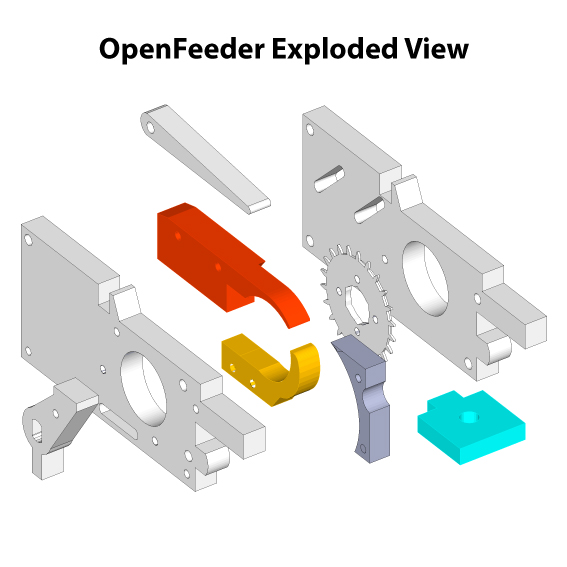
Ok kids, here is the GitHub repo of my OpenFeeder design!


This feeder design is for MY machine. Extensive modifications to existing machines may be necessary to accommodate it. Its meant to fit a 20mm aluminum t-slot. I am using t-slots from MakerSlide. My OpenPNP machine consists of only one pickup nozzle, the other is a "dead" nozzle, just a simple push rod to press the feeder arm.


Feel free to ask questions or make comments. :0)


FYI: this is my first 3D Cad design and my first GitHub repo! 


Anthony Webb

unread,
Dec 3, 2015, 7:08:39 PM12/3/15
to OpenPnP
Looks real great!  Do you have any video of it in action?

Jason von Nieda

unread,
Dec 3, 2015, 7:29:36 PM12/3/15
to ope...@googlegroups.com
Awesome! Thanks for posting this, and let me say Great Work! on your first Github repo. Your documentation is looking really good.

Jason


--
You received this message because you are subscribed to the Google Groups "OpenPnP" group.
To unsubscribe from this group and stop receiving emails from it, send an email to openpnp+u...@googlegroups.com.
To post to this group, send email to ope...@googlegroups.com.
To view this discussion on the web visit https://groups.google.com/d/msgid/openpnp/164ef69f-0a81-4624-99aa-a8d0770978ff%40googlegroups.com.
For more options, visit https://groups.google.com/d/optout.

Jason von Nieda

unread,
Dec 3, 2015, 7:49:11 PM12/3/15
to ope...@googlegroups.com
Hey William,

Your post has inspired me to put up a page on openpnp.org listing OpenPnP compatible hardware. I've put a preview of it here: http://openpnp.org/hardware1/

This will replace the current /hardware link which just redirects to the OpenBuilds machine Github.

So, a few questions: 

1. Is it okay to list your feeder there?
2. Anything you'd like to change about the link or description?

Thanks,
Jason


On Thu, Dec 3, 2015 at 2:38 PM, william hare <billm...@gmail.com> wrote:

william hare

unread,
Dec 3, 2015, 8:28:49 PM12/3/15
to OpenPnP
@Anthony

Yes I do. It is an older Rev of the design. But you will get the idea.


@Jason

WOW! Thanks!

Yes, feel free to list it. Description is good. If you don't mind, can you also add a link to my blog? http://portfolioabout.me/

Jason von Nieda

unread,
Dec 3, 2015, 9:05:49 PM12/3/15
to ope...@googlegroups.com

Yes, feel free to list it. Description is good. If you don't mind, can you also add a link to my blog? http://portfolioabout.me/

Done, thanks!

Jason
 

--
You received this message because you are subscribed to the Google Groups "OpenPnP" group.
To unsubscribe from this group and stop receiving emails from it, send an email to openpnp+u...@googlegroups.com.
To post to this group, send email to ope...@googlegroups.com.

william hare

unread,
Dec 3, 2015, 9:14:12 PM12/3/15
to OpenPnP
Thanks Jason!

Here are some more Cad images....


Graeme Bridge

unread,
Dec 4, 2015, 3:39:10 AM12/4/15
to OpenPnP
William 

Looks great, I'm guessing this clips onto a T slot rail? 
Would you allow this feeder design to be used on my cost sensitive design?

Graeme

Malte R.

unread,
Dec 4, 2015, 8:55:36 AM12/4/15
to OpenPnP
Hi,

nice design and clean files; I like it.

How do you remove the cover tape? By weights and gravity?

If I understand correctly, the feed rate and feed distance are only depending on Z-travel of the actuator pushing down the lever?

This means that the actuator has to provide that level of control and probably that camera must be used to determine component alignment - correct?

Have you seen Karl's design? He uses a combination of fancy gears and a locking pin which makes sure tape is only advanced to the next sprocket hole:
https://vimeo.com/144454867

I think your solution is simpler to make as it does not rely on several precision milled metal gears.

On the other hand I think that Karl's feeder might be easier to use.

I think it would be possible to add similar locking pin to your feeder, wouldn't it? Add a a spring loaded actuator and it should work fine.

What do you think?

Karl seems to be making good progress with his feeders:
http://liteplacer.com/phpBB/viewtopic.php?f=11&t=191&start=20#p1492

I hope it is OK to link to a post in LitePlacer forum here?

Thank you and best regards
Malte

william hare

unread,
Dec 4, 2015, 10:42:34 AM12/4/15
to OpenPnP
@Graeme

Correct, it latches on to a t-slot 2020 or 2040.

Look at my blog, there are a few photos of the feeder. But that feeder is an older Rev.


@Malte

I have seen his design. Infact.....that was very close to the start of my design. Mine started out as a "Pawl Gear" too. But here is the problem I saw. Not all tape components "part pitch" are the same. So a pawl gear design would be limited in the long run. This feeder was designed to be expandable, to use 8mm, 10mm and 12mm wide tapes. Just need to change out a few hardware parts.

So in theory, you set the Z press (to feed) for a specific part pitch, and it should be the same every time. If the next feeder has a different part pitch, that feeder has its own Z press distance. Which will feed at that distance every time.

Hell, you could set it up to SKIP every other part if you wanted, and with only one press. </facetious>

For now the tape cover is pulled back via a fishing weight.

The only non "off the shelf" part is the drive sprocket, everything else can be sourced from US or China (lowest cost), or made. Most can even be had at a local hardware store. The only truly custom part is the drive sprocket. But this would be most of the problems with any DIY feeder. I will be testing some new Nylon filament soon. I will fully 3D print a drive sprocket and see how it turns out.

But for now, I have over 50 stainless steel laser cut drive sprockets, ready to go. And I do have a US supplier for them, so its not a issue.


His design for design for the Juki nozzle charger is fantastic! I was going to do something like Juki does, basically a moving slotted plate.

Malte R.

unread,
Dec 4, 2015, 12:52:55 PM12/4/15
to OpenPnP
Thanks for the explanation.

I understand the advantage of being able to advance the tape by almost arbritrary distances - though it makes the actuator a bit more complex.

I think corrections could be applied using very similar algorithms to the drag feeder vision demoed here:
https://www.youtube.com/watch?v=VviPLNRWDFk

What is the maximum tape travel that can be achieved with one push?

In practice, I think most tapes work with 4mm pitch or multiples thereof (8, 12, 16). So with Karl's feeder design I suppose one could just push the lever several times - or implement a customized gear for those tapes; which would be less flexible.

Only exception are probably 8mm tapes with 2mm part pitch - but that could be adressed by using different pickup location for every second part.

Long story short - I believe the DIY PnP community benefits from trying multiple approaches and we will see which one works best and is easy to make.

Speaking of making: I used Taulman Bridge nylon filament quite a bit on my 3D printer and it indeed makes very sturdy parts. Downside is that they are also a bit flexible, which definetely is an issue when making gears and might be a problem for sprocket wheels... I will wait for your report :-)

Otherwise CNC milling or laser cutting is not too expensive either.

Regarding the Juki nozzle changer: I have just ordered custom machined nozzle holders from China for a new head design. I might buy larger quantity and resell sets with nozzles if quality and price are OK. The coupler will feature the same ball lock / push mechanism that Karl used for his auto changer. If you're interested, I can keep you posted.

Regards
Malte


william hare

unread,
Dec 4, 2015, 1:17:39 PM12/4/15
to OpenPnP
You are 100% correct, the more stuff we throw at the wall, the more likely something will stick!


I do not feel this actuator is "complex". It's a one way bearing on a M6 bolt. The sprocket is attached to, and part of the one way bearing. When the arm is pressed the bearing engages and drives the tape. The the arm is released the bearing disengages, the sprocket remains stationary, and the M6 bolt rotates back to the start position. Its basically one moving part.

Anthony Webb

unread,
Dec 4, 2015, 4:37:09 PM12/4/15
to OpenPnP
Do keep us posted on the Juki nozzle changer, I know I will want to have something of the sorts so any insight is greatly appreciated

Malte R.

unread,
Dec 5, 2015, 8:16:51 AM12/5/15
to OpenPnP
@William


I do not feel this actuator is "complex".

Sorry - I did not mean the lever on your feeder; that looks nice and straightforward.

I was referring to the actuator that actually drives the lever - so the part that will likely be attached to the PnP head.

With your design linear motion of that actuator along Z-axis needs to be controlled precisely - simplest solution probably being a lead screw and stepper motor. It's certainly not rocket science, but the "complexity" of advancing the tape by the right distance is moved from the feeder to that actuator.

With Karl's approach it is just a matter of pushing the lever far enough - e.g. by using a spring loaded probe attached to the head, solenoid or pneumatic system.

Not sure what works better - so I might end up trying both ;-)

@Anthony

Sure, I will. Auto change is exactly what I am aiming for. While my PnP platform currently is based on LitePlacer, I think the design for the head + changer should work fine on many DIY PnP.

william hare

unread,
Dec 5, 2015, 11:48:17 AM12/5/15
to OpenPnP
Ahh, ok, I can see where you are coming from now. :)

My machine  design is a little different then the Jason's. I was intending on using 0 backlash precision ball screws for all linear movements, with precision liner slides. And make the whole machine a little smaller then his, so I have no screw whip (and to fit my desktop). Therefor I was not worried about Z precision for feeder actuation. 

But I will investigate adapting a pawl design, make the OpenFeeder even more universal. :)

Graeme Bridge

unread,
Dec 5, 2015, 11:53:18 AM12/5/15
to OpenPnP
I was thinking about this earlier, could a central locking or solenoid motor be used to mounted under the feeder so as to take up less space? 


On Thursday, December 3, 2015 at 10:38:36 PM UTC, william hare wrote:

william hare

unread,
Dec 5, 2015, 11:59:58 AM12/5/15
to OpenPnP
Not sure if OpenPNP has the capability to control multiple solenoids for feeder.

BUT......you just gave me a great idea!!!!! :) :)

Ray Kholodovsky

unread,
Dec 6, 2015, 1:55:02 AM12/6/15
to OpenPnP
William, 
When I first saw your design I could swear I had seen it somewhere before.  A sprocket sandwiched between 2 plates, real specific, I know :)

Here is what I was thinking of:  http://tim.cexx.org/?p=803  

Have you seen this before?  

william hare

unread,
Dec 6, 2015, 11:01:38 AM12/6/15
to OpenPnP
Yes, I have seen that one before.

I used his sprocket program to make my drive sprocket. :)

The body of my feeder requires less milling. His has a track for the tape to run through.

Jason von Nieda

unread,
Dec 7, 2015, 3:29:42 PM12/7/15
to ope...@googlegroups.com
I just came across this http://lasergist.com/shop/lasergist/ and thought of this thread. Might help get the sprockets in small quantities for a decent price.

Jason


--
You received this message because you are subscribed to the Google Groups "OpenPnP" group.
To unsubscribe from this group and stop receiving emails from it, send an email to openpnp+u...@googlegroups.com.
To post to this group, send email to ope...@googlegroups.com.

Anthony Webb

unread,
Dec 7, 2015, 3:36:03 PM12/7/15
to OpenPnP
I've used http://ponoko.com before too, pretty reasonable.  They have various materials of varying thickness, although I dont think they have metal stock as thick as the place you linked to Jason, nice.

william hare

unread,
Dec 7, 2015, 4:40:06 PM12/7/15
to OpenPnP
OK, need some feedback on this...

Keep in mind this is just an IDEA, sketched it up to get some thoughts on this "stand alone" system.

What we have is the OpenFeeder with an added servo and opto switch.

Theory of operation:

The nozzle goes down to pick part
Enters opto read zone/part pickup zone
Pick part and moves out of opto read zone.
Ardunio based controller reads the nozzle has left the pick up zone
Ardunio controls servo to advance the feeder; Reading the servo encoder to make sure not to miss steps.
Arduino waits for next part to be picked.

This could save OpenPNP a step in feeding the parts itself. Basically you plug in only the feeders you need to the arduino. Servos and optos are pretty cheap.

The photo is just an example only. Arm lengths need to be calculated and such.

This is the kind of stuff that keeps me up at night....LOL


Graeme Bridge

unread,
Dec 7, 2015, 4:45:20 PM12/7/15
to OpenPnP
William, the opto is how i had thought to trigger a solenoid ;) theory of operation is pretty much spot on

william hare

unread,
Dec 7, 2015, 4:54:58 PM12/7/15
to OpenPnP
LOL. You mentioning solenoid is what made me think opto. Then did some solenoid searching, and came up with the servo instead. 

Graeme Bridge

unread,
Dec 7, 2015, 5:00:46 PM12/7/15
to OpenPnP
lol i noticed your "i have an idea" lol and you were gone

I enjoy designing stuff and some times things pop into my head which was the reason for asking about making it an active feeder.

Im wondering if there is a way to move the lever inside so you can stack feeders closer together.

I remember being shown a juke feeder and how they operate with an air cylinder to advance the tape

Graeme Bridge

unread,
Dec 7, 2015, 5:13:13 PM12/7/15
to OpenPnP
William, have you seen these http://www.robotdigg.com/product/223/Ultra+thin+stepper+motor+Nema11+for+stirrers the sprocket could be cut to sit on the drive gear

Anthony Webb

unread,
Dec 7, 2015, 5:18:04 PM12/7/15
to OpenPnP
I dont think you need any arms do you?  Just direct drive the advancement sprocket.

Graeme Bridge

unread,
Dec 7, 2015, 5:22:05 PM12/7/15
to OpenPnP
yes that was my thinking. I havmt looked to see if i can find that any cheaper yet

william hare

unread,
Dec 7, 2015, 5:23:01 PM12/7/15
to OpenPnP
@Anthony,

The arms would be twofold.... It would creat a simple lever to provide less effort for the servo, and places the servo under the body. This keeps the width of the feeder smaller to fit more feeders across the machine.

Gearing could be used to drive the sprocket with the servo, but making arms is very simple, compared to making gears.

Anthony Webb

unread,
Dec 7, 2015, 5:49:20 PM12/7/15
to OpenPnP
Maybe in the interest of cramming max amounts of tapes into a given width you could do away with the one servo per tape, and instead have a single motor turn an advancement shaft, then have a separate motor turn a selection cam which would engage the proper tape? The idea being that with only two motors (advancement and cam selector) you could feed maybe 15 or so different part tapes?  Creating the cam might be the hard part, but some threaded rod and sandwiched acrylic might do it.

Ray Kholodovsky

unread,
Dec 7, 2015, 9:13:24 PM12/7/15
to OpenPnP
I've been thinking a lot about feeders lately and I definitely would prefer the "chain them all on a bus" communication method.  But instead of having to put a dedicated pcb in each feeder, what if all the servos go to an arduino uno or nano (either one is only several US Dollars from china) - and that one gets a simple gcode command "feed now" at "this slot" "this much length (in the form of a universal distance, not machine specific)", whether that is over i2c, serial, etc... can be determined later - but my thought is that the main controller passes it along, as opposed to hooking this second controller to a USB port in addition to the primary.  Now you have a block of feeders - this is how I'm seeing the professional pnp machines do it - the feeders are in a set of 12, 16, etc. wide, you have to configure all the feed speeds and other such settings on the feeder module itself and from what I can tell the signals the machine sends it are quite basic as I described above.  

I'm referencing what I've seen in this video:  https://www.youtube.com/watch?v=XuHYhp0ltME , the configuration fun starts around 16 - 17 minutes in.  

Immediate rant concluded.  I can move this to a separate thread if you want, but just figured I'd throw out my control systems philosophy since electronics are now in play. 

Cheers,
Ray

william hare

unread,
Dec 7, 2015, 9:29:48 PM12/7/15
to ope...@googlegroups.com

@ray

That was the intention. One Arduino board to control 10ish feeders. Each feeder does not need its own PCB. Just its own opto switch and servo.

I think it can be done without I2C or serial. Just need a I/O expander shield for the extra pins needed. Since only one feeder is feeding at on time, the system does not need to be complex. A custom shield would be the way to go. Then use JST type connector to attach each feeder to the custom shield.

Going back to the solenoid, I am afraid that when it kicks on, the parts might jump off the tape. Just a thought.

--
You received this message because you are subscribed to a topic in the Google Groups "OpenPnP" group.
To unsubscribe from this topic, visit https://groups.google.com/d/topic/openpnp/9QUzQ3I7aRc/unsubscribe.
To unsubscribe from this group and all its topics, send an email to openpnp+u...@googlegroups.com.

To post to this group, send email to ope...@googlegroups.com.

Ray Kholodovsky

unread,
Dec 7, 2015, 9:51:16 PM12/7/15
to OpenPnP
@william

Multiplexing.  Now I'm excited.  I have the CD74HC4067 in DIP form and I'm sure we could devise a board for the SMT chip.  It's the same chip as what is used here:  https://www.sparkfun.com/products/9056  which is why I chose those about 5-6 years ago to mux a bunch of devices to a limited number of digital controls for robotics.  But the real potential here is that they can pass through analog signals so if your opto sensing needs it, it is there.  That breakout board is only 5 bucks so you may as well just get a handful of those.  I'm staring at the 5 year old packet from Mouser with the chips in it as we speak.

I advise against the actual mux shield (link) because while it uses the same chip for analog pass through, it uses shift registers for digital and I don't see driving a servo that way as fun (or feasible).  

What is your board and firmware controlling the pnp machine?  In my abstraction I have an arduino mega/ ramps controlling the machine and a separate smaller arduino slave dedicated to a set of feeders.  Am I to understand that your main controller is an arduino?  Are you running Marlin?  I've already begun the adding of the gcodes for control of the various solenoids, pumps, and peripherals, I'd be more than happy to continue on that path if we can begin to standardize the gCodes we want for PnP.

Cheers,
Ray

Richard Hornbaker

unread,
Dec 8, 2015, 1:17:38 AM12/8/15
to OpenPnP
Throwing ideas into the fray...

Cut slots in the drive sprocket to act as encoder for distance; it's more granular and consistently reliable than reading the tape holes. Use an opto sensor, or even an LED wired to work like one.

Use a single drive shaft for the bank. Maybe smooth, toothed, worm gear, etc.

Have a small solenoid in each feeder that engages a gear. Rotate the drive shaft until the sprocket opto sensor has gone the distance.

Devise a scheme for programming the distance to travel per feeder "step".

Opto sensor for pick operation. Triggers tape feed.

Use an o-ring belt drive for cover tape, so it can slip when tape builds up and the gear ratio for it changes.

The design would be autonomous, although on a bank-by-bank basis.

Wayne C. Gramlich

unread,
Dec 8, 2015, 2:25:22 AM12/8/15
to ope...@googlegroups.com, Wayne C. Gramlich
There are tons of small stepper motors on Ebay. Direct drive of
the sprocket would probably be the simplest. The electronics to
drive a stepper are not complex. H-bridge IC's are relatively cheap.
Frankly, 4 FET's are probably even cheaper. There does not need
to be a PCB per feeder, just four wires back to a common stepper
controller.

For tape pickup, my strange thought is to use a rotary paper trimmer
to simply slice all the tapes into confetti. Just drive it back and
forth to snip the excess off and into a garbage can. Again, I would
just use a single motor (DC or stepper) to drive the rotary cutter
back and forth.

Just some more ideas to throw into the fray.

Regards,

-Wyne

william hare

unread,
Dec 8, 2015, 10:48:08 AM12/8/15
to OpenPnP
@ray

I haven't even begun to build my machine yet! LOL!!!

But the main controller will be a Smoothieboard. Most likely a MKS Sbase (smoothie clone) Its only about $60 and has 5 stepper outputs. I recently up graded my Ebay China laser to Smoothieware. So far so good with the MKS.

As for the Arduino controlled feeder array, its still just a thought/discussion. I just put it here to get some feed back. But it seems like a popular idea. :)

To be honest I have ZERO skills at programming Ardunio. The only code I know is Proton PICBasic. :/


Solenoid vs. stepper vs. servo:

Solenoid:
Cheap
No control - only on and off
Violent action when engage and dis-engage. Part might jump out of tape.

Stepper:
Cost more then servos
Needs stepper drivers to run them
Needs 12vdc

Servo:
Cheap
Needs only 5-6vdc
Easy to run 16 of them on one Arduno shield Like This
More compact then stepper
Most cities have a hobby shop that would carry one.


Just my 2cents....

Graeme Bridge

unread,
Dec 8, 2015, 10:59:34 AM12/8/15
to OpenPnP
William,

Im like you and still in the design phase of my machine but it helps to figure out everything before you build.

12v shouldn't be an issue as the machine will have that somewhere, i did some looking last night and found some 9.6mm stepper motors for PnP machines on alibaba


Rich Obermeyer

unread,
Dec 8, 2015, 12:49:46 PM12/8/15
to ope...@googlegroups.com
Where do you get the mating pinion for that stepper?

--
You received this message because you are subscribed to the Google Groups "OpenPnP" group.
To unsubscribe from this group and stop receiving emails from it, send an email to openpnp+u...@googlegroups.com.

To post to this group, send email to ope...@googlegroups.com.

For more options, visit https://groups.google.com/d/optout.


--
Rich

Graeme Bridge

unread,
Dec 8, 2015, 12:57:16 PM12/8/15
to OpenPnP
This seller includes the pinion http://www.aliexpress.com/item/5-PCS-lot-1-8deg-nema-23-flat-stepper-motor-9-6mm-with-pinion-round-type/32301206557.html

My thought was to simply laser cut the sprocket to clip over the drive pinion, no gearing direct drive

Anthony Webb

unread,
Dec 8, 2015, 1:15:47 PM12/8/15
to OpenPnP
Looks similar to the ones here:
http://www.robotdigg.com/product/224/Ultra+flat+stepper+motor+Nema23+for+feeders

Direct drive could greatly simplify things (ie no springs, lever, etc)  I suppose a custom stepper driver board could be designed, might be made even more simple since there is only a need to drive one stepper at a time?  Could a single driver be wired up to multiple steppers and in software/hardware we designate which stepper would get the juice?  Perhaps that would be more complicated than simply giving every stepper their own driver?

I'm not totally sold on the need for the opto, I think OpenPNP would be very capable to let a feeder know that it just took a part and to advance slot X by Y mm.  Sure the feeder would not be stand alone at that point, but I'm convinced the added complexity/expense of the opto is worth it.

-Anthony

Rich Obermeyer

unread,
Dec 8, 2015, 1:25:00 PM12/8/15
to ope...@googlegroups.com
The robotdigg is over twice the cost. $25 just for the stepper buts this as an expensive option.

Don't you have to keep the power on to the stepper all the time if it uses microsteps?
Can we do without microstepping and get the accuracy needed? 


For more options, visit https://groups.google.com/d/optout.


--
Rich

Graeme Bridge

unread,
Dec 8, 2015, 1:50:00 PM12/8/15
to OpenPnP
Keeping power brakes the motor to stop it moving, this could be a pretty crude design as all it needs to do is move the tape a set distance each time its advanced. I don't think there would be a need to hold the tape on the motor

Rich Obermeyer

unread,
Dec 8, 2015, 2:23:05 PM12/8/15
to ope...@googlegroups.com
Microstepping is position, not braking.  If the stepper stops between native steps the microstep can not be recovered.


For more options, visit https://groups.google.com/d/optout.


--
Rich

Ray Kholodovsky

unread,
Dec 8, 2015, 2:39:09 PM12/8/15
to OpenPnP
I wouldn't use the pancake stepper.  If you want to go with a stepper - I'd recommend the small and cheap 28BYJ-48.  It can be driven from a dedicated driver (a4988 type) or from a ULN2003 Darlington Array board driver that can come included.  Usually that combination is only a few bucks a set in small quantity.  Since the motor is geared, it can most definitely be driven without microstepping and the ULN2003 board doesn't even do that.  

I like servo because it's self contained position control and because it can depress the lever of this particular feeder various amounts for tapes with different distances between the components.  Solenoid is much more boolean on-off and would have a fixed travel that may not be conducive to a variety of tapes.  

I'll start a separate thread on protocols later.  

Anthony Webb

unread,
Dec 8, 2015, 3:02:45 PM12/8/15
to OpenPnP
Ray, do you find there is anything to be gained by not direct driving the sprocket with a servo?  I cant think of a valid reason you would need levers, springs, bearings, etc when you could simply feed parts directly with the servo?  

The only argument I heard was that the servo would use less space if it were decoupled.  But depending on how you laid it out the motor could still recess into the device, and other devices could have recesses in them such that the modules could seat together in a space saving manner.

Rich Obermeyer

unread,
Dec 8, 2015, 3:34:16 PM12/8/15
to ope...@googlegroups.com
@Anthony,  I think you are right.  Those levers springs and stuff further complicate a simple design.
Direct driving the pan cake stepper with ULN2003 IC could be simplest to implement.
That should give enough accuracy.  
What feedback is required to make the alignment of the parts 100% every time.

FYI, Those steppers are designed for this purpose.  Can't ignore somebody that does this for a living :-)

--
You received this message because you are subscribed to the Google Groups "OpenPnP" group.
To unsubscribe from this group and stop receiving emails from it, send an email to openpnp+u...@googlegroups.com.
To post to this group, send email to ope...@googlegroups.com.

For more options, visit https://groups.google.com/d/optout.


--
Rich

Ray Kholodovsky

unread,
Dec 8, 2015, 3:54:47 PM12/8/15
to OpenPnP
That's what I'd like as well - a much more direct drive solution, but I was talking in context of making William's design here work when I spoke of the servo and the solenoid.

My philosophy:  feeders should be simple, cheap, and plentiful.  I'd like to be able to have a bunch of them with component reels loaded and swap in and out of the machine as needed, or be able to put as many feeders on the machine as possible.  Same philosophy as a spool of 3d printer filament.  I don't store the filament loose and then spend half an hour coiling it onto one of only several reels every time I want to use it.  
 
I don't see how a servo, which has only a 180 degree of motion, could directly drive a sprocket which requires continuous forward rotation.  I was imagining something like a simple hook on the servo arm that would enter the hole in the tape, move it forward the required amount, and then the servo arm would retract to its original angular position without moving the tape backwards.  

If you haven't already, check out Protovoltaics. I found some of their posts earlier in this group, I met them at Maker Faire NYC and their machine was really cool.  This is a video of their feeder:  https://www.youtube.com/watch?v=uNBV_dabrDA    I think it's overkill.  *That* is a pancake stepper in their design.  The wide one that costs around $20.  I also think it moves too abruptly and the components may fly off the reel, but that could probably be fixed by slowing it down.

As for the 28BYJ-48, I affectionately will refer to that as the cheap-o air duct motor (they're used to toggle some sort of vent in AC units and accuracy isn't all that important  Does "louver" mean anything to you?  Apparently those are vents on the ac unit.  That's what they do).   Putting a sprocket on that, if it has enough torque to do so itself, would certainly qualify as cheap.  Backlash on these units is not insignificant, again due to the internal gearbox, but we only need to drive it forward and there's no retraction needed, so theoretically should be fine once the initial slack in the system is removed.  And I've seen these motors drive small robots so shouldn't be an issue.  May want to do 2 sprockets as seen in the ProtoVoltaics video because I think otherwise the motor would be sticking out and make the feeder quite thick.  

Please clarify your posts to avoid any miscommunication, I think Maddog meant the 28byj-48 as he referred to driving it with the ULN2003, and Anthony I'm not quite sure about because servos have that 180 degree motion limit and a continuous rotation servo would kind of defeat the point.

Cheers guys.

Graeme Bridge

unread,
Dec 8, 2015, 3:59:54 PM12/8/15
to OpenPnP
Hobby servo can be modified for 360º rotation but personally i think the pancake stepper is the way forward, the physical width means that even a narrow feeder won't take as much space as one using a stepper thats over 30mm wide

mob...@gmail.com

unread,
Dec 8, 2015, 4:24:27 PM12/8/15
to OpenPnP
28BYJ-48 works, using cny70 for detecting holes simplify feeder precision a lot.
The spacing for feeders is 15mm using double lane feeder design.

Rich Obermeyer

unread,
Dec 8, 2015, 4:47:21 PM12/8/15
to ope...@googlegroups.com
If you watch closely you will see that the feeder with the pancake motor does not feed 4mm each time.
It looks to be slightly more than 4mm and over time the part is clearly 2mm off from where it will be picked up from.
Totally unacceptable even though the person talking says otherwise.
That's why I think some feedback will be required to make sure it stops in the right place every time.
@mobifra What is "cny70"?

Why is that big gear in between the drive gear and the motor (distance)?
Where would one get that big gear?
Why can't the ULN2003 drive the pancake motor?


On Tue, Dec 8, 2015 at 1:24 PM, <mob...@gmail.com> wrote:
28BYJ-48 works, using cny70 for detecting holes simplify feeder precision a lot.
The spacing for feeders is 15mm using double lane feeder design.
--
You received this message because you are subscribed to the Google Groups "OpenPnP" group.
To unsubscribe from this group and stop receiving emails from it, send an email to openpnp+u...@googlegroups.com.
To post to this group, send email to ope...@googlegroups.com.

For more options, visit https://groups.google.com/d/optout.


--
Rich

Ray Kholodovsky

unread,
Dec 8, 2015, 5:10:28 PM12/8/15
to OpenPnP
The BYJ has 5 wire connectors and if you buy a ULN2003 board it'll probably have the connector wired as such for that motor specifically.  Most typical steppers have a 4 wire connector.  So right off the bat, it's inconvenient.  Can it be done?  Probably.  The chip and whatever else is needed on a custom board to drive a single feeder or a bank of 10-20?  Sure!  The chips are less than 5 bucks for 100 from China.  Minimal other components required.  

This link shows a promising setup.  It suggests "the quad half-H ICs like SN754410" but those are closer to $1 per chip.  And apparently one of the ULN2003's can drive 2 stepper motors! Sweet!  

Regarding the cny70:  It seems to be an phototransistor sender-receiver.  According to this (link) application note, it can reflect light off a card.  I can imagine that it would detect the presence of the side of the tape where there is not a hole and potentially be able to trigger when the hole comes into position.  But the beams are slanted so the sensor would have to be placed at a specific distance away from the tape, lots of testing, and I'm not even sure if the precision is there considering the size of the holes in the tape.  I was going to suggest an optical slot encoder.  It's the same idea but like a letter U, the beam is emitted from one side, there is an opening, and then it is received on the other side if no obstruction is in the slot.  It's how printers detect when a new sheet of paper has been fed into the rollers.  But I'm still concerned about whether it is focused enough to accurately detect the hole.  Frankly, I think we need a laser diode and a photocell enclosed in the same U shape as the slot encoder.  And that's too much. So I'll prefer a mechanical solution and for the downward facing vision camera to account for any imperfections.

Graeme Bridge

unread,
Dec 8, 2015, 5:19:01 PM12/8/15
to OpenPnP
the simplest method is sometimes the best, the link below is using a microswitch and the holes in the tap

Chris Riegel

unread,
Dec 8, 2015, 5:32:45 PM12/8/15
to OpenPnP
Hi Gang,

Chris from ProtoVoltaics here.  I've tried a lot of experience trying lots of things with feeders, and I'm happy to share so feel free to bounce ideas off of me if you like.

We started with solenoids that had a claw arm (pawl) that would pull a ratchet.  The solenoid was too weak to pull a full reel.  If you gear up the ratchet then the amount of movement is quite unpredictable and the pull speed is not easily controllable.  I really recommend you not waste your time with this approach.

Obviously we're now using the pancake motor approach.  We drive the pancake steppers with a Microchip MTS62C19A, which are about $1 in low volumes.  We daisy chain the steppers and they talk using a CAN bus, which is super reliable.  The host PC talks to one of the feeders using USB, and this "master" feeder forwards commands on to the other feeders on the CAN bus.  Our feeder driver is just a few bucks and we run it off of the 24V that we feed to our X-Carve PnP motors with.  You could use a lower voltage to drive it though.

That youtube video of ours is rather old, and we made it the same day we got that first unit assembled.  We've changed the design a bit since then.  You can program in the number of steps taken for each feed operation (actually it's hundredths of a step to account for errors you would get if you just used full steps), which is handy when you have reels with different separation distances between the parts.  It was mentioned that the feed in the video is not exactly 4mm, and that's true, but we did nothing to calibrate it for that video.  We just wanted to get the video off.  The feed is much more accurate when you put the proper number of steps in.  Also, our system uses vision feedback to correct for any offset errors that might occur.  So in our setup it really doesn't matter that there is a little bit of positional error.  I don't think you should try to guarantee zero positional error.  Our approach is to expect some positional error and use vision to correct for it.  I mean for the smaller parts you are going to have to anticipate some positional error.

While our design might look complex, it's all laser cut stainless steel, which is pretty cheap.  Just a few bucks in metal costs and laser time.  The most expensive thing is the pancake motor by a large margin.

I gave the communication specs to CriS a long time ago to build a module for OpenPnP.  I still want to integrate it with OpenPnP, but I'm a bit swamped with work now.  I laser cut the sprockets that william is using for his feeder design, so if I can help others too let me know.

 - Chris

Anthony Webb

unread,
Dec 8, 2015, 5:36:42 PM12/8/15
to OpenPnP
Very clever, I like it

mob...@gmail.com

unread,
Dec 9, 2015, 12:00:31 PM12/9/15
to OpenPnP
Yes, the cny70 is opto reflex coupler and the geared stepper are not precise. The reflex coupler don't measure the transport holes but the driving wheel. This allows precise driving costing only the cny70, two resistors and one input pin, possibly ADC.
For microswitch there having electrical life of 50.000 . This is less then 10 mini reels.
Measuring it directly with optical is pain in the ass for paper tape or transparent carrier that are transparent for it.

Anthony Webb

unread,
Dec 9, 2015, 12:48:45 PM12/9/15
to OpenPnP
This idea Graeme posted earlier of advancing the next part by peeling back the cover with a servo seems like it is the most simple and apparent seems to work very well.  Is there any flaws you guys can see in that method?

rayk...@gmail.com

unread,
Dec 9, 2015, 1:07:19 PM12/9/15
to ope...@googlegroups.com
I agree, I like the simplicity. We don't know how well it works and it requires modding all the servos to be continuous rotation. Not something I see as mass-reproducible. 

Ray

On Dec 9, 2015, at 12:48 PM, Anthony Webb <anthon...@gmail.com> wrote:

This idea Graeme posted earlier of advancing the next part by peeling back the cover with a servo seems like it is the most simple and apparent seems to work very well.  Is there any flaws you guys can see in that method?

--
You received this message because you are subscribed to a topic in the Google Groups "OpenPnP" group.
To unsubscribe from this topic, visit https://groups.google.com/d/topic/openpnp/9QUzQ3I7aRc/unsubscribe.
To unsubscribe from this group and all its topics, send an email to openpnp+u...@googlegroups.com.

To post to this group, send email to ope...@googlegroups.com.

Graeme Bridge

unread,
Dec 9, 2015, 1:10:26 PM12/9/15
to OpenPnP
Video here https://youtu.be/CPw1u8_RcOc

I was more interested in the microswitch idea as a trigger, I'm not running 50,000 components in a week so if i need to change a switch once a year its hardly a major issue

rayk...@gmail.com

unread,
Dec 9, 2015, 1:19:58 PM12/9/15
to ope...@googlegroups.com
That's working very well! I like it. I don't like that the AV4404 switch they're using costs over $2 each. I'd like to make it work with the cheap micro switches we find on the 3d printer endstops or something else equally common. 

Ray

Anthony Webb

unread,
Dec 9, 2015, 1:29:00 PM12/9/15
to OpenPnP
Even shops like adafruit sell continuous rotation servos, so I suspect they would be easier to source than you think.  Worst case, the mod is a simple one too
https://www.adafruit.com/product/154

Ray Kholodovsky

unread,
Dec 9, 2015, 1:37:56 PM12/9/15
to OpenPnP
@Anthony - Fair enough.  I think they're using a 9g servo though.  I didn't see a specific mention on the page other than "modell servo".

@Graeme - I stand corrected.  The "dome" of their switch is very important, apparently. I took a basic microswitch, removed the lever, and cut the majority of the depression "button" out until it fit in the tape hole. It reads the hole fine, but then snags the tape when trying to move to the next one.  So a more gentle switch is required.  

Anthony Webb

unread,
Dec 9, 2015, 1:46:40 PM12/9/15
to OpenPnP
I think you are right, I found another one that is the same brand as the one adafruit sells that specifically mentions "9G", I'm not sure what that means though as I've not dealt with servos much, would it be problematic for us? http://www.robotshop.com/en/9g-continuous-rotation-micro-servo.html

Graeme Bridge

unread,
Dec 9, 2015, 1:49:36 PM12/9/15
to OpenPnP
9g would be the servo force

Ray Kholodovsky

unread,
Dec 9, 2015, 1:55:47 PM12/9/15
to OpenPnP
They all go by the similar names of 9g Servo "SG-90", or some other letters -90.  

Very cool that you found it in a continuous rotation config straight up, but unfortunately it's out of stock.

This should be the same:  https://www.pololu.com/product/2820 and it is in stock!

I have the non-continuous, aka normal, variant for less than $1.50 out of China shipped.  I can mod them if needed.  But now that we know that the continuous version is available, I'm all for it.  

Robert Walter

unread,
Dec 10, 2015, 1:17:42 PM12/10/15
to OpenPnP
The microswitch idea is nice, but I notice that it is being used on paper tape which is about four times thicker than plastic tapes, and also much more rigid. Exerting force of any kind on the tape, especially that of a snap action switch does not sit well with me. I would like to see that setup run with plastic tape, and then revise my opinion.

With regards to the size and cost of the switch ($2), you may find switches similar in size that are cheaper, but most are limited to relatively low mechanical lifespans (50K operations). That doesn't translate to many reels of components before breakdown. It is amazing how small things need to be in order to detect those small holes accurately.

Rob.

Malte R.

unread,
Dec 10, 2015, 2:09:40 PM12/10/15
to OpenPnP
Hi Rob.

The microswitch idea is nice, but I notice that it is being used on paper tape which is about four times thicker than plastic tapes [...]

Volker describes the switch in more details on his homepage - but it is all in German:
https://www.vbesmens.de/de/bestueckungsautomat/gurtfeeder.html

I'll try to translate this bit for you ;-)

Apparently Volker used opto sensors at first, but these gave him problems with transparent plastic tapes. He also tried a bunch of different micro switches and fount the one he refers to work nicely.

It needs to be small enough, work with little force and have a dome shaped actuator so it does not stall the tape.

While the video shows paper tapes, the feeder does also support many sorts of plastic tape (plastic and clear) with different embossed profiles.

The trick to have tapes of different thickness work with the same switch is a small plastic part which pushes the tape upwards aggainst the switch. I tried to render this from the Cubify CAD files which Volker kindly shares on his website.


Here are a few more pictures which show the mechanism:


[...] and also much more rigid. Exerting force of any kind on the tape, especially that of a snap action switch does not sit well with me.

I doubt that paper tape is more rigid than plastic. I often saw ripped paper tapes on industrial P&P while plastic tapes hardly rip in practice... So I believe this will not be an issue.

Hope this helps!

Regards
Malte

 
Auto Generated Inline Image 1
Auto Generated Inline Image 2
Auto Generated Inline Image 3
Auto Generated Inline Image 4

Robert Walter

unread,
Dec 10, 2015, 2:23:51 PM12/10/15
to OpenPnP
Ah, nice idea! I did look at his site a long time ago, and actually started looking at his software as well. I might have played with the software more but since it was done in Delphi (with a high price development kit cost) I decided to forget about the software.

I did not see the images regarding the spring plate under the tape. That makes much more sense. Lots of little pieces, but should work well.

I am going optical in my design, but in an encoder type of way. It does away with the whole microswitch, wear, springs, plate, etc. I am not sure how long the little nub on the switch will last, but Volker did come up with a clever solution.

Rob.

Graeme Bridge

unread,
Dec 10, 2015, 2:27:27 PM12/10/15
to OpenPnP
Rob is the optical going on the drive sprocket? 

Ray Kholodovsky

unread,
Dec 10, 2015, 4:25:16 PM12/10/15
to OpenPnP
This is what Jason suggested to me: a hole in the sprocket that drives the tape and a slot encoder to sense a full rotation of the sprocket.  Now that I think about it, wouldn't there need to be a hole for every single feed?  If so, that makes sense to me.  
If it's just one hole in total, what about a flat magnet pressed into it and a reed switch or hall effect sensor on the feeder body to sense this? Or do we want to avoid magnets near electronics and in close proximity to other magnets?     But for there to be only one hole, the gear that it is on would have to make a full revolution every feed otherwise it is feeding blind with an occasional trigger.  

Jason von Nieda

unread,
Dec 10, 2015, 6:17:07 PM12/10/15
to ope...@googlegroups.com
Hi Ray,

Must have been a misunderstanding. I was not suggesting a single hole on the sprocket but instead a thin slot per sprocket tooth which would act as an encoder for the sprocket using a slot opto interruptor. Since the sprocket can be laser cut from thin stainless, it's not much harder to add a little slot or hole per tooth and just use it to index the tape. My idea is to use a cheap DC worm drive motor like this http://www.ebay.com/itm/261898122713?_trksid=p2060353.m2749.l2649&ssPageName=STRK%3AMEBIDX%3AIT to turn the drive sprocket along with a set of two small loosely meshing spur gears also driven by the same motor to pull on the cover tape.

The whole thing will be driven by the smallest AVR I can find and a simple mosfet. When the opto sees light it stops. Should be pretty repeatable, avoid cumulative error and be super easy to drive.

Haven't had time yet to draw this up, but that's where my thoughts are headed. 

Jason


--
You received this message because you are subscribed to the Google Groups "OpenPnP" group.
To unsubscribe from this group and stop receiving emails from it, send an email to openpnp+u...@googlegroups.com.

To post to this group, send email to ope...@googlegroups.com.

Robert Walter

unread,
Dec 10, 2015, 6:22:36 PM12/10/15
to OpenPnP
Jason,

You are pretty much spot with the route I am taking....

In any case, i like the way you think...

Rob.

Ray Kholodovsky

unread,
Dec 10, 2015, 6:33:14 PM12/10/15
to OpenPnP
Hi Jason,
Thanks for clarifying the slot per tooth bit.  Completely with you on the slot encoder method. Everything else you explained very well and I recall the words you've written now exactly from our chat.  

Cheers. 

Lisandro B

unread,
Dec 11, 2015, 2:31:23 PM12/11/15
to OpenPnP
I have been following this thread closely and IMHO, the servos pulling the tape cover are one of the best ideas:

Pros:
Simple
Easy to scale
Cheap (u$1.3 each servo )
Solves the cover problem, no fishing weights or extra stepper
Very simple to drive (u$ 5+/- for a 16pwm servo shield, and stackable!)

Cons:
Durability? dont know how much of a problem this is, and in such case, servos can be replaced, also, there is a metal gear version

As for the switch, I dont like the durability of mechanical switches, would prefer optical but there is the transparent tape problem. A simples solution migth be a OpenPNP calibration cicle with the camera and an offset recognition before each pick
Reply all
Reply to author
Forward
0 new messages