
Nozzle rotation acceleration vs free articulation?

vespaman
The chmt has a silicone tube connection to the nozzles, hence we need to "limit to range".


vespaman

mark maker
> But then I read (in the mouse over of "Wrap around"), that I need to set the SET_GLOBAL_OFFSETS_COMMAND. Where can I learn more about how to do this?
This is all automatic with I&S. Don't worry, you surely
already have it.
--
You received this message because you are subscribed to the Google Groups "OpenPnP" group.
To unsubscribe from this group and stop receiving emails from it, send an email to openpnp+u...@googlegroups.com.
To view this discussion on the web visit https://groups.google.com/d/msgid/openpnp/95cf87bd-ca4c-47fb-b04a-71a9c660b11bn%40googlegroups.com.
vespaman
mark maker
> Main scenario is that I want the second nozzle pick, to pick as soon as possible. With original, the chmt has a silicon tube that does not allow free articulation, so the nozzles have to rotate before picking. The cups let's the motor rotate freely, so with the settings above, the second nozzle pick can just pick, regardless of its current angle
Ah, I understand, thanks. For those reading along, he is tlking about Rotation Mode:
https://github.com/openpnp/openpnp/wiki/Nozzle-Rotation-Mode
Specifically the Minimal Rotation mode.
I can't say if this will "pay" in the end, if you have to reduce
acceleration rates as a trade-off due to friction. As a matter of
fact, there is another rotation in the Alignment step (assuming
"pre-rotate", as you should). So it is unclear which is worse in
the end.
Clearly, OpenPnP has potential for optimization too (to avoid the cups and friction):
- By looking ahead and rotating both nozzles while moving to the (first nozzle) pick location, and/or while moving back to Alignment. In fact it was one of my goals to allow moving more than three axes at the same time when doing Advanced Motion Control, so that part would actually be ready. But that kind of "looking ahead" is not how the JobProcessor currently works, so don't hold your breath.
- A more low hanging fruit would be a "polarity does not matter"
switch on the Package. So OpenPnP could take any
rotation modulo 180°, effectively halving the average rotation
for those parts, or even more, as we have placement angles in
90° increments and two are halved, and one is even zeroed. And
as those parts (resistors, ceramic caps) are typically the most
numerous in a job, this could actually end up helping quite a
lot. If only I had more spare time...
_Mark
--
You received this message because you are subscribed to the Google Groups "OpenPnP" group.
To unsubscribe from this group and stop receiving emails from it, send an email to openpnp+u...@googlegroups.com.
To view this discussion on the web visit https://groups.google.com/d/msgid/openpnp/887b5286-af61-4d13-ba7b-9478bfbe18fbn%40googlegroups.com.
vespaman
mark maker
> If I understood you correctly, the logic behind the
rotation is that it is not started until the move to the pick
location is started(?).
Yes.
(I'm also explaining for those reading along:)
For the first nozzle that is usually okay, as it is moving from the last placement location. i.e. a rather long move where rotation can take place in parallel. However, for the second nozzle, this is just the move from one feeder pick location to the other feeder pick location, those can be close together, and if you have two compatible nozzle tips it might even be from the same feeder, so the move is only the between-nozzles offset (plus/minus 2mm for 0402), i.e., not enough time to rotate.
The same happens in Alignment, above the bottom camera.
Technically, if you have two independent rotation motors on the
nozzles (as most machines have), OpenPnP could rotate the second
nozzle in parallel with the first nozzle, i.e., while moving to
the feeders/bottom camera. Advanced Motion Control actually can
do that (it wasn't possible before). But as I said, it would have
to peek ahead in the Job Processor, and that's not too easy...
_Mark
To view this discussion on the web visit https://groups.google.com/d/msgid/openpnp/577793b0-e71e-4c42-95c6-01daa5cbdc50n%40googlegroups.com.
vespaman

Jan
Interesting mod you did!
As Mark says, the JobProcessor handles nozzles in series. On the way to
the first pick location, there is a lot of time to perform any rotation
needed. The same on the way from pick to align. But for the second (and
any other) nozzle the distance might be quite short and hence limited by
the rotation. So if you have a polarized part, the penalty at alignment
is still there (depending on pick, pre-rotate setting and place
orientation).
@Mark: how would one request additional movements at the
AsyncGCodeDriver? MoveTo() only provides arguments for four axis. Are
shared rotation situations handled automatically by the AsyncGCodeDriver
or would that have to be done by the caller?
From my current understanding of the JobProcessor everything is - in
theory - there: it's a question if special care for shared rotation
machines has to be added and where the usual move-to-safe-z is happening
(are the rotation information for other nozzles available at safe-z or not?)
Jan
On 29.01.2024 11:53, vespaman wrote:
> >But as I said, it would have to peek ahead in the Job Processor, and
> that's not too easy...
>
> Yes, that indeed sounds very complicated to add on. And, at least from
> the point of feeders, I suspect that most machines with not 2 nozzles
> already have a solution for free rotation. And for the rest of us we can
> always change this when needed.
> So from that perspective, the lower hanging fruit with the "polarity
> does not matter" is worth more imo, since it will help all set-ups to
> some extent, lessen the worst case 180deg scenario.
> (Also during alignment, I suspect, as well as components that does not
> handle rotation well in general - e.g. those tact switches that can
> swivel because the key top is not fixated very securely to the body).
>
> (I suppose a parallel rotation for alignment over up looking camera
> issues might be easier to solve, looking at it isolated (?), since by
> then, the components/rotation should be known)
>
> - Micael
> måndag 29 januari 2024 kl. 10:49:19 UTC+1 skrev ma...@makr.zone:
>
> started(?).
> Yes.
>
> (I'm also explaining for those reading along:)
>
> For the first nozzle that is usually okay, as it is moving from the
> last placement location. i.e. a rather long move where rotation can
> take place in parallel. However, for the second nozzle, this is just
> the move from one feeder pick location to the other feeder pick
> location, those can be close together, and if you have two
> compatible nozzle tips it might even be from the same feeder, so the
> move is only the between-nozzles offset (plus/minus 2mm for 0402),
> i.e., not enough time to rotate.
>
> The same happens in Alignment, above the bottom camera.
>
> Technically, if you have two independent rotation motors on the
> nozzles (as most machines have), OpenPnP could rotate the second
> nozzle in parallel with the first nozzle, i.e., while moving to the
>> silicon tube that does not allow free articulation, so the
>> nozzles have to rotate before picking. The cups let's the
>> motor rotate freely, so with the settings above, the second
>> Ah, I understand, thanks. For those reading along, he is
>> tlking about Rotation Mode:
>>
>> https://github.com/openpnp/openpnp/wiki/Nozzle-Rotation-Mode
>> <https://github.com/openpnp/openpnp/wiki/Nozzle-Rotation-Mode>
>>
>> Specifically the Minimal Rotation
>> I can't say if this will "pay" in the end, if you have to
>> reduce acceleration rates as a trade-off due to friction. As a
>> matter of fact, there is another rotation in the Alignment
>> step (assuming "pre-rotate", as you should). So it is unclear
>> which is worse in the end.
>>
>> Clearly, OpenPnP has potential for optimization too (to avoid
>> the cups and friction):
>>
>> back to Alignment. In fact it was one of my goals to allow
>> moving more than three axes at the same time when doing
>> Advanced Motion Control, so that part would actually be
>> matter" switch on the Package. So OpenPnP could take /any/
>> --
>> You received this message because you are subscribed to the Google
>> Groups "OpenPnP" group.
>> To unsubscribe from this group and stop receiving emails from it,
>> send an email to openpnp+u...@googlegroups.com.
>> To view this discussion on the web visit
> --
> You received this message because you are subscribed to the Google
> Groups "OpenPnP" group.
> To unsubscribe from this group and stop receiving emails from it, send
> an email to openpnp+u...@googlegroups.com
vespaman
mark maker
> @Mark: how would one request additional movements at the AsyncGCodeDriver? MoveTo() only provides arguments for four axis. Are shared rotation situations handled automatically by the AsyncGCodeDriver or would that have to be done by the caller?
Yes, OpenPnP has the Location data type which is X, Y, Z, C only (4-axis).
But underneath, since I implemented Advanced Motion Control, it is all managed in AxesLocation, which supports an arbitrary number of axes.
Furthermore, motion is never immediately executed. Instead the
motion sequence is added to the motion planner. Only when the
situation requires motion to be complete (for instance when we
want to take a camera shot), then we tell the planner that we need
to wait for motion completion. This in turn forces the motion to
actually being processed and ultimately sent to controllers. The
planner can do arbitrary optimization to the path and also
distribute and coordinate the motion commands across multiple
drivers, in parallel. Remember, it actually can do Motion
Blending and other cool stuff (if only the controllers and
serial interfaces were fast enough 😕).
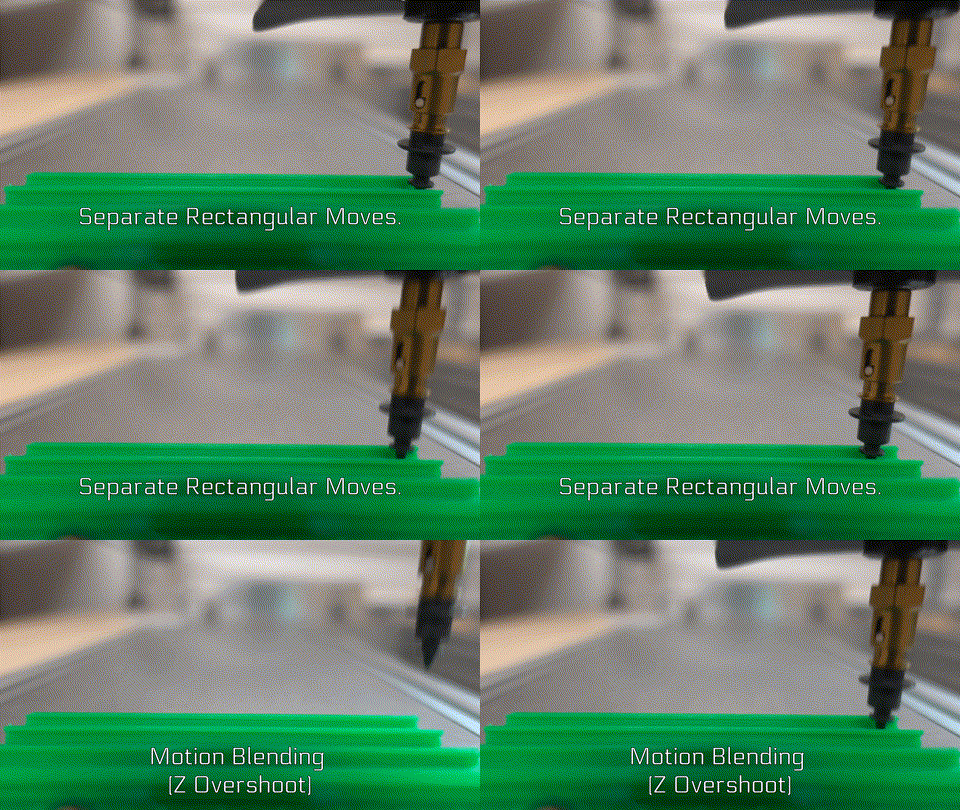
To move in more than 4 axes at a time, one would need to
implement a new MotionOption.Subordinate,
added here:
https://github.com/openpnp/openpnp/blob/develop/src/main/java/org/openpnp/model/Motion.java#L55
But instead of adding a new motion segment, it would have
accumulate AxesLocation coordinates to the previous motion
target, but never change axes that were already there. Somewhere
here:
But that is complicated by things such as backlash compensation. I.e. it would have to undo not only the last but also the second to last motion segment.
Usage in JobProcessor code (pseudo code off the top of my head):
    currentPlacement.nozzle.moveTo(currentPlacement.targetLocationOfStep);

    for each (upcomingPlacement : upcomingPlacements) {
        upcomingPlacement.nozzle.moveTo(upcomingPlacement.targetLocationOfStep, MotionOption.Subordinate);
    }
_Mark
mark maker
You're right, with the drag operation it is even more
complicated. It now needs to look ahead from the Feed operation
not only into its won Pick operation, but also into those of the
other nozzle(s).
🤯
_Mark
--
You received this message because you are subscribed to the Google Groups "OpenPnP" group.
To unsubscribe from this group and stop receiving emails from it, send an email to openpnp+u...@googlegroups.com.
To view this discussion on the web visit https://groups.google.com/d/msgid/openpnp/207d0e61-abba-4e84-9f34-04fb800dbfe9n%40googlegroups.com.
vespaman
mark maker
Good discussion. Yeah, I agree with this analysis, and yes, the polarity optimization might already bring the worst case down to rotations that are no longer (much) limiting the speed.
You could always also use real tube decouplers, even my
Liteplacer has one, and I don't believe it has much friction.

_Mark
To view this discussion on the web visit https://groups.google.com/d/msgid/openpnp/f0e144b9-7aa9-4352-acc0-eb4f0f9a6e05n%40googlegroups.com.
vespaman
mark maker
I just went to the workshop quickly and the coupling is really
going very easy, no friction that I can see. Remember, the
original machine needs to twist the silicon rubber tube, which is
not nothing. On the Liteplacer there is also some sort of tubing
(don't know if that is silicon) and the friction of the coupling
is so low that when I twist the tubing, it immediately snaps back
to the original rotation, no "creeping" or "sticking", whatsoever,
i.e. the twisting forces are way higher than any friction present.
Plus the thingy seems to be made out of very light plastic and hardly weighs anything. Even one nut of your head assembly probably weighs more. 🙂
I doubt this is significant at all.
_Mark
--
You received this message because you are subscribed to the Google Groups "OpenPnP" group.
To unsubscribe from this group and stop receiving emails from it, send an email to openpnp+u...@googlegroups.com.
To view this discussion on the web visit https://groups.google.com/d/msgid/openpnp/640d30b3-955b-4e49-bb25-9ed288014b44n%40googlegroups.com.
vespaman
vespaman
mark maker
what is the weight of your motors? do 9 grams really matter?
To view this discussion on the web visit https://groups.google.com/d/msgid/openpnp/4b0963be-44af-41a0-9c65-0693958927f6n%40googlegroups.com.
Jan
what I'm intending to add. We'll then see if the driver rotates all
nozzles on the long moves...
Jan
On 29.01.2024 15:12, 'mark maker' via OpenPnP wrote:
> /> @Mark: how would one request additional movements at the
> shared rotation situations handled automatically by the AsyncGCodeDriver
>
> Yes, OpenPnP has the *Location* data type which is X, Y, Z, C only
>
> But underneath, since I implemented Advanced Motion Control, it is all
> Furthermore, motion is never immediately executed. Instead the motion
> sequence is added to the motion planner. Only when the situation
> requires motion to be complete (for instance when we want to take a
> camera shot), then we tell the planner that we need to wait for motion
> completion. This in turn forces the motion to actually being processed
> and ultimately sent to controllers. The planner can do arbitrary
> optimization to the path and also distribute and coordinate the motion
> commands across multiple drivers, in parallel. Remember, it actually can
> do Motion Blending
> fast enough 😕).
>
>
> To move in more than 4 axes at a time, one would need to implement a
> https://github.com/openpnp/openpnp/blob/develop/src/main/java/org/openpnp/model/Motion.java#L55
>
> But instead of adding a new motion segment, it would have accumulate
>
> https://github.com/openpnp/openpnp/blob/dd58cf65b0465b426bef8ebd7b87cc7b767ddf7f/src/main/java/org/openpnp/machine/reference/driver/AbstractMotionPlanner.java#L407
>
> But that is complicated by things such as backlash compensation. I.e. it
> would have to undo not only the last but also the second to last motion
> segment.
>
> https://github.com/openpnp/openpnp/blob/dd58cf65b0465b426bef8ebd7b87cc7b767ddf7f/src/main/java/org/openpnp/machine/reference/driver/AbstractMotionPlanner.java#L384-L403
>
> Usage in JobProcessor code (pseudo code off the top of my head):
>
> currentPlacement.nozzle.moveTo(currentPlacement.targetLocationOfStep);
>
> for each (upcomingPlacement : upcomingPlacements) {
Jan
> >On the way to the first pick location, there is a lot of time to
> perform any rotation needed.
>
> assumption.
>
part of the Pick step, the required feeder is selected among the
available feeders and then a feed action is executed. If that feed
action requires dragging, its done. After feeding, the nozzle is moved
to the pick location and the part is picked. As part of that move the
rotation takes place because its part of the pick location. The same
happens for the pick on the second nozzle and for the alignment steps.
You'll probably notice, that moving the first nozzle to the camera does
not require anything else, hence its rotation is already part of the
long move. For the second nozzle again, the rotation is only executed
when the nozzle is send to the camera.
As I asked in the other response and as Mark replied, the solution is
to schedule all nozzle rotations after selecting the feeder but before
the feed operation. This way the long move to the feeder - regardless if
thats for a feed or pick operation - will rotate all nozzles and the
nozzles will arrive with the correct rotation. (I'm not aware of any
feed operation that requires the nozzle to be in a certain orientation.
So even opening a blinds feeder with the same nozzle tip shall work.)
For the alignment step, I'd add the same, schedule all nozzles
rotations before starting to move to the camera. This even shall not
harm in the case that alignment is skipped.
Jan
vespaman
> what is the weight of your motors? do 9 grams really matter?
2023-12-13 11:39:17.822 AbstractHeadMountable DEBUG: N1.moveTo((505.361436, 260.253213, -10.300000, 90.000000 mm), 1.0)
2023-12-13 11:39:17.822 ReferenceNozzle TRACE: N1.toHeadLocation((505.361436, 260.253213, -10.300000, -67.453924 mm), ...) rotation mode offset 157.453924149721
2023-12-13 11:39:17.822 ReferenceNozzle TRACE: N1.toHeadLocation((505.413261, 260.211480, -10.300000, -67.453924 mm), ...) runout compensation (-0.051825, 0.041733, 0.000000, 0.000000 mm)
2023-12-13 11:39:17.822 ReferenceNozzle DEBUG: N1.pick()
2023-12-13 11:39:17.822 Scripting TRACE: Scripting.on Nozzle.BeforePick
2023-12-13 11:39:17.822 GcodeAsyncDriver DEBUG: [GcodeDriver:ttyUSB0] commandQueue offer >> M204 S14241 G1 X471.37 Y278.45 A-67.5 F74937 ; move to target
2023-12-13 11:39:17.822 GcodeAsyncDriver$WriterThread TRACE: [GcodeDriver:ttyUSB0] >> M204S14241G1X471.37Y278.45A-67.5F74937
2023-12-13 11:39:17.822 GcodeDriver$ReaderThread TRACE: [GcodeDriver:ttyUSB0] << ok
2023-12-13 11:39:17.823 GcodeAsyncDriver DEBUG: [GcodeDriver:ttyUSB0] commandQueue offer >> M204 S139 G1 X471.43 Y278.51 F600 ; move to target
2023-12-13 11:39:17.823 GcodeAsyncDriver$WriterThread TRACE: [GcodeDriver:ttyUSB0] >> M204S139G1X471.43Y278.51F600
2023-12-13 11:39:17.824 GcodeDriver$ReaderThread TRACE: [GcodeDriver:ttyUSB0] << ok
2023-12-13 11:39:17.824 GcodeAsyncDriver DEBUG: [GcodeDriver:ttyUSB0] commandQueue offer >> M204 S90909 G1 Z-36.1 F60000 ; move to target
2023-12-13 11:39:17.824 GcodeAsyncDriver$WriterThread TRACE: [GcodeDriver:ttyUSB0] >> M204S90909G1Z-36.1F60000
2023-12-13 11:39:17.825 GcodeDriver$ReaderThread TRACE: [GcodeDriver:ttyUSB0] << ok
2023-12-13 11:39:17.830 GcodeAsyncDriver DEBUG: [GcodeDriver:ttyUSB0] commandQueue offer >> M400 ; Wait for moves to complete before returning
2023-12-13 11:39:17.830 GcodeAsyncDriver DEBUG: [GcodeDriver:ttyUSB0] commandQueue offer >> M114 ; get position
2023-12-13 11:39:17.830 GcodeAsyncDriver$WriterThread TRACE: [GcodeDriver:ttyUSB0] >> M400
2023-12-13 11:39:17.830 GcodeAsyncDriver$WriterThread TRACE: [GcodeDriver:ttyUSB0] >> M114
2023-12-13 11:39:18.113 GcodeDriver$ReaderThread TRACE: [GcodeDriver:ttyUSB0] << ok
2023-12-13 11:39:18.114 GcodeDriver$ReaderThread TRACE: [GcodeDriver:ttyUSB0] << ok C: X:471.4300 Y:278.5100 Z:-36.1000 A:-67.5000 B:23.2000 C:0.0000 D:0.0000
2023-12-13 11:39:18.114 GcodeDriver TRACE: Position report: ok C: X:471.4300 Y:278.5100 Z:-36.1000 A:-67.5000 B:23.2000 C:0.0000 D:0.0000
2023-12-13 11:39:18.114 GcodeDriver TRACE: GcodeDriver got lastReportedLocation (X:471.430000, Y:278.510000, ZN:-36.100000, C1:-67.500000, C2:23.200000, LPeel:0.000000, RPeel:0.000000)
2023-12-13 11:39:18.114 GcodeAsyncDriver TRACE: GcodeDriver confirmation complete.
vespaman
mark maker
> But if I put the 9grams on the fixed part of the head, with the existing silicon tube (just shortened a little) it does not matter.
I'm not sure I understand the situation correctly. If not, the
following might be completely wrong. 😇 A photo with any cover off
might help.
My assumptions: there is a short piece of tube from the Z-movable, rotating hollow shaft, up to a crossbar, where the coupling will be mounted, rigidly in Z (and X, Y).
So if that is true, the tube will be bent to take the Z
compression, and form a sort of snake-line. Quite a
"counter-spring".
And for rotation, you get a sort of "flex connecting rod", i.e. the rotation is "force-squished" through the silicon tubes, on top of the snake-line, likely forming some sort of "squish-spiral".
If this is true, it will surely create bad lateral forces on the
coupling, and even if the coupling could still take that
with little friction (long term), a lot of friction will result
from squishing the tubes themselves. I would even expect the
rotation to sputter with the residual sticky friction against
elasticity.
If that is even remotely true, I would definitely put the
couplings directly on the hollow shafts, and then use generous
tube lengths that can take the Z compression, and with some
bend-adjusting (if possible even above and beyond the head) you
can even balance-out half the lateral forces. No rotation
is squished into the tubes.
_Mark
--
You received this message because you are subscribed to the Google Groups "OpenPnP" group.
To unsubscribe from this group and stop receiving emails from it, send an email to openpnp+u...@googlegroups.com.
To view this discussion on the web visit https://groups.google.com/d/msgid/openpnp/920c4f89-809c-4779-81d6-d6807930cc5fn%40googlegroups.com.
mark maker
> since there is already a simple solution to the problem (by adding some kind of swivel junction) if one is interested in better performance.
This help in the feeder Pick, but not in Alignment.
_Mark
--
You received this message because you are subscribed to the Google Groups "OpenPnP" group.
To unsubscribe from this group and stop receiving emails from it, send an email to openpnp+u...@googlegroups.com.
To view this discussion on the web visit https://groups.google.com/d/msgid/openpnp/8e932aab-3c26-4247-9c9e-644f76ae9233n%40googlegroups.com.
vespaman
vespaman
mark maker
> Or maybe, like you say mount the coupling rigidly on the motors
You mean on the motor hollow shafts, right?
I.e. the underside of the coupling turns with the hollow shaft, the upper side with the tube stays (more or less) put.
Something like this:
https://www.aliexpress.us/item/3256804211715767.html
_Mark
To view this discussion on the web visit https://groups.google.com/d/msgid/openpnp/156a11d8-016f-402e-902c-48bf84a128b7n%40googlegroups.com.
mark maker
> In my mind, this is much simpler code, than trying to look up ahead all nozzles/feeders/placements etc ahead.
Not sure at all.
You still need to anticipate the pre-rotate option, and if enabled (which is much recommended!) you need the PCB placement angle, including the PCB rotation and even fiducial adjustments, which is also not that easy, i.e., not sure if readily available inside the JobProcessor.
The ideal Job Planner would be able to fully simulate the
whole job, or at least groups of placements. It could then even
account for real world time cost, based on prior measurements on
that machine. This simulation could then also be used to find the
optimized combinations of picks, i.e., avoid that picks from
feeders are far from each other etc. It could also be used to
optimize in which order the nozzles are done. Looking ahead would
be as simple as "playing" that simulation.
Jan has already added a nozzle ordering optimization in the test version, but this too would even be better if it could look ahead.
Note, I just merged it into the OpenPnP testing version:
https://github.com/openpnp/openpnp/pull/1574
@Jan, please announce as planned.
_Mark
--
You received this message because you are subscribed to the Google Groups "OpenPnP" group.
To unsubscribe from this group and stop receiving emails from it, send an email to openpnp+u...@googlegroups.com.
To view this discussion on the web visit https://groups.google.com/d/msgid/openpnp/062bc635-a8ef-4321-b8eb-615f5ffdb46en%40googlegroups.com.
vespaman
>You mean on the motor hollow shafts, right?
>I.e. the underside of the coupling turns with the hollow shaft, the upper side with the tube stays (more or less) put.
>Something like this:
Well, if you do it like that, then there's no difference to reversing it, by putting the coupler on the other end of the tube, which I intended to do. Both times the tube will twist equally much. But by putting it on the other end, there's no weight on the motor.
If you put the coupler on the hollow axle, and then fixed the outer shell of the coupler to the motor body, you will not get any twist of the tube, only the Z. This is what I thought you meant. :-)
- Micael
vespaman

Wayne Black


Mike Menci
To view this discussion on the web visit https://groups.google.com/d/msgid/openpnp/80f2145f-7b32-42d5-b8e7-09bbdbe5e987n%40googlegroups.com.
Mike Menci

On 30 Jan 2024, at 20.59, Mike Menci <mike....@gmail.com> wrote:
My PnP has it this way - fixed tube - nozzle turns with stepper shaft (Nema8 stepper with full shaft)
Mike Menci

vespaman
mark maker
> Well, if you do it like that, then there's no difference to reversing it, by putting the coupler on the other end of the tube, which I intended to do. Both times the tube will twist equally much.
Maybe I misunderstand something.
The difference, IMHO, is that the rotation by the motor will directly be decoupled, i.e. it will turn freely. The tube is not twisted, because there is no friction that could transfer the rotation forces.
In the image (source/credit)
below, only the part marked red will rotate, the green parts and
the tube remain still (the tube must only flex with the Z
compression):

> If you put the coupler on the hollow axle, and then fixed the outer shell of the coupler to the motor body, you will not get any twist of the tube, only the Z. This is what I thought you meant. :-)
I don't understand. See above.
_Mark
--
You received this message because you are subscribed to the Google Groups "OpenPnP" group.
To unsubscribe from this group and stop receiving emails from it, send an email to openpnp+u...@googlegroups.com.
To view this discussion on the web visit https://groups.google.com/d/msgid/openpnp/ffd7038a-ee2b-4c53-bade-824fb4382242n%40googlegroups.com.
Wayne Black
Wayne Black
vespaman
vespaman
Wayne Black
vespaman
- Micael
Wayne Black


mark maker
Like I said, maybe all of this is a misunderstanding 🙂. A picture says more than 100 words, so here it is:
The way I understand you plan to assemble it is like so, with the
decoupler at the top:

So the rotation forces must be transferred across a
snake-line/spiral of a flexible tube that is bent by Z
compression. I'm also assuming the bent tube will not be able to
rotate freely, the bend will be squishing against the backside of
the head or something, rotation needs to fight against the block,
i.e. the bend in the tube is forced to rotate in the material.
The friction I'm talking about happens inside the
material, i.e. the forces required to deform the tube that way.
Whereas when you simply attach the coupling to the hollow shaft,
the tube rotation remains static and it only needs to compress
with Z. By having a generous tube bend, possibly up and beyond the
head, these compression forces will also be much smaller than in
the clamped and short configuration above.

_Mark
To view this discussion on the web visit https://groups.google.com/d/msgid/openpnp/411b0f32-e36a-406d-9f31-1b591efc6a1dn%40googlegroups.com.
vespaman

vespaman

Wayne Black
To view this discussion on the web visit https://groups.google.com/d/msgid/openpnp/5486d0d5-3d3b-4e19-a57f-62450964f1d4n%40googlegroups.com.

vespaman
vespaman
Wayne Black
To view this discussion on the web visit https://groups.google.com/d/msgid/openpnp/e32e5e90-a4c9-45c8-8baa-607e064a5ec6n%40googlegroups.com.
Jan
You're measurements suggests that the original pump could/should be
enhanced by adding a reservoir. I guess that already 100..250ml should
provide a significant advantage. Did you by change ever tried that?
Related question: how did you guys configured your dwell times? I tried
some numbers but that was more poking around in the fog. Currently I'm
quite happy with 40ms pick dwell time but your graphs suggest that I
shall use rather 250ms. However, I never measured all the delays and
jitter introduced by OpenPnP controlling smoothie controlling the valve.
Jan
On 31.01.2024 05:31, Wayne Black wrote:
> Micael,
> I hope this doesn't derail you're initial topic, but if you're really
> interested speed/accuracy on the stock chmt head, you're time might be
> better spent on the pneumatics. I just did back to back test the oem
> chmt pump vs a HS15 venturi at 50psi. In a nut shell the venturi is
> about 10x faster in reaching stable vacuum and the vacuum is much more
> stable. I was never able to get Openpnp part detection via vac sense to
> work on my machine, now Im sure it will. I dunno how you're determining
> picks or not, but doing it via vac at time of pick vs running it over to
> the camera would also save a lot of time. All of this is just my exp,
> you mileage may vary...
>
> I scoped this pretty quickly on the bench measuring the raw output of
> the vac sense board. The yellow is the analog and the blue is pump or
> solenoid.
>
> On Tuesday, January 30, 2024 at 11:04:09 AM UTC-8 micael....@gmail.com
> wrote:
>
> Wayne, yes, agree. And there's also slightly more mass on one side
> of the coupler. But it is easy to get tangled up if adding too many
> details, especially for us non-native English guys.
>
> The quality of the coupler, while also having its issues, should be
> better, since it specifically optimized for low friction and
> probably has better materials int its seal. Also, the internal
> diameter of the couples is less afaict, so less surface-surface
> friction.
> I think the main issue with my 3d printed solution, is that there's
> a limited amount of seals available in this size, so I had to pick
> what was available to me.
>
> The ones I am getting, is the ones made for slower motion (up to 500
> RPM), maybe I should have opted for the ones for higher speed, since
> they have 2 ball bearings instead of one.
>
> But time will tell, which solution is the better - and I'll post my
> results and solution in this thread. I think I may have to modify
> the couplers in a few ways to suit me, and the mounting of them.
>
> - Micael
> tisdag 30 januari 2024 kl. 19:35:05 UTC+1 skrev
> black...@blackboxembedded.com:
>
> in the vice, and measure the torque, you will get the same
> friction, right?
> /The friction of the coupler is the same on both sides.
> /
> /This means that the same amount of force is needed if you turn
> it around./
> /So the tube will have meet the same rotational force, no matter
> where you put the coupler, and no matter how you turn it./
> /
> /
>
> Maybe I misunderstand something.
>
> The difference, IMHO, is that the rotation by the motor
> that could transfer the rotation forces.
>
> In the image (source/credit
> parts and the tube remain still (the tube must only flex
> with the Z compression):
>
>
> you will not get any twist of the tube, only the Z. This
> I don't understand. See above.
>
> _Mark
>
> On 30.01.2024 16:56, vespaman wrote:
>>
>> >I.e. the underside of the coupling turns with the
>> hollow shaft, the upper side with the tube stays (more
>> or less) put.
>>
>> >Something like this:
>>
>> Well, if you do it like that, then there's no
>> difference to reversing it, by putting the coupler on
>> the other end of the tube, which I intended to do.
>> Both times the tube will twist equally much. But by
>> putting it on the other end, there's no weight on the
>> motor.
>>
>> If you put the coupler on the hollow axle, and then
>> fixed the outer shell of the coupler to the motor
>> body, you will not get any twist of the tube, only the
>> Z. This is what I thought you meant. :-)
>>
>> - Micael
>>
>>
>> --
>> You received this message because you are subscribed
>> to the Google Groups "OpenPnP" group.
>> To unsubscribe from this group and stop receiving
>> emails from it, send an email to
>> openpnp+u...@googlegroups.com.
>> To view this discussion on the web visit
> --
> You received this message because you are subscribed to the Google
> Groups "OpenPnP" group.
> To unsubscribe from this group and stop receiving emails from it, send
> an email to openpnp+u...@googlegroups.com
Wayne Black
vespaman
Jan
Yes, I keep my vacuum pump running all the time while running a job
(Thanks to Mark that's nowadays easy to setup. Before, the first picks
of the day usually suffered from insufficient vacuum...) I think the
idea of a stable vacuum and just switched the connection to the nozzle
tips is faster and hence more valuable to me then the noise reduction by
switching the pump off between picks. I put my pump on rubber feeds
(https://www.amazon.com/Rubber-Absorber-Isolator-Vibration-Silentblock/dp/B0839GJ5D6/)
that helped. In addition I placed some absorbing material between table
and machine body to damp the vibrations.
From you measurements I think now that I should add a small reservoir
between pump and valves. 4x the air volume between valve and tip of the
nozzle tip is likely sufficient, 10x would be even better to damp the
drop in pressure when picking. This mod is easy to add and shall provide
a more reliable and faster picking.
Yes, I would love to read a build log of your machine. However, you
already mentioned so many modifications you did that I'll likely not
follow. I'm currently quite happy with the few modification I did,
except that I'd like to have a nozzle tip changer...
I'd say that this list is the better place for your build log. To my
understanding the Desktop pnp group is more for people trying to run
small commercial machines with commercial software while here you meet
people building their own machines.
Jan
> > --
> > You received this message because you are subscribed to the Google
> > Groups "OpenPnP" group.
> > To unsubscribe from this group and stop receiving emails from it,
> send
> > an email to openpnp+u...@googlegroups.com
> > <mailto:openpnp+u...@googlegroups.com>.
> > To view this discussion on the web visit
> >
> --
> You received this message because you are subscribed to the Google
> Groups "OpenPnP" group.
> To unsubscribe from this group and stop receiving emails from it, send
> an email to openpnp+u...@googlegroups.com
> <mailto:openpnp+u...@googlegroups.com>.
> To view this discussion on the web visit
Jan
If you know, that you never hit the 40ms, why accept the jitter/delay
by measuring the same over and over again? If you take average values
from different nozzle tips you should be able to disentangle the
constant (tubing, nozzle related) part from the nozzle tip related part
using a linear fit and configure fixed dwell times. This can then be
executed by the controller without computer intervention already queuing
the next moves.
(I know, that pick retries are bound to part-on checks. However, speed
requires reliably picks without retries...)
Jan
PS: I guess we're turning your initial question into something
completely different. Maybe it would be a good idea to group vacuum
related stuff into a different topic...
> > --
> > You received this message because you are subscribed to the Google
> > Groups "OpenPnP" group.
> > To unsubscribe from this group and stop receiving emails from it,
> send
> > an email to openpnp+u...@googlegroups.com
> > <mailto:openpnp+u...@googlegroups.com>.
> > To view this discussion on the web visit
> >
> --
> You received this message because you are subscribed to the Google
> Groups "OpenPnP" group.
> To unsubscribe from this group and stop receiving emails from it, send
> an email to openpnp+u...@googlegroups.com
> <mailto:openpnp+u...@googlegroups.com>.
> To view this discussion on the web visit
vespaman
vespaman


Wayne Black
vespaman
Jan
Thank You very much, Mark! Thats exactely what I was looking for and
what I'm intending to add. We'll then see if the driver rotates all
nozzles on the long moves...
Jan
On 29.01.2024 15:12, 'mark maker' via OpenPnP wrote:
> /> @Mark: how would one request additional movements at the
> AsyncGCodeDriver? MoveTo() only provides arguments for four axis. Are
> shared rotation situations handled automatically by the AsyncGCodeDriver
> or would that have to be done by the caller?/
>
> Yes, OpenPnP has the *Location* data type which is X, Y, Z, C only
> (4-axis).
>
> But underneath, since I implemented Advanced Motion Control, it is all
> managed in *AxesLocation*, which supports an arbitrary number of axes.
>
> Furthermore, motion is never immediately executed. Instead the motion
> sequence is added to the motion planner. Only when the situation
> requires motion to be complete (for instance when we want to take a
> camera shot), then we tell the planner that we need to wait for motion
> completion. This in turn forces the motion to actually being processed
> and ultimately sent to controllers. The planner can do arbitrary
> optimization to the path and also distribute and coordinate the motion
> commands across multiple drivers, in parallel. Remember, it actually can
> do Motion Blending
> <https://github.com/openpnp/openpnp/wiki/Motion-Planner#motion-blending>
> and other cool stuff (if only the controllers and serial interfaces were
> fast enough 😕).
>
> AdvancedMotionAnimation
>
> To move in more than 4 axes at a time, one would need to implement a
> new*MotionOption.Subordinate*, added here:
>
> https://github.com/openpnp/openpnp/blob/develop/src/main/java/org/openpnp/model/Motion.java#L55
>
> But instead of adding a new motion segment, it would have accumulate
> AxesLocation coordinates to the*previous* motion target, but never
> change axes that were already there. Somewhere here:
>
> https://github.com/openpnp/openpnp/blob/dd58cf65b0465b426bef8ebd7b87cc7b767ddf7f/src/main/java/org/openpnp/machine/reference/driver/AbstractMotionPlanner.java#L407
>
> But that is complicated by things such as backlash compensation. I.e. it
> would have to undo not only the last but also the second to last motion
> segment.
>
> https://github.com/openpnp/openpnp/blob/dd58cf65b0465b426bef8ebd7b87cc7b767ddf7f/src/main/java/org/openpnp/machine/reference/driver/AbstractMotionPlanner.java#L384-L403
>
> Usage in JobProcessor code (pseudo code off the top of my head):
>
> currentPlacement.nozzle.moveTo(currentPlacement.targetLocationOfStep);
>
> for each (upcomingPlacement : upcomingPlacements) {
> upcomingPlacement.nozzle.moveTo(upcomingPlacement.targetLocationOfStep,*MotionOption.Subordinate*);
> }
>
>
> _Mark
>
>
> On 29.01.2024 14:20, 'Jan' via OpenPnP wrote:
>> Hi Micael!
>> Interesting mod you did!
>> As Mark says, the JobProcessor handles nozzles in series. On the
>> way to the first pick location, there is a lot of time to perform any
>> rotation needed. The same on the way from pick to align. But for the
>> second (and any other) nozzle the distance might be quite short and
>> hence limited by the rotation. So if you have a polarized part, the
>> penalty at alignment is still there (depending on pick, pre-rotate
>> setting and place orientation).
>> @Mark: how would one request additional movements at the
>> AsyncGCodeDriver? MoveTo() only provides arguments for four axis. Are
>> shared rotation situations handled automatically by the
>> AsyncGCodeDriver or would that have to be done by the caller?
>> From my current understanding of the JobProcessor everything is -
>> in theory - there: it's a question if special care for shared rotation
>> machines has to be added and where the usual move-to-safe-z is
>> happening (are the rotation information for other nozzles available at
>> safe-z or not?)
>>
>> Jan
>>
>> On 29.01.2024 11:53, vespaman wrote:
>>> >But as I said, it would have to peek ahead in the Job Processor,
>>> and that's not too easy...
>>>
>>> Yes, that indeed sounds very complicated to add on. And, at least
>>> from the point of feeders, I suspect that most machines with not 2
>>> nozzles already have a solution for free rotation. And for the rest
>>> of us we can always change this when needed.
>>> So from that perspective, the lower hanging fruit with the "polarity
>>> does not matter" is worth more imo, since it will help all set-ups to
>>> some extent, lessen the worst case 180deg scenario.
>>> (Also during alignment, I suspect, as well as components that does
>>> not handle rotation well in general - e.g. those tact switches that
>>> can swivel because the key top is not fixated very securely to the
>>> body).
>>>
>>> (I suppose a parallel rotation for alignment over up looking camera
>>> issues might be easier to solve, looking at it isolated (?), since by
>>> then, the components/rotation should be known)
>>>
>>> - Micael
>>> måndag 29 januari 2024 kl. 10:49:19 UTC+1 skrev ma...@makr.zone:
>>>
>>> /> If I understood you correctly, the logic behind the rotation is
>>> that it is not started until the move to the pick location is
>>> started(?).
>>> /
>>>
>>> Yes.
>>>
>>> (I'm also explaining for those reading along:)
>>>
>>> For the first nozzle that is usually okay, as it is moving from the
>>> last placement location. i.e. a rather long move where rotation can
>>> take place in parallel. However, for the second nozzle, this is just
>>> the move from one feeder pick location to the other feeder pick
>>> location, those can be close together, and if you have two
>>> compatible nozzle tips it might even be from the same feeder, so the
>>> move is only the between-nozzles offset (plus/minus 2mm for 0402),
>>> i.e., not enough time to rotate.
>>>
>>> The same happens in Alignment, above the bottom camera.
>>>
>>> Technically, if you have two independent rotation motors on the
>>> nozzles (as most machines have), OpenPnP could rotate the second
>>> nozzle in parallel with the first nozzle, i.e., while moving to the
>>> feeders/bottom camera. Advanced Motion Control actually *can* do
>>> that (it wasn't possible before). But as I said, it would have to
>>> peek ahead in the Job Processor, and that's not too easy...
>>>
>>> _Mark
>>>
>>> On 29.01.2024 10:07, vespaman wrote:
>>>>
>>>> 1. OK, I will not hold my breath! :-)
>>>> 2. Yes, I think you mentioned this in another thread. I know all
>>>> about time (the lack of) :-) so I am no holding my breath here
>>>> either. But I agree that this would be very nice.
>>>>
>>>> Today I decided I needed to do some tests, to get at least some
>>>> feeling what can be achieved, and got to think about the motion
>>>> planner test, I am not sure if this is similar motion, but if it
>>>> is, it is very useful for testing the consequences of the rotation.
>>>> Moving 2mm without rotation takes about 90ms. With rotation 90 to
>>>> -90 (and 100000/2000 acc/feedrate), same operation takes ~170ms as
>>>> per the result of the motion planner test.
>>>>
>>>> If I understood you correctly, the logic behind the rotation is
>>>> that it is not started until the move to the pick location is
>>>> started(?).
>>>> So I also tested a move from end of drag to first nozzle, first
>>>> pick location, to see if also that where also held back by the
>>>> rotation.
>>>> This is a slightly longer move that involves both x and y.
>>>> Move without rotation: ~125ms. With also rotation 90 to -90,
>>>> ~170ms.
>>>>
>>>> So, if this test is indicative to real life, it makes me think the
>>>> total rotation "cost" on this double pick is around 130ms, which
>>>> is not insignificant.
>>>>
>>>> Incidentally, today, I tried yanking up the acc/feedrate with the
>>>> cups mounted. And it looked (by the eye) to be working just fine
>>>> for some reason. Not sure if it really holds together in real life
>>>> though.
>>>> I suppose the only way to know if I'll be loosing steps, is to run
>>>> a job. That could be a nightmare. :-o
>>>> I probably should setup some test job instead, so I don't have to
>>>> spend half a day to correct 0402 on real boards.
>>>>
>>>> - Micael
>>>>
>>>>
>>>> måndag 29 januari 2024 kl. 09:05:18 UTC+1 skrev ma...@makr.zone:
>>>>
>>>> /> Main scenario is that I want the second nozzle pick, to
>>>> pick as soon as possible. With original, the chmt has a
>>>> silicon tube that does not allow free articulation, so the
>>>> nozzles have to rotate before picking. The cups let's the
>>>> motor rotate freely, so with the settings above, the second
>>>> nozzle pick can just pick, regardless of its current angle/
>>>>
>>>> Ah, I understand, thanks. For those reading along, he is
>>>> tlking about Rotation Mode:
>>>>
>>>> https://github.com/openpnp/openpnp/wiki/Nozzle-Rotation-Mode
>>>> <https://github.com/openpnp/openpnp/wiki/Nozzle-Rotation-Mode>
>>>>
>>>> Specifically the Minimal Rotation
>>>> <https://github.com/openpnp/openpnp/wiki/Nozzle-Rotation-Mode#rotation-modes> mode.
>>>>
>>>> I can't say if this will "pay" in the end, if you have to
>>>> reduce acceleration rates as a trade-off due to friction. As a
>>>> matter of fact, there is another rotation in the Alignment
>>>> step (assuming "pre-rotate", as you should). So it is unclear
>>>> which is worse in the end.
>>>>
>>>> Clearly, OpenPnP has potential for optimization too (to avoid
>>>> the cups and friction):
>>>>
>>>> 1. By looking ahead and rotating /both/ nozzles while moving
>>>> to the (first nozzle) pick location, and/or while moving
>>>> back to Alignment. In fact it was one of my goals to allow
>>>> moving more than three axes at the same time when doing
>>>> Advanced Motion Control, so that part would actually be
>>>> ready. But that kind of "looking ahead" is *not* how the
>>>> JobProcessor currently works, so don't hold your breath.
>>>> 2. A more low hanging fruit would be a "polarity does not
>>>> matter" switch on the Package. So OpenPnP could take /any/
>>>> rotation modulo 180°, effectively halving the average
>>>> rotation for those parts, or even more, as we have
>>>> placement angles in 90° increments and two are halved, and
>>>> one is even zeroed. And as those parts (resistors, ceramic
>>>> caps) are typically the most numerous in a job, this could
>>>> actually end up helping quite a lot. If only I had more
>>>> spare time...
>>>>
>>>> _Mark
>>>>
>>>> On 28.01.2024 19:03, vespaman wrote:
>>>>> >This is all automatic with I&S. Don't worry, you surely
>>>>> already have it.
>>>>> OK, good!
>>>>>
>>>>> >Frankly, I don't really understand your scenario and how
>>>>> these 3D printed cups are supposed to improve the situation?
>>>>>
>>>>> Main scenario is that I want the second nozzle pick, to pick
>>>>> as soon as possible. With original, the chmt has a silicon
>>>>> tube that does not allow free articulation, so the nozzles
>>>>> have to rotate before picking.
>>>>> The cups let's the motor rotate freely, so with the settings
>>>>> above, the second nozzle pick can just pick, regardless of
>>>>> its current angle, only need to wait for the 4mm X-move
>>>>> (without turning the nozzle), if I understand everything
>>>>> correctly. So we don't have to wait for the nozzle turning
>>>>> prior to pick.
>>>>> (This is 0402 on a ref push pull feeder, with both pockets
>>>>> open, both nozzle picks from the same feeder)
>>>>>
>>>>>
>>>>> - Micael
>>>>>
>>>>> -- You received this message because you are
>>>>> subscribed to the
>>>>> Google Groups "OpenPnP" group.
>>>>> To unsubscribe from this group and stop receiving emails from
>>>>> it, send an email to openpnp+u...@googlegroups.com.
>>>>> To view this discussion on the web visit
>>>>> https://groups.google.com/d/msgid/openpnp/887b5286-af61-4d13-ba7b-9478bfbe18fbn%40googlegroups.com <https://groups.google.com/d/msgid/openpnp/887b5286-af61-4d13-ba7b-9478bfbe18fbn%40googlegroups.com?utm_medium=email&utm_source=footer>.
>>>>
>>>> -- You received this message because you are subscribed to
>>>> the Google
>>>> Groups "OpenPnP" group.
>>>> To unsubscribe from this group and stop receiving emails from it,
>>>> send an email to openpnp+u...@googlegroups.com.
>>>> To view this discussion on the web visit
>>>> https://groups.google.com/d/msgid/openpnp/577793b0-e71e-4c42-95c6-01daa5cbdc50n%40googlegroups.com <https://groups.google.com/d/msgid/openpnp/577793b0-e71e-4c42-95c6-01daa5cbdc50n%40googlegroups.com?utm_medium=email&utm_source=footer>.
>>>
>>> --
>>> You received this message because you are subscribed to the Google
>>> Groups "OpenPnP" group.
>>> To unsubscribe from this group and stop receiving emails from it,
>>> send an email to openpnp+u...@googlegroups.com
>>> <mailto:openpnp+u...@googlegroups.com>.
>>> To view this discussion on the web visit
>>> https://groups.google.com/d/msgid/openpnp/c5747ae8-2190-4f05-abb2-03e5fb152f5bn%40googlegroups.com <https://groups.google.com/d/msgid/openpnp/c5747ae8-2190-4f05-abb2-03e5fb152f5bn%40googlegroups.com?utm_medium=email&utm_source=footer>.
>>
> --
> You received this message because you are subscribed to the Google
> Groups "OpenPnP" group.
> To unsubscribe from this group and stop receiving emails from it, send
> an email to openpnp+u...@googlegroups.com
> <mailto:openpnp+u...@googlegroups.com>.
> To view this discussion on the web visit
mark maker
Maybe you should open a new thread for this. 😉
Regarding the merging:
Good question. I haven't thought this out.
Maybe we need to reverse it like so:
Usage in JobProcessor would be the other way around:
    for each (upcomingPlacement : upcomingPlacements) {
        upcomingPlacement.nozzle.moveTo(upcomingPlacement.targetLocationOfStep, MotionOption.Subordinate);
    }
currentPlacement.nozzle.moveTo(currentPlacement.targetLocationOfStep);
Then in the AbstractMotionPlanner.moveTo() if the MotionOpen.Subordinate is given, you only record the subordinate location temporarily. Only record the subordinate axis-coordinates that have changed vs. currentLocation. Do not really plan the motion yet, i.e., stop after simply storing the subordinate location in the AbstractMotionPlanner.
Multiple calls with MotionOpen.Subordinate are combined by
AxesLocation.put() into the temporary subordinate location. NOTE:
machines with shared Z or C axes might overwrite the same physical
axis multiple times. You have to decide which one wins: the first
or last caller i.e. which is to be the left or right argument of
put().
Then when the next non-subordinate moveTo() comes, you take the subordinate location and put() it into the newLocation and then put() the new non-subordinate axesLocation on top.
Then also reset the recorded subordinate location, so it starts empty for the next round.
Note this also solves the backlash compensation problem, as it comes before it is even determined.
Much cleaner like that! 😎
_Mark
To view this discussion on the web visit https://groups.google.com/d/msgid/openpnp/00bdd901-f11e-44c7-87d6-af13bbf5a874n%40googlegroups.com.
Jan
I'm digging deeper into the mud and found some new issues, I'd like to
discuss: at present I've implemented pre-rotation as separate steps in
the job processor located between optimization and actual execution. For
picking the pre-rotation is therefore executed even before the feed,
which is nice, because under the assumption, that the move from place to
pick or feed is much longer then from feed to pick, this is efficient.
However, for ReferencePushPullFeeder used as drag feeders, the feed
operation resets the additional rotation axis in line 422 (I've
configured my peeler as such, with additive rotation). This trigger - in
my current implementation - a "subordinated motion queue not empty"
warning, which voids the pre-rotation. Could we move this to the end of
the feed operation or handle the reset asynchronously as this axis is
never used elsewhere and it's safe to reset it at any time?
Jan
On 05.04.2024 13:21, 'mark maker' via OpenPnP wrote:
> Maybe you should open a new thread for this. 😉
>
> Regarding the merging:
>
> Good question. I haven't thought this out.
>
> Maybe we need to reverse it like so:
>
> Usage in JobProcessor would be the other way around:
>
> for each (upcomingPlacement : upcomingPlacements) {
>
> currentPlacement.nozzle.moveTo(currentPlacement.targetLocationOfStep);
>
> Then in the AbstractMotionPlanner.moveTo()
> Multiple calls with MotionOpen.Subordinate are combined by
> AxesLocation.put() into the temporary subordinate location. NOTE:
> machines with shared Z or C axes might overwrite the same physical axis
> multiple times. You have to decide which one wins: the first or last
> caller i.e. which is to be the left or right argument of put().
>
>> >>>> -- You received this message because you are
>> subscribed to
>> >>>> the Google
>> >>>> Groups "OpenPnP" group.
>> >>>> To unsubscribe from this group and stop receiving emails
>> from it,
>> >>>> send an email to openpnp+u...@googlegroups.com.
>> >>>> To view this discussion on the web visit
>> >>>>
>> >>> --
>> >>> You received this message because you are subscribed to the
>> >>> Groups "OpenPnP" group.
>> >>> To unsubscribe from this group and stop receiving emails from it,
>> >>> send an email to openpnp+u...@googlegroups.com
>> >>> <mailto:openpnp+u...@googlegroups.com>.
>> >>> To view this discussion on the web visit
>> >>>
>> > --
>> > You received this message because you are subscribed to the Google
>> > Groups "OpenPnP" group.
>> > To unsubscribe from this group and stop receiving emails from
>> it, send
>> > an email to openpnp+u...@googlegroups.com
>> > <mailto:openpnp+u...@googlegroups.com>.
>> > To view this discussion on the web visit
>> >
>> --
>> You received this message because you are subscribed to the Google
>> Groups "OpenPnP" group.
>> To unsubscribe from this group and stop receiving emails from it, send
>> an email to openpnp+u...@googlegroups.com.
>> To view this discussion on the web visit
> --
> You received this message because you are subscribed to the Google
> Groups "OpenPnP" group.
> To unsubscribe from this group and stop receiving emails from it, send
> an email to openpnp+u...@googlegroups.com
> <mailto:openpnp+u...@googlegroups.com>.
> To view this discussion on the web visit
mark maker
I'll answer in the new thread 😉
Hi Mark!