Diagrammatic Reasoning and AI

112 views
Skip to first unread message

John F Sowa

unread,
Aug 26, 2023, 6:12:57 PM8/26/23
to ontolo...@googlegroups.com, Peirce List, CG
Doug F, et al.,

I'm writing an article about Peirce's phaneroscopy and diagrammatic reasoning, which has strong implications for ontology, reasoning methods, and their implications for the latest issues in generative artificial intelligence.  See below for excerpts from that article and some links for further information.

John

PS:  I just did a cut & paste below, but the diagrams did not get copied.   I'll include a PDF later.  But the text explains the issues, and the citations have more explanations and diagrams.
___________________________________

From a Science Egg to a Science of Diagrams

John F. Sowa 
Draft of 26 August 2023

Abstract. In the last decade of his life, Peirce developed phaneroscopy and existential graphs as the basis for a proof of pragmaticism. To publish the proof, he wrote a series of articles for the Monist.  The first two began with phaneroscopy. But in 1906, he added a version of tinctured existential graphs to the third article, An Apology for Pragmaticism. In 1908, he began a fourth article, which he never finished. One reason he stopped may be his remark in 1909: “Phaneroscopy, still in the condition of a science-egg, hardly any details of it being as yet distinguishable.” Other reasons involve issues about the graphs, which he resolved in 1911. Although Peirce did not complete the proof, his writings inspired aspects of Lady Welby’s significs, Wittgenstein’s language games, and patterns of diagrams in every branch of science and engineering. Today, Peirce’s theories of phaneroscopy and diagrammatic reasoning clarify critical issues in cognitive science.  Among them are the methods of reasoning in linguistics, neuroscience and artificial intelligence.

1. Developments from 1903 to 1913

For Peirce, 1902 brought an end to two major projects:  Baldwin’s dictionary was finished, and funding for his Minute Logic was rejected.  But three events in 1903 led him to rethink every aspect of his life’s work:  his Harvard lectures in the spring, his Lowell lectures in the fall, and his correspondence with Victoria Welby.  As a guide to the new developments, the tree in Figure 1 shows his classification of the sciences and dependencies among them.  Branches show the classification, and dotted lines show the dependencies. Sciences to the right of each dotted line depend on sciences to the left.  Pure mathematics stands alone, and all other sciences and engineering depend on mathematics (CP 1.180ff, 1903).
. . . [deleted]
In summary, phaneroscopy depends on mathematics, which includes existential graphs as a formal logic.  But as a diagrammatic logic, EGs can be used in two ways.  For phaneroscopy, the option of changing shape is important.  Nodes of a graph may be moved to match the shape of the image they represent. For logic, however, changing the shape does not change the meaning. Since the same notation can serve both purposes, EGs support Peirce’s prediction that phaneroscopy “surely will in the future become a strong and beneficient science” (R645, 1909).

2. The Role of Diagrams in Phaneroscopy

For the third Monist article, Prolegomena to an Apology for Pragmaticism, Peirce chose a title that echoes Kant’s Prolegomena. In it, he addressed Kant’s three “transcendental questions”: How is pure mathematics possible?  How is pure natural science possible?  How is metaphysics in general possible? The dotted lines in Figure 1 suggested the answer shown in Figure 2:   diagrams, such as EGs, are mathematical structures that relate phaneroscopy, metaphysics, and the natural sciences to methods for thinking, talking, and acting in and on the world.


Figure 2:  Diagrams relate thought and language to the world
The first sentence sets the stage:  “Come on, my Reader, and let us construct a diagram to illustrate the general course of thought; I mean a System of diagrammatization by means of which any course of thought can be represented with exactitude” (CP 4:530). Figure 2 shows an important step beyond Tarski’s model theory.  Instead of a one-step mapping from the world to language, the diagram splits the mapping in two distinct steps.
Phaneroscopy maps some aspect of the world to a diagram, which is “an icon of a set of rationally related objects” (R293, NEM 4:316). It serves as a Tarski-style model for determining the denotation of languages, formal or informal.  But when a continuous world is mapped to a discrete diagram, an enormous amount of detail is lost.  Although the right side can be a precise map from a graph to a formal logic, it may be an approximate mapping from an informal diagram to the informal languages that people speak.  In his career as a scientist, engineer, linguist, lexicographer, and philosopher, Peirce understood the complexity of both sides.
. . . [deleted]
An appropriate logic should facilitate a proof of pragmaticism. Peirce stated the requirements in his Prolegomena:  “a System of diagrammatization by means of which any course of thought can be represented with exactitude.” Then “operations upon diagrams, whether external or imaginary, take the place of the experiments upon real things that one performs in chemical and physical research.” The system has four aspects: (1) diagrams in EGs or other notations; (2) grammars for mapping languages to and from diagrams; (3) critic for evaluating the denotation {true,false} of diagrams in terms of a formal logic; and (4) perception and action for relating the world to the diagram. The arrows in the hexagon of Figure 4 indicate the flow of any course of thought.

See https:\\jfsowa.com\talks\eswc.pdf  for some of the diagrams

Figure 4:  The flow of thought in an intelligent system
The hexagon in Figure 4 shows details implicit in Figure 2. The upper three corners and the starburst of phemes represent intelligent processing.  The lower three corners correspond to the drawing by Uexküll in Figure 3. The arrow from mental experience to and from action supports routine habits or emergency responses.  Behavior that requires complex reasoning may involve all the nodes and arrows.
As Peirce insisted, a diagram of information flow, such as Figure 4, is not a psychological theory. It may represent data that controls a robot or the thought of an alien being in a distant galaxy. But the word exactitude for representing “any course of thought” poses a challenge.  As Figure 2 shows, the mapping between the world and a diagram can only be approximate, and the mapping between a diagram and a language can only be exact for notations that are designed to represent those diagrams. Approximations must be recognized and accommodated.
With his constant questioning, Peirce’s ideas kept evolving. In 1907, he had stated the basis for his proof:  “the Graphs break to pieces all the really serious barriers, not only to the logical analysis of thought but also to the digestion of a different lesson by rendering literally visible before one’s very eyes the operation of thinking in actu” (CP 4.6, R298). 1909, he expressed his concerns about phaneroscopy “still in the condition of a science-egg” (R645). But in In the next two years, he addressed those issues and generalized existential graphs to accommodate them.

3. Relating Images to Diagrams

Since the semes and phemes that flow along the arrows of Figure 4 may contain uninterpreted percepts and images, ordinary existential graphs cannot represent them.  In the letter L231, in which Peirce specified his most general notation for EGs, he mentioned his hopes of representingn“stereoscopic moving images.” To accommodate them, Sowa (2016, 2018) proposed generalized existential graphs (GEGs). Figure 5 shows Euclid’s Proposition 1 stated in three kinds of GEGs:  “On a given finite straight line, to draw an equilateral triangle.”
. . . [deleted].
For details, see Sowa (2018) Reasoning with diagrams and images, Journal of Applied Logics 5:5, 987-1059. http://www.collegepublications.co.uk/downloads/ifcolog00025.pdf

4. Significs

. . . [deleted]
During the following decade, correspondence between Peirce and Welby strongly influenced both.  In 1903, Peirce had adopted Kant’s abstract phenomenology.  But in 1904, he coined the new word phaneroscopy, which he discussed in terms that were closer to Welby’s emphasis on observation and mental experience.  In his letters to her, Peirce added examples that clarified the motivation and explained the details of his abstract analysis.  His classification of the sciences in 1903 (Figure 1) illustrates the differences, Peirce had sharply distinguished mathematics, phaneroscopy, and the normative sciences. With her emphasis on examples, Welby showed how practical issues affected the details of each case.  As a result of their correspondence, Peirce revised and generalized the foundation of his logic, semeiotic, and pragmatism.
. . . [deleted]
Welby shared Peirce”s broad view of meaning and communication. In What is Meaning (1903), she wrote “There is, strictly speaking, no such thing as the Sense of a word, but only the sense in which it is used — the circumstances, state of mind, reference, ‘universe of discourse’ belonging to it”. In the Encyclopedia Britannica (1911), she emphasized the “importance of acquiring a clear and orderly use of the terms of what we vaguely call Meaning; and also of the active modes, by gesture, signal or otherwise, of conveying intention, desire, impression and rational or emotional thought.”
Whitehead and Wittgenstein would agree, but Frege, Russell, and their followers would strongly disagree. Among linguists, the founder of transformational grammar, Zellig Harris, wrote “We understand what other people say through empathy — imagining ourselves to be in the situation they were in, including imaging wanting to say what they wanted to say.” But his star pupil, Noam Chomsky, would claim that empathy is outside the subject matter of linguistics.

5. Language Games

Peirce and Wittgenstein made a major transition from their early philosophy to their later, and both in the same direction. One critic said that Wittgenstein began as a logician and ended as a lexicographer.  Ironically, that remark, which was intended in a derogatory sense, is true in a higher sense:  they both discovered the flexibility and expressive power of natural languages. For Peirce, the transition was marked by the 16,000 definitions he wrote or edited for the Century Dictionary. For Wittgenstein, it was his second published book, Wörterbuch für Kindern, which he wrote when he was teaching elementary school in Austrian mountain villages. He learned that children do not think or speak along the lines of his first book, the Tractatus Logico-Philosophicus (TLP).
. . . [deleted]

6. Diagrams As the Language of Thought

Peirce’s writings on logic, semeiotic, and diagrammatic reasoning, which had been neglected for most of the 20th century, are now at the forefront of research in the 21st. The psychologist Johnson-Laird (2002), who had written extensively about mental models, said that Peirce’s existential graphs and rules of inference are a good candidate for a neural theory of reasoning:
Peirce’s existential graphs are remarkable.  They establish the feasibility of a diagrammatic system of reasoning equivalent to the first-order predicate calculus.  They anticipate the theory of mental models in many respects, including their iconic and symbolic components, their eschewal of variables, and their fundamental operations of insertion and deletion.  Much is known about the psychology of reasoning...  But we still lack a comprehensive account of how individuals represent multiply-quantified assertions, and so the graphs may provide a guide to the future development of psychological theories.
. . . [deleted]
These observations imply that cognition involves an open-ended variety of interacting processes. Frege’s rejection of psychologism and “mental pictures” reinforced the behaviorism of the early 20th century. But the latest work in neuroscience uses “folk psychology” and introspection to interpret data from brain scans (Dehaene 2014). The neuroscientist Antonio Damasio (2010) summarized the issues:
The distinctive feature of brains such as the one we own is their uncanny ability to create maps...  But when brains make maps, they are also creating images, the main currency of our minds.  Ultimately consciousness allows us to experience maps as images, to manipulate those images, and to apply reasoning to them.
The maps and images form mental models of the real world or of the imaginary worlds in our hopes, fears, plans, and desires.  They provide a “model theoretic” semantics for language that uses perception and action for testing models against reality.  Like Tarski’s models, they define the criteria for truth, but they are flexible, dynamic, and situated in the daily drama of life.

7. Diagrammatic Reasoning

Everybody thinks in diagrams — from children who draw diagrams of what they see to the most advanced scientists and engineers who draw what they think.  Ancient peoples saw diagrams in the sky, and ancient monuments are based on those celestial diagrams. They correspond to the mathematical “patterns of plausible inference” identified by Pólya (1954). The role of diagrammatic reasoning is one of Peirce’s most brilliant insights, and the generalized EGs in his late writings include much more than an alternative to predicate calculus.
All necessary reasoning without exception is diagrammatic.  That is, we construct an icon of our hypothetical state of things and proceed to observe it.  This observation leads us to suspect that something is true, which we may or may not be able to formulate with precision, and we proceed to inquire whether it is true or not.  For this purpose it is necessary to form a plan of investigation, and this is the most difficult part of the whole operation.  We not only have to select the features of the diagram which it will be pertinent to pay attention to, but it is also of great importance to return again and again to certain features.  (EP 2:212)
. . . [deleted]
Computer systems can communicate with people by traslating their internal represenations to and from notations that people can read and understand.  But as Zelling Harris said, computers cannot understand what people say until they have sufficient empathy to imagine themselves to be in the situations the humans are in, including imaging wanting to say what the humans want to say. 


doug foxvog

unread,
Aug 26, 2023, 10:17:09 PM8/26/23
to ontolo...@googlegroups.com
On Sat, August 26, 2023 18:12, John F Sowa wrote:
> Doug F, et al.,

> I'm writing an article about Peirce's phaneroscopy and diagrammatic
> reasoning, which has strong implications for ontology, reasoning methods,
> and their implications for the latest issues in generative artificial
> intelligence. See below for excerpts from that article and some links for
> further information.

Section 7 starts out with "Everybody thinks in diagrams" without supporting
the statement. It doesn't address if blind people think in diagrams. It
merely gives examples of people who CONVERT some of their thoughts into
diagrams. That's very different.

Even if most everybody often thinks in diagrams, that doesn't mean it is
the sole method of thinking. If i am listening to a bird or insect making
noises outside my window, my attempt to recognize the type of animal is
not diagramatic. If i am smelling a flower blindfolded, my attempt to
recognize the type of bloom is not diagramatic. If i am petting my cat
while reading and detect a bur in her fur, that is not diagramatic. If i
taste something i am cooking to determine whether to add more (and which)
herb or spice, i am not engaged in diagramatic thinking.

Of course, many things (including thought processes) can be diagrammed,
but that doesn't mean all thoughts are diagramatic. Merely stating so
doesn't make it true.

-- doug foxvog
> John
>
> PS: I just did a cut & paste below, but the diagrams did not get copied.
> I'll include a PDF later. But the text explains the issues, and the
> citations have more explanations and diagrams.
> ___________________________________
> From a Science Egg to a Science of DiagramsJohn F. Sowa
> Draft of 26 August 2023Abstract. In the last decade of his life, Peirce
> developed phaneroscopy and existential graphs as the basis for a proof of
> pragmaticism. To publish the proof, he wrote a series of articles for the
> Monist. The first two began with phaneroscopy. But in 1906, he added a
> version of tinctured existential graphs to the third article, An Apology
> for Pragmaticism. In 1908, he began a fourth article, which he never
> finished. One reason he stopped may be his remark in 1909:
> “Phaneroscopy, still in the condition of a science-egg, hardly any
> details of it being as yet distinguishable.” Other reasons involve
> issues about the graphs, which he resolved in 1911. Although Peirce did
> not complete the proof, his writings inspired aspects of Lady Welby’s
> significs, Wittgenstein’s language games, and patterns of diagrams in
> every branch of science and engineering. Today, Peirce’s theories of
> phaneroscopy and diagrammatic reasoning clarify critical issues in
> cognitive science. Among them are the methods of reasoning in
> linguistics, neuroscience and artificial intelligence.
> 1. Developments from 1903 to 1913For Peirce, 1902 brought an end to two
> major projects: Baldwin’s dictionary was finished, and funding for his
> Minute Logic was rejected. But three events in 1903 led him to rethink
> every aspect of his life’s work: his Harvard lectures in the spring,
> his Lowell lectures in the fall, and his correspondence with Victoria
> Welby. As a guide to the new developments, the tree in Figure 1 shows his
> classification of the sciences and dependencies among them. Branches show
> the classification, and dotted lines show the dependencies. Sciences to
> the right of each dotted line depend on sciences to the left. Pure
> mathematics stands alone, and all other sciences and engineering depend on
> mathematics (CP 1.180ff, 1903).
> . . . [deleted]
> In summary, phaneroscopy depends on mathematics, which includes
> existential graphs as a formal logic. But as a diagrammatic logic, EGs
> can be used in two ways. For phaneroscopy, the option of changing shape
> is important. Nodes of a graph may be moved to match the shape of the
> image they represent. For logic, however, changing the shape does not
> change the meaning. Since the same notation can serve both purposes, EGs
> support Peirce’s prediction that phaneroscopy “surely will in the
> future become a strong and beneficient science” (R645, 1909).
> 2. The Role of Diagrams in PhaneroscopyFor the third Monist article,
> 3. Relating Images to DiagramsSince the semes and phemes that flow along
> the arrows of Figure 4 may contain uninterpreted percepts and images,
> ordinary existential graphs cannot represent them. In the letter L231, in
> which Peirce specified his most general notation for EGs, he mentioned his
> hopes of representingn“stereoscopic moving images.” To accommodate
> them, Sowa (2016, 2018) proposed generalized existential graphs (GEGs).
> Figure 5 shows Euclid’s Proposition 1 stated in three kinds of GEGs:
> “On a given finite straight line, to draw an equilateral triangle.”
> . . . [deleted].
> For details, see Sowa (2018) Reasoning with diagrams and images, Journal
> of Applied Logics 5:5, 987-1059.
> http://www.collegepublications.co.uk/downloads/ifcolog00025.pdf
> 4. Significs. . . [deleted]
> 5. Language GamesPeirce and Wittgenstein made a major transition from
> their early philosophy to their later, and both in the same direction. One
> critic said that Wittgenstein began as a logician and ended as a
> lexicographer. Ironically, that remark, which was intended in a
> derogatory sense, is true in a higher sense: they both discovered the
> flexibility and expressive power of natural languages. For Peirce, the
> transition was marked by the 16,000 definitions he wrote or edited for the
> Century Dictionary. For Wittgenstein, it was his second published book,
> Wörterbuch für Kindern, which he wrote when he was teaching elementary
> school in Austrian mountain villages. He learned that children do not
> think or speak along the lines of his first book, the Tractatus
> Logico-Philosophicus (TLP).
> . . . [deleted]
> 6. Diagrams As the Language of ThoughtPeirce’s writings on logic,
> semeiotic, and diagrammatic reasoning, which had been neglected for most
> of the 20th century, are now at the forefront of research in the 21st. The
> psychologist Johnson-Laird (2002), who had written extensively about
> mental models, said that Peirce’s existential graphs and rules of
> inference are a good candidate for a neural theory of reasoning:
> Peirce’s existential graphs are remarkable. They establish the
> feasibility of a diagrammatic system of reasoning equivalent to the
> first-order predicate calculus. They anticipate the theory of mental
> models in many respects, including their iconic and symbolic components,
> their eschewal of variables, and their fundamental operations of insertion
> and deletion. Much is known about the psychology of reasoning... But we
> still lack a comprehensive account of how individuals represent
> multiply-quantified assertions, and so the graphs may provide a guide to
> the future development of psychological theories.. . . [deleted]
> These observations imply that cognition involves an open-ended variety of
> interacting processes. Frege’s rejection of psychologism and “mental
> pictures” reinforced the behaviorism of the early 20th century. But the
> latest work in neuroscience uses “folk psychology” and introspection
> to interpret data from brain scans (Dehaene 2014). The neuroscientist
> Antonio Damasio (2010) summarized the issues:
> The distinctive feature of brains such as the one we own is their uncanny
> ability to create maps... But when brains make maps, they are also
> creating images, the main currency of our minds. Ultimately consciousness
> allows us to experience maps as images, to manipulate those images, and to
> apply reasoning to them.The maps and images form mental models of the real
> world or of the imaginary worlds in our hopes, fears, plans, and desires.
> They provide a “model theoretic” semantics for language that uses
> perception and action for testing models against reality. Like Tarski’s
> models, they define the criteria for truth, but they are flexible,
> dynamic, and situated in the daily drama of life.


> 7. Diagrammatic Reasoning
>Everybody thinks in diagrams -- from children
> who draw diagrams of what they see to the most advanced scientists and
> engineers who draw what they think. Ancient peoples saw diagrams in the
> sky, and ancient monuments are based on those celestial diagrams. They
> correspond to the mathematical “patterns of plausible inference”
> identified by Pólya (1954). The role of diagrammatic reasoning is one of
> Peirce’s most brilliant insights, and the generalized EGs in his late
> writings include much more than an alternative to predicate calculus.
> All necessary reasoning without exception is diagrammatic. That is, we
> construct an icon of our hypothetical state of things and proceed to
> observe it. This observation leads us to suspect that something is true,
> which we may or may not be able to formulate with precision, and we
> proceed to inquire whether it is true or not. For this purpose it is
> necessary to form a plan of investigation, and this is the most difficult
> part of the whole operation. We not only have to select the features of
> the diagram which it will be pertinent to pay attention to, but it is also
> of great importance to return again and again to certain features. (EP
> 2:212). . . [deleted]

Ravi Sharma

unread,
Aug 27, 2023, 2:53:36 AM8/27/23
to ontolo...@googlegroups.com
John, Doug
  1. I have referenced my conversations with Norwood Hanson, Yale Prof of Philosophy in the 1960's on the topic of "Picture Theory of Theory Meaning". I reached there in 1966 after he passed away as a pilot in a crash.
  2. I also predict and see a trend that the next generations will progressively move to ward knowledge acquired by use of media (AV). There is going to be much less scope of learning through formal text languages in this AI influenced world!
  3. From first hand thinking about understanding Particle and Nuclear theory and often Quantum FIeld Theory, yes based on Math related comments, using all knowledge of math to support, we end up making "mind" models of Physical Universe, frequently supplemented by others knowledge and astrophysics and LHC type visuals.
  4. As we are able to understand fMRI, PET and other mental learning processes and relate them to learning, we will see that inherent in development of human life from infancy is a synergy of sound (usually) and Visuals in life experiences, this will become more clear as we have better tools.
  5. I look forward to learning the scholarly track of how western philosophers have developed new subjects such as phaneroscopy etc, but I like " All necessary reasoning without exception is diagrammatic"
Regards

Thanks.
Ravi
(Dr. Ravi Sharma, Ph.D. USA)
NASA Apollo Achievement Award
Ontolog Board of Trustees
Particle and Space Physics
Senior Enterprise Architect


--
All contributions to this forum are covered by an open-source license.
For information about the wiki, the license, and how to subscribe or
unsubscribe to the forum, see http://ontologforum.org/info/
---
You received this message because you are subscribed to the Google Groups "ontolog-forum" group.
To unsubscribe from this group and stop receiving emails from it, send an email to ontolog-foru...@googlegroups.com.
To view this discussion on the web visit https://groups.google.com/d/msgid/ontolog-forum/c10785e0de6a44f549164c2090bb92e6.squirrel%40emailmg.ipage.com.

Alex Shkotin

unread,
Aug 27, 2023, 4:11:01 AM8/27/23
to ontolo...@googlegroups.com
Ravi, et al.,

For me there is a much more powerful idea and this is the idea of a structure. If a diagram can help to get or work with structure we use it.
Diagram is just a picture. Rotate it on 180 grads or delete labels, nothing to think about structure :-)
So "All necessary reasoning without exception is struturematic"
Consider this kind of structure: create a node and draw an arrow from it and at the end of it create another node, and so on ad infinitum.
Thinking the process is complete we get the structure for the natural numbers.
It can probably be drawn if it helps in its study. 

Alex

вс, 27 авг. 2023 г. в 09:53, Ravi Sharma <drravi...@gmail.com>:

John F Sowa

unread,
Aug 27, 2023, 10:21:17 PM8/27/23
to ontolo...@googlegroups.com, Peirce List, CG
Alex, Doug F, 

I'm attaching a PDF of the article I sent yesterday.   This version has diagrams that will clarify many of the issues.

Figure 2 is fundamental, and Figures 3 and 4 clarify some of the details.  (To Alex :  every diagram is a structure, and every structure is a diagram.  They serve exactly the same purpose.)

Doug F> Even if most everybody often thinks in diagrams, that doesn't mean it is

the sole method of thinking.  If i am listening to a bird or insect making
noises outside my window, my attempt to recognize the type of animal is
not diagramatic.  If i am smelling a flower blindfolded, my attempt to
recognize the type of bloom is not diagramatic.  If i am petting my cat
while reading and detect a bur in her fur, that is not diagramatic.

[JFS> All those sensations and actions are continuous.  But  if you want to talk about them or relate them to your inner stock of discrete words/concepts, you must simplify them to a structure/diagram that is constructed of discrete parts.]

DF>  If I taste something i am cooking to determine whether to add more (and which)
herb or spice, i am not engaged in diagrammatic thinking. 

[JFS> Now you have converted the continuous perceptions to discrete units (concepts/words).   That can be represented as a structure or diagram.  A sentence made up of words is just a one-dimensional diagram/structure.  A moving multidimensional diagram can be a much closer map to your perceptions, plans, and actions.  That is what Peirce called diagrammatic thinking.]

In every one of those examples, the percept is a continuous reflection of external imagery.   As Figures 2, 3, and 4show, that continuous information must be mapped to discrete units before they can be mapped to and from any language that has discrete words or concepts.

Peirce used the word 'diagram', and Alex used the word 'structure', you could also use words like graph, hypergraph, or whatever.   But the critical issue is that some discrete structure of some kind must serve as the intermediate stage between a continuous world and any discrete set of words or concepts used to talk about it.  I also attached a long list of references, which represent a small subset of the things I have consulted while developing the ideas in that article.   I invite you to explore them (and/or any others you may prefer).

John  
PhanAbst.pdf

Alex Shkotin

unread,
Aug 28, 2023, 6:05:03 AM8/28/23
to ontolo...@googlegroups.com

John,


Diagrams are used wherever they can be used to explain and sometimes even imagine what the structure is, up to the structure of the process. This is because a human being really has a very developed thinking in visual images.

For example, diagrams, especially commutative ones, are widely used in category theory, but it absolutely does not follow from this that the category itself is a diagram. A diagram and a structure are not the same thing. We can always draw a diagram. The structure, especially if it is infinite, or very large, is impossible to draw. A crystal has a structure, and various diagrams can be drawn to explain its structure. Let's take any fractal, is it also a diagram?

The diagram is a powerful tool. And there are many different types and varieties. Suffice it to recall UML, ER etc.


For me, the science of diagrams would begin with a careful enumeration of their types (there are hundreds if not thousands) and an indication of what is not. For example, an engineering drawing of some detail or mechanism. Is this a diagram?

Such a science (some prefer the term "theory") would be quite extensive.


In your main text, the word "structures" occurs once: "...diagrams, such as EGs, are mathematical structures…" p.1. Here I absolutely agree with you.


Alex


пн, 28 авг. 2023 г. в 05:21, John F Sowa <so...@bestweb.net>:
--
All contributions to this forum are covered by an open-source license.
For information about the wiki, the license, and how to subscribe or
unsubscribe to the forum, see http://ontologforum.org/info/
---
You received this message because you are subscribed to the Google Groups "ontolog-forum" group.
To unsubscribe from this group and stop receiving emails from it, send an email to ontolog-foru...@googlegroups.com.

Alex Shkotin

unread,
Aug 28, 2023, 8:26:08 AM8/28/23
to ontolo...@googlegroups.com
IN ADDITION:

To show the omnipresence of diagrams and to compare the approach of diagrams and formulas, we can consider the presentation of an English sentence with which R. Montague worked. It is considered in [1] among others.

eng: John tries to find a unicorn and wishes to eat it.

mth: (John ((try-s ((to find) (a unicorn))) and ((wishe-s ((to eat) it)))))


And here are several types of diagrams representing the same thing:

expression tree
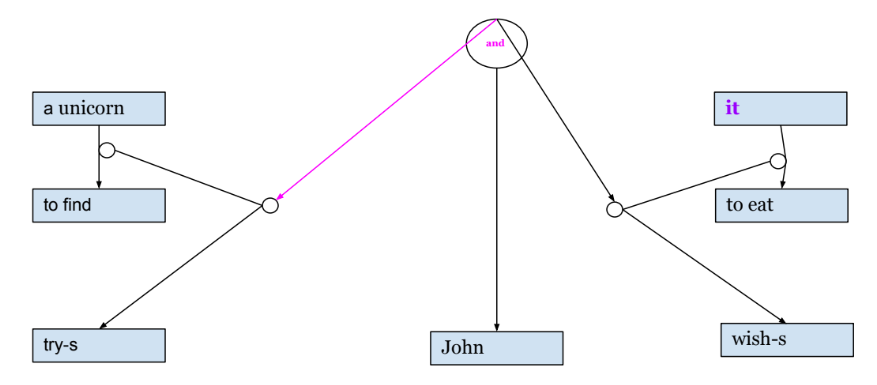
arrow-arrow tree

nested rectangles

variation. unary operand(!) is a label

Details are in [1].

Alex


[1] https://www.researchgate.net/publication/366216531_English_is_a_HOL_language_message_1X


пн, 28 авг. 2023 г. в 13:04, Alex Shkotin <alex.s...@gmail.com>:

John F Sowa

unread,
Aug 28, 2023, 3:36:22 PM8/28/23
to ontolo...@googlegroups.com, Peirce List, CG
I took a set of 86 slides, deleted 36 of them, and created the attached file on diagrammatic reasoning.  The most important slide is #2, which emphasizes the need for diagrammatic reasoning in mathematics.  It includes quotations by (1) a former president of the American Mathematical Society and (2) Albert Einstein.    Both of them noted that diagrams were far more important than symbolic proofs for discovery and teaching -- but they  admitted that the symbolic proofs are useful for showing that the diagrammatic reasoning was formally correct in all details.

In any case, diagrams are essential for everybody from beginners to the most advanced experts.  And by the way, the quotation by Einstein was published by Hadamard, who happened to be a member of the Bourbaki, who tried to eliminate diagrams.

If anyone wants to read all 86 slides, see http://jfsowa.com/talks/bionlp.pdf

John
diagrams.pdf

Nadin, Mihai

unread,
Aug 28, 2023, 3:53:09 PM8/28/23
to ontolo...@googlegroups.com

Hadamard was NOT an active member of the Bourbaki group. Jean Dieudonné, one of the founders, specifically excluded Hadamard from the group. Of course, not important for the argument John Sowa makes.


MN

--

All contributions to this forum are covered by an open-source license.
For information about the wiki, the license, and how to subscribe or
unsubscribe to the forum, see http://ontologforum.org/info/
---
You received this message because you are subscribed to the Google Groups "ontolog-forum" group.
To unsubscribe from this group and stop receiving emails from it, send an email to ontolog-foru...@googlegroups.com.

John F Sowa

unread,
Aug 28, 2023, 4:21:20 PM8/28/23
to Edwina Taborsky, ontolo...@googlegroups.com, Peirce List, CG
Edwina, Alex, and Doug F,

In my note to Alex, I said that every diagram is a structure, and every structure is a diagram.  But I was too hasty in saying that.  I should have said that a diagram is a kind of structure that may be used to represent the significant aspects of something else. 

A diagram could be isomorphic to the structure it represents, but more often than not, a diagram represents only some aspect of a structure that is considered significant for some purpose.  That significance is the Thirdness. 

For example, an architect's blueprint for a building only represents a small, but important part -- namely a map of the major parts and how they fit together.  As a simplified outline, it would be Secondness.  But as an intentional plan, it would beThirdness.

In any case, it's safe to say that every diagram is a structure.  Its relationship to some other structure could be secondness if it if just happens to resemble it.  But the relationship would be thirdness if the person who drew the diagram had intended some purpose for it, such as a plan for building something, for teaching something, for selling something, for repairing something, or for destroying something.

And for Doug F, I would emphasize that the purpose of the diagram might be conscious in the mind of the person who draws it, but the reasoning methods in the cerebellum for constructing the diagram would not be conscious.  An expert painter freely uses techniques that may have required years of conscious thought to learn.

John


From: "Edwina Taborsky" <edwina....@gmail.com>

John, list

Thank you for an impressive paper and outline of diagrammatic thinking. 

My question is - in your paper, do you explain how a diagram becomes [ as operative in the categorical mode of Thirdness] a  primary mediative force in the movement from sensation [of the object] to an Interpretant [of that object].  That is, the diagram is not always in a non-interfering  mode of Firstness or Secondness but can become, so to speak, agential [ as in ideology, as in a defective immune system,,as well, of course, when we identify the bird or insect outside the window].

Edwina

John F Sowa

unread,
Aug 28, 2023, 6:28:54 PM8/28/23
to ontolo...@googlegroups.com, Peirce List, CG
Alex,

The words 'structure' and 'diagram' have multiple informal meanings in dictionaries of English. They also have multiple formal meanings in different theories of engineering, science, architecture, mathematics, ...

Alex> Diagram is just a picture. Rotate it on 180 grads or delete labels, nothing to think about structure :-)

From ancient times to the present, the angles and sizes of many kinds of diagrams have been very significant -- but there is usually some fixed ratio of the size of the diagram to the structure it represents:  diagrams in geometry, architectural plans, maps of the earth, moon, stars, and designs of engineering systems (a car,  a pump,  or a violin, for example).

But I agree that some diagrams of linguistics or logic can be moved or rotated without changing the meaning.

But the beauty of Peirce's existential graphs is that they can be used for multiple purposes.  For representing logic, an EG can be mapped to and from a linear notation without any change in meaning.

But in 1911, he wanted to generalize his graphs to represent "stereoscopic moving images" or "moving pictures of thought".  For those purposes, he could generalize EGs to map pictures, even moving pictures, to graphs that have two kinds of information:  abstract logic that has no implicit physical information and representations of physical structures where the relative positions and angles are significant.

This is a very important reason why Peirce's diagrammatic reasoning is far more expressive than predicate calculus *and* LLMs.  I'm writing another article about Peirce's Delta Graphs, which appear to be going in that direction (just before Peirce had a serious accident and left the document incomplete).  But he left enough hints and requirements to indicate the direction he intended.  In 2018, I published an article about generalizing existential graphs (see the references in the PDF I sent).

John


From: "Alex Shkotin" <alex.s...@gmail.com>

Alex Shkotin

unread,
Aug 29, 2023, 6:39:55 AM8/29/23
to ontolo...@googlegroups.com
John,

I look forward to reading your article, as the presentation is more or less sketchy. Diagrams are a wonderful tool, but thinking in concepts is what science and technology, and thinking in general, relies on.
And creating, researching and using structures is also very important.
Formula is amazing way to keep process definition, like
h = gt^2/2
where h - height, g - gravity constant, t - time of falling from the Leaning Tower of Pisa.

Alex

вт, 29 авг. 2023 г. в 01:28, John F Sowa <so...@bestweb.net>:
--
All contributions to this forum are covered by an open-source license.
For information about the wiki, the license, and how to subscribe or
unsubscribe to the forum, see http://ontologforum.org/info/
---
You received this message because you are subscribed to the Google Groups "ontolog-forum" group.
To unsubscribe from this group and stop receiving emails from it, send an email to ontolog-foru...@googlegroups.com.

John F Sowa

unread,
Aug 29, 2023, 3:49:54 PM8/29/23
to ontolo...@googlegroups.com, Peirce List, CG
Alex and Michael DB,

To Alex:  I agree with what you wrote, but with three important qualifications:  (1) Every node in a diagram represents a concept. (2) Every linear notation for mathematics is a special case of some diagram; in some cases, the linearization is a one-to-one mapping; but in other cases, it loses some of the information, or it encodes that information in a more obscure way.  Euclidean geometry is the most obvious example, but other kinds of geometry are even stronger reasons for multi-dimensional diagrams.  (3) The tensors that represent LLMs are special cases of diagrams with special-case operations;  for full generality, they must be supplemented with more general diagrams and operations on them.

And by the way, the title of my first book, Conceptual Structures, emphasizes the point that diagrams represent structures, and every structure can be represented by a diagram.  Linear notations are just one-dimensional diagrams.  Mapping a multi-dimensional structure into a one-dimensional line adds a huge amount of complexity.  As just one example:  direct connections by lines must be replaced by special symbols called names.  And those names create a huge amount of complexity when they are constantly being renamed.

To Micheal:   Since you agree with me, I agree with you.

Re consciousness:  The fact that the cerebellum has over 4 times as many neurons as the much larger cerebral cortex is important.  Even more important is that (1) Those neurons are essential for high-speed mathematical computation and reasoning.  (2) They are aslo essential for all complex methods of performance in music, gymnastics, art architecture, and complex design of machinery of any kind. and (3) Nothing in the cerebellum is conscious.

Just look at the fantastic gymnastics by Simone Biles.  She required years of dedicated *conscious* training to learn those moves, but the details of the high-speed performance are outside of any conscious control.  It would be impossible to think in words about each of those details at the speed at which they were performed.  Each performance was initiated and controlled by conscious decisions, but the speed is too fast for any conscious control.  She was conscious of the performance, but not of every detail computed by her cerebellum.

That is a very important distinction:  the computation in the cerebellum is not conscious.  And no definition of consciousness would  have the slightest value for understanding what and how the cerebellum computes its operations

But since you mention Searle, I'm not surprised at his response about panpsychism.  I remember another story about a dinner party he attended, where the guests were sitting outside while the food was being prepared.  At one point, Searle jumped up and proclaimed in a loud voice that frightened the neighbors, their children, and their dogs, a denunciation of "Derrida and the other inhabitants of Frogistan."

John
 
_______________________________________
From: "Alex Shkotin" <alex.s...@gmail.com>

John,

I look forward to reading your article, as the presentation is more or less sketchy. Diagrams are a wonderful tool, but thinking in concepts is what science and technology, and thinking in general, relies on.
And creating, researching and using structures is also very important.
Formula is amazing way to keep process definition, like
h = gt^2/2
where h - height, g - gravity constant, t - time of falling from the Leaning Tower of Pisa.

Alex
__________________________________________
From: "Michael DeBellis" <mdebe...@gmail.com>
Subject: [ontolog-forum] Re: On the concept of consciousness 

I was going to write a reply to this... actually I did anyway but it's shorter because John Sowa already said what I was going to say. No-one really has a clue and virtually all the discussions I've ever seen on this end up going nowhere. IMO there are some questions that are amenable to scientific analysis and some (given our current knowledge) that aren't and consciousness is one of those that currently aren't. You have extremes such as a paper I saw years ago by some leading neuroscientists that talked in depth about   consciousness and defined it as the opposite of being asleep or in a coma. And on the other extreme people like Kristof Koch who believe in Pansychism, that everything in the universe is conscious. 

Many years ago I sat in on a Philosophy of Mind lecture series led by John Searle at Berkeley. One of my favorite classes was a guest lecture by Koch. Searle started out by lauding him as one of the most brilliant minds ever (which at the start of his talk I could see why, Koch really knows his neuroscience). Then Koch started getting into his Pansychism philosophy and you could just see the color draining from Searle's face and Searle finally said something like "Wait, you are serious?! I thought you were talking about Pansychism as an example of a clearly wrong theory!" And it got more entertaining from there. 

I don't agree with Patricia Churchland much but there is a book called "This Idea Must Die!"  where she talks about the Neural Correlate of  Consciousness (NCC) as an idea that must die. Her reasoning was that there are so many concepts we don't have coherent, falsifiable models of yet such as the Language Faculty and Episodic Memory and that whatever   consciousness is, we probably all agree that it is closely tied to memory and language so until we at least have decent theories on such more basic (but still barely understood) concepts it is pointless to postulate theories about   consciousness. I mean it can be fun but not something I expect to see any serious science on. 

Michael

Alex Shkotin

unread,
Aug 30, 2023, 5:08:54 AM8/30/23
to ontolo...@googlegroups.com

John,


It is nice to hear from you that "Every node in a diagram represents a concept." And precisely: a node (and let me add a labeled node) represents a concept, but the concept is not a diagram.

The question raises: is diagram a finite structure?

And about your "every structure can be represented by a diagram".

This raises the point that structuring (determination of structures)  is the deal number one. As reasoning and theories are about structures.

What kind of structures do we have and what kind of determinations is good for entities to exist?

Do we have infinite structures?

For example, as I mentioned before.

Let's build a digraph like this: create a node, keep it as the current one.  ad infinitum: from the current node create the arrow and create a node at the end of it, keep this new node as the current one. 

The Nat1 structure will be obtained if the process is considered terminated.

We have a ground structure for natural numbers. Does this structure exist?

What is a diagram for this structure?


What kind of math structures do we have to model objects and processes of reality? This is the question.

As Gelfand told in his lecture in Japan: we do not have math for biology yet.

Or let me say this way: they try to use a whole power of math, beginning at least from Newton's Principia, to model reality.


Alex


вт, 29 авг. 2023 г. в 22:49, John F Sowa <so...@bestweb.net>:
--
All contributions to this forum are covered by an open-source license.
For information about the wiki, the license, and how to subscribe or
unsubscribe to the forum, see http://ontologforum.org/info/
---
You received this message because you are subscribed to the Google Groups "ontolog-forum" group.
To unsubscribe from this group and stop receiving emails from it, send an email to ontolog-foru...@googlegroups.com.

John F Sowa

unread,
Aug 30, 2023, 12:39:27 PM8/30/23
to ontolo...@googlegroups.com
Alex,

When I talk about mathematics, I mean the uncountably many possible theories, of which only a countable subset can be represented by a linear string of symbols.  Continuous diagrams can represent an uncountable infinity.  Nobody, not even the best mathematicians, know what might be discovered in the future.  If they did, they would have discovered it.

When I talk about diagrams, I include all the possibilities that anyone on any planet of the universe might invent plus all those that nobody has yet invented.   In my book Conceptual Structures, Information Processing in Mind and Machine, I defined a concept as a node in a conceptual graph,  I would generalize that to include an open-ended variety of structures that have discrete units that could be called concepts.  I would not exclude concept nodes that have not yet been named.   Any theory about concepts would very likely have axioms that generate concepts, and the process of generating a concept would take place before the concept was named.
 
Alex> We have a ground structure for natural numbers. Does this structure exist?  What is a diagram for this structure?

What do you mean by the word 'exist'?  If you mean "Exist in a Platonic world that is outside of space and time.", the answer is yes.  But if you mean "Exist in some form of storage, such as paper or bits in a computer", the answer is "only finite subsets."  The simplest diagram for the integers is a dotted line that begins with zero (or one) and continues as far as anyone might go and continues infinitely farther.   But additions might be added for all the functions and relations that might be added

Alex> Or let me say this way: they try to use a whole power of math, beginning at least from Newton's Principia, to model reality.

That is just a tiny subset of what mathematicians talk about and prove theorems about.   For mathematicians, that is trivial. 

John


From: "Alex Shkotin" <alex.s...@gmail.com>

John,


Alex Shkotin

unread,
Aug 31, 2023, 5:01:12 AM8/31/23
to ontolo...@googlegroups.com

John,


You have moved into the realm of philosophy and other worlds. I won't go there.

For me, diagrams are a wonderful tool, which if somebody can use it, then the researcher is very lucky.

My immediate task is to identify theoretical knowledge about reality and see how it can be formalized. It is expected that formalization leads to more precise definitions of terms and the general structure of the theory. If some theoretical knowledge contains diagrams of one kind or another, they will also have to be formalized. Fortunately, you have already formalized your diagrams yourself.

The main advantage of formalization is that then a lot of work with domain knowledge can be entrusted to algorithms.

I'm going to explore how the T-box and A-box of some ontology on OWL2 from OBO Foundry is divided into theoretical and factual knowledge. And what structure is hidden behind the factual knowledge.


Alex


ср, 30 авг. 2023 г. в 19:39, John F Sowa <so...@bestweb.net>:
--
All contributions to this forum are covered by an open-source license.
For information about the wiki, the license, and how to subscribe or
unsubscribe to the forum, see http://ontologforum.org/info/
---
You received this message because you are subscribed to the Google Groups "ontolog-forum" group.
To unsubscribe from this group and stop receiving emails from it, send an email to ontolog-foru...@googlegroups.com.

John F Sowa

unread,
Aug 31, 2023, 6:11:30 PM8/31/23
to ontolo...@googlegroups.com
Alex,

I am talking about mathematics, and the way that mathematicians characterize their own subject.   See those slides that I sent in an earlier note in this thread.  Slide #2 included comments by (1) A former president of the American Mathematical Association, (2) Albert Einstein, (3) Jacques Hadamard who obtained that comment by Einstein and similar ones from many other mathematicians by sending them a questionnaire.

I can send many more similar quotations by other prominent mathematicians, if you don't believe those.

You can call that philosophy of mathematics, if you wish, but it is what mathematicians talk about when they discuss their own subject.   That is not my opinion, it's their opinion.  I suggest that you read what the mathematicians say about their subject before you state your opinion.

John


From: "Alex Shkotin" <alex.s...@gmail.com>

John,


You have moved into the realm of philosophy and other worlds. I won't go there.... 


Alex

Alex Shkotin

unread,
Sep 1, 2023, 4:20:22 AM9/1/23
to ontolo...@googlegroups.com

John,


A few more thoughts.

It is very interesting to compare your approach with this [1] project of Jon Awbrey as you have the same root: Pierce's EG.


By the way, even such a formalist as N. Bourbaki, in order to avoid variables bound by a quantifiers, turned a formative construction into a graph. In this graph, occurrences of quantifier variables are replaced by the sign □, and are directly connected to their quantifier by an edge. This saved N. Bourbaki from writing an algorithm for binding a quantifier variable to its own quantifier.


Alex


[1] https://inquiryintoinquiry.com/2023/08/24/logical-graphs-first-impressions/


пт, 1 сент. 2023 г. в 01:11, John F Sowa <so...@bestweb.net>:

John F Sowa

unread,
Sep 1, 2023, 9:17:31 AM9/1/23
to ontolo...@googlegroups.com, Peirce List, CG
Alex,

Your observations about existential graphs are a good starting point for several topics.

Re Jon Awbrey:  I've known him for many years.  He's developing a system that begins with EGs and connects with many mathematical issues.  But I've been relating a much broader range of Peirce's theories to the full range of issues in the latest developments of AI and cognitive science.

Re Boutbaki:  They started from a totally different direction, and they discovered a version of "squashed" existential graphs.  They define variables by starting with a linear formula with existential quantifiers.  Then they draw arcs above the line to connect each quantifier with the place in each function or relation where a variable would appear.  Finally, they choose a letter as the name of each arc.  Then they insert the name of the arc at each end point of each arc.  Finally, they erase the arcs to get a more familiar formula.

To map their squashed EGs to Peirce's notation, (1) convert each formula to a version with just the operators for AND, NOT, and EXISTS; (2) Erase all the AND operators and assume that the blank regions represent AND. (3) Replace each NOT operator with a shaded region. (4) pull the squashed EGs apart to full two dimensional graphs with shaded ovals for negation. (5) If some of the arc lines cross, move to 3D to avoid any crossing. 

And voila:  You now have an existential graph.  The Bourbaki demonstrated that all of mathematics can be specified by EGs.

But please read the following article:  "The ignorance of the Bourbaki" by  Adrian Mathias, ttps://www.dpmms.cam.ac.uk/~ardm/bourbaki.pdf

Individually, the members of the Bourbaki were brilliant mathematicians, the books they produced contain a great deal of important insights and mathematical results.  But their goal was mistaken, and their method had some serious flaws.  The article is only 12 pages long, and it is well worth reading.

And by the way, note the huge number of mathematical theories they related.  Tha's only a finite number, but there is no limit to the number that could be developed -- that implies infinity.  

Just look at Wolfram's Mathematica for the huge number of theories that have been implemented in computable forms that can be used for practical applications.  Unlike LLMs, those theories are very precise, and they don't make stupid mistakes.  Nobody calls them AI.  They call them mathematics.

John


From: "Alex Shkotin" <alex.s...@gmail.com>

John,


Alex Shkotin

unread,
Sep 1, 2023, 12:20:04 PM9/1/23
to ontolo...@googlegroups.com
John,

Thank you. Very interesting. You make my weekend, together with two ontologies I choose to split to theoretical and factological (structural) parts:

Alex

пт, 1 сент. 2023 г. в 16:17, John F Sowa <so...@bestweb.net>:
--
All contributions to this forum are covered by an open-source license.
For information about the wiki, the license, and how to subscribe or
unsubscribe to the forum, see http://ontologforum.org/info/
---
You received this message because you are subscribed to the Google Groups "ontolog-forum" group.
To unsubscribe from this group and stop receiving emails from it, send an email to ontolog-foru...@googlegroups.com.
Reply all
Reply to author
Forward
0 new messages